Cinemark Holdings, Inc. CNK
New risk paragraphs, branching off last year
Each branch is a paragraph in Risk Factors with nothing like it in the 10-K filed Feb 19, 2025. A box jumps to the paragraph as filed, below.
Paragraphs with nothing like them in last year's 10-K
7 paragraphs in Risk Factors of the 10-K filed Feb 18, 2026 with nothing like them in the 10-K filed Feb 19, 2025. Quoted exactly. Paragraphs that were only edited are under 10-K change.
Our business depends on the availability and performance of films for theatrical exhibition. Our industry relies on a consistent cadence of high-quality, wide-release films with broad consumer appeal. A reduced volume of new film releases, weaker film performance, or less effective marketing support can adversely affect attendance and revenue. Film production and release schedules may be disrupted by reductions in financing and production, as well as by labor actions such as strikes or work stoppages involving directors, writers, actors, or other industry groups. For example, the 2023 work stoppages by the Writers Guild of America and SAG-AFTRA delayed the production and release of certain films. Contract expirations for the WGA, DGA, and SAG‑AFTRA are scheduled again in 2026, and any related work stoppages could similarly delay future film releases.
The volume of new theatrical content has improved but has not returned to historical levels and may not fully recover, which could materially impact our business. Consolidation among major studios and evolving distribution strategies may further limit film availability, increase distributors’ bargaining power, or change the terms under which we license films. Certain distributors have also released titles exclusively or primarily in select premium formats, which can reduce the number of commercially viable titles available for our circuit and negatively impact attendance and revenue. Studios may additionally designate certain content for direct‑to‑streaming release, reducing the number of titles available for theatrical exhibition.
The exclusive theatrical window (“window”) refers to the period during which a film is exclusively available in theaters before it becomes accessible through in-home distribution channels, such as digital rental and/or sell-through (eg: PVOD, PEST), streaming services, television and physical media. This window remains a significant driver of box office performance and supports the overall value of the theatrical experience.
In the post-pandemic environment, theatrical windows have become more dynamic with length and structure varying by studio, film, and release timing. Certain studios have adopted strategies that have meaningfully reduced the duration of the window.
Shorter or more variable windows may influence guest behavior, including the decision to wait for in-home availability rather than attend a theater, which could adversely affect our attendance, results of operations, financial condition, and cash flows. In addition, reduced theatrical exclusivity may lessen the perceived distinctiveness of the theatrical experience, potentially impacting long-term consumer preferences.
We collect, use, store and maintain electronic information and data necessary to conduct our business, including confidential and proprietary information of the company, our customers, and our employees. We also rely on the availability of information technology systems to operate our business, including for communications, receiving and displaying movies, ticketing, guest services, cash receipts and payments, and other general operations. We rely on
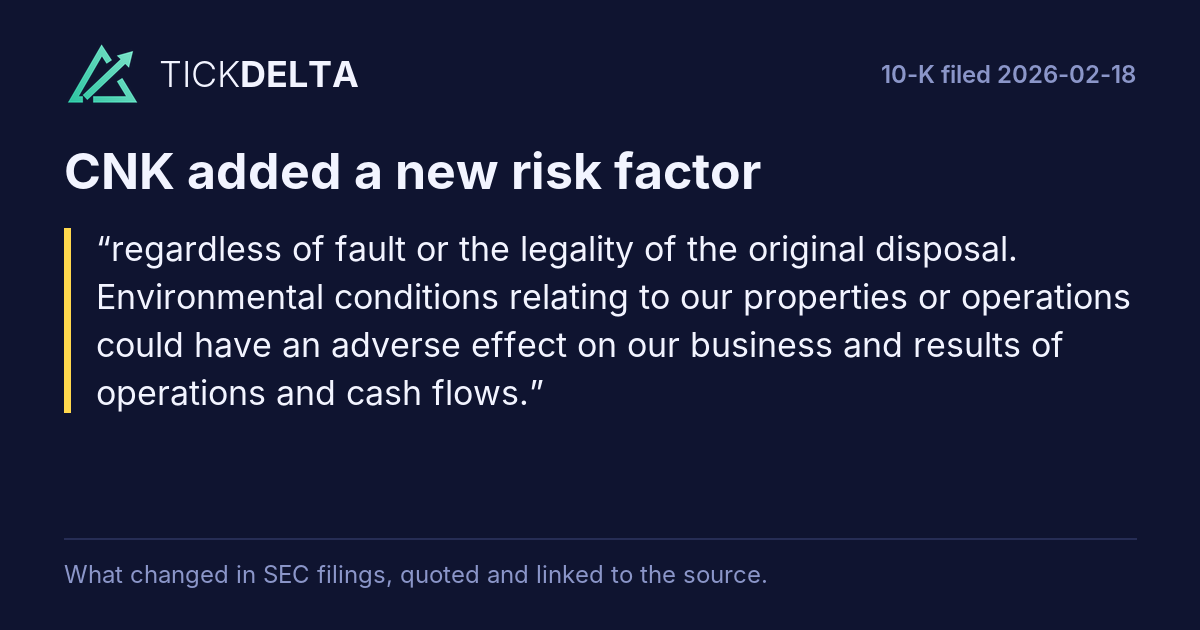
regardless of fault or the legality of the original disposal. Environmental conditions relating to our properties or operations could have an adverse effect on our business and results of operations and cash flows.
Paragraphs in the 10-Q filed Nov 3, 2026 that were not in the one before
New in the latest 10-Q
41 paragraphs in the 10-Q filed Nov 3, 2026 with nothing like them in the 10-Q filed Jul 30, 2026 (at least half the words must differ; new numbers alone do not count). Quoted exactly, grouped by the item heading above them. This is text that changed, not a judgement of how serious it is.
Financial statements and notes
The Company sells gift cards and discount ticket vouchers, the proceeds from which are recorded as deferred revenue. Deferred revenue for gift cards and discount ticket vouchers is recognized when they are redeemed for concession items, or if redeemed for movie tickets, when the movie showtime has passed. The Company generally records breakage revenue on unredeemed gift cards and discount ticket vouchers based on redemption activity and historical experience associated with unused balances.
Read in the 10-Q
The Company offers a subscription program in the U.S., whereby patrons can pay a monthly or annual fee to receive a monthly credit for use towards a future movie ticket purchase. The Company offers similar subscription fee programs in several of its international locations where customers can pay a monthly or annual fee to receive benefits such as a free monthly movie ticket. The Company records subscription program fees as deferred revenue and records admissions revenue when the showtime for a movie ticket purchased with a credit has passed. The Company records breakage revenue for unused credits based upon redemption of subscription credits and historical experience with unused credits.
Read in the 10-Q
The Company has loyalty programs in the U.S. and many of its international locations that either have a prepaid annual fee or award points to customers as purchases are made. For those loyalty programs that have a prepaid annual fee, the Company recognizes the fee collected as other revenue on a straight-line basis over the annual membership period. For those loyalty programs that award points to customers based on their purchases, the Company records a portion of the original transaction proceeds as deferred revenue based on the number of reward points issued to customers and recognizes the deferred revenue when the customer redeems such points. The value of loyalty points issued is based on the estimated fair value of the rewards offered. The Company records breakage revenue for unredeemed loyalty points based upon redemption of loyalty points and historical experience with the expiration of unused points.
Read in the 10-Q
Accounts receivable as of September 30, 2026 and December 31, 2025 included approximately $38.6 and $31.2, respectively, of receivables related to contracts with customers. The Company did not record any assets related to the costs to obtain or fulfill a contract with customers during the nine months ended September 30, 2026.
Read in the 10-Q
The Company does not report total assets by segment because that information is not used to evaluate the performance of, or allocate resources between, segments.
Read in the 10-Q
Show the other 36
The following table sets forth, for the periods indicated, the amounts for certain items reflected in the operating income of Holdings along with each of those items as a percentage of revenue.
Read in the 10-Q
All costs are expressed as a percentage of total revenue, except film rentals and advertising, which are expressed as a percentage of admissions revenue, and concession supplies, which are expressed as a percentage of concession revenue.
Read in the 10-Q
Average screen count is calculated based on the average of month-end screen counts.
Read in the 10-Q
U.S. reportable segment revenue includes eliminations of intercompany transactions with the international reportable segment. See Note 15 to our condensed consolidated financial statements.
Read in the 10-Q
Average ticket price is calculated as admissions revenue divided by attendance. Concession revenue per patron is calculated as concession revenue divided by attendance.
Read in the 10-Q
Impairment of Long-Lived Assets. We did not record any asset impairment charges during the third quarter of 2026. We recorded an asset impairment charge of $0.6 million during the third quarter of 2025 related to one domestic theater and three international theaters that underperformed relative to the rest of our theater circuit.
Read in the 10-Q
Loss on Warrants. Holdings recorded a loss on warrants of $54.5 million during the third quarter of 2025 primarily related to the fair value adjustments recorded as a result of the Warrant Early Termination Agreements entered into on August 15, 2025.
Read in the 10-Q
U.S. reportable segment revenue includes eliminations of intercompany transactions with the international reportable segment. See Note 15 to our condensed consolidated financial statements.
Read in the 10-Q
Average ticket price is calculated as admissions revenue divided by attendance. Concession revenue per patron is calculated as concession revenue divided by attendance.
Read in the 10-Q
Loss on Warrants. Holdings recorded a loss on warrants of $54.5 million during the third quarter of 2025 primarily related to the fair value adjustments recorded as a result of the Warrant Early Termination Agreements entered into on August 15, 2025.
Read in the 10-Q
Cash provided by operating activities was $475.8 million for Holdings and $476.1 million for CUSA for the nine months ended September 30, 2026, compared with cash provided by operating activities of $248.3 million for Holdings and $260.1 million for CUSA for the nine months ended September 30, 2025. The increase in cash provided by operating activities was primarily driven by the level of revenue earned during each period and the timing of payments to vendors for expenses.
Read in the 10-Q
Investing activities have been principally related to the development, remodel and enhancement of theaters. Cash used for investing activities was $166.5 million and $98.6 million for the nine months ended September 30, 2026 and 2025, respectively. The increase in cash used for investing activities was primarily due to an increase in capital expenditures to support the continued enhancement of our global circuit.
Read in the 10-Q
Below is a summary of capital expenditures, disaggregated by new and existing theaters, for the nine months ended September 30, 2026 and 2025 (in millions):
Read in the 10-Q
We operated 496 theaters with 5,618 screens worldwide as of September 30, 2026. Theaters and screens opened and closed during the nine months ended September 30, 2026 were as follows:
Read in the 10-Q
Approximately $3.0 million is expected to be paid during the remainder of 2026 and $22.3 million and $23.8 million is expected to be paid during 2027 and 2028, respectively. The timing of payments is subject to change in the event of construction or other delays.
Read in the 10-Q
Cash used for financing activities was $95.7 million for Holdings and $96.0 million for CUSA for the nine months ended September 30, 2026, compared with $761.8 million for Holdings and $544.1 million for CUSA for the nine months ended September 30, 2025. The cash used for financing activities for Holdings primarily reflects repurchases of the Company’s common stock, the payment of quarterly cash dividends, and payroll tax payments associated with equity awards that vested during the period. The cash used for financing activities for Holdings for the nine months ended September 30, 2025 also reflects the repayment of the principal of the 4.50% Convertible Senior Notes, and the cash settlement of the warrants in the third quarter of 2025. Cash used for financing activities for CUSA primarily reflects cash distributions to Cinemark Holdings, Inc. to fund the Company’s shareholder dividends and share repurchases, and, in 2025, to fund the cash settlement of the principal on the 4.50% Convertible Senior Notes and the warrant transactions. Cash used for financing activities for CUSA also reflects payroll tax payments associated with equity awards that vested during the period.
Read in the 10-Q
as well as other relevant factors. The following table summarizes the quarterly dividends paid during the nine months ended September 30, 2026 and 2025.
Read in the 10-Q
CUSA may redeem the 7.00% Senior Notes in whole or in part at any time on or after August 1, 2027 at redemption prices set forth in the indenture governing the 7.00% Senior Notes as indicated below:
Read in the 10-Q
The indenture governing the 7.00% Senior Notes contains covenants that limit, among other things, the ability of CUSA and certain of its subsidiaries to (1) incur or guarantee additional indebtedness, (2) pay dividends or distributions on, or redeem or repurchase, capital stock and make other restricted payments, (3) make certain investments, (4) engage in certain transactions with affiliates, (5) incur or assume certain liens, and (6) consolidate, merge or transfer all or substantially all of its assets. Additionally, upon a change in control, as defined in the indenture governing the 7.00% Senior Notes, CUSA would be required to make an offer to repurchase all of the 7.00% Senior Notes at a price equal to 101% of the aggregate principal amount outstanding plus accrued and unpaid interest, if any, through the date of repurchase.
Read in the 10-Q
CUSA may redeem the 5.25% Senior Notes in whole or in part at par, as set forth in the indenture.
Read in the 10-Q
See discussion of dividend restrictions and the net senior secured leverage ratio under the Credit Agreement at Senior Secured Credit Facility above.
Read in the 10-Q
As of September 30, 2026, we believe we were in full compliance with all agreements, including all related covenants, governing our outstanding debt.
Read in the 10-Q
Market risk
We have exposure to financial market risks, including changes in interest rates and foreign currency exchange rates.
Read in the 10-Q
The Company currently has variable rate debt. An increase or decrease in interest rates would affect its interest expense related to this variable rate debt. At September 30, 2026, we had an aggregate of $177.6 million of variable rate debt outstanding, after giving effect to the interest rate swaps. Based on the interest rates in effect on the variable rate debt outstanding at September 30, 2026, a 100 basis point increase in market interest rates would increase our annual interest expense by $1.8 million.
Read in the 10-Q
Fixed rate amounts include the hedged portion of Holdings’ variable rate debt. See “Interest Rate Swap Agreements” below.
Read in the 10-Q
All of the interest rate swap agreements qualify for cash flow hedge accounting. The fair values of the interest rate swaps are recorded on each of Holdings’ and CUSA’s condensed consolidated balance sheets as an asset or liability with the related gains or losses reported as a component of accumulated other comprehensive loss. The fixed rate debt amounts reflected in the table above include $450.0 million of variable rate borrowings that are subject to interest rate swap agreements that expire on December 31, 2027. Absent replacement hedging arrangements, these variable rate borrowings would become exposed to variable interest rates following the expiration of the interest rate swaps. See Note 7 to the condensed consolidated financial statements for further discussion of the interest rate swap agreements.
Read in the 10-Q
Controls and procedures
There have been no changes in Holdings’ and CUSA’s internal control over financial reporting identified in connection with the evaluation required by paragraph (d) of Exchange Act Rules 13a-15 that occurred during the quarter ended September 30, 2026 that materially affected, or are reasonably likely to materially affect, Holdings’ and CUSA’s internal control over financial reporting.
Read in the 10-Q
Share sales and buybacks
(c) In the third quarter of 2026, Holdings purchased shares of its common stock as follows:
Read in the 10-Q
(1) Represents shares of Holdings’ common stock (in thousands) repurchased in July, August, and September of 2026 to satisfy employee tax-withholding obligations upon the vesting of restricted stock, restricted stock units and performance stock units. See Note 9 to the condensed consolidated financial statements.
Read in the 10-Q
For a description of limitations on the payment of Holdings’ dividends, see “Management’s Discussion and Analysis of Financial Condition and Results of Operations - Liquidity and Capital Resources. ”
Read in the 10-Q
Other information
Unaudited Condensed Consolidating Balance Sheet as of September 30, 2026 48 Unaudited Condensed Consolidating Statement of Income for the nine months ended September 30, 2026 49 Unaudited Condensed Consolidating Statement of Comprehensive Income for the nine months ended September 30, 2026 50 Unaudited Condensed Consolidating Statement of Cash Flows for the nine months ended September 30, 2026 51 ────────────────────────────────────────────────────────────────────────────────────────────────────────────────────────────── Page
Read in the 10-Q
Note: “Restricted Group” and “Unrestricted Group” are defined in the indentures for the senior notes.
Read in the 10-Q
Note: “Restricted Group” and “Unrestricted Group” are defined in the indentures for the senior notes.
Read in the 10-Q
Note: “Restricted Group” and “Unrestricted Group” are defined in the indentures for the senior notes.
Read in the 10-Q
Note: “Restricted Group” and “Unrestricted Group” are defined in the indentures for the senior notes.
Read in the 10-Q
Item 6
*10.1 Eleventh Amendment, dated as of September 28, 2026, to Indenture of Lease, dated as of December 1, 1995, by and between Syufy Enterprises, L.P., as landlord and Century Theaters of California, Inc. (succeeded by Century Theaters, Inc.), as tenant for Century 14, Folsom, CA.
Read in the 10-Q
The 10-Q's risk factors against the 10-K
Item 1A of the 10-Q filed Nov 3, 2026 against Item 1A of the 10-K filed Feb 18, 2026.
A 10-Q repeats only the risks that changed, so a 10-K paragraph that is missing from it is not counted as removed.
Added is a paragraph with nothing like it in the 10-K, Reworded a sentence that is in both with several words changed,
Quiet changes a sentence in both where one to four words changed and one is a hedge or a modal
(cut words struck through, new words highlighted).
Text on the page, not a score; each links to the filing at sec.gov.
What the 10-Q itself says about its risk factors:We believe there have been no material changes in our risk factors from those disclosed in “Risk Factors” in the Company’s Annual Report on Form 10-K for the year ended December 31, 2025 filed February 18, 2026.
Read in the 10-Q
1 paragraph in the 10-Q's Item 1A, and none of them adds, rewords or quietly edits a paragraph of the 10-K's.
Phrases used for the first time
Two-word phrases in Risk Factors of the 10-K filed Feb 18, 2026 that are in none of the 1 earlier 10-Ks stored, back to Feb 19, 2025
Where each one is used
- work stoppages: Our business depends on the availability and performance of films for theatrical exhibition. Our industry relies on a consistent cadence of high-quality, wide-release films with broad consumer appeal. A reduced volume of new film releases, weaker film performance, or less effective marketing support can adversely...
- titles available: The volume of new theatrical content has improved but has not returned to historical levels and may not fully recover, which could materially impact our business. Consolidation among major studios and evolving distribution strategies may further limit film availability, increase distributors’ bargaining power, or...
- exclusive theatrical: Our results of operations may be impacted by the reduction of exclusive theatrical windows
- theatrical windows: Our results of operations may be impacted by the reduction of exclusive theatrical windows
- theatrical experience: The exclusive theatrical window (“window”) refers to the period during which a film is exclusively available in theaters before it becomes accessible through in-home distribution channels, such as digital rental and/or sell-through (eg: PVOD, PEST), streaming services, television and physical media. This window...
Used at least twice, small words left out. Counted, not picked: a phrase can be new because the company renamed something.
What was taken out
17 paragraphs of last year's Risk Factors with nothing like them now. The longest are quoted.
Sources
Item 1A of each 10-K and 10-Q on EDGAR, quoted exactly. Each paragraph links to the filing at sec.gov.
Also
10-K change: what was reworded or cut, section by section.
Work with it
Excel workbook · CSV. Google Sheet that stays up to date: paste =IMPORTDATA("https://tickdelta.com/company/CNK/export.csv") into a cell.