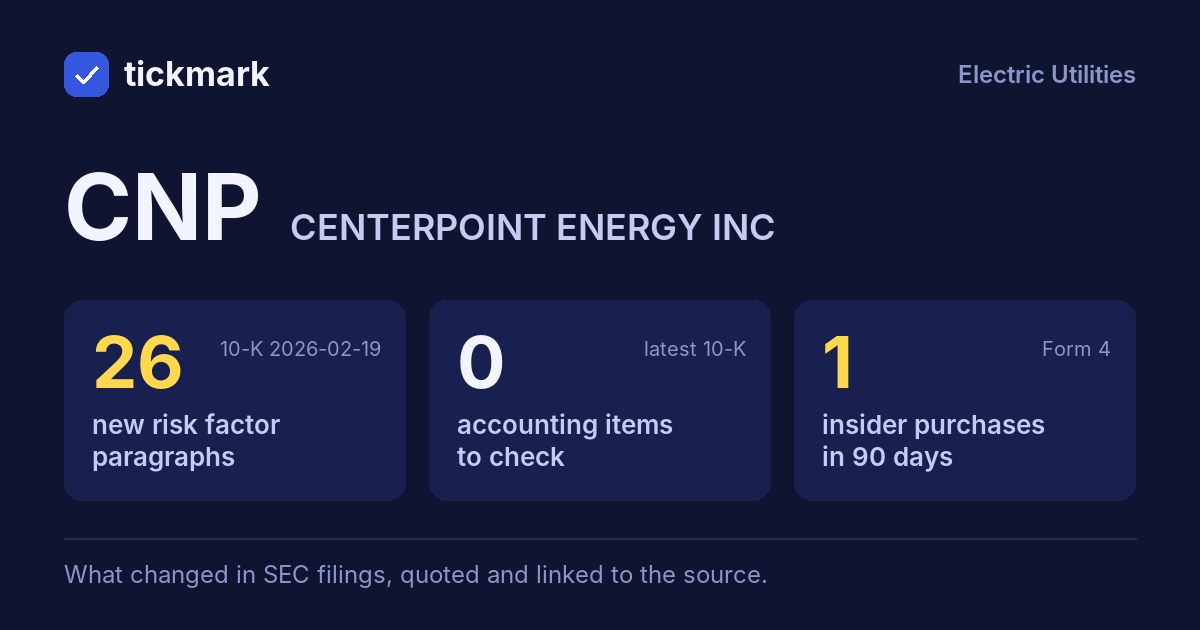
10-K 0001130310-26-000008 (2026-02-19) vs 10-K 0001130310-25-000040 (2025-02-20)
| Section | Compared text | Words now | Changed |
|---|
| Risk Factors | Item 1A | 22,772 |
43.5% |
| MD&A | Item 7 | 21,606 |
44.1% |
| Legal Proceedings | Item 3 | 131 |
not compared |
| Accounting Policies | Item 8 (note not found) | 0 |
not compared |
The redline: what was cut and what was added
In each section, the paragraph that changed most, marked against last year's 10-K:
cut words struck through, new words highlighted and underlined.
Risk Factors 697 words changed in this paragraph; it is 43% similar to last year's version.
In September 2021, CenterPoint Energy announced has adopted energy transition goals and its net zero emission goals for Scope 1 and certain Scope 2 emissions by 2035 and a 20-30% reduction in certain Scope 3 emissions by 2035 as compared to 2021 levels. CenterPoint Energy’s analysis and plan plans for execution requires require it to make a number of assumptions. These goals and underlying assumptions involve risks and uncertainties and are not guarantees. guarantees, and our ability to achieve these goals will ultimately be driven by the needs of our business, the needs and desires of the customers, jurisdictions and other stakeholders we serve and our performance for our shareholders. In addition, forecasting is inherently speculative and the trajectory of the greater energy transition is uncertain. Should one or more of CenterPoint Energy’s underlying assumptions require updating, its our actual results and ability to make progress towards and achieve its net zero our energy transition goals and GHG emissions reduction goals by 2035 the timing thereof could differ materially from its expectations. expectations, and CenterPoint Energy may elect to modify or update such goals. Further, there can be no guarantee that CenterPoint Energy will sustain or achieve these goals. Certain of the assumptions that could impact CenterPoint Energy’s ability to meet its net zero and GHG emissions reduction our energy transition goals and the timing thereof include, but are not limited to: GHG emission levels, service territory size and size, capacity needs and customer demand remaining in line with Company expectations, CenterPoint Energy’s expectations when such goals were announced, including with respect to demand for our services and in relation to the announced recent sale of CenterPoint Energy’s Louisiana and Mississippi natural gas LDC businesses; businesses and the announced sale of CenterPoint Energy’s Ohio natural gas LDC business; the ability to appropriately estimate and effectively manage business opportunities from and maintain reliability in connection with new customers and load growth resulting from, among other things, expansion of data centers, centers (associated with, among other things, increasing demand for AI), energy export facilities, including hydrogen facilities, electrification of industrial processes refining and transport exports, advanced manufacturing and logistics in our service territories; regulatory approvals related to Indiana Electric’s generation transition plan and our ability to obtain such approvals; the ability to execute anticipated divestitures, portfolio optimizations or other strategic transactions; interconnection delays in the footprints of regional transmission organizations and/or interconnection costs; impacts on cost and affordability of customer rates; rates and related concerns; customer demand for GHG emission free or lower GHG emissions energy; impacts of future regulations regulations, legislation or legislation, other governmental action, including those related to our operation of certain generating facilities (including the U.S. Department of Energy’s December 2025 emergency 202(c) order directing Indiana Electric to continue operating F.B. Culley Unit 2 through March 23, 2026), the environment and tax (including the effects of the OBBBA, Executive Order 14315, the IRA and any further changes to or the repeal of the renewable energy tax credits enacted in the IRA); federal and state executive, legislative and regulatory actions (including regulatory uncertainty resulting from changes in federal energy policy) and support for certain types of generation; impacts of future carbon pricing regulation or legislation, including a future carbon tax; price, availability and regulation of carbon offsets; price of fuel, such as natural gas; cost and technological development/innovation, adoption and commercialization of energy generation technologies, such as wind and solar, natural gas and storage solutions; adoption of solutions, and alternative energy by the public, energy, including adoption of electric vehicles; rate of technology innovation with regards to alternative energy resources; CenterPoint Energy’s our ability to implement its our modernization plans for its pipelines and facilities; the ability to complete and timely implement and maintain system reliability during and after transitioning to generation alternatives, such as solar and wind generation, alternatives to Indiana Electric’s coal generation and retirement or fuel conversion dates of Indiana Electric’s coal facilities by 2035; the ability to construct and/or permit new natural gas pipelines; the ability to procure resources needed to build at a reasonable cost, the lack of or scarcity of resources and labor, any project cancellations, construction delays or overruns (including as a result of tariffs, legislation, bans, retaliatory trade measures taken against the United States or related governmental action) and the ability to appropriately estimate costs of new generation; impact of any supply chain disruptions; changes in applicable standards, metrics, methodologies or frameworks; and enhancement of energy efficiencies. Our businesses may face increased scrutiny from investors, governmental authorities and other stakeholders related to our sustainability and human capital management activities, including the goals, targets, and objectives we announce, our methodologies and timelines for pursuing them, our progress towards achieving them, and related disclosures. We could also face challenges with managing conflicting requirements and our various stakeholders’ expectations. If our sustainability practices do not align with investor or other stakeholder expectations and standards, which continue to evolve, vary, and sometimes conflict, our reputation, our ability to attract or retain employees, and our attractiveness as an investment or business partner could be negatively affected. Similarly, our failure or perceived failure to pursue, fulfill or demonstrate meaningful progress towards our sustainability-focused goals, targets, and objectives, to comply with or otherwise meet ethical, environmental or other standards, regulations, or expectations, which may be varied or conflicting, or to satisfy various reporting standards with respect to these matters (including if there are real or perceived inaccuracies in the data and information we report or if we are exposed to allegations that certain public statements regarding sustainability-related matters are false and misleading “greenwashing” campaigns), within the timelines we announce, or at all, could adversely affect our business or reputation, as well as expose us to government enforcement actions and private litigation.
Source: Item 1A, 10-K 0001130310-26-000008 vs Item 1A, 10-K 0001130310-25-000040
MD&A 342 words changed in this paragraph; it is 40% similar to last year's version.
On April 29, 2024, Houston Electric filed its first transmission and distribution system resiliency plan with the PUCT, which proposed to implement 25 resiliency measures over a three-year period. On August 1, 2024, Houston Electric announced that it was withdrawing its application for approval of its transmission and distribution system resiliency plan in order to focus on addressing the impacts of Hurricane Beryl and accelerating preparedness and resiliency efforts for the remaining storm season. The ALJ granted Houston Electric’s request for withdrawal of the transmission and distribution system resiliency plan on August 16, 2024. Following feedback from customers, external experts and other stakeholders, including elected officials and local agencies, Houston Electric filed the a revised SRP with the PUCT on January 31, 2025 for review and approval. Anticipated to benefit Houston Electric customers by saving approximately 1.3 billion customer minutes of interruption, the The filed SRP proposes proposed to invest approximately $5.75 billion over a three-year period from 2026 to 2028 for transmission and distribution infrastructure, information technology and cybersecurity assets and event response capability. This plan proposes proposed 39 resiliency-enhancing measures and a microgrid pilot program to be implemented over the three-year period. The SRP has as filed had an estimated capital cost of approximately $5.54 billion and an estimated operations and maintenance expense of approximately $211 million. Approximately $2.17 billion of such cost is was for transmission-related investments, and approximately $3.58 billion is was for distribution-related investments. Intervenor testimony was filed on April 8, 2025, and PUCT staff testimony was filed on April 15, 2025. On June 12, 2025, Houston Electric announced that it had reached a settlement agreement with parties to its SRP, which provides for approximately $3.18 billion in distribution-related investments. The proposed transmission investments were removed from the SRP and Houston Electric intends to implement such investments, as appropriate, outside of the SRP process. The agreement also includes the deferral of more than $240 million of the approximate $3.18 billion in SRP costs until the second half of 2029, which is intended to help reduce the bill impact for customers by spreading costs over a four-year period instead of three years. Once approved, and while some cost recovery would be deferred into 2029, it is expected that all SRP work agreed upon in the settlement agreement will be completed in the proposed 2025 to 2028 timeframe. At its November 14, 2025 open meeting, the PUCT approved the SRP. The final order issued on November 19, 2025 includes twenty-seven resiliency measures totaling approximately $2.68 billion in capital investments and an estimated $185 million in operations and maintenance expense. The approved SRP also includes the deferral of $217 million of the approximate $2.87 billion in SRP costs until the second half of 2029.
Source: Item 7, 10-K 0001130310-26-000008 vs Item 7, 10-K 0001130310-25-000040
Every change, by type
Sentences and paragraphs of CNP's Risk Factors and MD&A, 10-K 2026-02-19 against 10-K 2025-02-20.
Each links to the text at sec.gov.
Quiet changes are sentences kept from last year with one to four words changed, at least one of them a hedge, a modal or a qualifier
(may, could, will, not, significant, material…). A year or date rolling forward is not counted.
The full word list
adverse, adversely, all, although, anticipate, anticipates, any, approximately, believe, believes, can, cannot, certain, could, expect, expects, generally, however, if, intend, intends, largely, likely, many, material, materially, may, might, most, must, never, no, not, possible, primarily, probable, should, significant, significantly, some, substantial, substantially, unlikely, will, would
AddedRisk Factors
Electric’s 2022/2023 IRP recommended the conversion of F.B. Culley Unit 3 from coal to natural gas by 2027, the 2025 IRP re-evaluated this conversion in light of customer affordability concerns, among other things, and deferred the decision regarding F.B. Culley Unit 3’s replacement to a future IRP. If Indiana Electric is unable to implement its generation transition plan, it may have an adverse effect on CenterPoint Energy’s ability to execute on its energy transition goals, execute on its growth strategy, achieve its financial goals, and otherwise impact its business, financial condition, results of operations and cash flows.
Read it in 10-K 2026-02-19 at sec.gov ↗
AddedRisk Factors
or any completed future transactions may not be realized fully or at all, or may not be realized in the anticipated timeframe, which could adversely impact our business, financial condition, results of operations and cash flows. Finally, if such transactions are successful and thereby result in Houston Electric having fewer TEEEF units to deploy in its service territory, and conditions occur that could be or are perceived to have the potential to be addressed by Houston Electric’s deployment of TEEEF, Houston Electric could be subject to claims, demands, litigation, liability, regulatory scrutiny and loss of reputation.
Read it in 10-K 2026-02-19 at sec.gov ↗
AddedRisk Factors
Inherent in the regulatory process is some level of risk that jurisdictional regulatory authorities may challenge the reasonableness or prudency of operating expenses incurred or capital investments made by the Registrants or their subsidiaries and deny the full recovery of their cost of service in rates. For example, concerns about customer affordability could cause regulators to approve lesser amounts in ratemaking or cost recovery proceedings. From time to time, reviews and investigations
Read it in 10-K 2026-02-19 at sec.gov ↗
AddedRisk Factors
Our successful execution and completion of capital projects and programs, including those within our 10-year capital plan, are subject to substantial risks, and our business, financial condition, results of operations and cash flows could be materially affected should such efforts not be executed and completed as planned.
Read it in 10-K 2026-02-19 at sec.gov ↗
AddedRisk Factors
We are managing ongoing, and planning future, significant capital projects relating to, among other things, improvements to our electric and natural gas transmission and distribution infrastructure. The execution of our capital projects, including those within our 10-year capital plan, may not be completed in accordance with current expectations or produce the desired results. Our ability to execute and complete our capital projects, including Houston Electric’s proposed 765 kV and other transmission projects, in a timely and cost-effective manner and within budget is contingent upon many variables and subject to substantial risks. These variables and risks include, but are not limited to, availability of and costs for materials, equipment, commodities and qualified labor; cost and availability of financing; cost of regulatory compliance; economic and market conditions; regulatory approvals, licensing and permitting; land and easement acquisition (including requirements and constraints relating to eminent domain); regulatory, political, public and community relations risks (including in relation to customer affordability concerns); tax law; our ability to capitalize on business opportunities and such opportunities providing desirable rates of return; load growth (including our forecasts thereof) and our ability to capitalize on opportunities relating thereto; safety and environmental requirements; the ability of third parties to provide timely and satisfactory performance under their contracts; delays and cost increases; and supply chains and material constraints. Certain events that may be beyond our control may occur that materially affect the schedule, cost and performance of these projects, including Houston Electric’s proposed 765 kV and other transmission projects. These events may relate to facing public and policymaker opposition to the projects or the real or perceived cost of such projects; delays in obtaining permits; challenges in securing sufficient land/easements for projects (including challenges to our use of eminent domain); shortages in materials and qualified labor; third parties not performing as expected or required under their contracts and/or experiencing financial problems that inhibit their ability to fulfill their obligations under contracts; supply chain delays or disruptions; changes in the scope and timing of projects; strikes; and adverse weather conditions. For example, our failure to capitalize on the opportunities presented by these developments or potential large load customers delaying or cancelling their planned projects could lead to delays or the cancellation of the projects
Read it in 10-K 2026-02-19 at sec.gov ↗
AddedRisk Factors
included in our 10-year capital plan. Additionally, regulators may investigate the prudence of costs in our rates and examine, among other things, the reasonableness or prudence of our level of expenditures (including costs associated with our capital projects). If we do not execute or complete our capital projects, including those within our 10-year capital plan, in accordance with current expectations or if our capital plan does not produce the desired results, our business, financial condition, results of operations and cash flows could be materially affected.
Read it in 10-K 2026-02-19 at sec.gov ↗
AddedRisk Factors
decrease in demand for our services. For further discussion, see “Business—Environmental Matters” in Item 1 and “ —Our natural gas businesses must compete with…”
Read it in 10-K 2026-02-19 at sec.gov ↗
AddedRisk Factors
Indiana Electric’s coal generation; execution of the retirement or fuel conversion of Indiana Electric’s coal facilities on anticipated timelines or at all; the ability to construct and/or permit new natural gas pipelines; the ability to procure resources needed to build at a reasonable cost, the lack of or scarcity of resources and labor, any project cancellations, construction delays or overruns (including as a result of changes in U.S. or foreign trade policies) and the ability to appropriately estimate costs of new generation; impact of any supply chain disruptions; changes in applicable standards, metrics, methodologies or frameworks; and enhancement of energy efficiencies.
Read it in 10-K 2026-02-19 at sec.gov ↗
AddedRisk Factors
In the planning and management of our operations, we must address existing and proposed laws and regulations regarding safety, reliability and other matters, as well as potential changes in regulatory frameworks, including reinterpretation of such regulations, initiatives by federal and state legislatures, regional transmission organizations (e.g., ERCOT and MISO), utility regulators, and taxing authorities, and actions by local jurisdictions regarding such matters. As has occurred in the past, if it were determined that we failed to comply with applicable laws and regulations or with applicable tariff provisions regarding such matters, we could become subject to fines, penalties, refund or disgorgement orders, or disallowed costs, or be required to implement additional compliance or remediation programs, the cost of which could be material. We cannot predict the impact of new laws, rules, regulations, tariffs, principles, or practices by federal or state agencies or regional transmission operators, or challenges or changes to present laws, rules, regulations, tariffs, principles, or practices and the interpretation of any adoption or change. Significant changes in the nature of the regulation of our businesses, including expiration or discontinuation of, or significant changes to, existing regulatory mechanisms, and the current federal administration’s approach to U.S. energy policy and resultant changes in regulatory enforcement priorities, and/or evolving interpretations of existing regulatory requirements, could require changes to our business planning, strategy and management of our businesses and could adversely affect our business, financial condition, results of operations and cash flows.
Read it in 10-K 2026-02-19 at sec.gov ↗
AddedRisk Factors
In addition, external sources of capital may not be adequate or available on reasonable terms. If we are unable to arrange future financings on acceptable terms, our ability to finance our operations and capital expenditures, including our 10-year capital plan announced in 2025 and increased in February 2026 (through which CenterPoint Energy plans to invest at least $65.5 billion through 2035), or refinance our outstanding indebtedness could be limited. Any of these outcomes could have a material adverse effect on our business, financial condition, results of operations and cash flows. Our future financing activities may be significantly affected by, among other things:
Read it in 10-K 2026-02-19 at sec.gov ↗
AddedRisk Factors
•general economic and capital market conditions, including inflation and recession;
Read it in 10-K 2026-02-19 at sec.gov ↗
AddedRisk Factors
•investor confidence in us, our regulatory environment, our industry and the markets in which we operate;
Read it in 10-K 2026-02-19 at sec.gov ↗
RemovedRisk Factors
The operations of Houston Electric and Indiana Electric are subject to the usual hazards associated with high-voltage electricity transmission and distribution, including inclement or severe weather, natural disasters, including wildfires, mechanical failure, contact with electrified facilities by people, equipment, and debris, unscheduled downtime, equipment
Read it in 10-K 2025-02-20 at sec.gov ↗
RemovedRisk Factors
which the governor has issued a disaster or emergency declaration, affecting distribution customers served by a radial transmission or distribution facility that creates a risk to public health or safety and that has lasted or is expected to last for at least 12 hours, or creating a risk to public health or safety because it affects a critical infrastructure facility that serves the public. Pursuant to the amendment, the Texas Division of Emergency Management, ERCOT, or the executive director of the PUCT may also determine that a power outage other than one described above is a significant power outage for purposes of use of TEEEF. In response to this amendment, Houston Electric entered into additional leases for small 200-kilowatt to one MW TEEEF.
Read it in 10-K 2025-02-20 at sec.gov ↗
RemovedRisk Factors
In April 2023, the PUCT approved revenue recovery of $39 million of TEEEF costs incurred in 2021, and in October 2023, an agreement with intervenors was reached with respect to Houston Electric’s second TEEEF filing for revenue recovery of $153 million ($114 million incremental to the prior filing) of TEEEF costs incurred through December 31, 2022, and the agreement was approved by PUCT in February 2024. On September 11, 2024, the TCA filed a complaint with the PUCT requesting that the PUCT modify its rulings with respect to its prior decisions related to the TEEEF filings made in 2022 and 2023. Specifically, TCA requested that the PUCT end cost recovery and return on investment on all the large 32 MW and 5 MW TEEEF units approved in docket 53442. On October 2, 2024, Houston Electric filed a response to the TCA complaint and requested that the complaint be dismissed due to the principles of res judicata and collateral estoppel. On October 8, 2024, TCA supplemented its complaint, and on October 9, 2024, PUCT staff filed a statement of position stating that Houston Electric’s response provided a strong argument for dismissal of the complaint, but also stating that it would be prudent to have a thorough legal argument from TCA. On October 10, 2024, PUCT issued Order No. 2 finding the TCA complaint insufficient and
Read it in 10-K 2025-02-20 at sec.gov ↗
RemovedRisk Factors
requiring supplemental information or amendment from TCA by October 24, 2024; TCA filed supplemental information on October 24, 2024 and indicated it was prepared to submit supplemental evidence, but only in camera. On October 25, 2024, PUCT issued Order No. 3 in which TCA’s request for confidentiality with regard to its membership information was appropriate; Order No. 3 entered a protective order to govern the use of confidential materials in this docket. On November 13, 2024 TCA responded to Order No. 3 and repeated its offer to submit membership information in camera which the ALJ considered to be a motion for rehearing. On November 14, 2024, PUCT issued Order No. 4 which denied the motion to reconsider and extended the prior deadline to file supplemental information to December 13, 2024. On December 16, 2024, PUCT issued Order No. 5 granting waiver of the requirement for informal disposition and soliciting PUCT staff recommendation by January 16, 2025. On January 16, 2025, PUCT staff filed a supplemental recommendation recommending that TCA had not met the requirement to first present its complaint to the City of Houston prior to presenting it to the PUCT. On January 17, 2025 the case was abated until February 28, 2025 to enable TCA to present its complaint to the City of Houston.
Read it in 10-K 2025-02-20 at sec.gov ↗
RemovedRisk Factors
Despite the recovery of certain TEEEF costs in the past, there can be no assurance that Houston Electric will seek to or be able to recover certain future TEEEF costs or be able to retain those costs previously approved for recovery. For example, on August 28, 2024, Houston Electric announced its proposal to forego approximately $110 million of profit related to its storm hardening and TEEEF efforts, which would be represented in part by Houston Electric not filing, beginning in 2028, for approximately $40 million in anticipated equity profit associated with Load Shed orientated TEEEF leased by Houston Electric through the remaining regulatory life of the leases in 2032 as new dispatchable generation is likely to come online in the state of Texas as a result of the Texas Energy Fund. Additionally, as noted above, legislation has been proposed in Texas to disallow recovery of costs associated with such disallowed leases and implement a process to refund ratepayers the charges paid for the leasing of certain TEEEF. If Houston Electric is unable to recover or must return any or certain of its TEEEF costs our financial condition, results of operations and cash flows may be adversely affected. For further information, see “— Rate regulation of Registrants’ Electric...”, “— Our insurance coverage may not...” and “— We are subject to operational...”
Read it in 10-K 2025-02-20 at sec.gov ↗
RemovedRisk Factors
In July 2024, Hurricane Beryl made landfall in Texas, bringing sustained winds, storm surges and torrential rain, which impacted our operations, customers and personnel in our Texas Gulf Coast markets. Hurricane Beryl caused significant damage to Houston Electric’s electric delivery system, resulting in a substantial number of its customers (peaking at more than 2.1 million customers out of 2.8 million customers) being without power, many for extended periods of time.
Read it in 10-K 2025-02-20 at sec.gov ↗
RemovedRisk Factors
The total cost for the restoration of Houston Electric’s electric delivery facilities as a result of Hurricane Beryl is currently estimated to be $1.1 billion, excluding carrying costs, but such estimate is preliminary and restoration costs could vary from that estimate. Houston Electric believes it is entitled to recover prudently incurred storm restoration costs in accordance with applicable regulatory and legal principles. However, neither the amount nor timing of the recovery is certain. Houston Electric’s failure to recover costs incurred as a result of Hurricane Beryl could adversely affect our liquidity, cash flows and financial condition.
Read it in 10-K 2025-02-20 at sec.gov ↗
RemovedRisk Factors
Various federal, state and local governmental and regulatory agencies and other entities, such as the Texas Governor’s office, the Texas legislature and the PUCT, have called for or are conducting inquiries and investigations into Hurricane Beryl and the efforts made by Houston Electric to prepare for, and respond to, this event, including, among other things, the electric service outage issues. Moreover, additional governmental and regulatory agencies and other entities may conduct such inquiries and investigations, as well. On August 12, 2024, Texas Attorney General Ken Paxton opened an investigation to evaluate CenterPoint Energy’s conduct during Hurricane Beryl. Certain government officials have also made public statements calling for, and proposed legislation seeking to require, Houston Electric to pay certain costs related to TEEEF. For more information regarding TEEEF-related risks, see “— Houston Electric’s use of TEEEF ...” There are significant uncertainties around these inquiries and investigations and potential results and consequences, including with respect to our recovery of costs incurred as a result of Hurricane Beryl and whether any financial penalties will be assessed or changes to Houston Electric’s system, service territories, operations and/or regulatory treatment will result therefrom. If these or other inquiries, investigations or reviews ultimately result in changes to Houston Electric’s system, service territories, operations and/or regulatory treatment, such changes could have an adverse impact on our business, results of operations, cash flows and financial condition. Further, on January 22, 2025, a putative shareholder of CenterPoint Energy, Donel Davidson, filed a derivative petition in Harris County District Court, Texas, alleging breach of fiduciary duty and unjust enrichment on behalf of CenterPoint Energy against certain of its current and former directors and officers citing, in part, the topics of these inquiries and investigations. The action seeks to recover damages and other relief from the defendants on behalf of CenterPoint Energy. Additionally, on February 12, 2025, a second putative shareholder of CenterPoint Energy made a demand on the Board to investigate the same basic allegations raised in the derivative petition filed by Donel Davidson.
Read it in 10-K 2025-02-20 at sec.gov ↗
RemovedRisk Factors
CenterPoint Energy and Houston Electric are subject to current and potential future litigation and claims arising out of Hurricane Beryl, which litigation and claims could include allegations of, among other things, personal injury, property damage, various economic losses in connection with loss of power, unlawful business practices, and others. As of December 31, 2024, five lawsuits had been filed against CenterPoint Energy and/or Houston Electric in the District Courts of Harris County, including three putative class actions claiming losses due to power outages following Hurricane Beryl. Each class action seeks damages in excess of $100 million for, among other things, business interruption, property damage and loss, cost of repair, loss of use and market value, lost income, nuisance, extreme mental anguish and/or punitive damages. CenterPoint Energy and its subsidiaries have general and excess liability insurance policies that provide coverage for third party bodily injury and property damage claims. Given the nature of some allegations, it is possible that the insurers could dispute coverage for some types of claims or damages that may be alleged by plaintiffs, and CenterPoint Energy has received from two insurers denial of indemnity coverage in the putative class actions based on the failure to supply exclusion. Those insurers have also reserved their rights with respect to coverage in those actions. CenterPoint Energy and Houston Electric intend to continue to pursue all available insurance coverage for all of these matters. While CenterPoint Energy and Houston Electric intend to vigorously defend themselves against the lawsuits, final resolution of these matters, or any potential future claims or liabilities, may require expenditures that may be in excess of established insurance or reserves and may have a material adverse effect on the Registrants’ financial condition, results of operation, cash flows and liquidity.
Read it in 10-K 2025-02-20 at sec.gov ↗
RemovedRisk Factors
Increases in the cost or reduction in supply of solar energy system components due to tariffs or trade restrictions imposed by the U.S. government may have an adverse effect on our business, financial condition and results of operations.
Read it in 10-K 2025-02-20 at sec.gov ↗
RemovedRisk Factors
China is a major producer of solar panels and other solar products. Certain solar cells, modules, laminates and panels from China are subject to various antidumping and countervailing duty rates, depending on the exporter supplying the product, imposed by the U.S. government as a result of determinations the United States was materially injured as a result of such imports being sold at less than fair value and subsidized by the Chinese government. Additionally, in March 2022, the DOC announced it would initiate an investigation into whether imports of solar cells and panels produced in Cambodia, Malaysia, Thailand and Vietnam are circumventing U.S. rules and laws, such as antidumping and countervailing duty rates, which impose a tariff on imports of solar cells and panels manufactured in China. On August 18, 2023, the DOC announced its final determination that five of the eight companies investigated were attempting to bypass U.S. duties by doing minor processing in Southeast Asian countries before shipment to the United States. On May 15, 2024, based on a petition filed by the American Alliance for Solar Manufacturing Trade Committee, the DOC announced the initiation of antidumping and countervailing duty investigations of silicon photovoltaic cells from Cambodia, Malaysia, Thailand, and Vietnam. On October 1, 2024, the DOC’s preliminary countervailing duty determination affirmed the petition and established preliminary duty rates. A final
Read it in 10-K 2025-02-20 at sec.gov ↗
RemovedRisk Factors
determination is expected in the first quarter of 2025. On November 29, 2024, the DOC announced its preliminary affirmative determination in the antidumping investigation and established preliminary dumping rates. A final determination is expected in the second quarter of 2025. In addition, in December 2021, the United States enacted the Uyghur Forced Labor Prevention Act, which bans goods from China’s Xinjiang region due to the use of forced labor. Continuing tensions between the United States and China may lead to restrictions in trade between the two countries or new legislation, tariffs or bans. Furthermore, President Trump has expressed a desire to impose substantial new or increased tariffs on foreign imports into the United States, and in February 2025, President Trump imposed tariffs on several countries (the effectiveness of tariffs imposed on certain countries was subsequently delayed until March 2025) and certain imports into the United States. These tariffs, as well as new legislation, tariffs, bans, potential retaliatory trade measures taken against the United States or related governmental action, could further negatively impact the supply of solar panels. In addition to supply reductions, these or similar duties, legislation and other measures have and may in the future also put upward pressure on prices of these solar energy products, which may reduce our ability to acquire these items in a timely and cost-efficient manner. If we or the developers we are working with are unable to secure such solar energy products in a timely and cost-efficient manner, we may be required to seek additional regulatory review and approvals and/or be forced to delay, downsize and/or cancel solar projects, in which case we may not be able to fully execute on our ten-year capital plan or achieve our net zero and GHG emissions reduction goals. We have experienced project delays due to developers of our projects being unable to acquire solar panels due to supply chain constraints. Additionally, delays or cancellations by developers of third-party solar power facilities expected to interconnect with CenterPoint Energy’s and Houston Electric’s system may have adverse impacts, such as delayed or reduced potential future revenues. We cannot predict what additional actions the U.S. government may adopt with respect to tariffs, trade agreements or other trade regulations in the future or what actions may be taken by other countries in retaliation for such measures. If the DOC imposes tariffs on solar panels as a result of its findings or other additional measures are imposed, our business, financial condition and results of operations may be adversely affected.
Read it in 10-K 2025-02-20 at sec.gov ↗
RewordedRisk Factors
GHG emission levels, service territory size and size, capacity needs and customer demand remaining in line with Company expectations, CenterPoint Energy’s expectations when such goals were announced, including with respect to demand for our services and in relation to the announced recent sale of CenterPoint Energy’s Louisiana and Mississippi natural gas LDC businesses; businesses and the announced sale of CenterPoint Energy’s Ohio natural gas LDC business; the ability to appropriately estimate and effectively manage business opportunities from and maintain reliability in connection with new customers and load growth resulting from, among other things, expansion of data centers, centers (associated with, among other things, increasing demand for AI), energy export facilities, including hydrogen facilities, electrification of industrial processes refining and transport exports, advanced manufacturing and logistics in our service territories; regulatory approvals related to Indiana Electric’s generation transition plan and our ability to obtain such approvals; the ability to execute anticipated divestitures, portfolio optimizations or other strategic transactions; interconnection delays in the footprints of regional transmission organizations and/or interconnection costs; impacts on cost and affordability of customer rates; rates and related concerns; customer demand for GHG emission free or lower GHG emissions energy; impacts of future regulations regulations, legislation or legislation, other governmental action, including those related to our operation of certain generating facilities (including the environment and tax (including changes to the renewable energy tax credits enacted in the IRA); impacts of future carbon pricing regulation or legislation, including a future carbon tax; price, availability and regulation of carbon offsets; price of fuel, such as natural gas; cost of energy generation technologies, such as wind and solar, natural gas and storage solutions; adoption of alternative energy by the public, including adoption of electric vehicles; rate of technology innovation with regards to alternative energy resources; U.S.
Read it in 10-K 2026-02-19 at sec.gov ↗
RewordedRisk Factors
As we evaluate business opportunities presented by such development in our service territories, we We are subject to potential challenges including accurately predicting future power needs due in capitalizing on opportunities presented by these developments (including if such opportunities do not materialize to rapidly changing technology and market dynamics, the degree expected), managing the potential power demand, generation sources, and transmission capabilities to meet potential load growth, financing the capital investment needed to build and maintain the necessary infrastructure to support such development, development on satisfactory terms and conditions and consistent with the maintenance of satisfactory credit ratings, executing on such build and maintenance of the necessary infrastructure to support such development on acceptable timelines and in a cost-effective manner while maintaining affordability for customers, managing the possible environmental impact of the potential increased power demand, achieving our net zero and GHG emissions reduction energy transition goals on expected timelines and evaluating and complying with evolving regulations related to such development.
Read it in 10-K 2026-02-19 at sec.gov ↗
RewordedRisk Factors
If Houston Electric is unable to deploy a sufficient number of TEEEF resources in time to respond to a particular event (including as a result of re-leasing releasing TEEEF to third parties or similar transactions, as described further below, or if leasing certain TEEEF becomes prohibited by law, transactions as further described below); if TEEEF resources fail to perform, or are perceived to fail to perform, as intended; if Houston Electric is otherwise unable, or perceived as unable, to provide back-up generation resources and restore power (such as intended; in the event of ERCOT issuing a directive requiring TDUs to Load Shed); or if the use of TEEEF resources or their failure to perform causes or is alleged to cause any personal injury, property damage, or other damage or loss due to allegations Houston Electric failed to deploy such units reasonably or effectively and failed to respond to particular power outages, Houston Electric could be subject to claims, demands, litigation, liability, regulatory scrutiny, and loss of reputation. reputation and new legislation could be passed making it no longer viable for Houston Electric to lease TEEEF at the same or similar scale that it currently leases such resources or at all.
Read it in 10-K 2026-02-19 at sec.gov ↗
RewordedRisk Factors
For example, following Hurricane Beryl, various federal, state and local governmental and regulatory agencies and other entities, such as the Texas Governor’s office, the Texas legislature and the PUCT, have entities called for or are conducting conducted inquiries and investigations into Hurricane Beryl and the efforts made by Houston Electric to prepare for, and respond to, this event, including, among other things, Houston Electric’s procurement of TEEEF. TEEEF, and certain government officials argued that Houston Electric, rather than ratepayers, should be held responsible for paying approximately $800 million (the amount the PUCT had previously approved Houston Electric to recover from ratepayers relating to Houston Electric’s leasing of TEEEF).
Read it in 10-K 2026-02-19 at sec.gov ↗
RewordedRisk Factors
There are significant uncertainties around these Ongoing and future inquiries, investigations and proposed legislation regarding Houston Electric’s TEEEF could adversely affect our business, financial condition, results of operations and potential results and consequences, cash flows, including with respect to our recovery of costs incurred as a result of Hurricane Beryl and whether any or future severe weather events; the assessment of financial penalties will be assessed; whether penalties; changes to Houston Electric’s system, service territories, operations and/or regulatory treatment will result therefrom; or whether it will be viable treatment; and the viability for Houston Electric to continue leasing TEEEF.
Read it in 10-K 2026-02-19 at sec.gov ↗
RewordedRisk Factors
While Future labor shortages in the coal supply shortage that Indiana Electric experienced did not impact its ability to deliver electricity to its customers, labor shortages industry as well as coal supply shortages (such as those experienced by Indiana Electric in the future, whether caused by insufficient supply or supplier bankruptcy or other regulatory 2021 and supply issues in the mining industry, part of 2022), may lead to increased cost and have an adverse impact on our operations, business, financial condition, results of operations and cash flows.
Read it in 10-K 2026-02-19 at sec.gov ↗
RewordedRisk Factors
Our These challenges, and our efforts to predict and address these challenges them, could have a material impact on us, including if we fail to capitalize on the opportunities relating to these developments or fully realize anticipated benefits from significant capital investments and expenditures made to address such development, which could adversely affect our ability to execute our 10-year capital plan, cause us to incur additional expenses to terminate or redeploy any underutilized assets or infrastructure, or fail to fully recover our capital expenditures, all of which could have an adverse effect on our business, financial condition, results of operations and cash flows.
Read it in 10-K 2026-02-19 at sec.gov ↗
RewordedRisk Factors
Additionally, suitable Suitable future transactions may not be available on terms and conditions we find acceptable, or the expected benefits of Houston Electric’s proposal to release of its 15 large 27 MW to 32 MW and medium TEEEF units to San Antonio or any completed future transactions may not be realized fully or at all, or may not be realized in the anticipated timeframe, which could adversely impact our business, reputation, financial condition, results of operations and cash flows.
Read it in 10-K 2026-02-19 at sec.gov ↗
RewordedRisk Factors
If power generation capacity is severely disrupted or is inadequate for any reason in the future, future or in the event of significant system disturbances, Houston Electric’s or Indiana Electric’s transmission and distribution services may be diminished diminished, interrupted or interrupted. halted, which could lead to prolonged customer outages, and Houston Electric and Indiana Electric may not be able to promptly repair and restart their facilities, which could adversely affect our businesses, financial condition, results of operations and cash flows.
Read it in 10-K 2026-02-19 at sec.gov ↗
RewordedRisk Factors
The collective bargaining agreements with Gas Workers Union Local 340, IBEW Local 949 Locals 1393 and OPEIU Local 12 USW Locals 12213 & 7441 related to CERC employees in Minnesota, Indiana Gas employees, as well as with IBEW Local 702 66 related to SIGECO Houston Electric employees, are scheduled to expire in April 2025, December 2025, December 2025 2026 (IBEW Local 1393 & USW Locals 12213 & 7441) and June 2025, respectively, May 2026 (IBEW Local 66), and negotiations of these agreements are expected to be completed before the respective expirations.
Read it in 10-K 2026-02-19 at sec.gov ↗
RewordedRisk Factors
The regulated utility businesses, and the energy industry as a whole, have experienced a period of rising Rising costs and investments and an the upward trend in spending, especially with respect to infrastructure investments, which spending is likely to continue in the foreseeable future and could result in more frequent rate cases and requests for, and the continuation of, cost recovery mechanisms, all of which could result in adverse cost recovery determinations and/or face resistance from customers and other stakeholders stakeholders, especially in a rising cost environment, whether due to inflation, tariffs, customer affordability concerns, tariffs or changes to governmental policies and programs, high fuel prices or otherwise, and/or in periods of economic decline or hardship.
Read it in 10-K 2026-02-19 at sec.gov ↗
RewordedRisk Factors
We have programs in place to comply with regulations related to CERC’s operation and maintenance of natural gas infrastructure, such as leak detection surveys and corrosion and critical valve inspections, and we systematically monitor and renew infrastructure over time; however, CERC has received minor fines failed to maintain compliance with applicable regulations in the past and has received fines for noncompliance, and a significant incident or material finding of non-compliance in the future could result in penalties and higher costs of operations. past noncompliance.
Read it in 10-K 2026-02-19 at sec.gov ↗
Quiet changesRisk Factors
Further, certain investors, lenders, regulators and other stakeholders are focusing on issues related to environmental justice, which may result in increased scrutiny of our applicable regulatory processes and additional costs of compliance or may adversely affect our reputation.
Read it in 10-K 2026-02-19 at sec.gov ↗
Quiet changesRisk Factors
If CenterPoint Energy redeems the ZENS prior to their maturity in 2029, its ultimate tax liability and redemption payments would may result in significant cash payments, which would adversely impact its cash flows and liquidity.
Read it in 10-K 2026-02-19 at sec.gov ↗
Quiet changesRisk Factors
We can make no assurances regarding the completion of this sale, which could be subject to delays or otherwise may not ultimately be consummated.
Read it in 10-K 2026-02-19 at sec.gov ↗
AddedMD&A
•The Electric reportable segment consisted of electric transmission and distribution services in the Texas Gulf Coast area in the ERCOT region and electric transmission and distribution services primarily to southwestern Indiana and includes power generation and wholesale power operations in the MISO region.
Read it in 10-K 2026-02-19 at sec.gov ↗
AddedMD&A
We continue to execute on our strategic goals for our businesses that were set in September 2025. Pursuant to this business strategy and in light of the nature of our businesses, significant capital investments are reflected in our new 10-year capital plan. In September 2025, we announced our new 10-year capital plan to invest $65 billion from 2026 through 2035, inclusive of a $2 billion increase in previously planned capital expenditures through 2030, and in February 2026, we announced an additional increase to reflect total expenditures of approximately $65.5 billion. Our 10-year capital plan is intended to advance economic
Read it in 10-K 2026-02-19 at sec.gov ↗
AddedMD&A
our results. To the extent population growth is affected by lower energy prices and there is financial pressure on some of our customers who operate within the energy industry, there may be an impact on the growth rate of our customer base and overall demand for our services.
Read it in 10-K 2026-02-19 at sec.gov ↗
AddedMD&A
The utility industry has experienced a period of rising costs and investments and an upward trend in spending, especially with respect to infrastructure investments. As noted above, we are making, and plan to continue to make, significant capital investments in our service territories under our 10-year capital plan to help operate and maintain safer, more reliable and growing electric and natural gas systems and support the electric demand growth that management is forecasting over the next decade. Rising costs and investments and the upward trend in spending are likely to continue in the foreseeable future and could result in more frequent rate cases and requests for, and the continuation of, cost recovery mechanisms. Increased rates and impacts on customer bills or the perceived potential for such impacts, particularly in the current economic environment, has caused and could continue to cause customer affordability concerns, resistance from customers and other stakeholders and increased political, regulatory, community and other scrutiny and pressures. For example, in consideration of customer affordability concerns, Indiana Electric cancelled nearly $1 billion in renewable energy generation projects in 2025. These matters could impact our ability to execute our 10-year capital plan, result in adverse ratemaking and cost recovery determinations, increased financing needs and otherwise adversely affect our business, financial condition, results of operations and cash flows. For more information regarding such risk, see Part I, Item 1A. “Risk Factors.”
Read it in 10-K 2026-02-19 at sec.gov ↗
AddedMD&A
Updated 10-Year Capital Plan. On September 29, 2025, CenterPoint Energy announced a new 10-year capital plan to invest $65 billion from 2026 through 2035, inclusive of a $2 billion increase in previously planned capital expenditures through 2030. On February 19, 2026, CenterPoint Energy announced an additional increase of $500 million to reflect total capital expenditures of approximately $65.5 billion through 2035. The plan is expected to advance economic growth, enhance the experience of the Registrants’ customers and deliver consistent value for stakeholders across the Registrants’ jurisdictions.
Read it in 10-K 2026-02-19 at sec.gov ↗
AddedMD&A
Treasury Notice 2026-7. On February 18, 2026, Treasury Notice 2026-7 was issued. This notice clarifies the computation of AFSI by including an adjustment to deduct certain repair and maintenance costs that are capitalized in the applicable financial statement. While CenterPoint Energy is still evaluating this guidance, it expects a prospective reduction to its annual CAMT liability. Additionally, CenterPoint Energy expects to be able to amend prior year tax returns to claim a refund of CAMT paid.
Read it in 10-K 2026-02-19 at sec.gov ↗
AddedMD&A
TEEEF. In June 2025, Houston Electric entered into the ERCOT Transaction, subject to PUCT approval, to release its 15 large (27 MW to 32 MW) TEEEF units to ERCOT at CPS Energy facilities to serve the greater San Antonio region until March 2027 unless terminated earlier pursuant to the provisions of the ERCOT Transaction, reduce its TEEEF fleet capacity and reduce its rates to reflect removal of the large TEEEF units from its fleet. Following the completion of service in the San Antonio area, Houston Electric anticipates that it would complete one or more future transactions involving its large TEEEF units. As the large TEEEF units would not be available to serve Houston Electric customers during such time, Houston Electric plans to continue to not charge customers for these units for any future periods. In November 2025, Houston Electric proposed to release its five medium (5.7 MW) TEEEF units and to remove the associated lease costs from its rates effective January 1, 2026. On February 13, 2026, Houston Electric requested continued abatement until February 27, 2026 due to continued settlement discussions. For additional information, see Note 7 to the consolidated financial statements.
Read it in 10-K 2026-02-19 at sec.gov ↗
AddedMD&A
CenterPoint Energy Board Leadership Structure Changes. On October 8, 2025, the Board unanimously appointed Jason P. Wells, Chief Executive Officer and President of CenterPoint Energy, to serve as Chair of the Board, effective immediately. Mr. Wells has served as a director on the Board since January 5, 2024. In addition, the Board approved the creation of a Lead Independent Director of the Board position and the independent directors of the Board unanimously appointed independent director Christopher H. Franklin to serve as the Lead Independent Director of the Board, effective immediately.
Read it in 10-K 2026-02-19 at sec.gov ↗
AddedMD&A
CenterPoint Energy Appointment of Chief Operating Officer. On July 21, 2025, CenterPoint Energy announced the appointment of Jesus Soto, Jr. to the position of Executive Vice President and Chief Operating Officer of CenterPoint Energy, effective August 11, 2025.
Read it in 10-K 2026-02-19 at sec.gov ↗
AddedMD&A
OBBBA and Executive Order 14315. On July 4, 2025, the OBBBA was signed into law. The OBBBA includes significant provisions, such as the permanent extension of certain expiring provisions of the TCJA and numerous changes to the energy tax credits initially introduced and expanded under the IRA. The legislation has multiple effective dates, with certain provisions effective in 2025 and others implemented through 2027. Additionally, on July 7, 2025, President Trump issued Executive Order 14315, which relates to the implementation of such changes to energy tax credits. The Registrants have assessed the potential effects of the OBBBA and Executive Order 14315 and concluded that neither is expected to have a material impact on their
Read it in 10-K 2026-02-19 at sec.gov ↗
AddedMD&A
future financial results because the Registrants have limited generation activities qualifying for tax credits under the IRA. The Registrants will consider the impacts of the OBBBA and Executive Order 14315, as well as related guidance, on any future generation projects, including any BTAs or PPAs, as applicable.
Read it in 10-K 2026-02-19 at sec.gov ↗
AddedMD&A
•our ability to execute and complete our planned capital projects and programs, including those within our 10-year capital plan, in a timely and cost-effective manner and within budget, obtain the anticipated benefits of such projects, and manage costs and impacts of such projects on customer affordability;
Read it in 10-K 2026-02-19 at sec.gov ↗
RemovedMD&A
•The Electric reportable segment includes electric transmission and distribution services that are subject to rate regulation in Houston Electric’s and Indiana Electric’s service territories, as well as the impacts of generation-related stranded costs and other true-up balances recoverable by the regulated electric utility and energy delivery services to electric customers and electric generation assets to serve electric customers and optimize those assets in the wholesale power market in Indiana Electric’s service territory.
Read it in 10-K 2025-02-20 at sec.gov ↗
RemovedMD&A
We continue to execute on our strategic goals for our businesses which were set in 2021. These include our ten-year capital plan from 2021 through 2030, a focus on targeting controllable operations and maintenance savings for the benefit of our customers, prudent capital funding including divestitures of non-core assets, and net zero and GHG emissions reduction goals. Our focus continues to be on the growth of our regulated utility businesses including our electric and gas utility operations, which comprise over 95% of our earnings for the year ended December 31, 2024. See Note 16 to the consolidated financial statements for further details.
Read it in 10-K 2025-02-20 at sec.gov ↗
RemovedMD&A
The regulation of electric transmission, distribution and generation facilities as well as natural gas pipelines and related facilities by federal and state regulatory agencies affects our businesses. In accordance with applicable regulations, we are making, and will continue to make, significant capital investments in our service territories under our capital plan to help operate and maintain safer, more reliable and growing electric and natural gas systems. The current economic environment (e.g., sustained higher interest rates and higher relative levels of inflation in the United States) discussed further below could result in heightened regulatory scrutiny as these regulatory agencies seek to reduce the financial impact of utility bills on customers.
Read it in 10-K 2025-02-20 at sec.gov ↗
RemovedMD&A
investments within those jurisdictions. The outcome of these base rate proceedings is uncertain and may be impacted by the current economic environment. CERC’s Texas and Minnesota gas jurisdictions filed rate cases in 2023, which were settled in 2024. For additional detail, see “—Liquidity and Capital Resources —Regulatory Matters” below.
Read it in 10-K 2025-02-20 at sec.gov ↗
RemovedMD&A
Inflation and high interest rates and a recessionary environment could potentially adversely impact CenterPoint Energy’s ability to execute on its 10-year capital plan. The inability to execute on our capital plan may result in lost future revenues for CenterPoint Energy. Additionally, these economic conditions may affect customers’ ability to pay their utility bills which may preclude our ability to collect balances due from such customers.
Read it in 10-K 2025-02-20 at sec.gov ↗
RemovedMD&A
Further, in response to concerns for protecting the environment, we have strived to take a leading stance in the transition to safer and cleaner energy by being the first combined electric and natural gas utility with regulated generation assets to adopt net zero for its Scope 1 and certain Scope 2 emissions by 2035 goals. In addition, we set a Scope 3 emission reduction goal across our multi-state footprint by committing to help our residential and commercial customers reduce GHG emissions attributable to their end use of natural gas by 20% to 30% by 2035 from a 2021 baseline. Our capital plan supports these goals. For more information regarding CenterPoint Energy’s net zero and GHG emissions reduction goals and the risks associated with them, see Part I, Item 1A. “Risk Factors — Risk Factors Affecting Regulatory, Environmental and Legal Risks — CenterPoint Energy is subject to operational and financial risks...”
Read it in 10-K 2025-02-20 at sec.gov ↗
RemovedMD&A
May 2024 Storm Events and Hurricane Beryl. Houston Electric’s service territory experienced sudden and destructive severe weather events in May 2024 that included hurricane-like winds and tornadoes. Subsequently, on July 8, 2024, Hurricane Beryl made landfall in Texas, bringing sustained winds, storm surges and torrential rain into Houston Electric’s service territory. The May 2024 Storm Events and Hurricane Beryl caused significant damage to Houston Electric’s electric delivery system and resulted in electric service interruptions peaking at an estimated 922,000 customers and more than 2.1 million customers, respectively.
Read it in 10-K 2025-02-20 at sec.gov ↗
RemovedMD&A
Various federal, state and local governmental and regulatory agencies and other entities, such as the Texas Governor’s office, the Texas legislature and the PUCT, have called for or are conducting inquiries and investigations into Hurricane Beryl, the efforts made by Houston Electric to prepare for, and respond to, this event, including the electric service outage issues, and the procurement of TEEEF. Moreover, additional governmental and regulatory agencies and other entities may conduct such inquiries and investigations, as well. On August 12, 2024, Texas Attorney General Ken Paxton opened an investigation to evaluate CenterPoint Energy’s conduct during Hurricane Beryl. Texas Lieutenant Governor Patrick has publicly urged the PUCT to hold Houston Electric, rather than ratepayers, responsible for paying $800 million, which was the amount the PUCT had previously approved Houston Electric to recover from ratepayers pursuant to Texas legislation passed after the 2021 Winter Storm Event relating to emergency responsiveness and the leasing of temporary generation units. Additionally, legislation has been proposed in Texas to, among other things, require the PUCT to review TEEEF leased by TDUs, disallow any leases that do not conform to the terms of the proposed legislation (which include, among other things, requirements relating to the speed with which TEEEF may be deployed), disallow recovery of costs associated with such disallowed leases, and implement a process to refund ratepayers the charges paid for the leasing of certain TEEEF. There are significant uncertainties around these inquiries and investigations and potential results and consequences, including with respect to our recovery of costs incurred as a result of Hurricane Beryl and whether any financial penalties will be assessed or changes to Houston Electric’s system, service territories, operations and/or regulatory treatment will result therefrom. Further, on January 22, 2025, a putative shareholder of CenterPoint Energy, Donel Davidson, filed a derivative petition in Harris County District Court, Texas, alleging breach of fiduciary duty and unjust enrichment on behalf of CenterPoint Energy against certain of its current and former directors and officers citing, in part, the topics of these inquiries and investigations. The action seeks to recover damages and other relief from the defendants on behalf of CenterPoint Energy. Additionally, on February 12, 2025, a second putative shareholder of CenterPoint Energy made a demand on the Board to investigate the same basic allegations raised in the derivative petition filed by Donel Davidson.
Read it in 10-K 2025-02-20 at sec.gov ↗
RemovedMD&A
Houston Electric announced an initial hurricane preparedness and response action plan to the PUCT on July 25, 2024 to enhance the resiliency of the electric system through various investments. Following a meeting with Texas Governor Abbott on August 1, 2024, Houston Electric publicly committed to accelerating its previously announced initial hurricane preparedness and response action plan. Accordingly, Houston Electric announced that it was withdrawing its application for approval of its transmission and distribution system resiliency plan with the PUCT in order to focus on addressing the impacts of Hurricane Beryl in its service territory and accelerating preparedness and resiliency efforts for the remaining storm season, and the withdrawal granted by the PUCT. On August 5, 2024, Houston Electric announced the launch of its GHRI. Subsequently, Houston Electric announced the completion of core resiliency actions as part of the first phase of its GHRI, which included certain vegetation management and pole installation goals. In September 2024, Houston Electric announced the launch of the second phase of its GHRI, which included a series of resiliency plans to install new poles, manage higher-risk vegetation and install certain automated devices prior to the start of the 2025 hurricane season as part of its efforts to strengthen grid resiliency, improve public and customer communications and strengthen local, community and emergency partnerships. Following feedback from customers, external experts and other stakeholders, including elected officials and local agencies, Houston Electric filed the SRP with the PUCT on January 31, 2025, which proposes investing approximately $5.75 billion over a three-year period for transmission and distribution infrastructure, information technology and cybersecurity assets, and event response capability.
Read it in 10-K 2025-02-20 at sec.gov ↗
RemovedMD&A
Houston Electric announced on August 28, 2024 its proposal to forego approximately $110 million of profit related to its storm hardening and TEEEF efforts, which would be represented by (1) Houston Electric not seeking to recover approximately $70 million in incremental storm hardening costs incurred in connection with accelerated operational activities after Hurricane Beryl; and (2) Houston Electric not filing, beginning in 2028, for approximately $40 million in anticipated equity profit associated with load-shed orientated TEEEF leased by Houston Electric through the remaining regulatory life of the leases in 2032 as new dispatchable generation is likely to come online in the state of Texas as a result of the Texas Energy Fund. Additionally, on December 19, 2024, Houston Electric announced a proposal to release Houston Electric’s 15 large 27 MW to 32 MW TEEEF units to the San Antonio area prior to the summer of 2025 in an effort to help ERCOT address a potential energy shortfall and Load Shed risk and to provide additional electric generation capacity to support growing energy demand in the greater San Antonio region. Under the proposal, Houston Electric would not receive revenue or profit from ERCOT and would also not charge Houston-area customers for these TEEEF units for the period when they are in San Antonio serving ERCOT, which is currently expected to be for a period of up to two years. Houston Electric would anticipate receiving revenues from one or more future transactions after the period the units are utilized to temporarily serve an energy need in the San Antonio area, and would therefore plan to continue to not charge customers for these units for any future periods. As of the date of the filing of this Form 10-K, Houston Electric estimates that the value of the TEEEF units to be removed from the rate base as a result of the aforementioned proposal will be approximately $375 million. The proposal has not been finalized and is subject to the negotiation of definitive documentation among the relevant parties, as well as being subject to the approval of ERCOT and other stakeholders. It is not certain that mutually agreeable definitive documentation will be entered into at all or that all approvals will be obtained.
Read it in 10-K 2025-02-20 at sec.gov ↗
RemovedMD&A
Equity Transactions. On August 9, 2024, CenterPoint Energy issued 9,754,194 shares of Common Stock in an underwritten public offering at a price of $25.36 per share, for net proceeds of $247 million after deducting issuance costs. For further information, see Note 11 to the consolidated financial statements.
Read it in 10-K 2025-02-20 at sec.gov ↗
RemovedMD&A
On January 10, 2024, CenterPoint Energy entered into an Equity Distribution Agreement with certain financial institutions with respect to the offering and sale from time to time of shares of Common Stock, having an aggregate gross sales price of up to $500 million. Sales of Common Stock may be made by any method permitted by applicable law and deemed to be an “at the market offering” as defined in Rule 415 of the Securities Act of 1933, as amended. CenterPoint Energy may also enter into one or more forward sales agreements pursuant to master forward confirmations. During the year ended December 31, 2024, CenterPoint Energy issued 8,790,848 shares of Common Stock through the ATM Managers under the Equity Distribution Agreement, representing aggregate cash proceeds of $247 million, which was net of compensation paid by CenterPoint Energy to the ATM Managers of $2 million. As of December 31, 2024, CenterPoint Energy had not entered into any forward sale agreements under the at-the-market program. Additionally, as of December 31, 2024, CenterPoint Energy had $250 million of remaining capacity available under the program. For further information, see Note 11 to the consolidated financial statements.
Read it in 10-K 2025-02-20 at sec.gov ↗
RewordedMD&A
Favorable (Unfavorable) 2025 to 2024 2024 to 2023 2023 to 2022 (in millions) Revenues Cost of natural gas, offset in utility natural gas, fuel and purchased power below $ 372 $ (367) $ (728) Nine days in January 2022 for Arkansas and Oklahoma Natural Gas businesses due to sale — (38) Gross receipts tax, offset in taxes other than income taxes below 14 1 (15) Weather and usage 12 (9) (7) Energy efficiency and other pass-through, offset in operation and maintenance below 39 (10) 8 Non-volumetric and miscellaneous revenue 11 (6) 13 Non-utility revenues 2 15 18 Customer growth 14 13 20 Customer rates 137 139 78 Impact of divestiture of Louisiana and Mississippi natural gas LDCs on March 31, 2025 (182) — Total $ 419 $ (224) $ (651) Utility natural gas Cost of natural gas, offset in revenues above $ (372) $ 367 $ 728 Nine days in January 2022 for Arkansas Impact of divestiture of Louisiana and Oklahoma Natural Gas businesses due to sale Mississippi natural gas LDCs on March 31, 2025 58 — 23 Total $ (314) $ 367 $ 751 Non-utility costs of revenues, including natural gas Other, primarily non-utility cost of revenues $ — $ 1 Total $ — $ 1 Operation and maintenance All other operations and maintenance expenses, including bad debt expense $ (12) $ 21 $ (36) Energy efficiency and other pass-through, offset in revenues above (39) 10 (8) Contract services (12) (6) Impact of divestiture of Louisiana and Mississippi natural gas LDCs on March 31, 2025 53 — Nine days in January 2022 for Arkansas and Oklahoma Natural Gas businesses due to sale — 3 Labor and benefits (25) 8 11 Corporate support services (12) 23 12 Total $ (47) $ 56 $ (18) Depreciation and amortization Ongoing additions to plant-in-service $ (58) $ (29) $ (47) Indiana lower depreciation rates from recent rate order Impact of divestiture of Louisiana and Mississippi natural gas LDCs on March 31, 2025 39 — — Nine days in January 2022 for Arkansas and Oklahoma Natural Gas businesses due to sale — 2 Total $ (19) $ (29) $ (45) Taxes other than income taxes Gross receipts tax, offset in revenues above $ (14) $ (1) $ 15 Nine days in January 2022 for Arkansas and Oklahoma Natural Gas businesses due to sale — 1 Incremental capital projects placed in service, and the impact of updated property tax rates (9) 10 (2) Impact of divestiture of Louisiana and Mississippi natural gas LDCs on March 31, 2025 15 — Total $ (8) $ 9 $ 14 Gain on sale Net gain Gain on sale of Arkansas Louisiana and Oklahoma Natural Gas Mississippi natural gas LDC businesses $ 46 $ — $ (557) Total $ 46 $ — $ (557) Interest expense and other finance charges Changes in outstanding debt $ (3) $ (11) $ (56) Other, primarily AFUDC and impacts of regulatory deferrals (4) (8) 8 Impact of divestiture of Louisiana and Mississippi natural gas LDCs on March 31, 2025 $ 10 $ — Total $ 3 $ (19) $ (48) Other income (expense), net Changes to non-service benefit cost, primarily settlement cost incurred in 2022 $ 4 $ 3 $ 60 Other income, including interest income from affiliated companies and AFUDC - Equity 3 9 Other (8) 9 10 (5) Impact of divestiture of Louisiana and Mississippi natural gas LDCs on March 31, 2025 $ (1) $ — Total $ 13 $ (2) $ 78
Read it in 10-K 2026-02-19 at sec.gov ↗
RewordedMD&A
The following table provides variance explanations by major income statement caption for the Natural Gas reportable segment:Favorable (Unfavorable) 2025 to 2024 2024 to 2023 2023 to 2022 (in millions) Revenues Cost of natural gas, offset in utility natural gas and fuel below $ 384 $ (368) $ (754) Nine days in January 2022 for Arkansas and Oklahoma Natural Gas businesses due to sale — (38) Gross receipts tax, offset in taxes other than income taxes below 14 1 (17) Weather and usage 12 (11) (7) Non-volumetric and miscellaneous revenue (7) 14 10 (5) Energy efficiency and other pass-through, offset in operation and maintenance below 40 (20) 17 Non-utility revenues 2 15 18 Customer growth 14 20 14 Customer rates and impact of the change in rate design 142 145 80 Impact of divestiture of Louisiana and Mississippi natural gas LDCs on March 31, 2025 (182) $ — Total $ (231) 436 $ (667) (229) Utility natural gas and fuel Cost of natural gas, offset in revenues above $ (384) $ 368 $ 754 Nine days in January 2022 for Arkansas Impact of divestiture of Louisiana and Oklahoma Natural Gas businesses due to sale Mississippi natural gas LDCs on March 31, 2025 58 — 23 Total $ (326) $ 368 $ 777 Non-utility costs of revenues, including natural gas Non-utility cost of revenues, including natural gas $ (1) $ — $ 1 Total $ (1) $ — $ 1 Operation and maintenance All other operations and maintenance expenses, including bad debt expense $ (15) $ 23 $ (36) Energy efficiency and other pass-through, offset in revenues above (40) 20 (17) Contract services (10) (6) (3) Nine days in January 2022 for Arkansas Impact of divestiture of Louisiana and Oklahoma Natural Gas businesses due to sale Mississippi natural gas LDCs on March 31, 2025 53 — 3 Labor and benefits (25) 8 11 Corporate support services (13) 23 12 Total $ (50) $ 68 $ (30) Depreciation and amortization Ongoing additions to plant-in-service $ (60) $ (29) $ (49) Nine days in January 2022 for Arkansas Impact of divestiture of Louisiana and Oklahoma Natural Gas businesses due to sale Mississippi natural gas LDCs on March 31, 2025 39 — 2 Total $ (21) $ (29) $ (47) Taxes other than income taxes Gross receipts tax, offset in revenues above $ (14) $ (1) $ 17 Nine days in January 2022 for Arkansas Impact of divestiture of Louisiana and Oklahoma Natural Gas businesses due to sale Mississippi natural gas LDCs on March 31, 2025 15 — 1 Incremental capital projects placed in service, and the impact of updated property tax rates (9) 9 (2) Total $ (8) $ 8 $ 16 Gain Loss on Sale Gain Loss on Sale sale of Arkansas Louisiana and Oklahoma Natural Gas Mississippi natural gas LDC businesses in 2022 $ (49) $ — $ (303) Total $ (49) $ — $ (303) Interest expense and other finance charges Changes in outstanding debt $ (6) $ (12) $ (59) Other, primarily AFUDC and impacts of regulatory deferrals (5) (7) 8 Impact of divestiture of Louisiana and Mississippi natural gas LDCs on March 31, 2025 10 — Total $ (1) $ (19) $ (51) Other income (expense), net Changes to non-service benefit cost, primarily settlement cost incurred in 2022 $ 4 $ 3 $ 60 Other income, including interest income from affiliated companies and AFUDC - Equity 3 10 Other (7) 7 (4) Impact of divestiture of Louisiana and Mississippi natural gas LDCs on March 31, 2025 (1) — Total $ 13 $ (1) $ 77
Read it in 10-K 2026-02-19 at sec.gov ↗
RewordedMD&A
Favorable (Unfavorable) 2025 to 2024 2024 to 2023 2023 to 2022 (in millions) Revenues Customer rates and impact of the change in rate design $ 34 $ 153 $ 187 Transmission Revenues, including TCOS and TCRF, inclusive of costs billed by transmission providers, partially offset in operation and maintenance below 88 217 120 Customer growth 25 22 25 Energy efficiency, partially offset in operation and maintenance below 29 5 1 Miscellaneous revenues 13 1 (4) Lost revenues as a result of outages associated with Hurricane Beryl in 2024 10 (10) — Equity return, related to the annual true-up of transition charges for amounts over or under collected in prior periods (18) (19) (5) Weather, efficiency improvements and other usage impacts 27 (24) (15) Bond Companies, offset in other line items below (60) (86) (44) Total $ 145 $ 262 $ 265 Operation and maintenance, excluding Bond Companies Transmission costs billed by transmission providers, offset in revenues above $ (40) $ (124) $ (26) Incremental storm expenses, including storm hardening expenses incurred in connection with accelerated operational activities after Hurricane Beryl in 2024 112 (112) — Contract services (29) 7 (23) Energy efficiency, offset in revenues above (3) (6) (8) Corporate support services (23) (2) (6) Labor and benefits (8) 1 3 All other operation and maintenance expense, including materials and supplies and insurance 1 (18) 38 Total $ 10 $ (254) $ (22) Depreciation and amortization, excluding Bond Companies Ongoing additions to plant-in-service $ (47) $ (95) $ (114) Lease expense associated with TEEEF units no longer eligible for regulatory deferral (60) — Total $ (107) $ (95) $ (114) Taxes other than income taxes Franchise fees and other taxes $ (7) $ (2) Incremental capital projects placed in service, and the impact of changes to tax rates $ (17) $ (26) 1 Franchise fees and other taxes — (7) Total $ (17) $ (33) $ (1) Bond Companies expense Operations and maintenance and depreciation expense, offset in revenues above $ 66 $ 81 $ 35 Total $ 66 $ 81 $ 35 Interest expense and other finance charges Changes in outstanding debt $ (75) $ (55) $ (64) Other, primarily AFUDC and impacts of regulatory deferrals 17 3 7 Total $ (58) $ (52) $ (57) Interest expense on Securitization Bonds Lower Change in outstanding principal balance, offset in revenues above $ 5 (3) $ 5 Total $ 5 (3) $ 5 Other income, net Other income, including AFUDC - equity $ 7 $ 9 $ 11 Bond Companies interest income, offset in other line items (2) — 4 Total $ 5 $ 9 $ 15
Read it in 10-K 2026-02-19 at sec.gov ↗
RewordedMD&A
The following table provides variance explanations by major income statement caption for the Electric reportable segment:Favorable (Unfavorable) 2025 to 2024 2024 to 2023 2023 to 2022 (in millions) Revenues Customer rates and impact of the change in rate design $ 109 $ 143 $ 167 Transmission Revenues, including TCOS and TCRF, inclusive of costs billed by transmission providers, partially offset in operation and maintenance below 88 217 122 Customer growth 26 26 Energy efficiency, partially offset in operation and maintenance below 29 5 — Equity return, related to the annual true-up of transition charges for amounts over or under collected in prior periods (18) (20) (5) Pass-through revenues, offset in operation and maintenance below 3 (5) (13) Miscellaneous revenues, including service connections and off-system sales (11) 1 (14) Lost revenues as a result of outages associated with Hurricane Beryl in 2024 10 (10) — Bond Companies and SIGECO Securitization Subsidiary, offset in other line items below (62) (70) (27) Weather, efficiency improvements and other usage impacts 40 (9) (28) Cost of fuel and purchased power, offset in utility natural gas, fuel and purchased power below 62 22 (46) Total $ 276 $ 300 $ 182 Utility natural gas, fuel and purchased power Cost of purchased power, offset in revenues above $ (53) $ (87) $ 30 Cost of fuel, including coal, natural gas, and fuel oil, offset in revenues above (19) 65 16 Total $ (72) $ (22) $ 46 Operation and maintenance Transmission costs billed by transmission providers, offset in revenues above $ (40) $ (124) $ (26) Incremental storm expenses, including storm hardening expenses incurred in connection with accelerated operational activities after Hurricane Beryl in 2024 112 (112) — Contract services (34) 16 (21) Energy efficiency, and other pass-through, offset in revenues above (3) (1) 3 Corporate support services (28) — (8) Bond Companies and SIGECO Securitization Subsidiary, offset in other line items 3 — Labor and benefits (9) 4 7 All other operation and maintenance expense, including materials and supplies and insurance (13) 25 29 Total $ (12) $ (192) $ (16) Depreciation and amortization Ongoing additions to plant-in-service $ (74) $ (79) $ (106) Lease expense associated with TEEEF units no longer eligible for regulatory deferral (59) — Bond Companies and SIGECO Securitization Subsidiary, offset in other line items 64 74 27 Total $ (69) $ (5) $ (79) Taxes other than income taxes Incremental capital projects placed in service, and the impact of updated property tax rates $ (17) $ (26) $ 2 Franchise fees and other taxes — (6) 1 Total $ (17) $ (32) $ 3 Interest expense and other finance charges Changes in outstanding debt $ (90) $ (63) $ (76) Bond Companies and SIGECO Securitization Subsidiary, offset in other line items above (4) (2) (4) Other, primarily AFUDC and impacts of regulatory deferrals 19 (2) 12 Total $ (73) $ (69) $ (68) Other income (expense), net Other income, including AFUDC - equity $ 19 $ 5 $ 21 Bond Companies and SIGECO Securitization Subsidiary, offset in other line items above (3) — 4 Total $ 16 $ 5 $ 25
Read it in 10-K 2026-02-19 at sec.gov ↗
RewordedMD&A
To fund these capital investments, we rely on internally-generated cash, borrowings under our credit facilities, proceeds from commercial paper, cash proceeds from strategic transactions (such as the divestitures of our Arkansas and Oklahoma LDC businesses in 2022, our Energy Systems Group divestiture in 2023 and 2023, the proposed sale of our Louisiana and Mississippi natural gas LDC businesses, businesses in 2025 and the announced sale of our Ohio natural gas LDC business, which is expected to close in the first fourth quarter of 2025), 2026) and issuances of equity and debt securities in the capital markets, including the issuance of non-recourse securitization system restoration bonds at Houston Electric related to recover costs incurred primarily during the year ended December 31, 2024 due to the May 2024 Storm Events Events, as well as Hurricane Beryl and Hurricane Beryl. other significant storms.
Read it in 10-K 2026-02-19 at sec.gov ↗
RewordedMD&A
CenterPoint Energy Houston Electric CERC (in millions) Estimated capital expenditures (1) $ 4,802 6,695 $ 2,560 4,031 $ 1,391 Estimated restoration costs associated with May 2024 Storm Events (2) 34 34 — Estimated restoration costs associated with Hurricane Beryl (2) 102 102 — 2,198 Scheduled principal payments on Securitization Bonds 13 40 27 — — Scheduled principal payments on debt instruments, excluding Securitization Bonds 2,377 800 60 Expected contributions to pension plans and other postretirement plans 120 1 86 — 5
Read it in 10-K 2026-02-19 at sec.gov ↗
RewordedMD&A
On May 30, 2023, the IURC approved the Warrick County solar amended PPA; however, due to MISO interconnection study delays, delays and estimated interconnection cost increases, on April 24, 2025, Indiana Electric provided notice that it was exercising its right to terminate the developer disclosed PPA, which terminated all further obligations of Indiana Electric with respect to the project in-service date would be delayed to 2026. project.
Read it in 10-K 2026-02-19 at sec.gov ↗
RewordedMD&A
Brown coal generation facilities, In connection with the securitization of transition property or system restoration property or to facilitate the securitization financing of qualified costs, CenterPoint Energy evaluated Energy, Houston Electric and SIGECO evaluate the VIE consisting of the SIGECO Securitization Subsidiary, a wholly-owned, bankruptcy-remote, special purpose entity, entities, which are VIEs, for possible consolidation, including review of qualitative factors such as the power to direct the activities of the VIE and the obligation to absorb losses of the VIE.
Read it in 10-K 2026-02-19 at sec.gov ↗
RewordedMD&A
As announced in September 2025 and February 2026, CenterPoint Energy has increased its planned capital expenditures in its Electric and Natural Gas businesses multiple times over the recent years pursuant to support rate base growth its new 10-year capital plan, which calls for investment of at least $65.5 billion through 2035, and CenterPoint Energy may continue to do so increase such planned capital investments in the future.
Read it in 10-K 2026-02-19 at sec.gov ↗
RewordedMD&A
Further, the global supply chain has experienced and may continue to experience significant disruptions due to a multitude of factors, such as geopolitical and economic uncertainty, regulatory and political policy instability, import tariffs and other changes in U.S. and foreign trade agreements, policy, changes in laws (including tax laws), executive orders, labor shortages, resource availability, long lead times, manufacturer production limitations, delivery delays, inflation and inflation, severe weather events. events and disruptions to internal or international shipping, including as a result of armed conflicts.
Read it in 10-K 2026-02-19 at sec.gov ↗
RewordedMD&A
DCRF 73 December 2023 April 2024 March 2024 $123 February 2025 July 2025 June 2025 Based on the net change in distribution invested capital since its last base rate proceeding of approximately $2.5 $1 billion for the period January 1, 2019 2024 through September 30, 2023, of which $672 million is incremental to the previous DCRF filing, December 31, 2024, for an incremental revenue increase of $86 million, $123 million adjusted for load growth.
Read it in 10-K 2026-02-19 at sec.gov ↗
RewordedMD&A
On August April 30, 2023, 2025, Houston Electric filed a CCN application with the PUCT for approval to build replace a portion of a 138 kV double circuit transmission line in Chambers Galveston County, Texas that will loop the existing 138 kV Chevron to Langston circuit number 86 on connects Houston Electric’s transmission system to Houston Electric’s planned Kilgore substation. Stewart and West Bay substations.
Read it in 10-K 2026-02-19 at sec.gov ↗
Quiet changesMD&A
The request accounted for increased cost of debt related to this PPA, which provides would provide equivalent equity return to offset imputed debt during the 25-year life of the PPA.
Read it in 10-K 2026-02-19 at sec.gov ↗