Core Natural Resources, Inc. CNR
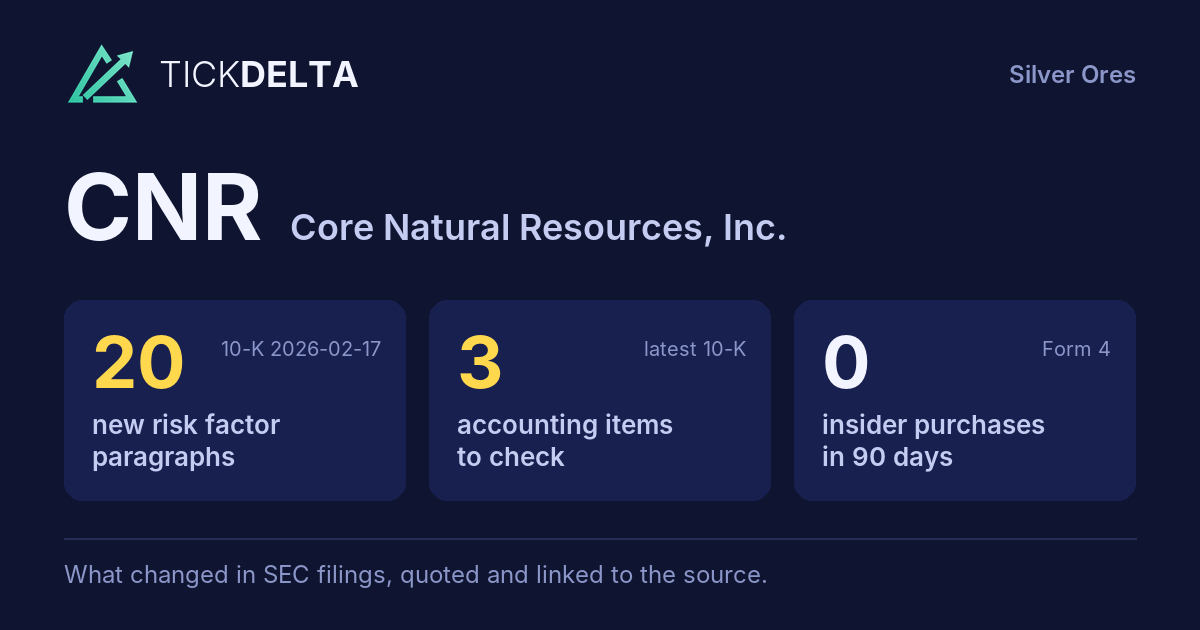
New risk paragraphs, branching off last year
Each branch is a paragraph in Risk Factors with nothing like it in the 10-K filed Feb 20, 2025. A box jumps to the paragraph as filed, below.
Paragraphs with nothing like them in last year's 10-K
20 paragraphs in Risk Factors of the 10-K filed Feb 17, 2026 with nothing like them in the 10-K filed Feb 20, 2025. Quoted exactly. Paragraphs that were only edited are under 10-K change.
•retaliatory tariffs by our trading partners on the price of coal we receive; and
•tariffs on the cost of supplies we procure from overseas vendors or that include foreign components.
We face risks related to our pursuit of new lines of business, such as those involving sustainable innovations and rare earth minerals.
We have pursued, and will continue to pursue, a variety of new lines of business, including alternative and innovative uses of coal led by our subsidiary, CONSOL Innovations LLC, including, but not limited to, products with aerospace, defense, battery and building product applications, and potential new lines of business involving rare earth elements (“REEs”). Additional information regarding these new lines of business can be found in “Our Strategy” in Item 1 of this Report. Pursuing new lines of business subjects us to a number of material risks, including, but not limited to:
•the possibility that we may invest significant time and resources in our attempts to pursue new lines of business that may never be profitable;
•exposure to new laws and regulations with which we are not familiar and which may lead to increased litigation and regulatory risk;
•difficulty in hiring personnel or acquiring the know-how needed to operate any new line of business; and
•failure of our management team to successfully manage new and shifting risk considerations, compliance obligations, competitors or market preferences.
In particular, as we continue to evaluate a potential new line of business involving REEs, our strategy may include expanding into the exploration, development, extraction, processing, separation, or commercialization of REEs and related downstream activities. These initiatives are subject to significant uncertainty and may require substantial capital investment, specialized technical expertise, proprietary or emerging processing technologies and extensive regulatory approvals. Volatility in commodity pricing and other market dynamics, competition from established participants and fluctuations in demand for REEs may adversely affect the economic viability of such new lines of business.
In addition, REE deposits often present complex mineralogy, low concentrations and challenging metallurgy, requiring specialized beneficiation, separation and refining processes. Even where REEs are identified, the economic feasibility of extraction and processing may be constrained by high operating and capital costs. Furthermore, recoveries of individual REEs may vary significantly, and unfavorable element mixes may reduce the overall economic value of a deposit. If the extraction, processing or sale of REEs proves to be economically unviable, we may be unable to recover any investments in REE-related initiatives, which may impact future profitability.
business, as well as the laws of the U.S. governing our business activities in those other countries, such as the U.S. Foreign Corrupt Practices Act.
Numerous proposals have been made and are likely to continue to be made at the international, national, regional and state levels of government that are intended to limit emissions of GHGs. Foreign governments, including the European Union and member countries, have adopted regulations governing GHG emissions. Independent of regulation, the UNFCCC seeks to establish GHG emissions reduction requirements for developed countries. The UNFCCC’s governing body, the Conference of the Parties (“COP”), meets annually to implement and refine a framework for the international Paris Agreement, a voluntary commitment to limit or reduce GHG emissions in order to limit global warming below 2 degrees Celsius from temperatures in the pre-industrial era. Nevertheless, the international community has been called upon to achieve a 43% reduction in GHG emissions by 2030 (compared to 2019 levels) through actions that drive the transition away from fossil fuels in energy systems. The U.S. has withdrawn from the Paris Agreement and, on January 7, 2026, President Trump issued an executive order calling for the withdrawal of the U.S. from the UNFCCC. However, the ultimate effect of these withdrawals is uncertain, as it may incite various state and other policymakers to introduce stricter requirements.
In addition, several individual U.S. states have already adopted measures requiring GHG emissions reductions or a shift to renewable energy sources within their boundaries. Other states have elected to participate in regional cap-and-trade programs like the Regional Greenhouse Gas Initiative (“RGGI”) in the northeastern U.S. Any significant legislative changes at the international, national, state or local levels designed to reduce GHG emissions could significantly affect our ability to produce and sell our coal and develop our reserves, could increase the cost of the production and sale of coal and could materially reduce the value of our coal and coal reserves.
We are subject to various risks associated with scrutiny of companies’ management of ESG matters.
Show the other 5
The Federal Coal Mine Safety and Health Act and Mine Improvement and New Emergency Response Act impose stringent health and safety standards on mining operations. Regulations that have been adopted are comprehensive and
We have become increasingly dependent upon digital technologies, including information systems, hardware, software, infrastructure, networks and cloud applications and services (collectively, “IT Systems”) to operate our businesses, process and record financial and operating data, including proprietary and potentially sensitive data (collectively, “Confidential Information”), communicate with our employees and business partners, and estimate quantities of coal reserves, as well as other activities related to our businesses. We own and manage some of these IT Systems but also rely on third parties for a range of IT Systems and related products and services.
In addition to the existing risks, the adoption of new technologies, such as artificial intelligence (“AI”), by us, our customers or third parties may also increase our exposure to data breaches or our ability to detect and remediate effects of a breach. Further, as cyber incidents continue to increase in frequency and sophistication, particularly given the increasing availability and sophistication of AI, we may be required to expend additional resources to continue to modify or enhance our protective measures or to investigate and remediate any vulnerability to cyber incidents. As a result, we may be unable to detect, investigate, remediate or recover from future attacks or incidents, or to avoid a material adverse impact to our IT Systems, Confidential Information or business. There can also be no assurance that our cybersecurity risk management program and processes, including our policies, controls or procedures, will be fully implemented, complied with or effective in protecting our IT Systems and Confidential Information.
Any adverse impact to the availability, integrity or confidentiality of our IT Systems or Confidential Information can result in legal claims or proceedings, regulatory investigations and enforcement actions, fines and penalties, negative reputational impacts that cause us to lose existing or future customers and/or significant incident response, system restoration or remediation and future compliance costs. Any or all of the foregoing could materially adversely affect our business, financial condition and results of operations.
incorporation inapplicable to, or unenforceable in respect of, one or more of the specified types of actions or proceedings, we may incur additional costs associated with resolving such matters in other jurisdictions.
Additionally, certain operations may not realize the full potential that we anticipated at the Merger due to operational issues we have faced, including at our Leer South and West Elk locations in 2025. The Leer South longwall system had been idle since January 13, 2025, when combustion-related activity was detected in a previously mined area. In addition, our West Elk longwall mine in Colorado experienced a period of transition associated with its move to the B-Seam in the fourth quarter of 2025.
Paragraphs in the 10-Q filed Nov 5, 2026 that were not in the one before
New in the latest 10-Q
6 paragraphs in the 10-Q filed Nov 5, 2026 with nothing like them in the 10-Q filed Aug 6, 2026 (at least half the words must differ; new numbers alone do not count). Quoted exactly, grouped by the item heading above them. This is text that changed, not a judgement of how serious it is.
Financial statements and notes
We have a 35% ownership interest in DTA, which operates the Dominion Terminal, a coal export terminal in Newport News, Virginia. Through our storage capacity at DTA, we fulfill a broad range of coal quality requirements for our customers. In June 2026, the majority partner announced a key piece of equipment, a stacker reclaimer machine, at DTA sustained significant damage due to high winds from a storm. DTA leadership, as part of DTA’s insurance claims process, is in contact with its insurance providers to evaluate its options and work on developing an action plan. The terminal remains operational, but the damage to the stacker reclaimer has resulted in a slowdown in handling coal from certain areas of the stockpile yard until equipment replacement or repairs or other workarounds can be put in place. As of September 30, 2026, this event has not had a material impact; however, further disruptions or delays could affect our operations, financial results or liquidity.
Read in the 10-Q
We believe that realized coal revenue and realized coal revenue per ton sold better reflect our revenue for the quality of coal sold and our operating results by including all income from coal sales. We believe cash cost of coal sold, cash cost
Read in the 10-Q
Controls and procedures
accumulated and communicated to the Company’s management, including the Company’s principal executive officer and principal financial officer, as appropriate, to allow timely decisions regarding required disclosure.
Read in the 10-Q
Other information
• On August 18, 2026, George J. Schuller, Jr., Senior Vice President and Chief Operating Officer, adopted a Rule 10b5-1 trading arrangement for the sale of up to 27,100 shares of our common stock, subject to certain conditions. The number of shares represents the maximum number of shares that could potentially be sold pursuant to the Rule 10b5-1 trading arrangement, including sales made in connection with the vesting of future equity awards. Accordingly, in calculating this amount, we have not considered any potential reductions in shares available to be sold due to tax withholdings at the time such equity awards vest, and, for performance-based awards, we have assumed such awards will vest at maximum value. The arrangement’s expiration date is August 17, 2027, for a duration of 365 days.
Read in the 10-Q
• On August 31, 2026, James A. Brock, Chair and Chief Executive Officer, adopted a Rule 10b5-1 trading arrangement for the sale of up to 100,000 shares of our common stock, subject to certain conditions. The arrangement’s expiration date is May 28, 2027, for a duration of 271 days.
Read in the 10-Q
Show the other 1
Item 6
Exhibits Description Method of Filing ───────────────────────────────────────────────────────────────────────────────────────────────────────────────────────────────────────────────────── 95 Mine Safety and Health Administration Safety Data Filed herewith 101 Interactive Data File (Form 10-Q for the quarterly period ended September 30, 2026, furnished in Inline XBRL) Filed herewith 104 Cover Page Interactive Data File (formatted as Inline XBRL and contained in Exhibit 101) Filed herewith
Read in the 10-Q
The 10-Q's risk factors against the 10-K
Item 1A of the 10-Q filed Nov 5, 2026 against Item 1A of the 10-K filed Feb 17, 2026.
A 10-Q repeats only the risks that changed, so a 10-K paragraph that is missing from it is not counted as removed.
Added is a paragraph with nothing like it in the 10-K, Reworded a sentence that is in both with several words changed,
Quiet changes a sentence in both where one to four words changed and one is a hedge or a modal
(cut words struck through, new words highlighted).
Text on the page, not a score; each links to the filing at sec.gov.
What the 10-Q itself says about its risk factors:In addition to the other information set forth in this Report, you should carefully consider the factors described in Part I, Item 1A. “Risk Factors” of the Company’s Annual Report on Form 10-K for the year ended December 31, 2025. These described risks are not the only risks the Company faces. Additional risks and uncertainties not currently known to Core or that the Company currently deems to be immaterial also may materially adversely affect Core’s business, results of operations, financial condition and cash flows.
Read in the 10-Q
1 paragraph in the 10-Q's Item 1A, and none of them adds, rewords or quietly edits a paragraph of the 10-K's.
Phrases used for the first time
Two-word phrases in Risk Factors of the 10-K filed Feb 17, 2026 that are in none of the 1 earlier 10-Ks stored, back to Feb 20, 2025
Where each one is used
- core marine: The availability and reliability of modes of transportation and transportation facilities as well as fluctuations in transportation costs could affect the demand for our coal, and any significant damage to the Core Marine Terminal or the Dominion Terminal that impacts their use could impair our ability to supply...
- series bonds: •$98 million under our Pennsylvania Economic Development Financing Authority (“PEDFA”) 5.45% Solid Waste Disposal Facility Revenue Bonds due March 2035 (“PEDFA Bonds,” and together with the WVEDA Bonds and the MEDCO Bonds, the “Series 2025 Bonds”);
- confidential information: We have become increasingly dependent upon digital technologies, including information systems, hardware, software, infrastructure, networks and cloud applications and services (collectively, “IT Systems”) to operate our businesses, process and record financial and operating data, including proprietary and...
- bonds indentures: Our senior secured credit agreement and the indentures associated with our Series 2025 Bonds (the “Series 2025 Bonds Indentures”) limit the incurrence of additional indebtedness unless specified tests or exceptions are met. In addition, our senior secured credit agreement and the Series 2025 Bonds Indentures...
- due march: •$106 million under our West Virginia Economic Development Authority (“WVEDA”) 5.45% Solid Waste Disposal Facility Revenue Bonds due March 2035 (“WVEDA Bonds”);
- retaliatory tariffs: •retaliatory tariffs by our trading partners on the price of coal we receive; and
- customer’s coal: Our ability to collect payments from our customers for coal sold and delivered could be impaired if their creditworthiness declines or if they fail to honor their contracts. If the creditworthiness of a significant customer declines or the customer significantly delays payments to us, our business, cash flows and...
- rare earth: We face risks related to our pursuit of new lines of business, such as those involving sustainable innovations and rare earth minerals.
Used at least twice, small words left out. Counted, not picked: a phrase can be new because the company renamed something.
What was taken out
9 paragraphs of last year's Risk Factors with nothing like them now. The longest are quoted.
Sources
Item 1A of each 10-K and 10-Q on EDGAR, quoted exactly. Each paragraph links to the filing at sec.gov.
Also
10-K change: what was reworded or cut, section by section.
Work with it
Excel workbook · CSV. Google Sheet that stays up to date: paste =IMPORTDATA("https://tickdelta.com/company/CNR/export.csv") into a cell.