Screener / SEC EDGAR /CIK 0001284812 /10-K filed Feb 27, 2026, compared with Feb 21, 2025 /Numbers from the XBRL of the 10-Ks
NYSE Financials · Asset Management

Cohen & Steers, Inc. CNS

Compare with peers Embed
The 10-K against last year's

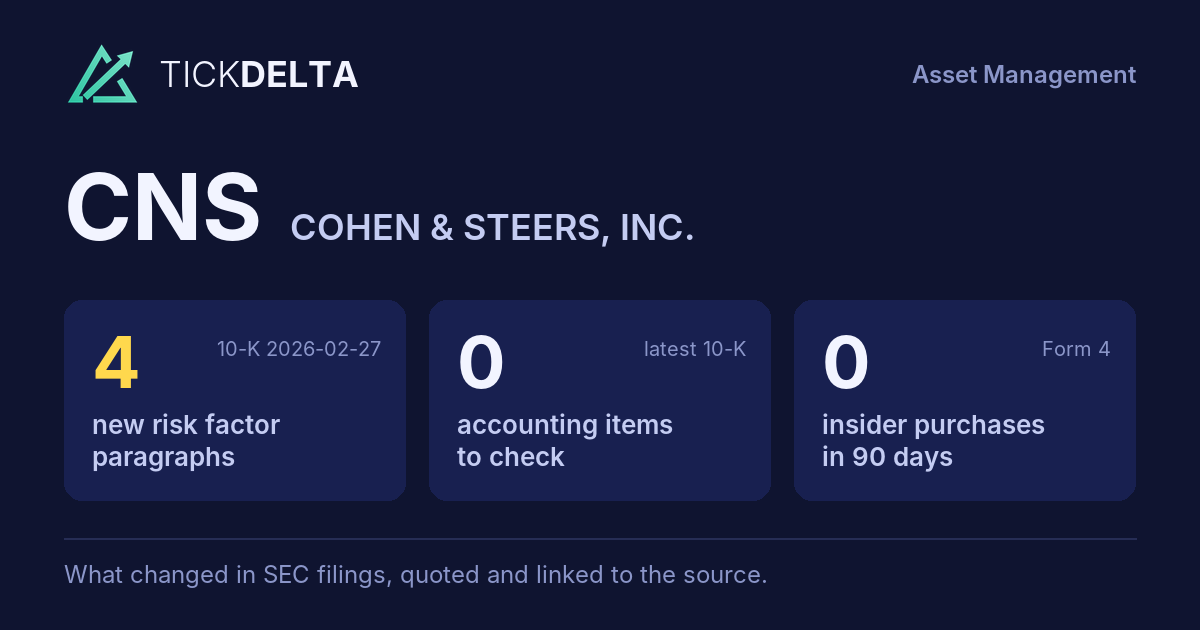
69 changes: 8 added, 13 removed, 47 reworded, 1 quiet changes

10-K Feb 27, 2026 vs Feb 21, 2025

10-K 0001284812-26-000011 (Feb 27, 2026) vs 10-K 0001284812-25-000087 (Feb 21, 2025) Not compared: Legal Proceedings.

Every paragraph, and how much of it changed

One bar per paragraph, in the order of the 10-K. Height and colour show the share of its words not in the closest paragraph a year earlier; the tallest bars are new paragraphs.

Risk Factors

99 paragraphs · 4 new · 39 reworded · 4 gone · 10-K Feb 27, 2026 against Feb 21, 2025
New paragraph Reworded (5% of its words or more) Same or nearly
Paragraph 49 · 50% changed Every version of it
Additionally, our business could be affected by regulatory and legal requirements through new rules and restrictions around technological advancements that could increase the cost of compliance when employing these technological changes. Broad regulatory obligations applicable to AI and machine-learning are uncertain and developing, which heightens the potential risk that such technologies may pose to us. In order to reduce these new and expanded risks and liabilities, we could choose to limit some of our activities related to such technologies, which could harm our funds’ financial performance or increase fund expenses.
Paragraph 11 · 49% changed Every version of it
Limitations have an adverse effect on the assets we manage, limit our ability to utilize leverage increase and invest assets in these strategies and reduce the closed-end funds fees we sponsor could reduce earn and our assets under management and revenue.
Paragraph 3 · 44% changed Every version of it
As of December 31, 2024, approximately 65.2% of the assets we managed was concentrated in real estate securities strategies, including approximately 26.2% in the aggregate in Cohen & Steers Real Estate Securities Fund, Inc., Cohen & Steers Realty Shares, Inc. and Cohen & Steers Institutional Realty Shares, Inc. Real estate securities and real property investments owned by the issuers of real estate securities are subject to varying degrees of risk that could affect investment performance. Returns on investments in real estate securities depend on the amount of income and capital appreciation or loss realized by the underlying real property. We are paid a management fee or incentive fee based on the net asset value or returns, respectively, of certain of our investment vehicles and declines in the value of real estate securities and real property investments may reduce the fees we earn and our assets under management. Income and real estate values may be adversely affected by, among other things, unfavorable changes to tax laws and other laws and regulations applicable to real estate securities, global or regional events and disruptions that directly impact the real estate sector, the cost of compliance with applicable laws and regulations, sensitivity to certain economic factors such as interest rate changes and market volatility or economic recession, the availability and terms of financing, the creditworthiness of tenants, the volume and market terms of commercial real estate purchase and sale transactions, general and local economic conditions, the limited ability of issuers of real estate securities to vary their portfolios promptly in response to changes in market conditions and other factors that are beyond our control. In addition, distress in the commercial real estate sector, including office properties, as well as shifting business trends and/or workforce reductions in certain geographies and industries, has negatively impacted and may continue to negatively impact certain markets in which we invest, including for example, as a result of low occupancy rates, tenant defaults, reduced rental rates, the maturation of a significant amount of commercial real property loans amid an elevated interest rate environment, tightening credit conditions imposed by traditional sources of real estate financing and refinancing and commercial mortgage loan defaults. Real estate values may also be adversely affected by new businesses and approaches in the real estate market and sectors in which we invest that cause disruptions in the industry with technological and other innovations, such as impacts to the value of hospitality properties due to competition from the non-traditional hospitality sector (such as short-term rental services) and office properties due to competition from shared office spaces (including co-working environments) or remote work arrangements. Further, our investments in real estate securities and real property may be exposed to new or increased risks and liabilities that could have a negative impact on our investment strategies and reduce our assets under management, revenue and earnings, including risks associated with global climate change, such as increased frequency and/or intensity of adverse weather and natural disasters. If underlying properties do not generate sufficient income to pay for ongoing operating expenses, the income and the ability of an issuer of real estate securities to pay interest and principal on debt securities or any dividends on common or preferred stocks will be adversely affected. A decline in the performance or value of real estate securities would have an adverse effect on the assets we manage and reduce the fees we earn and our revenue.
Paragraph 95 · 35% changed Every version of it
On behalf of our clients, we make decisions to buy and sell securities, select broker-dealers to execute trades and negotiate brokerage commission rates. In connection with these transactions and subject to best execution, we receive commission credits to pay for eligible research and services from broker-dealers and other eligible service providers. As a result of regulations in the European Union (EU) and U.K., we may continue to eliminate the use of commission credits to pay for research and eligible services for accounts where we have certain obligations within the scope of MiFID II (together with substantially similar national rules of the U.K. and implementing rules and regulations). Our operating expenses then include payment for research and eligible services for these accounts. Depending on the evolution of Evolving market practices and regulatory developments, changes in the various jurisdictions in which we operate may look impact the amount of commission credits we generate or our ability to use commission credits to pay for research in the future or elect to pay for eligible research and expenses globally, subject to applicable SEC regulations, services which would impact could increase our operating expenses. expenses and negatively impact net income.
Paragraph 68 · 35% changed Every version of it
We depend on a number of key vendors for various fund administration, fund and corporate accounting, custody and transfer agent services, information technology services, market data and other operational needs. The failure or inability of the Company to establish backup for key services or the failure of any key vendor to fulfill its obligations for any reason, including those that may be beyond our or such vendor’s control, could lead to operational issues for the Company and certain of its products, which could result in financial losses for the Company and its clients.
Paragraph 42 · 33% changed Every version of it
Our assets under management are concentrated military developments in the U.S., Asia Pacific and European equity markets. Equity securities may decline in value as a result of many global, regional or issuer-specific economic or market factors, including changes in interest rates, inflation, an issuer’s actual or perceived financial condition and growth prospects, investor perception of an industry, geography or sector, changes in currency exchange rates and changes in regulations. In addition, national and international geopolitical risks and events, including the armed conflict between Russia and Ukraine and ongoing conflicts in the Middle East, tensions between the U.S. and China, deglobalization trends and changes in national industrial and trade policies and national elections in countries such as the U.S., Taiwan and India, Venezuela, have caused and may continue to cause volatility in the global financial markets and economy. Such volatility has led and may continue to lead to the disruption of global supply chains, tariffs, labor shortages, sudden fluctuations in commodity prices and energy costs, greater political instability and the implementation of sanctions and heightened cybersecurity concerns, any or all of which may create severe long-term macroeconomic challenges, limit liquidity opportunities or lead to higher costs. Any declines in the equity markets, or in market segments in which our investment products and strategies are concentrated, could reduce the value of our seed investments and/or our assets under management, revenue and earnings.
Paragraph 59 · 31% changed Every version of it
Our operations are dependent on our ability to protect our personnel, offices and technology infrastructure against damage from catastrophic or business continuity events that could have a significant disruptive effect on our operations. We and our third-party intermediaries, service providers and key vendors could experience a local or regional disaster, such as an epidemic or pandemic, weather event such as an earthquake, flood, hurricane or fire, terrorist attack, security breach, power loss and other failure of technology or telecommunications systems or operations. Events like these could threaten the safety and welfare of our workforce, cause the loss of client data or cause us to experience material adverse interruptions to our operations. Infectious illness outbreaks or other adverse public health developments in countries where we or our clients or investors operate, as well as restrictive measures implemented to control such outbreaks, could adversely affect the economies of many nations or the global economy, the financial condition of individual issuers or companies and capital markets, in ways that are not within our control and cannot be foreseen. A sustained decline in the performance of or demand for the portfolios and strategies we manage as a result of negative market, financial and economic conditions caused by catastrophic events could adversely impact our assets under management and the fees we earn, and these conditions could lead us to experience operational issues and interruptions, require us to incur significant additional costs and negatively impact our business.
Paragraph 41 · 26% changed Every version of it
Our assets under management are concentrated in the U.S., Asia Pacific and European equity markets. Equity securities may decline in value as a result of many global, regional or issuer-specific economic or market factors, including changes in interest rates, inflation, an issuer’s actual or perceived financial condition and growth prospects, investor perception of an industry, geography or sector, changes in currency exchange rates and changes in regulations. In addition, national and international geopolitical risks and events, including the armed conflict between Russia and Ukraine and ongoing conflicts in the Middle East, tensions between the U.S. and China, deglobalization trends and changes in national industrial and trade policies and national elections in countries such as the U.S., Taiwan and India, have caused and may continue to cause volatility in the global financial markets recent political and economy. Such volatility has led and may continue to lead to the disruption of global supply chains, tariffs, sudden fluctuations in commodity prices and energy costs, greater political instability and the implementation of sanctions and heightened cybersecurity concerns, any or all of which may create severe long-term macroeconomic challenges, limit liquidity opportunities or lead to higher costs. Any declines in the equity markets, or in market segments in which our investment products and strategies are concentrated, could reduce the value of our seed investments and/or our assets under management, revenue and earnings.

MD&A

79 paragraphs · 4 new · 41 reworded · 9 gone · 10-K Feb 27, 2026 against Feb 21, 2025
New paragraph Reworded (5% of its words or more) Same or nearly
Paragraph 47 · 48% changed
Years Ended December 31, 2024 2023 U.S. statutory tax rate 21.0% 21.0% State and local income taxes, net of federal benefit 2.7 3.2 Non-deductible executive compensation 1.2 1.9 Valuation allowance (0.7) 0.4 Excess (5)Includes excess tax benefits related to the vesting and delivery of restricted stock units (0.3) (1.2) Other (0.3) — Effective income and unrecognized tax rate 23.6% 25.3% benefit adjustments.
Paragraph 48 · 48% changed
(1)Represents the impact of consolidated funds and the net effect expenses incurred on behalf of corporate seed investment performance. certain Company-sponsored funds.
Paragraph 45 · 44% changed
(2)Represents (3)Represents reimbursement of filing fees paid by certain members of senior leadership for the year ended December 31, 2025, and the impact of incremental expenses associated with the separation of certain employees. employees for the year ended December 31, 2024.
Paragraph 50 · 44% changed
(2)Represents (3)Represents reimbursement of filing fees paid by certain members of senior leadership for the year ended December 31, 2025, and the impact of incremental expenses associated with the separation of certain employees. employees for the year ended December 31, 2024.
Paragraph 17 · 31% changed
•Net outflows of $563 $324 million including $292 $316 million from global/international real estate assets multi-strategy (included in "Other"); and $233 million from U.S. real estate
Paragraph 13 · 30% changed
•Net outflows inflows of $211 million $1.7 billion including $297 million from global/international $1.2 billion into U.S. real estate, $354 million into real assets multi-strategy (included in "Other") and $333 million into global listed infrastructure, partially offset by net inflows outflows of $134 $582 million into U.S. real estate from preferred securities;
Paragraph 44 · 30% changed
(3)Represents (2)Represents the impact of lease and other expenses related to the Company's prior headquarters, for which the lease expired in January 2024. From a GAAP perspective, the Company recognized lease expense on both its prior and current headquarters as a result of overlapping lease terms.
Paragraph 49 · 30% changed
(3)Represents (2)Represents the impact of lease and other expenses related to the Company's prior headquarters, for which the lease expired in January 2024. From a GAAP perspective, the Company recognized lease expense on both its prior and current headquarters as a result of overlapping lease terms.

A paragraph is matched with the one last year that shares the most of its words; under half in common makes it new. The paragraphs shown are the 8 reworded the most in each section.

The paragraph that changed most in each section

The redline

Marked against last year's 10-K: cut words struck through, new words highlighted.

Risk Factors156 words changed in this paragraph; it is 84% similar to last year's version.
As of December 31, 2024, 2025, approximately 65.2% 63.8% of the assets we managed was concentrated in real estate securities strategies, including approximately 26.2% 25.9% in the aggregate in Cohen & Steers Real Estate Securities Fund, Inc., Cohen & Steers Realty Shares, Inc. and Cohen & Steers Institutional Realty Shares, Inc. Real estate securities and real property investments owned by the issuers of real estate securities are subject to varying degrees of risk that could affect investment performance. Returns on investments in real estate securities depend on the amount of income and capital appreciation or loss realized by the underlying real property. We are paid a management fee or incentive fee based on the net asset value or returns, respectively, of certain of our investment vehicles and declines in the value of real estate securities and real property investments may reduce the fees we earn and our assets under management. Income and real estate values may be adversely affected by, among other things, unfavorable changes to tax laws and other laws and regulations applicable to real estate securities, global or regional events and disruptions that directly impact the real estate sector, the cost of compliance with applicable laws and regulations, sensitivity to certain economic factors such as uncertainty around the timing and extent of interest rate changes and market volatility or economic recession, the availability and terms of financing, the creditworthiness of tenants, the volume and market terms of commercial real estate purchase and sale transactions, general and local economic conditions, the limited ability of issuers of real estate securities to vary their portfolios promptly in response to changes in market conditions and other factors that are beyond our control. In addition, distress in the commercial real estate sector, including office properties, as well as shifting business trends and/or workforce reductions in certain geographies and industries, has negatively impacted and may continue to negatively impact certain markets in which we invest, including for example, as a result of low occupancy rates, tenant defaults, reduced rental rates, the maturation of a significant amount of commercial real property loans amid an elevated interest rate environment, tightening credit conditions imposed by traditional sources of real estate financing and refinancing and commercial mortgage loan defaults. Real estate values may also be adversely affected by new businesses and approaches in the real estate market and sectors in which we invest that cause disruptions in the industry with technological and other innovations, such as impacts to the value of hospitality properties due to competition from the non-traditional hospitality sector (such as short-term rental services) and office properties due to competition from shared office spaces (including co-working environments) or remote work arrangements. Further, our investments in real estate securities and real property may be exposed to new or increased risks and liabilities that could have a negative impact on our investment strategies and reduce our assets under management, revenue and earnings, including risks associated with global climate change, such as increased frequency and/or intensity of adverse weather and natural disasters. If underlying properties do not generate sufficient income to pay for ongoing operating expenses, the income and the ability of an issuer of real estate securities to pay interest and principal on debt securities or any dividends on common or preferred stocks will be adversely affected. A decline in the performance or value of real estate securities would have an adverse effect on the assets we manage and reduce the fees we earn and our revenue.

Source: Item 1A, 10-K 0001284812-26-000011 vs Item 1A, 10-K 0001284812-25-000087

Accounting Policies136 words changed in this paragraph; it is 34% similar to last year's version.
In November 2023, September 2025, the FASB issued ASU 2023-07, Segment Reporting (Topic 280): 2025-06, Intangibles - Goodwill and Other - Internal-Use Software (Subtopic 350-40): Targeted Improvements to Reportable Segment Disclosures. the Accounting for Internal-Use-Software. The standard requires enhanced disclosure ASU provides targeted amendments to modernize the accounting framework for internal-use software development, including the removal of reportable segments the traditional "development stage" model and additional information about the introduction of a segment’s expenses. more principles-based approach to capitalization. Under the new guidance, companies may begin capitalizing internal-use software costs when: management with the relevant authority authorizes and commits to funding the software project and it is probable that the project will be completed, and the software will be used to perform its intended function. This new guidance became will be effective on January 1, 2024. 2028. The Company's Company does not expect that the adoption of this new standard did not will have a material impact on the Company's consolidated financial statements. Refer to Note 18 for further discussion. statements and related disclosures.

Source: 10-K text, Note 2 – Summary of Significant Accounting Policies, 10-K 0001284812-26-000011 vs 10-K text, Note 2 – Summary of Significant Accounting Policies, 10-K 0001284812-25-000087

MD&A78 words changed in this paragraph; it is 76% similar to last year's version.
We have retained an independent valuation services firm to assist in the determination of the fair value of certain of our private real estate investments. Each real property investment is valued no less than quarterly in accordance with the applicable governing documents. Limited partnerships that hold real property investments are valued using the valuation methodology we deem most appropriate and consistent with industry best practices and market conditions. We expect the primary methodology used to value real property investments will be the income approach, whereby value is derived by determining the present value of an asset’s expected stream of future cash flows (for example, discounted cash flow analysis). Consistent with industry practices, the income approach incorporates actual contractual lease income, professional judgments regarding comparable rental and operating expense data, the capitalization or discount rate and projections of future rent and expenses based on appropriate market evidence, and other subjective factors. Other methodologies that may also be used to value a real property investment include, among other approaches, sales comparisons and cost approaches. We monitor the real property investments for events that we believe could have a material impact on the most recent estimated fair values of such real property investments.

Source: Item 7, 10-K 0001284812-26-000011 vs Item 7, 10-K 0001284812-25-000087

Sentences and paragraphs added, removed or reworded

Every change, by type

Sentences and paragraphs of CNS's Risk Factors and MD&A, 10-K Feb 27, 2026 against 10-K Feb 21, 2025. Each links to the text at sec.gov.

Quiet changes are sentences kept from last year with one to four words changed, at least one of them a hedge, a modal or a qualifier (may, could, will, not, significant, material…). A year or date rolling forward is not counted.

The full word list

adverse, adversely, all, although, anticipate, anticipates, any, approximately, believe, believes, can, cannot, certain, could, expect, expects, generally, however, if, intend, intends, largely, likely, many, material, materially, may, might, most, must, never, no, not, possible, primarily, probable, should, significant, significantly, some, substantial, substantially, unlikely, will, would

AddedRisk Factors
third-party distribution channels, or changes to their structure and terms, or any reduction in our ability to access clients and investors through existing and new distribution channels, could adversely affect our business.
Read it in 10-K Feb 27, 2026 at sec.gov
AddedRisk Factors
Changes related to the development, adoption or implementation of AI technologies may be difficult to anticipate, may occur rapidly and may materially alter competitive dynamics, operating models and cost structures, which may materially reduce market share and levels of demand for products, services or offerings for companies in the sectors in which we invest. Any such company or sector-level disruptions, dislocations, or volatility due to the introduction of AI tools and technologies may negatively affect our investment performance.
Read it in 10-K Feb 27, 2026 at sec.gov
AddedRisk Factors
In January 2026, the United States undertook military and law-enforcement actions in Venezuela in connection with criminal proceedings against senior Venezuelan officials, including Venezuelan President Nicolás Maduro, and publicly indicated its intent to support a political transition. The resulting geopolitical uncertainty, including the risk of further conflict, civil unrest, sanctions changes and disruption to regional energy and capital markets, may increase volatility in global financial markets and adversely affect economic conditions relevant to our investments.
Read it in 10-K Feb 27, 2026 at sec.gov
RemovedRisk Factors
until launched. Highly publicized security breaches continue to expose failures of companies to keep pace with the threats posed by cyber-attackers and have led to increased government, regulatory and media scrutiny.
Read it in 10-K Feb 21, 2025 at sec.gov
RemovedRisk Factors
portfolios, may require us to adapt our strategy, business and operations to address these trends and pressures. Our competitive position may weaken if we are unable to meet these client priorities.
Read it in 10-K Feb 21, 2025 at sec.gov
RemovedRisk Factors
with our growth strategy, may in some cases be based on anticipated legal, regulatory, financial or accounting treatment that may not be realized within the timeframe or in the form expected, or at all.
Read it in 10-K Feb 21, 2025 at sec.gov
Show the other 38
RewordedRisk Factors
As a result of Under regulations in the European Union (EU) and U.K., we may continue to eliminate the use of commission credits to pay for research and eligible services for accounts where we have certain obligations within the scope of MiFID II (together with substantially similar national rules of the U.K. and implementing rules and regulations). regulations), where our operating expenses then include payment for research and eligible services for these accounts, or use commission credits to pay for research subject to applicable SEC regulations, which would impact our operating expenses.
Read it in 10-K Feb 27, 2026 at sec.gov
RewordedRisk Factors
The failure or inability of the Company to establish backup for key services or the failure of any key vendor to fulfill its obligations for any reason, including those that may be beyond our or such vendor’s control, could lead to operational issues for the Company and certain of its products, which could result in financial losses for the Company and its clients.
Read it in 10-K Feb 27, 2026 at sec.gov
RewordedRisk Factors
In addition, launches of new strategies or products, including private real estate investing, and adjustments to existing strategies or products in connection with our growth strategy, may in some cases be based on anticipated legal, regulatory, financial or accounting treatment that may not be realized within the timeframe or in the form expected, or at all.
Read it in 10-K Feb 27, 2026 at sec.gov
RewordedRisk Factors
A decline in the performance or value of preferred securities or similar investments, or diminishment in the attractiveness or availability of preferred securities or similar investments, would have an adverse effect on the assets we manage, limit our ability to increase and invest assets in these strategies and reduce the fees we earn and our revenue.
Read it in 10-K Feb 27, 2026 at sec.gov
RewordedRisk Factors
Volatility or disruption in any such industries or geographies may cause a decline in the value of our preferred securities portfolios and negatively impact our investment returns, such as the stress and contagion fears arising out of the U.S. banking sector, utility sector in 2023 upon and the collapse and subsequent regulatory takeover of certain U.S. regional banks. broader financial industry.
Read it in 10-K Feb 27, 2026 at sec.gov
RewordedRisk Factors
Changes in market and global economic conditions, including elevated interest rates, volatile equity markets, rapid and unpredictable changes in technology, slowing growth and rising inflation as well as client and governmental policy responses thereto, as well as and geopolitical risks such as regional armed conflicts, trade policy unpredictability, shifting foreign policy positions and alliances and government shutdowns, could adversely affect the value of our assets under management, which would reduce the fees we earn and our revenue.
Read it in 10-K Feb 27, 2026 at sec.gov
RewordedRisk Factors
Further, the departure of a portfolio manager could cause clients in investment strategies overseen by such manager to withdraw funds from, or reconsider the allocation of additional funds to, such strategies, and cause consultants and other intermediaries to discontinue recommendations of such strategies, any of which would reduce our assets under management, investment advisory fees and net income.
Read it in 10-K Feb 27, 2026 at sec.gov
RewordedRisk Factors
Further, advances in technology, including through artificial intelligence AI capabilities, automation and digital wealth and distribution tools, as well as growing client interest for enhanced digital interaction with their investment portfolios, may require us to adapt our strategy, business and operations to address these trends and pressures.
Read it in 10-K Feb 27, 2026 at sec.gov
RewordedRisk Factors
The nature of these threats and the techniques used by cyber criminals are constantly evolving, can originate from a wide variety of sources and are becoming increasingly sophisticated, including the use of “ransomware” artificial intelligence (AI) by threat actors to develop cyberattacks and the use of “ransomware”, social engineering and phishing attacks, and may not be recognized until launched.
Read it in 10-K Feb 27, 2026 at sec.gov
RewordedRisk Factors
As of December 31, 2024, 2025, our largest institutional client, Daiwa Asset Management, which held most of its assets in U.S. real estate strategies subadvised by us in Japan, represented approximately 19.6% 4.5% of our institutional account total revenue and approximately 4.9% 8.7% of our total revenue assets under management for 2024. 2025.
Read it in 10-K Feb 27, 2026 at sec.gov
RewordedRisk Factors
Real estate values may also be adversely affected by new businesses and approaches in the real estate market and sectors in which we invest that cause disruptions in the industry with technological and other innovations, such as impacts to the value of hospitality properties due to competition from the non-traditional hospitality sector (such as short-term rental services) and office properties due to competition from shared office spaces (including co-working environments) or remote work arrangements.
Read it in 10-K Feb 27, 2026 at sec.gov
RewordedRisk Factors
In addition, national and international geopolitical risks and events, including the armed conflict between Russia and Ukraine and ongoing conflicts in the Middle East, tensions between the U.S. and China, deglobalization trends and changes in national industrial and trade policies and national elections in countries such as the U.S., Taiwan and India, have caused and may continue to cause volatility in the global financial markets recent political and economy.
Read it in 10-K Feb 27, 2026 at sec.gov
AddedMD&A
Global economic conditions remained volatile throughout 2025, with heightened uncertainty persisting into the fourth quarter. Fiscal policy shifts, evolving monetary strategies, and ongoing trade tensions continued to shape the macroeconomic landscape. Key developments included the passage of new U.S. tax legislation, the Federal Reserve’s initiation of an interest rate cutting cycle, historically large revisions to economic data, and the longest U.S. government shutdown on record. These factors, combined with diverging policy responses across major economies, influenced investor sentiment and drove significant asset flows across regions and sectors. Central banks remained focused on balancing inflation risks against mounting evidence of slowing growth, while elevated trade and policy uncertainty added further complexity to the operating environment.
Read it in 10-K Feb 27, 2026 at sec.gov
AddedMD&A
Despite these challenges, we maintained our disciplined approach, leveraging our portfolio management expertise and robust risk management framework. Our continued emphasis on prudent cost control and operational efficiency has positioned us to navigate this complex environment and adapt to evolving market conditions.
Read it in 10-K Feb 27, 2026 at sec.gov
AddedMD&A
General and administrative expenses increased from the year ended December 31, 2024, primarily due to expenses paid on behalf of certain Company-sponsored funds totaling $3.5 million, increased talent acquisition costs of $2.0 million, and fund organization cost related to the UTF rights offering of $1.5 million.
Read it in 10-K Feb 27, 2026 at sec.gov
RemovedMD&A
During 2024, global economic conditions remained complex, marked by varying levels of growth across regions and recalibrations to new political administrations. Global equity and fixed income markets reflected these dynamics, with investor sentiment fluctuating in response to monetary policy developments, inflation trends and geopolitical uncertainties. Despite these challenges, we continue to see investment opportunities across our asset classes. As a global asset manager, we navigated these macroeconomic conditions by leveraging our extensive portfolio management expertise, disciplined risk management framework and prudent cost control.
Read it in 10-K Feb 21, 2025 at sec.gov
RemovedMD&A
Effective January 1, 2023, the Company revised its methodology for as adjusted results to include interest and dividends from corporate seed investments. Amounts for the year ended December 31, 2022 have not been recast to conform with the current methodology as the impact was not significant.
Read it in 10-K Feb 21, 2025 at sec.gov
RemovedMD&A
(6)Tax adjustments are summarized in the following table:Years Ended December 31, (in thousands) 2024 2023 2022 Impact of tax effects associated with items noted above $ (2,020) $ (3,085) $ (3,522) Impact of discrete tax items (1,792) (1,115) (11,120) Total tax adjustments $ (3,812) $ (4,200) $ (14,642)
Read it in 10-K Feb 21, 2025 at sec.gov
RemovedMD&A
On April 22, 2024, we issued 1,007,057 shares of common stock through an offering. The net proceeds, after deducting commissions and offering expenses, were approximately $68.5 million. We intend to use the net proceeds for general corporate purposes, including seeding track record strategies and investment vehicles. The offering was completed on April 22, 2024 after the issuance of the shares.
Read it in 10-K Feb 21, 2025 at sec.gov
RemovedMD&A
Due to the uncertainty with respect to the timing of future cash flows associated with unrecognized tax benefits at December 31, 2024, the Company is unable to reasonably estimate when cash settlement with the respective taxing authorities will occur. Therefore, $1.3 million of gross unrecognized tax benefits have been excluded from the contractual obligations table above. See Note 15, Income Taxes, in the notes to the consolidated financial statements included in Part IV, Item 15 of this filing.
Read it in 10-K Feb 21, 2025 at sec.gov
RewordedMD&A
GAAP $ 153,217 $ 151,265 $ 129,049 $ 171,042 Seed investments—net (1) (6,391) (6,245) 2,252 4,317 Accelerated vesting of restricted stock units 3,269 7,134 1,318 10,260 Other non-recurring expenses (2) 1,196 — — Lease transition and other costs - 280 Park Avenue (3) (2) — 807 9,721 776 Closed-end fund Fund launch and rights offering costs (4) 11,464 — — 15,239 Other non-recurring expenses (3) 616 1,196 — Foreign currency exchange (gains) losses—net (5) (4) 3,456 (1,059) 2,371 (4,741) Tax adjustments—net (6) (3,812) (4,200) (14,642) effects of adjustments above (2,851) (2,020) (3,085) Tax effects of discrete tax items (5) (3,665) (1,792) (1,115) Net income attributable to common stockholders, as adjusted $ 159,115 $ 149,286 $ 140,511 $ 182,251 Diluted weighted average shares outstanding 51,526 50,938 49,553 49,297 Diluted earnings per share, U.S.
Read it in 10-K Feb 27, 2026 at sec.gov
RewordedMD&A
GAAP $ 2.97 $ 2.97 $ 2.60 $ 3.47 Seed investments—net (1) (0.12) (0.12) 0.05 0.09 Accelerated vesting of restricted stock units 0.06 0.14 0.03 0.21 Other non-recurring expenses (2) 0.02 — — Lease transition and other costs - 280 Park Avenue (3) (2) — 0.02 0.20 0.02 Closed-end fund Fund launch and rights offering costs (4) 0.22 — — 0.31 Other non-recurring expenses (3) 0.01 0.02 — Foreign currency exchange (gains) losses—net (5) (4) 0.07 (0.02) 0.05 (0.10) Tax adjustments—net (6) (0.08) (0.09) (0.30) effects of adjustments above (0.05) (0.04) (0.06) Tax effects of discrete tax items (5) (0.07) (0.04) (0.03) Diluted earnings per share, as adjusted $ 3.09 $ 2.93 $ 2.84 $ 3.70
Read it in 10-K Feb 27, 2026 at sec.gov
RewordedMD&A
Years Ended December 31, 2025 2024 2023 U.S. federal statutory tax rate 21.0% 21.0% State and local income taxes, net of federal benefit 3.0 2.7 3.2 Non-deductible executive compensation 1.2 1.9 Valuation allowance (0.7) 0.4 Excess tax benefits related to the vesting and delivery of restricted stock units (0.3) (1.2) Other (0.3) — Effective income tax rate 23.6% 25.3% Nontaxable or nondeductible items:
Read it in 10-K Feb 27, 2026 at sec.gov
RewordedMD&A
Non-operating Income (Loss)(in thousands) Year Ended December 31, 2024 2025 Consolidated Corporate - Total Funds (1) Seed and Other Interest and dividend income $ 3,117 4,321 $ 16,227 17,688 $ 19,344 22,009 Gain (loss) from investments—net 15,573 1,009 16,582 7,277 1,435 8,712 Foreign currency gain (loss)—net (578) 1,316 738 (253) (3,574) (3,827) Total non-operating income (loss) 18,112 18,552 36,664 11,345 15,549 26,894 Net (income) loss attributable to noncontrolling interests (11,527) (4,181) — (11,527) (4,181) Non-operating income (loss) attributable to the Company $ 6,585 7,164 $ 18,552 15,549 $ 25,137 22,713
Read it in 10-K Feb 27, 2026 at sec.gov
RewordedMD&A
(in thousands) Year Ended December 31, 2023 2024 Consolidated Corporate - Total Funds (1) Seed and Other Interest and dividend income $ 3,622 3,117 $ 10,996 16,227 $ 14,618 19,344 Gain (loss) from investments—net 4,915 (624) 4,291 15,573 1,009 16,582 Foreign currency gain (loss)—net (556) (2,579) (3,135) (578) 1,316 738 Total non-operating income (loss) 7,981 7,793 15,774 18,112 18,552 36,664 Net (income) loss attributable to noncontrolling interests (7,560) (11,527) — (7,560) (11,527) Non-operating income (loss) attributable to the Company $ 421 6,585 $ 7,793 18,552 $ 8,214 25,137
Read it in 10-K Feb 27, 2026 at sec.gov
RewordedMD&A
Employee compensation and benefits increased from the year ended December 31, 2023 2024, primarily due to higher incentive compensation of $8.7 million and an increase in salaries of $2.2 million, partially offset by lower amortization of restricted stock units of $7.7 million, including $5.8 million of accelerated vesting of certain restricted $6.3 million.
Read it in 10-K Feb 27, 2026 at sec.gov
RewordedMD&A
Consistent with industry practices, the income approach incorporates actual contractual lease income, professional judgments regarding comparable rental and operating expense data, the capitalization or discount rate and projections of future rent and expenses based on appropriate market evidence, and other subjective factors.
Read it in 10-K Feb 27, 2026 at sec.gov
RewordedMD&A
Net cash provided by financing activities was $18.2 $73.8 million, including net contributions from noncontrolling interests of $88.9 million and proceeds of $68.5 million from the issuance of common stock in a registered public offering, $228.7 million, partially offset by dividends paid to stockholders of $119.2 $126.9 million and repurchases of common stock to satisfy employee withholding tax obligations on the vesting and delivery of restricted stock units of $21.1 $28.4 million.
Read it in 10-K Feb 27, 2026 at sec.gov
RewordedMD&A
Distribution and service fee expenses fees increased by $3.0 million from the year ended December 31, 2023 2024, primarily due to higher average assets under management in U.S. open-end funds. funds, partially offset by a shift into lower fee paying share classes.
Read it in 10-K Feb 27, 2026 at sec.gov
RewordedMD&A
Distribution and service fee expenses fees expense increased by $3.0 million from the year ended December 31, 2023 2024, primarily due to $9.9 million of expenses related to the UTF rights offering and higher average assets under management in U.S. open-end funds.
Read it in 10-K Feb 27, 2026 at sec.gov
RewordedMD&A
Net cash provided by (used in) operating activities $ (120,444) $ 96,689 $ 171,961 $ 61,680 Net cash provided by (used in) investing activities 8,356 (119,712) (114,776) (2,857) Net cash provided by (used in) financing activities 73,837 18,167 (119,052) 8,975 Net increase (decrease) in cash and cash equivalents (38,251) (4,856) (61,867) 67,798 Effect of foreign exchange rate changes on cash and cash equivalents 1,693 (1,585) 2,756 (4,440) Cash and cash equivalents, beginning of the period 183,162 189,603 248,714 185,356 Cash and cash equivalents, end of the period $ 146,604 $ 183,162 $ 189,603 $ 248,714
Read it in 10-K Feb 27, 2026 at sec.gov
RewordedMD&A
The increase was due to net inflows of $1.5 billion and market appreciation of $5.4 $6.1 billion, partially offset by net outflows of $171 million and distributions of $2.6 $2.9 billion.
Read it in 10-K Feb 27, 2026 at sec.gov
Quiet changesMD&A
In accordance with Accounting Standards Codification ( Topic 740, Income Taxes (ASC 740), a tax benefit from an uncertain tax position may be is recognized when it is more likely than not that the position will be sustained upon examination, including resolutions of any related appeals or litigation processes, on the basis of the technical merits.
Read it in 10-K Feb 27, 2026 at sec.gov

Sources

The two latest 10-Ks on EDGAR, section by section. Each change links to the text at sec.gov.

Also

New risk factors: paragraphs with nothing like them last year, quoted in full.

Work with it

Excel workbook · CSV. Google Sheet that stays up to date: paste =IMPORTDATA("https://tickdelta.com/company/CNS/export.csv") into a cell.

Next:Related parties
Esc

Type a ticker such as AAPL, a name, an investor such as Buffett, or a topic such as tariffs. ↑ ↓ to move, Enter to open.