COFCapital One
Capital One Financial Corporation, a Delaware corporation established in 1994 and headquartered in McLean, Virginia, is a diversified financial services holding company with banking and non-banking subsidiaries. 10-K, Item 1
- Employees
- 76,300
- Headquarters
- Mclean, VA
- CEO
- Richard D. Fairbank
- Next results
- around Jan 21, 2027
75 paragraphs in Risk Factors of the 10-K filed Feb 19, 2026 with nothing like them in the 10-K filed Feb 20, 2025. Quoted exactly. Paragraphs that were only edited are under 10-K change.
Compared with the Risk Factors in the latest 10-K of the other 75 Financials companies: a paragraph with at least half its words the same at another company is called similar, and the companies are listed under it. A paragraph most of them have is marked boilerplate. No line means no other company has one like it. This counts text; it does not say how serious a risk is.
•We may not be able to successfully integrate our businesses associated with the Transaction, or such integration may be more difficult, time-consuming or costly than expected.
Read in the 10-K ↗
•The integration of Discover may have an adverse effect on our business and results of operations due to the diversion of a substantial portion of the time and attention of our management team as well as potential employee attrition.
Read in the 10-K ↗
•Risks of external fraud exceeding our expectations due to larger, more sophisticated, or more frequent fraud attacks, failure to detect and respond to such attacks and/or the reduced capability to recover losses from those incidents. This could result in increased fraud loss, operational cost, customer dissatisfaction, reputational damage and/or constrained revenue growth for us.
Read in the 10-K ↗
•A change in market preference towards other operators of payment networks and alternative payment providers could result in reduced transaction volume, limited merchant acceptance of our cards and limited issuance of cards on our networks by third parties, and in turn may impact our revenue margins.
•If we are unsuccessful in creating and maintaining a strong base of network licensees and achieving meaningful global card acceptance, we may be unable to achieve long-term success in our recently acquired international network business.
Read in the 10-K ↗
•A reduction in the number of large merchants that accept cards on our recently acquired Discover Network or PULSE Network or in the rates they pay could materially adversely affect our business, financial condition, results of operations and cash flows.
•Defaults or risks from bankruptcies, liquidations, restructurings, consolidations and outages by our network participants may adversely affect our business, financial condition, cash flows and results of operations.
Read in the 10-K ↗
We may not be able to successfully integrate our businesses associated with the Transaction, or such integration may be more difficult, time-consuming or costly than expected.
Read in the 10-K ↗
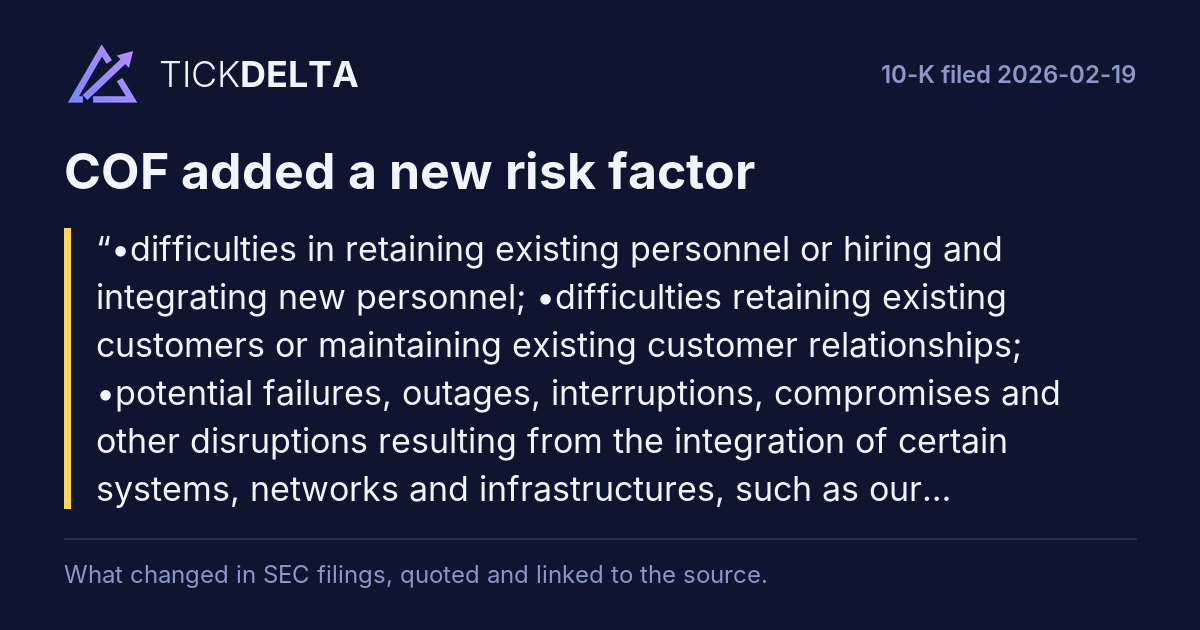
•difficulties integrating operations, systems and networks, including related technology, operations and compliance programs;
•difficulties managing our expanded operations, including challenges related to management and monitoring of new operations and associated increased costs and complexity;
Similar paragraph at 1 of 75 other Financials companies: GPN•difficulties managing our expanded international business footprint, including risks adapting to new markets, legal and regulatory regimes, languages, businesses and cultural practices;
•challenges in conforming standards, controls, procedures and accounting and other policies, such as the integration of Discover into our Framework and corporate culture;
Read in the 10-K ↗
•difficulties in retaining existing personnel or hiring and integrating new personnel;
•difficulties retaining existing customers or maintaining existing customer relationships;
•potential failures, outages, interruptions, compromises and other disruptions resulting from the integration of certain systems, networks and infrastructures, such as our third-party cloud infrastructure platforms or mainframes;
•changes in laws or regulations or in the interpretation of existing laws or regulations;
Similar paragraph at 1 of 75 other Financials companies: CPAY•risks arising from known or potential unknown contingencies and liabilities of Discover assumed in connection with the consummation of the Transaction; and
•risks related to the outcome of any legal, regulatory, political or community group proceedings or inquiries that may be currently pending or later instituted against us in connection with the Transaction.
The successful combination of our businesses depends on the result of the factors listed above and on the resolution of any potential unknown liabilities, adverse consequences and unforeseen events and increased expenses associated with the Transaction, some or all of which may be outside of our control. If we are unable to successfully integrate our businesses or manage risks related to the above factors, the anticipated benefits of the Transaction may not be fully realized or at all, or may take longer to realize than expected, all of which may have an adverse effect on our business, financial condition and results of operations.
Read in the 10-K ↗
27 more
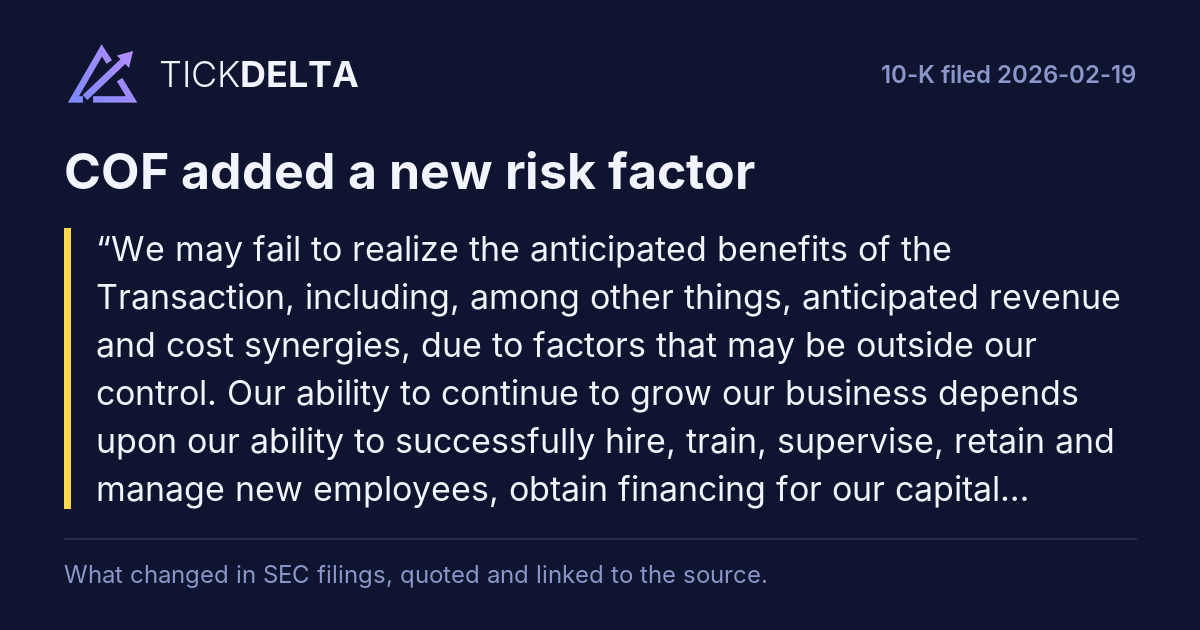
We may fail to realize the anticipated benefits of the Transaction, including, among other things, anticipated revenue and cost synergies, due to factors that may be outside our control. Our ability to continue to grow our business depends upon our ability to successfully hire, train, supervise, retain and manage new employees, obtain financing for our capital needs, expand our systems effectively, control increasing costs, allocate our human resources optimally, maintain clear lines of communication between our operational functions and our finance and accounting functions and manage the pressures on our management and administrative, operational and financial infrastructure. There can be no assurance that we will be able to accurately anticipate and respond to the changing demands we will face as we continue to expand our operations or that we will be able to achieve
further growth at all. Additionally, we face risks that any business, technology, service or product we integrate from Discover may significantly under-perform relative to our expectations, and that we may not achieve the benefits we expect, which could, among other things, result in a write-down of goodwill and other intangible assets associated with the Transaction.
Similar paragraph at 1 of 75 other Financials companies: FITBRead in the 10-K ↗
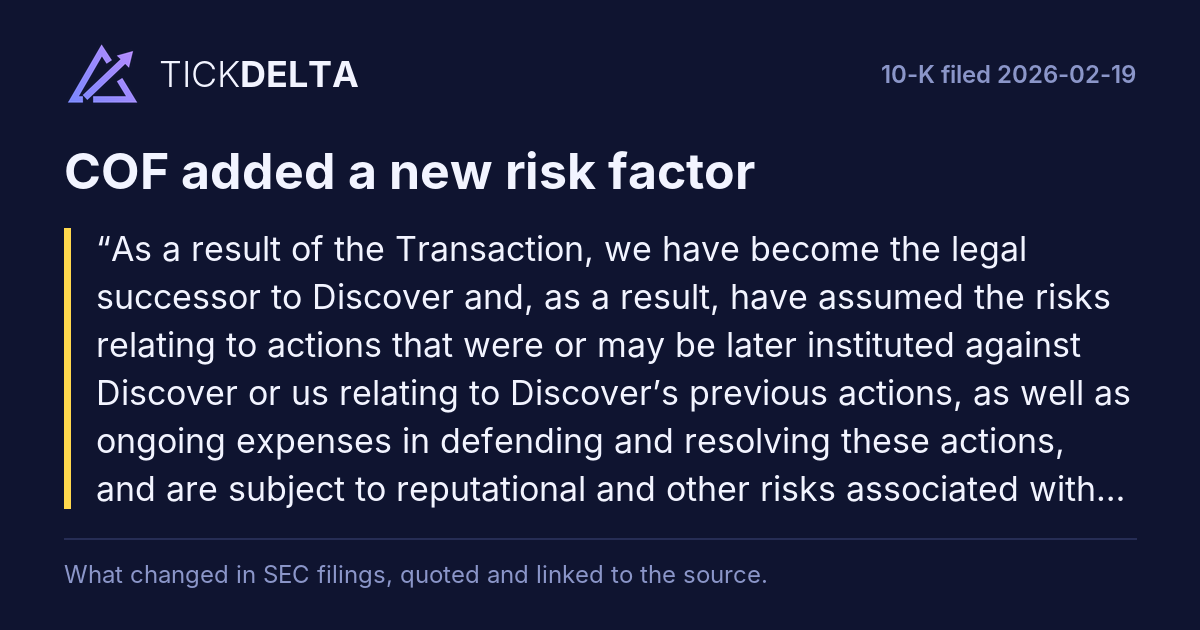
As a result of the Transaction, we have become the legal successor to Discover and, as a result, have assumed the risks relating to actions that were or may be later instituted against Discover or us relating to Discover’s previous actions, as well as ongoing expenses in defending and resolving these actions, and are subject to reputational and other risks associated with Discover’s previous actions.
Read in the 10-K ↗
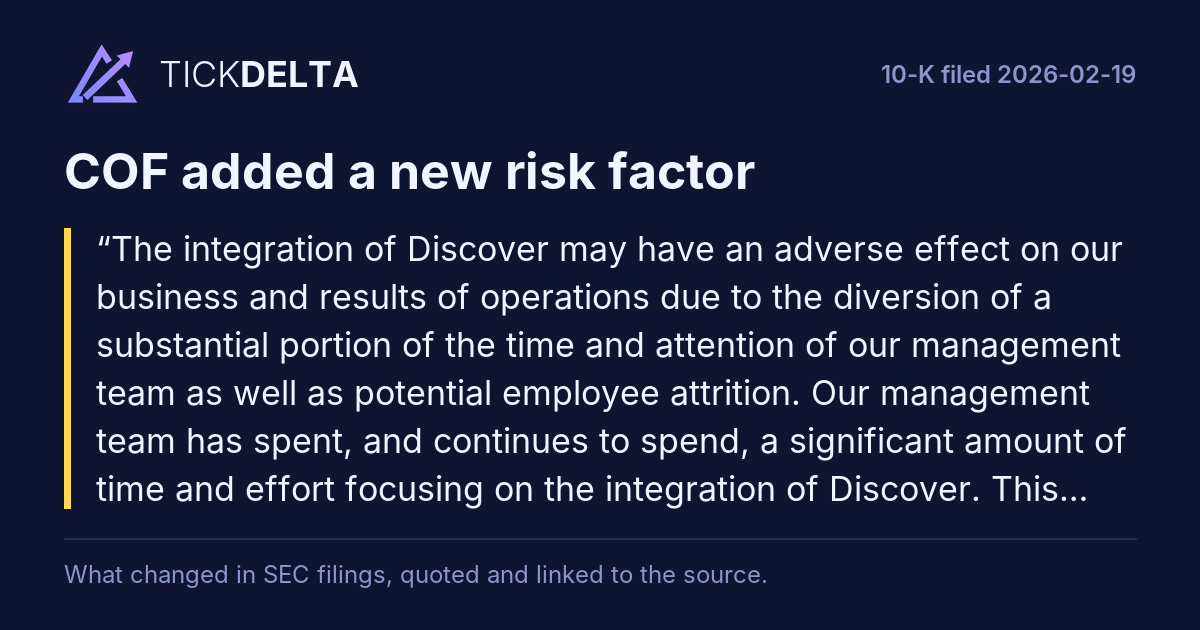
The integration of Discover may have an adverse effect on our business and results of operations due to the diversion of a substantial portion of the time and attention of our management team as well as potential employee attrition.
Our management team has spent, and continues to spend, a significant amount of time and effort focusing on the integration of Discover. This diversion of attention may have an adverse effect on the conduct of our business, and, as a result, on our financial condition and results of operations, particularly if the time it takes to complete the integration is protracted. During this period of integration, our employees may face distraction and uncertainty, and we may experience increased levels of employee attrition. A loss of key personnel or material erosion of employee morale could have a materially adverse effect on our ability to meet customer expectations, thereby adversely affecting our business and results of operations. The failure to retain members of our management team and other key personnel could also impair our ability to execute our strategy and implement operational initiatives, thereby having a material adverse effect on our financial condition and results of operations.
Similar paragraph at 1 of 75 other Financials companies: FITBRead in the 10-K ↗
•Fiscal policy actions, such as changes to applicable tax codes and programs supported by government funding (e.g., Medicaid, Medicare, Social Security);
Read in the 10-K ↗
•Trade wars, trade barriers, tariffs, economic sanctions, labor shortages and disruptions of global supply chains, including their impacts on the auto industry;
Read in the 10-K ↗
•Adverse developments impacting the U.S. or global banking industry, including bank failures, the failure of non-bank financial institutions and liquidity concerns and fluctuations or other significant changes in both debt and equity capital markets and currencies;
Read in the 10-K ↗
Additionally, we have and may in the future implement measures to tighten credit access in response to certain consumer and economic indicators that have or may in the future impact our financial performance, such as purchase volume and new accounts.
Read in the 10-K ↗
•Counterparty Credit Risk: In addition to consumer credit risk, we are exposed to counterparty credit risk arising from business-facing activities, including our operation of the Global Payment Network and related arrangements. These activities include purchasing for our investment securities portfolio, entering into derivative transactions to manage our market risk exposure and to accommodate customers, extending short-term advances on syndication activity including bridge financing transactions we have underwritten, depositing certain operational cash balances in other financial institutions, executing certain foreign exchange transactions and extending customer overdrafts. If one or more of these counterparties fail to perform on their obligations to us, for example, by failing to meet settlement, reimbursement or guarantee obligations, or by experiencing financial or operational distress, we could experience losses, delayed or disrupted settlement of transactions, increased funding and liquidity needs, higher credit losses or other adverse effects on our business, financial condition and results of operations.
Read in the 10-K ↗
Additionally, growth in our total consolidated assets (including as a result of our acquisition of Discover) or cross-jurisdictional activity could affect the Company’s continued classification as a Category III institution. If the Company were to have $700 billion or more in total consolidated assets or $75 billion or more in cross-jurisdictional activity, each as measured based on the average for the four most recent calendar quarters, the Company and the Bank would become subject to more stringent capital and liquidity regulations as a Category II institution and Category II bank, respectively. For example, if the Company were to become a Category II institution, each of the Company and Bank would become subject to the full LCR requirement, which would multiply its total net cash flows by an outflow adjustment percentage of 100% (rather than 85%), and the full NSFR requirement, which would require it to maintain an available stable funding in an amount at least equal to 100% (rather than 85%) of its required stable funding, as well as required daily (rather than monthly) liquidity reporting. In addition, unlike Category III institutions, Category II institutions are not permitted to exclude AOCI from regulatory capital calculations and are subject to a more stringent capital deductions framework as well as the advanced approaches framework under the current Basel III Capital Rules. Although the Company is currently a Category III institution, we cannot predict with certainty whether or when future growth will result in its exceeding the applicable thresholds for classification as a Category II institution.
Read in the 10-K ↗
Technologies, systems, networks and other devices of Capital One, as well as those of our employees, service providers, insiders, customers, partners, network participants, including merchants, and other third parties with whom we interact, have been and may continue to be the subject of cyber-attacks and other security incidents, including computer viruses, hacking,
Read in the 10-K ↗
Furthermore, the Transaction exposes us to additional cybersecurity risks, which we expect to continue until the integration of Discover is completed. These risks include the possibility of previously undetected cybersecurity threats in Discover's operations, systems and networks, as well as risks related to the cybersecurity posture of Discover and its third-party service providers. The materialization of such risks could lead to the degradation or disruption of our operations and services; unauthorized access; breach of confidentiality; and misuse or modification of systems, networks and data. Additionally, in connection with the integration of Discover, failures or difficulties in retaining new personnel, including those with access to our confidential or sensitive information (including personal information), and other difficulties in the organizational,
technological and cultural integration process may heighten the risk of cyber-attacks and other security incidents, including as a result of human error, fraud or malice on the part of current or former employees.
Read in the 10-K ↗
However, there are significant risks involved in using models and AI, and we cannot assure that our use will enhance our businesses or produce only the intended or beneficial results. For example, generative AI has been known to produce false or “hallucinatory” inferences or output. Certain generative AI tools use machine learning and predictive analytics, which can create inaccurate, incomplete or misleading outputs; unexpected results; or errors or inadequacies, any of which may not be easily detectable. In addition, models and AI that are based on historical data sets might not be accurate predictors of future outcomes. The ability of models and AI to appropriately predict future outcomes may degrade over time due to limited historical patterns, extreme or unanticipated market movements, or customer behavior and liquidity, especially during severe market downturns or stress events (e.g., geopolitical or pandemic events). Consequently, our use of models and AI could result in inaccurate forecasts, ineffective risk management practices, inaccurate risk reporting and other negative or unexpected consequences.
Read in the 10-K ↗
While we continuously update our policies, programs, processes and risk management practices, many of our data management, modeling, AI, aggregation and implementation processes are manual. They may be subject to human error, data limitations, process delays or system failure. If any of our employees, contractors, third-party service providers or other third parties with which we do business use any third-party AI solutions in connection with our business, it may lead to the inadvertent or unauthorized disclosure or incorporation of our sensitive and confidential information, including personal information, into third-party systems or publicly available or third-party training sets, which may impact our ability to realize the benefit of our intellectual property or other proprietary rights in such information. Failure to manage data effectively and to aggregate data in an accurate and timely manner may limit our ability to manage current and emerging risks; to produce accurate financial, regulatory and operational reporting; and to manage changing business needs. If our Framework is ineffective, we could suffer unexpected losses, which could materially adversely affect our results of operation or financial condition.
Any information we provide to the public or to our regulators based on incorrectly designed/implemented models or AI could be inaccurate or misleading. Some of the decisions that our regulators make could be adversely affected if their perception is that the quality of the data, models and AI used to generate the information is insufficient.
Similar paragraph at 1 of 75 other Financials companies: HBANThe regulation of AI is rapidly evolving worldwide as legislators and regulators are increasingly focused on these powerful, emerging technologies. The technologies underlying AI and its uses are subject to a variety of laws and regulations, including intellectual property, privacy, data protection and data security, consumer protection, competition and equal opportunity laws and regulations. They are expected to be subject to increased regulation and new laws or new applications of existing laws and regulations.
Various U.S. governmental and regulatory agencies continue to review AI. Several U.S. states and foreign jurisdictions are applying (or are considering applying) their platform moderation, privacy, data protection, and data security laws and regulations to AI. They are also considering general legal frameworks for AI. In particular, several states, including Colorado and California, have passed or are continuing to propose laws and regulations that govern various facets and uses of AI.
We may not be able to anticipate how to respond to these rapidly evolving frameworks, and we may need to expend resources to adjust our offerings in certain jurisdictions if the legal frameworks are inconsistent across jurisdictions. Furthermore, because AI technology itself is highly complex and rapidly developing, it is not possible to predict all of the legal, operational, competitive or technological risks that may arise from using AI.
Risks of external fraud exceeding our expectations due to larger, more sophisticated, or more frequent fraud attacks, failure to detect and respond to such attacks and/or the reduced capability to recover losses from those incidents. This could result in increased fraud loss, operational cost, customer dissatisfaction, reputational damage and/or constrained revenue growth for us.
Read in the 10-K ↗
There are also risks to our ability to recover fraud losses based on potential changes to fraud liability. Additionally, consumer activists and regulators have sought to expand financial institutions’ responsibility to hold customers harmless for transactions that they authorized on their accounts that are the result of scams.
Emerging generative AI capabilities, such as synthetic video, images and identity documents may introduce new risks, in the form of identity fraud and scams. Additionally, the growth of agentic commerce, in which autonomous AI agents initiate and execute transactions on behalf of users, may increase fraud losses as well as change circumstances when the merchant or issuer is liable for fraud losses.
Legal frameworks governing such autonomous agents remain nascent, with limited direct guidance, and the interplay between laws and regulations relating to, among other things, fraud, payments, privacy, data protection, data security and AI may create uncertainty around compliance obligations and potential liability exposure as more participants (including sellers, fintechs, AI developers and enablers) enter the agentic commerce ecosystem.
Read in the 10-K ↗
Compliance expectations and expenditures have significantly increased over time for us, particularly as regulators have heightened their focus on the adequacy of controls to support business operations. We may have to make additional investments in risk management, compliance and other functions in response to enforcement actions, supervisory expectations and the integration of Discover into our Framework and corporate culture. We may face additional risks, including risks of supervisory and enforcement actions, if we are unable to align Discover’s risk and control culture and environment with the expectations of
our regulators. We may become subject to compliance and regulatory risks if new issues, including issues that may be more severe than we anticipated before the closing of the Transaction, are identified as part of the integration of Discover or otherwise relating to Discover’s activities. We may also face compliance and regulatory risks if we introduce new or changed products and services or enter into new business arrangements with third-party service providers, alternative payment providers or other industry participants as a result of the Transaction. Heightened regulatory expectations and increased volume of regulatory changes may generate additional expenses or require significant time and resources to maintain compliance.
Read in the 10-K ↗
In December 2025, the OCC issued a report of preliminary findings of its ongoing supervisory review, in accordance with Executive Order 14331 “Guaranteeing Fair Banking for All Americans,” of the nine largest OCC-regulated banks, including the Bank, to determine whether those banks may have debanked or discriminated against customers or potential customers on the basis of their political or religious beliefs or lawful business activities. In the report, the OCC states that its review is ongoing and, once its supervisory review has concluded, it intends to hold the banks reviewed accountable for any unlawful debanking activities, including by making referrals to the Attorney General.
Read in the 10-K ↗
As a result of the Transaction, we have assumed the contingencies and liabilities of Discover, for which we have incurred and may continue to incur financial risk, compliance obligations, litigation risk, or reputational risk, including as a result of assuming ongoing litigation disputes, claims, government agency investigations and enforcement actions and other proceedings associated with Discover’s actions prior to the Transaction. For additional information regarding legal and regulatory proceedings in connection with the Transaction, refer to “Part II—Item 8. Financial Statements and Supplementary Data—Note 19—Commitments, Contingencies, Guarantees and Others.”
We continue to face significant uncertainty regarding the contingencies and liabilities we have assumed from Discover, and any significant or unanticipated liability we may incur from these matters may adversely impact our business, financial condition and results of operations.
Similar paragraph at 1 of 75 other Financials companies: FISRead in the 10-K ↗
The increased pressure on transaction fees associated with card payments due to competition could create additional risk to growth for both our card issuing businesses and the Global Payment Network. This, in turn, could adversely affect the revenue
Read in the 10-K ↗
A change in market preference towards other operators of payment networks and alternative payment providers could result in reduced transaction volume, limited merchant acceptance of our cards and limited issuance of cards on our networks by third parties, and in turn may impact our revenue margins.
As a result of our recent acquisition of the Global Payment Network, we now face substantial and increasingly intense competition in the payments industry, both from traditional players and new, emerging alternative payment providers. For example, we now compete with other payment networks to attract Network Partners to issue credit and debit cards and other card products on the Global Payment Network. In addition, increased competition with certain network operators, such as Visa and Mastercard, could affect our existing partnerships and business relationships with these networks, which have historically played a significant role in facilitating our card-issuing and transaction processing services. Competition with other operators of payment networks is generally based on issuer fees, fees paid to networks (including switch fees), merchant acceptance and functionality, technological capabilities and other economic terms. Competition is also based on customer perception of service quality, merchant acceptance, brand image, reputation and market share. Further, we are now facing ongoing competition from emerging alternative payment providers who may create innovative networks or other arrangements with our primary competitors, large merchants or other industry participants, or provide stablecoins, other digital currencies or tokenized deposits, which could adversely impact our costs, transaction volume and ability to grow our business. In addition, we, along with our competitors, clients, network participants and others, are developing or participating in alternative payment systems or products such as mobile and ecommerce payment services, P2P payment services, real-time and faster payment initiatives, and
payment services that could reduce our role in, or otherwise disintermediate us from, transaction processing or the value-added services we provide to support such processing.
Many of our payment network and alternative payment provider competitors are well established and have significant financial resources and scale. These competitors have provided financial incentives to card issuers, such as large cash signing bonuses for new programs and funding for, and sponsorship of, marketing programs and other bonuses.
We cannot be certain that we will be able to continue to increase international merchant acceptance, as well as the perception of merchant acceptance of the Global Payment Network, and we cannot be certain that we will achieve global market parity with Visa or Mastercard. In addition, Visa and Mastercard have entered into long-term arrangements with financial institutions, some of which are exclusive, or nearly exclusive, which has the effect of limiting our ability to conduct material amounts of business with these institutions. Moreover, American Express is also a strong competitor with international merchant acceptance, competitive transaction fees and an upscale brand image. Internationally, American Express competes in the same market segments as Diners Club. We may face challenges in increasing international merchant acceptance on our networks, particularly if third parties that we rely on to issue Diners Club cards, increase card acceptance and market our brands, do not perform to our expectations. In such a competitive environment, any disruption to our existing relationships with Visa or Mastercard or our ability to grow the Global Payment Network could affect our ability to remain competitive by adjusting issuer fees and incentives, and we may be unable to offer adequate pricing to Network Partners while maintaining sufficient net revenues.
In addition, if we are unable to maintain sufficient network functionality to be competitive with other networks, or if our competitors develop better data security solutions or more innovative products and services than we do, our ability to retain and attract Network Partners and maintain or increase the revenues generated by the Global Payment Network or our proprietary card-issuing businesses could be materially and adversely affected. Our competitive position could also be affected if we are unable to deploy, in a cost-effective and competitive manner, technology such as generative AI. Additionally, competitors may develop ancillary products, which as a consequence of the competitors’ size and scale, we may be forced to use. Such developments could adversely affect our business, as those competitors may be better positioned to absorb the costs of such data security solutions over higher volumes or a larger customer base.
Our recently acquired network business depends upon relationships with card issuers, merchant acquirers, alternative payment providers and licensees, many of whom are financial institutions. The economic and regulatory environment and increased competition and innovation in the payments space could decrease our opportunities for new business and may result in the termination of existing business relationships. In addition, if as a result of this environment, financial institutions have decreased interest in engaging in new card issuance opportunities or expanding existing card issuance relationships, that would inhibit our ability to grow our network business. We will face substantial and intense competition in the payments industry, which may impact our revenue margins, transaction volume and business strategies.
If we are unsuccessful in creating and maintaining a strong base of network licensees and achieving meaningful global card acceptance, we may be unable to achieve long-term success in our recently acquired international network business.
The success of our international network business, and our ability to grow global card acceptance for the Global Payment Network, depends on the cooperation, support and continued operation of the network licensees that issue Diners Club cards and maintain associated merchant acceptance relationships, as well as the partners that participate in our network alliances with us; these participants issue cards that operate on our network and support merchant acceptance in their respective markets.
Outside of the United States, we do not issue cards that are accepted on our networks, and we do not determine the terms and conditions of cards issued by our international network participants, whether they are Diners Club participants or work with us through a network alliance. The level of acceptance in any given market reflects a combination of factors, including the number and competitiveness of cards issued directly by us and by network participants, whether merchants in a given market view acceptance of our cards as commercially attractive based on perceived customer demand and competitive pricing and terms, and the commitment, investment and effectiveness of those participants in promoting card usage and expanding or sustaining merchant acceptance.
If we are unable to continue our relationships with network participants, or if those participants are unable to continue their relationships with merchants or otherwise effectively support merchant acceptance, our ability to maintain or increase revenues and remain competitive would be adversely affected due to the potential deterioration in our card issuers’ relationships with their cardholders, which would in turn reduce demand and lead to declines in transaction volume or acceptance levels. If one or more network participants were to experience a significant impairment of their business or cease doing business for economic,
regulatory or other reasons, we could face business interruption in affected markets, including loss of volume, global card acceptance and revenue and exposure to potential reputational risk. If such conditions arise in the future, we may need to deploy resources and incur expenses in order to sustain network acceptance and support network functionality. Additionally, interruption of network licensee relationships could have an adverse effect on the international acceptance of our credit cards when they are used on our networks.
Achieving global card acceptance would allow our customers, including third-party issuers leveraging the network, to use their cards at merchant and ATM locations around the world. The long-term success of our international network business depends upon achieving meaningful global card acceptance, which may include higher overall costs or longer time frames than anticipated.
Read in the 10-K ↗
defendants conspired to fix the level of interchange fees. For additional information about the lawsuits, see “Part II—Item 8. Financial Statements and Supplementary Data—Note 19—Commitments, Contingencies, Guarantees and Others.” .
Read in the 10-K ↗
A reduction in the number of large merchants that accept cards on our recently acquired Discover Network or PULSE Network or in the rates they pay could materially adversely affect our business, financial condition, results of operations and cash flows.
The largest merchants participating in our recently acquired Discover Network or PULSE Network could seek to negotiate different pricing or other financial incentives by conditioning their continued participation on a change in the terms of their economic participation. Loss of acceptance at these merchants would decrease transaction volume, negatively impact our recently acquired brand and could cause customer attrition. In addition, some of the merchants on these networks, primarily small- and mid-size merchants, are not contractually committed to us for any period of time and may cease to participate in our Discover Network and PULSE Network at any time on short notice.
Actual or perceived limitations on acceptance of credit cards issued on the Discover Network or debit cards issued on the PULSE Network could adversely affect the use of, or the attractiveness to prospective customers of, our credit cards that rely on the Discover Network. Also, we may have difficulty attracting and retaining Network Partners if we are unable to add or retain acquirers or merchants who accept cards issued on the Discover or PULSE Networks. As a result of these factors, a reduction in the number of our merchants or the rates they pay could materially adversely affect our business, financial condition, results of operations and cash flows.
Defaults or risks from bankruptcies, liquidations, restructurings, consolidations and outages by our network participants may adversely affect our business, financial condition, cash flows and results of operations.
As the operator of the Global Payment Network, as an issuer and as a merchant acquirer, we face credit risk related to transactions on the Global Payment Network, including bankruptcies, liquidations, insolvencies, financial distress,
restructurings, consolidations, operational outages, cybersecurity incidents and other similar events that may occur in any industry. For example, we are contingently liable for certain disputed credit card sales transactions that arise between customers and merchants. If a dispute is resolved in the customer’s favor, we will cause a credit or refund of the amount to be issued to the customer and charge back the transaction to the merchant or merchant acquirer. If we are unable to collect this amount from the merchant or merchant acquirer, we will bear the loss for the amount credited or refunded to the customer. Where the purchased product or service is not provided until some later date following the purchase, such as an airline ticket, the likelihood of potential liability increases.
Read in the 10-K ↗
Furthermore, any new technology could have a significant impact on the effectiveness of the Company’s system of internal controls. Failure to successfully manage these risks in the development and implementation of new lines of business, new products or services and/or new technologies could have a material adverse effect on our business, financial condition and results of operations.
Similar paragraph at 14 of 75 other Financials companies: ACGL, AIZ, CFG, CPAY, FIS, FITB, GL, GPN and 6 moreRead in the 10-K ↗
Any merger, acquisition, disposition or strategic partnership we undertake, including the Transaction, entails certain risks, which may materially and adversely affect our results of operations. If we experience greater than anticipated costs to integrate
Read in the 10-K ↗
Our ability to attract and retain customers is highly dependent upon the perceptions of consumer and commercial borrowers and deposit holders and other external perceptions of our products, services, business practices, workplace culture, compliance practices or our financial health. Capital One’s brands, including Discover, PULSE and Diners Club, are some of our most
Read in the 10-K ↗
The proliferation of social media and its rapid and broad dissemination of information (or misinformation and disinformation) may increase the likelihood that negative public opinion from any of the actual or alleged events discussed above may trigger a loss of trust or confidence on the part of clients, counterparties, shareholders, investors, debt holders, market analysts or other relevant parties, including regulators, and could impact our reputation and business.
Read in the 10-K ↗
Environmental, social and corporate governance policies may create competing stakeholder, legislative and regulatory scrutiny that may impact our reputation or operations. As a result, we may not be able to meet the full range of expectations and demands of all our stakeholders. Any failure to meet our stakeholders full range of expectations and demands could result in reputational damage, a loss of customer and investor confidence, increased legal and operational risks and other adverse effects on our results of operations and prospects. For example, as part of our acquisition of Discover, we have committed to a $265 billion Community Benefits Plan (“CBP”) over five years. Failure to adequately deliver on, or material revisions to, this commitment, whether due to financial constraints, operational inefficiencies or external economic factors, may lead to public criticism, which may expose us to significant reputational risks. Also, some stakeholders may object to the scope or nature of the CBP initiative, which could give rise to negative responses by governmental actors (e.g., litigation, retaliatory legislation) or by customers and advocates (e.g., boycotts) that could adversely affect our brand value.
Read in the 10-K ↗
In addition, advances in technology, such as automation and AI, may lead to workforce evolution. This could require us to invest in additional employee training, manage impacts on morale and retention, and compete for employment candidates who possess more advanced technological skills, all of which could have a negative impact on our business and operations.
Read in the 10-K ↗
New in the latest 10-Q
14 paragraphs in the 10-Q filed Nov 3, 2026 with nothing like them in the 10-Q filed Jul 28, 2026 (at least half the words must differ; new numbers alone do not count). Quoted exactly, grouped by the item heading above them. This is text that changed, not a judgement of how serious it is.
10-Q
On September 1, 2026, we redeemed all outstanding shares of our Fixed Rate Reset Non-Cumulative Perpetual Preferred Stock, Series M for $1.0 billion. The redemption reduced our net income available to common stockholders by $12 million in the third quarter of 2026, as we recognized the previously deferred issuance costs associated with this series.
Read in the 10-Q ↗
(2) On September 1, 2026, we redeemed all outstanding shares of our Preferred Stock, Series M.
Read in the 10-Q ↗
As a BHC, our ability to pay dividends is largely dependent upon the receipt of dividends or other payments from our subsidiaries. The Bank is subject to regulatory restrictions that limit its ability to transfer funds to the BHC. For example, under the National Bank Act, the Bank may not pay a dividend if the total dividends declared in any calendar year period exceed the sum of the Bank’s current year net income plus the Bank’s retained net income from the two preceding calendar year periods, without prior OCC approval. As of September 30, 2026, under the National Bank Act, funds available for dividend payments from the Bank were $3.8 billion.
Read in the 10-Q ↗
In September 2026, the Federal Reserve finalized a rule amending the calculation of the stress capital buffer requirement applicable to large banking organizations, including the Company (the “SCB Averaging Rule”). Under the final rule, the Federal Reserve will calculate the stress capital buffer requirement by averaging results over the two most recent stress test cycles. The SCB Averaging Rule also shifts the annual effective date of the stress capital buffer requirement from October 1 to January 1 and adjusts the forward-looking period used to calculate the dividend add-on component of the stress capital buffer requirement to be consistent with this change. The averaging mechanism will first apply to the 2028 stress testing cycle, with the resulting stress capital buffer requirement becoming effective on January 1, 2029.
Read in the 10-Q ↗
In September 2026, the Federal Reserve finalized revisions to its supervisory stress testing framework (the “Stress Testing Transparency Rule”). Under the Stress Testing Transparency Rule, the Federal Reserve will annually disclose its supervisory stress test models and provide a formal public comment period on material changes to these models and the design of annual supervisory stress test scenarios. The Stress Testing Transparency Rule also shifts certain timelines on the stress testing calendar and adopts revisions to stress testing reporting requirements.
Read in the 10-Q ↗
Concurrently with the finalization of the SCB Averaging Rule and the Stress Testing Transparency Rule, the Federal Reserve also re-proposed certain revisions to the supervisory models to be used to project non-interest income in the 2027 supervisory stress test.
Read in the 10-Q ↗
SCB Averaging Rule: The Federal Reserve’s September 2026 rule that calculates stress capital buffer requirements by averaging results over the two most recent stress test cycles and shifts their annual effective date from October 1 to January 1.
Read in the 10-Q ↗
Nine Months Ended September 30, (Dollars in millions) 2026 2025 ────────────────────────────────────────────────────────────────────────────────────────────────────────────────────────────────────────────────────────── Operating activities: Income from continuing operations, net of tax $ 8,740 $ 334 Loss from discontinued operations, net of tax (7) (15) Net income 8,733 319 Adjustments to reconcile net income to net cash from operating activities: Provision for credit losses 9,973 16,513 Depreciation and amortization, net 4,661 3,655 Deferred tax provision (benefit) 314 (1,404) Net investment securities losses 40 — Stock-based compensation expense 521 576 Other, net 1 103 Loans held for sale: Originations and purchases (3,663) (3,687) Proceeds from sales and paydowns 3,916 3,264 Changes in operating assets and liabilities: Changes in interest receivable (36) 2 Changes in other assets (2,455) (640) Changes in interest payable (62) (187) Changes in other liabilities (1,764) 1,359 Net change from discontinued operations — 14 Net cash from operating activities $ 20,179 $ 19,887 Investing activities: Investment securities available for sale: Purchases $ (12,983) $ (12,585) Proceeds from paydowns and maturities 13,391 13,287 Proceeds from sales 662 1 Investment securities held to maturity: Purchases (3,739) — Proceeds from paydowns and maturities 106 — Proceeds from sales of securities related to the Transaction — 9,696 Net changes in loans originated as held for investment (19,268) (17,202) Changes in premises and equipment (1,312) (1,134) Net cash (used) received in acquisitions (2,298) 16,465 Net cash used in other investing activities (1,262) (1,163) Net cash from (used in) investing activities $ (26,703) $ 7,365
Read in the 10-Q ↗
(2) Includes $ 500 million of short-term FHLB advances with original maturities greater than three months that were issued in the third quarter of 2026. These issuances are reported in changes in other borrowings on the consolidated statements of cash flows.
Read in the 10-Q ↗
(2) On September 1, 2026, we redeemed all outstanding shares of our Preferred Stock, Series M.
Read in the 10-Q ↗
(1) Includes $ 12 million of deferred issuance costs associated with the redemption of our Preferred Stock, Series M for the three and nine months ended September 30, 2026, and $ 6 million of discount associated with the redemption of our Preferred Stock, Series P for the nine months ended September 30, 2025.
Read in the 10-Q ↗
Other information
Pursuant to Section 13(r) of the Exchange Act, Capital One is required to disclose in its annual or quarterly reports, as applicable, whether it or any of its affiliates knowingly engaged in certain activities, transactions or dealings relating to Iran or with individuals or entities designated pursuant to certain Executive Orders. Disclosure may be required even where the activities, transactions or dealings were conducted in compliance with applicable law. Except as set forth below, as of the date of this Quarterly Report on Form 10-Q, Capital One is not aware of any other activity, transaction or dealing by any of its affiliates during the quarter ended September 30, 2026 that requires disclosure under Section 13(r) of the Exchange Act.
Read in the 10-Q ↗
During the quarter ended September 30, 2026, in compliance with the applicable law, Capital One and its affiliates processed eight authorized payments, which totaled $763,713, pursuant to general or specific licenses issued by the U.S. Department of the Treasury’s Office of Foreign Assets Control (“OFAC”) regarding the provision of legal services for or on behalf of persons designated pursuant to Executive Order 13224.
Read in the 10-Q ↗
These transactions resulted in de minimis gross revenues and net profits in the quarter ended September 30, 2026, which were negligible relative to the overall revenues and profits of Capital One. Capital One may in the future engage in similar transactions for its clients to the extent permitted by U.S. law.
Read in the 10-Q ↗
The 10-Q's risk factors against the 10-K
Item 1A of the 10-Q filed Nov 3, 2026 against Item 1A of the 10-K filed Feb 19, 2026.
A 10-Q repeats only the risks that changed, so a 10-K paragraph that is missing from it is not counted as removed.
Added is a paragraph with nothing like it in the 10-K, Reworded a sentence that is in both with several words changed,
Quiet changes a sentence in both where one to four words changed and one is a hedge or a modal
(cut words struck through, new words highlighted and underlined).
Text on the page, not a score; each links to the filing at sec.gov.
What the 10-Q itself says about its risk factors:
Read in the 10-Q ↗
We are not aware of any material changes from the risk factors set forth under “Part I - Item 1A. Risk Factors” in our 2025 Form 10-K.
1 paragraph in the 10-Q's Item 1A, and none of them adds, rewords or quietly edits a paragraph of the 10-K's.
Work on COF in a spreadsheet:
Excel workbook (a sheet per section, ten years by column, charts, links to the filings) ·
CSV.
For a Google Sheet that stays up to date, paste =IMPORTDATA("https://tickdelta.com/company/COF/export.csv") into a cell.