ACGLArch Capital Group
Arch Capital is a publicly listed Bermuda exempted company with approximately $26.9 billion in capital at December 31, 2025 and is part of the S&P 500 index. 10-K, Item 1
- Employees
- 8,000
- Headquarters
- Pembroke, D0
- Next results
- around Feb 8, 2027
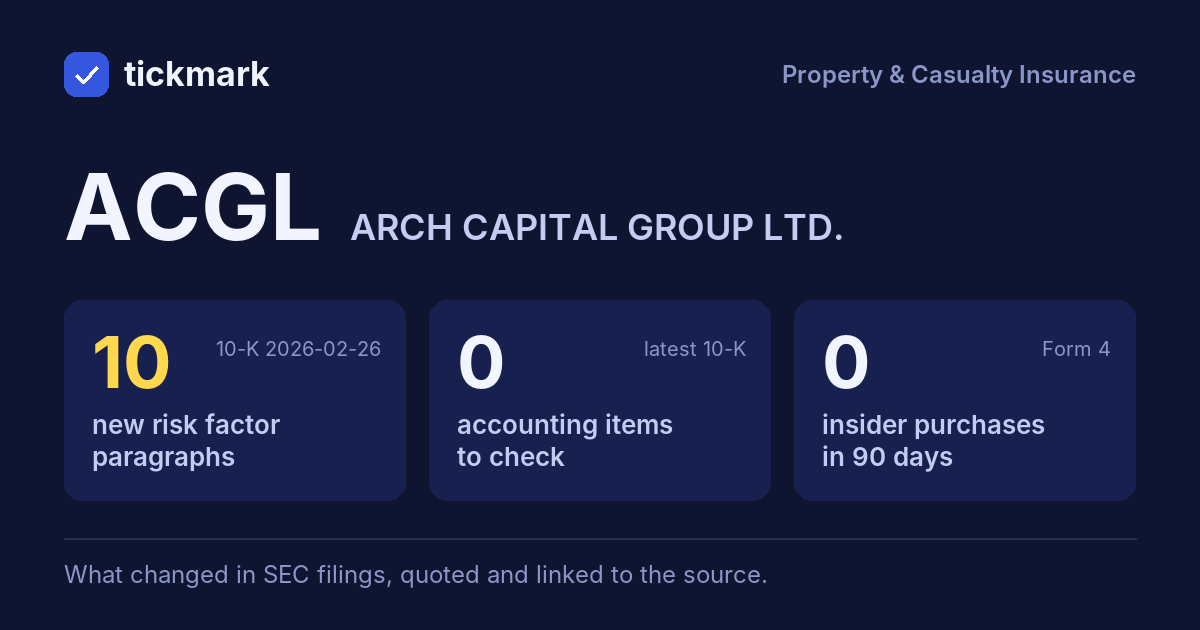
10 paragraphs in Risk Factors of the 10-K filed Feb 26, 2026 with nothing like them in the 10-K filed Feb 27, 2025. Quoted exactly. Paragraphs that were only edited are under 10-K change.
Compared with the Risk Factors in the latest 10-K of the other 75 Financials companies: a paragraph with at least half its words the same at another company is called similar, and the companies are listed under it. A paragraph most of them have is marked boilerplate. No line means no other company has one like it. This counts text; it does not say how serious a risk is.
•Certain U.S. policies and actions have created geopolitical risks which are not possible to manage or predict, some of which may result in uncertainty in the global markets.
Read in the 10-K ↗
Certain U.S. policies and actions have created geopolitical risks which are not possible to manage or predict, some of which may result in uncertainty in the global markets.
Recent U.S. policies and actions, such as actions relating to Venezuela and Greenland, may jeopardize certain global alliances and create geopolitical uncertainty. While the long-term impact of these policies is currently unknown, these policies and other geopolitical tensions have resulted in, or could result in, volatile global capital markets, sanctions, trade restrictions and harm countries’ relationships.
Read in the 10-K ↗
With new technologies and AI tools emerging at a rapid pace, there is no assurance that we will be able to evaluate and integrate new technologies or update our existing systems to keep pace with our competitors and customer needs. While we believe AI presents significant opportunities to support our strategic goals, we may not be successful in implementing AI technologies. It is possible that any AI we use does not perform as anticipated, suffers from “hallucinations” or that its outputs may not be as expected or may result in unlawful discrimination, which may put us at a competitive disadvantage, result in reputational damage and regulatory fines and actions.
Additionally, the regulatory landscape surrounding traditional AI and generative AI is evolving, and the expanded use of these technologies may become subject to regulatory scrutiny under new or existing laws. Moreover, the intellectual property and ownership rights associated with both forms of artificial intelligence have not been fully addressed by courts in the U.S. or in other jurisdictions that we operate in. We established the Artificial Intelligence Governance and Oversight Committee (“AIGOC”) to evaluate and approve new AI use cases and issue and oversee our Company’s Artificial Intelligence Policy. While we believe the AIGOC and our larger AI governance framework is responsive to new risks and regulations, failure to comply with the applicable AI-related regulations could result in fines, penalties, litigation, or restrictions on our business operations. These outcomes may have a materially adverse effect on our business or financial condition.
Read in the 10-K ↗
remediation costs, increased insurance premiums, employee dissatisfaction and/or monetary fines, penalties or litigation, any of which could adversely affect our business.
Read in the 10-K ↗
“terminated” or 100% collateral upon the entry of an order of rehabilitation, liquidation or conservation against a ceding insurer.
Read in the 10-K ↗
which would limit their ability to sell the property without incurring a loss and could increase the frequency and severity of claims. Changes to credit scoring models, data inputs or evaluation frameworks could result in borrowers being assessed as lower risk than their actual performance ultimately reflect, increasing uncertainty in default and claim performance due to model changes.
Read in the 10-K ↗
While some countries outside of the EU have begun implementing the Basel III Endgame, both the U.K. and the EU have announced that the start of implementation will be delayed until January 1, 2027. In addition, the U.K. is considering applying different rules for smaller banks, and the EU is consulting on proposals to amend the EU Securitization Regulation (“SECR”) and Capital Requirements Regulation (“CRR”), which implement the Basel III Endgame. The proposed SECR and CRR amendments improve the capital relief EU banks receive from insurance-based SRT transactions in which the Company participates. The timing, requirements, and implementation of the final rules remain uncertain and subject to continued debate, which could negatively impact the capital relief afforded by the protection we provide and the volume of insurance-based SRT transactions in the EU.
Read in the 10-K ↗
In 2019, the OECD published a “Programme of Work,” divided into two pillars, which is designed to address the tax challenges created by an increasing digitalized economy. Pillar I addresses the broader challenge of a digitalized
Read in the 10-K ↗
New in the latest 10-Q
4 paragraphs in the 10-Q filed Nov 4, 2026 with nothing like them in the 10-Q filed Aug 4, 2026 (at least half the words must differ; new numbers alone do not count). Quoted exactly, grouped by the item heading above them. This is text that changed, not a judgement of how serious it is.
Financial statements and notes
On October 30, 2026, the Company announced that it has entered into an agreement to acquire Premier Dealer Holding Corp., a Dublin, Ohio-based provider of automotive finance and insurance product services. This transaction is subject to regulatory approvals and satisfaction of other customary closing conditions.
Read in the 10-Q ↗
Three Months Ended Nine Months Ended September 30, September 30, 2026 2025 2026 2025 ────────────────────────────────────────────────────────────────────────────────────────────────────────────────────────────────────────────────────────────────────────────────────────────────────────────── Reserve for losses and loss adjustment expenses at beginning of period $ 34,775 $ 32,089 $ 33,547 $ 29,369 Unpaid losses and loss adjustment expenses recoverable 9,311 8,513 9,054 7,821 Net reserve for losses and loss adjustment expenses at beginning of period 25,464 23,576 24,493 21,548 Net incurred losses and loss adjustment expenses relating to losses occurring in: Current year 2,395 2,321 7,069 7,561 Prior years (189) (121) (578) (471) Total net incurred losses and loss adjustment expenses 2,206 2,200 6,491 7,090 Net losses and loss adjustment expense reserves of acquired businesses (1) — — — 50 Net foreign exchange (gains) losses and other (20) (52) (88) 541 Net paid losses and loss adjustment expenses relating to losses occurring in: Current year (853) (422) (1,182) (1,287) Prior years (912) (1,147) (3,829) (3,787) Total net paid losses and loss adjustment expenses (1,765) (1,569) (5,011) (5,074) Net reserve for losses and loss adjustment expenses at end of period 25,885 24,155 25,885 24,155 Unpaid losses and loss adjustment expenses recoverable 9,620 8,667 9,620 8,667 Reserve for losses and loss adjustment expenses at end of period $ 35,505 $ 32,822 $ 35,505 $ 32,822
Read in the 10-Q ↗
(1) Coverage from a separate panel of reinsurers remaining at September 30, 2026.
Read in the 10-Q ↗
Unrealized holding gains (losses) arising during period $ (1,284) $ (127) $ (1,157)
Read in the 10-Q ↗
The 10-Q's risk factors against the 10-K
Item 1A of the 10-Q filed Nov 4, 2026 against Item 1A of the 10-K filed Feb 26, 2026.
A 10-Q repeats only the risks that changed, so a 10-K paragraph that is missing from it is not counted as removed.
Added is a paragraph with nothing like it in the 10-K, Reworded a sentence that is in both with several words changed,
Quiet changes a sentence in both where one to four words changed and one is a hedge or a modal
(cut words struck through, new words highlighted and underlined).
Text on the page, not a score; each links to the filing at sec.gov.
What the 10-Q itself says about its risk factors:
Read in the 10-Q ↗
There were no material changes from the risk factors previously disclosed in our Annual Report on Form 10-K for the year ended December 31, 2025.
1 paragraph in the 10-Q's Item 1A, and none of them adds, rewords or quietly edits a paragraph of the 10-K's.
Work on ACGL in a spreadsheet:
Excel workbook (a sheet per section, ten years by column, charts, links to the filings) ·
CSV.
For a Google Sheet that stays up to date, paste =IMPORTDATA("https://tickdelta.com/company/ACGL/export.csv") into a cell.