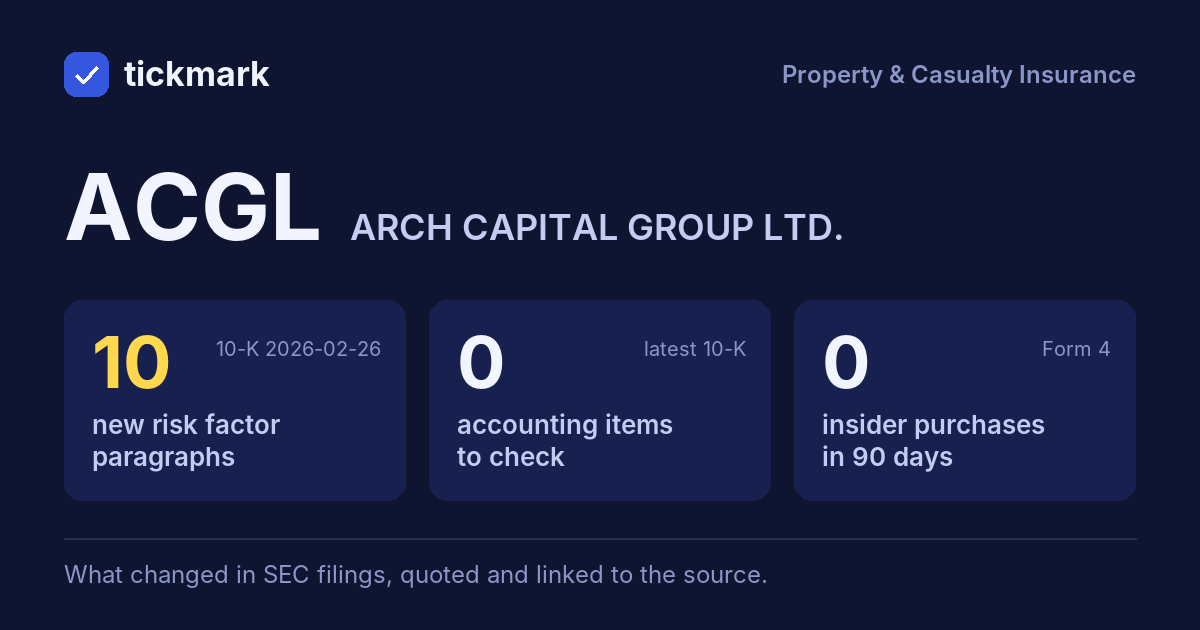
10-K 0000947484-26-000017 (2026-02-26) vs 10-K 0000947484-25-000017 (2025-02-27)
| Section | Compared text | Words now | Changed |
|---|
| Risk Factors | Item 1A | 15,460 |
15.5% |
| MD&A | Item 7 | 19,118 |
14.7% |
| Legal Proceedings | Item 3, via Note 18 – Commitments and Contingencies | 626 |
0.8% |
| Accounting Policies | Item 8, Note 3 – Significant Accounting Policies | 6,877 |
21.4% |
The redline: what was cut and what was added
In each section, the paragraph that changed most, marked against last year's 10-K:
cut words struck through, new words highlighted and underlined.
Risk Factors 200 words changed in this paragraph; it is 49% similar to last year's version.
On July 27, In 2023, the Federal banking agencies released a proposed rule to implement the Basel III Endgame in the United States. States, which would apply to banks with assets greater than $100 billion. The proposal would increase the capital charges for mortgages held in portfolio and eliminate the capital relief currently afforded mortgage loans protected by private mortgage insurance. Instead, the capital treatment would be based on the mortgage’s loan to value ratio without consideration of mortgage insurance. The comment period for this proposal closed on January 16, 2024. If the U.S. regulators decide to adopt the proposed Basel III Endgame approach to mortgage assets, the capital treatment of mortgages held in portfolio will increase and the capital relief benefits of mortgage insurance would be eliminated, insurance, which could adversely affect the volume of mortgages originated by banks subject to the rule and the demand for mortgage insurance. With the change in the Presidential administration, administration in 2025, and based on feedback received in response to the proposed rule, the Federal Banking banking agencies have indicated an intent to repropose the Basel III Rules, Rules. In September 2025, Federal Reserve Vice Chair for Supervision, Michelle Bowman, stated that the U.S. bank regulators are working toward unveiling a revised Basel III Endgame by early 2026. She indicated that the revised proposal would be more “industry friendly” than prior versions, though the timing, requirements, and implementation of the reproposed rule remain uncertain. In January 2025, the European Commission stated that it is considering what steps to take in light of possible delay or changes to the Basel III implementation in the United States, and the Bank of England announced a one-year delay in implementation in order to get clarity on what the United States plans to do.
Source: Item 1A, 10-K 0000947484-26-000017 vs Item 1A, 10-K 0000947484-25-000017
Accounting Policies 149 words changed in this paragraph; it is 67% similar to last year's version.
The Company applies a fair value based measurement method in accounting for its share-based payment arrangements with eligible employees and directors. Compensation expense is estimated based on the fair value of the award at the grant date and is recognized in net income over the requisite service period with a corresponding increase in shareholders’ equity. No value is attributed to awards that employees forfeit because they fail to satisfy vesting conditions. The Company’s (i) time-based awards generally vest over a three year period with one-third vesting on the first, second and third anniversaries of the grant date and (ii) performance-based awards cliff vest after each three year performance period based on achievement of the specified performance criteria. The share-based compensation expense associated with awards that have graded vesting features and vest based on service conditions only is calculated on a straight-line basis over the requisite service period for the entire award. Compensation expense recognized in connection with performance awards is based on the achievement of the specified performance and service conditions. The final measure of compensation expense recognized over the requisite service period reflects the final performance outcome. During the recognition period compensation expense is accrued based on the performance condition that is probable of achievement. For awards granted to retirement-eligible employees where no service is required for the employee to retain the award, the grant date fair value is immediately recognized as compensation expense at the grant date because the employee is able to retain the award without continuing to provide service. For employees near retirement eligibility, attribution of compensation cost is over the period from the grant date to the retirement eligibility date. These charges had no impact on the Company’s cash flows or total shareholders’ equity. See note 22, for information relating to the Company’s share-based payment awards.
Source: Item 8, Note 3 – Significant Accounting Policies, 10-K 0000947484-26-000017 vs Item 8, Note 3 – Significant Accounting Policies, 10-K 0000947484-25-000017
MD&A 146 words changed in this paragraph; it is 37% similar to last year's version.
If we are not able to obtain adequate capital, our business, results of operations and financial condition could be adversely affected, which could include, among other things, the following possible outcomes: (1) potential downgrades in the financial strength ratings assigned by ratings agencies to our operating subsidiaries, which could place those operating subsidiaries at a competitive disadvantage compared to higher-rated competitors; (2) reductions in the amount of business that our operating subsidiaries are able to write in order to meet capital adequacy-based tests enforced by statutory agencies; and (3) any resultant ratings downgrades could, among other things, affect our ability to write business and increase the cost of bank credit and letters of credit. In addition, under certain of the reinsurance agreements assumed by our reinsurance operations, upon the occurrence of a ratings downgrade or other specified triggering event with respect to our reinsurance operations, such as a reduction in surplus by specified amounts during specified periods, our ceding company clients may be provided with certain rights, including, among other things, the right to terminate the subject reinsurance agreement and/or to require that our reinsurance operations post additional collateral.
Source: Item 7, 10-K 0000947484-26-000017 vs Item 7, 10-K 0000947484-25-000017
Legal Proceedings 5 words changed in this paragraph; it is 99% similar to last year's version.
The areas where significant concentrations of credit risk may exist include unpaid losses and loss adjustment expenses recoverable, contractholder receivables, ceded unearned premiums, paid losses and loss adjustment expenses recoverable net of reinsurance balances payable, investments and cash and cash equivalent balances. A credit exposure exists with respect to reinsurance recoverables as they may become uncollectible. The Company manages its credit risk in its reinsurance relationships by transacting with reinsurers that it considers financially sound and, if necessary, the Company may hold collateral in the form of funds, trust accounts and/or irrevocable letters of credit. This collateral can be drawn on for amounts that remain unpaid beyond specified time periods on an individual reinsurer basis. In addition, certain insurance policies written by the Company’s insurance operations feature large deductibles, primarily in its construction and national accounts lines of business. Under such contracts, the Company is obligated to pay the claimant for the full amount of the claim. The Company is subsequently reimbursed by the policyholder for the deductible amount. These amounts are included on a gross basis in the consolidated balance sheet in contractholder payables and contractholder receivables, respectively. In the event that the Company is unable to collect from the policyholder, the Company would be liable for such defaulted amounts. Collateral, primarily in
Source: Item 3, via Note 18 – Commitments and Contingencies, 10-K 0000947484-26-000017 vs Item 3, via Note 18 – Commitments and Contingencies, 10-K 0000947484-25-000017
Every change, by type
Sentences and paragraphs of ACGL's Risk Factors and MD&A, 10-K 2026-02-26 against 10-K 2025-02-27.
Each links to the text at sec.gov.
Quiet changes are sentences kept from last year with one to four words changed, at least one of them a hedge, a modal or a qualifier
(may, could, will, not, significant, material…). A year or date rolling forward is not counted.
The full word list
adverse, adversely, all, although, anticipate, anticipates, any, approximately, believe, believes, can, cannot, certain, could, expect, expects, generally, however, if, intend, intends, largely, likely, many, material, materially, may, might, most, must, never, no, not, possible, primarily, probable, should, significant, significantly, some, substantial, substantially, unlikely, will, would
AddedRisk Factors
•Certain U.S. policies and actions have created geopolitical risks which are not possible to manage or predict, some of which may result in uncertainty in the global markets.
Read it in 10-K 2026-02-26 at sec.gov ↗
AddedRisk Factors
Certain U.S. policies and actions have created geopolitical risks which are not possible to manage or predict, some of which may result in uncertainty in the global markets.
Read it in 10-K 2026-02-26 at sec.gov ↗
AddedRisk Factors
Recent U.S. policies and actions, such as actions relating to Venezuela and Greenland, may jeopardize certain global alliances and create geopolitical uncertainty. While the long-term impact of these policies is currently unknown, these policies and other geopolitical tensions have resulted in, or could result in, volatile global capital markets, sanctions, trade restrictions and harm countries’ relationships.
Read it in 10-K 2026-02-26 at sec.gov ↗
AddedRisk Factors
With new technologies and AI tools emerging at a rapid pace, there is no assurance that we will be able to evaluate and integrate new technologies or update our existing systems to keep pace with our competitors and customer needs. While we believe AI presents significant opportunities to support our strategic goals, we may not be successful in implementing AI technologies. It is possible that any AI we use does not perform as anticipated, suffers from “hallucinations” or that its outputs may not be as expected or may result in unlawful discrimination, which may put us at a competitive disadvantage, result in reputational damage and regulatory fines and actions.
Read it in 10-K 2026-02-26 at sec.gov ↗
AddedRisk Factors
Additionally, the regulatory landscape surrounding traditional AI and generative AI is evolving, and the expanded use of these technologies may become subject to regulatory scrutiny under new or existing laws. Moreover, the intellectual property and ownership rights associated with both forms of artificial intelligence have not been fully addressed by courts in the U.S. or in other jurisdictions that we operate in. We established the Artificial Intelligence Governance and Oversight Committee (“AIGOC”) to evaluate and approve new AI use cases and issue and oversee our Company’s Artificial Intelligence Policy. While we believe the AIGOC and our larger AI governance framework is responsive to new risks and regulations, failure to comply with the applicable AI-related regulations could result in fines, penalties, litigation, or restrictions on our business operations. These outcomes may have a materially adverse effect on our business or financial condition.
Read it in 10-K 2026-02-26 at sec.gov ↗
AddedRisk Factors
remediation costs, increased insurance premiums, employee dissatisfaction and/or monetary fines, penalties or litigation, any of which could adversely affect our business.
Read it in 10-K 2026-02-26 at sec.gov ↗
AddedRisk Factors
“terminated” or 100% collateral upon the entry of an order of rehabilitation, liquidation or conservation against a ceding insurer.
Read it in 10-K 2026-02-26 at sec.gov ↗
AddedRisk Factors
which would limit their ability to sell the property without incurring a loss and could increase the frequency and severity of claims. Changes to credit scoring models, data inputs or evaluation frameworks could result in borrowers being assessed as lower risk than their actual performance ultimately reflect, increasing uncertainty in default and claim performance due to model changes.
Read it in 10-K 2026-02-26 at sec.gov ↗
AddedRisk Factors
While some countries outside of the EU have begun implementing the Basel III Endgame, both the U.K. and the EU have announced that the start of implementation will be delayed until January 1, 2027. In addition, the U.K. is considering applying different rules for smaller banks, and the EU is consulting on proposals to amend the EU Securitization Regulation (“SECR”) and Capital Requirements Regulation (“CRR”), which implement the Basel III Endgame. The proposed SECR and CRR amendments improve the capital relief EU banks receive from insurance-based SRT transactions in which the Company participates. The timing, requirements, and implementation of the final rules remain uncertain and subject to continued debate, which could negatively impact the capital relief afforded by the protection we provide and the volume of insurance-based SRT transactions in the EU.
Read it in 10-K 2026-02-26 at sec.gov ↗
AddedRisk Factors
In 2019, the OECD published a “Programme of Work,” divided into two pillars, which is designed to address the tax challenges created by an increasing digitalized economy. Pillar I addresses the broader challenge of a digitalized
Read it in 10-K 2026-02-26 at sec.gov ↗
RemovedRisk Factors
•We and our non-U.S. subsidiaries may become subject to U.S. federal income taxation and/or the U.S. federal income tax liabilities of our U.S. subsidiaries may increase, including as a result of changes in tax law.
Read it in 10-K 2025-02-27 at sec.gov ↗
RemovedRisk Factors
•The continuing implementation of the Tax Cuts Act may have a material and adverse impact on our operations and financial condition.
Read it in 10-K 2025-02-27 at sec.gov ↗
RemovedRisk Factors
•Proposed Treasury Regulations issued on January 24, 2022, if finalized in their current form, could (on prospective basis) cause our U.S. shareholders (including tax-exempt U.S. shareholders) to be subject to current U.S. federal income tax on the portion of our earnings attributable to certain intercompany reinsurance income (whether or not such income is distributed).
Read it in 10-K 2025-02-27 at sec.gov ↗
RemovedRisk Factors
•Legislation enacted in Bermuda as to Economic Substance may affect our operations.
Read it in 10-K 2025-02-27 at sec.gov ↗
RemovedRisk Factors
technologies or update our existing systems to keep pace with our competitors and customer needs.
Read it in 10-K 2025-02-27 at sec.gov ↗
RemovedRisk Factors
Mortgage insurance premiums are set at the time coverage is procured, based in part on the expected duration of the coverage. We cannot cancel mortgage insurance coverage or adjust renewal premiums during the life of the policy. Thus,
Read it in 10-K 2025-02-27 at sec.gov ↗
RemovedRisk Factors
The private mortgage insurers’ principal government competitor is the Federal Housing Administration (“FHA”).
Read it in 10-K 2025-02-27 at sec.gov ↗
RemovedRisk Factors
On January 2, 2025, the U.S. Department of Treasury (the “Treasury Department”) and FHFA announced an agreement to amend the preferred stock purchase agreements between
Read it in 10-K 2025-02-27 at sec.gov ↗
RemovedRisk Factors
representing at least 65% of the total voting power of our shares entitled generally to vote at an election of directors.
Read it in 10-K 2025-02-27 at sec.gov ↗
RemovedRisk Factors
threshold is expected to be reduced to €10 billion following future review of the operation of Amount A. The review of when to reduce the revenue threshold begins beginning seven years after the effective date of Amount A.
Read it in 10-K 2025-02-27 at sec.gov ↗
RewordedRisk Factors
The OECD has released additional administrative 2025 guidance on the global minimum tax in February, July and December of 2023, June of 2024 and January of 2025 (with this latest administrative guidance introducing introduced a new interpretation (with retroactive effect) for determining the treatment of Deferred Tax Items, which may affect the effective tax rate calculations of an in-scope entity following a grace period). period including a potential write-off of a portion of the net deferred tax asset related to the economic transition adjustment established upon the enactment of the Bermuda CIT Act in 2023.
Read it in 10-K 2026-02-26 at sec.gov ↗
RewordedRisk Factors
We Although we may make take strategic business decisions actions in response to address or respond to some of the legal and policy changes relating to climate change, but changes, there is no assurance that these decisions actions will adequately fully address these exposures the risks or that they will not result in a avoid material adverse effect effects on our results of operations, results, financial condition or share price.
Read it in 10-K 2026-02-26 at sec.gov ↗
RewordedRisk Factors
The OECD has released additional administrative guidance on the global minimum tax in February, July and December of 2023, June of 2024 2024, January of 2025 and January of 2025 (with this latest administrative guidance introducing a new interpretation (with retroactive effect) for determining the treatment of Deferred Tax Items, which may affect the effective tax rate calculations of an in-scope entity following a grace period). 2026 (the Side-by-Side package).
Read it in 10-K 2026-02-26 at sec.gov ↗
RewordedRisk Factors
If the U.S. regulators decide to adopt the proposed Basel III Endgame approach to mortgage assets, The proposal would increase the capital treatment of charges for mortgages held in portfolio will increase and eliminate the capital relief benefits of currently afforded mortgage insurance would be eliminated, loans protected by private mortgage insurance, which could adversely affect the volume of mortgages originated by banks subject to the rule and the demand for mortgage insurance.
Read it in 10-K 2026-02-26 at sec.gov ↗
RewordedRisk Factors
Factors Other factors affecting the volume of low down payment mortgage originations include, among others: restrictions on mortgage credit due to stringent underwriting standards and liquidity issues affecting lenders; changes in affordability due to increased mortgage interest rates and home prices, and other economic conditions in the U.S., Australian and regional economies; population trends, including the rate of household formation; formation and immigration; supply constraints and increased building costs; and U.S. government housing policy, and Australian government housing policy. policy, including policies encouraging loans to first time home buyers.
Read it in 10-K 2026-02-26 at sec.gov ↗
RewordedRisk Factors
Our efforts to address these exposures are based in part risks rely on the outcomes of our loss mitigation measures and loss‑mitigation measures, risk modeling, our financial operating results of operations and our communications engagement with our customers and shareholders.
Read it in 10-K 2026-02-26 at sec.gov ↗
RewordedRisk Factors
Operational Additionally, operational risk and losses can result from, among other things, fraud, errors, failure to document transactions properly or to obtain proper internal authorization, failure to comply with regulatory requirements, information technology or information security failures and failure to train employees appropriately or adequately. requirements across all jurisdictions where Arch conducts
Read it in 10-K 2026-02-26 at sec.gov ↗
RewordedRisk Factors
Certain regulators may at any time, by written notice, object to a person holding shares in an insurer or an insurer's holding company if it appears to the regulator that the person is not or is no longer fit and proper to be such a holder.
Read it in 10-K 2026-02-26 at sec.gov ↗
RewordedRisk Factors
Legislative and or regulatory initiatives and actions, as well as court decisions following major catastrophes, could force expansion of certain require broader insurance coverages for catastrophe claims coverage or otherwise adversely negatively impact our business. operations.
Read it in 10-K 2026-02-26 at sec.gov ↗
RewordedRisk Factors
To the extent that an act of terrorism is certified by the Secretary of the Treasury and aggregate industry insured losses resulting from the act of terrorism exceeds the prescribed program trigger, our U.S. insurance operations may be covered under TRIP TRIA for up to 80% subject to (i) a mandatory deductible of 20% of our prior year’s direct earned premium for covered property and liability
Read it in 10-K 2026-02-26 at sec.gov ↗
RewordedRisk Factors
We are subject to some of these changing laws, regulations evolving and public often unpredictable requirements and policy debates, which are difficult to predict and forecast or quantify and may have an adverse impact on adversely affect our business.
Read it in 10-K 2026-02-26 at sec.gov ↗
RewordedRisk Factors
Inflated home prices followed by a decline in home values could significantly decrease a borrower’s equity in their home, which would limit their ability to sell the property without incurring a loss and could increase the frequency and severity of claims.
Read it in 10-K 2026-02-26 at sec.gov ↗
Quiet changesRisk Factors
Disputes relating to coverage and choice of legal forum may also arise.
Read it in 10-K 2026-02-26 at sec.gov ↗
Quiet changesRisk Factors
Increases to mortgage interest rates have materially increased financing costs, and as a result may decrease have decreased the number of qualified borrowers and the volume of low down payment mortgage originations.
Read it in 10-K 2026-02-26 at sec.gov ↗
Quiet changesRisk Factors
The PMIERs impose limitations on the type of risk insured, the forms and insurance policies issued, standards for the geographic and customer diversification of risk, acceptable underwriting practices, quality assurance, loss mitigation, claims handling, standards for certain reinsurance cessions and financial requirements, among other things.
Read it in 10-K 2026-02-26 at sec.gov ↗
Quiet changesRisk Factors
This update will become became effective March 31, 2025, but the impact will be phased in through September 30, 2026.
Read it in 10-K 2026-02-26 at sec.gov ↗
AddedMD&A
We reported very good results for 2025, with an annualized net income return on average common equity and operating return on average common equity of 20.1% and 17.1%, respectively. See “Comment on Non-GAAP Financial Measures.” Meaningful contributions from all three segments along with solid investment returns resulted in book value growth for 2025 of 22.6%. Our strong balance sheet and capital-generating capabilities permit us to both invest in our business and return capital to investors. During 2025, we repurchased $1.9 billion of Arch common shares.
Read it in 10-K 2026-02-26 at sec.gov ↗
AddedMD&A
As we head into 2026 with measured optimism and increased competition across our property and casualty businesses, our commitment to deliver long-term value for our shareholders remains unchanged. Critical to our cycle management is emphasizing risk selection, as we continue to leverage our diversified specialty platform and the expertise of our underwriting teams. We invest and use data and analytics to sharpen insights, enhance risk selection and deliver a differentiated customer experience while fostering a culture that attracts the best-in-class talent. We closed 2025 with a balance sheet in excellent health, giving us optionality as we remain prudent stewards of the capital entrusted to us by our shareholders.
Read it in 10-K 2026-02-26 at sec.gov ↗
AddedMD&A
Our insurance segment reported $375 million of underwriting income in 2025, with net premium written nearly $7.8 billion, an increase of 13.4% from 2024. Growth in net premiums written primarily resulted from the U.S MidCorp and Entertainment insurance businesses acquired from Allianz on August 1, 2024 (“MCE Acquisition”). The acquired business further expands our insurance platform, providing more opportunities to capitalize on attractive margins. Across the insurance platform, our underwriters continue to pursue growth in areas where risk-adjusted returns exceed or meet our long-term objectives. In North America, the casualty rate environment is largely keeping pace with loss cost trends, while pricing in our international business units is tracking slightly below loss trends. In North America, we continue to grow in specialty casualty lines, including alternative markets, construction and E&S casualty. Within each geography, consistent with our cycle management approach, we adjust our business mix in response to changing market conditions and pricing dynamics.
Read it in 10-K 2026-02-26 at sec.gov ↗
AddedMD&A
Our reinsurance segment contributed $1.6 billion of underwriting income in 2025. At the January 1, 2026 renewals, property catastrophe and more generally short-tail excess of loss renewals were highly competitive with rates down 10% to 20%. Despite these headwinds, our underwriting teams leveraged the strength of our platform and trading relationships to source new opportunities that mitigate the impact of the rate pressure in the market. We are growing selectively and focusing on areas where margins are attractive. We continue to like our prospects in most lines of business and, with improving conditions in casualty lines, our agility and ability to create opportunities is an advantage for us in this market. Our diversified reinsurance platform, supported by strong partnerships with brokers and cedants across multiple lines and geographies, further enhance our ability to navigate a competitive environment.
Read it in 10-K 2026-02-26 at sec.gov ↗
AddedMD&A
(1) ‘Other underwriting income’ includes revenue earned from underwriting related activities covered under existing service contracts.
Read it in 10-K 2026-02-26 at sec.gov ↗
AddedMD&A
(2) The ‘Other operating expense ratio’ for the 2025 period includes ‘Other underwriting income.’ See ‘Comments on Non-GAAP Financial Measures’ for further details.
Read it in 10-K 2026-02-26 at sec.gov ↗
AddedMD&A
(1) ‘Other underwriting income’ includes revenue earned from underwriting related activities covered under existing service contracts.
Read it in 10-K 2026-02-26 at sec.gov ↗
AddedMD&A
(2) The ‘Other operating expense ratio’ for the 2025 period includes ‘Other underwriting income.’ See ‘Comments on Non-GAAP Financial Measures’ for further details.
Read it in 10-K 2026-02-26 at sec.gov ↗
AddedMD&A
(1) ‘Other underwriting income’ includes revenue earned from underwriting related activities covered under existing service contracts.
Read it in 10-K 2026-02-26 at sec.gov ↗
AddedMD&A
(2) The ‘Other operating expense ratio’ for the 2025 period includes ‘Other underwriting income.’ See ‘Comments on Non-GAAP Financial Measures’ for further details.
Read it in 10-K 2026-02-26 at sec.gov ↗
AddedMD&A
(1) Amounts include dividends and other distributions on investment funds, term loan investments, funds held balances, cash balances and other items.
Read it in 10-K 2026-02-26 at sec.gov ↗
AddedMD&A
(1) Represents delinquent loans related to the acquisition of RMIC Companies, Inc.
Read it in 10-K 2026-02-26 at sec.gov ↗
RemovedMD&A
As we head into 2025, our objective to deliver long-term value for our shareholders remains the same. We will continue to execute on the key pillars of our strategy which are: to build a diversified mix of businesses; actively manage the underwriting cycle; remain prudent stewards of the capital entrusted to us by our shareholders; and be dynamic managers of a data-driven enterprise with a culture that attracts best-in-class talent. Book value per share, a key measure of value creation, ended 2024 at $53.11, representing a 13.1% increase for the year and up 23.8% after adjusting for the impact of the $5 per share special dividend paid to common shareholders in December 2024. The decision to pay a special dividend was the result of Arch's strong financial performance and capital position and represented an effective means of returning excess capital to our shareholders.
Read it in 10-K 2025-02-27 at sec.gov ↗
RemovedMD&A
Overall, we believe the property and casualty environment remains favorable, despite increasing competition in many of our lines of business. This makes underwriting and risk mitigation increasingly important. Our underwriting strategies empower our businesses to respond quickly to their trading environment. This has been, and remains, a competitive advantage as we have the agility and expertise to reallocate capital to more profitable opportunities across our diversified platform. We are selectively deploying capital to the areas producing attractive risk-adjusted returns, such as insurance and reinsurance liability lines, specialty business at Lloyd's and property catastrophe reinsurance.
Read it in 10-K 2025-02-27 at sec.gov ↗
RemovedMD&A
A high level of industry catastrophic losses throughout 2024, combined with the California wildfires at the start of 2025, should continue to support demand for property insurance and reinsurance. Notwithstanding this increased loss activity, we believe the property market remains attractive. On the casualty side, we believe that rates are continuing to outpace loss cost trends, and have selectively increased casualty writings in both our insurance and reinsurance segments.
Read it in 10-K 2025-02-27 at sec.gov ↗
RemovedMD&A
Our property and casualty underwriting teams continued to benefit from attractive market conditions, delivering a combined $1.6 billion of underwriting income and over $20 billion of gross premiums written in 2024, up nearly 19% from 2023.
Read it in 10-K 2025-02-27 at sec.gov ↗
RemovedMD&A
Our reinsurance segment contributed $1.2 billion of underwriting income in 2024, despite the impact of catastrophic events. At the January 1, 2025 renewals, we selectively increased our writings in property, liability and specialty lines with a focus not only on price adequacy, but also terms and conditions. Our underwriting culture dictates that we include a meaningful margin of safety in our pricing, especially given competitive market conditions, and take a longer term view of inflation and rates. As underwriting opportunities arise, our reinsurance segment reacts quickly and significantly when markets pivot.
Read it in 10-K 2025-02-27 at sec.gov ↗
RemovedMD&A
Our insurance segment also seized on strong growth opportunities in 2024, while elevated catastrophe activity such as Hurricanes Helene and Milton limited underwriting income. For the full year, the insurance group contributed $6.9 billion of net premium written, a 17% increase from 2023 and delivered $0.3 billion of underwriting income. On August 1, 2024, we completed the acquisition of the U.S. MidCorp and Entertainment insurance businesses from Allianz (“MCE Acquisition”). As such, the insurance segment’s 2024 results include five months of activity related to the acquired business. This acquisition expands our capabilities for insureds in the U.S. middle markets and represents an important component of our insurance segment. Excluding the MCE Acquisition, insurance growth was in the mid-single digits and included attractive opportunities in casualty, programs and in the London specialty market. Looking ahead, we expect primary market conditions to remain competitive given the attractive underlying margins, which may result in a slowdown of new business opportunities.
Read it in 10-K 2025-02-27 at sec.gov ↗
RemovedMD&A
In the 2023 fourth quarter, the Company established a net deferred income tax asset, resulting in a benefit of $1.18 billion, consistent with the transition provisions specified in the Bermuda CIT Act. Due to the non-recurring nature of this one-time item, the Company believes that excluding this item from after-tax operating income or loss available to common shareholders provides the user with a better evaluation of the Company’s ongoing business performance.
Read it in 10-K 2025-02-27 at sec.gov ↗
RemovedMD&A
The insurance segment’s underwriting expense ratio was 33.4% in 2024, compared to 34.4% in 2023. The impact of the MCE Acquisition lowered the underwriting expense ratio by approximately 1.6 points, primarily due to the effects of the fair value estimation of the assets acquired at closing, including the non-recognition of deferred acquisition costs. The value of policies in force at closing are considered within the value of business acquired which is amortized through ‘amortization of intangible assets.’ The underwriting expense ratio also benefited from an initial lower level of operating expenses in the acquired business.
Read it in 10-K 2025-02-27 at sec.gov ↗
RemovedMD&A
government entities and private organizations, in addition to other factors which generally impact cure rates in unaffected areas.
Read it in 10-K 2025-02-27 at sec.gov ↗
RemovedMD&A
(1) Includes interest income on operating cash, distributions from investment funds and other items.
Read it in 10-K 2025-02-27 at sec.gov ↗
RemovedMD&A
between the provision for income taxes and the expected tax provision at the weighted average statutory tax rate for 2024 and 2023.
Read it in 10-K 2025-02-27 at sec.gov ↗
RemovedMD&A
(1) At December 31, 2024, 35.0% of total net reserves represent policy years 2014 and prior and the remainder from later policy years. At December 31, 2023, 31.0% of total net reserves represent policy years 2014 and prior and the remainder from later policy years.
Read it in 10-K 2025-02-27 at sec.gov ↗
RewordedMD&A
The Company’s corporate results include net investment income, net realized gains or losses, losses (which includes, but is not limited to, realized and unrealized changes in the fair value of equity securities and assets accounted for using the fair value option, realized and unrealized gains or losses on derivative instruments, changes in the allowance for credit losses on financial assets and gains or losses realized from the acquisition or disposition of subsidiaries), equity in net income or loss of investments accounted for using the equity method, other income (loss), or loss, corporate expenses, transaction costs and other, amortization of intangible assets, interest expense, net foreign exchange gains or losses, income taxes items (which for 2023 reflects the establishment of a net deferred income tax asset related to the enactment of Bermuda’s new corporate income tax), taxes, income from operating affiliates and items related to our non-cumulative preferred shares.
Read it in 10-K 2026-02-26 at sec.gov ↗
RewordedMD&A
Year Ended December 31, 2025 2024 2023 % Change Gross premiums written $ 9,053 1,305 $ 7,911 14.4 1,351 (3.4) Premiums ceded (2,179) (2,049) (245) (239) Net premiums written 6,874 5,862 17.3 1,060 1,112 (4.7) Change in unearned premiums (247) (416) 112 119 Net premiums earned 6,627 5,446 21.7 1,172 1,231 (4.8) Other underwriting income (1) 22 17 Losses and loss adjustment expenses (4,070) (3,122) 4 55 Acquisition expenses (1,217) (1,055) (13) (2) Other operating expenses (995) (819) (185) (207) Underwriting income $ 345 1,000 $ 450 (23.3) 1,094 (8.6) Underwriting Ratios % Point Change Loss ratio 61.4 (0.4) % 57.3 (4.4) % 4.1 4.0 Acquisition expense ratio 18.4 1.1 % 19.4 0.2 % (1.0) 0.9 Other operating expense ratio 15.0 (2) 13.9 % 15.0 16.8 % — (2.9) Combined ratio 94.8 14.6 % 91.7 12.6 % 3.1 2.0
Read it in 10-K 2026-02-26 at sec.gov ↗
RewordedMD&A
Payment due by period Total 2025 2026 2027 and 2027 2028 2029 and 2029 2030 Thereafter Operating activities Estimated gross payments for losses and loss adjustment expenses (1) $ 29,369 33,547 $ 9,295 9,960 $ 9,255 10,880 $ 4,333 5,122 $ 6,486 7,585 Contractholder payables (2) 2,165 244 433 337 1,151 2,277 741 770 318 448 Operating lease obligations 200 32 60 44 64 234 34 65 50 85 Purchase obligations 260 111 108 41 307 160 124 23 — Contingent and deferred consideration liabilities 73 56 12 3 2 18 6 8 4 — Investing activities Unfunded investment commitments (3) 4,433 4,433 3,679 3,679 — — — Financing activities Senior notes (including interest payments) 4,914 127 734 4,788 627 214 3,839 214 3,733 Total contractual obligations and commitments $ 41,414 44,850 $ 14,298 15,207 $ 10,602 12,061 $ 4,972 5,731 $ 11,542 11,851
Read it in 10-K 2026-02-26 at sec.gov ↗
RewordedMD&A
(2) 19.6 20.5 A- Lloyd’s syndicates (3) 4.9 A+ Hannover Rück SE 4.4 A+ Lloyd’s syndicates (3) 4.3 4.1 A+ Munich Reinsurance America, Inc. 3.0 Re Group 2.9 A+ RenaissanceRe Holdings Ltd. 2.7 2.4 A+ Swiss Reinsurance America Corporation 2.5 Company Ltd. 2.1 A+ Everest Reinsurance Company 2.2 Group Ltd. 1.9 A+ Partner Reinsurance Company of the U.S. 1.6 Allianz 1.5 A+ AXIS Capital Holdings Limited 1.5 A Transatlantic Reinsurance Company 1.6 1.4 A++ Fortitude Reinsurance Company Ltd. 1.6 A All other -- “A-” or better 20.3 18.9 All other -- not rated (4) 36.2 37.9 Total 100.0
Read it in 10-K 2026-02-26 at sec.gov ↗
RewordedMD&A
Revenues Net investment income $ 3 $ 27 $ 5 $ 14 $ 2 $ 4 Net realized gains (losses) (10) (1) (4) — — — Equity in net income (loss) of investments accounted for using the equity method — — — (4) — (2) Total revenues (7) 26 1 10 2 2 Expenses Corporate expenses 57 10 116 7 93 9 Interest expense 59 26 59 26 Interest expense (intercompany) — 58 — 53 — 51 Total expenses 116 94 175 86 152 86 Income (loss) before income taxes (123) (68) (174) (76) (150) (84) Income tax (expense) benefit 58 9 — 22 41 19 Income (loss) from operating affiliates (1) — (1) — operating affiliates Net income available to Arch (66) (59) (175) (54) (110) (65) Preferred dividends (40) — (40) — Net income available to Arch common shareholders $ (106) $ (59) $ (215) $ (54) $ (150) $ (65) Arch common shareholders
Read it in 10-K 2026-02-26 at sec.gov ↗
RewordedMD&A
Year Ended December 31, 2025 2024 2023 % Change Gross premiums written $ 10,435 $ 9,053 $ 7,911 14.4 15.3 Premiums ceded (2,637) (2,179) (2,049) Net premiums written 7,798 6,874 5,862 17.3 13.4 Change in unearned premiums (27) (247) (416) Net premiums earned 7,771 6,627 5,446 21.7 17.3 Other underwriting income (1) 36 — Losses and loss adjustment expenses (4,764) (4,070) (3,122) Acquisition expenses (1,496) (1,217) (1,055) Other operating expenses (1,172) (995) (819) Underwriting income $ 375 $ 345 $ 450 (23.3) 8.7 Underwriting Ratios % Point Change Loss ratio 61.3 % 61.4 % 57.3 % 4.1 (0.1) Acquisition expense ratio 19.3 % 18.4 % 19.4 % (1.0) 0.9 Other operating expense ratio 15.0 (2) 14.6 % 15.0 % — (0.4) Combined ratio 95.2 % 94.8 % 91.7 % 3.1 0.4
Read it in 10-K 2026-02-26 at sec.gov ↗
RewordedMD&A
The following tables set forth our reinsurance segment’s underwriting results:Year Ended December 31, 2025 2024 2023 % Change Gross premiums written $ 11,149 $ 11,112 $ 9,113 21.9 0.3 Premiums ceded (3,531) (3,366) (2,559) Net premiums written 7,618 7,746 6,554 18.2 (1.7) Change in unearned premiums 504 (504) (718) Net premiums earned 8,122 7,242 5,836 24.1 12.2 Other underwriting income (loss) (1) 159 9 17 Losses and loss adjustment expenses (4,610) (4,327) (3,227) Acquisition expenses (1,644) (1,432) (1,240) Other operating expenses (469) (270) (288) Underwriting income $ 1,558 $ 1,222 $ 1,098 11.3 27.5 Underwriting Ratios % Point Change Loss ratio 56.8 % 59.7 % 55.3 % 4.4 (2.9) Acquisition expense ratio 20.2 % 19.8 % 21.2 % (1.4) 0.4 Other operating expense ratio (2) 3.8 % 3.7 % 4.9 % (1.2) 0.1 Combined ratio 80.8 % 83.2 % 81.4 % 1.8 (2.4)
Read it in 10-K 2026-02-26 at sec.gov ↗
RewordedMD&A
Assets Total investments $ 40 $ 442 $ 43 $ 549 $ 17 $ 145 Cash 13 5 9 4 13 5 Investment in operating affiliates 3 — 4 3 — Due from subsidiaries 16 14 6 10 and affiliates 6 10 — — Other assets 194 129 66 101 58 56 Total assets $ 266 $ 589 $ 131 $ 665 $ 88 $ 206 Liabilities Senior notes 1,287 495 1,288 496 1,287 495 Due to subsidiaries 6 993 11 994 and affiliates 11 994 — 993 Other liabilities 41 58 48 50 38 42 Total liabilities 1,335 1,547 1,346 1,539 1,325 1,530 Non-cumulative preferred shares $ 830 $ — $ 830 $ —
Read it in 10-K 2026-02-26 at sec.gov ↗
RewordedMD&A
December 31, 2024 2025 Gross Amount Acquisition Expenses Net Amount Other specialty Specialty $ 1,599 1,417 $ (447) (359) $ 1,152 1,058 Casualty 547 (177) 370 Property excluding property catastrophe 676 (207) 469 Casualty 495 (144) 351 (136) 333 Marine and aviation 212 237 (43) 169 194 Property catastrophe 14 5 — 14 5 Other 85 (13) 72 109 (14) 95 Total $ 3,081 2,784 $ (854) (729) $ 2,227 2,055
Read it in 10-K 2026-02-26 at sec.gov ↗
RewordedMD&A
There can be no assurances that we will not suffer pre-tax losses greater than 25% of our tangible shareholders’ equity from one or more catastrophic events or severe economic events due to several factors, including These factors include the inherent uncertainties in estimating the frequency and severity of such events and the margin of error in making such determinations resulting from potential inaccuracies and inadequacies in the data provided by clients and brokers, the modeling techniques and the application of such techniques or as a result of a decision to change the percentage of shareholders' equity exposed to a single catastrophic event or severe economic event.
Read it in 10-K 2026-02-26 at sec.gov ↗
RewordedMD&A
Year Ended December 31, 2025 2024 2023 Net income available to Arch common shareholders $ 4,359 $ 4,272 $ 4,403 Net realized (gains) losses (1) (464) (197) 165 Equity in net (income) loss of investments accounted for using the equity method (504) (580) (278) Net foreign exchange (gains) losses 128 (75) 62 Transaction costs and other 75 81 6 Income tax expense (benefit) (2) 106 41 (1,157) After-tax operating income available to Arch common shareholders $ 3,700 $ 3,542 $ 3,201 Beginning common shareholders’ equity $ 19,990 $ 17,523 $ 12,080 Ending common shareholders’ equity 23,376 19,990 17,523 Average common shareholders’ equity $ 21,683 $ 18,757 $ 14,802 Annualized net income return on average common equity % 20.1 22.8 29.7 Annualized operating return on average common equity % 17.1 18.9 21.6
Read it in 10-K 2026-02-26 at sec.gov ↗
RewordedMD&A
This presentation includes the use of after-tax operating income available to Arch common shareholders, which is defined as net income available to Arch common shareholders, excluding net realized gains or losses (which includes includes, but is not limited to, realized and unrealized changes in the fair value of equity securities and assets accounted for using the fair value option, realized and unrealized gains or losses on derivative instruments, changes in the allowance for credit losses on financial assets and gains or losses realized from the acquisition or disposition of subsidiaries), equity in net income or loss of investments accounted for using the equity method, net foreign exchange gains or losses, transaction costs and other, net of income taxes (which for the 2023 fourth quarter includes a one-time deferred income tax benefit related to the enactment of Bermuda’s new corporate income tax), taxes, and the use of annualized operating return on average common equity.
Read it in 10-K 2026-02-26 at sec.gov ↗
Quiet changesMD&A
The use of the equity method on certain of our investments in certain funds that invest in fixed maturity securities is driven by the ownership structure of such funds (either limited partnerships or limited liability companies).
Read it in 10-K 2026-02-26 at sec.gov ↗
Quiet changesMD&A
This update will become became effective on March 31, 2025, but the impact will be phased in through September 30, 2026.
Read it in 10-K 2026-02-26 at sec.gov ↗