Compass, Inc. COMP
New risk paragraphs, branching off last year
Each branch is a paragraph in Risk Factors with nothing like it in the 10-K filed Feb 25, 2025. A box jumps to the paragraph as filed, below.
Paragraphs with nothing like them in last year's 10-K
90 paragraphs in Risk Factors of the 10-K filed Feb 27, 2026 with nothing like them in the 10-K filed Feb 25, 2025. Quoted exactly. Paragraphs that were only edited are under 10-K change.
The U.S. real estate market is significantly affected by the monetary policies of the federal government and its agencies, and is particularly affected by the policies of the Federal Reserve Board, which regulates the supply of money and credit in the U.S. and impacts the real estate market through its effect on mortgage interest rates. Mortgage rates remained elevated by historical standards, with the average 30-year fixed mortgage rate still in the low-6% range as of January 2026. The
Lower transaction volume also reduces demand for title, escrow, settlement, and mortgage services. Reduced purchase and refinance activity generally increases competition among loan originators and title agencies, putting pressure on revenue and margins in our mortgage and title agency businesses.
We may be unable to successfully integrate Anywhere’s business and realize cost synergies and other anticipated benefits of the Anywhere Merger.
The success of the Anywhere Merger will depend, in part, on our ability to successfully combine and integrate the two companies and realize the cost synergies and other anticipated benefits, including innovation opportunities and operational efficiencies, from the Anywhere Merger, in a manner that does not materially disrupt existing real estate professional, broker, franchise, affiliate, customer, real estate partner, employee and other stakeholder relations nor result in decreased revenues. If we are unable to achieve the cost synergies and other anticipated benefits within the expected timeframe, or at all, our business, financial condition, results of operations and the trading price of our Class A common stock may be materially adversely affected.
The integration of the two companies may result in material challenges, including, without limitation:
•the diversion of management’s attention from ongoing business concerns and performance shortfalls at the combined business as a result of the devotion of management’s attention to the Anywhere Merger and related integration work;
•the disruption of, or loss of momentum in, ongoing businesses or inconsistencies in standards, controls, procedures and policies;
•managing a larger and more complex combined business, including a diverse portfolio of brands, a significantly expanded franchisee system, a larger title and escrow business, a relocation business, a leads business, and a title underwriter joint venture;
•maintaining employee morale, retaining key management and other employees and the possibility that the integration process and potential organizational changes may adversely impact the ability to maintain employee relationships;
•retaining existing business and operational relationships, including but not limited to those with real estate professionals, brokers, franchisees, affiliates, customers, real estate partners, employees and other counterparties; and attracting new business and operational relationships;
•the integration process not proceeding as expected, including due to a possibility of faulty assumptions or expectations regarding the integration process or Anywhere’s operations;
•the ability to identify and provide change-in-control notices or otherwise avoid defaults, penalties, or other adverse contractual consequences;
•consolidating corporate, administrative and compliance infrastructures and eliminating duplicative operations;
•coordinating geographically separate organizations, including in international markets with differing business, legal and regulatory climates;
•challenges and risks associated with onboarding real estate professionals and franchisees affiliated with Anywhere onto our platform on a timely basis or at all;
•pending such onboarding, the increased complexity and risk related to the maintenance of Anywhere’s products and services;
•unanticipated issues in integrating information technology, communications and other complex systems;
•uncertainty among affiliates, partners and others with whom we do business (which may cause them to delay, defer, renegotiate or terminate business relationships); and
•unforeseen expenses, costs, liabilities or delays associated with the Anywhere Merger or the integration.
Many of these factors will be outside of our control, and any one of them could result in delays, increased costs, decreases in the amount of expected revenues or cost synergies and diversion of management’s time and energy, which could materially affect our business, financial condition, results of operations and the trading price of our Class A common stock.
In connection with the Anywhere Merger, we became a party to significant additional indebtedness, which could adversely affect our business and operations, including by decreasing our business flexibility and significantly increasing our interest expense, among other things.
In connection with the Anywhere Merger, we became a party (through our subsidiaries and as a guarantor) to the Anywhere Secured Notes and Anywhere Unsecured Notes; issued and sold $1.0 billion in aggregate principal amount of the Convertible Notes; executed a performance guarantee for the Apple Ridge securitization program; and continue to be subject to the 2025 Revolving Credit Facility and Concierge Facility. Additionally, lender commitments for the 2025 Revolving Credit Facility, which is secured by substantially all of our assets and our subsidiary guarantors, automatically increased to $0.5 billion upon consummation of the Anywhere Merger. We may also incur additional indebtedness to meet future financing needs.
As a result, we have substantially increased indebtedness following completion of the Anywhere Merger in comparison to our historical levels, which could have the effect, among other things, of:
•reducing our flexibility to respond to changing business and economic conditions;
•requiring the dedication of a substantial portion of our cash flow from operations to service our indebtedness, which will reduce the amount of cash available for other purposes;
•limiting our flexibility to plan for, or react to, changes in our business; and
•placing us at a possible competitive disadvantage with competitors that are less leveraged than us or have better access to capital.
Our interest expense has significantly increased in connection with such indebtedness. If we do not achieve the cost synergies and other anticipated benefits from the Anywhere Merger, if the financial performance of the combined company
does not meet current expectations, or if our business does not otherwise generate sufficient funds, then our ability to comply with the financial covenant under the 2025 Revolving Credit Facility, service our indebtedness, or satisfy our other cash needs may be adversely impacted, any of which may have a material adverse impact on our financial condition and results of operations.
An event of default under our 2025 Revolving Credit Facility or the indentures governing our other material indebtedness would adversely affect our operations and our ability to satisfy obligations under our indebtedness.
If we are unable to comply with the Total Net Leverage Ratio covenant under the 2025 Revolving Credit Facility (as defined in the underlying agreement) or if we are unable to comply with other restrictive covenants under that agreement or the indentures governing the Anywhere Secured Notes and Anywhere Unsecured Notes and we fail to remedy or avoid a default as permitted under the applicable debt arrangement, there would be an “event of default” under such arrangement.
Other events of default include, without limitation, nonpayment of principal or interest, material misrepresentations, insolvency, bankruptcy, certain material judgments, change of control, and cross-events of default on material indebtedness as well as, under the 2025 Revolving Credit Facility, failure to obtain an unqualified audit opinion by 90 days after the end of any fiscal year. Upon the occurrence of an event of default under the 2025 Revolving Credit Facility, the lenders will not be required to lend any additional amounts to us, could elect to declare all borrowings outstanding, together with accrued interest and fees, to be immediately due and payable and may prevent us from making payments on the Anywhere Secured Notes, Anywhere Unsecured Notes and Convertible Notes, any of which could result in an event of default under the indentures governing such notes or our securitization programs.
If we were unable to repay the amounts outstanding under our 2025 Revolving Credit Facility, the lenders and holders of such debt could proceed against the collateral granted to secure those debt arrangements. We have pledged a significant portion of our assets as collateral to secure such indebtedness. If the lenders under those debt arrangements accelerate the repayment of borrowings, we may not have sufficient assets to repay the 2025 Revolving Credit Facility and our other indebtedness or be able to borrow sufficient funds to refinance or restructure such indebtedness.
Upon the occurrence of an event of default under the indentures governing our Convertible Notes, Anywhere Secured Notes and Anywhere Unsecured Notes, the trustee or holders of 25% of the outstanding applicable notes could elect to declare the principal of, premium, if any, and accrued but unpaid interest on such notes to be due and payable. Any of the foregoing would have a material adverse effect on our business, financial condition and results of operations.
Uncertainties associated with the Anywhere Merger, including but not limited to issues related to the actual or perceived difficulty of integration or desire not to become associated with the combined company, may cause real estate professionals recruitment and retention rates to decline. Furthermore, we may be required to incur additional costs to retain real estate professionals at our owned-brokerage, potentially by offering them compensation arrangements on terms that are less favorable to us. As a result, we may experience a decline in gross sales commissions that we generate or we may not generate anticipated gross sales commissions on the expected timeframe, which could adversely affect our business, financial condition and results of operations. Likewise, our franchisees could experience similar issues, which could result in a decrease in royalty fees received by us, negatively affect franchisees’ perception of our value proposition, limit our ability to expand our franchise network, or require us to offer more advantageous financial arrangements to attract and retain franchisees. Any of the foregoing could adversely affect our business, financial condition and results of operations.
Regulatory authorities and private parties may continue to review the Anywhere Merger, and any challenges and resulting actions could adversely affect our business.
Although the Anywhere Merger has been completed, applicable U.S. authorities or any state attorney general could take any action under antitrust or other applicable regulatory laws as they deem necessary or desirable in the public interest, which may include inquiries, investigations, or enforcement actions that could potentially result in conditions, restrictions, or required divestitures, as well as increased compliance costs or operational limitations. Private parties may also challenge the Anywhere Merger under applicable laws. Any of these actions could negatively impact our business, financial condition, or results of operations.
Show the other 20
Our franchisees face similar risks, and any decline in gross commission income or in the percentage of commissions they are able to collect would generally result in a decline in our royalty revenues, which could be material. Additionally, such declines could negatively affect current or potential franchisees’ perception of our value proposition, which in turn could limit our ability to expand our franchisee network or require us to offer more advantageous financial arrangements to attract and retain franchisees.
Our franchise business increased significantly as a result of the Anywhere Merger, and our future financial results are expected to be materially impacted by the operating results of our franchisees and the terms of our arrangements with them.
The Anywhere Merger substantially increased the scale of our franchise business, and going forward, our financial results are expected to be materially influenced by the operational and financial performance of our franchisees, particularly our largest franchisees. If industry trends or broader economic conditions weaken or fail to improve, or if one or more of our top-performing franchisees becomes less competitive, experiences financial distress, or elects to leave our franchise system, our royalty revenues could decline, which may materially and adversely affect our revenues and profitability.
The franchise model also exposes us to risks related to franchisee liquidity, terminations, and non-renewals. From time to time, Anywhere had to increase its bad debt and note reserves and record impairment charges related to funding provided to eligible franchisees, as well as terminated franchises that failed to meet payment obligations. We may face similar circumstances, including with respect to our largest franchisees. Any such actions could adversely affect the applicable brand and materially impact our financial results.
In addition, consolidation among Anywhere’s largest franchisees previously created challenges in renewing or negotiating franchise agreements on favorable terms, which negatively affected Anywhere’s royalty revenue. We may encounter similar pressures. Increased concentration among franchisees could further exacerbate the risks described above.
Moreover, the ownership model for some larger franchisees has shifted to control by private investor groups that are more likely to have a higher proportion of debt and may have different priorities than historic franchisee owners, which increases franchisee liquidity, termination and non-renewal risks and the risk that we may have to impair some or all of the conversion notes we have extended or may extend to these franchisees, which could materially adversely affect our financial results.
The real estate market has experienced high interest rates followed by a material decrease in the number of real estate transactions. To date, we have managed our cash and expenses in light of these and other challenging market conditions through reductions in force, changes to our spending approval processes, adjustments to our sales incentives and sales teams, and otherwise by pivoting our focus from growth to profitability and cash flow.
In connection with the Anywhere Merger, we have incurred and expect to continue to incur substantial costs, including non-recurring expenses such as employee retention and severance, heightened advisor fees, and costs related to formulating and implementing integration plans, including facilities and systems consolidation costs and employment-related costs, including with respect to medical and other employee benefits. The elimination of duplicative costs across the combined business, as well as the realization of other efficiencies related to the integration of the businesses, may not offset integration-related costs, the combined company may be more difficult and costly to manage than expected and, we may not achieve a net benefit in the near term, or at all. The costs described above, as well as other unanticipated costs and expenses, could have a material adverse effect on our business, financial condition and results of operations.
In addition, although we expect to continue to make future investments in the development and expansion of our business, we expect to undertake further initiatives to restructure our operations to improve operational efficiency. There are one-time restructuring costs and negative impacts on sales growth and company operations relating to restructurings. We may be unable to successfully implement our cost savings strategies as much as is necessary given market conditions. Achieving meaningful cost savings on the required timeline involves operational risks and we may experience disruptions to our business, which may be material, in connection with our implementation of such strategies. If we are unable to execute these initiatives effectively, or if savings are delayed, smaller than expected, or offset by inflationary or market pressures, our profitability, cash flow, and ability to invest in growth, innovation, and integration efforts may be adversely impacted. In addition, gaining additional efficiencies may become increasingly difficult over time.
Moreover, since we were founded, we have incurred net losses and have had an accumulated deficit, and may continue to do so, for a number of reasons, including: declines in U.S. residential real estate transaction volumes; changes in general economic conditions; changes in real estate market conditions; expansion into new markets for which we typically incur significant losses immediately following entry; increased competition; increased costs to attract and retain real estate professionals at our owned-brokerage; increased costs related to the expansion of our franchise business; increased costs to
Moreover, we also have relationships with developers in select major cities (in particular, New York City) to provide marketing and brokerage services in new developments. The irregular volume and timing of new development closings may contribute to uneven financial results and deceleration in the building of new housing may result in lower unit sales in the new development market, which has previously had a material adverse effect on Anywhere’s profitability.
Rapid adoption and development of AI and AI-related technologies, and technologies using AI (“AI technologies”) could lead to changes in the real estate industry and alter the way consumers search for, buy or sell homes. The adoption of AI technologies within the real estate industry has introduced, and will likely continue to introduce, increased risk of disintermediation, as future AI technologies might be able to provide direct access to information or capabilities that currently require assistance of real estate professionals. If AI technologies enable consumers to search for, buy or sell homes independently, the demand for full-service real estate professionals or the cost of delivering their services could decline. Additionally, if our competitors or new market entrants deploy AI technologies more quickly, more effectively or at a lower cost, gain or leverage superior access to AI technologies or achieve higher acceptance of their AI technologies,
We have integrated, and plan to continue to integrate, AI technologies in our business, including, but not limited to, a number of tools and features available on our platform, and AI technologies may become more important to our business over time. There can be no assurance that we will realize the desired or anticipated benefits from AI technology.
We may not realize the expected benefits from our existing or future joint ventures, including our mortgage business and title insurance underwriter.
From time to time, we evaluate a wide array of potential strategic opportunities, including acquisitions and “acqui-hires” of businesses in new geographies. We sometimes engage in acquisitions of brokerage businesses to provide us with greater access to a given market. At times, we may also look to acquisitions to provide us with additional technology to further enhance our technology offerings and accelerate our ability to offer new products or to expand our integrated services offerings.
The Anywhere Merger increases our exposure to cybersecurity threats, operational vulnerabilities, and data-security risks due to increased attack surface areas, potential incompatibilities in cybersecurity controls, and a potential increase in attacks from cyber threat actors, among other factors. Any failure to effectively integrate and secure the combined technology environments could materially adversely affect our business, financial condition and results of operations.
We are exposed to the risk of fraud, misconduct and other improper activities by employees, independent contractors (including real estate professionals), franchisees and their real estate professionals, affiliates, partners, vendors, customers and other third parties, including through collusive or coordinated actions. Fraudulent conduct may take many forms, including wire fraud, cyber fraud, identity theft, payment fraud, misappropriation of assets, embezzlement of escrow or closing funds held by us, falsification of records, physical theft, misuse of confidential information or other deceptive or illegal activities. Fraud, defalcation, and misconduct by employees and others are also risks inherent in our title and escrow business. Fraudulent or improper activities, whether or not detected in a timely manner, could result in financial losses,
litigation, regulatory scrutiny, reputational harm, which could materially harm our operations, business, results, and financial condition.
Our goodwill and other long-lived assets are subject to potential impairment which could negatively impact our earnings.
A significant portion of our assets consists of goodwill and other long-lived assets, the carrying value of which may be reduced if we determine that those assets are impaired. If actual results differ from the assumptions and estimates used in the goodwill and long-lived asset valuation calculations (due to the risks reflected in this Annual Report or otherwise), we could incur impairment charges (including as related to management’s estimates with respect to the potential impact of the ongoing housing market downturn on our business), which would negatively impact our earnings. Anywhere recognized significant non-cash impairment charges from time to time and we may be required to take additional such charges in the future, which may be material.
We may incur substantial liabilities arising out of Anywhere’s legacy pension plan.
In connection with the Anywhere Merger, we assumed Anywhere’s legacy defined benefit pension plan for which participation was frozen as of July 1, 1997; however, the plan is subject to minimum funding requirements. Anywhere, to date, has met its minimum funding requirements. The pension plan now represents a liability on our balance sheet and will continue to require cash contributions from us, which may increase beyond our expectations in future years based on changing market conditions. In addition, changes in interest rates, mortality rates, health care costs, early retirement rates, investment returns and the market value of plan assets can affect the funded status of the pension plan and cause volatility in the future funding requirements of the plan.
Additionally, as we expand our brokerage business internationally, our platform becomes subject to complex U.S. and foreign export controls, economic sanctions, and technology licensing requirements, including the U.S. Export
Administration Regulations and sanctions administered by the Office of Foreign Assets Control. Complying with these regulations, such as obtaining necessary licenses for encryption technology or screening for embargoed jurisdictions, can be time-consuming and may delay or prevent the deployment of our platform in certain markets. Failure to comply with these laws could result in significant fines, penalties, operational restrictions, and reputational harm. Furthermore, changes in these regulatory regimes or our inability to secure required authorizations could limit the ability to use our platform globally, adversely affecting our business and growth opportunities.
We may be unable to continue to securitize certain of the relocation assets of Cartus, which may adversely impact our liquidity.
In connection with the Anywhere Merger, we entered into a performance guaranty for up to $180 million of securitization obligations through the special purpose entities monetizing certain assets of Cartus under one lending facility (which we refer to as the “Apple Ridge securitization program”). The performance guaranty guarantees the obligations of Cartus and its subsidiaries, as originator and servicer under the Apple Ridge securitization program. Our significant debt obligations may limit our ability to incur additional borrowings under our existing securitization facilities. The securitization markets have experienced, and may again experience, significant disruptions, which may have the effect of increasing our cost of funding or reducing our access to these markets in the future.
In addition, the Apple Ridge securitization facility contains terms which if triggered may result in a termination or limitation of new or existing funding under the facility and/or may result in a requirement that all collections on the assets be used to pay down the amounts outstanding under such facility. If securitization financing is not available to us for any reason, we could be required to borrow under the 2025 Revolving Credit Facility, which would adversely impact our liquidity, or we may be required to find additional sources of funding which may be on less favorable terms or may not be available at all.
diminish employee morale, reduce engagement, or lead to the loss of key personnel if we are unable to successfully foster a unified and productive work environment.
We may not be able to generate a meaningful number of high-quality leads for real estate professionals and franchisees.
If we are unable to generate high-quality leads for real estate professionals and franchisees, our ability to recruit and retain real estate professionals and attract and retain new franchisees may be negatively impacted, which could adversely affect our revenues and profitability, including as a result of the loss of downstream revenues at our franchise, brokerage and title businesses as well as our minority-owned mortgage origination and title insurance underwriter joint ventures. In addition, our lead generation business is highly regulated, subject to complex federal and state laws (including RESPA and similar state laws as well as state laws limiting or prohibiting inducements, cash rebates and gifts to consumers), and subject to changing economic and political influences as well as changing industry rules and practices. A change in such laws, more
restrictive interpretations of such laws by administrative, legislative or other governmental bodies, or changes to industry rules or practices that may result in leads being less valuable could have a material adverse effect on this business.
Continued reductions in the global spending on relocation services or a cessation or reduction in the volume of business generated from multiple significant relocation clients, or the loss of our largest real estate benefit program client could adversely affect our revenues and profitability.
The relocation services business we acquired as part of the Anywhere Merger is subject to many of the general residential housing trends impacting our businesses that derive revenue from home sales. Additionally, global corporate spending on relocation services has continued to shift to lower cost relocation benefits. Even if general residential housing trends begin to improve, spending on relocation services may not return to former levels, which would negatively impact the revenue and operating results of our relocation operations.
Contracts with our real estate benefit program clients and relocation clients are generally terminable at any time at the option of the client, do not require such client to maintain any level of business with us and are non-exclusive. Our real estate benefit program revenues are highly concentrated. If our largest real estate benefit program client or multiple significant relocation clients ceased or materially reduced volume under their contract with us, our revenue (including downstream revenue) and profitability may be materially adversely affected.
In addition, certain relocation clients have required that we implement certain additional ESG procedures or standards in order to continue to do business with us and additional clients may impose such requirements in the future. Meeting these evolving expectations could be costly and failure (or perceived failure) to satisfy stakeholder expectations and standards could also cause reputational harm to our business and brands.
In addition, we may face increased scrutiny related to any actions or positions we could be viewed as taking in this space. We could be subjected to negative responses (such as boycotts or negative publicity campaigns) by either proponents or detractors of any particular ESG-related topic, including activists and consumers, which could adversely affect our reputation and business.
Our trade secrets, trade names, domain names, trademarks, copyrights and other intellectual property rights are important assets to us, and litigation to defend intellectual property can be expensive and lengthy. Various factors may pose a threat
Any unauthorized or improper use of our intellectual property by third parties, including real estate professionals at our owned-brokerage and our franchises, could reduce our competitive advantages or otherwise harm our business and brands.
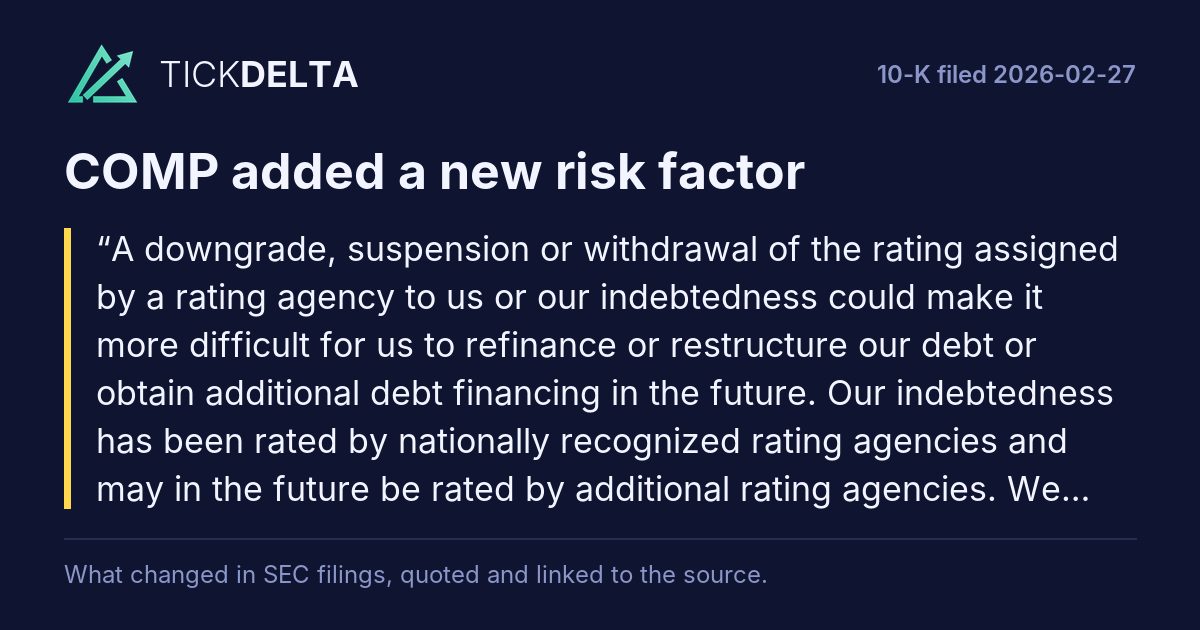
A downgrade, suspension or withdrawal of the rating assigned by a rating agency to us or our indebtedness could make it more difficult for us to refinance or restructure our debt or obtain additional debt financing in the future.
Our indebtedness has been rated by nationally recognized rating agencies and may in the future be rated by additional rating agencies. We cannot assure you that any rating assigned to us or our indebtedness will remain for any given period of time or that a rating will not be lowered or withdrawn entirely by a rating agency if, in that rating agency’s judgment, circumstances relating to the basis of the rating, such as adverse changes in our business, so warrant. Any downgrade, suspension or withdrawal of a rating by a rating agency (or any anticipated downgrade, suspension or withdrawal) as well as any actual or anticipated placement on negative outlook by a rating agency could make it more difficult or more expensive for us to refinance or restructure our debt or obtain additional debt financing in the future.
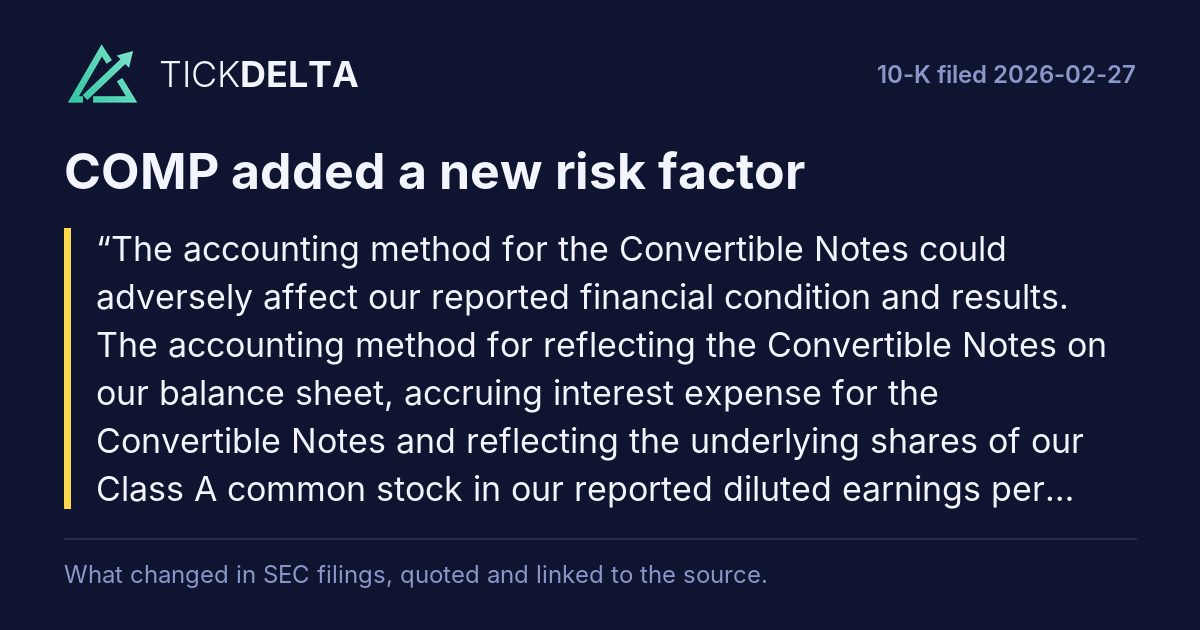
The accounting method for the Convertible Notes could adversely affect our reported financial condition and results.
The accounting method for reflecting the Convertible Notes on our balance sheet, accruing interest expense for the Convertible Notes and reflecting the underlying shares of our Class A common stock in our reported diluted earnings per share may adversely affect our reported earnings and financial condition.
In August 2020, the Financial Accounting Standards Board published an Accounting Standards Update, which we refer to as ASU 2020-06, which simplifies certain of the accounting standards that apply to convertible notes. In accordance with ASU 2020-06, the Convertible Notes are reflected as a liability on our balance sheets, with the initial carrying amount equal to the principal amount of the Convertible Notes, net of issuance costs. The issuance costs were treated as a debt discount for accounting purposes, which will be amortized into interest expense over the term of the Convertible Notes. As a result of this amortization, the interest expense that we expect to recognize for the Convertible Notes for accounting purposes will be greater than the cash interest payments we will pay on the Convertible Notes, which will result in lower reported income.
In addition, we expect that the shares underlying the Convertible Notes will be reflected in our diluted earnings per share using the “if converted” method, in accordance with ASU 2020-06. Under that method, if the conversion value of the notes exceeds their principal amount for a reporting period, we will calculate our diluted earnings per share assuming that all of the Convertible Notes were converted solely into shares of our Class A common stock at the beginning of the reporting period and that we issued shares of our Class A common stock to settle the excess. However, if reflecting the Convertible Notes in diluted earnings per share in this manner is anti-dilutive, or if the conversion value of the Convertible Notes does not exceed their principal amount for a reporting period, then the shares underlying the Convertible Notes will not be reflected in our diluted earnings per share. The application of the if-converted method may reduce our reported diluted earnings per share, and accounting standards may change in the future in a manner that may adversely affect our diluted earnings per share.
Furthermore, if any of the conditions to the convertibility of the Convertible Notes is satisfied, we may be required under applicable accounting standards to reclassify the liability carrying value of the Convertible Notes as a current, rather than a long-term liability. This reclassification could be required even if no noteholders convert their Convertible Notes and could materially reduce our reported working capital.
Conversion of the Convertible Notes may dilute the ownership interest of our stockholders or may otherwise depress the price of our Class A common stock.
The conversion of some or all of the Convertible Notes may dilute the ownership interests of our stockholders. Upon conversion of the Convertible Notes, we have the option to pay or deliver, as the case may be, cash, shares of our Class A common stock, or a combination of cash and shares of our Class A common stock in respect of the remainder, if any, of our conversion obligation in excess of the aggregate principal amount of the Convertible Notes being converted. If we elect to settle the remainder, if any, of our conversion obligation in excess of the aggregate principal amount of the Convertible Notes being converted in shares of our Class A common stock or a combination of cash and shares of our Class A common stock, any sales in the public market of our Class A common stock issuable upon such conversion could adversely affect prevailing market prices of our Class A common stock. In addition, the existence of the Convertible Notes may encourage short selling by market participants because the conversion of our Convertible Notes could be used to satisfy short positions, or anticipated conversion of our Convertible Notes into shares of our Class A common stock could depress the price of our Class A common stock.
In connection with the pricing of the Convertible Notes, we entered into privately negotiated capped call transactions with the option counterparties. The capped call transactions are expected generally to reduce the potential dilution of our Class A common stock upon any conversion of the Convertible Notes and/or at our election (subject to certain conditions) offset any potential cash payments we are required to make in excess of the principal amount of converted notes, as the case may be, with such reduction and/or offset subject to a cap.
In addition, the option counterparties and/or their respective affiliates may modify their hedge positions by entering into or unwinding various derivatives with respect to our Class A common stock and/or purchasing or selling our Class A common stock or other securities of ours in secondary market transactions following the pricing of the Convertible Notes and prior to the maturity of the Convertible Notes (and are likely to do so during the relevant valuation period under the capped call transactions or, to the extent we exercise the relevant termination election under the capped call transactions, following any repurchase, redemption or early conversion of the Convertible Notes or if we otherwise unwind all or a portion of the capped call transactions). This activity could also cause or avoid an increase or a decrease in the market price of our Class A common stock.
In addition, if any such capped call transaction fails to become effective, the option counterparties or their respective affiliates may unwind their hedge positions with respect to our Class A common stock, which could adversely affect the value of our Class A common stock.
We are subject to counterparty risk with respect to the capped call transactions, and the capped call may not operate as planned.
The option counterparties are, or are affiliates of, financial institutions, and we will be subject to the risk that they might default or otherwise fail to perform, or may exercise certain rights to terminate their obligations under the applicable capped call transactions. Our exposure to the credit risk of the option counterparties will not be secured by any collateral. Global economic conditions have from time to time resulted in the actual or perceived failure or financial difficulties of many financial institutions, including the bankruptcy filing by Lehman Brothers Holdings Inc. and its various affiliates. If an option counterparty becomes subject to insolvency proceedings, we will become an unsecured creditor in those proceedings with a claim equal to our exposure at that time under such transactions with that option counterparty. Our exposure will depend on many factors, but, generally, the increase in our exposure will be correlated with increases in the market price or the volatility of our Class A common stock. In addition, upon a default or other failure to perform, or a termination of obligations by an option counterparty, we may suffer adverse tax consequences and more dilution than we currently anticipate with respect to our Class A common stock. We can provide no assurances as to the financial stability or viability of any option counterparty.
In addition, the capped call transactions are complex, and they may not operate as planned. For example, the terms of the capped call transactions may be subject to adjustment, modification or, in some cases, renegotiation if certain corporate or other transactions occur. Accordingly, these transactions may not operate as we intend if we are required to adjust their terms as a result of transactions in the future or upon unanticipated developments that may adversely affect the functioning of the capped call transactions.
Paragraphs in the 10-Q filed Nov 6, 2026 that were not in the one before
New in the latest 10-Q
15 paragraphs in the 10-Q filed Nov 6, 2026 with nothing like them in the 10-Q filed Aug 6, 2026 (at least half the words must differ; new numbers alone do not count). Quoted exactly, grouped by the item heading above them. This is text that changed, not a judgement of how serious it is.
Financial statements and notes
During the three months ended September 30, 2026, the Company acquired 100 % of the equity interests in four Sotheby’s International Realty franchisees and converted them to company-owned brokerage operations (the “Conversions”). The Company has accounted for the Conversions as business combinations.
Read in the 10-Q
The total consideration for the Conversions completed during the three months ended September 30, 2026 was $ 238 million, primarily comprised of: (i) $ 98 million of cash paid at or near closing, net of $ 12 million of cash acquired; (ii) $ 55 million of the Company's Class A common stock issued at closing; (iii) an estimated $ 20 million of deferred purchase price consideration to be paid in cash or the Company's Class A common stock at a later date; and (iv) $ 43 million of amounts payable in cash or Class A common stock, contingent on the respective businesses achieving certain earnings-based targets through 2028. $ 18 million of deferred purchase price consideration and $ 20 million of contingent consideration was recorded within Accrued expenses and other current liabilities and $ 2 million of deferred purchase price and $ 23 million of contingent consideration was recorded within Other non-current liabilities on the condensed consolidated balance sheet. The range of undiscounted amounts the Company could pay related to contingent consideration is between zero and $ 57 million.
Read in the 10-Q
The fair value of the assets acquired and the liabilities assumed primarily resulted in the recognition of $ 76 million of goodwill, $ 64 million of ROU lease assets, $ 14 million of current lease liabilities, $ 50 million of non-current lease liabilities, and $ 156 million of intangible assets related to customer relationships, which are being amortized over the estimated useful life of approximately five years. Goodwill represents the expected synergies from combining the acquired assets and the operations of the Company and the value of the assembled workforce.
Read in the 10-Q
The Company has recorded preliminary purchase price allocations and expects to finalize them within each applicable one-year measurement period.
Read in the 10-Q
The converted entities' results have been included in the Company's consolidated financial statements from the respective conversion dates onward. For the three months ended September 30, 2026, the Conversions contributed an incremental $ 141 million in revenue and $ 4 million in net income.
Read in the 10-Q
Show the other 10
Pro Forma Three Months Ended September 30, 2026 Three Months Ended September 30, 2025 Nine Months Ended September 30, 2026 Nine Months Ended September 30, 2025 Revenue $ 4,008 $ 3,721 $ 11,566 $ 10,486 Net income (loss) 50 (35) (243) 100
Read in the 10-Q
During the nine months ended September 30, 2026 and 2025, the Company received distributions from equity method investments of $ 11 million and $ 3 million, respectively, classified as operating activities (return of earnings). During the nine months ended September 30, 2026, the Company also received $ 8 million of distributions classified as investing activities (return of investment). These distributions primarily relate to equity method investments acquired in the Anywhere Merger. Because the Company’s cumulative equity in earnings of these investments is measured from the Anywhere Closing Date, distributions received in excess of earnings recognized since the Merger are classified as returns of investment, even though they are paid from the investees’ earnings.
Read in the 10-Q
(1) For more information on the increase of the gross carrying amount of customer relationships during the third quarter, refer to Note 3 - “Acquisitions”.
Read in the 10-Q
September 30, 2026 December 31, 2025 ──────────────────────────────────────────────────────────────────────────────────────────────────────────────── Accrued payroll and related employee costs $ 213 $ 65 Accrued litigation settlements 69 — Accrued interest 63 — Accrued merger-related severance costs 28 — Accrued expenses 146 40 Contingent consideration 33 7 Other 123 26 Total accrued expenses and other current liabilities $ 675 $ 138
Read in the 10-Q
On October 7, 2026, a putative class action captioned Magloire v. Compass, Inc., et al., No. 1:26-cv-08885, was filed in the U.S. District Court for the Southern District of New York against the Company and certain individual defendants, including current and former officers and directors of the Company. The complaint asserts claims under Sections 11, 12(a)(2), and 15 of the Securities Act of 1933 on behalf of former Anywhere stockholders who acquired the Company's common stock in connection with the January 2026 Anywhere Merger, alleging that the registration statement and prospectus for the Merger contained materially false and misleading statements and omissions regarding the regulatory review process and related risks. The plaintiff seeks unspecified monetary damages, equitable relief, including rescission or disgorgement, and attorney's fees and costs.
Read in the 10-Q
The Company previously undertook a restructuring plan to better align its organizational structure with its long-term strategy, drive cost efficiencies, and progress toward profitability and positive free cash flow. The plan included workforce reductions, which were completed in prior periods, and actions to reduce occupancy costs. Costs incurred in the current periods are largely lease-related and consist of (i) termination costs for leases the Company exited from the restructuring through the closing of the Anywhere Merger and (ii) ongoing costs for office space Anywhere had vacated or terminated before the Anywhere Merger, which the Company assumed at closing.
Read in the 10-Q
Other information
On August 7, 2026, Robert Reffkin, Founder and Chief Executive Officer, and Ruth Reffkin Family Trust, adopted a Rule 10b5-1 trading arrangement that is intended to satisfy the affirmative defense of Rule 10b5-1(c) for the sale of up to 3,840,743 shares of the Company's common stock at various limit prices. This arrangement replaces a prior Rule 10b5-1 trading plan adopted on March 3, 2026 covering up to 3,411,111 shares, which was terminated on August 6, 2026, after 70,368 shares were sold. The trading arrangement is set to end on October 29, 2027.
Read in the 10-Q
On September 15, 2026, Scott Wahlers, Chief Financial Officer, adopted a Rule 10b5-1 trading arrangement that is intended to satisfy the affirmative defense of Rule 10b5-1(c) for the sale of up to 718,259 shares of the Company's common stock at various limit prices. The trading arrangement is set to end on February 9, 2030.
Read in the 10-Q
On August 6, 2026, Ethan Glass, Chief Legal Officer, adopted a Rule 10b5-1 trading arrangement that is intended to satisfy the affirmative defense of Rule 10b5-1(c) for the sale of up to 151,399 shares of the Company's common stock at various limit prices. The trading arrangement is set to end on December 31, 2027.
Read in the 10-Q
On August 6, 2026, Timothy Gustavson, Chief Accounting Officer, adopted a Rule 10b5-1 trading arrangement that is intended to satisfy the affirmative defense of Rule 10b5-1(c) for the sale of up to 66,569 shares of the Company's common stock at various limit prices. The trading arrangement is set to end on November 5, 2027.
Read in the 10-Q
The 10-Q's risk factors against the 10-K
Item 1A of the 10-Q filed Nov 6, 2026 against Item 1A of the 10-K filed Feb 27, 2026.
A 10-Q repeats only the risks that changed, so a 10-K paragraph that is missing from it is not counted as removed.
Added is a paragraph with nothing like it in the 10-K, Reworded a sentence that is in both with several words changed,
Quiet changes a sentence in both where one to four words changed and one is a hedge or a modal
(cut words struck through, new words highlighted).
Text on the page, not a score; each links to the filing at sec.gov.
What the 10-Q itself says about its risk factors:We are subject to various risks and uncertainties, which could materially affect our business, results of operations, financial condition, future results, and the trading price of our common stock. You should read carefully the information appearing in Part I, Item 1A, Risk Factors in our 2025 Form 10-K. There have been no material changes to the risk factors set forth in our 2025 Form 10-K. However, additional risks and uncertainties not currently known to us or that we currently deem to be immaterial may materially adversely affect our business, financial condition and/or operating results.
Read in the 10-Q
1 paragraph in the 10-Q's Item 1A, and none of them adds, rewords or quietly edits a paragraph of the 10-K's.
Phrases used for the first time
Two-word phrases in Risk Factors of the 10-K filed Feb 27, 2026 that are in none of the 1 earlier 10-Ks stored, back to Feb 25, 2025
Where each one is used
- estate professionals: As our revenue is primarily driven by sales commissions, transaction fees and royalty fees, any slowdown or decrease in the total number of residential real estate sale transactions executed by real estate professionals could adversely affect our business, financial condition and results of operations....
- convertible notes: In connection with the Anywhere Merger, we became a party (through our subsidiaries and as a guarantor) to the Anywhere Secured Notes and Anywhere Unsecured Notes; issued and sold $1.0 billion in aggregate principal amount of the Convertible Notes; executed a performance guarantee for the Apple Ridge securitization...
- anywhere merger: We may be unable to successfully integrate Anywhere’s business and realize cost synergies and other anticipated benefits of the Anywhere Merger.
- professionals clients: We may not be able to maintain or establish relationships with MLSs and third-party listing providers, which could limit the information we are able to provide to real estate professionals and real estate professionals’ clients.
- capped call: In connection with the pricing of the Convertible Notes, we entered into privately negotiated capped call transactions with the option counterparties. The capped call transactions are expected generally to reduce the potential dilution of our Class A common stock upon any conversion of the Convertible Notes and/or...
- retain real: We might not be able to recruit and retain real estate professionals at the same rate as in the past, which could adversely affect our and the combined company’s business, financial condition and results of operations.
- call transactions: In connection with the pricing of the Convertible Notes, we entered into privately negotiated capped call transactions with the option counterparties. The capped call transactions are expected generally to reduce the potential dilution of our Class A common stock upon any conversion of the Convertible Notes and/or...
- estate professional: As our revenue is primarily driven by sales commissions, transaction fees and royalty fees, any slowdown or decrease in the total number of residential real estate sale transactions executed by real estate professionals could adversely affect our business, financial condition and results of operations....
Used at least twice, small words left out. Counted, not picked: a phrase can be new because the company renamed something.
What was taken out
28 paragraphs of last year's Risk Factors with nothing like them now. The longest are quoted.
Sources
Item 1A of each 10-K and 10-Q on EDGAR, quoted exactly. Each paragraph links to the filing at sec.gov.
Also
10-K change: what was reworded or cut, section by section.
Work with it
Excel workbook · CSV. Google Sheet that stays up to date: paste =IMPORTDATA("https://tickdelta.com/company/COMP/export.csv") into a cell.