Corcept Therapeutics Inc CORT
New risk paragraphs, branching off last year
Each branch is a paragraph in Risk Factors with nothing like it in the 10-K filed Feb 26, 2025. A box jumps to the paragraph as filed, below.
Paragraphs with nothing like them in last year's 10-K
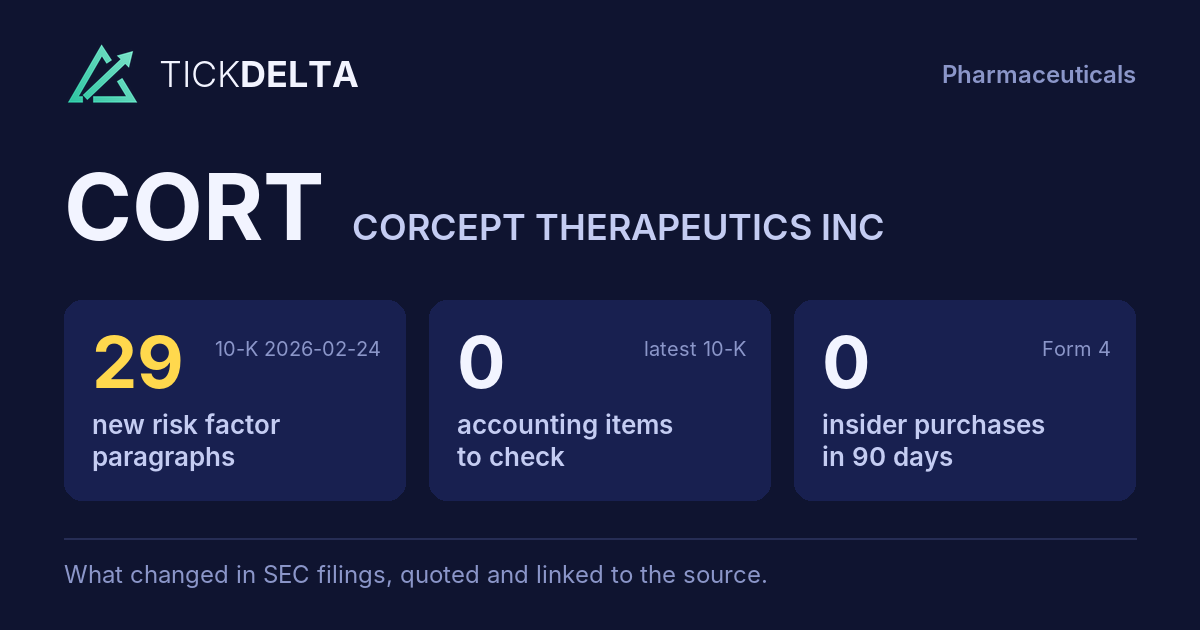
29 paragraphs in Risk Factors of the 10-K filed Feb 24, 2026 with nothing like them in the 10-K filed Feb 26, 2025. Quoted exactly. Paragraphs that were only edited are under 10-K change.
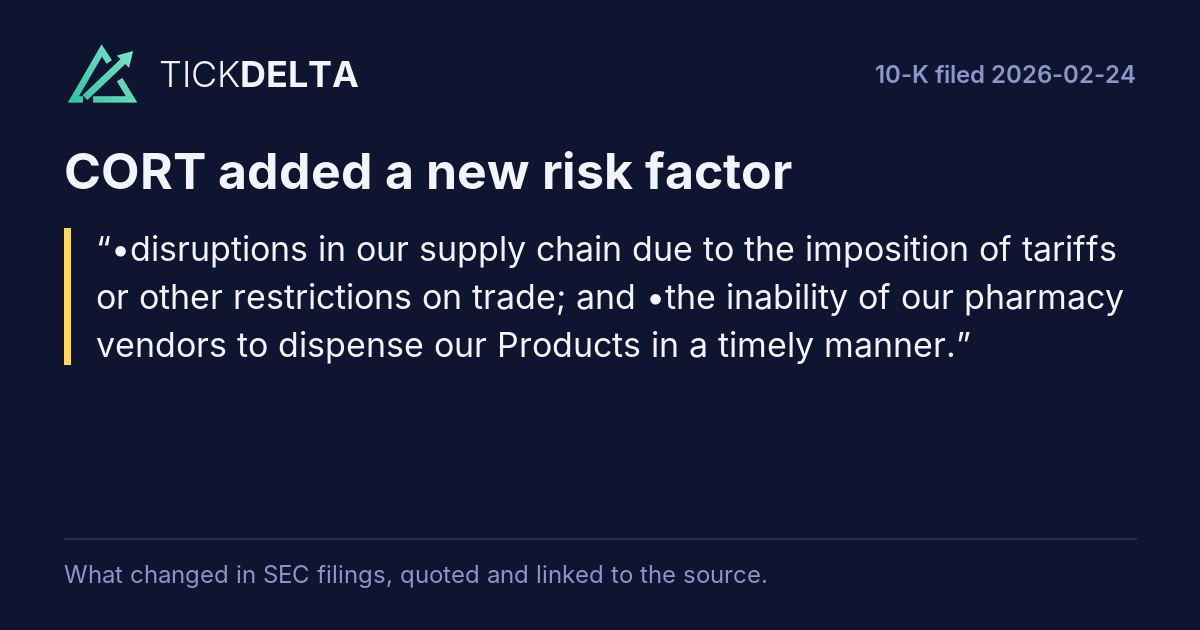
•disruptions in our supply chain due to the imposition of tariffs or other restrictions on trade; and
•the inability of our pharmacy vendors to dispense our Products in a timely manner.
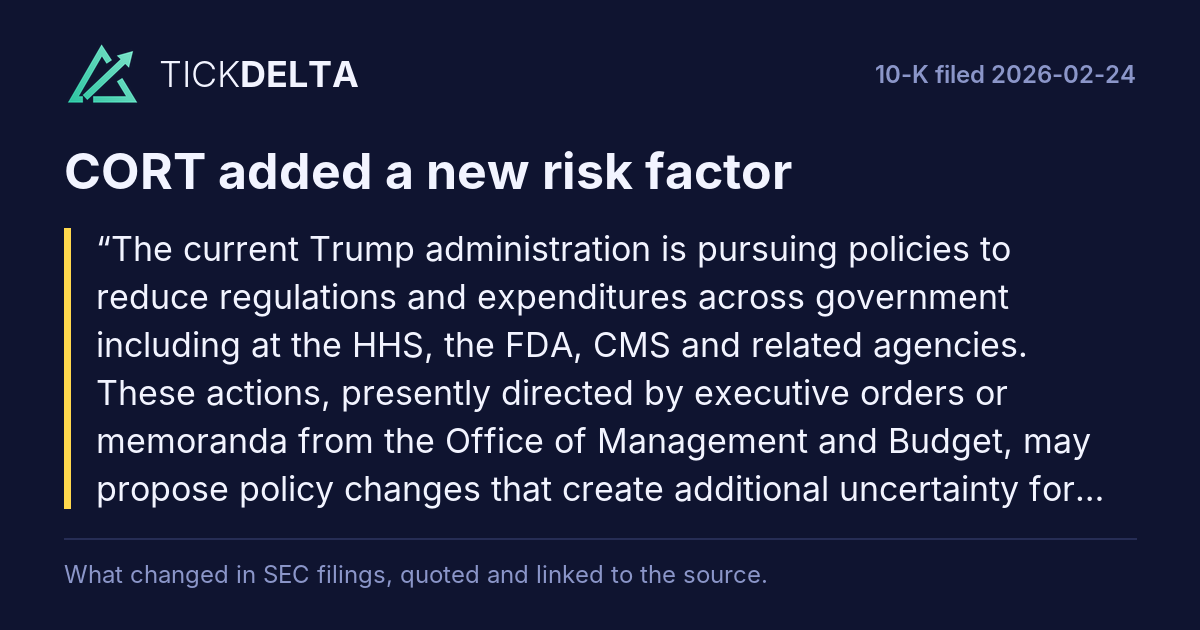
The current Trump administration is pursuing policies to reduce regulations and expenditures across government including at the HHS, the FDA, CMS and related agencies. These actions, presently directed by executive orders or memoranda from the Office of Management and Budget, may propose policy changes that create additional uncertainty for our business. These actions and proposals may, for example, include directives: (1) reducing agency workforce and cutting programs; (2) rescinding a Biden administration executive order tasking the Center for Medicare and Medicaid Innovation, or CMNI, to consider new payment and healthcare models to limit drug spending; (3) eliminating the Biden administration’s executive order that directed the HHS to establishing an AI task force and developing a strategic plan; (4) directing HHS and other agencies to lower prescription drug costs through a variety of initiatives, including by improving upon the Medicare Drug Price Negotiation Program and establishing Most-Favored-Nation pricing for pharmaceutical products; (5) imposing tariffs on imported pharmaceutical products; and (6) directing certain federal agencies to enforce existing law regarding hospital and plan price transparency and by standardizing prices across hospitals and health plans. Congress may introduce and ultimately pass health care related legislation that could impact the drug approval process and make changes to the Medicare Drug Price Negotiation Program created under the IRA. This could lower the price that we receive for any approved product. Any denial in coverage or reduction in reimbursement from Medicare or other government-funded programs may result in a similar denial or reduction in payments from private payors, which may prevent us from being able to generate sufficient revenue, attain profitability or commercialize our product candidates, if approved. Furthermore, on July 4, 2025, legislation commonly referred to as the One Big Beautiful Bill Act was signed into law, which reduced funding to federal healthcare programs and imposed additional requirements to be eligible for healthcare, which may result in decreased access to healthcare, particularly in Medicaid programs.
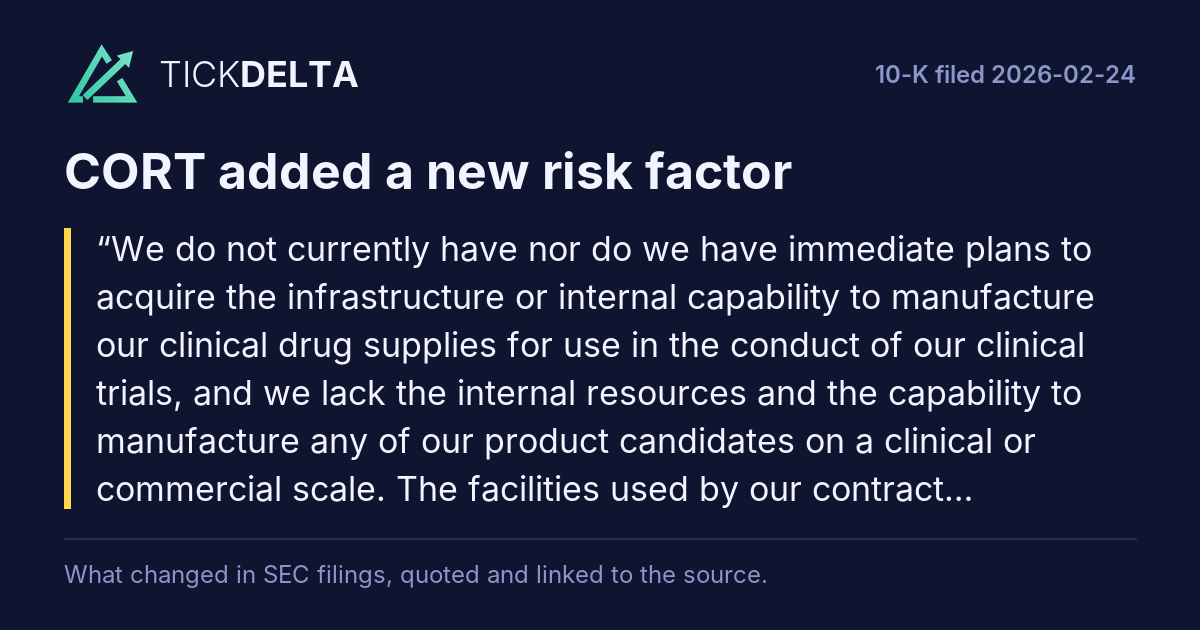
We do not currently have nor do we have immediate plans to acquire the infrastructure or internal capability to manufacture our clinical drug supplies for use in the conduct of our clinical trials, and we lack the internal resources and the capability to manufacture any of our product candidates on a clinical or commercial scale. The facilities used by our contract manufacturers to manufacture our product candidates must be approved by the FDA pursuant to inspections that will be conducted after we submit our NDA to the FDA. If our contract manufacturers cannot successfully manufacture material that conforms to our specifications and the strict regulatory requirements of the FDA or others, they will not be able to secure and/or maintain regulatory approval for their manufacturing facilities. If the FDA or a comparable foreign regulatory authority does not approve these facilities for the manufacture of our product candidates or if it withdraws any such approval in the future, we may need to find alternative manufacturing facilities, which would significantly impact our ability to develop, obtain regulatory approval for or market our product candidates, if approved.
Any replacement of our manufacturers could require significant effort and expertise because there may be a limited number of qualified replacements. In some cases, the technology required to manufacture our product candidates may be unique to the original manufacturer and we may have difficulty transferring such skills or technology to another third party. The
process of changing manufacturers is extensive and time-consuming and could cause delays or interruptions in our product candidate supply. Further, if we are required to change manufacturers for any reason, we will be required to verify that the new manufacturer maintains facilities and procedures that comply with all applicable regulations and guidelines, including cGMPs, and that the post-change material is comparable to pre-change. The delays associated with the verification of a new manufacturer could negatively affect our ability to develop product candidates in a timely manner or within budget.
Our failure, or the failure of our third-party manufacturers, to comply with applicable regulations could result in sanctions being imposed on us, including clinical holds, fines, injunctions, civil penalties, delays, suspension or withdrawal of approvals, license revocation, seizures or recalls of product candidates or drugs, operating restrictions and criminal prosecutions, any of which could significantly and adversely affect supply of our products.
•failure to show efficacy or acceptable safety, including failure to demonstrate statistical significance;
•the supply or quality of our product candidates or other materials necessary to conduct clinical trials of our product candidates may be insufficient or inadequate;
•unforeseen safety issues, undesirable side effects, or other unexpected characteristics; and
Show the other 10
and supportive studies that we consider appropriate and the results are positive, we may not receive regulatory approval and marketing authorization to market our product candidates, which would adversely affect our business, financial condition, results of operations and prospects. Following regulatory approval, there is no assurance of commercial success.
In addition, the FDA and comparable foreign regulatory authorities may change their policies, issue additional regulations or revise existing regulations, or take other actions, which may prevent or delay approval of our future products under development on a timely basis. There remains substantial uncertainty as to how the current U.S. administration will seek or continue to modify or revise the requirements and policies of the FDA and other regulatory agencies with jurisdiction over our product candidates. State governments may also attempt to address or react to changes at the federal level with changes to their own regulatory frameworks in a manner that is adverse to our operations. This uncertainty could present new challenges or potential opportunities as we navigate the clinical development and approval process for our product candidates. Such policy or regulatory changes through, for example, executive orders or legislation could impose additional requirements upon us that could delay our ability to obtain approvals, increase the costs of compliance or restrict our ability to maintain any marketing authorizations we may have obtained.
Interim results from our clinical trials and preclinical studies that we announce or publish from time to time may change as more patient data become available and are subject to audit and verification procedures that could result in material changes in the final data.
From time to time, we may publish interim results from our preclinical studies and clinical trials, which are based on an analysis of then-available data. Their results and related findings and conclusions are subject to change following the availability of more data or following a more comprehensive review of the data related to the particular study or trial. We also make assumptions, estimations, calculations and conclusions as part of our analyses of data, and we may not have received or had the opportunity to fully and carefully evaluate all data. As a result, interim results from clinical trials are subject to the risk that one or more of the clinical outcomes may materially change as patient enrollment continues and more patient data become available. As a result, interim data should be viewed with caution until the final data are available. Differences between interim data and final data could adversely affect our business prospects and may cause the trading price of our common stock to fluctuate significantly.
Further, others, including regulatory agencies, may not accept or agree with our assumptions, estimates, calculations, conclusions or analyses or may interpret or weigh the importance of data differently, which could impact the value of the particular program, the approvability or commercialization of the particular product candidate or product and our company in general. In addition, the information we choose to publicly disclose regarding a particular study or clinical trial is based on what is typically extensive information, and investors or others may not agree with what we determine is material or otherwise appropriate information to include in our disclosure, and any information we determine not to disclose may ultimately be deemed significant with respect to future decisions, conclusions, views, activities or otherwise regarding a particular product candidate or our business. If data we report differ from actual results, or if others, including regulatory authorities, disagree with our conclusions, our ability to obtain approval for, and commercialize, our product candidates may be harmed, which could adversely affect our business, operating results, prospects or financial condition.
We cannot sell a product without the approval of the FDA, EMA or comparable regulatory authority. Obtaining such approval is difficult, uncertain, lengthy and expensive. Failure can occur at any stage. In order to receive FDA approval for a new drug, we must demonstrate to the FDA’s satisfaction that the new drug is safe and effective for its intended use and that our manufacturing processes comply with cGMPs. Recent disruptions at the FDA and other government agencies caused by changing presidential administrations or funding shortages could hinder their ability to hire, retain or deploy key leadership and other personnel, prevent new or modified product candidates from being developed, reviewed, approved or commercialized in a timely manner or at all, which could negatively impact our business. In addition, policies, regulations, and the type and amount of clinical data that the regulatory authority views as necessary for approval may change during the course of a product candidate’s clinical development and may vary among jurisdictions. Even if we believe the preclinical or clinical data for our product candidates are promising, such data may not be sufficient to support approval by the FDA or comparable foreign regulatory authorities.
Our inability or the inability of our vendors to comply with applicable FDA and other regulatory requirements can result in delays in or denials of new product approvals, suspending or withdrawing our existing regulatory approvals, mandatory modifications to labeling or promotional materials, requirements to provide corrective information to healthcare professionals, warning letters, untitled letters, fines, consent decrees restricting or suspending manufacturing operations, injunctions, civil penalties, recall or seizure of products, product detention or refusing to permit import or export of our products, total or partial
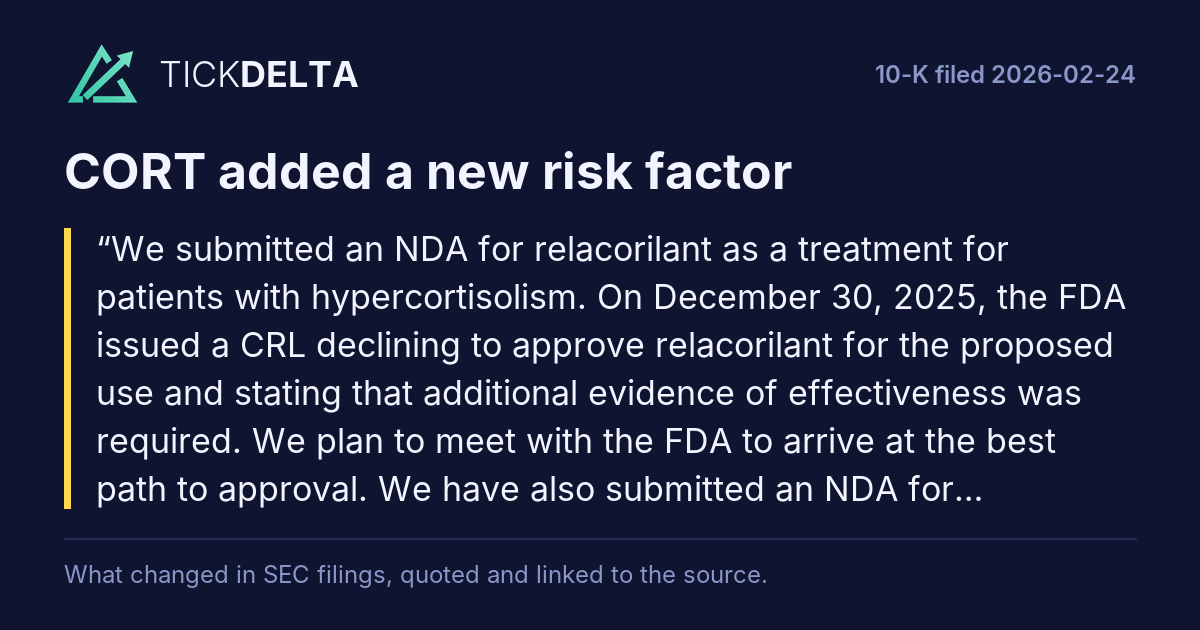
We submitted an NDA for relacorilant as a treatment for patients with hypercortisolism. On December 30, 2025, the FDA issued a CRL declining to approve relacorilant for the proposed use and stating that additional evidence of effectiveness was required. We plan to meet with the FDA to arrive at the best path to approval. We have also submitted an NDA for relacorilant as a treatment, in combination with the chemotherapy medication nab-paclitaxel, for patients with platinum-resistant ovarian cancer with a PDUFA date of July 11, 2026. We have also submitted to the EMA an MAA for relacorilant in combination with nab-paclitaxel as a treatment for patients with platinum-resistant ovarian cancer with a likely regulatory decision date in the fourth quarter of 2026. These applications may be delayed and there is no assurance that they will be approved.
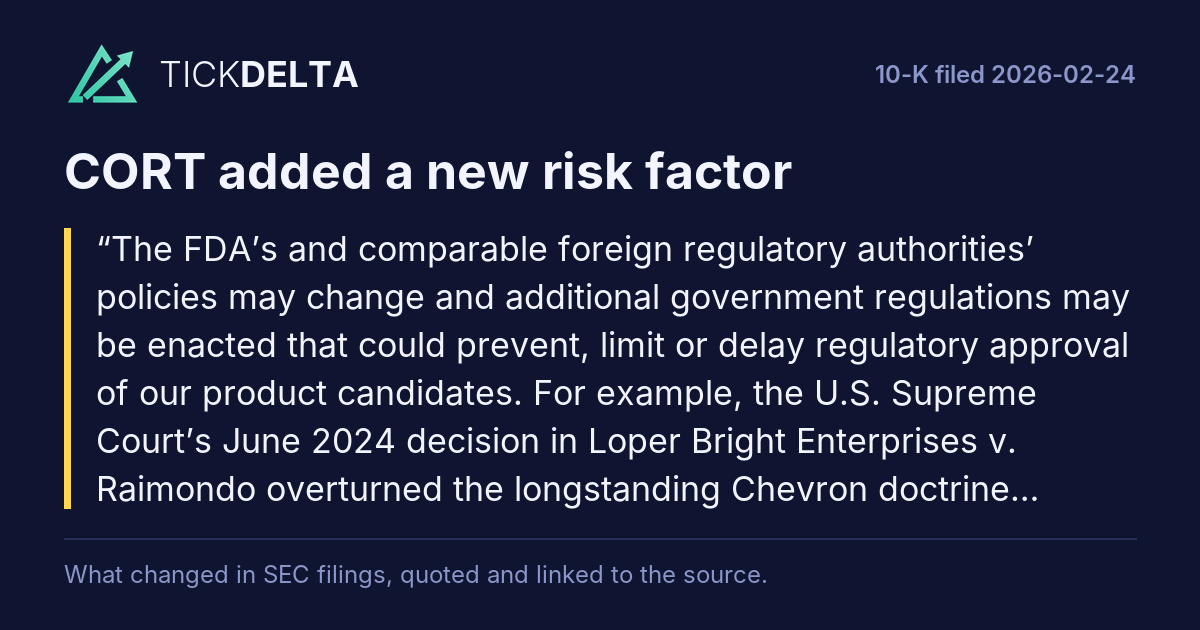
The FDA’s and comparable foreign regulatory authorities’ policies may change and additional government regulations may be enacted that could prevent, limit or delay regulatory approval of our product candidates. For example, the U.S. Supreme Court’s June 2024 decision in Loper Bright Enterprises v. Raimondo overturned the longstanding Chevron doctrine, under which courts were required to give deference to regulatory agencies’ reasonable interpretations of ambiguous federal statutes. The Loper decision could result in additional legal challenges to regulations and guidance issues by federal agencies, including the FDA, on which we rely. Any such legal challenges, if successful, could have a material impact on our business. The Loper decision also may result in increased regulatory uncertainty, inconsistent judicial interpretations, and other impacts to the agency rulemaking process, any of which could adversely impact our business and operations. We cannot predict the likelihood, nature or extent of government regulation that may arise from future legislation or administrative action, either in the United States or abroad. If we are slow or unable to adapt to changes in existing requirements or the adoption of new requirements or policies, or if we are not able to maintain regulatory compliance, we may lose any marketing approval that we may have obtained and we may not achieve or sustain profitability, which could adversely affect business, operating results, prospects or financial condition.
product candidates or products may be harmed and our ability to generate product revenues from them may be delayed or eliminated.
•we may discontinue marketing of the product candidate, or decide to remove it from the marketplace;
•we may not be able to achieve or maintain third-party payor coverage or adequate reimbursement;
The federal government of the United States has recently significantly reduced funding for scientific research conducted by the federal government and universities, terminated large numbers of employees at government agencies that support health care research and regulation, including the FDA, Centers for Disease Control and National Institutes of Health, and has passed laws that will, over the next several years, significantly reduce the number of people covered by Medicaid. In addition, President Trump has imposed new tariffs on international trade, increased existing tariffs, and abruptly paused or reversed tariffs in ways that will increase our costs and make planning difficult. The government’s actions have caused economic and regulatory uncertainty and have been adverse to our clinical and commercial efforts.
It is likely the administration will adopt new policies or take new actions that make it more difficult and costly to develop our product candidates. Significant cuts or disruptions to the staffing of government agencies and their budgets may delay review of current and future NDAs and may hamper our ability to advance our other clinical programs. The research programs of our academic collaborators may be canceled or their funding reduced. All of these actions may be taken with little or no advance notice.
The significant cuts to funding for Medicaid contained in the OBBBA enacted in July 2025 will increase the cost of our financial assistance and charitable donation programs. There may be further reductions in federal healthcare spending that harm our business.
Additionally, disruptions at the FDA may impede its ability to review applications to start clinical trials, complete reviews of new drug applications, and conduct other activities critical to our business in a timely way or at all. On October 1, 2025, the Congress and the President failed to pass legislation required to fund government activities and, as a consequence, the government shut down and ceased to perform many of its normal functions until November 12, 2025. Regulatory agencies, including the FDA, had to furlough some critical employees and stop some critical activities. Although some of the activities upon which our business relies, including the review of new drug applications, are funded independently by user fees, these fees
may not be sufficient, and if a prolonged government shutdown occurs again, it could require the FDA to curtail or cease its activities, which could have a material adverse effect on our business.
Further, a prolonged or future shutdown of the U.S. federal government could materially impact the operations of the SEC. For example, the SEC announced that during the recent U.S. federal government shutdown, it would not declare registration statements effective. In the event of a future extended shutdown, the SEC could operate with limited staff or suspend certain functions altogether, which could delay the review or effectiveness of our filings, including registration statements or other financing-related disclosures. Such delays could adversely affect our ability to access the public markets and obtain necessary capital in order to properly capitalize and continue to fund our operations.
The DOJ issued a rule in 2025 entitled, “Access to U.S. Sensitive Personal Data and Government-Related Data by Countries of Concern or Covered Persons,” and known less formally as the “Bulk Transfer Rule.” The Bulk Transfer Rule is codified at 28 CFR part 202 and prohibits and restricts bulk transfers of sensitive personal data (including genetic and health data) to countries of concern, such as China, Russia, and Iran to prevent access by foreign adversaries. It restricts our ability to engage in certain cross-border transactions involving genomic or biological samples and related data, which may increase compliance costs, lead to increased regulatory scrutiny or liability, and may require additional contractual negotiations, which may adversely impact our business, financial condition, and operating results.
Paragraphs in the 10-Q filed Nov 3, 2026 that were not in the one before
New in the latest 10-Q
14 paragraphs in the 10-Q filed Nov 3, 2026 with nothing like them in the 10-Q filed Jul 29, 2026 (at least half the words must differ; new numbers alone do not count). Quoted exactly, grouped by the item heading above them. This is text that changed, not a judgement of how serious it is.
Financial statements and notes
We have initiated trials to evaluate the potential for Lifyorli to treat patients with other types of solid tumors, at different stages of treatment, and in combination with other anti-cancer agents. BELLA is an open-label Phase 2 trial with three parts. In each part, the primary endpoint is PFS, with OS being a key secondary endpoint. In October 2026, we announced results of our primary analysis of data from Part A of BELLA. In Part A, 95 patients with platinum-resistant ovarian cancer treated with Lifyorli plus nab-paclitaxel and bevacizumab demonstrated clinically meaningful median PFS of 7.2 months and objective response rate (“ORR”) of 59 percent. Although median OS had not yet been reached at the time of the primary analysis, 88% of patients were alive at 6 months. Clinical benefit was most pronounced among patients earliest in their course of treatment in the platinum-resistant setting, including those who had not received bevacizumab previously. In bevacizumab-naïve patients, median PFS was 8.1 months, ORR was 66 percent and 91 percent of patients were alive at 6 months. The safety profile of Lifyorli plus nab-paclitaxel and bevacizumab was consistent with the known profiles of each individual agent, with no new safety signals identified.
Read in the 10-Q
Patients who received 200 mg of miricorilant twice weekly experienced a significantly larger reduction in liver fat than patients who received 100 mg of miricorilant twice weekly. The comparison between those who received miricorilant and placebo was not statistically significant. Patients who received pre- and post-treatment liver biopsies - those in Cohort A - experienced an improvement in fibrosis of 19.2 percent at 48 weeks. Miricorilant was very well tolerated in both cohorts. The rate of adverse events was virtually indistinguishable between the miricorilant and placebo arms.
Read in the 10-Q
Risk Factors
Participation in GUARD would likely be mandatory for us. The GUARD rules have not been finalized and may change; a final rule has been under review by the Office of Management and Budget since June 2026. In September 2026, CMS finalized a similar international reference pricing model for drugs covered by Medicare Part B, the Global Benchmark for Efficient Drug Pricing (“GLOBE”) model.
Read in the 10-Q
resulting from a violation of the federal Anti-Kickback Statute constitutes a false or fraudulent claim for purposes of the False Claims Act;
Read in the 10-Q
• delays or inability to obtain Institutional Review Board (“IRB”) approval at prospective trial sites;
Read in the 10-Q
Show the other 9
Our inability or the inability of our vendors to comply with applicable FDA and other regulatory requirements can result in delays in or denials of new product approvals, suspending or withdrawing our existing regulatory approvals, mandatory
Read in the 10-Q
• investor concerns that physicians will prefer, now or in the future, medications that compete with our Products;
Read in the 10-Q
The use of artificial intelligence (“AI”) by us and our vendors could adversely affect our business.
Read in the 10-Q
We and our vendors use AI in connection with our business. Even when best-practice security measures are employed, use of AI could result in the inadvertent disclosure of confidential, proprietary or other sensitive information and its incorporation into publicly accessible databases, AI training sets or similar repositories. The AI capabilities, security practices and compliance controls of our vendors may be inadequate and could expose us to cybersecurity, confidentiality, privacy, operational and other risks. Malicious actors may use AI to identify and exploit vulnerabilities in our or our vendors’ networks, software, websites or databases and to enhance the effectiveness of their attacks, which could result in disclosure or loss of confidential, proprietary or other sensitive information, disruption of our operations or the operations of vendors upon whom we rely, and may adversely affect our business and financial results.
Read in the 10-Q
Other information
Roberto Vieira, our President, Oncology, was appointed as an officer, as defined in Rule 16a-1(f) under the Exchange Act, effective as of September 1, 2026. Mr. Vieira adopted a Rule 10b5-1 trading arrangement on June 17, 2026, prior to his appointment as an officer. As Mr. Vieira was not an officer subject to the disclosure requirements of Item 408(a) of Regulation S-K at the time of adoption of this trading arrangement, no disclosure of this 10b5-1 plan was made in our Quarterly Report ...
Read in the 10-Q
Item 6
10.1#^ Consulting Services Agreement, dated as of September 22, 2026 and effective as of October 1, 2026, by and between Corcept Therapeutics Incorporated and Sean Maduck.
Read in the 10-Q
10.3# Severance and Change in Control Agreement by and between Corcept Therapeutics Incorporated and Roberto Vieira, dated January 29, 2024.
Read in the 10-Q
10.5# Severance and Change in Control Agreement by and between Corcept Therapeutics Incorporated and Justin Gunn, dated October 1, 2026.
Read in the 10-Q
Certain of the exhibits and schedules to this Exhibit have been omitted in accordance with Regulation S-K Item 601. The Registrant agrees to furnish a copy of all omitted exhibits and schedules to the SEC upon its request.
Read in the 10-Q
The 10-Q's risk factors against the 10-K
Item 1A of the 10-Q filed Nov 3, 2026 against Item 1A of the 10-K filed Feb 24, 2026.
A 10-Q repeats only the risks that changed, so a 10-K paragraph that is missing from it is not counted as removed.
Added is a paragraph with nothing like it in the 10-K, Reworded a sentence that is in both with several words changed,
Quiet changes a sentence in both where one to four words changed and one is a hedge or a modal
(cut words struck through, new words highlighted).
Text on the page, not a score; each links to the filing at sec.gov.
Show the other 22
The first 27 of 72 are shown (at most 12 of each type).
Phrases used for the first time
Two-word phrases in Risk Factors of the 10-K filed Feb 24, 2026 that are in none of the 1 earlier 10-Ks stored, back to Feb 26, 2025
Where each one is used
- regulatory agencies: In addition, the FDA and comparable foreign regulatory authorities may change their policies, issue additional regulations or revise existing regulations, or take other actions, which may prevent or delay approval of our future products under development on a timely basis. There remains substantial uncertainty as...
- drug price: The commercial success of our Products depends on the availability of acceptable pricing and adequate insurance coverage and reimbursement. Government payers, including Medicare, Medicaid and the Veterans Administration, as well as private insurers and health maintenance organizations, are increasingly attempting...
- pharmacy vendor: •the inability of our pharmacy vendors to dispense our Products in a timely manner.
- cros clinical: Third-party clinical investigators and clinical sites enroll patients and CROs manage many of our trials and perform data collection and analysis. Because we currently rely and intend to continue to rely on these third parties, we will have less control over the timing, quality and other aspects of preclinical...
- final data: Interim results from our clinical trials and preclinical studies that we announce or publish from time to time may change as more patient data become available and are subject to audit and verification procedures that could result in material changes in the final data.
- government agencies: We cannot sell a product without the approval of the FDA, EMA or comparable regulatory authority. Obtaining such approval is difficult, uncertain, lengthy and expensive. Failure can occur at any stage. In order to receive FDA approval for a new drug, we must demonstrate to the FDA’s satisfaction that the new drug...
- current products: •Public perception of mifepristone or legislation limiting or barring its distribution or use for termination of early pregnancy may limit our ability to sell our current Products.
- created unprecedented: •Actions by the federal government of the United States have created unprecedented legal, governmental, regulatory and economic uncertainty and risks that may adversely affect our business.
Used at least twice, small words left out. Counted, not picked: a phrase can be new because the company renamed something.
What was taken out
4 paragraphs of last year's Risk Factors with nothing like them now. The longest are quoted.
Sources
Item 1A of each 10-K and 10-Q on EDGAR, quoted exactly. Each paragraph links to the filing at sec.gov.
Also
10-K change: what was reworded or cut, section by section.
Work with it
Excel workbook · CSV. Google Sheet that stays up to date: paste =IMPORTDATA("https://tickdelta.com/company/CORT/export.csv") into a cell.