Paragraph 33 · 45% changed
Every version of it
Screener
/
SEC EDGAR
/CIK 0000016732
/10-K filed Sep 24, 2026, compared with Sep 18, 2025
/Numbers from the XBRL of the 10-Ks
Nasdaq
Consumer staples · Packaged Foods
CAMPBELL'S Co CPB
The 10-K against last year's
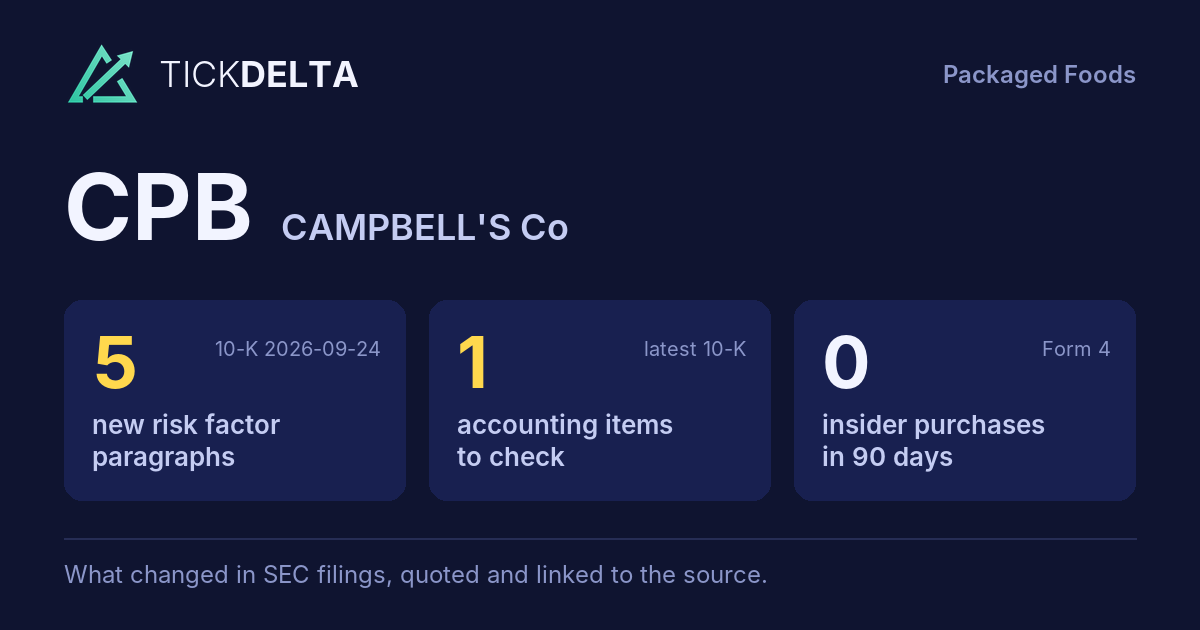
153 changes: 19 added, 10 removed, 122 reworded, 2 quiet changes
10-K Sep 24, 2026 vs Sep 18, 2025
Risk Factors
12.4%
of the text changed · 7,054 words now · 5 new paragraphs, 2 gone
MD&A
23.0%
of the text changed · 13,406 words now · 14 new paragraphs, 8 gone
Legal Proceedings
0.3%
of the text changed · 661 words now
Accounting Policies
3.3%
of the text changed · 1,991 words now
10-K 0000016732-26-000026 (Sep 24, 2026) vs 10-K 0000016732-25-000112 (Sep 18, 2025)
Every paragraph, and how much of it changed
One bar per paragraph, in the order of the 10-K. Height and colour show the share of its words not in the closest paragraph a year earlier; the tallest bars are new paragraphs.
Risk Factors
76 paragraphs · 5 new · 30 reworded · 2 gone · 10-K Sep 24, 2026 against Sep 18, 2025
New paragraph
Reworded (5% of its words or more)
Same or nearly
Paragraph 15 · 38% changed
Every version of it
Paragraph 42 · 35% changed
Every version of it
Consumer preferences for food and beverage products are continually evolving. Our ability to compete also depends upon our ability to predict, identify, and interpret the tastes and dietary habits of consumers and to offer products that appeal to those preferences. There are inherent marketplace risks associated with new product or packaging introductions, including uncertainties about trade and consumer acceptance. If we do not succeed in offering products that consumers want to buy, our sales and market share will decrease, resulting in reduced profitability. It may be difficult to predict which shifts in consumer preferences are short-term or long-term trends. For instance, consumer behaviors may continue to shift over time in response to certain health and wellness trends, including the use of weight-management medications. If we are unable to accurately predict which shifts in consumer preferences will be long-lasting, or are unable to introduce new and improved products to satisfy those preferences, our sales will decline. Weak economic conditions, recessions, significant inflation, government regulation (including in the health and wellness space) and other factors, such as pandemics, could affect consumer preferences and demand. In addition, given the variety of backgrounds and identities of consumers in our consumer base, we must offer a sufficient array of products to satisfy the broad spectrum of consumer preferences. As such, we must be successful in developing innovative products across a multitude of product categories. We must also be able to respond successfully to technological advances (including artificial intelligence and machine learning, which may become critical in interpreting consumer preferences in the future) and intellectual property rights of our competitors, and failure to do so could compromise our competitive position and negatively impact our product sales. Finally, if we fail to rapidly develop products in faster-growing and more profitable categories, we could experience reduced demand for our products, or fail to expand
Paragraph 32 · 27% changed
Every version of it
To address the risks to our information technology systems and the associated costs, we maintain an information security program that includes updating administrative, physical and technical controls and safeguards. These controls and safeguards include technology and security policies, cybersecurity insurance, employee awareness training and monitoring monitoring, a third-party risk management program, and routine testing of our information technology systems. We believe that these preventative and detective actions provide adequate measures of protection against security breaches, generally reduce our cybersecurity risks and enhance our ability to prevent, detect and respond to disruptive events. Our information security program includes capabilities designed to evaluate and mitigate cyber risks arising from third-party service providers. Additionally, we evaluate our major technology suppliers and outsourced service providers against accepted security certifications and standards. We believe that these capabilities provide insights and visibility to the security posture of our third-party service providers; however, cyber threats to those organizations are beyond our control. If these service providers do not perform effectively due to breach or system failure, we may not be able to achieve the expected benefits, and our business may be disrupted.
Paragraph 43 · 26% changed
Every version of it
Paragraph 60 · 26% changed
Every version of it
We are a party to a variety of legal and regulatory proceedings and claims arising out of the normal course of business. See Note 18 19 to the Consolidated Financial Statements for information regarding certain legal proceedings. Since these actions are inherently uncertain, there is no guarantee that we will be successful in defending ourselves against such proceedings or claims, or that our assessment of the materiality or immateriality of these matters, including any reserves taken in connection with such matters, will be consistent with the ultimate outcome of such proceedings or claims. The manufacture and marketing of food products has come under increased scrutiny in recent years, and the food industry has been subject to changes in laws and regulations at the state and federal levels and an increasing number of proceedings and claims relating to alleged false or deceptive marketing under federal, state and foreign laws or regulations. In light of recent actions by the United States Department of Health and Human Services, FDA and states, we anticipate continued legislative legislative, regulatory and regulatory policy developments with respect to food ingredients (including but not limited to whether products contain ingredients such as Food, Drug, and Cosmetic Act (FD&C) colors, bioengineered ingredients, or ingredients Generally Recognized as Safe (GRAS)), labeling (including but not limited to potential front of pack labeling) and packaging at the state and federal levels, along with related changes in consumer expectations and behavior. In April 2025, the FDA called on industry to phase out all “petroleum-based synthetic dyes” from the nation’s food supply, and Heightened scrutiny of "ultra-processed" foods, including policy proposals outlined in May 2025, reports by the Make America Healthy Again (MAHA) Commission published an assessment report discussing factors contributing to chronic childhood disease including diet, environmental exposure, lack as well as state legislative activity, could result in new definitions, labeling requirements, marketing restrictions, or reformulation mandates that increase our compliance costs or adversely affect consumer demand for certain of physical activity and healthcare. The MAHA Commission transmitted its strategy report, setting forth certain recommendations for addressing chronic childhood disease, to the President in August 2025 and publicly released it in September 2025. While the effects of all of these proposals remain uncertain at this time, we our products. We are continuing to monitor changes to laws and regulations that affect the food industry and evaluate their impact on our business, financial condition and results of operations.
Paragraph 19 · 17% changed
Every version of it
During 2025, 2026, we experienced some volatility in commodity and supply chain costs, including the costs of labor, raw materials, packaging materials, energy, fuel, packaging materials logistics, finished products and finished products, with a moderate impact labor, driven in part by impacts from tariffs and ongoing geopolitical conflicts in the fourth quarter. Middle East. In 2026, 2027, we expect more significant cost inflationary pressures and volatility in various input costs to persist, primarily driven by tariff impacts. impacts from tariffs, logistics costs and ongoing geopolitical conflicts. We plan to reduce some of these costs and impacts over time through cost savings initiatives, inventory management practices, supplier collaboration, alternative sourcing opportunities, continued supply chain productivity initiatives, surgical pricing actions where necessary and other mitigation efforts. If we cannot effectively mitigate these costs, our results could be adversely impacted.
Paragraph 13 · 16% changed
Every version of it
The global economy has been negatively impacted by ongoing geopolitical conflicts, including the military conflicts between Russia conflicts. Governments in various regions have imposed, and Ukraine, the conflicts in the Middle East, as well as tensions between China and Taiwan. For instance, governments in the U.S., United Kingdom and European Union have each imposed may continue to impose, blockades, export controls and trade restrictions on certain products and financial and economic sanctions on certain industry sectors and parties in Russia. Although we have no operations in Russia, Ukraine, the Middle East, China or Taiwan, we parties. We have experienced shortages in materials and increased costs for transportation, energy and raw material materials due in part to the negative impact of these ongoing geopolitical conflicts on the global economy. The scope and duration of such conflicts are uncertain, rapidly changing and hard to predict. Further escalation of these geopolitical conflicts, including increased trade barriers or restrictions on global trade, could result in, among other things, cyberattacks, supply disruptions, heightened inflationary pressures, lower consumer demand, and changes to foreign exchange rates and financial markets, any of which may adversely affect our business and supply chain. In addition, the effects of the ongoing conflicts could also heighten many of the other risk factors discussed in this Item 1A, or in other reports we periodically file with the SEC.
Paragraph 33 · 45% changed
Every version of it
10-K Sep 18, 2025To address the risks to our information technology systems and the associated costs, we maintain an information security program that includes updating technology and security policies, cybersecurity insurance, employee awareness training and monitoring and routine testing of our information technology systems. We believe that these preventative and detective actions provide adequate measures of protection against security breaches, generally reduce our cybersecurity risks and enhance our ability to prevent, detect and respond to disruptive events. Our information security program includes capabilities designed to evaluate and mitigate cyber risks arising from third-party service providers. We believe that these capabilities provide insights and visibility to the security posture of our third-party service providers; however, cyber threats to those organizations are beyond our control. If these service providers do not perform effectively due to breach or system failure, we may not be able to achieve the expected benefits, and our business may be disrupted.
10-K Sep 24, 2026
however, cyber threats to those organizations are beyond our control. If these service providers do not perform effectively due to breach or system failure, we may not be able to achieve the expected benefits, and our business may be disrupted.
Paragraph 15 · 38% changed
Every version of it
10-K Sep 18, 2025The current U.S. presidential administration has announced a wide range of tariffs on certain ingredients, inputs and imports from many countries, including Canada, Mexico, members of the European Union and the United Kingdom. The imposition of such tariffs have resulted in increased costs, including on ingredients, packaging, such as tinplate steel used to make cans, and other materials used to produce and distribute our products, and on finished products that we import. We are continuing to monitor the rapidly evolving tariff and global trade policies and are working with our suppliers to mitigate potential impacts on our business. The extent and duration of the tariffs and the resulting impact on general economic conditions and on our business are uncertain and depend on various factors, such as recent legal challenges to the U.S.'s imposition of tariffs, negotiations between the U.S. and affected countries, the responses of other countries or regions, relief that may be granted, availability and cost of alternative sources of supply and demand for our products in affected markets. The uncertainty of the tariffs, including a potential increase in input costs and decrease in demand for our products, could heighten the other risks factors and uncertainties discussed in this Item 1A, or in other reports we periodically file with the SEC, and impact our financial condition or results of operations. Furthermore, our competitors may be less exposed to tariff impacts or in a better position to mitigate the increased costs of tariffs.
10-K Sep 24, 2026
In 2026, tariff actions taken by the U.S. and retaliatory measures taken by its trading partners resulted in increased production costs, supply chain costs and distribution costs, primarily for ingredients, packaging (such as tinplate steel used to make cans), and imported finished products. Although uncertainty regarding the extent and duration of these tariffs remains, we are working with our suppliers to mitigate potential impacts on our business. The uncertainty of the tariffs, including a potential increase in input costs and decrease in demand for our products, could heighten the other risk factors and uncertainties discussed in this Item 1A, or in other reports we periodically file with the SEC, and impact our financial condition or results of operations. Furthermore, our competitors may be less exposed to tariff impacts or in a better position to mitigate the increased costs of tariffs.
Paragraph 42 · 35% changed
Every version of it
10-K Sep 18, 2025
Our ability to compete also depends upon our ability to predict, identify, and interpret the tastes and dietary habits of consumers and to offer products that appeal to those preferences. There are inherent marketplace risks associated with new product or packaging introductions, including uncertainties about trade and consumer acceptance. If we do not succeed in offering products that consumers want to buy, our sales and market share will decrease, resulting in reduced profitability. If we are unable to accurately predict which shifts in consumer preferences will be long-lasting, or are unable to introduce new and improved products to satisfy those preferences, our sales will decline. Weak economic conditions, recessions, significant inflation, government regulation (including in the health and wellness space) and other factors, such as pandemics, could affect consumer preferences and demand. In addition, given the variety of backgrounds and identities of consumers in our consumer base, we must offer a sufficient array of products to satisfy the broad spectrum of consumer preferences. As such, we must be successful in developing innovative products across a multitude of product categories. We must also be able to respond successfully to technological advances (including artificial intelligence and machine learning, which may become critical in interpreting consumer preferences in the future) and intellectual property rights of our competitors, and failure to do so could compromise our competitive position and negatively impact our product sales. Finally, if we fail to rapidly develop products in faster-growing and more profitable categories, we could experience reduced demand for our products, or fail to expand
10-K Sep 24, 2026
Consumer preferences for food and beverage products are continually evolving. Our ability to compete depends upon our ability to predict, identify, and interpret the tastes and dietary habits of consumers and to offer products that appeal to those preferences. There are inherent marketplace risks associated with new product or packaging introductions, including uncertainties about trade and consumer acceptance. If we do not succeed in offering products that consumers want to buy, our sales and market share will decrease, resulting in reduced profitability. It may be difficult to predict which shifts in consumer preferences are short-term or long-term trends. For instance, consumer behaviors may continue to shift over time in response to certain health and wellness trends, including the use of weight-management medications. If we are unable to accurately predict which shifts in consumer preferences will be long-lasting, or are unable to introduce new and improved products to satisfy those preferences, our sales will decline. Weak economic conditions, recessions, significant inflation, government regulation
Paragraph 32 · 27% changed
Every version of it
10-K Sep 18, 2025
To address the risks to our information technology systems and the associated costs, we maintain an information security program that includes updating technology and security policies, cybersecurity insurance, employee awareness training and monitoring and routine testing of our information technology systems. We believe that these preventative and detective actions provide adequate measures of protection against security breaches, generally reduce our cybersecurity risks and enhance our ability to prevent, detect and respond to disruptive events. Our information security program includes capabilities designed to evaluate and mitigate cyber risks arising from third-party service providers. We believe that these capabilities provide insights and visibility to the security posture of our third-party service providers; however, cyber threats to those organizations are beyond our control. If these service providers do not perform effectively due to breach or system failure, we may not be able to achieve the expected benefits, and our business may be disrupted.
10-K Sep 24, 2026
To address the risks to our information technology systems and the associated costs, we maintain an information security program that includes administrative, physical and technical controls and safeguards. These controls and safeguards include technology and security policies, cybersecurity insurance, employee awareness training and monitoring, a third-party risk management program, and routine testing of our information technology systems. We believe that these preventative and detective actions provide adequate measures of protection against security breaches, generally reduce our cybersecurity risks and enhance our ability to prevent, detect and respond to disruptive events. Our information security program includes capabilities designed to evaluate and mitigate cyber risks arising from third-party service providers. Additionally, we evaluate our major technology suppliers and outsourced service providers against accepted security certifications and standards. We believe that these capabilities provide insights and visibility to the security posture of our third-party service providers;
Paragraph 43 · 26% changed
Every version of it
10-K Sep 18, 2025Our ability to compete also depends upon our ability to predict, identify, and interpret the tastes and dietary habits of consumers and to offer products that appeal to those preferences. There are inherent marketplace risks associated with new product or packaging introductions, including uncertainties about trade and consumer acceptance. If we do not succeed in offering products that consumers want to buy, our sales and market share will decrease, resulting in reduced profitability. If we are unable to accurately predict which shifts in consumer preferences will be long-lasting, or are unable to introduce new and improved products to satisfy those preferences, our sales will decline. Weak economic conditions, recessions, significant inflation, government regulation (including in the health and wellness space) and other factors, such as pandemics, could affect consumer preferences and demand. In addition, given the variety of backgrounds and identities of consumers in our consumer base, we must offer a sufficient array of products to satisfy the broad spectrum of consumer preferences. As such, we must be successful in developing innovative products across a multitude of product categories. We must also be able to respond successfully to technological advances (including artificial intelligence and machine learning, which may become critical in interpreting consumer preferences in the future) and intellectual property rights of our competitors, and failure to do so could compromise our competitive position and negatively impact our product sales. Finally, if we fail to rapidly develop products in faster-growing and more profitable categories, we could experience reduced demand for our products, or fail to expand
10-K Sep 24, 2026
(including in the health and wellness space) and other factors, such as pandemics, could affect consumer preferences and demand. In addition, given the variety of backgrounds and identities of consumers in our consumer base, we must offer a sufficient array of products to satisfy the broad spectrum of consumer preferences. As such, we must be successful in developing innovative products across a multitude of product categories. We must also be able to respond successfully to technological advances (including AI and machine learning, which may become critical in interpreting or shaping consumer preferences in the future) and intellectual property rights of our competitors, and failure to do so could compromise our competitive position and negatively impact our product sales. Finally, if we fail to rapidly develop products in faster-growing and more profitable categories, we could experience reduced demand for our products, or fail to expand margins.
Paragraph 60 · 26% changed
Every version of it
10-K Sep 18, 2025
We are a party to a variety of legal and regulatory proceedings and claims arising out of the normal course of business. See Note 18 to the Consolidated Financial Statements for information regarding certain legal proceedings. Since these actions are inherently uncertain, there is no guarantee that we will be successful in defending ourselves against such proceedings or claims, or that our assessment of the materiality or immateriality of these matters, including any reserves taken in connection with such matters, will be consistent with the ultimate outcome of such proceedings or claims. The manufacture and marketing of food products has come under increased scrutiny in recent years, and the food industry has been subject to changes in laws and regulations at the state and federal levels and an increasing number of proceedings and claims relating to alleged false or deceptive marketing under federal, state and foreign laws or regulations. In light of recent actions by the United States Department of Health and Human Services, FDA and states, we anticipate continued legislative and regulatory developments with respect to food ingredients, labeling and packaging at the state and federal levels, along with related changes in consumer expectations and behavior. In April 2025, the FDA called on industry to phase out all “petroleum-based synthetic dyes” from the nation’s food supply, and in May 2025, the Make America Healthy Again (MAHA) Commission published an assessment report discussing factors contributing to chronic childhood disease including diet, environmental exposure, lack of physical activity and healthcare. The MAHA Commission transmitted its strategy report, setting forth certain recommendations for addressing chronic childhood disease, to the President in August 2025 and publicly released it in September 2025. While the effects of all of these proposals remain uncertain at this time, we are continuing to monitor changes to laws and regulations that affect the food industry and evaluate their impact on our business, financial condition and results of operations.
10-K Sep 24, 2026
We are a party to a variety of legal and regulatory proceedings and claims arising out of the normal course of business. See Note 19 to the Consolidated Financial Statements for information regarding certain legal proceedings. Since these actions are inherently uncertain, there is no guarantee that we will be successful in defending ourselves against such proceedings or claims, or that our assessment of the materiality or immateriality of these matters, including any reserves taken in connection with such matters, will be consistent with the ultimate outcome of such proceedings or claims. The manufacture and marketing of food products has come under increased scrutiny in recent years, and the food industry has been subject to changes in laws and regulations at the state and federal levels and an increasing number of proceedings and claims relating to alleged false or deceptive marketing under federal, state and foreign laws or regulations. In light of recent actions by the United States Department of Health and Human Services, FDA and states, we anticipate continued legislative, regulatory and policy developments with respect to food ingredients (including but not limited to whether products contain ingredients such as Food, Drug, and Cosmetic Act (FD&C) colors, bioengineered ingredients, or ingredients Generally Recognized as Safe (GRAS)), labeling (including but not limited to potential front of pack labeling) and packaging at the state and federal levels, along with related changes in consumer expectations and behavior. Heightened scrutiny of "ultra-processed" foods, including policy proposals outlined in reports by the Make America Healthy Again (MAHA) Commission as well as state legislative activity, could result in new definitions, labeling requirements, marketing restrictions, or reformulation mandates that increase our compliance costs or adversely affect consumer demand for certain of our products. We are continuing to monitor changes to laws and regulations that affect the food industry and evaluate their impact on our business, financial condition and results of operations.
Paragraph 19 · 17% changed
Every version of it
10-K Sep 18, 2025
During 2025, we experienced some volatility in commodity and supply chain costs, including the costs of labor, raw materials, energy, fuel, packaging materials and finished products, with a moderate impact from tariffs in the fourth quarter. In 2026, we expect more significant cost pressures primarily driven by tariff impacts. We plan to reduce some of these costs and impacts over time through cost savings initiatives, inventory management practices, supplier collaboration, alternative sourcing opportunities, continued supply chain productivity initiatives, surgical pricing actions where necessary and other mitigation efforts. If we cannot effectively mitigate these costs, our results could be adversely impacted.
10-K Sep 24, 2026
During 2026, we experienced volatility in commodity and supply chain costs, including the costs of raw materials, packaging materials, energy, logistics, finished products and labor, driven in part by impacts from tariffs and ongoing geopolitical conflicts in the Middle East. In 2027, we expect inflationary pressures and volatility in various input costs to persist, primarily driven by impacts from tariffs, logistics costs and ongoing geopolitical conflicts. We plan to reduce some of these impacts over time through cost savings initiatives, inventory management practices, supplier collaboration, alternative sourcing opportunities, continued supply chain productivity initiatives, surgical pricing actions where necessary and other mitigation efforts. If we cannot effectively mitigate these costs, our results could be adversely impacted.
Paragraph 13 · 16% changed
Every version of it
10-K Sep 18, 2025
The global economy has been negatively impacted by ongoing geopolitical conflicts, including the military conflicts between Russia and Ukraine, the conflicts in the Middle East, as well as tensions between China and Taiwan. For instance, governments in the U.S., United Kingdom and European Union have each imposed export controls on certain products and financial and economic sanctions on certain industry sectors and parties in Russia. Although we have no operations in Russia, Ukraine, the Middle East, China or Taiwan, we have experienced shortages in materials and increased costs for transportation, energy and raw material due in part to the negative impact of these ongoing geopolitical conflicts on the global economy. The scope and duration of such conflicts are uncertain, rapidly changing and hard to predict. Further escalation of these geopolitical conflicts, including increased trade barriers or restrictions on global trade, could result in, among other things, cyberattacks, supply disruptions, lower consumer demand, and changes to foreign exchange rates and financial markets, any of which may adversely affect our business and supply chain. In addition, the effects of the ongoing conflicts could also heighten many of the other risk factors discussed in this Item 1A, or in other reports we periodically file with the SEC.
10-K Sep 24, 2026
The global economy has been negatively impacted by ongoing geopolitical conflicts. Governments in various regions have imposed, and may continue to impose, blockades, export controls and trade restrictions on certain products and financial and economic sanctions on certain industry sectors and parties. We have experienced shortages in materials and increased costs for transportation, energy and raw materials due in part to the negative impact of these ongoing geopolitical conflicts on the global economy. The scope and duration of such conflicts are uncertain, rapidly changing and hard to predict. Further escalation of these geopolitical conflicts, including increased trade barriers or restrictions on global trade, could result in, among other things, cyberattacks, supply disruptions, heightened inflationary pressures, lower consumer demand, and changes to foreign exchange rates and financial markets, any of which may adversely affect our business and supply chain. In addition, the effects of the ongoing conflicts could also heighten many of the other risk factors discussed in this Item 1A, or in other reports we periodically file with the SEC.
MD&A
238 paragraphs · 14 new · 106 reworded · 8 gone · 10-K Sep 24, 2026 against Sep 18, 2025
New paragraph
Reworded (5% of its words or more)
Same or nearly
Paragraph 11 · 50% changed
Paragraph 143 · 49% changed
On November 15, 2022, we entered into a delayed draw term loan credit agreement (the 2022 DDTL Credit Agreement) totaling up to $500 million scheduled to mature on November 15, 2025. Loans under the 2022 DDTL Credit Agreement bear interest at the rates specified in the 2022 DDTL Credit Agreement, which vary based on the type of loan and certain other conditions. The 2022 DDTL Credit Agreement contains customary representations and warranties, affirmative and negative covenants, including a financial covenant with respect to a minimum consolidated interest coverage ratio of consolidated adjusted EBITDA to consolidated interest expense (as each is defined in the 2022 DDTL Credit Agreement) of not less than 3.25:1.00, and events of default for credit facilities of this type. We borrowed $500 million under the 2022 DDTL Credit Agreement on in March 13, 2023, and used the proceeds and cash on hand to repay the 3.65% $566 million Notes that matured on March 15, 2023. On April 5, 2024, we repaid $100 million of the The $500 million outstanding under the 2022 DDTL Credit Agreement. The remaining $400 million was repaid in October 2024 and November 2024 as described below.
Paragraph 36 · 48% changed
•In the first second quarter of 2024, 2026, we announced our intent entered into purchase agreements to acquire Sovos Brands 49% of the issued and outstanding equity interests of La Regina. The acquisition was completed on March 12, 2024 May 4, 2026. The aggregate consideration for the acquisition closed. transaction is $286 million to be paid in two tranches: (i) $146 million was paid in cash at the closing, and (ii) $140 million will be payable at our discretion in either cash or shares of our capital stock on May 4, 2027. In 2024, 2026, we incurred $126 $26 million of costs associated with the acquisition, of which $21 $23 million was recorded in Restructuring charges, $47 million in Administrative expenses, $35 million in Other expenses / (income), (income) and $3 million in Marketing and selling expenses, $2 million in Research and development expenses and $18 million in Cost of products sold, of which $17 million was sold associated with the acquisition date fair value adjustment for inventory. We also recorded costs of $2 million in Interest expense related to costs associated with the Delayed Draw Term Loan Credit Agreement (the 2024 DDTL Credit Agreement) used to fund the acquisition. The aggregate impact was $128 million, $109 $19 million after tax, tax and the amount attributable to noncontrolling interests, or $.36 $.06 per share. The amount attributable to noncontrolling interests was $1 million after tax;
Paragraph 127 · 48% changed
On September 10, 2024, 3, 2026, we announced plans to implement cost savings initiatives beginning in 2025, 2027, including initiatives to further optimize our supply chain and manufacturing network, optimization of our information technology infrastructure and targeted cost management. We also identified additional opportunities for cost synergies as we integrate Sovos Brands. As mentioned above, we substantially completed our previous multi-year cost savings initiatives and Snyder's-Lance cost transformation program and integration. Certain initiatives from that program have been incorporated into those remaining under our 2025 cost savings initiatives. initiatives, targeted overhead savings actions and an enterprise spend optimization project to improve how we manage and deploy direct and indirect spending. Cost estimates for the 2025 these new initiatives, as well as timing for certain activities, are continuing to be developed.
Paragraph 144 · 45% changed
On October 10, 2023, we entered into the 2024 DDTL Credit Agreement totaling up to $2 billion scheduled to mature on October 8, 2024. Loans under the 2024 DDTL Credit Agreement bear interest at the rates specified in the 2024 DDTL Credit Agreement, which vary based on the type of loan and certain other conditions. The 2024 DDTL Credit Agreement contains customary representations and warranties, affirmative and negative covenants, including a financial covenant with respect to a minimum consolidated interest coverage ratio of consolidated adjusted EBITDA to consolidated interest expense (as each is defined in the 2024 DDTL Credit Agreement) of not less than 3.25:1.00, and events of default for credit facilities of this type. The proceeds of the loans under the 2024 DDTL Credit Agreement could only be used in connection with the acquisition of Sovos Brands and the payment of fees and expenses incurred in connection therewith. On March 12, 2024, we borrowed $2 billion under the 2024 DDTL Credit Agreement and used the proceeds in order to fund the acquisition of Sovos Brands, along with the fees and expenses incurred in connection therewith. The $2 billion was repaid in full as described below.
Paragraph 135 · 43% changed
Capital expenditures were $361 million in 2026, $426 million in 2025, 2025 and $517 million in 2024 and $370 million in 2023. 2024. Capital expenditures are expected to total approximately $420 $300 million in 2026. 2027. Capital expenditures in 2025 2026 included network optimization for our Meals & Beverages business, chip and cracker capacity expansion for our Snacks business and enhancements to our headquarters in Camden, New Jersey. Capital expenditures in 2024 included chip and cracker capacity expansion for our Snacks business, upgrades of assets across both segments of the business, enhancements to our headquarters in Camden, New Jersey and network optimization for our Meals & Beverages business. Capital expenditures in 2023 included chip and cracker capacity expansion for our Snacks business and a new manufacturing line for our Meals & Beverages business.
Paragraph 186 · 39% changed
Paragraph 12 · 38% changed
In addition, in light of recent actions by the United States Department of Health and Human Services, Food and Drug Administration (FDA) and states, we anticipate continued legislative legislative, regulatory and regulatory policy developments with respect to food ingredients, labeling and packaging at the state and federal levels, along with related changes in consumer expectations and behavior. In April 2025, Heightened scrutiny of “ultra-processed” foods, including policy proposals outlined in reports by the FDA called on industry to phase out all “petroleum-based synthetic dyes” from the nation’s food supply, and Make America Healthy Again (MAHA) Commission as well as state legislative activity, could result in May 2025, the MAHA Commission published an assessment report discussing factors contributing to chronic childhood disease including diet, environmental exposure, lack new definitions, labeling requirements, marketing restrictions, or reformulation mandates that increase our compliance costs or adversely affect consumer demand for certain of physical activity and healthcare. The MAHA Commission transmitted its strategy report, setting forth certain recommendations for addressing chronic childhood disease, to the President in August 2025 and publicly released it in September 2025. our products. While the effects of all of these proposals developments remain uncertain at this time, uncertain, we are continuing to monitor changes to laws and regulations that affect the food industry and evaluate their impact on our business, financial condition and results of operations.
Paragraph 11 · 50% changed
10-K Sep 18, 2025Tariffs on certain ingredients, inputs and imports from many countries, including Canada, Mexico, members of the European Union and the United Kingdom have resulted in increased costs, including on ingredients, packaging, such as tinplate steel used to make cans and other materials used to produce and distribute our products and on finished products that we import. We are continuing to monitor the rapidly evolving tariff and global trade policies and are working with our suppliers to mitigate potential impacts on our business. The extent and duration of the tariffs and the resulting impact on general economic conditions and on our business are uncertain and depend on various factors, such as recent legal challenges to the U.S.'s imposition of tariffs, negotiations between the U.S. and affected countries, the responses of other countries or regions, relief that may be granted, availability and cost of alternative sources of supply and demand for our products in affected markets.
10-K Sep 24, 2026
Shifting global trade policies and tariffs have resulted in increased production costs, supply chain costs and distribution costs, primarily for ingredients, packaging (such as tinplate steel used to make cans), and imported finished products. Although uncertainty regarding the extent and duration of these tariffs remains, we are continuing to monitor the rapidly evolving operating landscape and are working with our suppliers to mitigate potential impacts on our business.
Paragraph 143 · 49% changed
10-K Sep 18, 2025
On November 15, 2022, we entered into a delayed draw term loan credit agreement (the 2022 DDTL Credit Agreement) totaling up to $500 million scheduled to mature on November 15, 2025. Loans under the 2022 DDTL Credit Agreement bear interest at the rates specified in the 2022 DDTL Credit Agreement, which vary based on the type of loan and certain other conditions. The 2022 DDTL Credit Agreement contains customary representations and warranties, affirmative and negative covenants, including a financial covenant with respect to a minimum consolidated interest coverage ratio of consolidated adjusted EBITDA to consolidated interest expense (as each is defined in the 2022 DDTL Credit Agreement) of not less than 3.25:1.00, and events of default for credit facilities of this type. We borrowed $500 million under the 2022 DDTL Credit Agreement on March 13, 2023, and used the proceeds and cash on hand to repay the 3.65% $566 million Notes that matured on March 15, 2023. On April 5, 2024, we repaid $100 million of the $500 million outstanding under the 2022 DDTL Credit Agreement. The remaining $400 million was repaid in October 2024 and November 2024 as described below.
10-K Sep 24, 2026
On November 15, 2022, we entered into a delayed draw term loan credit agreement (the 2022 DDTL Credit Agreement) totaling up to $500 million scheduled to mature on November 15, 2025. We borrowed $500 million under the 2022 DDTL Credit Agreement in March 2023. The $500 million was repaid as described below.
Paragraph 36 · 48% changed
10-K Sep 18, 2025
•In the first quarter of 2024, we announced our intent to acquire Sovos Brands and on March 12, 2024 the acquisition closed. In 2024, we incurred $126 million of costs associated with the acquisition, of which $21 million was recorded in Restructuring charges, $47 million in Administrative expenses, $35 million in Other expenses / (income), $3 million in Marketing and selling expenses, $2 million in Research and development expenses and $18 million in Cost of products sold, of which $17 million was associated with the acquisition date fair value adjustment for inventory. We also recorded costs of $2 million in Interest expense related to costs associated with the Delayed Draw Term Loan Credit Agreement (the 2024 DDTL Credit Agreement) used to fund the acquisition. The aggregate impact was $128 million, $109 million after tax, or $.36 per share.
10-K Sep 24, 2026
•In the second quarter of 2026, we entered into purchase agreements to acquire 49% of the issued and outstanding equity interests of La Regina. The acquisition was completed on May 4, 2026. The aggregate consideration for the transaction is $286 million to be paid in two tranches: (i) $146 million was paid in cash at the closing, and (ii) $140 million will be payable at our discretion in either cash or shares of our capital stock on May 4, 2027. In 2026, we incurred $26 million of costs associated with the acquisition, of which $23 million was recorded in Other expenses / (income) and $3 million in Cost of products sold associated with the acquisition date fair value adjustment for inventory. The aggregate impact was $19 million after tax and the amount attributable to noncontrolling interests, or $.06 per share. The amount attributable to noncontrolling interests was $1 million after tax;
Paragraph 127 · 48% changed
10-K Sep 18, 2025
On September 10, 2024, we announced plans to implement cost savings initiatives beginning in 2025, including initiatives to further optimize our supply chain and manufacturing network, optimization of our information technology infrastructure and targeted cost management. We also identified additional opportunities for cost synergies as we integrate Sovos Brands. As mentioned above, we substantially completed our previous multi-year cost savings initiatives and Snyder's-Lance cost transformation program and integration. Certain initiatives from that program have been incorporated into our 2025 cost savings initiatives. Cost estimates for the 2025 initiatives, as well as timing for certain activities, are continuing to be developed.
10-K Sep 24, 2026
On September 3, 2026, we announced plans to implement cost savings initiatives beginning in 2027, including those remaining under our 2025 cost savings initiatives, targeted overhead savings actions and an enterprise spend optimization project to improve how we manage and deploy direct and indirect spending. Cost estimates for these new initiatives, as well as timing for certain activities, are continuing to be developed.
Paragraph 144 · 45% changed
10-K Sep 18, 2025
On October 10, 2023, we entered into the 2024 DDTL Credit Agreement totaling up to $2 billion scheduled to mature on October 8, 2024. Loans under the 2024 DDTL Credit Agreement bear interest at the rates specified in the 2024 DDTL Credit Agreement, which vary based on the type of loan and certain other conditions. The 2024 DDTL Credit Agreement contains customary representations and warranties, affirmative and negative covenants, including a financial covenant with respect to a minimum consolidated interest coverage ratio of consolidated adjusted EBITDA to consolidated interest expense (as each is defined in the 2024 DDTL Credit Agreement) of not less than 3.25:1.00, and events of default for credit facilities of this type. The proceeds of the loans under the 2024 DDTL Credit Agreement could only be used in connection with the acquisition of Sovos Brands and the payment of fees and expenses incurred in connection therewith. On March 12, 2024, we borrowed $2 billion under the 2024 DDTL Credit Agreement and used the proceeds in order to fund the acquisition of Sovos Brands, along with the fees and expenses incurred in connection therewith.
10-K Sep 24, 2026
On October 10, 2023, we entered into the 2024 DDTL Credit Agreement totaling up to $2 billion scheduled to mature on October 8, 2024. On March 12, 2024, we borrowed $2 billion under the 2024 DDTL Credit Agreement and used the proceeds in order to fund the acquisition of Sovos Brands, along with the fees and expenses incurred in connection therewith. The $2 billion was repaid in full as described below.
Paragraph 135 · 43% changed
10-K Sep 18, 2025
Capital expenditures were $426 million in 2025, $517 million in 2024 and $370 million in 2023. Capital expenditures are expected to total approximately $420 million in 2026. Capital expenditures in 2025 included network optimization for our Meals & Beverages business, chip and cracker capacity expansion for our Snacks business and enhancements to our headquarters in Camden, New Jersey. Capital expenditures in 2024 included chip and cracker capacity expansion for our Snacks business, upgrades of assets across both segments of the business, enhancements to our headquarters in Camden, New Jersey and network optimization for our Meals & Beverages business. Capital expenditures in 2023 included chip and cracker capacity expansion for our Snacks business and a new manufacturing line for our Meals & Beverages business.
10-K Sep 24, 2026
Capital expenditures were $361 million in 2026, $426 million in 2025 and $517 million in 2024. Capital expenditures are expected to total approximately $300 million in 2027. Capital expenditures in 2026 included network optimization for our
Paragraph 186 · 39% changed
10-K Sep 18, 2025In the fourth quarter of 2024, we recognized an impairment charge of $53 million on our Allied brands trademarks.
10-K Sep 24, 2026
During the second quarter of 2025, we performed an interim impairment assessment on our Allied brands trademarks as
Paragraph 12 · 38% changed
10-K Sep 18, 2025
In addition, in light of recent actions by the United States Department of Health and Human Services, Food and Drug Administration (FDA) and states, we anticipate continued legislative and regulatory developments with respect to food ingredients, labeling and packaging at the state and federal levels, along with related changes in consumer expectations and behavior. In April 2025, the FDA called on industry to phase out all “petroleum-based synthetic dyes” from the nation’s food supply, and in May 2025, the MAHA Commission published an assessment report discussing factors contributing to chronic childhood disease including diet, environmental exposure, lack of physical activity and healthcare. The MAHA Commission transmitted its strategy report, setting forth certain recommendations for addressing chronic childhood disease, to the President in August 2025 and publicly released it in September 2025. While the effects of all of these proposals remain uncertain at this time, we are continuing to monitor changes to laws and regulations that affect the food industry and evaluate their impact on our business, financial condition and results of operations.
10-K Sep 24, 2026
In addition, in light of recent actions by the United States Department of Health and Human Services, Food and Drug Administration (FDA) and states, we anticipate continued legislative, regulatory and policy developments with respect to food ingredients, labeling and packaging at the state and federal levels, along with related changes in consumer expectations and behavior. Heightened scrutiny of “ultra-processed” foods, including policy proposals outlined in reports by the Make America Healthy Again (MAHA) Commission as well as state legislative activity, could result in new definitions, labeling requirements, marketing restrictions, or reformulation mandates that increase our compliance costs or adversely affect consumer demand for certain of our products. While the effects of these developments remain uncertain, we are continuing to monitor changes to laws and regulations that affect the food industry and evaluate their impact on our business, financial condition and results of operations.
A paragraph is matched with the one last year that shares the most of its words; under half in common makes it new. The paragraphs shown are the 8 reworded the most in each section.
The paragraph that changed most in each section
The redline
Marked against last year's 10-K: cut words struck through, new words highlighted.
Risk Factors194 words changed in this paragraph; it is 54% similar to last year's version.
Consumer preferences for food and beverage products are continually evolving. Our ability to compete also depends upon our ability to predict, identify, and interpret the tastes and dietary habits of consumers and to offer products that appeal to those preferences. There are inherent marketplace risks associated with new product or packaging introductions, including uncertainties about trade and consumer acceptance. If we do not succeed in offering products that consumers want to buy, our sales and market share will decrease, resulting in reduced profitability. It may be difficult to predict which shifts in consumer preferences are short-term or long-term trends. For instance, consumer behaviors may continue to shift over time in response to certain health and wellness trends, including the use of weight-management medications. If we are unable to accurately predict which shifts in consumer preferences will be long-lasting, or are unable to introduce new and improved products to satisfy those preferences, our sales will decline. Weak economic conditions, recessions, significant inflation, government regulation (including in the health and wellness space) and other factors, such as pandemics, could affect consumer preferences and demand. In addition, given the variety of backgrounds and identities of consumers in our consumer base, we must offer a sufficient array of products to satisfy the broad spectrum of consumer preferences. As such, we must be successful in developing innovative products across a multitude of product categories. We must also be able to respond successfully to technological advances (including artificial intelligence and machine learning, which may become critical in interpreting consumer preferences in the future) and intellectual property rights of our competitors, and failure to do so could compromise our competitive position and negatively impact our product sales. Finally, if we fail to rapidly develop products in faster-growing and more profitable categories, we could experience reduced demand for our products, or fail to expand
Source: Item 1A, 10-K 0000016732-26-000026 vs Item 1A, 10-K 0000016732-25-000112
MD&A162 words changed in this paragraph; it is 30% similar to last year's version.
Source: Item 7, 10-K 0000016732-26-000026 vs Item 7, 10-K 0000016732-25-000112
Accounting Policies56 words changed in this paragraph; it is 66% similar to last year's version.
Basis of Presentation — The consolidated financial statements include our accounts and entities in which we maintain a controlling financial interest. interest and variable interest entities (VIEs) for which we are the primary beneficiary. Intercompany transactions are eliminated in consolidation. Ownership interests of other parties in our consolidated subsidiaries and VIEs are presented in the consolidated financial statements as activities and balances attributable to noncontrolling interests. See Note 5 for additional information on VIEs and redeemable noncontrolling interests. Our fiscal year ends on the Sunday nearest July 31. There were 52 weeks in 2026, 53 weeks in 2025 2025, and 52 weeks in 2024 and 2023. 2024. There will be 52 weeks in 2026. 2027.
Source: Item 8, Note 1 – Summary of Significant Accounting Policies, 10-K 0000016732-26-000026 vs Item 8, Note 1 – Summary of Significant Accounting Policies, 10-K 0000016732-25-000112
Legal Proceedings2 words changed in this paragraph; it is 99% similar to last year's version.
We guarantee approximately 4,500 4,600 bank loans made to independent contractor distributors by third-party financial institutions for the purchase of distribution routes. The maximum potential amount of the future payments under existing guarantees we could be required to make is $570 $598 million as of August 3, 2025. 2, 2026. Our guarantees are indirectly secured by the distribution routes. We do not expect that we will be required to make material guarantee payments as a result of defaults on the bank loans guaranteed. The amounts recognized as of August 2, 2026, and August 3, 2025, and July 28, 2024, were not material.
Source: Item 3, via Note 19 – Commitments and Contingencies, 10-K 0000016732-26-000026 vs Item 3, via Note 18 – Commitments and Contingencies, 10-K 0000016732-25-000112
Sentences and paragraphs added, removed or reworded
Every change, by type
Sentences and paragraphs of CPB's Risk Factors and MD&A, 10-K Sep 24, 2026 against 10-K Sep 18, 2025. Each links to the text at sec.gov.
Quiet changes are sentences kept from last year with one to four words changed, at least one of them a hedge, a modal or a qualifier (may, could, will, not, significant, material…). A year or date rolling forward is not counted.
The full word list
adverse, adversely, all, although, anticipate, anticipates, any, approximately, believe, believes, can, cannot, certain, could, expect, expects, generally, however, if, intend, intends, largely, likely, many, material, materially, may, might, most, must, never, no, not, possible, primarily, probable, should, significant, significantly, some, substantial, substantially, unlikely, will, would
AddedRisk Factors
We must identify changing consumer preferences and develop and offer food products and packaging to meet consumer preferences.
Read it in 10-K Sep 24, 2026 at sec.gov
AddedRisk Factors
Our borrowing costs, ability to refinance debt, debt issuances and access to commercial paper markets could be adversely affected by a downgrade or potential downgrade of our credit ratings.
Read it in 10-K Sep 24, 2026 at sec.gov
AddedRisk Factors
Our credit ratings are an important factor in our ability to borrow, issue unsecured debt, access the commercial paper markets, and maintain financial flexibility. A downgrade or potential downgrade of our credit ratings could increase our borrowing costs and impair our ability to issue unsecured debt or access the commercial paper markets, which could adversely affect our liquidity. If our credit ratings are lowered or placed on negative outlook or review, we could be required to rely on more expensive sources of financing.
Read it in 10-K Sep 24, 2026 at sec.gov
AddedRisk Factors
may be adversely affected. In addition, our reputation could be damaged by allegations made in proceedings or claims (even if untrue).
Read it in 10-K Sep 24, 2026 at sec.gov
AddedRisk Factors
distribution operations. In addition, natural disasters and extreme weather conditions may disrupt the productivity of our facilities or the operation of our supply chain.
Read it in 10-K Sep 24, 2026 at sec.gov
RemovedRisk Factors
RemovedRisk Factors
RewordedRisk Factors
In light of recent actions by the United States Department of Health and Human Services, FDA and states, we anticipate continued legislative legislative, regulatory and regulatory policy developments with respect to food ingredients (including but not limited to whether products contain ingredients such as Food, Drug, and Cosmetic Act (FD&C) colors, bioengineered ingredients, or ingredients Generally Recognized as Safe (GRAS)), labeling (including but not limited to potential front of pack labeling) and packaging at the state and federal levels, along with related changes in consumer expectations and behavior.
Read it in 10-K Sep 24, 2026 at sec.gov
Show the other 45
RewordedRisk Factors
For a discussion of certain risks and uncertainties of tariff impacts on our financial condition or results of operations, see Item 1A - Business and Operational Risks - Changes in global trade policies, including imposed and threatened tariffs by the U.S. and reciprocal tariffs by its trading partners, remain uncertain and could impact our financial condition or results of operations. 1A.
Read it in 10-K Sep 24, 2026 at sec.gov
RewordedRisk Factors
Brand value could diminish significantly due to a number of factors, including consumer perception that we have acted in an irresponsible manner, adverse publicity about our products, packaging, waste management, ingredients, or our environmental, social, human capital or governance practices, our failure to maintain the quality of our products, the failure of our products to deliver consistently positive consumer experiences, consumer trends emphasizing health and wellness, concerns or perceptions regarding ingredients and processed foods, or the products becoming unavailable to consumers. consumers (including as a result of changes in funding for benefits programs or restrictions on the inclusion of products in such programs, such as the Supplemental Nutrition Assistance Program (SNAP)).
Read it in 10-K Sep 24, 2026 at sec.gov
RewordedRisk Factors
During 2025, 2026, we experienced some volatility in commodity and supply chain costs, including the costs of labor, raw materials, packaging materials, energy, fuel, packaging materials logistics, finished products and finished products, with a moderate impact labor, driven in part by impacts from tariffs and ongoing geopolitical conflicts in the fourth quarter. Middle East.
Read it in 10-K Sep 24, 2026 at sec.gov
RewordedRisk Factors
RewordedRisk Factors
RewordedRisk Factors
RewordedRisk Factors
RewordedRisk Factors
The global economy has been negatively impacted by ongoing geopolitical conflicts, including the military conflicts between Russia and Ukraine, the conflicts in the Middle East, as well as tensions between China and Taiwan. conflicts.
Read it in 10-K Sep 24, 2026 at sec.gov
RewordedRisk Factors
To address the risks to our information technology systems and the associated costs, we maintain an information security program that includes updating technology administrative, physical and security policies, cybersecurity insurance, employee awareness training technical controls and monitoring and routine testing of our information technology systems. safeguards.
Read it in 10-K Sep 24, 2026 at sec.gov
RewordedRisk Factors
RewordedRisk Factors
We have in the past been, and may continue to be, adversely affected by changes in global macroeconomic conditions, including geopolitical conflicts, global trade policies, supply chain challenges (including imposed and threatened tariffs by the U.S. and reciprocal tariffs by its trading partners), challenges, inflation, consumer spending patterns, recession, rising interest rates, energy availability and costs, labor shortages, pandemics or other local or global health issues.
Read it in 10-K Sep 24, 2026 at sec.gov
Quiet changesRisk Factors
In the event we are unable to successfully defend ourselves against these proceedings or claims, or if our assessment of the materiality of these proceedings or claims proves inaccurate, our business or financial results may be adversely affected.
Read it in 10-K Sep 24, 2026 at sec.gov
AddedMD&A
Our strategy is focused on strengthening our position in U.S. everyday cooking and snacking, rapidly turning consumer insights into relevant food and brands, and advancing enterprise-wide transformation initiatives that support our long-term growth. We plan to direct our efforts on priority areas within everyday cooking and everyday snacking by identifying clear brand roles and growth channels, while continuing to execute across our broader brand portfolio and retail landscape. We believe this strategy is designed to strengthen our connection with consumers, improve execution across the enterprise and position the company to deliver sustainable profitable growth and long-term value for our shareholders.
Read it in 10-K Sep 24, 2026 at sec.gov
AddedMD&A
We plan to leverage consumer insights, elevate food and packaging innovation, improve product availability, advance revenue growth management capabilities and enhance the consumer experience. We also intend to support our growth through transformation pillars focused on performance culture, commercial capabilities, digital advancement and fuel for growth, which are designed to improve decision-making, build key capabilities, deploy technology to enable our teams and drive cost savings and efficiencies across the enterprise.
Read it in 10-K Sep 24, 2026 at sec.gov
AddedMD&A
On May 4, 2026, we acquired 49% of the issued and outstanding equity interests of La Regina di San Marzano di Antonio Romano S.p.A. (La Regina SPA) and La Regina Atlantica, LLC (La Regina Atlantica, and together with La Regina SPA, La Regina) and paid $146 million in cash, representing the first of two tranches of the aggregate $286 million consideration for the transaction. The second tranche payment of $140 million will be payable at our discretion in either cash or unregistered shares of our capital stock (not to exceed 19.9% of our outstanding capital stock and voting power prior to issuance) on May 4, 2027. For additional information on this transaction, see our Form 8-K filed with the U.S. Securities and Exchange Commission (SEC) on December 9, 2025, and Note 3 to the Consolidated Financial Statements.
Read it in 10-K Sep 24, 2026 at sec.gov
AddedMD&A
Net Earnings attributable to The Campbell's Company common shareholders - Diluted - 2026 Compared with 2025
Read it in 10-K Sep 24, 2026 at sec.gov
AddedMD&A
•In 2026, we recorded a liability at fair value on the La Regina acquisition for the deferred consideration of $140 million that will be paid on May 4, 2027. In 2026, we recognized changes in the fair value of the deferred consideration in Interest expense of $2 million ($1 million after tax) and had unrecognized accretion of $4 million after tax, or $.01 per share. See Notes 3 and 10 for additional information;
Read it in 10-K Sep 24, 2026 at sec.gov
AddedMD&A
•In 2026, we recognized accretion of redeemable noncontrolling interests of $5 million, or $.02 per share. See Notes 5 and 10 for additional information;
Read it in 10-K Sep 24, 2026 at sec.gov
AddedMD&A
Net Earnings attributable to The Campbell's Company common shareholders - Diluted - 2025 Compared with 2024
Read it in 10-K Sep 24, 2026 at sec.gov
AddedMD&A
Net earnings attributable to The Campbell's Company common shareholders - Diluted $ 602 $ 2.01 $ 567 $ 1.89
Read it in 10-K Sep 24, 2026 at sec.gov
AddedMD&A
Impact of items on Net earnings attributable to The Campbell's Company common shareholders - Diluted(1) $ (290) $ (.97) $ (358) $ (1.19)
Read it in 10-K Sep 24, 2026 at sec.gov
AddedMD&A
transformation program and integration and had identified initial opportunities for cost synergies as we integrated Sovos Brands. Certain initiatives from those programs were incorporated into our 2025 cost savings initiatives. In the third quarter of 2026, we commenced a voluntary early retirement program as part of our cost savings initiatives. The program was available to certain salaried employees who met age and length-of-service criteria. The eligible employees were entitled to receive severance pay and benefits, including enhanced pension benefits for certain employees. Substantially all electing employees will depart the company by December 2026.
Read it in 10-K Sep 24, 2026 at sec.gov
AddedMD&A
On May 4, 2026, we acquired the 49% interests in La Regina and paid cash of $146 million and acquired cash of $147 million at closing.
Read it in 10-K Sep 24, 2026 at sec.gov
AddedMD&A
On April 5, 2024, we repaid $100 million of the $500 million outstanding under the 2022 DDTL Credit Agreement due November 15, 2025. The remaining $400 million was repaid in October 2024 and November 2024 as described below.
Read it in 10-K Sep 24, 2026 at sec.gov
RemovedMD&A
RemovedMD&A
RemovedMD&A
RemovedMD&A
RemovedMD&A
RemovedMD&A
RemovedMD&A
RemovedMD&A
RewordedMD&A
The decrease was primarily due to increased benefits from cost savings initiatives (approximately 8 points); 5 points) and lower costs associated with the acquisition in the prior year (approximately 6 points); lower incentive compensation (approximately 2 points); lower costs related to cost savings initiatives (approximately 2 points); and lower benefit-related costs (approximately 1 point), points), partially offset by inflation and higher general administrative costs and inflation (approximately 7 2 points) and the impact of the acquisition an increase in certain litigation expenses (approximately 3 points). 1 point).
Read it in 10-K Sep 24, 2026 at sec.gov
RewordedMD&A
Our industry continues to navigate a dynamic challenging operating and regulatory environment driven by evolving consumer purchasing and spending patterns and shifting retail dynamics with non-traditional commercial channels increasing in importance against a backdrop of commodity cost volatility, supply chain pressures, tariffs and shifting global trade policies and tariffs, competitive pressures and other economic uncertainties, as well as evolving consumer purchasing and spending patterns. uncertainties.
Read it in 10-K Sep 24, 2026 at sec.gov
RewordedMD&A
In 2024, 2026, we incurred $126 $26 million of costs associated with the acquisition, of which $21 $23 million was recorded in Restructuring charges, $47 million in Administrative expenses, $35 million in Other expenses / (income), (income) and $3 million in Marketing and selling expenses, $2 million in Research and development expenses and $18 million in Cost of products sold, of which $17 million was sold associated with the acquisition date fair value adjustment for inventory.
Read it in 10-K Sep 24, 2026 at sec.gov
RewordedMD&A
RewordedMD&A
Excluding the impact impacts from the additional week and the divestiture of the Pop Secret popcorn business and the benefit of the additional week, business, sales decreased primarily due to declines in chips, third-party partner brands and contract manufacturing, Goldfish crackers, Snyder's of Hanover pretzels, Lance sandwich crackers, fresh bakery related to supply constraints and declines in pretzels, partially offset by gains in Pepperidge Farm cookies.
Read it in 10-K Sep 24, 2026 at sec.gov
RewordedMD&A
Excluding the benefit impacts from the Sovos Brands acquisition, the benefit of the additional week and the impact from the divestiture of the noosa yoghurt business, sales were comparable decreased primarily due to gains declines in foodservice, Canada U.S. soup, V8 beverages, Canada, Pace Mexican sauces and Rao's Prego pasta sauces, partially offset by declines gains in U.S. soup and SpaghettiOs. Rao's.
Read it in 10-K Sep 24, 2026 at sec.gov
RewordedMD&A
Margin Impact 2026 2025 2024 Cost inflation, supply chain costs and other factors(1) (520) (150) (310) Net price realization (40) 60 Volume/mix(2) (90) (10) 20 Productivity improvements 150 240 Impact of acquisition(3) 10 (40) Higher costs associated with cost savings initiatives (10) — (10) Productivity improvements 300 150 Net price realization 90 (40) Impact of acquisition(3) — 10 (230) (40)
Read it in 10-K Sep 24, 2026 at sec.gov
RewordedMD&A
(Millions, except per share amounts) 2026 2025 Recognized as of August 2, 2026 Restructuring charges $ 67 $ 24 $ 91 Administrative expenses 29 41 70 Cost of products sold 39 32 71 Marketing and selling expenses 4 4 8 Research and development expenses 4 3 7 Other expenses / (income) 38 — 38 Total pre-tax charges $ 181 $ 104 $ 285 Aggregate after-tax impact $ 138 $ 79 Per share impact $ .46 $ .26
Read it in 10-K Sep 24, 2026 at sec.gov
RewordedMD&A
(Millions) Rao's Snyder's of Hanover Lance Pace Pacific Foods Kettle Brand Cape Cod Late July Allied brands 1% increase in the weighted-average cost of capital $95 $65 $60 $ 10 $20 $45 $25 $5 $5 1% reduction in revenue growth $10 $ — $— $25 $5 $20 $10 $— $5 $5 $— 1% decrease in royalty rate $15 $35 $ — $10 $55 $45 $10 $30 $25 $10
Read it in 10-K Sep 24, 2026 at sec.gov
RewordedMD&A
Gross profit margin decreased primarily due to higher the gross impact of tariffs, cost inflation and other supply chain costs, costs and unfavorable net price realization and the dilutive impact of the acquisition, volume/mix, partially offset by supply chain productivity improvements, favorable net price realization and benefits from cost savings initiatives and favorable volume/mix. initiatives.
Read it in 10-K Sep 24, 2026 at sec.gov
RewordedMD&A
After adjusting for items impacting comparability, earnings decreased primarily due to higher interest expense lower gross profit, partially offset by lower administrative expenses and higher lower marketing and selling expenses, partially offset by an increase in gross profit and a lower effective tax rate. expenses.
Read it in 10-K Sep 24, 2026 at sec.gov
RewordedMD&A
In 2026, 2027, we expect significant cost inflationary pressures and volatility in various input costs to persist, primarily driven by tariff impacts that from tariffs, logistics costs and ongoing geopolitical conflicts, which could negatively impact our business, financial condition and results of operations.
Read it in 10-K Sep 24, 2026 at sec.gov
Quiet changesMD&A
These forward-looking statements can be identified by words such as "anticipate," "believe," "could," "estimate," "expect," "intend," "may," "plan," "pursue," "seek," "strategy," "target," "will" and similar expressions.
Read it in 10-K Sep 24, 2026 at sec.gov
Sources
The two latest 10-Ks on EDGAR, section by section. Each change links to the text at sec.gov.
Also
New risk factors: paragraphs with nothing like them last year, quoted in full.
Work with it
Excel workbook · CSV. Google Sheet that stays up to date: paste =IMPORTDATA("https://tickdelta.com/company/CPB/export.csv") into a cell.