Form 10-K
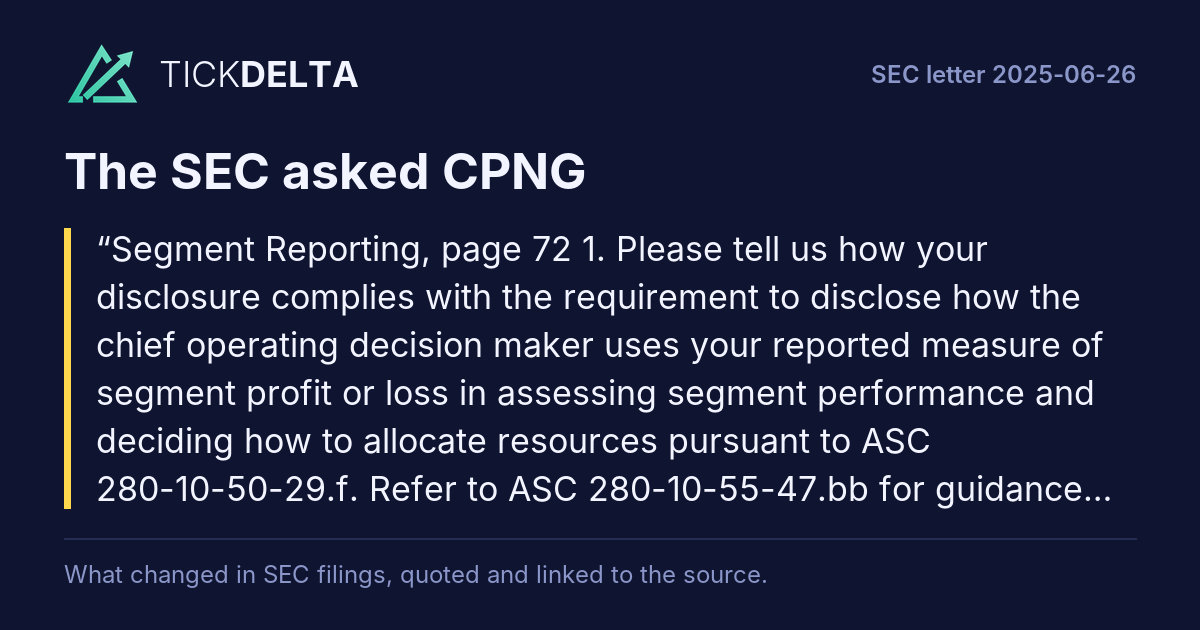
Segment Reporting, page 72 1. Please tell us how your disclosure complies with the requirement to disclose how the chief operating decision maker uses your reported measure of segment profit or loss in assessing segment performance and deciding how to allocate resources pursuant to ASC 280-10-50-29.f. Refer to ASC 280-10-55-47.bb for guidance.Rest of the question
Please tell us how you considered whether costs included in “operating, general and administrative” expenses were significant segment expenses in accordance with ASC 280-10-50-26A, or other segment items in accordance with ASC 280-10-50-26B. In defining segment adjusted EBITDA, you state “other segment items in reconciling from net revenues by segment to Segment Adjusted EBITDA include cost of sales, operating, general and administrative expense, and the adjustments described below." However, it appears from the table on page 73 that cost of sales is a significant segment expense. Please advise. After considering the points above, please also revise 2. to present any costs included in Segment Adjusted EBITDA that are not deemed significant segment expenses as other segment items on a segment basis. We remind you that the company and its management are responsible for the accuracy and adequacy of their disclosures, notwithstanding any review, comments, action or absence of action by the staff.
We respectfully acknowledge the Staff’s comment. In our Form 10-Q for the quarter ended June 30, 2025 as well as in future annual filings, we will expand our disclosure as follows:Read in the reply
The CODM uses two profitability measures, Segment Adjusted EBITDA and Segment Gross Profit, in assessing segment performance and allocating resources to each segment. Segment Adjusted EBITDA and Segment Gross Profit are evaluated on a monthly basis by our CODM by monitoring actual results versus prior periods.Rest of the answer
This comparison is performed to make strategic assessments and decisions regarding segment profitability, resource allocation, pricing strategies and cost optimization and whether to reinvest profits into each of these segments or into other initiatives.
2.Please tell us how you considered whether costs included in “operating, general and administrative” expenses were significant segment expenses in accordance with ASC 280-10-50-26A, or other segment items in accordance with ASC 280-10-50-26B.
In defining segment adjusted EBITDA, you state “other segment items in reconciling from net revenues by segment to Segment Adjusted EBITDA include cost of sales, operating, general and administrative expense, and the adjustments described below." However, it appears from the table on page 73 that cost of sales is a significant segment expense. Please advise. After considering the points above, please also revise to present any costs included in Segment Adjusted EBITDA that are not deemed significant segment expenses as other segment items on a segment basis.
We respectfully acknowledge the Staff’s comment. We advise the Staff that costs included in “operating, general and administrative” expenses are included in other segment items and do not include significant segment expenses regularly provided to the Chief Operating Decision Maker (“CODM”). The CODM is regularly provided Segment Adjusted EBITDA and Segment Gross Profit, from which segment cost of sales expense is easily computable. Accordingly, the disclosure included in our Form 10-K for the fiscal year ended December 31, 2024 disclosed segment cost of sales as a significant segment expense in accordance with ASC 280-10-50-26A. However, in addition to there being no expense information regularly provided to the CODM, the information regularly provided to the CODM does not provide the CODM enough information to easily compute other expenses categories included in reported segment profit or loss measures. Due to the adjustments for depreciation and amortization, equity-based compensation expense, impairments and other items that we do not believe are reflective of our ongoing operations included in both “cost of sales” and “operating, general and administrative” expense, the difference between Segment Gross Profit and Segment Adjusted EBITDA does not allow the CODM to easily compute “operating, general and administrative” expenses.
In our Form 10-Q for the quarter ended June 30, 2025, as well as, future interim and annual filings we will revise our disclosure to clarify the presentation of these other segment items as follows:
Segment Adjusted EBITDA is defined as income (loss) before income taxes for a period before depreciation and amortization, equity-based compensation expense, interest expense, interest income, and other income (expense), net. Segment adjusted EBITDA also excludes impairments and other items that we do not believe are reflective of our ongoing operations. Other segment items in reconciling from net revenues by segment to Segment Adjusted EBITDA include cost of sales, operating, general and administrative expense, and the adjustments described below.
Reportable segment financial information is as follows:
(in millions) 2024 2023 2022
Net revenues
Product Commerce $ 26,699 $ 23,594 $ 19,955
Developing Offerings 3,569 789 628
Total net revenues $ 30,268 $ 24,383 $ 20,583
Cost of sales
Product Commerce $ 18,594 $ 17,313 $ 15,280
Developing Offerings 2,843 880 593
Total cost of sales $ 21,437 $ 18,193 $ 15,873
Gross profit
Product Commerce $ 8,105 $ 6,282 $ 4,675
Developing Offerings 726 (91) 35
Total gross profit $ 8,831 $ 6,190 $ 4,710
Other segment items (1)
Product Commerce $ 6,099 $ 4,742 $ 4,069
Developing Offerings 1,357 375 260
Total other segment items $ 7,456 $ 5,116 $ 4,329
Segment adjusted EBITDA
Product Commerce $ 2,006 $ 1,540 $ 606
Developing Offerings (631) (466) (225)
Total segment adjusted EBITDA $ 1,375 $ 1,074 $ 381
(1)Other segment items relate to operating, general and administrative expense, excluding depreciation and amortization, equity-based compensation expense, impairments and other items that we do not believe are reflective of our ongoing operations. The CODM does not regularly review disaggregated expense information included within “Other segment items” for any individual segment.
Reconciliations of segment profit or loss:
Operating, general and administrative (8,395) (5,717) (4,822)
Interest expense (140) (48) (27)
Interest income 216 178 53
Other expense, net (39) (19) (7)
Income (loss) before income taxes $ 473 $ 584 $ (93)
Depreciation and amortization (433) (275) (231)
Equity-based compensation (433) (326) (262)
Acquisition and restructuring related costs (127) — —
KFTC administrative fine (see Note 14) (121) — —
FC Fire insurance gain 175 — —
Note: Amounts may not foot due to rounding.
Also in this review: request for more time, Jun 30, 2025, closing letter, 2025-07-28