Paragraph 82 · 44% changed
Every version of it
Screener
/
SEC EDGAR
/CIK 0001530721
/10-K filed May 27, 2026, compared with May 28, 2025
/Numbers from the XBRL of the 10-Ks
NYSE
Consumer discretionary · Leather Goods
Capri Holdings Ltd CPRI
The 10-K against last year's
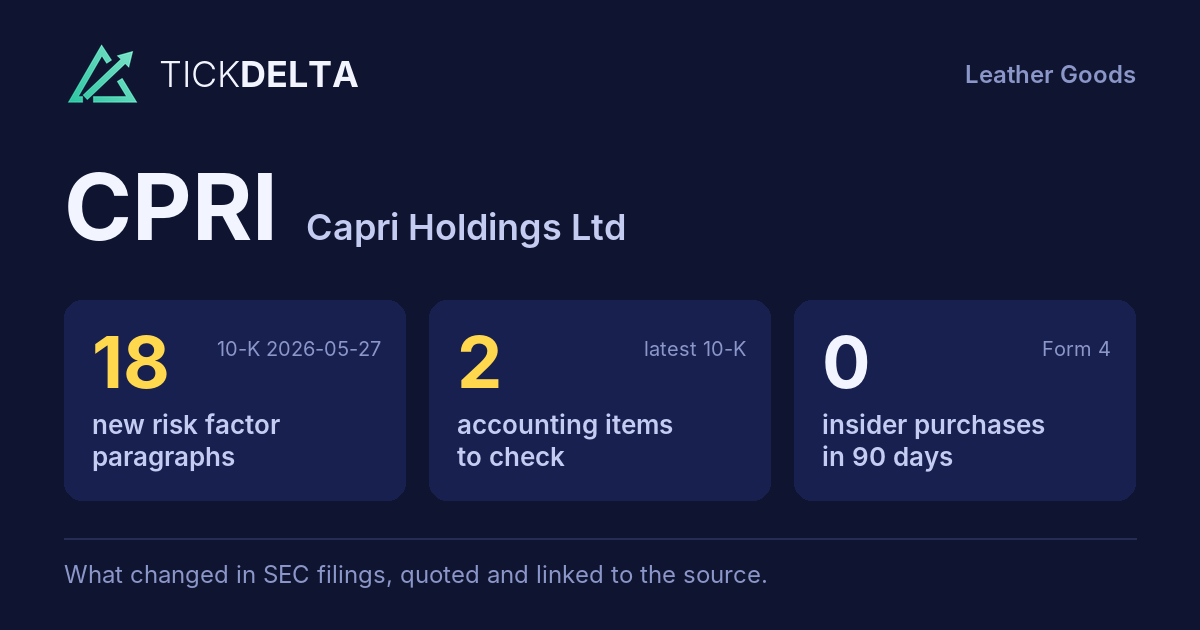
209 changes: 34 added, 53 removed, 121 reworded, 1 quiet changes
10-K May 27, 2026 vs May 28, 2025
Risk Factors
19.4%
of the text changed · 12,704 words now · 18 new paragraphs, 17 gone
MD&A
44.1%
of the text changed · 10,166 words now · 16 new paragraphs, 36 gone
Legal Proceedings
26.4%
of the text changed · 260 words now
Accounting Policies
19.6%
of the text changed · 5,725 words now
10-K 0001530721-26-000047 (May 27, 2026) vs 10-K 0001530721-25-000052 (May 28, 2025)
Every paragraph, and how much of it changed
One bar per paragraph, in the order of the 10-K. Height and colour show the share of its words not in the closest paragraph a year earlier; the tallest bars are new paragraphs.
Risk Factors
149 paragraphs · 18 new · 39 reworded · 17 gone · 10-K May 27, 2026 against May 28, 2025
New paragraph
Reworded (5% of its words or more)
Same or nearly
Paragraph 24 · 43% changed
Every version of it
There are risks inherent to importing our products. Virtually all of our imported products are subject to duties which may impact the cost of such products. In April 2025, the U.S. Government announced tariffs on imports from select countries. The majority addition, all of the Company's our products sold in the U.S. are imported from foreign countries in which these tariffs were announced, including Vietnam, Cambodia, Indonesia and Bangladesh, where the primary manufacturers of Michael Kors products are located. In addition, retaliatory tariffs located, and are therefore subject to changes in U.S. and international trade policies. Trade actions, including tariffs, safeguard measures, quotas, or other import restrictions, may be implemented by countries imposed, modified, challenged, or replaced from time to time under various legal authorities, and the scope, duration, and applicability of such measures can be unpredictable. Refunds or relief from tariffs or duties, where available, are subject to administrative review, timing delays, and changes in interpretation or enforcement, and there can be no assurance that such amounts will be recovered, or recovered in a timely manner, which could adversely affect operating income and cash flows. Countries where our manufacturers products are located and/or countries manufactured or sold may implement retaliatory measures or impose additional restrictions in response to which changes in U.S. trade policy. While we ship our products may impose safeguard quotas seek to limit mitigate the quantity impact of products that may be imported. Where we can, we rely on trade measures through sourcing strategies, free trade agreements and other supply chain initiatives in order to maximize efficiencies relating to product importation. Increased where available, increased tariffs or other trade restrictions against countries where our products are manufactured, and/or any tariffs or other trade restrictions implemented by these countries in retaliation, uncertainty regarding their application, could limit our ability to manufacture products in countries that have the labor and technical expertise needed and we may not be able to find alternative sourcing options in a timely manner or at all. In addition, such tariffs or other trade restrictions could require us to incur significant costs or cause Such measures may also force us to increase the price charged to consumers for our products, either prices, absorb higher costs, or adjust sourcing arrangements, any of which could materially impact adversely affect our revenue and profitability. Our ability to navigate any uncertainty, changes or expansion in tariffs or other trade restrictions could have a material negative impact on our business, revenue, profitability, results of operations and or financial condition.
Paragraph 33 · 40% changed
Every version of it
•significant increase in fuel, freight, shipping and other logistics costs, costs or increased transit times, including as a result of disruptions at ports of entry; entry or international shipping routes (including the Red Sea corridor and other routes impacted by the conflicts in the Middle East);
Paragraph 103 · 37% changed
Every version of it
Our business business, including our retail, distribution and manufacturing operations, is susceptible to the physical and transitional risks associated with climate change and other environmental impacts which that could negatively affect our business and operations. For example, the acute and chronic physical risks of climate change, such as increased severity of extreme weather
Paragraph 139 · 33% changed
Every version of it
Our share repurchase activity is subject to market conditions, liquidity, and other factors and may be limited, suspended, or discontinued at any time. If we are unable to conduct share repurchases at expected levels, our share price could be adversely affected.
Paragraph 2 · 32% changed
Every version of it
The accessories, footwear and apparel industries are heavily influenced by general macroeconomic cycles that affect consumer spending and a prolonged period of depressed consumer spending could have a material adverse effect on materially adversely affect demand for our business, results of operations products, pricing dynamics and financial condition. our ability to manage inventory levels and margins.
Paragraph 89 · 27% changed
Every version of it
Our results of operations for our international subsidiaries are exposed to foreign exchange rate fluctuations as the financial results of the applicable subsidiaries are translated from the local currency into United States dollar during financial statement consolidation. If the United States dollar strengthens against foreign currencies, the translation of these foreign currency denominated transactions could impact our consolidated results of operations. In addition, we have had in the past, and may again in the future have, intercompany notes amongst certain of our non-United States subsidiaries, which may be denominated in a currency other than the functional currency of a particular reporting entity. As a result of using a currency other than the functional currency of the related subsidiary, results of these operations may be adversely affected during times of significant fluctuation between the functional currency of that subsidiary and the denomination currency of the note. We continuously monitor our foreign currency exposure and hedge a portion of our foreign subsidiaries’ foreign currency-denominated inventory purchases to minimize the impact of changes in foreign currency exchange rates. However, As of March 28, 2026, we have $3.5 billion of hedges outstanding to hedge our net investment in Swiss Franc denominated subsidiaries with contract maturity dates between March 2027 and May 2045, and $2.364 billion of fixed-to-fixed cross-currency hedges outstanding related to our net investment in Euro denominated subsidiaries with contract maturity dates between December 2027 and July 2031. We cannot fully anticipate all of our foreign currency exposures and cannot ensure that these hedges will fully offset the impact of foreign currency exchange rate fluctuations and no hedging strategy can completely insulate us from foreign currency exchange risk. We also use forward foreign Certain of these net investment hedge contracts are supported by credit support annexes which provide for collateral exchange contracts and cross-currency swap contracts to hedge our net investments if the fair value of a derivative contract exceeds a certain threshold, with the earliest effective date being June 2030. Adverse movements in foreign operations against future volatility in the exchange rates between different currencies. We are exposed to risks related to foreign currency exchange rate movements on our net investments in foreign operations due to the volatility in the exchange rates between different functional currencies. A 10% appreciation or devaluation of the United States dollar compared to the level of foreign currency exchange rates for currencies under contract as of March 29, 2025, would or interest rates could result in a net increase or decrease, respectively, of approximately $365 million significant collateral posting requirements in the fair value future, which could negatively affect our liquidity, reduce cash available for operations and capital allocation, or require us to obtain additional financing on unfavorable terms. In addition, market disruptions, regulatory or accounting changes, counterparty defaults, or early termination events could increase the cost of maintaining or replacing these contracts.
Paragraph 68 · 26% changed
Every version of it
We perform impairment assessments of goodwill and indefinite-lived intangible assets on an annual basis or whenever impairment indicators exist. Judgments regarding the existence of impairment indicators are based on market conditions and operational performance of the business. In the absence of any impairment indicators, goodwill and indefinite-lived intangible assets are assessed for impairment during the fourth quarter of each fiscal year. If the testing performed indicates that impairment exists, we are required to record impairment charges for the difference between the carrying value of the goodwill or intangible assets and the implied fair value of the goodwill and/or intangible assets in the period the determination is made. Goodwill and intangible asset impairment charges have in the past been, and could in the future be, significant. It is also possible that our conclusions regarding impairment or recoverability of goodwill or other intangible assets could change in future periods if, for example, (i) our businesses do not perform as projected, (ii) overall economic conditions in future years vary from current assumptions, (iii) business conditions or strategies change from our current assumptions, (iv) discount rates change, (v) market multiples change or (vi) the identification of our reporting units change, among other factors. Such changes could result in future impairment charges of goodwill or other intangible assets and such amounts could be significant, which could have a material adverse impact on our results of operations and financial condition.
Paragraph 82 · 44% changed
Every version of it
10-K May 28, 2025We are increasingly looking for opportunities to cost effectively enhance the capability of business services, which includes outsourcing certain functions. While we believe we conduct appropriate due diligence before entering into agreements with these third-party service providers, the failure of any of these third-parties to provide the expected services, provide them on a timely basis or to provide them at the prices we expect could disrupt or harm our business. Any significant interruption in the operations of these outsource service providers, including as a result of changes in social, political, and economic conditions, and those resulting from military conflicts or other hostilities, that result in the disruptions of business where these outsource providers are located, could also have an adverse effect on our business. Furthermore, we may be unable to provide these services ourselves in the future or implement substitute arrangements on a timely and cost-effective basis on terms favorable to us.
10-K May 27, 2026
outsource providers are located, could also have an adverse effect on our business. Furthermore, we may be unable to provide these services ourselves in the future or implement substitute arrangements on a timely and cost-effective basis on terms favorable to us.
Paragraph 24 · 43% changed
Every version of it
10-K May 28, 2025
There are risks inherent to importing our products. Virtually all of our imported products are subject to duties which may impact the cost of such products. In April 2025, the U.S. Government announced tariffs on imports from select countries. The majority of the Company's products sold in the U.S. are imported from countries in which these tariffs were announced, including Vietnam, Cambodia, Indonesia and Bangladesh, where the primary manufacturers of Michael Kors products are located. In addition, retaliatory tariffs may be implemented by countries where our manufacturers are located and/or countries to which we ship our products may impose safeguard quotas to limit the quantity of products that may be imported. Where we can, we rely on free trade agreements and other supply chain initiatives in order to maximize efficiencies relating to product importation. Increased tariffs or other trade restrictions against countries where our products are manufactured, and/or any tariffs or other trade restrictions implemented by these countries in retaliation, could limit our ability to manufacture products in countries that have the labor and technical expertise needed and we may not be able to find alternative sourcing options in a timely manner or at all. In addition, such tariffs or other trade restrictions could require us to incur significant costs or cause us to increase the price charged to consumers for our products, either of which could materially impact our revenue and profitability. Our ability to navigate any uncertainty, changes or expansion in tariffs or other trade restrictions could have a material negative impact on our business, results of operations and financial condition.
10-K May 27, 2026
There are risks inherent to importing our products. Virtually all of our imported products are subject to duties which may impact the cost of such products. In addition, all of our products sold in the U.S. are imported from foreign countries including Vietnam, Cambodia, Indonesia and Bangladesh, where the primary manufacturers of Michael Kors products are located, and are therefore subject to changes in U.S. and international trade policies. Trade actions, including tariffs, safeguard measures, quotas, or other import restrictions, may be imposed, modified, challenged, or replaced from time to time under various legal authorities, and the scope, duration, and applicability of such measures can be unpredictable. Refunds or relief from tariffs or duties, where available, are subject to administrative review, timing delays, and changes in interpretation or enforcement, and there can be no assurance that such amounts will be recovered, or recovered in a timely manner, which could adversely affect operating income and cash flows. Countries where our products are manufactured or sold may implement retaliatory measures or impose additional restrictions in response to changes in U.S. trade policy. While we seek to mitigate the impact of trade measures through sourcing strategies, free trade agreements and other supply chain initiatives where available, increased tariffs or other trade restrictions or uncertainty regarding their application, could limit our ability to manufacture products in countries that have the labor and technical expertise needed and we may not be able to find alternative sourcing options in a timely manner or at all. Such measures may also force us to increase prices, absorb higher costs, or adjust sourcing arrangements, any of which could materially adversely affect our revenue, profitability, results of operations or financial condition.
Paragraph 33 · 40% changed
Every version of it
10-K May 28, 2025
•significant increase in freight, shipping and other logistics costs, including as a result of disruptions at ports of entry;
10-K May 27, 2026
•significant increase in fuel, freight, shipping and other logistics costs or increased transit times, including as a result of disruptions at ports of entry or international shipping routes (including the Red Sea corridor and other routes impacted by the conflicts in the Middle East);
Paragraph 103 · 37% changed
Every version of it
10-K May 28, 2025
Our business is susceptible to the risks associated with climate change and other environmental impacts which could negatively affect our business and operations.
10-K May 27, 2026
Our business, including our retail, distribution and manufacturing operations, is susceptible to the physical and transitional risks associated with climate change and other environmental impacts that could negatively affect our business and operations. For example, the acute and chronic physical risks of climate change, such as increased severity of extreme weather
Paragraph 139 · 33% changed
Every version of it
10-K May 28, 2025
If we are unable to conduct share repurchases at expected levels, our share price could be adversely affected.
10-K May 27, 2026
Our share repurchase activity is subject to market conditions, liquidity, and other factors and may be limited, suspended, or discontinued at any time. If we are unable to conduct share repurchases at expected levels, our share price could be adversely affected.
Paragraph 2 · 32% changed
Every version of it
10-K May 28, 2025
The accessories, footwear and apparel industries are heavily influenced by general macroeconomic cycles that affect consumer spending and a prolonged period of depressed consumer spending could have a material adverse effect on our business, results of operations and financial condition.
10-K May 27, 2026
The accessories, footwear and apparel industries are heavily influenced by general macroeconomic cycles that affect consumer spending and a prolonged period of depressed consumer spending could materially adversely affect demand for our products, pricing dynamics and our ability to manage inventory levels and margins.
Paragraph 89 · 27% changed
Every version of it
10-K May 28, 2025
Our results of operations for our international subsidiaries are exposed to foreign exchange rate fluctuations as the financial results of the applicable subsidiaries are translated from the local currency into United States dollar during financial statement consolidation. If the United States dollar strengthens against foreign currencies, the translation of these foreign currency denominated transactions could impact our consolidated results of operations. In addition, we have intercompany notes amongst certain of our non-United States subsidiaries, which may be denominated in a currency other than the functional currency of a particular reporting entity. As a result of using a currency other than the functional currency of the related subsidiary, results of these operations may be adversely affected during times of significant fluctuation between the functional currency of that subsidiary and the denomination currency of the note. We continuously monitor our foreign currency exposure and hedge a portion of our foreign subsidiaries’ foreign currency-denominated inventory purchases to minimize the impact of changes in foreign currency exchange rates. However, we cannot fully anticipate all of our foreign currency exposures and cannot ensure that these hedges will fully offset the impact of foreign currency exchange rate fluctuations and no hedging strategy can completely insulate us from foreign currency exchange risk. We also use forward foreign exchange contracts and cross-currency swap contracts to hedge our net investments in foreign operations against future volatility in the exchange rates between different currencies. We are exposed to risks related to foreign currency exchange rate movements on our net investments in foreign operations due to the volatility in the exchange rates between different functional currencies. A 10% appreciation or devaluation of the United States dollar compared to the level of foreign currency exchange rates for currencies under contract as of March 29, 2025, would result in a net increase or decrease, respectively, of approximately $365 million in the fair value of these contracts.
10-K May 27, 2026
Our results of operations for our international subsidiaries are exposed to foreign exchange rate fluctuations as the financial results of the applicable subsidiaries are translated from the local currency into United States dollar during financial statement consolidation. If the United States dollar strengthens against foreign currencies, the translation of these foreign currency denominated transactions could impact our consolidated results of operations. In addition, we have had in the past, and may again in the future have, intercompany notes amongst certain of our non-United States subsidiaries, which may be denominated in a currency other than the functional currency of a particular reporting entity. As a result of using a currency other than the functional currency of the related subsidiary, results of these operations may be adversely affected during times of significant fluctuation between the functional currency of that subsidiary and the denomination currency of the note. We continuously monitor our foreign currency exposure and hedge a portion of our foreign subsidiaries’ foreign currency-denominated inventory purchases to minimize the impact of changes in foreign currency exchange rates. As of March 28, 2026, we have $3.5 billion of hedges outstanding to hedge our net investment in Swiss Franc denominated subsidiaries with contract maturity dates between March 2027 and May 2045, and $2.364 billion of fixed-to-fixed cross-currency hedges outstanding related to our net investment in Euro denominated subsidiaries with contract maturity dates between December 2027 and July 2031. We cannot fully anticipate all of our foreign currency exposures and cannot ensure that these hedges will fully offset the impact of foreign currency exchange rate fluctuations and no hedging strategy can completely insulate us from foreign currency exchange risk. Certain of these net investment hedge contracts are supported by credit support annexes which provide for collateral exchange if the fair value of a derivative contract exceeds a certain threshold, with the earliest effective date being June 2030. Adverse movements in foreign currency exchange rates or interest rates could result in significant collateral posting requirements in the future, which could negatively affect our liquidity, reduce cash available for operations and capital allocation, or require us to obtain additional financing on unfavorable terms. In addition, market disruptions, regulatory or accounting changes, counterparty defaults, or early termination events could increase the cost of maintaining or replacing these
Paragraph 68 · 26% changed
Every version of it
10-K May 28, 2025
possible that our conclusions regarding impairment or recoverability of goodwill or other intangible assets could change in future periods if, for example, (i) our businesses do not perform as projected, (ii) overall economic conditions in future years vary from current assumptions, (iii) business conditions or strategies change from our current assumptions, (iv) discount rates change, (v) market multiples change or (vi) the identification of our reporting units change, among other factors. Such changes could result in future impairment charges of goodwill or other intangible assets and such amounts could be significant, which could have a material adverse impact on our results of operations and financial condition.
10-K May 27, 2026
We perform impairment assessments of goodwill and indefinite-lived intangible assets on an annual basis or whenever impairment indicators exist. Judgments regarding the existence of impairment indicators are based on market conditions and operational performance of the business. In the absence of any impairment indicators, goodwill and indefinite-lived intangible assets are assessed for impairment during the fourth quarter of each fiscal year. If the testing performed indicates that impairment exists, we are required to record impairment charges for the difference between the carrying value of the goodwill or intangible assets and the implied fair value of the goodwill and/or intangible assets in the period the determination is made. Goodwill and intangible asset impairment charges have in the past been, and could in the future be, significant. It is also possible that our conclusions regarding impairment or recoverability of goodwill or other intangible assets could change in future periods if, for example, (i) our businesses do not perform as projected, (ii) overall economic conditions in future years vary from current assumptions, (iii) business conditions or strategies change from our current assumptions, (iv) discount rates change, (v) market multiples change or (vi) the identification of our reporting units change, among other factors. Such changes could result in future impairment charges of goodwill or other intangible assets and such amounts could be significant, which could have a material adverse impact on our results of operations and financial condition.
MD&A
135 paragraphs · 16 new · 90 reworded · 36 gone · 10-K May 27, 2026 against May 28, 2025
New paragraph
Reworded (5% of its words or more)
Same or nearly
Paragraph 37 · 50% changed
Paragraph 12 · 48% changed
Foreign currency fluctuation. fluctuation and foreign currency hedging instruments. Our consolidated operations are results were impacted by the relationships movements in foreign currency exchange rates between our reporting currency, the United States dollar, and those the functional currency of our non-United States subsidiaries whose functional/local currency is other than the United States dollar, subsidiaries, primarily the Euro, the British Pound, the Chinese Renminbi and the Japanese Yen, among others. Currency volatility impacted our Fiscal 2026 reported results and contributed, or are expected to contribute, to variability of results in prior and future periods. We continue also utilize derivative instruments, including cross-currency hedges, to expect volatility in the global manage foreign currency exposure associated with our net investments in foreign subsidiaries, which can help mitigate, but does not eliminate, the impact of foreign exchange rates, which may have a negative impact on fluctuations, and the reported results of certain effectiveness of our non-United States subsidiaries in hedging strategies may vary based on market conditions and the future, when translated to the United States dollar. timing and magnitude of currency movements.
Paragraph 69 · 46% changed
Paragraph 47 · 42% changed
Paragraph 89 · 40% changed
During Fiscal 2025, we recognized restructuring and other expense of $7 $5 million, primarily related to severance and store closure costs, partially offset by gains on lease terminations. During Fiscal 2024, we recognized net restructuring and other expense of $33 million, primarily relating to severance costs in connection with the Global Optimization Plan and equity awards associated with the acquisition of Versace partially offset by a $10 million gain on the sale of a long-lived corporate asset (see Note 11 to the accompanying consolidated financial statements for additional information). expenses were immaterial.
Paragraph 36 · 38% changed
Based on the results of these assessments, we determined there was no impairment for the Jimmy Choo Wholesale and Licensing reporting unit unit’s goodwill as the fair value exceeded was higher than the related carrying value. However, we concluded that the fair value of the Jimmy Choo Wholesale reporting unit goodwill and Retail and Wholesale brand indefinite-lived intangible assets did not exceed their related carrying amounts and we recorded impairment. These impairment charges were primarily related to a decline in revenue driven by softening demand globally for fashion luxury goods. Accordingly, we recorded goodwill impairment charges of $66 million related to the Jimmy Choo Wholesale reporting unit that has a remaining balance of $27 million. The Jimmy Choo Retail reporting unit’s goodwill balance was fully impaired during Fiscal 2024. We also recorded Further, we concluded there was no impairment charges of $15 million related to for the Jimmy Choo Retail and Wholesale brand intangible assets that have remaining balances of $151 million and $53 million, respectively.
Paragraph 112 · 38% changed
Net cash used in financing activities was $208 million $1.3 billion during Fiscal 2024, 2026, as compared to $776 $242 million used in financing activities during Fiscal 2023. 2025. The decrease increase in cash used in financing activities of $568 million was primarily attributable to a decrease in cash payments to repurchase our ordinary shares of $1.257 billion, offset by lower higher net debt borrowings repayments of $689 million compared to prior year. $1 billion from the cash proceeds received from the closing of the sale of the Versace business.
Paragraph 68 · 37% changed
During Fiscal 2025, 2026, we recognized $452 $27 million of an income tax provision on compared to a pre-tax loss provision of $727 million compared with $54 million of income tax benefit on a pre-tax loss of $283 $524 million for Fiscal 2024. 2025. Our effective tax rate for Fiscal 2025 2026 compared to our effective tax rate in Fiscal 2024 2025 is not a meaningful metric due to the increased pre-tax loss for Fiscal 2025. The income tax provision of $452 million was primarily related to the full valuation allowance recorded against the Company's net deferred tax assets (see Note 18 to the accompanying consolidated financial statements for additional information).
Paragraph 37 · 50% changed
10-K May 28, 2025Based on the results of these assessments, we determined there was no impairment for the Jimmy Choo Licensing reporting unit goodwill as the fair value exceeded the related carrying value. However, we concluded that the fair value of the Jimmy Choo Wholesale reporting unit goodwill and Retail and Wholesale brand indefinite-lived intangible assets did not exceed their related carrying amounts and we recorded impairment. These impairment charges were primarily related to a decline in revenue driven by softening demand globally for fashion luxury goods. Accordingly, we recorded goodwill impairment charges of $66 million related to the Jimmy Choo Wholesale reporting unit that has a remaining balance of $27 million. The Jimmy Choo Retail reporting unit’s goodwill balance was fully impaired during Fiscal 2024. We also recorded impairment charges of $15 million related to the Jimmy Choo Retail and Wholesale brand intangible assets that have remaining balances of $151 million and $53 million, respectively.
10-K May 27, 2026
Jimmy Choo Wholesale reporting unit’s brand intangible asset as the fair value was higher than the related carrying value. There was also no impairment for the Jimmy Choo Retail brand intangible asset as the fair value exceeded its carrying value by approximately 6% which has a remaining net carrying value of $155 million.
Paragraph 12 · 48% changed
10-K May 28, 2025
Foreign currency fluctuation. Our consolidated operations are impacted by the relationships between our reporting currency, the United States dollar, and those of our non-United States subsidiaries whose functional/local currency is other than the United States dollar, primarily the Euro, the British Pound, the Chinese Renminbi and the Japanese Yen, among others. We continue to expect volatility in the global foreign currency exchange rates, which may have a negative impact on the reported results of certain of our non-United States subsidiaries in the future, when translated to the United States dollar.
10-K May 27, 2026
Foreign currency fluctuation and foreign currency hedging instruments. Our consolidated results were impacted by movements in foreign currency exchange rates between our reporting currency, the United States dollar, and the functional currency of our non-United States subsidiaries, primarily the Euro, the British Pound, the Chinese Renminbi and the Japanese Yen, among others. Currency volatility impacted our Fiscal 2026 reported results and contributed, or are expected to contribute, to variability of results in prior and future periods. We also utilize derivative instruments, including cross-currency hedges, to manage foreign currency exposure associated with our net investments in foreign subsidiaries, which can help mitigate, but does not eliminate, the impact of foreign exchange fluctuations, and the effectiveness of our hedging strategies may vary based on market conditions and the timing and magnitude of currency movements.
Paragraph 69 · 46% changed
10-K May 28, 2025See Note 4 to the accompanying consolidated financial statements for additional information.
10-K May 27, 2026
due to the full valuation allowance recorded against our net deferred tax asset in the prior year. Refer to Note 19 - “Income Taxes” to the accompanying consolidated financial statements for additional information.
Paragraph 47 · 42% changed
10-K May 28, 2025•Jimmy Choo revenues decreased $13 million, or 2.1%, to $605 million during Fiscal 2025, compared to $618 million for Fiscal 2024, which included unfavorable foreign currency effects of $4 million. On a constant currency basis, revenue decreased $9 million, or 1.5%, primarily attributable to softening demand globally for fashion luxury goods partially offset by higher revenues in EMEA.
10-K May 27, 2026
•Michael Kors revenues decreased $142 million, or 4.7%, to $2.874 billion during Fiscal 2026, compared to $3.016 billion for Fiscal 2025, which included favorable foreign currency effects of $55 million. On a constant currency basis, revenue decreased $197 million, or 6.5%, primarily driven by our quality of sale initiatives, as we reduced promotional activity and reduced discounted third party sales and off-price shipments.
Paragraph 89 · 40% changed
10-K May 28, 2025
During Fiscal 2025, we recognized restructuring and other expense of $7 million, primarily related to severance and store closure costs, partially offset by gains on lease terminations. During Fiscal 2024, we recognized restructuring and other expense of $33 million, primarily relating to severance costs in connection with the Global Optimization Plan and equity awards associated with the acquisition of Versace partially offset by a $10 million gain on the sale of a long-lived corporate asset (see Note 11 to the accompanying consolidated financial statements for additional information).
10-K May 27, 2026
During Fiscal 2025, we recognized restructuring and other expense of $5 million, primarily related to severance and store closure costs, partially offset by gains on lease terminations. During Fiscal 2024, net restructuring expenses were immaterial.
Paragraph 36 · 38% changed
10-K May 28, 2025
Based on the results of these assessments, we determined there was no impairment for the Jimmy Choo Licensing reporting unit goodwill as the fair value exceeded the related carrying value. However, we concluded that the fair value of the Jimmy Choo Wholesale reporting unit goodwill and Retail and Wholesale brand indefinite-lived intangible assets did not exceed their related carrying amounts and we recorded impairment. These impairment charges were primarily related to a decline in revenue driven by softening demand globally for fashion luxury goods. Accordingly, we recorded goodwill impairment charges of $66 million related to the Jimmy Choo Wholesale reporting unit that has a remaining balance of $27 million. The Jimmy Choo Retail reporting unit’s goodwill balance was fully impaired during Fiscal 2024. We also recorded impairment charges of $15 million related to the Jimmy Choo Retail and Wholesale brand intangible assets that have remaining balances of $151 million and $53 million, respectively.
10-K May 27, 2026
Based on the results of these assessments, we determined there was no impairment for the Jimmy Choo Wholesale and Licensing reporting unit’s goodwill as the fair value was higher than the related carrying value. The Jimmy Choo Retail reporting unit’s goodwill balance was fully impaired during Fiscal 2024. Further, we concluded there was no impairment for the
Paragraph 112 · 38% changed
10-K May 28, 2025
Net cash used in financing activities was $208 million during Fiscal 2024, as compared to $776 million during Fiscal 2023. The decrease in cash used in financing activities of $568 million was primarily attributable to a decrease in cash payments to repurchase our ordinary shares of $1.257 billion, offset by lower net debt borrowings of $689 million compared to prior year.
10-K May 27, 2026
Net cash used in financing activities was $1.3 billion during Fiscal 2026, as compared to $242 million used in financing activities during Fiscal 2025. The increase in cash used in financing activities was primarily attributable to higher net debt repayments of $1 billion from the cash proceeds received from the closing of the sale of the Versace business.
Paragraph 68 · 37% changed
10-K May 28, 2025
During Fiscal 2025, we recognized $452 million of an income tax provision on a pre-tax loss of $727 million compared with $54 million of income tax benefit on a pre-tax loss of $283 million for Fiscal 2024. Our effective tax rate for Fiscal 2025 compared to our effective tax rate in Fiscal 2024 is not a meaningful metric due to the increased pre-tax loss for Fiscal 2025. The income tax provision of $452 million was primarily related to the full valuation allowance recorded against the Company's net deferred tax assets (see Note 18 to the accompanying consolidated financial statements for additional information).
10-K May 27, 2026
During Fiscal 2026, we recognized $27 million of an income tax provision compared to a provision of $524 million for Fiscal 2025. Our effective tax rate for Fiscal 2026 compared to our effective tax rate in Fiscal 2025 is not a meaningful metric
A paragraph is matched with the one last year that shares the most of its words; under half in common makes it new. The paragraphs shown are the 8 reworded the most in each section.
The paragraph that changed most in each section
The redline
Marked against last year's 10-K: cut words struck through, new words highlighted.
Risk Factors288 words changed in this paragraph; it is 47% similar to last year's version.
There are risks inherent to importing our products. Virtually all of our imported products are subject to duties which may impact the cost of such products. In April 2025, the U.S. Government announced tariffs on imports from select countries. The majority addition, all of the Company's our products sold in the U.S. are imported from foreign countries in which these tariffs were announced, including Vietnam, Cambodia, Indonesia and Bangladesh, where the primary manufacturers of Michael Kors products are located. In addition, retaliatory tariffs located, and are therefore subject to changes in U.S. and international trade policies. Trade actions, including tariffs, safeguard measures, quotas, or other import restrictions, may be implemented by countries imposed, modified, challenged, or replaced from time to time under various legal authorities, and the scope, duration, and applicability of such measures can be unpredictable. Refunds or relief from tariffs or duties, where available, are subject to administrative review, timing delays, and changes in interpretation or enforcement, and there can be no assurance that such amounts will be recovered, or recovered in a timely manner, which could adversely affect operating income and cash flows. Countries where our manufacturers products are located and/or countries manufactured or sold may implement retaliatory measures or impose additional restrictions in response to which changes in U.S. trade policy. While we ship our products may impose safeguard quotas seek to limit mitigate the quantity impact of products that may be imported. Where we can, we rely on trade measures through sourcing strategies, free trade agreements and other supply chain initiatives in order to maximize efficiencies relating to product importation. Increased where available, increased tariffs or other trade restrictions against countries where our products are manufactured, and/or any tariffs or other trade restrictions implemented by these countries in retaliation, uncertainty regarding their application, could limit our ability to manufacture products in countries that have the labor and technical expertise needed and we may not be able to find alternative sourcing options in a timely manner or at all. In addition, such tariffs or other trade restrictions could require us to incur significant costs or cause Such measures may also force us to increase the price charged to consumers for our products, either prices, absorb higher costs, or adjust sourcing arrangements, any of which could materially impact adversely affect our revenue and profitability. Our ability to navigate any uncertainty, changes or expansion in tariffs or other trade restrictions could have a material negative impact on our business, revenue, profitability, results of operations and or financial condition.
Source: Item 1A, 10-K 0001530721-26-000047 vs Item 1A, 10-K 0001530721-25-000052
MD&A210 words changed in this paragraph; it is 31% similar to last year's version.
Macroeconomic conditions and inflationary pressures. Global economic conditions conditions, including inflationary pressure, geopolitical instability due to war or other geopolitical factors (such as the conflicts in the Middle East) and broader macroeconomic uncertainty and the related impact on levels of consumer spending worldwide impacted our business in Fiscal 2025, 2026, and are likely to continue to impact our business and the luxury accessories, footwear and apparel industry overall for the foreseeable future. Inflation, rising interest rates, higher fuel Given the discretionary nature of our products, fluctuations in consumer confidence and energy costs and commodity prices, reductions in net worth based on stock market declines and uncertainty, home prices, credit availability and consumer debt levels, political instability due to war or other geopolitical factors, including the presidential change in the U.S., and other macroeconomic pressures and general uncertainty regarding the overall future economic environment along with tariffs and foreign currency fluctuations have created a challenging retail environment, which is expected to continue in the near term. There continues to be uncertainty in the current macroeconomic environment due to the above-mentioned items. Our revenue and earnings in future periods may be subject to significant material change disposable income, as a result of these and other macroeconomic factors. Purchases of discretionary luxury items, such well as the accessories, footwear and apparel that we produce tend to decline when disposable income is lower or when there are recessions, inflationary pressures or other economic uncertainty which could negatively affect elevated inflation impacts our financial condition and results of operations. business performance.
Source: Item 7, 10-K 0001530721-26-000047 vs Item 7, 10-K 0001530721-25-000052
Legal Proceedings142 words changed in this paragraph; it is 68% similar to last year's version.
On December 23, 2024 and January 28, 2025, two purported shareholders of Capri filed putative class action complaints in the United States District Court for the District of Delaware against Capri, Tapestry and certain of their officers (including John D. Idol, our Chairman and Chief Executive Officer, and Thomas J. Edwards, Jr., our former Chief Financial and Chief Operating Officer) alleging violations of the federal securities laws based on certain statements by defendants concerning the previously proposed Merger and the FTC’s action to enjoin the Merger. The Court appointed the lead plaintiff on March 7, 2025, and on May 15, 2025 2025, the lead plaintiff filed the Amended Federal Consolidated Securities Law Complaint. The Amended Federal Consolidated Securities Law Complaint seeks sought to bring federal securities claims on behalf of a class of all persons who purchased Capri stock and sold Capri puts between August 10, 2023 and October 24, 2024. We may incur substantial costs defending On March 31, 2026, the Amended Federal Court granted our motion to dismiss the Consolidated Securities Law Complaint, Complaint without prejudice. On April 30, 2026, plaintiff's filed the First Amended Complaint. This litigation remains pending. Defending this litigation, even where claims are ultimately resolved in our favor, is costly and we cannot provide assurance regarding the time‑consuming and an adverse outcome of in this Amended Federal Securities Law Complaint. An unfavorable judgment or ruling matter could result in substantial liability. We may also be subject to additional demands or filed actions. Our potential liability to shareholders for federal securities claims or other matters related to the previously terminated Merger may be covered in part by our insurance policies, but we monetary damages, which may not always have adequate insurance to defend all claims. be fully covered by available insurance.
Source: Item 3, 10-K 0001530721-26-000047 vs Item 3, 10-K 0001530721-25-000052
Accounting Policies111 words changed in this paragraph; it is 38% similar to last year's version.
Source: 10-K text, Note 3 – Summary of Significant Accounting Policies, 10-K 0001530721-26-000047 vs 10-K text, Note 3 – Summary of Significant Accounting Policies, 10-K 0001530721-25-000052
Sentences and paragraphs added, removed or reworded
Every change, by type
Sentences and paragraphs of CPRI's Risk Factors and MD&A, 10-K May 27, 2026 against 10-K May 28, 2025. Each links to the text at sec.gov.
Quiet changes are sentences kept from last year with one to four words changed, at least one of them a hedge, a modal or a qualifier (may, could, will, not, significant, material…). A year or date rolling forward is not counted.
The full word list
adverse, adversely, all, although, anticipate, anticipates, any, approximately, believe, believes, can, cannot, certain, could, expect, expects, generally, however, if, intend, intends, largely, likely, many, material, materially, may, might, most, must, never, no, not, possible, primarily, probable, should, significant, significantly, some, substantial, substantially, unlikely, will, would
AddedRisk Factors
Global economic conditions and the related impact on levels of consumer spending worldwide, particularly for luxury goods, have adversely affected our business and may continue to do so. Inflation, higher fuel and energy costs, rising commodity prices for leather, textiles and other raw materials used in our products, tariffs imposed on imported goods, disruptions to global shipping routes, including the Red Sea corridor, resulting from the conflicts in the Middle East, and reduced consumer confidence have increased our cost of goods sold and may reduce demand for our products. Because our products are produced outside of the United States, these conditions affect both our supply chain costs and our ability to maintain gross margins. Prolonged or worsening macroeconomic conditions could disproportionately affect demand for our products, particularly where consumers are price sensitive. In addition, when disposable income is lower we may experience lower store traffic or have to increase our promotional activity.
Read it in 10-K May 27, 2026 at sec.gov
AddedRisk Factors
Other factors that could depress consumer spending and negatively impact our business include extreme weather conditions and natural disasters, pandemics or other public health crisis (including prior events such as COVID-19), high levels of unemployment, fluctuating foreign currency rates and increased taxation. Reduced consumer confidence and adversely impacted consumer spending patterns in any of the regions in which we operate could materially adversely affect demand for our products, pricing dynamics and our ability to manage inventory levels and margins.
Read it in 10-K May 27, 2026 at sec.gov
AddedRisk Factors
•geopolitical events or other political or civil unrest, including protests and other civil disruption;
Read it in 10-K May 27, 2026 at sec.gov
AddedRisk Factors
•foreign consumer behavior and demand dynamics, including changing economic and consumer conditions and shifts in domestic spending priorities, which could adversely affect demand for discretionary products in certain markets.
Read it in 10-K May 27, 2026 at sec.gov
AddedRisk Factors
Following the U.S. Supreme Court's February 2026 decision which held that tariffs imposed under IEEPA were unlawful, we are entitled to a refund of approximately $65 million in IEEPA tariffs previously paid to U.S. Customs and Border Protection. As of March 28, 2026, we intended to recover all the IEEPA Tariffs previously paid and has recorded an IEEPA Tariff refund receivable of $65 million. We have refund claims with CBP and expect to recover the full amount, though actual timing and amounts are subject to completion of CBP's refund process and involve inherent risks, including delays in government processing, administrative offsets, appeals of court orders directing refunds, or changes in law or policy affecting the refund process. In addition, in response to the U.S. Supreme Court's decision, the U.S. President issued an executive order imposing tariffs pursuant to Section 122 of the Trade Act of 1974 for 150 days, effective on February 24, 2026. The outlook on further trade policy actions is unclear, and these actions have led to significant volatility and uncertainty in global markets. Uncertainty regarding the scope, duration and administration of trade measures, including the timing and recoverability of tariff refunds or relief where applicable, has in the past contributed to, and may in the future continue to contribute to, variability in costs and cash flows.
Read it in 10-K May 27, 2026 at sec.gov
AddedRisk Factors
We are also subject to risks related to compliance with existing and evolving laws, regulations and enforcement actions related to forced labor, human rights, and supply chain transparency. Compliance with such requirements often requires extensive due diligence, documentation and traceability across multiple tiers of our supply chain, including suppliers over whom we have limited visibility or control. CBP has intensified enforcement of import laws including with respect to withhold release orders and seizures or detainments of shipments where it believes that goods may have been produced, wholly or in part, with forced labor or other prohibited labor practices. The failure by us or our suppliers to meet applicable requirements could result in shipment delays, detentions, exclusions or seizures, supply chain disruptions, increased costs, loss of inventory, potential penalties or reputational harm, any of which could materially affect product availability, revenue or margins or otherwise materially adversely affect our business, results of operations or financial condition.
Read it in 10-K May 27, 2026 at sec.gov
AddedRisk Factors
•political or military conflict (such as the war in Ukraine or the conflicts in the Middle East);
Read it in 10-K May 27, 2026 at sec.gov
AddedRisk Factors
respond to these risks and uncertainties might adversely affect the sales in our e-commerce business, as well as damage our reputation and brands.
Read it in 10-K May 27, 2026 at sec.gov
Show the other 65
AddedRisk Factors
collection of accounts receivable, increased expenses associated with collection efforts, increases in excess inventory, increases in credit losses and reduced cash flows.
Read it in 10-K May 27, 2026 at sec.gov
AddedRisk Factors
Our business is exposed to foreign currency exchange rate fluctuations and our use of foreign currency hedging instruments may not fully mitigate our exposure to exchange rate fluctuations and could materially adversely affect our financial condition and results of operations.
Read it in 10-K May 27, 2026 at sec.gov
AddedRisk Factors
hedges or limit their effectiveness, which could adversely affect our results of operations, financial condition and cash flows. We also use forward foreign exchange contracts and cross-currency swap contracts to hedge our net investments in foreign operations against future volatility in the exchange rates between different currencies. We are exposed to risks related to foreign currency exchange rate movements on our net investments in foreign operations due to the volatility in the exchange rates between different functional currencies. Refer to Item 7A. - “Quantitative and Qualitative Disclosures about Market Risk” for additional information related to the impact of foreign currency exchange rate changes and our foreign currency hedging instruments.
Read it in 10-K May 27, 2026 at sec.gov
AddedRisk Factors
The increasing use of AI by us and our third-party partners may present operational, legal, regulatory and reputational risks, including those related to data quality, intellectual property, transparency and complying with evolving laws and standards. If we are unable to effectively adopt and integrate AI technologies into our operations, supply chain, and consumer-facing platforms at the pace of our competitors, our competitive position, operating efficiency, and ability to meet evolving consumer expectations could be adversely affected. The rapid pace of AI development may also require significant investment, and there can be no assurance that our AI initiatives will achieve the intended benefits or keep pace with industry adoption.
Read it in 10-K May 27, 2026 at sec.gov
RemovedRisk Factors
RemovedRisk Factors
RemovedRisk Factors
RemovedRisk Factors
RemovedRisk Factors
RemovedRisk Factors
RemovedRisk Factors
RemovedRisk Factors
RemovedRisk Factors
RemovedRisk Factors
RemovedRisk Factors
RemovedRisk Factors
RewordedRisk Factors
RewordedRisk Factors
RewordedRisk Factors
The accessories, footwear and apparel industries are heavily influenced by general macroeconomic cycles that affect consumer spending and a prolonged period of depressed consumer spending could have a material adverse effect on materially adversely affect demand for our business, results of operations products, pricing dynamics and financial condition. our ability to manage inventory levels and margins.
Read it in 10-K May 27, 2026 at sec.gov
RewordedRisk Factors
For example, as of March 29, 2025, 28, 2026, we were party to operating leases associated with our retail stores that we operate directly throughout the globe, as well as other global corporate facilities, requiring future minimum lease payments aggregating to $949 million through Fiscal 2031 and approximately $318 million thereafter through Fiscal 2044.
Read it in 10-K May 27, 2026 at sec.gov
RewordedRisk Factors
Reduced travel resulting from economic conditions (including a recession or inflationary pressures), fuel shortages, increased fuel prices, prices (related to the conflicts in the Middle East), travel restrictions, travel concerns and other circumstances, including adverse weather conditions, disease pandemics (including prior events such as COVID-19), epidemics and other health-related concerns, war, terrorist attacks or the perceived threat of war or terrorist attacks, or unsettled regional and global conflicts (such as the current war in Ukraine) Ukraine and the conflicts in the Middle East) could have a material adverse effect on us, particularly if such events impact our customers’ desire to travel to our retail stores.
Read it in 10-K May 27, 2026 at sec.gov
RewordedRisk Factors
These challenges could lead to the need to extend payment terms, larger outstanding accounts receivable balances, delays in collection of accounts receivable, increased expenses associated with collection efforts, increases in excess inventory, increases in credit losses and reduced cash flows.
Read it in 10-K May 27, 2026 at sec.gov
RewordedRisk Factors
Changing customer behavior, increased costs of raw materials, shifts in customer preferences, increased stakeholder concern and stigmatization of the fashion industry are also climate-related transition risks that could negatively impact us.
Read it in 10-K May 27, 2026 at sec.gov
RewordedRisk Factors
Our business business, including our retail, distribution and manufacturing operations, is susceptible to the physical and transitional risks associated with climate change and other environmental impacts which that could negatively affect our business and operations.
Read it in 10-K May 27, 2026 at sec.gov
RewordedRisk Factors
Any significant interruption in the operations of these outsource service providers, including as a result of changes in social, political, and economic conditions, and those resulting from military conflicts or other hostilities, that result in the disruptions of business where these outsource providers are located, could also have an adverse effect on our business.
Read it in 10-K May 27, 2026 at sec.gov
RewordedRisk Factors
In addition, we have had in the past, and may again in the future have, intercompany notes amongst certain of our non-United States subsidiaries, which may be denominated in a currency other than the functional currency of a particular reporting entity.
Read it in 10-K May 27, 2026 at sec.gov
RewordedRisk Factors
We also rely on borrowings under our revolving credit facilities, under which we had $794 million $1.182 billion of borrowing capacity as of March 29, 2025. 28, 2026.
Read it in 10-K May 27, 2026 at sec.gov
RewordedRisk Factors
The CAMT was effective beginning Fiscal 2024 and is not expected to have a material impact on our effective tax rate, however, we will continue to monitor for any potential impact as additional guidance becomes available. impact.
Read it in 10-K May 27, 2026 at sec.gov
Quiet changesRisk Factors
AddedMD&A
On April 8, 2025, our Board of Directors made the decision to sell Versace to Prada, and a definitive agreement was entered into on April 10, 2025. Accordingly, we determined that the held for sale and discontinued operations criteria were met and we classified the results of operations and cash flows of our Versace business as discontinued operations in our consolidated statements of operations and comprehensive income (loss) and consolidated statements of cash flows for all periods presented. On December 2, 2025, we completed the sale of our Versace business. The related assets and liabilities associated with the discontinued operations are classified as held for sale in the consolidated balance sheet as of March 29, 2025. Unless otherwise noted, management’s discussion and analysis of financial condition and results of operations only relates to our continuing operations. Refer to Note 4 - “Discontinued Operations” to the accompanying consolidated financial statements for additional information.
Read it in 10-K May 27, 2026 at sec.gov
AddedMD&A
Macroeconomic conditions and inflationary pressures. Global economic conditions, including inflationary pressure, geopolitical instability due to war or other geopolitical factors (such as the conflicts in the Middle East) and broader macroeconomic uncertainty and the related impact on levels of consumer spending worldwide impacted our business in Fiscal 2026, and are likely to continue to impact our business and the luxury accessories, footwear and apparel industry overall for the foreseeable future. Given the discretionary nature of our products, fluctuations in consumer confidence and disposable income, as well as elevated inflation impacts our business performance.
Read it in 10-K May 27, 2026 at sec.gov
AddedMD&A
Costs of manufacturing, tariffs and import regulations. Our results of operations were impacted by volatility in manufacturing and sourcing costs during Fiscal 2026, primarily driven by changes in raw material prices, labor costs and fuel and freight expenses (including increases in such costs due to the conflicts in the Middle East). In addition, because all of our products sold in the United States are manufactured outside the U.S., changes in trade policies, tariffs and import regulations affected product costs and operating income. In February 2026, the U.S. Supreme Court held that tariffs imposed under IEEPA were unlawful. In response to the U.S. Supreme Court's decision, the U.S. President issued an executive order imposing tariffs pursuant to Section 122 of the Trade Act of 1974 for 150 days, effective on February 24, 2026. The outlook on further trade policy actions is unclear, and these actions have led to significant volatility and uncertainty in global markets. Uncertainty regarding the scope, duration and administration of trade measures, including the timing and recoverability of tariff refunds or relief where applicable, also contributed to, and may continue to contribute to, variability in costs and cash flows. We continue to seek to mitigate the impact of trade measures through sourcing strategies, free trade agreements and other supply chain initiatives, where available, but the extent to which we will be able to offset through such mitigation efforts is difficult to predict.
Read it in 10-K May 27, 2026 at sec.gov
AddedMD&A
Disruptions or delays in shipping and distribution and other supply chain constraints. Our results of operations have been impacted, and may continue to be impacted, by disruptions in global shipping, distribution and supply chain operations. During recent periods, port congestion and closures, capacity constraints across ocean, trucking and distribution networks, and disruptions to certain international shipping routes contributed to increased logistics and production costs, affected the timing of inventory receipts and created pressure on gross margin.
Read it in 10-K May 27, 2026 at sec.gov
AddedMD&A
Fiscal Years Ended March 28, March 29, March 30, 2026 2025 2024 Total revenue: Michael Kors $ 2,874 $ 3,016 $ 3,522 Jimmy Choo 600 605 618 Total revenue $ 3,474 $ 3,621 $ 4,140 Cost of goods sold: Michael Kors $ 1,120 $ 1,170 $ 1,333 Jimmy Choo 191 200 192 Total cost of goods sold $ 1,311 $ 1,370 $ 1,525 Selling, general and administrative expenses: Michael Kors $ 1,370 $ 1,426 $ 1,473 Jimmy Choo 403 393 394 Corporate 191 179 265 Total selling, general and administrative expenses $ 1,964 $ 1,998 $ 2,132 Depreciation and amortization: Michael Kors $ 72 $ 79 $ 82 Jimmy Choo 28 29 29 Corporate 21 24 21 Total depreciation and amortization $ 121 $ 132 $ 132 Income (loss) from continuing operations: Michael Kors $ 312 $ 341 $ 634 Jimmy Choo (22) (17) 3 290 324 637 Less: Corporate expenses (212) (217) (266) Impairment of assets (1) (40) (142) (292) Tapestry related transaction income (expense) — 14 (20) Restructuring and other expense (2) (15) (5) — Income (loss) from continuing operations $ 23 $ (26) $ 59
Read it in 10-K May 27, 2026 at sec.gov
AddedMD&A
As of March 28, March 29, March 30, 2026 2025 2024 Number of full price retail stores (including concessions): Michael Kors 342 399 461 Jimmy Choo 155 163 177 497 562 638 Number of outlet stores: Michael Kors 331 312 308 Jimmy Choo 56 56 57 387 368 365 Total number of retail stores 884 930 1,003
Read it in 10-K May 27, 2026 at sec.gov
AddedMD&A
A discussion regarding our results of operations for Fiscal 2026 compared to Fiscal 2025 is presented below. Since we have classified our results of operations of the Versace business as discontinued operations for all periods presented, we are also providing comparisons between Fiscal 2025 and Fiscal 2024. Refer to Note 4 - “Discontinued Operations” to the accompanying consolidated financial statements for additional information.
Read it in 10-K May 27, 2026 at sec.gov
AddedMD&A
States dollar compared to the Euro and British Pound. On a constant currency basis, our total revenue decreased $223 million, or 6.2%.
Read it in 10-K May 27, 2026 at sec.gov
AddedMD&A
Fiscal Years Ended (dollars in millions) March 28, March 29, $ Change % Change 2026 2025 Selling, general and administrative expenses: Michael Kors $ 1,370 $ 1,426 $ (56) (3.9)% Jimmy Choo 403 393 10 2.5% Corporate 191 179 12 6.7% Total selling, general and administrative expenses $ 1,964 $ 1,998 $ (34) (1.7)%
Read it in 10-K May 27, 2026 at sec.gov
AddedMD&A
On July 4, 2025, the U.S. government enacted the One Big Beautiful Bill Act of 2025 (“OBBBA”) which includes, among other provisions, changes to the U.S. corporate income tax system including the allowance of immediate expensing of qualifying research and development expenses and permanent extensions of certain provisions within the Tax Cuts and Jobs Act. Based upon our analysis, the OBBBA did not have a material impact on our consolidated financial statements.
Read it in 10-K May 27, 2026 at sec.gov
AddedMD&A
Fiscal Years Ended $ Change % Change % of Total Revenue for Fiscal Year Ended March 29, March 30, March 29, March 30, 2025 2024 2025 2024 Statements of Operations Data: Total revenue $ 3,621 $ 4,140 $ (519) (12.5)% Cost of goods sold 1,370 1,525 (155) (10.2)% 37.8% 36.8% Gross profit 2,251 2,615 (364) (13.9)% 62.2% 63.2% Selling, general and administrative expenses 1,998 2,132 (134) (6.3)% 55.2% 51.5% Depreciation and amortization 132 132 — —% 3.6% 3.2% Impairment of assets 142 292 (150) (51.4)% 3.9% 7.1% Restructuring and other expense 5 — 5 NM 0.1% —% Total operating expenses 2,277 2,556 (279) (10.9)% 62.9% 61.7% (Loss) income from continuing operations (26) 59 (85) NM (0.7)% 1.4% Other expense (income), net 8 (5) 13 NM 0.2% (0.1)% Interest (income) expense, net (37) 6 (43) NM (1.0)% 0.1% Foreign currency loss 5 37 (32) (86.5)% 0.1% 0.9% (Loss) income from continuing operations before income taxes (2) 21 (23) NM (0.1)% 0.5% Provision for income taxes 524 8 516 NM 14.5% 0.2% Net (loss) income from continuing operations (526) 13 (539) NM Net loss from discontinued operations, net of tax (653) (242) (411) NM Net loss (1,179) (229) (950) NM Less: Net income attributable to noncontrolling interests from continuing operations 3 — 3 NM Net loss attributable to Capri $ (1,182) $ (229) $ (953) NM
Read it in 10-K May 27, 2026 at sec.gov
AddedMD&A
Fiscal Years Ended (dollars in millions) March 29, March 30, $ Change % Change 2025 2024 Selling, general and administrative expenses: Michael Kors $ 1,426 $ 1,473 $ (47) (3.2)% Jimmy Choo 393 394 (1) (0.3)% Corporate 179 265 (86) (32.5)% Total selling, general and administrative expenses $ 1,998 $ 2,132 $ (134) (6.3)%
Read it in 10-K May 27, 2026 at sec.gov
RemovedMD&A
RemovedMD&A
RemovedMD&A
RemovedMD&A
RemovedMD&A
RemovedMD&A
RemovedMD&A
RemovedMD&A
RemovedMD&A
RemovedMD&A
RemovedMD&A
RemovedMD&A
RewordedMD&A
We generate revenue through the sale of Jimmy Choo luxury goods through directly operated Jimmy Choo retail and outlet stores throughout the Americas (United States, Canada and Latin America), Americas, certain parts of EMEA and certain parts of Asia, and through our e-commerce sites, as well as through wholesale sales of luxury goods to distribution partners (including geographic licensing arrangements that allow third parties to use the Jimmy Choo tradename in connection with retail and/or wholesale sales of Jimmy Choo branded products in specific geographic regions), multi-brand department stores and specialty stores worldwide. sites.
Read it in 10-K May 27, 2026 at sec.gov
RewordedMD&A
RewordedMD&A
Unallocated corporate expenses, which are included within selling, general and administrative expenses discussed above, but are not directly attributable to a reportable segment, decreased $82 $86 million, or 30.0%, 32.5%, to $191 $179 million for Fiscal 2025, compared to $265 million for Fiscal 2024, primarily due to the reimbursement for certain expenses pursuant to the termination of the Merger Agreement with Tapestry during Fiscal 2025 and a decrease in professional fees and information technology costs related to certain Capri transformation projects.
Read it in 10-K May 27, 2026 at sec.gov
RewordedMD&A
In addition, revenue is generated through wholesale sales of luxury goods to distribution partners (including geographic licensing arrangements that allow third parties to use the Jimmy Choo tradename in connection with retail and/or wholesale sales of Jimmy Choo branded products in specific geographic regions), department stores and specialty stores worldwide, as well as through product licensing agreements, which allow third parties to use the Jimmy Choo brand name and trademarks in connection with the manufacturing and sale of products, including fragrances and eyewear.
Read it in 10-K May 27, 2026 at sec.gov
RewordedMD&A
Operating margin decreased from 2.4% an operating loss of 2.8% for Fiscal 2024, 2025, to an operating loss of 6.6% 3.7% for Fiscal 2025, 2026, primarily due to deleveraging of operating expenses on lower revenues partially offset by lower marketing increased selling, general and administrative expenses compared to the prior year as noted above. year, partially offset by an increase in gross profit margin.
Read it in 10-K May 27, 2026 at sec.gov
RewordedMD&A
Fiscal Years Ended March 28, March 29, March 30, April 1, 2026 2025 2024 2023 Total revenue $ 4,442 3,474 $ 5,170 3,621 $ 5,619 4,140 Gross profit as a percent of total revenue 63.6 62.3 % 64.6 62.2 % 66.3 63.2 % (Loss) income Income (loss) from continuing operations $ (752) 23 $ (241) (26) $ 679 (Loss) income 59 Income (loss) from continuing operations as a percent of total revenue (16.9) 0.7 % (4.7) (0.7) % 12.1 1.4 %
Read it in 10-K May 27, 2026 at sec.gov
RewordedMD&A
The 200 130 basis point decrease increase in gross profit margin was primarily attributable to the unfavorable impact of the Sicla Acquisition on gross margin due to lower third party sales from our Italian shoe manufacturer, which typically carry carries lower manufacturer margins margins, and lower higher full price sell-throughs compared to the prior year. sell-throughs.
Read it in 10-K May 27, 2026 at sec.gov
RewordedMD&A
Operating activities from continuing operations $ 281 197 $ 309 154 $ 771 356 Investing activities (53) (135) 183 from continuing operations (63) 1 (81) Financing activities from continuing operations (1,301) (242) (208) (776) Effect of exchange rate changes (25) (16) (17) (94) Net (decrease) increase in cash, cash equivalents and restricted cash (1) $ (30) (1,192) $ (51) (103) $ 84 50
Read it in 10-K May 27, 2026 at sec.gov
RewordedMD&A
During Fiscal 2025, 2026, we recognized asset impairment charges of $797 $40 million, primarily related to the impairment of the Versace Retail and Wholesale and Jimmy Choo Wholesale reporting units’ goodwill and Versace and Jimmy Choo brand intangible assets as well as operating lease right-of-use assets at certain Versace, Michael Kors and Jimmy Choo and Michael Kors store locations.
Read it in 10-K May 27, 2026 at sec.gov
RewordedMD&A
RewordedMD&A
During Fiscal 2025, 2026, we recognized $452 $27 million of an income tax provision on compared to a pre-tax loss provision of $727 million compared with $54 million of income tax benefit on a pre-tax loss of $283 $524 million for Fiscal 2024. 2025.
Read it in 10-K May 27, 2026 at sec.gov
RewordedMD&A
The decrease increase in net cash provided by operating activities was primarily attributable to a decrease an increase in our net income after non-cash adjustments and stabilization of the decline in inventory levels, purchases, partially offset by the timing of payments due to improved management of Accounts Payable for both accounts receivable and Accounts Receivable accounts payable in the current year.
Read it in 10-K May 27, 2026 at sec.gov
Sources
The two latest 10-Ks on EDGAR, section by section. Each change links to the text at sec.gov.
Also
New risk factors: paragraphs with nothing like them last year, quoted in full.
Work with it
Excel workbook · CSV. Google Sheet that stays up to date: paste =IMPORTDATA("https://tickdelta.com/company/CPRI/export.csv") into a cell.