Added10-Q Nov 3, 2026 vs 10-K Feb 11, 2026
In addition to the other information set forth in this Quarterly Report, you should carefully consider the risk factors discussed in “Risk
Each branch is a paragraph in Risk Factors with nothing like it in the 10-K filed Feb 13, 2025. A box jumps to the paragraph as filed, below.
6 paragraphs in Risk Factors of the 10-K filed Feb 11, 2026 with nothing like them in the 10-K filed Feb 13, 2025. Quoted exactly. Paragraphs that were only edited are under 10-K change.
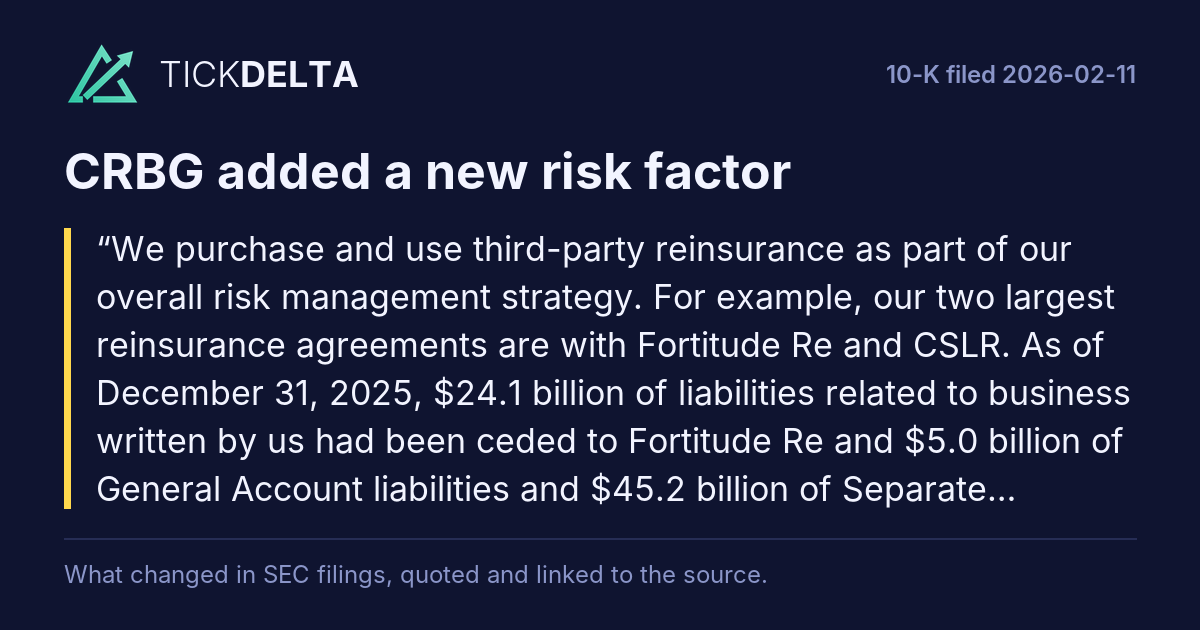
We purchase and use third-party reinsurance as part of our overall risk management strategy. For example, our two largest reinsurance agreements are with Fortitude Re and CSLR. As of December 31, 2025, $24.1 billion of liabilities related to business written by us had been ceded to Fortitude Re and $5.0 billion of General Account liabilities and $45.2 billion of Separate Accounts liabilities related to business written by us had been ceded to CSLR, under reinsurance transactions.
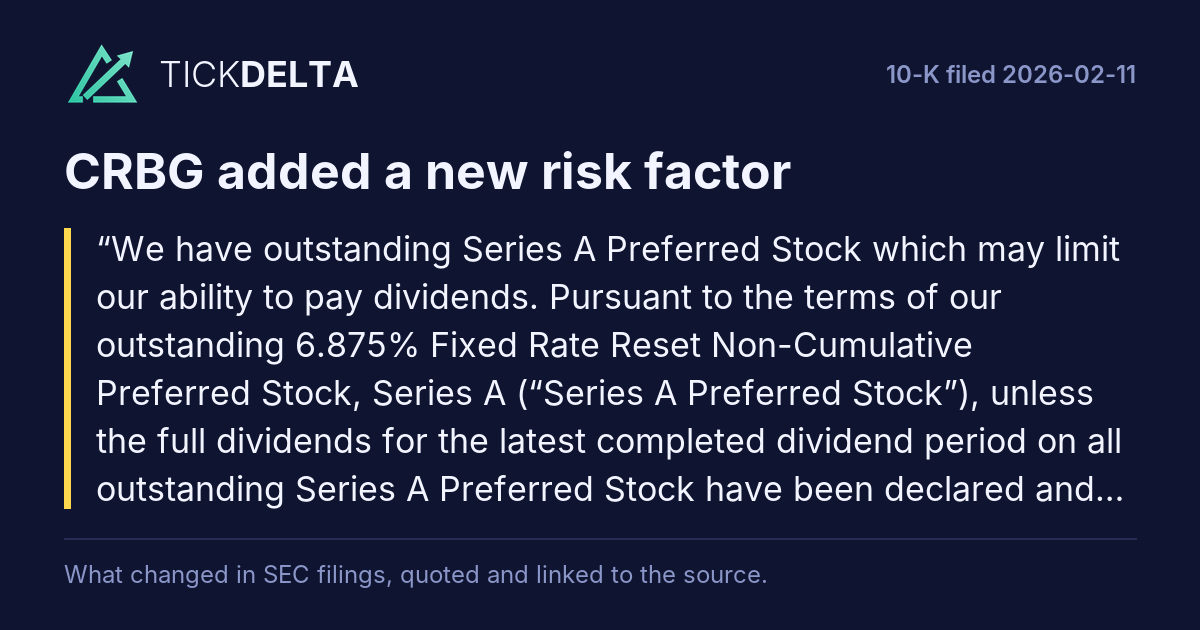
We have outstanding Series A Preferred Stock which may limit our ability to pay dividends.
Pursuant to the terms of our outstanding 6.875% Fixed Rate Reset Non-Cumulative Preferred Stock, Series A (“Series A Preferred Stock”), unless the full dividends for the latest completed dividend period on all outstanding Series A Preferred Stock have been declared and paid, or declared and a sum sufficient for the payment thereof has been set aside, then we will not, nor will we permit our subsidiaries to, declare or pay any dividends or distributions on, or redeem, purchase, acquire or make a liquidation payment with respect to, any shares of common stock or other junior capital stock of Corebridge Parent or make any guarantee payments regarding any guarantee issued by us of securities of any of our subsidiaries if the guarantee ranks upon our liquidation on parity with or junior to the Series A Preferred Stock.
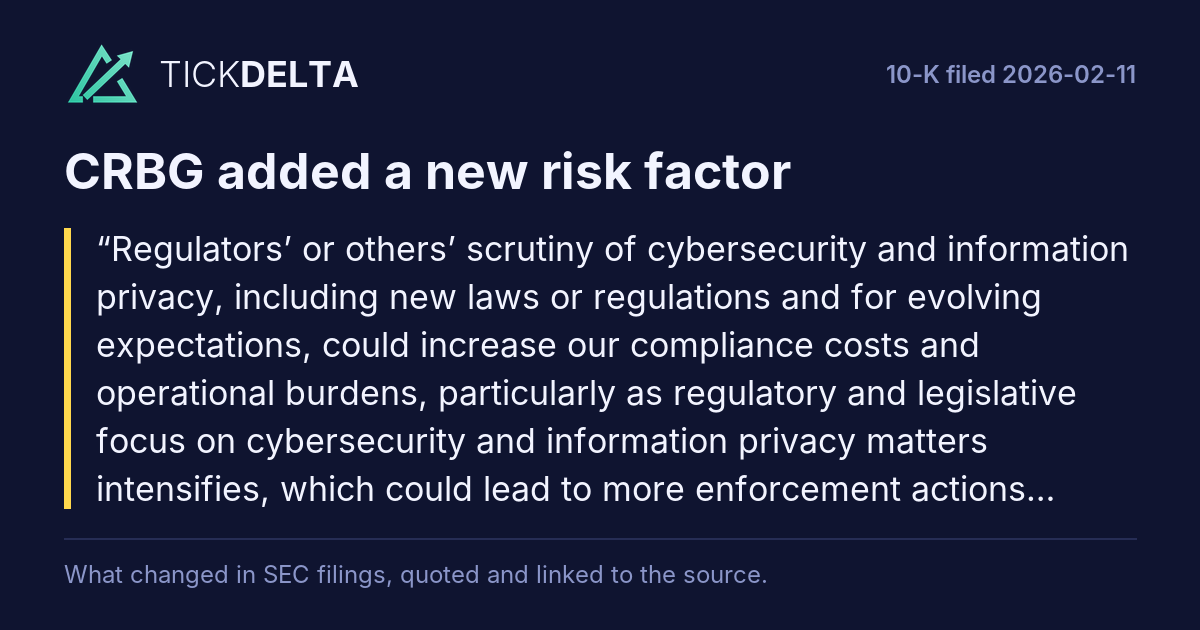
Regulators’ or others’ scrutiny of cybersecurity and information privacy, including new laws or regulations and for evolving expectations, could increase our compliance costs and operational burdens, particularly as regulatory and legislative focus on cybersecurity and information privacy matters intensifies, which could lead to more enforcement actions. Regulators, customers, or others may act against us for any cybersecurity failures. New and currently unforeseen laws and regulatory issues could also arise from the increased use of emerging technologies, data analytics and digital services, including the use of AI. If we are found not to be in compliance with these laws and regulations, we could be subjected to significant civil and criminal liability and exposed to financial and reputational harm.
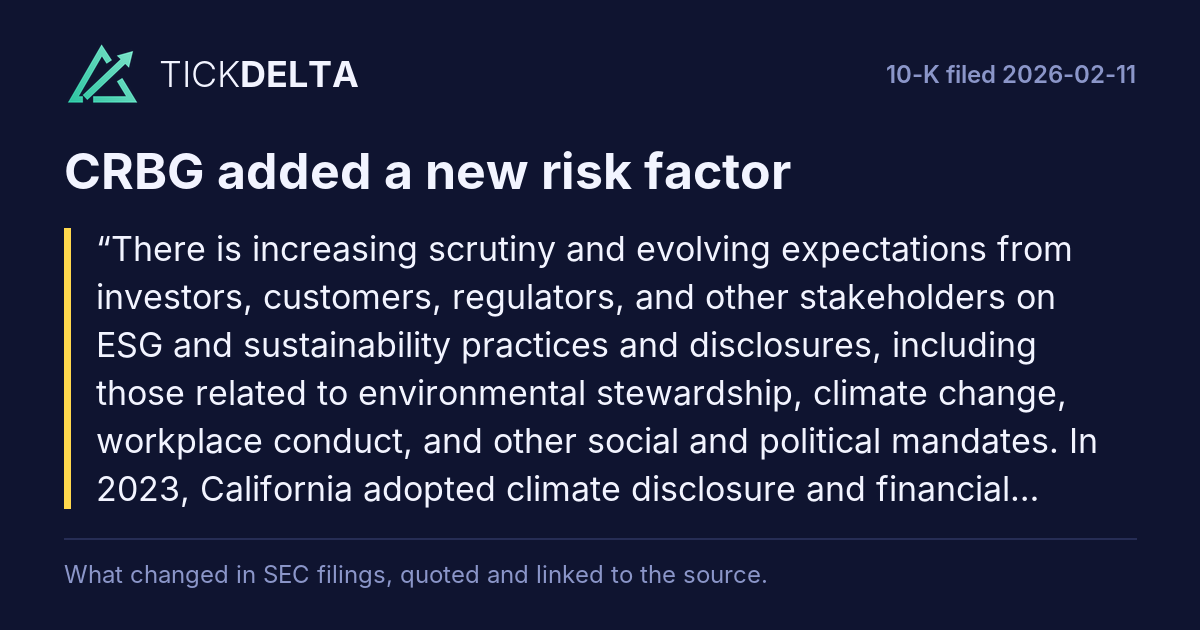
There is increasing scrutiny and evolving expectations from investors, customers, regulators, and other stakeholders on ESG and sustainability practices and disclosures, including those related to environmental stewardship, climate change, workplace conduct, and other social and political mandates.
In 2023, California adopted climate disclosure and financial reporting legislation which will require the reporting of greenhouse gas emissions and biennial climate-related financial risk reports. Although litigation challenging the California climate laws is pending, Corebridge expects to report under the Climate Corporate Data Accountability Act and the Climate Related Financial Risk Act. Other states, including New York and Illinois, have proposed but not yet passed climate disclosure laws similar to those adopted by California.
New in the latest 10-Q
80 paragraphs in the 10-Q filed Nov 3, 2026 with nothing like them in the 10-Q filed Aug 5, 2026 (at least half the words must differ; new numbers alone do not count). Quoted exactly, grouped by the item heading above them. This is text that changed, not a judgement of how serious it is.
Assets at Fair Value Impairment Charges Non-Recurring Basis Three Months Ended Nine Months Ended September 30, September 30, (in millions) Level 1 Level 2 Level 3 Total 2026 2025 2026 2025 September 30, 2026 Other investments $— $— $88 $88 $5 $12 $28 $42 Total $— $— $88 $88 $5 $12 $28 $42 December 31, 2025 Other investments $— $— $164 $164 Total $— $— $164 $164
Read in the 10-Q
(a) Includes the impairment of fixed maturity securities in second quarter 2025 that Corebridge intended to transfer or sell in conjunction with the Reinsurance Agreements
Read in the 10-Q
extensions and/or changes in interest payment terms. During the nine months ended September 30, 2025, commercial mortgage
Read in the 10-Q
modified loans represent 1 % of each of these two portfolio segments. These modifications added less than one year to the weighted
Read in the 10-Q
(c)During the third quarter 2026, the Company discontinued certain GIC fair value hedging relationships. There were no material fair value hedging adjustments related
Read in the 10-Q
net investment hedges, while regression analysis is employed for all other hedges.
Read in the 10-Q
discounted expected gross premiums for future policy benefits for nonparticipating contracts:
Read in the 10-Q
Nine Months Ended September 30, (in millions) 2026 2025 ──────────────────────────────────────────────────────────────────────────────────────────────────────────────────────────────────────────────── Individual Undiscounted expected future benefits and expense $1,833 $1,856 Retirement Undiscounted expected future gross premiums $— $— Group Retirement Undiscounted expected future benefits and expense $390 $418 Undiscounted expected future gross premiums $— $— Life Insurance Undiscounted expected future benefits and expense $30,316 $29,720 Undiscounted expected future gross premiums $20,391 $19,679 Discounted expected future gross premiums (at current discount rate) $13,057 $13,474 Institutional Undiscounted expected future benefits and expense $53,794 $51,382 Markets Undiscounted expected future gross premiums $— $— Corporate and Undiscounted expected future benefits and expense $38,800 $40,316 other Undiscounted expected future gross premiums $1,691 $1,838 Discounted expected future gross premiums (at current discount rate) $1,096 $1,263
Read in the 10-Q
In 2026, Corebridge recognized a favorable impact to net income, primarily driven by favorable mortality assumption updates related
Read in the 10-Q
to traditional life products. In 2025, Corebridge recognized an unfavorable impact to net income primarily driven by updates to
Read in the 10-Q
In 2026, Corebridge recognized an unfavorable impact to net income primarily due to lapse and mortality assumption updates for
Read in the 10-Q
certain blocks of universal life products. In 2025, Corebridge recognized an unfavorable impact to net income primarily due to lapse
Read in the 10-Q
For 2026, MRBs reflected an unfavorable impact due to model enhancements affecting fixed index annuity products in Individual and
Read in the 10-Q
Group Retirement, offset by a favorable impact from the related embedded derivatives. For 2025, Corebridge recognized an
Read in the 10-Q
unfavorable impact to net income primarily due to utilization updates for fixed annuities with living benefits and certain model
Read in the 10-Q
On August 20, 2026, Corebridge Parent issued $ 750 million of 5.90 % Senior Notes due 2036.
Read in the 10-Q
an aggregate purchase price of approximately $ 64 million, leaving approximately $ 0.8 billion under the share repurchase
Read in the 10-Q
Three Months Ended Nine Months Ended September 30, September 30, (in millions, except per common share data) 2026 2025 2026 2025 ────────────────────────────────────────────────────────────────────────────────────────────────────────────────────────────────────────────────────── Numerator for EPS: Net income (loss) $1,444 $137 $1,385 $(1,188) Less: Net income (loss) attributable to noncontrolling interests 4 (7) (4) (8) Net income (loss) attributable to Corebridge 1,440 144 1,389 (1,180) Less: Preferred stock dividends — — 18 — Net income (loss) available to Corebridge common shareholders $1,440 $144 $1,371 $(1,180) Denominator for EPS: Weighted average common shares outstanding - basic 445.6 539.1 457.7 549.1 Dilutive common shares 1.6 1.5 1.3 — Weighted average common shares outstanding - diluted 447.2 540.6 459.0 549.1 Income (loss) per common share available to Corebridge common shareholders Common stock - basic $3.23 $0.27 $3.00 $(2.15) Common stock - diluted $3.22 $0.27 $2.99 $(2.15)
Read in the 10-Q
Effective July 1, 2026, the Company changed its accounting policy for releasing stranded or disproportionate income tax effects in
Read in the 10-Q
AOCI related to its available-for-sale debt securities from the item-by-item approach to the aggregate portfolio approach.
Read in the 10-Q
Under the new aggregate portfolio approach, disproportionate tax effects remain in AOCI as long as the available-for-sale investment
Read in the 10-Q
portfolio remains in existence. The disproportionate tax effects are cleared from AOCI to income (loss) if and when the available-for-
Read in the 10-Q
sale portfolio is completely liquidated. This change is preferable given the aggregate portfolio approach better aligns with how the
Read in the 10-Q
Company manages its available-for-sale portfolios at a portfolio and asset-liability level.
Read in the 10-Q
The cumulative adjustment resulted in a decrease to net income and Retained earnings of $ 128 million, with a corresponding increase
Read in the 10-Q
to OCI and AOCI of $ 128 million reflecting the reversal of disproportionate tax effect releases that were previously recognized in
Read in the 10-Q
income from operations under the item-by-item approach that remain in AOCI under the aggregate portfolio approach. The
Read in the 10-Q
presentation of net income and retained earnings in prior periods was not recast to reflect this modification as the impact was
Read in the 10-Q
products we offer maintain policyholder deposits that are reported as liabilities and classified within either separate account liabilities
Read in the 10-Q
or policyholder contract deposits. Our products and riders also impact liabilities for future policyholder benefits and unearned
Read in the 10-Q
revenues and assets for DAC and DSI. The valuation of these assets and liabilities (other than deposits) is based on differing
Read in the 10-Q
accounting methods depending on the product, each of which requires numerous assumptions and considerable judgment. The
Read in the 10-Q
accounting guidance applied in the valuation of these assets and liabilities includes, but is not limited to, the following: (i) traditional life
Read in the 10-Q
and limited pay insurance products for which actual experience is reflected in the liability and assumptions are reviewed and updated
Read in the 10-Q
at least annually, if necessary, with the recognition and parenthetical presentation of any resulting re-measurement gain or loss in
Read in the 10-Q
policyholder benefits (except for discount rate changes) in the income statement; (ii) certain product guarantees for which benefit
Read in the 10-Q
guarantees reported as market risk benefits or index-linked interest credited features accounted for as embedded derivatives which
Read in the 10-Q
are carried at fair value; and (iv) unearned revenue and assets for DAC, VOBA and DSI which are amortized on a constant level basis
Read in the 10-Q
At least annually, typically in the third quarter, we conduct a comprehensive review of the underlying assumptions within our
Read in the 10-Q
actuarially determined assets and liabilities. These assumptions include, but are not limited to, policyholder behavior, mortality,
Read in the 10-Q
expenses, investment returns and policy crediting rates. Changes in assumptions can result in a significant change to the carrying
Read in the 10-Q
value of product liabilities and assets and, consequently, the impact could be material to earnings in the period of the change.
Read in the 10-Q
For further details of our accounting policies and related judgments pertaining to assumption updates, see “Update of Actuarial
Read in the 10-Q
Assumptions and Models”, herein and “Accounting Policies and Pronouncements - Critical Accounting Estimates - Market Risk
Read in the 10-Q
Products, Guaranteed Benefit Features of Variable Annuity, Fixed Annuity and Fixed Index Annuity Products, and Future Policy
Read in the 10-Q
Executive Committee and Plenary adopted revisions to the Life and Fraternal RBC Blanks, Instructions and Formula to modify RBC
Read in the 10-Q
charges for collateral loans by implementing a “look-through” approach to apply a capital charge based on the risk of the underlying
Read in the 10-Q
collateral and to use a percentage reduction to reflect overcollateralization to be effective for year-end 2027 reporting. We are actively
Read in the 10-Q
contemplate updating NAIC guidance for life insurance and annuity illustrations and disclosures and, on September 15, 2026, that
Read in the 10-Q
Working Group formally opened its Annuity Disclosure Model Regulation 245 revisions. Suggested revisions could include changes to
Read in the 10-Q
reinsurance agreement with CSLR, the impact of the annual actuarial assumption updates and the impact of lower increase in
Read in the 10-Q
charge at September 30, 2026 was slightly lower compared to December 31, 2025 primarily due to aging of the business.
Read in the 10-Q
plan proprietary annuity assets. These declines were mainly driven by negative net flows and unrealized losses on fixed maturities
Read in the 10-Q
• higher unfavorable impact of $14 million from the annual review and update of actuarial assumptions. For additional information
Read in the 10-Q
related to the impact of the update of actuarial assumptions, see Update of Actuarial Assumptions and Models below.
Read in the 10-Q
• higher unfavorable impact of $14 million from the annual review and update of actuarial assumptions. For additional information
Read in the 10-Q
related to the impact of the update of actuarial assumptions, see Update of Actuarial Assumptions and Models below; and
Read in the 10-Q
and deposits activity was largely driven by GIC and Corporate Market products while the benefit payments were driven by GIC, PRT
Read in the 10-Q
business of $1.7 billion and lower premiums and deposits for structured settlement products of $130 million.
Read in the 10-Q
(a) Includes the impairment of fixed maturity securities in second quarter 2025 that Corebridge intended to transfer or sell in conjunction with the Reinsurance Agreements
Read in the 10-Q
We review and update actuarial assumptions at least annually, generally in the third quarter.
Read in the 10-Q
We review and update assumptions used to value our universal life policies at least annually. These benefit reserves are also adjusted
Read in the 10-Q
VOBA, DSI and unearned revenue reserves) are amortized on a constant level basis.
Read in the 10-Q
these MRBs or embedded derivatives is based on actuarial assumptions, including policyholder behavior, as well as capital market
Read in the 10-Q
For traditional long-duration products discussed below, which includes whole life insurance, term life insurance, accident and health
Read in the 10-Q
insurance, PRT, life-contingent single premium immediate annuities and structured settlements, cash flow assumptions are reviewed
Read in the 10-Q
at least annually to determine any changes in the liability for future policy benefits. DAC and related items (which may include VOBA)
Read in the 10-Q
The net impacts to pre-tax income and APTOI because of the update of actuarial assumptions for the nine months ended September
Read in the 10-Q
* Liabilities ceded to Fortitude Re are reported in Corporate and Other. There is no impact to adjusted pre-tax operating income due to the annual update of actuarial
Read in the 10-Q
assumptions as these liabilities are 100% ceded. In addition, as a result of the reinsurance agreement between AGL and CSLR, effective in the third quarter of 2025, our
Read in the 10-Q
Corebridge recognized a $2 million favorable and $(167) million unfavorable impact to pre-tax income, for the nine months ended
Read in the 10-Q
September 30, 2026 and 2025, respectively, attributable to the annual actuarial assumption review. For 2026, the impacts primarily
Read in the 10-Q
reflected model enhancements affecting fixed index annuity products, partially offset by unfavorable mortality and lapse assumption
Read in the 10-Q
updates for certain blocks of universal life products. For 2025, the impacts were primarily driven by updates to policyholder
Read in the 10-Q
assumptions, including lapse and mortality updates related to traditional and universal life products, and utilization updates for fixed
Read in the 10-Q
Corebridge recognized a $(99) million and $(98) million unfavorable impact to adjusted pre-tax operating income, for the nine months
Read in the 10-Q
ended September 30, 2026 and 2025, respectively, attributable to the annual actuarial assumption review. For 2026, the impacts
Read in the 10-Q
primarily reflected unfavorable mortality and lapse assumption updates for certain blocks of universal life products, partially offset by
Read in the 10-Q
favorable mortality assumption updates for traditional life products. For 2025, the assumption update impacts were primarily driven by
Read in the 10-Q
On August 20, 2026, Corebridge Parent issued $750 million of 5.90% Senior Notes due 2036. The net proceeds of the issuance of the
Read in the 10-Q
Item 1A of the 10-Q filed Nov 3, 2026 against Item 1A of the 10-K filed Feb 11, 2026.
A 10-Q repeats only the risks that changed, so a 10-K paragraph that is missing from it is not counted as removed.
Added is a paragraph with nothing like it in the 10-K, Reworded a sentence that is in both with several words changed,
Quiet changes a sentence in both where one to four words changed and one is a hedge or a modal
(cut words struck through, new words highlighted).
Text on the page, not a score; each links to the filing at sec.gov.
What the 10-Q itself says about its risk factors:factors from those disclosed in "Risk Factors" in the 2025 Form 10-K. and in the first quarter 2026 Form 10-Q.
Read in the 10-Q
Two-word phrases in Risk Factors of the 10-K filed Feb 11, 2026 that are in none of the 1 earlier 10-Ks stored, back to Feb 13, 2025
Used at least twice, small words left out. Counted, not picked: a phrase can be new because the company renamed something.
23 paragraphs of last year's Risk Factors with nothing like them now. The longest are quoted.
Item 1A of each 10-K and 10-Q on EDGAR, quoted exactly. Each paragraph links to the filing at sec.gov.
10-K change: what was reworded or cut, section by section.
Excel workbook · CSV. Google Sheet that stays up to date: paste =IMPORTDATA("https://tickdelta.com/company/CRBG/export.csv") into a cell.