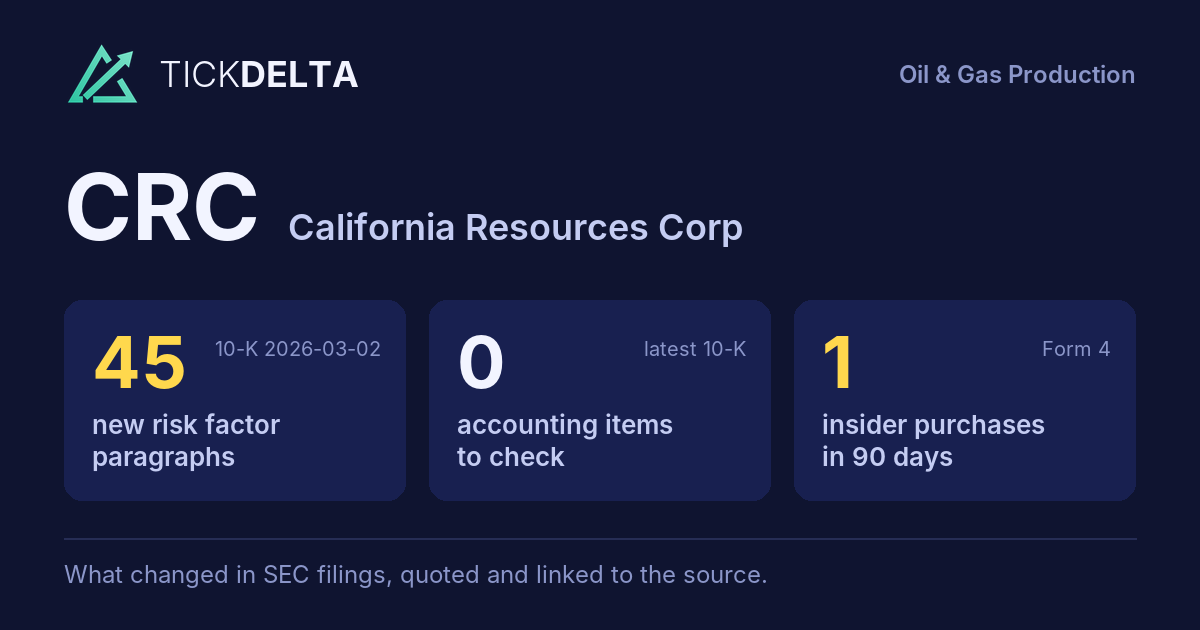
California Resources Corp CRC
New risk paragraphs, branching off last year
Each branch is a paragraph in Risk Factors with nothing like it in the 10-K filed Mar 3, 2025. A box jumps to the paragraph as filed, below.
Paragraphs with nothing like them in last year's 10-K
45 paragraphs in Risk Factors of the 10-K filed Mar 2, 2026 with nothing like them in the 10-K filed Mar 3, 2025. Quoted exactly. Paragraphs that were only edited are under 10-K change.
•Reductions in California refining and pipeline capacity could adversely affect our ability to market our production and our realized prices.
•We may be negatively impacted by inflation, including through increased operating, capital and financing costs.
•The other risk factors described under Risks Related to Our Oil and Gas Business below.
•Changes in expectations as to ESG matters may adversely impact our business, regulation and access to capital.
•The other risks described under Risks Related to Our Business Generally described below.
•Our operations in Utah are subject to additional regulatory, permitting and legal risks, including risks associated with federal and tribal lands.
Show the other 21
•The other risks described under Risks Related to Regulation and Government Action below.
Our financial condition, results of operations, cash flow and ability to invest in our assets are highly dependent on oil, natural gas and NGL prices. Prices for these products are volatile and are subject to fluctuations in response to factors beyond our control, including changes in global and regional supply and demand, inventory levels, geopolitical events (including conflicts in Ukraine and Israel and the geopolitical uncertainty in the Middle East and Venezuela), actions by OPEC and other significant producers, economic conditions, public health events, government regulation and policies relating to energy and climate change, weather conditions, natural disasters, transportation and storage constraints, and market speculation. Sustained periods of lower commodity prices could materially and adversely affect our business by reducing our cash flows, limiting our ability to fund capital expenditures, decreasing the value of our proved reserves, reducing our borrowing capacity under our Revolving Credit Facility, limiting our access to capital markets, and impairing our ability to service our indebtedness or comply with financial covenants. While we use commodity price hedging arrangements to manage a portion of our exposure to price volatility, our hedging program does not provide protection for all of our production, may limit our ability to benefit from price increases, and exposes us to counterparty risk. We may be unable to enter into additional hedging arrangements on acceptable terms or at all.
Reductions in California refining and pipeline capacity could adversely affect our ability to market our production and our realized prices.
We sell nearly all of our crude oil production into California markets. In recent periods, certain California refineries and interconnected pipelines have announced closures or reductions in operations, and additional reductions in refining capacity may occur in the future. Decreases in in-state refining capacity or in the availability of related pipeline throughput may disrupt our ability to efficiently transport and market our crude oil, increase competition among producers for access to remaining refining outlets and reduce the number of available purchasers for our products. For example, the recent shutdown of the San Pablo Bay Pipeline eliminated pipeline access to Bay Area refineries and has prompted us to modify our marketing, transportation and shipping arrangements to reach alternative markets. See Part I, Item 1 and 2 – Business and Properties, Oil and Natural Gas Segment, Marketing Arrangements, Our Principal Customers. While we seek to manage these risks through marketing arrangements and operational flexibility, reduced refining capacity or related pipeline takeaway could adversely affect our ability to efficiently deliver our production to market, negatively impact pricing dynamics for our crude oil and result in lower realized prices or wider differentials in future periods. Any such impacts could have a material adverse effect on our results of operations and cash flows.
We may be negatively impacted by inflation, including through increased operating, capital and financing costs.
Conflicts and geopolitical tensions have contributed to volatility in the prices of oil, natural gas and NGLs in recent periods. The extent and duration of military actions, sanctions, retaliatory measures and resulting market disruptions are uncertain and could continue to have a substantial impact on the global economy and our business. In addition, any easing, suspension or removal of sanctions on Venezuelan oil production or exports could increase global supply and exert downward pressure on oil prices, which could adversely affect our results of operations and cash flows. In addition, disruptions to global shipping routes, energy infrastructure or transportation corridors, including in or near the Middle East, could further constrain supply, increase costs or contribute to additional price volatility.
Actions by OPEC+ and other producing countries, including decisions to implement, extend, unwind or reinstate production limits, may significantly affect global oil supply and prices. Actual production levels and spare capacity are difficult to assess, and increased production by OPEC+ members or other producing countries could contribute to price declines. These geopolitical developments may also heighten or exacerbate other risks described in this “Risk Factors” section.
Reserves estimation is a partially subjective process that depends on numerous variables and assumptions, including geology, regulatory approvals, capital availability, development effectiveness and commodity prices, many of which are outside of our control. Actual developments that differ from our expectations could cause us to make significant negative revisions to our reserves which could materially adversely affect our business.
•CCS projects may require long-term agreements with emitters and other third parties, and we may be unable to secure such agreements on acceptable terms or at all.
•The performance of certain of our carbon and power-related projects depends in part on the reliable operation of associated power generation facilities, and reduced availability or unplanned outages could adversely affect project economics and expected returns.
We have adopted various sustainability-related targets and objectives, including our Responsible Net Zero objective, and our efforts to establish, pursue and report on these targets expose us to operational, reputational, financial, legal and other risks. Our Responsible Net Zero objective considers Scope 1 and Scope 2 emissions, reflecting an approach that prioritizes operational emissions reductions and carbon management solutions while recognizing the ongoing role of responsibly produced energy and the practical, regulatory and technological constraints associated with achieving absolute net zero emissions.
Our ability to advance our Responsible Net Zero objective depends in significant part on the successful development of our Carbon TerraVault business and related carbon capture and sequestration projects, as well as continued operational improvements. These efforts are subject to substantial regulatory, technical and commercial uncertainty, including risks related to permitting, financing, third-party participation and evolving regulatory frameworks. If we are unable to successfully develop these projects or achieve anticipated operational improvements, our ability to advance our Responsible Net Zero objective could be materially and adversely affected.
In addition, emissions accounting standards, regulatory requirements and climate science continue to evolve. Changes in applicable laws, regulations, guidance or methodologies could affect our ability to claim emissions reductions, accurately report progress or achieve our stated objectives on the timelines contemplated, if at all.
Our adoption of a Responsible Net Zero objective may increase scrutiny from investors, regulators and other stakeholders, some of whom may have differing views regarding the appropriate scope, pace or methods for achieving emissions reductions. A failure or perceived failure to pursue or accurately describe progress toward our Responsible Net Zero objective, or to align related disclosures with evolving regulatory or market expectations, could expose us to regulatory enforcement actions, litigation, reputational harm, increased costs or reduced access to capital.
Our Carbon TerraVault business and other CCS projects depend on financial and tax incentives established under federal and state laws, regulations and governmental programs to be economically viable. Governmental incentives are important to the expected economics of our carbon management business and related projects, including the Section 45Q carbon sequestration credit expanded under the Inflation Reduction Act, the One Big Beautiful Bill Act and LCFS credits under California law. The availability and value of these incentives depend on satisfaction of detailed statutory and regulatory requirements, some of which remain subject to evolving guidance, interpretation, audit and enforcement by the U.S. Department of the Treasury, the Internal Revenue Service, the California Air Resources Board and other federal and California state governmental authorities.
In addition to tax incentives, certain CCS projects may rely on federal grants, loans or other funding programs authorized under the Inflation Reduction Act or the Infrastructure Investment and Jobs Act. Such programs are subject to agency discretion, eligibility criteria, administrative review, funding availability and the risk of delay, modification, reprioritization or cancellation. Changes in federal administration priorities, executive orders, agency rulemaking, enforcement practices or congressional action have and could further modify, delay, limit, condition or repeal grants, funding programs or tax incentives applicable to our carbon management business. For example, the current administration has taken steps to reduce the availability of federal grants for CCS projects, including canceling grants that had been previously awarded.
If incentives such as the Section 45Q credit, LCFS credit or other applicable federal or state programs are eliminated, reduced, delayed, materially restricted or made subject to more burdensome compliance requirements, our Carbon TerraVault projects may become uneconomic or no longer feasible. In addition, the ability to monetize tax credits, including through direct pay, tax equity financing or credit transfers, is uncertain and depends on evolving federal rules, market liquidity, counterparties, pricing dynamics and compliance risk. We cannot assure that we or our partners will be able to efficiently monetize such incentives on acceptable terms or at all.
Many incentives applicable to CCS projects require long-term secure geological storage of captured CO₂ and ongoing compliance with monitoring, reporting and verification requirements. Failure to satisfy these requirements could result in the recapture of tax credits or other incentives, indemnification obligations to partners or counterparties, penalties, increased regulatory scrutiny or other liabilities. Any of the foregoing risks could materially and adversely affect our carbon management business, financial condition, results of operations and prospects.
Changes in expectations as to ESG matters may adversely impact our business, reputation and access to capital.
Certain public statements regarding ESG matters are subject to increasing regulatory, litigation and political scrutiny, including allegations of “greenwashing” or challenges from so-called “anti-ESG” constituencies, which could result in investigations, enforcement actions, litigation or reputational harm. Additionally, certain employment or business practices and social initiatives are the subject of scrutiny by both those calling for the continued advancement of such policies, as well as those who believe they should be curbed, including government actors, and the complex regulatory and legal frameworks applicable to such initiatives continue to evolve. As a result, we may face increased litigation risks from private parties and governmental authorities related to our ESG efforts. Such ESG-related matters may also impact our customers or suppliers, which may adversely impact our business, financial condition or results of operations.
•bear unexpected integration costs, experience delays or challenges in integrating assets, systems, personnel or operations (including, in the case of the Berry Merger, drilling services operations), or fail to achieve anticipated synergies;
Although the Berry Merger was completed in December 2025, the integration of Berry’s assets, operations and personnel is ongoing and subject to execution risk, and we may not realize anticipated benefits within expected timeframes or at all.
In connection with mergers and acquisitions, we are often only able to perform limited due diligence, and assessments of reserves, production, costs and liabilities may be inaccurate or incomplete.
We rely on electronic systems and networks to manage our operations, financial reporting, data storage and communications with employees, service providers and customers. Systems failures, data inaccuracies or outages could impair our ability to operate efficiently and make timely business decisions.
Energy-related assets may be at a heightened risk of cybersecurity or other malicious attacks. Such attacks could disrupt energy markets, delay or prevent product delivery, impair accounting or settlement processes or result in environmental or safety incidents.
In recent years, we experienced significant delays in obtaining new well, sidetrack, deepening and workover permits from CalGEM, including delays attributable to enhanced environmental review requirements, litigation challenging the Kern County environmental impact review process, agency resource constraints and policy developments. In early 2026, following the enactment of Senate Bill 237, CalGEM resumed issuing permits for new oil and gas wells in Kern County, and permitting activity has increased significantly with 31 permits for new wells issued in Kern County as of January 31, 2026. However, we cannot provide assurances that permit issuances will continue at anticipated levels or that future legislative, regulatory, administrative or judicial actions will not again delay or restrict permitting activity.
Although we have historically mitigated permitting risk by maintaining an inventory of approved permits, prolonged permitting delays or renewed uncertainty could limit our ability to execute drilling plans, adversely affect our capital program, reduce our ability to replace reserves and negatively impact our business, financial condition and results of operations.
California law authorizes local governments to impose regulations, restrictions or prohibitions on oil and gas operations within their jurisdictions, including with respect to existing operations. While certain local measures have previously been challenged successfully in court, recently enacted legislation has expanded local authority in this area. Although we do not currently operate in certain jurisdictions that have proposed or adopted phase-outs or bans, similar actions by local governments in areas where we do operate could increase operating costs, reduce production or reserves, or otherwise adversely affect our business.
Local restrictions may be adopted notwithstanding state-level permitting frameworks, and the resulting regulatory landscape may vary significantly by jurisdiction, increasing compliance complexity and uncertainty.
California continues to pursue policies aimed at reducing greenhouse gas emissions and transitioning the state’s energy system over time. Legislative, regulatory and executive actions may increase compliance costs, restrict development activities, limit infrastructure availability or otherwise adversely affect the production, transportation or consumption of oil and natural gas in the state.
While recent legislation, including Senate Bill 237, has provided greater regulatory clarity for certain permitting activities in Kern County, we cannot predict the scope, timing or cumulative impact of future state actions or whether such actions may offset or limit the benefits of recent legislative developments.
Senate Bill 614 (SB 614), enacted in October 2025, revises the definition of “pipeline” for purposes of the Elder California Pipeline Safety Act of 1981 to include intrastate pipelines used for the transportation of carbon dioxide (CO₂). The law requires the Office of the State Fire Marshal to adopt implementing regulations regarding the safe transportation of CO₂ in pipelines by July 1, 2026, establishing a pathway to lifting the current moratorium on the construction and operation of new CO₂ pipeline operations in the state. The legislation mandates stringent design, routing, and disclosure standards consistent with or exceeding a proposed revision to federal requirements under the Pipeline and Hazardous Materials Safety Administration that was subsequently withdrawn prior to federal enactment (Draft PHMSA Regulations). Under SB 614, CO₂ pipelines within a single facility and for which construction was permitted before July 1, 2025, shall not be required to subsequently comply with those regulations that pertain to design and construction if the pipeline is constructed to meet the standards of the Draft PHMSA Regulations. The CO₂ pipelines comprising our Carbon Terra Vault I (CTV I) project at our Elk Hills field were permitted prior to July 1, 2025, and have been constructed to meet the standards of the Draft PHMSA Regulations. Upon implementation, SB 614 is expected to help enable the development of carbon-capture and storage projects that rely upon capture of carbon dioxide from an emission source that is remote from the facility into which the emissions will be sequestered.
Our operations in Utah are subject to additional regulatory, permitting and legal risks, including risks associated with federal and tribal lands.
As a result of the Berry Merger, we have oil and gas operations and interests in Utah. Certain of these operations are located on federal lands administered by the U.S. Department of the Interior and the Bureau of Land Management, and certain acreage may be subject to tribal jurisdiction. Oil and gas development on federal and tribal lands is subject to regulatory regimes, approval processes and oversight that differ from those applicable to state or private lands and may be more complex, time-consuming or uncertain.
Development activities on federal lands may require compliance with the National Environmental Policy Act (NEPA) and other federal statutes and regulations, which can result in extended permitting timelines, additional environmental review requirements, increased costs, or litigation risk. Changes in federal laws, regulations, policies, enforcement practices or fiscal terms applicable to federal lands, including royalty rates, bonding requirements, leasing terms or permitting standards, could delay or restrict development activities or adversely affect the economics of our operations.
Operations on tribal lands may be subject to additional approvals, contractual requirements and regulatory authority of tribal governments. Disputes relating to tribal lands may be subject to different legal standards, forums or remedies, including limitations arising from tribal sovereign immunity, which could restrict our ability to enforce contractual rights or obtain judicial relief. Any of these factors could delay operations, increase costs, limit development opportunities or otherwise have a material adverse effect on our business, financial condition, results of operations or cash flows.
•require us to dedicate a significant portion of our cash flow to debt service, thereby reducing funds available for operations, capital expenditures, acquisitions or shareholder returns;
•limit our access to capital markets or increase the cost of future financing; and
•expose us to borrowing base reductions or interest rate increases that could adversely affect liquidity.
Paragraphs in the 10-Q filed Nov 3, 2026 that were not in the one before
New in the latest 10-Q
26 paragraphs in the 10-Q filed Nov 3, 2026 with nothing like them in the 10-Q filed Aug 10, 2026 (at least half the words must differ; new numbers alone do not count). Quoted exactly, grouped by the item heading above them. This is text that changed, not a judgement of how serious it is.
10-Q
• Crimson Acquisition - The all-cash acquisition of Crimson Midstream Holdings, LLC (Crimson) from CorEnergy Infrastructure Trust Inc. The effective date of the transaction was September 1, 2026.
Read in the 10-Q
Financial statements and notes
On September 1, 2026, we completed the Crimson Acquisition for a payment of $ 70 million, which included $ 7 million of preliminary purchase price adjustments. The final purchase price remains subject to certain adjustments. Crimson owns various onshore midstream assets in California, including the SoCal Pipeline System and San Pablo Bay Pipeline. We believe this transaction enhances our ability to efficiently transport California-produced crude oil to higher-value markets while increasing operational flexibility and flow assurance across our portfolio.
Read in the 10-Q
Preliminary Purchase Price (in millions) Assets Acquired Cash $ 2 Accounts receivable 7 Inventories 2 Other current assets 5 Property, plant and equipment 67 Other noncurrent assets 8 Total Assets Acquired 91 Liabilities Assumed Accounts payable $ 4 Accrued liabilities 7 Other long-term liabilities 10 Total Liabilities Assumed 21 Net Assets Acquired $ 70
Read in the 10-Q
For the period of September 1, 2026 through September 30, 2026, total operating revenue and loss before income taxes associated with Crimson were not material.
Read in the 10-Q
Transaction and integration costs incurred in connection with the Crimson Acquisition were not significant.
Read in the 10-Q
Show the other 21
We recorded cash based on Crimson's bank balances as of September 1, 2026. The measurements for predominantly all of the other current and other noncurrent assets acquired and accounts payable, accrued liabilities and other long-term liabilities assumed are based on contracts in place at Crimson on the acquisition date. The fair value of certain acquired PP&E, primarily consisting of pipelines, gathering lines, and pipeline rights-of-way, is still under review for measurement based on final appraisals.
Read in the 10-Q
The pro forma results are not included as the impact was not material to our financial statements.
Read in the 10-Q
(b) Refer to Note 16 Subsequent Events for more information on a recent extension to our Revolving Credit Facility.
Read in the 10-Q
The sale of our Uinta basin assets met the criteria for assets held for sale as of September 30, 2026. These assets, primarily consisting of PP&E, are presented as assets held for sale on our condensed consolidated balance sheet. The associated liabilities, which predominantly consist of asset retirement obligations and payables, are presented as liabilities associated with assets held for sale on our condensed consolidated balance sheet. The Uinta basin assets and liabilities are included in our oil and natural gas segment.
Read in the 10-Q
Following completion of the Crimson Acquisition in September 2026, we recognize pipeline transportation revenue as oil is transported, based on the volumes transported during the period and the applicable contractual or tariff rates. Revenue for our midstream pipeline transportation was not material for the three and nine months ended September 30, 2026.
Read in the 10-Q
In September 2026, we entered into an agreement to sell our Uinta basin assets for cash consideration of approximately $90 million, subject to customary purchase price adjustments (Uinta Basin Divestiture). The Uinta basin assets were acquired as part of the Berry Merger and make up our only material assets outside of California. The transaction has an effective date of July 1, 2026. Closing is expected in the fourth quarter of 2026, subject to the receipt of certain third-party consents and satisfaction of other customary closing conditions.
Read in the 10-Q
On September 1, 2026, we completed the Crimson Acquisition for a payment of $70 million, which included $7 million of preliminary purchase price adjustments. The final purchase price remains subject to certain adjustments. Crimson owns various onshore midstream assets in California, including the SoCal Pipeline System and San Pablo Bay Pipeline. We believe this transaction enhances our ability to efficiently transport California-produced crude oil to higher-value markets, while increasing operational flexibility and flow assurance across our portfolio.
Read in the 10-Q
In August 2026, we filed a complaint with the California Public Utilities Commission (CPUC) disputing the ability of the pipeline operator to pro-rate our nominations under the applicable tariff. We cannot predict the timing or outcome of this proceeding. Until this matter is resolved or additional transportation capacity becomes available, we expect reduced capacity on this pipeline segment to continue to negatively impact our realizations and transportation costs.
Read in the 10-Q
In the first six months of 2026, two counterparties made force majeure claims that continued to affect pricing and offtake commitments during the three months ended September 30, 2026. In October 2026, we settled our dispute with one of these counterparties with an effective date of September 1, 2026. We do not expect this settlement to materially affect our future price realizations or volumes sold. We continue to dispute the validity of the force majeure claim made by the other counterparty and expect to submit the dispute to arbitration later this year. We cannot predict the timing or outcome of any such arbitration.
Read in the 10-Q
On November 2, 2026, the Kern County Superior Court issued a ruling in litigation brought by a coalition of community and environmental organizations. The litigation challenges Kern County’s certification of the revised environmental impact report (REIR) prepared under CEQA for our Carbon TerraVault I CCS project at our Elk Hills field, and the County’s related approval of the project. The court granted the petition and directed the County to set aside its certification of the REIR and its approval of the project, and to refrain from taking further action to implement the project until a new EIR has been prepared and considered. This REIR underlies our CTV I project and impacts the CEQA analysis for the potential CalCapture project. However, we are developing multiple other CTV projects that do not rely on this REIR.
Read in the 10-Q
The ruling is not yet final and remains subject to further proceedings, and its impact on the existing operations at CTV I is uncertain. We intend to aggressively pursue legal actions to protect and advance our CTV I project; however, we can provide no assurances that we will be successful in these efforts. We do not expect the ruling to have a material impact on our results of operations or financial condition.
Read in the 10-Q
On October 8, 2026, the Kern County Superior Court issued a tentative ruling in litigation brought by our subsidiary, Aera Energy LLC, together with other industry participants, challenging CalGEM’s denial of certain well stimulation treatment permit applications and its subsequent 2024 rule prohibiting the approval of such permits. The tentative ruling would set aside the challenged permit denials as arbitrary and unsupported, annul the 2024 rule, and remands the denied applications to CalGEM for formal review. The ruling is not a final judgment and remains subject to further proceedings and potential appeal, and we cannot predict the outcome of the matter or its ultimate impact on our operations.
Read in the 10-Q
Effective on July 1, 2026, the Office of the State Fire Marshal (OSFM) adopted emergency regulations governing the safe transportation of carbon dioxide in intrastate pipelines pursuant to SB 614. The adoption of these regulations lifted the prior statewide moratorium on the construction and operation of new carbon dioxide pipelines used to transport carbon dioxide to or from carbon capture, removal or sequestration projects, subject to pipeline operators demonstrating compliance with the OSFM standards. Although SB 614 and the new OSFM emergency rules impose significant requirements on new carbon dioxide pipelines, it is still expected to make possible the development of projects that rely on transportation of carbon dioxide from a remote emission source to a sequestration facility.
Read in the 10-Q
As of September 30, 2026, we have nine Class VI UIC permit applications related to our carbon management segment pending with the EPA at various stages of the permitting process. We currently expect the EPA to issue draft permits for certain of these projects by year-end 2026; however, the timing remains uncertain, and we cannot provide assurances as to if or when the permits will be issued.
Read in the 10-Q
(a) Net loss on asset divestitures for the nine months ended September 30, 2025 related to the sale of oil and gas assets located in Ventura.
Read in the 10-Q
Natural Gas - North American natural gas prices for the three months ended September 30, 2026 were slightly higher compared to the three months ended June 30, 2026 due to strong seasonal demand. Our prices for the three months ended September 30, 2026 rebounded sharply as the west and southwest experienced warmer-than-normal temperatures and take-away capacity in key production regions provided out-of-state gas supplies with alternative markets to California.
Read in the 10-Q
September 30, 2026 2025 (in millions) ─────────────────────────────────────────────────────────────────────────────────────────────────────── Capital investments $ (438) $ (202) Changes in accrued capital investments (25) (10) Proceeds from asset divestitures — 2 Purchase of a business, net of cash acquired (68) — Asset acquisitions (5) — Distribution from unconsolidated subsidiary 10 — Other, net (8) (7) Net cash used in investing activities $ (534) $ (217)
Read in the 10-Q
• refinery closures and changes in pipeline transportation or storage capacity and their impact on future production, revenues and realizations;
Read in the 10-Q
• other factors discussed in Part I, Item 1A - Risk Factors of our 2025 Annual Report.
Read in the 10-Q
Market risk
We regularly review risks related to concentration of counterparty credit risk and seek to manage those risks to the extent practicable. For the nine months ended September 30, 2026, we had two customers in our oil and gas segment that collectively accounted for 51% of our sales (before the effects of hedging), including a single customer that represented 41% of sales. Oil accounted for approximately 80% of our production during the nine months ended September 30, 2026 and nearly all of our oil sales were to refineries in California. Trade receivables for substantially all of our commodities are collected within 30 to 60 days following the month of delivery.
Read in the 10-Q
Share sales and buybacks
Our share repurchase activity for the three months ended September 30, 2026 was as follows:
Read in the 10-Q
The 10-Q's risk factors against the 10-K
Item 1A of the 10-Q filed Nov 3, 2026 against Item 1A of the 10-K filed Mar 2, 2026.
A 10-Q repeats only the risks that changed, so a 10-K paragraph that is missing from it is not counted as removed.
Added is a paragraph with nothing like it in the 10-K, Reworded a sentence that is in both with several words changed,
Quiet changes a sentence in both where one to four words changed and one is a hedge or a modal
(cut words struck through, new words highlighted).
Text on the page, not a score; each links to the filing at sec.gov.
What the 10-Q itself says about its risk factors:We are subject to various risks and uncertainties in the course of our business. A discussion of such risks and uncertainties may be found under the heading Risk Factors in our 2025 Annual Report. There were no material changes to those risk factors during the three months ended September 30, 2026.
Read in the 10-Q
1 paragraph in the 10-Q's Item 1A, and none of them adds, rewords or quietly edits a paragraph of the 10-K's.
Phrases used for the first time
Two-word phrases in Risk Factors of the 10-K filed Mar 2, 2026 that are in none of the 1 earlier 10-Ks stored, back to Mar 3, 2025
Where each one is used
- responsible net: •Our ability to achieve our emissions goals, including our Responsible Net Zero objective, and other carbon management objectives is subject to significant risks and uncertainties.
- zero objective: •Our ability to achieve our emissions goals, including our Responsible Net Zero objective, and other carbon management objectives is subject to significant risks and uncertainties.
- berry merger: •Mergers, acquisitions and dispositions, including continued integration of the Berry Merger completed in December 2025, involve substantial risks.
- tribal lands: •Our operations in Utah are subject to additional regulatory, permitting and legal risks, including risks associated with federal and tribal lands.
- realized prices: •Reductions in California refining and pipeline capacity could adversely affect our ability to market our production and our realized prices.
- financing costs: •We may be negatively impacted by inflation, including through increased operating, capital and financing costs.
- refining capacity: We sell nearly all of our crude oil production into California markets. In recent periods, certain California refineries and interconnected pipelines have announced closures or reductions in operations, and additional reductions in refining capacity may occur in the future. Decreases in in-state refining capacity...
- reputational harm: Our adoption of a Responsible Net Zero objective may increase scrutiny from investors, regulators and other stakeholders, some of whom may have differing views regarding the appropriate scope, pace or methods for achieving emissions reductions. A failure or perceived failure to pursue or accurately describe...
Used at least twice, small words left out. Counted, not picked: a phrase can be new because the company renamed something.
What was taken out
50 paragraphs of last year's Risk Factors with nothing like them now. The longest are quoted.
Sources
Item 1A of each 10-K and 10-Q on EDGAR, quoted exactly. Each paragraph links to the filing at sec.gov.
Also
10-K change: what was reworded or cut, section by section.
Work with it
Excel workbook · CSV. Google Sheet that stays up to date: paste =IMPORTDATA("https://tickdelta.com/company/CRC/export.csv") into a cell.