Crawford & Co CRD-A
New risk paragraphs, branching off last year
Each branch is a paragraph in Risk Factors with nothing like it in the 10-K filed Mar 3, 2025. A box jumps to the paragraph as filed, below.
Paragraphs with nothing like them in last year's 10-K
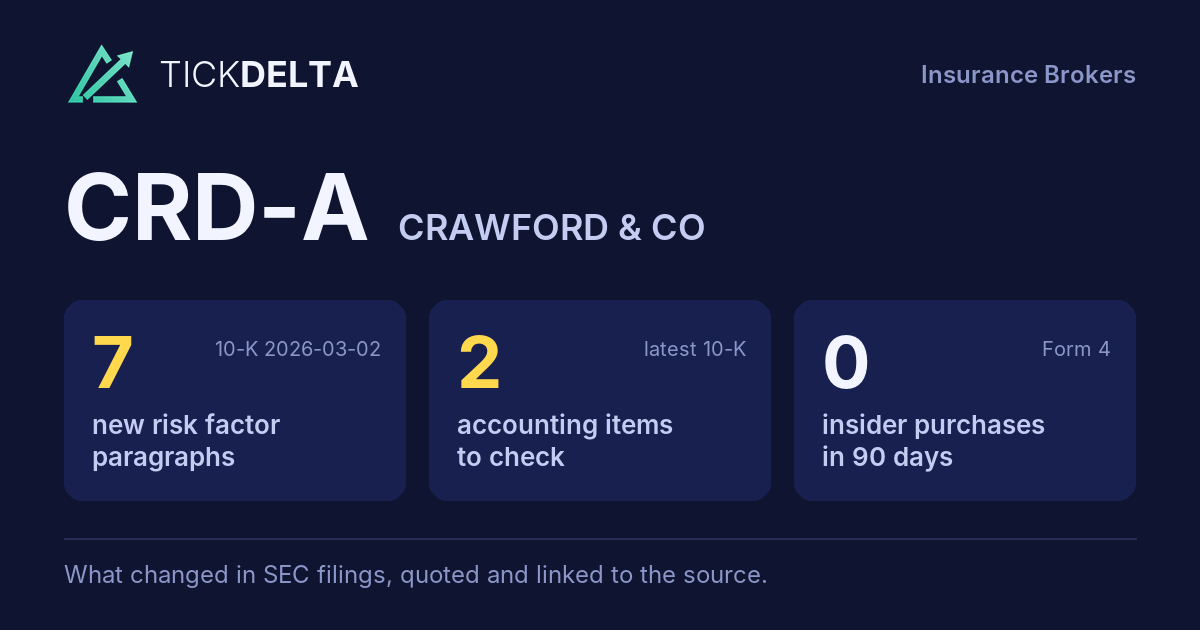
7 paragraphs in Risk Factors of the 10-K filed Mar 2, 2026 with nothing like them in the 10-K filed Mar 3, 2025. Quoted exactly. Paragraphs that were only edited are under 10-K change.
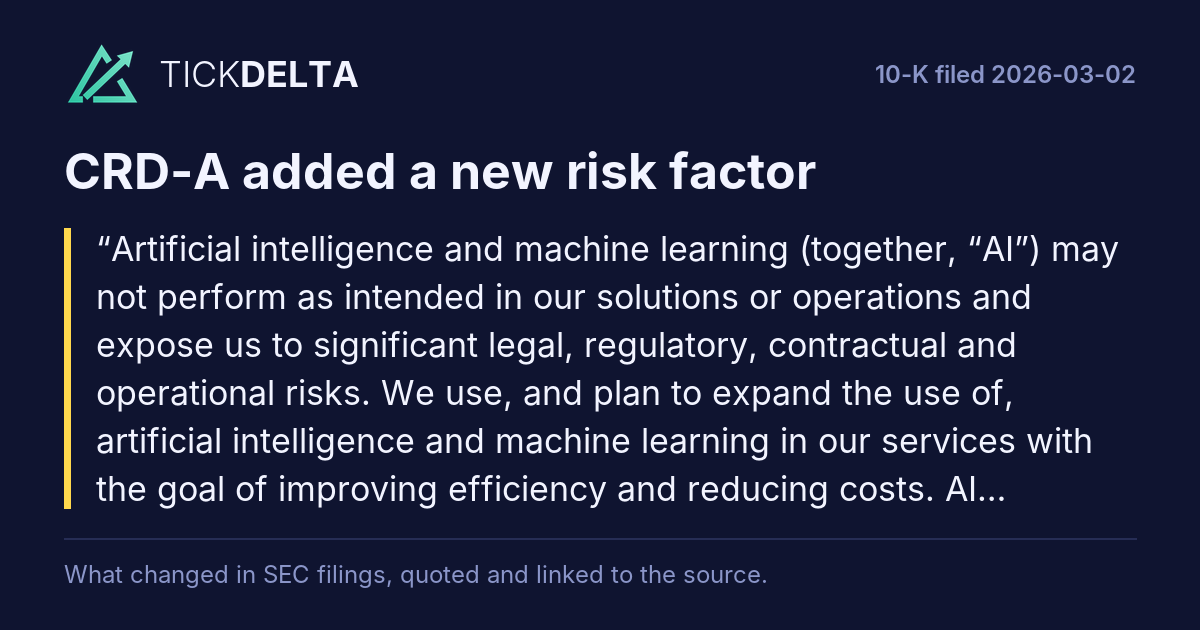
Artificial intelligence and machine learning (together, “AI”) may not perform as intended in our solutions or operations and expose us to significant legal, regulatory, contractual and operational risks.
We use, and plan to expand the use of, artificial intelligence and machine learning in our services with the goal of improving efficiency and reducing costs. AI initiatives are complex, costly and uncertain. They may not achieve anticipated performance, accuracy, efficiency or financial outcomes, and could adversely affect our business, results of operations and financial condition.
Model performance, explainability, and fairness. AI outputs may be inaccurate, incomplete, biased, or otherwise unreliable, which could contribute to errors in claims handling support, misalignment of work, missed fraud signals, or inaccurate data provided to clients. Where AI is used in HR, errors or bias could lead to employment claims. Failures to document model design, training data, testing, monitoring and human oversight could impede explainability and remediation, invite client disputes, or lead to adverse regulatory scrutiny.
Data governance, privacy and security. AI systems rely on large volumes of data, including personal, sensitive, and client‑confidential information. Inadequate data governance (including provenance, minimization, quality, retention, access controls, and vendor controls) may result in privacy or data protection violations, cross border transfer non-compliance, or contractual breaches. Use of third‑party AI tools can increase risk of data leakage, prompt‑injection, model exfiltration and other cyber threats. Any such incident could result in service disruption, regulatory investigations, litigation, fines, contractual liability, and reputational harm.
Emerging and evolving AI regulation. Multiple jurisdictions have adopted or proposed AI specific frameworks that may classify certain uses as higher risk and impose obligations such as risk management systems, testing and validation, technical documentation, transparency notices, impact/risk assessments, incident reporting, human oversight, and vendor/processor due diligence. We may also face requirements under general consumer protection, unfair practices, anti-discrimination and sectoral rules (including scrutiny of AI used in claims processes by insurance market stakeholders). Divergent or rapidly changing obligations can increase compliance costs, require product or process changes, delay deployments, and affect cross-border operations.
Contractual and client assurance pressures. Clients are increasingly requiring AI related representations, warranties, audit rights, transparency, impact assessments, and indemnities. Failure to meet client standards or disagreements over the scope of AI use, data rights, performance, bias, or audit findings could lead to lost business, disputes, or liabilities.
If any of these risks materialize, we could face investigations, enforcement actions, fines or penalties; private litigation; contractual liability to clients and partners; increased compliance and assurance costs; constraints on data use or model deployment; and loss of customers or market reputation. Compliance with new or differing AI requirements across jurisdictions could be costly and complex, and we may be unable to timely adapt our systems, processes and vendor arrangements.
Paragraphs in the 10-Q filed Nov 2, 2026 that were not in the one before
New in the latest 10-Q
7 paragraphs in the 10-Q filed Nov 2, 2026 with nothing like them in the 10-Q filed Aug 3, 2026 (at least half the words must differ; new numbers alone do not count). Quoted exactly, grouped by the item heading above them. This is text that changed, not a judgement of how serious it is.
Financial statements and notes
The computations of diluted net income attributable to shareholders of Crawford & Company per common share were as follows: Three Months Ended Nine Months Ended September 30, September 30, September 30, September 30,
Read in the 10-Q
On August 10, 2026, the Company entered into a Stock Purchase and Sale Agreement with Jesse C. Crawford, pursuant to which the Company purchased 1,000,000 shares of the Company's Class A Common Stock from Mr. Crawford. The purchase price per share was equal to 97% of the official closing price of the Class A Common Stock on the New York Stock Exchange immediately preceding the execution of the agreement at the close of market on the Effective Date of the Agreement, representing an aggregate purchase price of approximately $12,813,700. Mr. Crawford is the father of Jesse C. Crawford, Jr., Non-Executive Chair of the Company's Board of Directors, and is the majority shareholder of the Company. The Audit Committee of the Board of Directors reviewed and approved the transaction as a related party transaction in accordance with the Company's related party transaction policy. The Board of Directors separately approved the purchase, which reflects a 3% discount on the closing market price and which the Audit Committee and the Board determined to be fair to, and in the best interests of, the Company and its shareholders. As the Company's Board of Directors separately authorized this repurchase, the authorized shares remaining under the 2021 Repurchase Authorization were not impacted.
Read in the 10-Q
During the nine months ended September 30, 2026, the Company repurchased 1,815,458 shares of CRD-A at an average cost of $11.80 per share and 108,963 shares of CRD-B at an average cost of $10.25, of which, 1,000,000 shares of CRD-A were purchased pursuant to the Stock Purchase and Sale Agreement, dated August 10, 2026 as described above, separate from the 2021 Repurchase Authorization. During the nine months ended September 30, 2025, the Company repurchased 263,098 shares of CRD-A and 12,846 shares of CRD-B at an average cost of $10.71 and $10.40, respectively.
Read in the 10-Q
On September 30, 2026, the Company had 1,197,469 shares available for repurchase under the 2021 Repurchase Authorization.
Read in the 10-Q
International Operations, which services the global property and casualty market outside the U.S., includes all operations within the U.K., Europe, Australia, Asia, and Latin America as well as the Canadian operations that were previously reported within the North America Loss Adjusting segment.
Read in the 10-Q
Show the other 2
• risks associated with artificial intelligence may impact our operations and may expose us to significant legal, regulatory, contractual and operational risks,
Read in the 10-Q
Share sales and buybacks
On August 10, 2026, the Company entered into a Stock Purchase and Sale Agreement pursuant to which the Company purchased 1,000,000 shares of the Company's Class A Common Stock. As the Company's Board of Directors separately authorized this repurchase, the authorized shares remaining under the 2021 Repurchase Authorization were not impacted. As of September 30, 2026 the Company was authorized to repurchase 1,197,469 shares under the 2021 Repurchase Authorization.
Read in the 10-Q
The 10-Q's risk factors against the 10-K
Item 1A of the 10-Q filed Nov 2, 2026 against Item 1A of the 10-K filed Mar 2, 2026.
A 10-Q repeats only the risks that changed, so a 10-K paragraph that is missing from it is not counted as removed.
Added is a paragraph with nothing like it in the 10-K, Reworded a sentence that is in both with several words changed,
Quiet changes a sentence in both where one to four words changed and one is a hedge or a modal
(cut words struck through, new words highlighted).
Text on the page, not a score; each links to the filing at sec.gov.
Phrases used for the first time
Two-word phrases in Risk Factors of the 10-K filed Mar 2, 2026 that are in none of the 1 earlier 10-Ks stored, back to Mar 3, 2025
Where each one is used
- year ended: From time to time, we derive a material portion of our revenues from a limited number of clients. No single customer accounts for 10% or more of our consolidated revenues for the years ended December 31, 2025, 2024, or 2023. However, for the year ended December 31, 2025, two customers in our Platform Solutions...
- artificial intelligence: Artificial intelligence and machine learning (together, “AI”) may not perform as intended in our solutions or operations and expose us to significant legal, regulatory, contractual and operational risks.
- machine learning: Artificial intelligence and machine learning (together, “AI”) may not perform as intended in our solutions or operations and expose us to significant legal, regulatory, contractual and operational risks.
- human oversight: Model performance, explainability, and fairness. AI outputs may be inaccurate, incomplete, biased, or otherwise unreliable, which could contribute to errors in claims handling support, misalignment of work, missed fraud signals, or inaccurate data provided to clients. Where AI is used in HR, errors or bias could...
- data governance: Data governance, privacy and security. AI systems rely on large volumes of data, including personal, sensitive, and client‑confidential information. Inadequate data governance (including provenance, minimization, quality, retention, access controls, and vendor controls) may result in privacy or data protection...
- contractual liability: Data governance, privacy and security. AI systems rely on large volumes of data, including personal, sensitive, and client‑confidential information. Inadequate data governance (including provenance, minimization, quality, retention, access controls, and vendor controls) may result in privacy or data protection...
Used at least twice, small words left out. Counted, not picked: a phrase can be new because the company renamed something.
What was taken out
1 paragraph of last year's Risk Factors with nothing like them now. The longest are quoted.
Sources
Item 1A of each 10-K and 10-Q on EDGAR, quoted exactly. Each paragraph links to the filing at sec.gov.
Also
10-K change: what was reworded or cut, section by section.
Work with it
Excel workbook · CSV. Google Sheet that stays up to date: paste =IMPORTDATA("https://tickdelta.com/company/CRD-A/export.csv") into a cell.