Added10-Q Oct 29, 2026 vs 10-K Feb 12, 2026
ITEM 2. Unregistered Sales of Equity Securities, Use of Proceeds, and Issuer Purchases of Equity Securities
Each branch is a paragraph in Risk Factors with nothing like it in the 10-K filed Feb 13, 2025. A box jumps to the paragraph as filed, below.
14 paragraphs in Risk Factors of the 10-K filed Feb 12, 2026 with nothing like them in the 10-K filed Feb 13, 2025. Quoted exactly. Paragraphs that were only edited are under 10-K change.
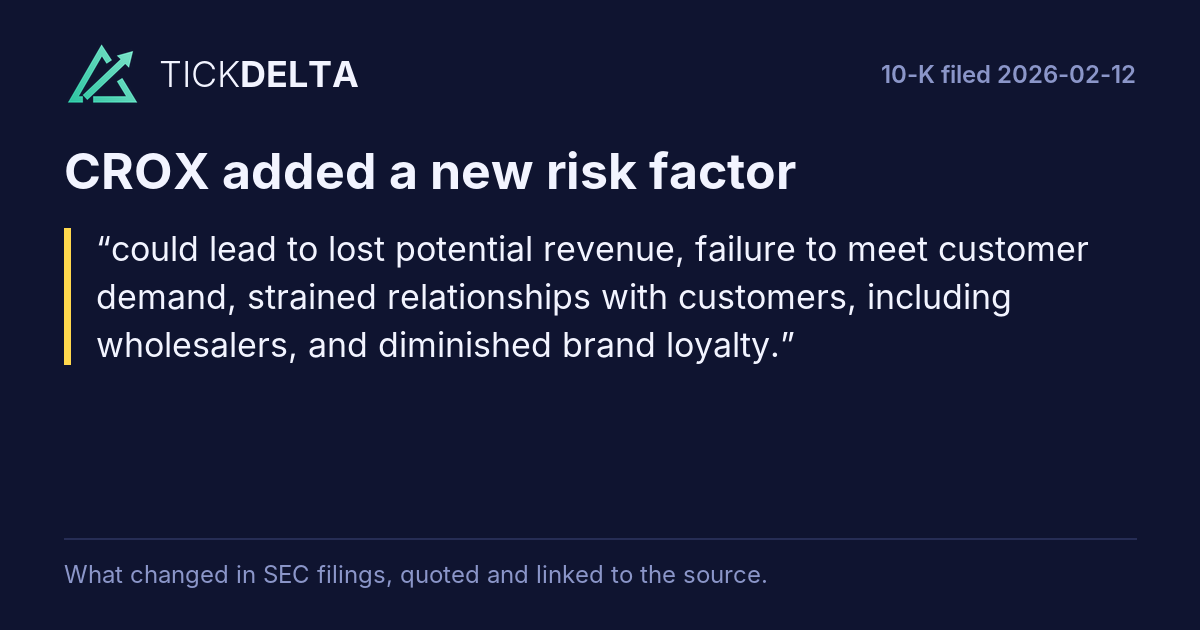
could lead to lost potential revenue, failure to meet customer demand, strained relationships with customers, including wholesalers, and diminished brand loyalty.
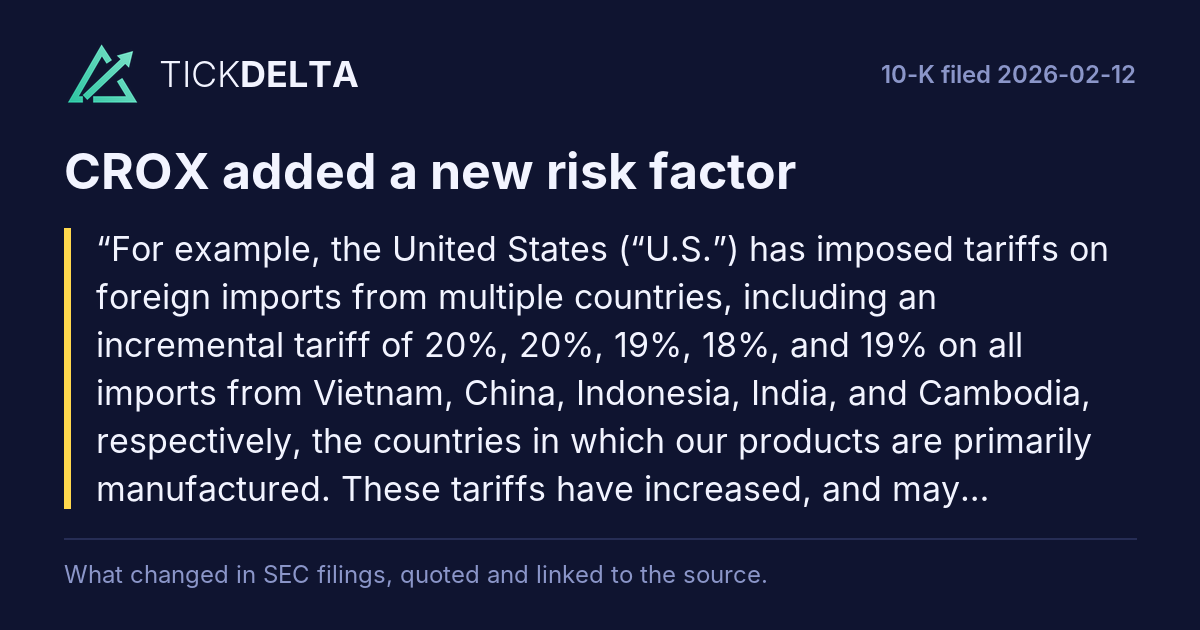
For example, the United States (“U.S.”) has imposed tariffs on foreign imports from multiple countries, including an incremental tariff of 20%, 20%, 19%, 18%, and 19% on all imports from Vietnam, China, Indonesia, India, and Cambodia, respectively, the countries in which our products are primarily manufactured. These tariffs have increased, and may continue to
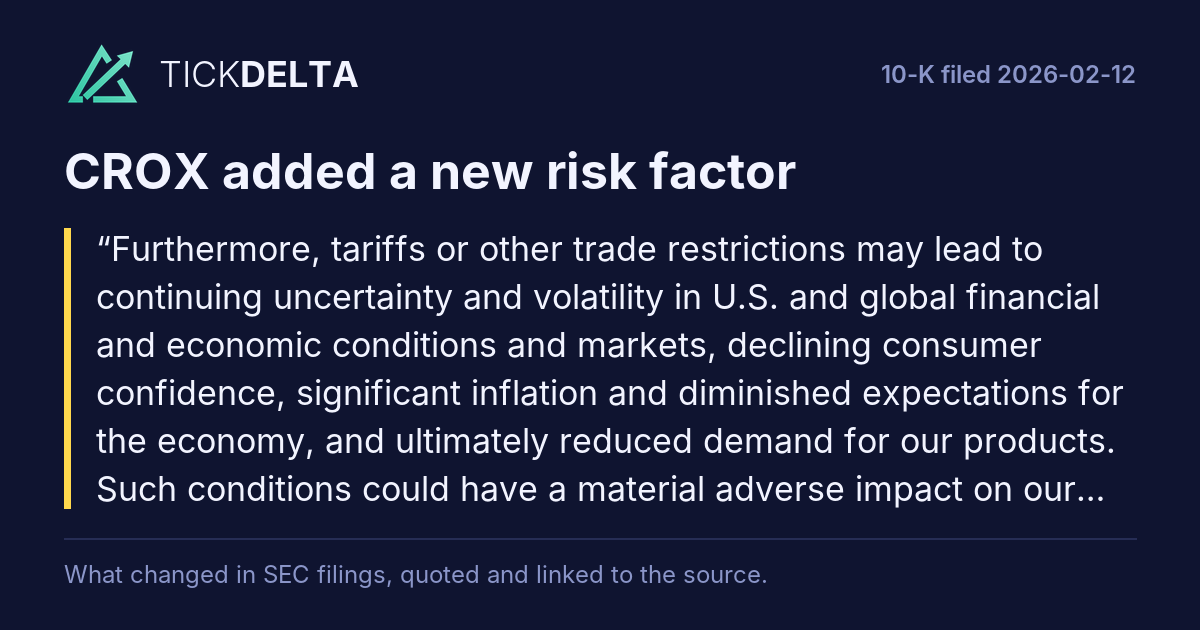
Furthermore, tariffs or other trade restrictions may lead to continuing uncertainty and volatility in U.S. and global financial and economic conditions and markets, declining consumer confidence, significant inflation and diminished expectations for the economy, and ultimately reduced demand for our products. Such conditions could have a material adverse impact on our business, results of operations, and cash flows. For instance, the fair values of our goodwill and indefinite-lived intangible assets are sensitive to the aforementioned potential unfavorable changes, which could result in the recognition of an impairment charge should the fair values of these assets fall below the carrying values. See also the risk factor under “Financial and Accounting Risks — We may incur impairments of the carrying value of our goodwill and other intangible assets, which could have a material adverse effect on our business and financial results.”
Also, disruptions and volatility in the financial markets may lead to adverse changes in the availability, terms, and cost of capital. Such adverse changes could increase our costs of capital and limit our access to external financing sources to fund acquisitions, capital projects, or refinancing of debt maturities on similar terms, which could in turn reduce our cash flows and limit our ability to pursue growth opportunities. See also the risk factor under “We conduct significant business activity outside the U.S., which exposes us to risks of international commerce.”
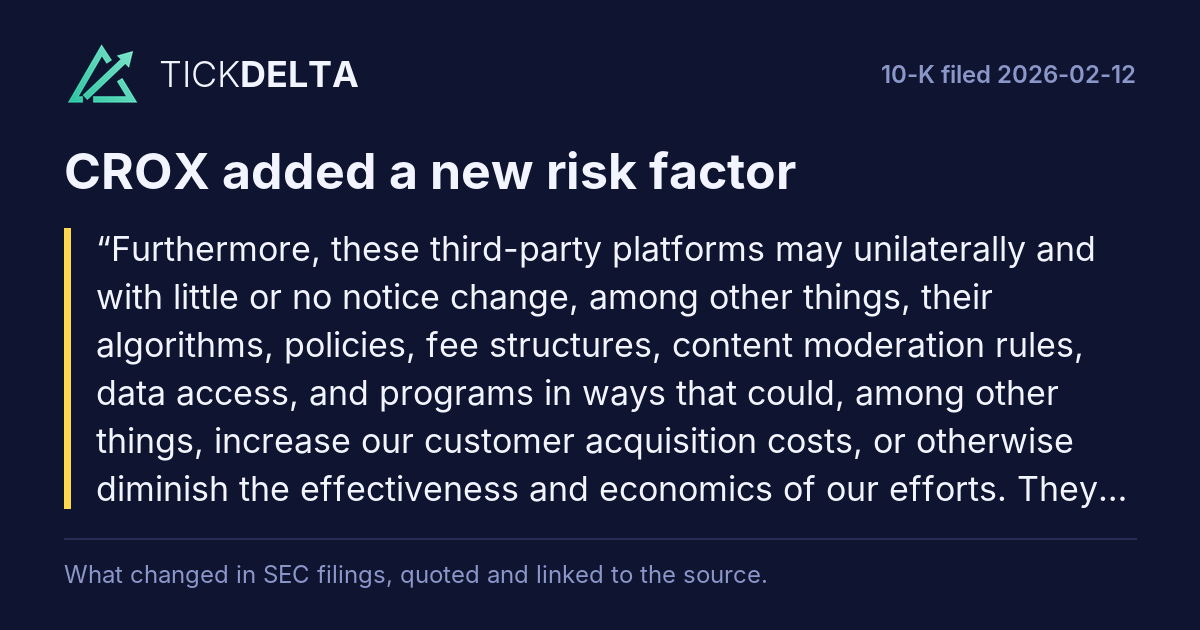
Furthermore, these third-party platforms may unilaterally and with little or no notice change, among other things, their algorithms, policies, fee structures, content moderation rules, data access, and programs in ways that could, among other things, increase our customer acquisition costs, or otherwise diminish the effectiveness and economics of our efforts. They may also modify order routing, payment processing, and fulfillment requirements or impose new seller standards that are costly or impracticable for us to meet. Any such changes could materially reduce traffic to our store fronts, negatively impact our conversion, impair our ability to target or retarget customers, or increase returns and chargebacks.
Our participation on these platforms also exposes us to certain operational and reputational risks. We have in the past, and may again in the future, encounter counterfeit, gray market, or unauthorized sellers offering similar or infringing products at lower prices, which could impact, among other things, our pricing and brand equity. In addition, because these platforms often control payment flows and dispute resolution processes, we may experience withheld funds, increased reserves, or unfavorable chargeback determinations that we are unable to contest effectively. In addition, platform‑mandated logistics or return policies may increase our shipping, warehousing, and reverse‑logistics costs, and fulfillment errors by platform partners may be attributed to us by consumers.
We are also exposed to evolving legal, regulatory, and geopolitical developments that may materially impact social commerce channels. Governmental actions, investigations, or restrictions targeting specific platforms or their parent companies, including potential bans, limitations on app store availability, forced divestitures, or heightened data‑privacy and content‑moderation requirements, could impair or eliminate our access to certain platforms, reduce user engagement, or necessitate costly changes to our operations and technology. Increased scrutiny of youth marketing, endorsements and influencer advertising, data collection and cross‑border data transfers, and artificial intelligence–driven recommendations may also lead to new compliance obligations, enforcement actions, fines, or litigation, including class actions and claims under consumer protection, privacy, advertising, or intellectual property laws. If we or our influencers, affiliates, or vendors fail to comply with applicable platform terms or legal requirements, we could face account suspensions, content removals, monetization limits, or termination.
Furthermore, the economics of social commerce remain uncertain. Platforms may, among other things, raise fees, reduce incentives or subsidies, revise revenue‑share arrangements, or introduce paid placement requirements that increase our customer acquisition costs or compress margins. Shifts in platform algorithms and consumer behavior can rapidly change traffic patterns and demand, and our investments in content, creative, and influencer relationships may not yield the anticipated returns. We depend on access to accurate, timely, and sufficiently granular data from these platforms to optimize marketing and inventory and restrictions on data availability, quality, or portability, whether due to platform policy, privacy laws, or technical changes, could also have a negative impact on our ability to measure performance and manage our business.
Any significant disruption, degradation, or change affecting one or more key social commerce platforms, or our inability to adapt to platform dynamics, could materially and adversely affect our revenue growth, brand perception, customer acquisition
and retention, operating expenses, and overall results of operations. Given the rapid pace of change in this channel and our growing reliance on it, these risks could be exacerbated over time.
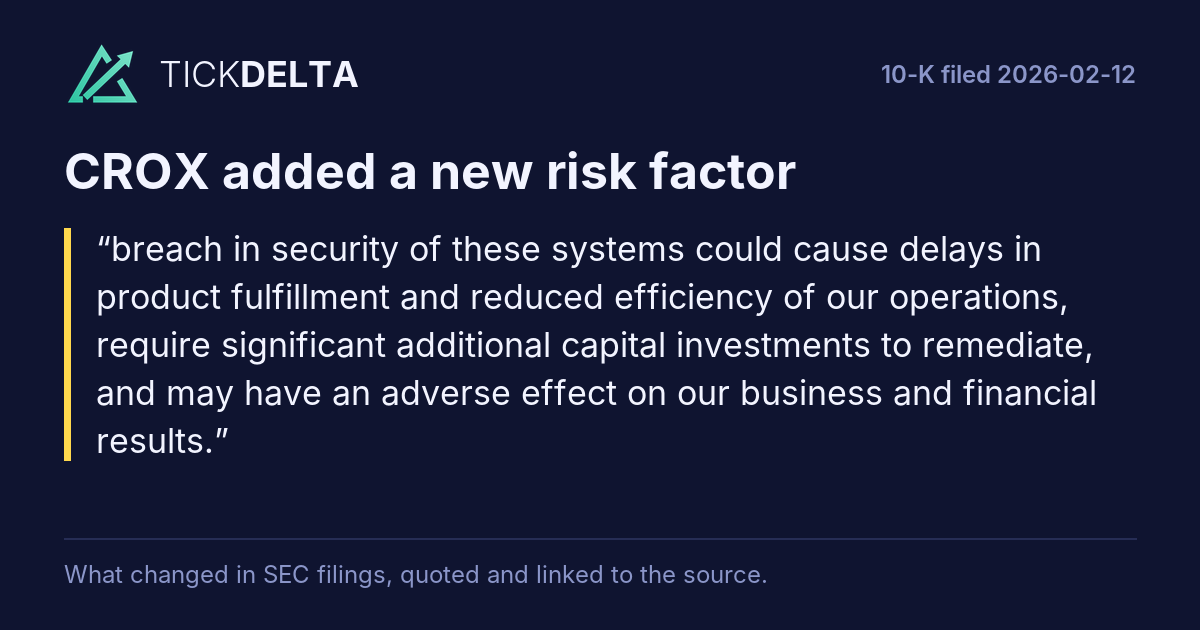
breach in security of these systems could cause delays in product fulfillment and reduced efficiency of our operations, require significant additional capital investments to remediate, and may have an adverse effect on our business and financial results.
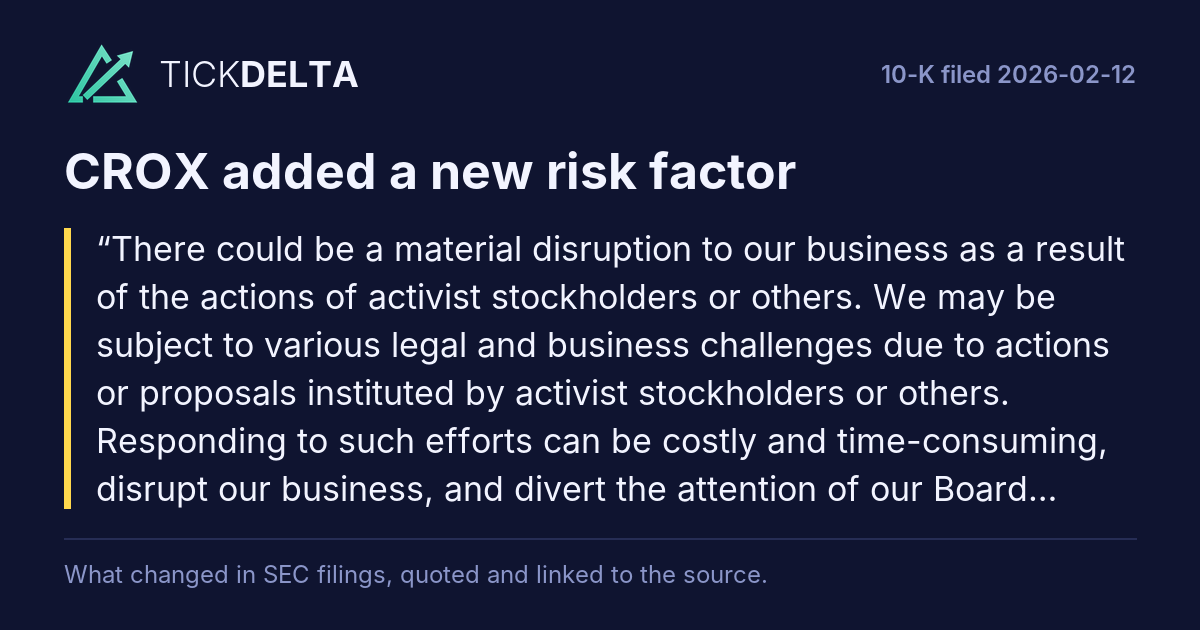
There could be a material disruption to our business as a result of the actions of activist stockholders or others.
We may be subject to various legal and business challenges due to actions or proposals instituted by activist stockholders or others. Responding to such efforts can be costly and time-consuming, disrupt our business, and divert the attention of our Board, management, and employees from the pursuit of our business strategies. Activist stockholders or others may also cause perceived uncertainties as to the future direction of our company or strategy which may be exploited by our competitors and may make it more difficult to attract and retain qualified personnel and potential consumers, and may affect our relationships with consumers, manufacturers, suppliers, investors, and other third parties. In addition, a proxy contest for the election of directors at our annual meeting could require us to incur significant legal and advisory fees and proxy solicitation expenses and require significant time and attention by management and our Board. The perceived uncertainties as to our future direction also could affect the market price and volatility of our securities.
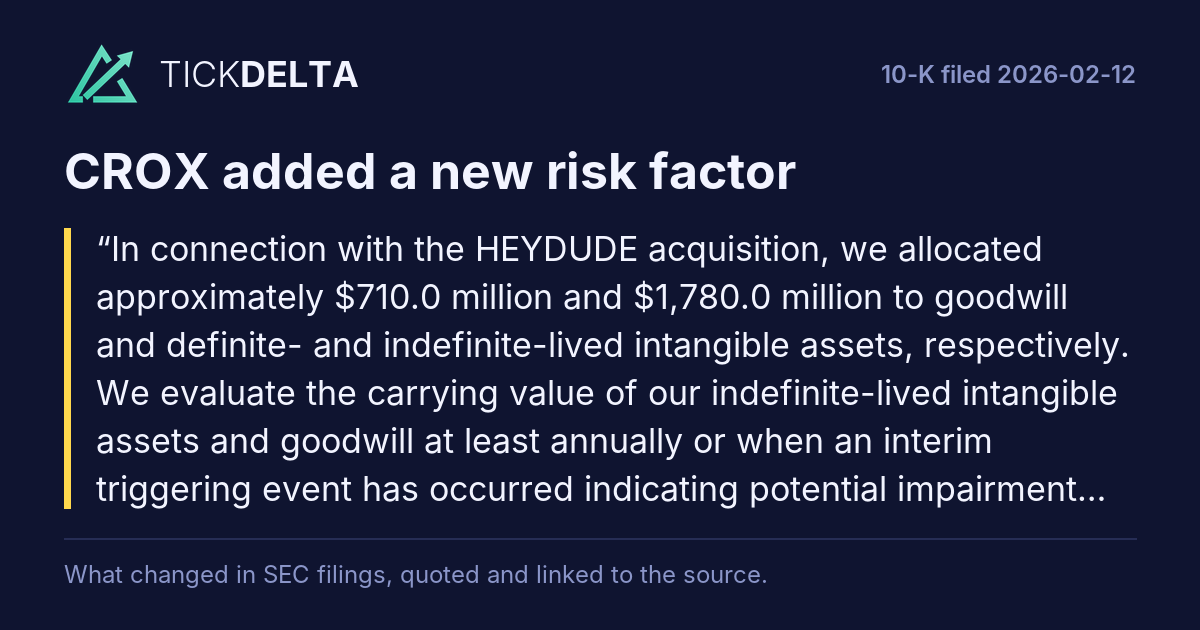
In connection with the HEYDUDE acquisition, we allocated approximately $710.0 million and $1,780.0 million to goodwill and definite- and indefinite-lived intangible assets, respectively. We evaluate the carrying value of our indefinite-lived intangible assets and goodwill at least annually or when an interim triggering event has occurred indicating potential impairment. During the second quarter of the fiscal year ended 2025, there was a triggering event for the trademark and the reporting unit goodwill, which resulted in non-cash impairment charges of $430.0 million for the trademark and $307.0 million for the reporting unit goodwill. The triggering event was due to downward revisions during the second quarter of the fiscal year ended 2025 to our internal HEYDUDE Brand forecast as a result of the extended time we believed it would take us to stabilize the HEYDUDE Brand and return it to growth. This was partly due to the current and projected impact of a weak U.S. consumer and the disproportionate impact of tariffs on HEYDUDE Brand products, which became evident in the second quarter of the fiscal year ended 2025. Our impairment evaluations represent a critical accounting policy as they require significant judgments and assumptions that we believe to be reasonable but that are inherently uncertain and unpredictable. Changes in the assumptions used to estimate the fair value of our goodwill and indefinite-lived intangible assets could result in impairment charges in future periods as the key assumptions are inherently uncertain, require significant judgment and are subject to change based on, among others, industry and geopolitical conditions, our ability to navigate changing macroeconomic conditions and trends as well as the timing and success of strategic initiatives. In addition, certain factors, such as failure to achieve forecasted revenue growth rates, earnings before interest, taxes, depreciation, and amortization, or increases in the discount rates, have the potential to create variances in the estimated fair values of our goodwill and indefinite-lived intangible assets that could result in additional impairment charges in future periods. See Part II - Item 7. Management’s Discussion and Analysis of Financial Condition and Results of Operations and Note 4 — Goodwill and Intangible Assets, Net in the accompanying notes to the consolidated financial statements included in Part II - Item 8. Financial Statements and Supplementary Data of this Annual Report on Form 10-K for more information.
New in the latest 10-Q
5 paragraphs in the 10-Q filed Oct 29, 2026 with nothing like them in the 10-Q filed Jul 30, 2026 (at least half the words must differ; new numbers alone do not count). Quoted exactly, grouped by the item heading above them. This is text that changed, not a judgement of how serious it is.
The Company and certain of its subsidiaries (the “Borrowers”) are parties to a credit agreement (as amended, the “Revolving Credit Agreement”) that provides for a senior secured revolving credit facility with aggregate commitments of $ 1.0 billion (the “Revolving Facility”). Subject to the terms of the Revolving Credit Agreement and lender commitments, the Borrowers may increase the commitments under the Revolving Facility by up to an additional $ 400.0 million, subject to certain conditions. The Revolving Facility matures in November 2027.
Read in the 10-Q
The Company was in compliance with all financial covenants as of September 30, 2026.
Read in the 10-Q
As of September 30, 2026, we had remaining authorization to repurchase $1.7 billion of our common stock, subject to restrictions under our debt agreements.
Read in the 10-Q
Interest Income. Interest income during the three months ended September 30, 2026, increased $2.8 million compared to the three months ended September 30, 2025. Interest income during the nine months ended September 30, 2026, increased $3.0 million compared to the nine months ended September 30, 2025. The increase in interest income for the three and nine months ended September 30, 2026, was due to interest on IEEPA tariff refunds received during the three months ended September 30, 2026 that were not present in the prior year.
Read in the 10-Q
Trading Arrangement Name and Position Action Date Rule 10b5-1* Non-Rule 10b5-1** Total Number of Shares to be Sold Expiration Date Anne Mehlman, Adopt 9/8/2026 X 7,276 6/8/2027 Executive Vice President and Brand President for Crocs Ronald Frasch, Director Adopt 9/9/2026 X 24,000 9/30/2027
Read in the 10-Q
Item 1A of the 10-Q filed Oct 29, 2026 against Item 1A of the 10-K filed Feb 12, 2026.
A 10-Q repeats only the risks that changed, so a 10-K paragraph that is missing from it is not counted as removed.
Added is a paragraph with nothing like it in the 10-K, Reworded a sentence that is in both with several words changed,
Quiet changes a sentence in both where one to four words changed and one is a hedge or a modal
(cut words struck through, new words highlighted).
Text on the page, not a score; each links to the filing at sec.gov.
What the 10-Q itself says about its risk factors:There have been no material changes to the risk factors contained in our Annual Report on Form 10-K for the year ended December 31, 2025.
Read in the 10-Q
Two-word phrases in Risk Factors of the 10-K filed Feb 12, 2026 that are in none of the 1 earlier 10-Ks stored, back to Feb 13, 2025
Used at least twice, small words left out. Counted, not picked: a phrase can be new because the company renamed something.
9 paragraphs of last year's Risk Factors with nothing like them now. The longest are quoted.
Item 1A of each 10-K and 10-Q on EDGAR, quoted exactly. Each paragraph links to the filing at sec.gov.
10-K change: what was reworded or cut, section by section.
Excel workbook · CSV. Google Sheet that stays up to date: paste =IMPORTDATA("https://tickdelta.com/company/CROX/export.csv") into a cell.