Form 10-K for the Fiscal Year Ended June 30, 2022
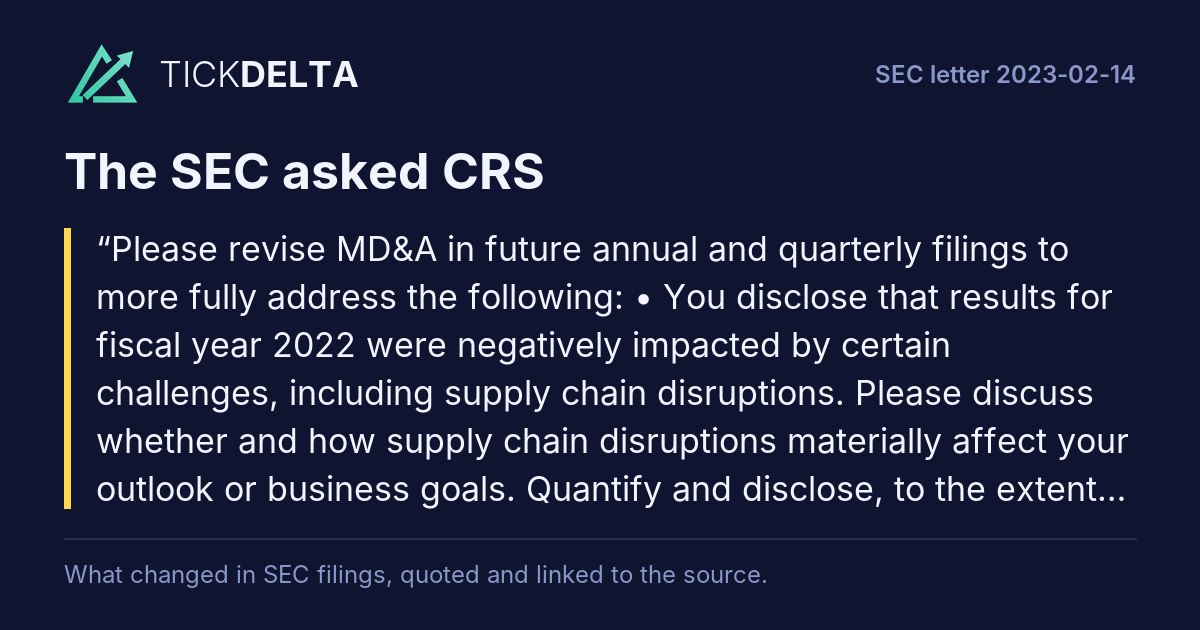
Please revise MD&A in future annual and quarterly filings to more fully address the following: • You disclose that results for fiscal year 2022 were negatively impacted by certain challenges, including supply chain disruptions. Please discuss whether and how supply chain disruptions materially affect your outlook or business goals.Rest of the question
Quantify and disclose, to the extent possible, how sales, profits, and/or liquidity have been impacted and discuss known trends or uncertainties resulting from mitigation efforts undertaken, including whether any mitigation efforts introduce new material risks, including those related to product quality, reliability, or approval. • You disclose here, and in quarterly filings, that you are experiencing ongoing inflationary cost increases. Please quantify and disclose the impact of the inflationary pressures you experience, including the combined impact of inflation and your LIFO inventory valuation method on cost of sales, gross profit, and inventory. Expand your disclosures to also indicate the extent to which you are able to pass increased costs on to customers, through surcharges, to mitigate inflationary pressures.
In response to the Staff’s comment, in future filings we will disclose and quantify, to the extent possible and appropriate, the impact of how supply chain disruptions affect our outlook and business goals. We will also expand disclosures with regard to the impact of inflationary pressures including the extent to which we are able to pass these costs on to customers.Read in the reply
First report after the company's reply of Feb 24, 2023: 10-Q filed Apr 27, 2023 ↗, against the 10-Q filed Jan 26, 2023 ↗.
Tickdelta does not hold the text of both reports, so they are not compared here.
We note you present several non-GAAP performance measures in which you eliminate the LIFO decrement charge you recorded in FY 2021. Please more fully explain to us what the LIFO decrement charge represents and why you believe eliminating it from non- GAAP performance measures is appropriate given your use of LIFO to account for the majority of your inventory.Rest of the question
Please also specifically address the following: • More fully explain to us how you determined the amount of the LIFO decrement charge and the factors that resulted in the charge. In this regard, we noted disclosures in current and prior year financial statements that indicate the current costs of LIFO valued inventories would be substantially higher which seems to indicate a potentially lower cost basis in older inventory balances; and • More fully explain to us how you considered the guidance in Question 100.04 of the Division of Corporation Finance’s Compliance & Disclosure Interpretations on Non- GAAP Financial Measures in determining the non-GAAP performance measures you present are appropriate.
In response to the Staff’s comment, the LIFO decrement charge was a result of the significant reduction in inventory during FY 2021. As required by the LIFO inventory method, the impact of the decrement was calculated by measuring the difference between the current costs of inventories included in costs of sales and the price index of each layer that was liquidated as a result of the FY 2021 inventory reduction or decrement.Read in the replyRest of the answer
In total and as the Staff has indicated, the current costs of LIFO valued inventories are significantly higher, however the layers associated with historical increments are higher or lower than current costs depending on the values at the time those LIFO layers were established. In the case of FY 2021, the decrement, which resulted in a charge as opposed to a benefit, was driven by LIFO layers that were liquidated that included a significant layer built in FY 2012 at a time when certain raw material prices were significantly higher than the FY 2021 current costs.
The Company considered the guidance in Question 100.04 of the Division of Corporation Finance’s Compliance & Disclosure Interpretations on Non-GAAP Financial Measures in determining the non-GAAP disclosure. More specifically, the Company has historically accounted for the majority of inventory using LIFO. The basic objective of the LIFO inventory method is to match current costs with current revenues. With that principle in mind, the costs of certain critical raw materials used in the manufacturing of our products may fluctuate significantly from period to period. We, and others in our industry, generally have been able to pass changes in the cost of certain major raw materials through to our customers using surcharges and other mechanisms. The Company significantly reduced inventory in FY 2021 due largely to unprecedented impacts of
COVID-19 on end-use market demand for the Company’s products. The significant reduction in inventory coupled with a substantial differential in historical costs between the current and historical years, as described above, resulted in a significant non-cash LIFO decrement charge. The LIFO decrement charge, because of its significance in FY 2021, was considered unusual and infrequent in nature and the Company believed excluding the LIFO decrement charge from our GAAP performance measures was appropriate. We believe that providing investors with our results of operations excluding this significant, non-cash charge provides a more consistent and meaningful basis for shareholders to compare the Company’s operating performance between periods.
First report after the company's reply of Feb 24, 2023: 10-Q filed Apr 27, 2023 ↗, against the 10-Q filed Jan 26, 2023 ↗.
Tickdelta does not hold the text of both reports, so they are not compared here.
We note your calculation of the non-GAAP liquidity measure you identify as "free cash flow" appears to differ from the standard calculation of this measure (i.e., cash flows from operations less capital expenditures). In order to avoid potential confusion, please revise the title of your non-GAAP liquidity measure in future filings to “adjusted free cash flow” or something similar.Rest of the question
Refer to Question 102.07 of the Division of Corporation Finance’s Compliance & Disclosure Interpretations on Non-GAAP Financial Measures.
In response to the Staff’s comment, the title of our non-GAAP liquidity measure will be revised to “adjusted free cash flow” in future filings.Read in the reply
First report after the company's reply of Feb 24, 2023: 10-Q filed Apr 27, 2023 ↗, against the 10-Q filed Jan 26, 2023 ↗.
Tickdelta does not hold the text of both reports, so they are not compared here.
Revenue, page 63 4. Please revise future filings to provide the disclosures required by ASC 606-10-50-6 and 50-8 or explain why you do not believe they are required.
In response to the Staff’s comment, the disclosures required by ASC 606-10-50-6 will be included in future filings.Read in the reply
In response to the Staff’s comment with regard to the disclosures required by ASC 606-10-50-8, the Company discloses total contract liabilities at each balance sheet date, however, the revenue recognized in the reporting period that was previously included in the contract liability balance has not been disclosed as it is not material.Rest of the answer
In future filings, we propose the following disclosure:
Revenue recognized for the years ended June 30, 20XX and 20XX from amounts included in contract liabilities at the beginning of the period was not significant and substantially all of our contract liabilities are recognized within a twelve-month period.
In connection with our responses to the Staff’s comments, we hereby acknowledge that:
the Company is responsible for the adequacy and accuracy of the disclosure in its filings;
the Staff’s comments, and our changes to disclosure in response to the Staff’s comments, do not foreclose the Commission from taking any action with respect to a filing; and the Company may not assert the Staff’s comments as a defense in any proceeding initiated by the Commission or any person under the federal securities laws of the United States.
First report after the company's reply of Feb 24, 2023: 10-Q filed Apr 27, 2023 ↗, against the 10-Q filed Jan 26, 2023 ↗.
Tickdelta does not hold the text of both reports, so they are not compared here.
Also in this review: closing letter, 2023-03-22