Paragraph 356 · 50% changed
Every version of it
Screener
/
SEC EDGAR
/CIK 0001674416
/10-K filed Feb 12, 2026, compared with Feb 11, 2025
/Numbers from the XBRL of the 10-Ks
Nasdaq
Health care · Biotechnology
CRISPR Therapeutics AG CRSP
The 10-K against last year's
182 changes: 38 added, 30 removed, 111 reworded, 3 quiet changes
10-K Feb 12, 2026 vs Feb 11, 2025
Risk Factors
14.4%
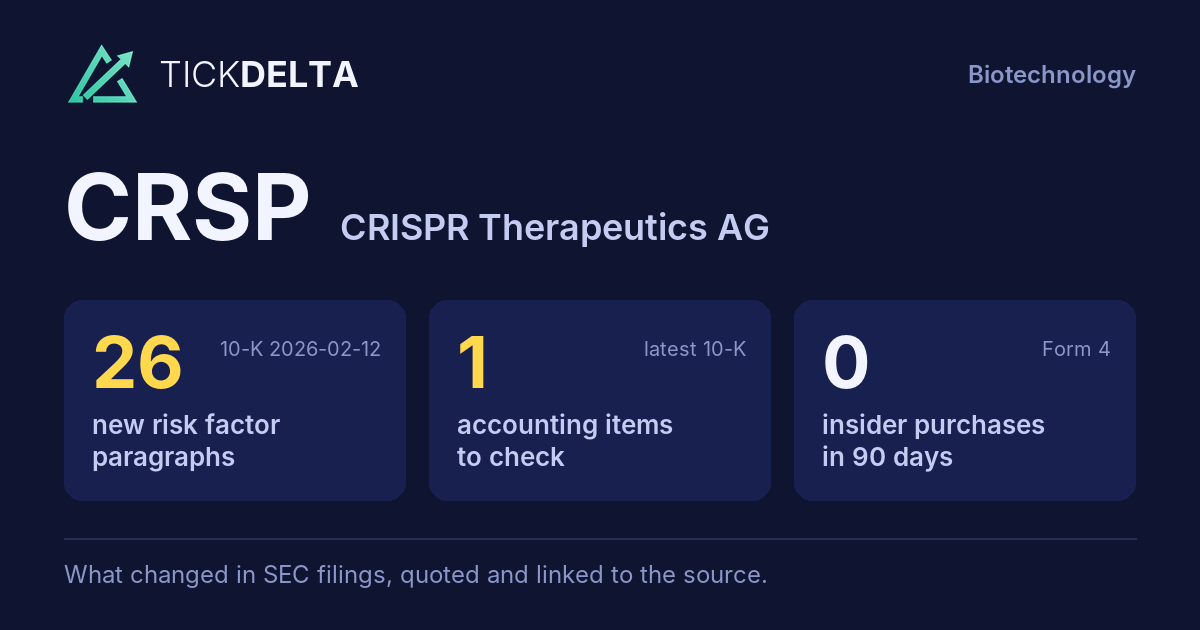
of the text changed · 45,259 words now · 26 new paragraphs, 22 gone
MD&A
26.8%
of the text changed · 7,380 words now · 12 new paragraphs, 8 gone
Legal Proceedings
64.1%
of the text changed · 1,066 words now
Accounting Policies
18.9%
of the text changed · 4,704 words now
10-K 0001193125-26-048957 (Feb 12, 2026) vs 10-K 0000950170-25-017899 (Feb 11, 2025)
Every paragraph, and how much of it changed
One bar per paragraph, in the order of the 10-K. Height and colour show the share of its words not in the closest paragraph a year earlier; the tallest bars are new paragraphs.
Risk Factors
495 paragraphs · 26 new · 148 reworded · 22 gone · 10-K Feb 12, 2026 against Feb 11, 2025
New paragraph
Reworded (5% of its words or more)
Same or nearly
Paragraph 114 · 46% changed
Every version of it
In general, the FDA requires the successful completion of two pivotal trials to support approval of a BLA, but in certain circumstances, will approve a BLA based on only one pivotal trial; and our ability to submit and obtain approval of a BLA is ultimately an FDA review decision, which will be dependent upon the data available at such time, and the available data may not be sufficiently robust from a safety and/or efficacy perspective to support the submission or approval of a BLA. For example, there is no assurance that data obtained at the completion of any of our clinical trials, including for our ongoing wholly-owned product candidates, including CTX112 and CTX131, will indicate clinically meaningful benefit or support submission of a BLA, or will be sufficiently robust from a safety and/or efficacy perspective to support either accelerated or conditional approval or full approval. Moreover, there is no assurance that the data obtained to date in the ongoing clinical trials of CASGEVY and being submitted or
Paragraph 267 · 46% changed
Every version of it
We are subject to numerous environmental, health and safety laws and regulations, including those governing laboratory procedures and the handling, use, storage, treatment and disposal of hazardous materials and wastes. Our operations involve the use of hazardous and flammable materials, including chemicals and biological materials. Our operations also produce hazardous waste products. We contract with third parties for the disposal of these materials and wastes. We will not be able to eliminate the risk of contamination or injury from these materials. In the event of contamination or injury resulting from any use by us of hazardous materials, we could be held liable for any resulting damages, and any liability could exceed our resources. We also could incur significant costs associated with civil or criminal fines and penalties for failure to comply with such laws and regulations.
Paragraph 420 · 44% changed
Every version of it
Paragraph 197 · 44% changed
Every version of it
Paragraph 451 · 42% changed
Every version of it
Paragraph 334 · 40% changed
Every version of it
We cannot guarantee the outcome of the oppositions to our in-licensed patents in Europe or other jurisdictions outside the United States included in the worldwide patent portfolio we have in-licensed from Dr. Charpentier, and an adverse result could preclude us from enforcing our rights against third parties in Europe or such other jurisdictions. The effects that any such proceedings and results may have on us and our intellectual property position are currently unknown. In any case, it may be years before there is a final determination on priority with respect to CVC Group’s patents included in the worldwide patent portfolio we have in-licensed from Dr. Charpentier.
Paragraph 72 · 39% changed
Every version of it
We aim to develop treatments and therapies for people suffering from serious diseases through transformative gene-based medicines, including ex vivo engineered cell therapies and in vivo therapies. Although there have been significant advances in recent years in the fields of gene therapy and genome editing, including CRISPR/Cas9 gene editing technology, such technologies, including in vivo CRISPR-based genome editing technologies in particular, are relatively new and only a limited number of clinical trials of product candidates based on such gene editing technologies have been commenced and their therapeutic utility is largely unproven. As such it is difficult to accurately predict the developmental challenges we may incur for our product candidates as they proceed through product discovery or identification, preclinical studies and clinical trials. For example, no genome editing in vivo therapy has been approved in the United States, EU or other key jurisdictions. While we and our partner, Vertex, have received marketing approvals for
Paragraph 356 · 50% changed
Every version of it
10-K Feb 11, 2025Claims that we have misappropriated the confidential information or trade secrets of third parties could have a similar material adverse effect on our business, financial condition, results of operations, and prospects.
10-K Feb 12, 2026
that we may seek to acquire. If we are unable to successfully obtain rights to required third-party intellectual property rights or maintain the existing intellectual property rights we have, we may have to abandon development of the relevant program, technology, or product candidate, or discontinue the practice of our core CRISPR/Cas9 gene editing technology, which could have a material adverse effect on our business, financial condition, results of operations, and prospects.
Paragraph 114 · 46% changed
Every version of it
10-K Feb 11, 2025
In general, the FDA requires the successful completion of two pivotal trials to support approval of a BLA, but in certain circumstances, will approve a BLA based on only one pivotal trial; and our ability to submit and obtain approval of a BLA is ultimately an FDA review decision, which will be dependent upon the data available at such time, and the available data may not be sufficiently robust from a safety and/or efficacy perspective to support the submission or approval of a BLA. For example, there is no assurance that data obtained at the completion of any of our clinical trials, including for our ongoing wholly-owned product candidates, including CTX112 and CTX131, will indicate clinically meaningful benefit or support submission of a BLA, or will be sufficiently robust from a safety and/or efficacy perspective to support either accelerated or conditional approval or full approval. Moreover, there is no assurance that the data obtained to date in the ongoing clinical trials of CASGEVY and being submitted or
10-K Feb 12, 2026
In general, the FDA requires the successful completion of two pivotal trials to support approval of a BLA, but in certain circumstances, will approve a BLA based on only one pivotal trial; and our ability to submit and obtain approval of a BLA is
Paragraph 267 · 46% changed
Every version of it
10-K Feb 11, 2025
We are subject to numerous environmental, health and safety laws and regulations, including those governing laboratory procedures and the handling, use, storage, treatment and disposal of hazardous materials and wastes. Our operations involve the use of hazardous and flammable materials, including chemicals and biological materials. Our operations also produce hazardous waste products. We contract with third parties for the disposal of these materials and wastes. We will not be able to eliminate the risk of contamination or injury from these materials. In the event of contamination or injury resulting from any use by us of hazardous materials, we could be held liable for any resulting damages, and any liability could exceed our resources. We also could incur significant costs associated with civil or criminal fines and penalties for failure to comply with such laws and regulations.
10-K Feb 12, 2026
We are subject to numerous environmental, health and safety laws and regulations, including those governing laboratory procedures and the handling, use, storage, treatment and disposal of hazardous materials and wastes. Our operations involve the use of
Paragraph 420 · 44% changed
Every version of it
10-K Feb 11, 2025A U.S. shareholder that qualifies for benefits under the U.S.-Swiss Tax Treaty, may apply for a refund of the tax withheld in excess of the 15% treaty rate (or in excess of the 5% reduced treaty rate for qualifying corporate shareholders with at least 10% voting rights, or for a full refund in the case of qualified pension funds). Non-Resident Shareholders should be aware that the procedures for claiming treaty benefits (and the time required for obtaining a refund) may differ from country to country. Non-Resident Shareholders should consult their own legal, financial or tax advisors regarding receipt, ownership, purchases, sale or other dispositions of shares and the procedures for claiming a refund of the Swiss withholding tax.
10-K Feb 12, 2026
should consult their own legal, financial or tax advisors regarding receipt, ownership, purchases, sale or other dispositions of shares and the procedures for claiming a refund of the Swiss withholding tax.
Paragraph 197 · 44% changed
Every version of it
10-K Feb 11, 2025Claims that we have misappropriated the confidential information or trade secrets of third parties could have a similar material adverse effect on our business, financial condition, results of operations, and prospects.
10-K Feb 12, 2026
under the Amended A&R Vertex JDCA. This could cause delays or difficulties in the development and commercialization of certain product candidates, including CASGEVY, and have a material adverse effect on our business, financial condition, results of operations, and prospects.
Paragraph 451 · 42% changed
Every version of it
10-K Feb 11, 2025Issues in the development and use of artificial intelligence, combined with an uncertain regulatory environment, may result in reputational harm, liability, or other adverse consequences to our business operations. As with many technological innovations, artificial intelligence presents risks and challenges that could impact our business. We may adopt and integrate generative artificial intelligence tools into our systems for specific use cases reviewed by legal and information security. Our vendors may incorporate generative artificial intelligence tools into their offerings without disclosing this use to us, and the providers of these generative artificial intelligence tools may not meet existing or rapidly evolving regulatory or industry standards with respect to privacy and data protection and may inhibit our or our vendors’ ability to maintain an adequate level of service and experience. If we, our vendors, or our third-party partners experience an actual or perceived breach or privacy or security incident because of the use of generative artificial intelligence, we may lose valuable intellectual property and confidential information and our reputation and the public perception of the effectiveness of our security measures could be harmed. Further, bad actors around the world use increasingly sophisticated methods, including the use of artificial intelligence, to engage in illegal activities involving the theft and misuse of personal information, confidential information, and intellectual property. Any of these outcomes could damage our reputation, result in the loss of valuable property and information, and adversely impact our business.
10-K Feb 12, 2026
Our vendors may in turn incorporate AI tools into their offerings, and the providers of these AI tools may not meet existing or rapidly evolving regulatory or industry standards, including with respect to privacy, data security and data integrity. Further, bad actors around the world use increasingly sophisticated methods, including the use of AI, to engage in illegal activities involving the theft and misuse of personal information, confidential information and intellectual property. In addition, the use of generative AI models in our internal or third-party systems may create new attack surfaces or methods for adversaries, which could impact us and our vendors. Any of these effects could damage our reputation, result in the loss of valuable property and information, cause us to breach applicable laws and regulations, and adversely impact our business.
Paragraph 334 · 40% changed
Every version of it
10-K Feb 11, 2025
The effects that any such proceedings and results may have on us and our intellectual property position are currently unknown. In any case, it may be years before there is a final determination on priority with respect to CVC Group’s patents included in the worldwide patent portfolio we have in-licensed from Dr. Charpentier.
10-K Feb 12, 2026
We cannot guarantee the outcome of the oppositions to our in-licensed patents in Europe or other jurisdictions outside the United States included in the worldwide patent portfolio we have in-licensed from Dr. Charpentier, and an adverse result could preclude us from enforcing our rights against third parties in Europe or such other jurisdictions. The effects that any such proceedings and results may have on us and our intellectual property position are currently unknown.
Paragraph 72 · 39% changed
Every version of it
10-K Feb 11, 2025
We aim to develop treatments and therapies for people suffering from serious diseases through transformative gene-based medicines, including ex vivo engineered cell therapies and in vivo therapies. Although there have been significant advances in recent years in the fields of gene therapy and genome editing, including CRISPR/Cas9 gene editing technology, such technologies, including in vivo CRISPR-based genome editing technologies in particular, are relatively new and only a limited number of clinical trials of product candidates based on such gene editing technologies have been commenced and their therapeutic utility is largely unproven. As such it is difficult to accurately predict the developmental challenges we may incur for our product candidates as they proceed through product discovery or identification, preclinical studies and clinical trials. For example, no genome editing in vivo therapy has been approved in the United States, EU or other key jurisdictions. While we and our partner, Vertex, have received marketing approvals for
10-K Feb 12, 2026
We aim to develop treatments and therapies for people suffering from serious diseases through transformative gene-based medicines, including ex vivo engineered cell therapies and in vivo therapies. Although there have been significant advances in recent years in the fields of gene therapy and genome editing, including CRISPR/Cas9 gene editing technology, such technologies, including
MD&A
101 paragraphs · 12 new · 42 reworded · 8 gone · 10-K Feb 12, 2026 against Feb 11, 2025
New paragraph
Reworded (5% of its words or more)
Same or nearly
Paragraph 75 · 47% changed
Paragraph 15 · 46% changed
We believe CRISPR/Cas9 has the potential to create the next generation of CAR T cell therapies that may have a superior product profile and allow broader patient access compared to current autologous therapies. We are advancing several cell therapy programs for oncology and/or autoimmune indications, including two next-generation allogeneic CAR T programs, CTX112 targeting Cluster of Differentiation 19, or CD19, indications and CTX131 targeting Cluster of Differentiation 70, or CD70. These product candidates incorporate edits designed to enhance CAR T potency, reduce CAR T exhaustion and evade the immune system. An additional edit in CTX131 is designed to prevent CAR T cells from killing other CAR T cells. In addition, these next-generation candidates exhibit increased manufacturing robustness, with a higher and more consistent number of CAR T cells produced per batch. We are producing CTX112 and CTX131 for clinical trials at our internal GMP manufacturing facility in Framingham, Massachusetts. oncology.
Paragraph 25 · 46% changed
Other Partnerships. We have entered into a number of additional collaborations collaborations, research and license agreements in other therapeutic areas, including an additional agreement agreements with Vertex including for the treatment of Duchenne muscular dystrophy and myotonic dystrophy type 1, as well as diabetes, and others others, including to support and complement our hematopoietic stem cell, CAR T, in vivo and T1D diabetes programs and platform, including agreements with: Nkarta, Inc. to develop and commercialize products leveraging donor-derived, gene-edited CAR-NK cells; Capsida Biotherapeutics, Inc. to develop in vivo gene editing therapies delivered with engineered adeno-associated virus vectors; Roswell Park Comprehensive Cancer Center to advance a gene-edited autologous CAR T program against a new target; MaxCyte, Inc. on ex vivo delivery for our hemoglobinopathy and CAR T programs; CureVac AG on optimized mRNA constructs and manufacturing for certain in vivo programs; and KSQ Therapeutics, Inc. on intellectual property for our allogeneic immuno-oncology programs. platform.
Paragraph 71 · 46% changed
Paragraph 16 · 45% changed
Paragraph 10 · 44% changed
Our first two in vivo programs utilizing our proprietary LNP platform, CTX310 and CTX320, aim to address portfolio includes cardiovascular disease by disrupting the validated targets angiopoietin-like programs, such as CTX310, directed towards angiopoietin-related protein 3, 3 or ANGPTL3, and lipoprotein (a), or Lp(a), respectively. CTX310 which is being investigated currently in an ongoing Phase 1b clinical trial targeting ANGPTL3 in patients with heterozygous familial hypercholesterolemia, homozygous familial hypercholesterolemia, mixed dyslipidemias, or severe hypertriglyceridemia. In addition,
Paragraph 20 · 43% changed
We continue to advance our regenerative medicine portfolio, including in diabetes. We are developing gene-edited stem cell-derived therapies for the treatment of T1D. We believe our gene editing capabilities have the potential to enable a beta-cell replacement product candidate that may deliver durable benefit to patients without the need for long-term immunosuppression. We have three parallel efforts to achieve this goal: (1) CTX211, an allogeneic, gene-edited, hypoimmune, stem cell derived product candidate in a device that is implanted into patients and intended to produce insulin in a glucose-dependent manner, and which is in an ongoing clinical trial; (2) advancing CTX213, a research stage deviceless beta cell replacement product candidate consisting of unencapsulated precursor islet cells derived from edited induced pluripotent stem cells; and (3) cells for the treatment of T1D. To date, CTX213 has demonstrated preclinical efficacy data via direct administration. In addition, we have granted a non-exclusive license to certain of our CRISPR/Cas9 intellectual property to Vertex to accelerate Vertex’s development of hypoimmune cell therapies for T1D in exchange for certain milestones and royalties.
Paragraph 74 · 43% changed
Paragraph 75 · 47% changed
10-K Feb 11, 2025Collaboration expense, net, was $110.3 million for the year ended December 31, 2024, compared to $130.3 million for the year ended December 31, 2023. The decrease of $20.0 million was attributable to our share of certain costs in 2023 arising from a license agreement between Vertex and a third party, which we agreed to pay to Vertex upon the occurrence of an event specified in Amendment No. 1 to the A&R Vertex JDCA. No similar costs were incurred in 2024. Refer to Note 8 of the notes to our consolidated financial statements included in this Annual Report on Form 10-K for a description of revenue recognized related to Vertex.
10-K Feb 12, 2026
Acquired in-process research and development expenses were $96.3 million for the year ended December 31, 2025. There were no acquired in-process research and development expenses for the year ended December 31, 2024. The $96.3 million acquired in-process research and development expense is attributable to the costs incurred upon entering the Sirius Agreement during the second quarter of 2025, as described in Note 8 of the notes to the consolidated financial statements included in this Annual Report on Form 10-K.
Paragraph 15 · 46% changed
10-K Feb 11, 2025
We believe CRISPR/Cas9 has the potential to create the next generation of CAR T cell therapies that may have a superior product profile and allow broader patient access compared to current autologous therapies. We are advancing several cell therapy programs for oncology and/or autoimmune indications, including two next-generation allogeneic CAR T programs, CTX112 targeting Cluster of Differentiation 19, or CD19, and CTX131 targeting Cluster of Differentiation 70, or CD70. These product candidates incorporate edits designed to enhance CAR T potency, reduce CAR T exhaustion and evade the immune system. An additional edit in CTX131 is designed to prevent CAR T cells from killing other CAR T cells. In addition, these next-generation candidates exhibit increased manufacturing robustness, with a higher and more consistent number of CAR T cells produced per batch. We are producing CTX112 and CTX131 for clinical trials at our internal GMP manufacturing facility in Framingham, Massachusetts.
10-K Feb 12, 2026
We believe CRISPR/Cas9 has the potential to create the next generation of CAR T cell therapies that may have a superior product profile and allow broader patient access compared to current autologous therapies. We are advancing cell therapy programs for autoimmune indications and oncology.
Paragraph 25 · 46% changed
10-K Feb 11, 2025
Other Partnerships. We have entered into a number of additional collaborations and license agreements in other therapeutic areas, including an additional agreement with Vertex for the treatment of Duchenne muscular dystrophy and myotonic dystrophy type 1, and others to support and complement our hematopoietic stem cell, CAR T, in vivo and T1D programs and platform, including agreements with: Nkarta, Inc. to develop and commercialize products leveraging donor-derived, gene-edited CAR-NK cells; Capsida Biotherapeutics, Inc. to develop in vivo gene editing therapies delivered with engineered adeno-associated virus vectors; Roswell Park Comprehensive Cancer Center to advance a gene-edited autologous CAR T program against a new target; MaxCyte, Inc. on ex vivo delivery for our hemoglobinopathy and CAR T programs; CureVac AG on optimized mRNA constructs and manufacturing for certain in vivo programs; and KSQ Therapeutics, Inc. on intellectual property for our allogeneic immuno-oncology programs.
10-K Feb 12, 2026
Other Partnerships. We have entered into a number of additional collaborations, research and license agreements in other therapeutic areas, including additional agreements with Vertex including for the treatment of Duchenne muscular dystrophy and myotonic dystrophy type 1, as well as diabetes, and others, including to support and complement our hematopoietic stem cell, CAR T, in vivo and diabetes programs and platform.
Paragraph 71 · 46% changed
10-K Feb 11, 2025•$7.9 million of decreased facility expenses primarily driven by lower laboratory-related costs; and
10-K Feb 12, 2026
•$25.8 million of decreased employee-related expenses, including stock-based compensation expenses, primarily driven by decreased headcount;
Paragraph 16 · 45% changed
10-K Feb 11, 2025We believe CRISPR/Cas9 has the potential to create the next generation of CAR T cell therapies that may have a superior product profile and allow broader patient access compared to current autologous therapies. We are advancing several cell therapy programs for oncology and/or autoimmune indications, including two next-generation allogeneic CAR T programs, CTX112 targeting Cluster of Differentiation 19, or CD19, and CTX131 targeting Cluster of Differentiation 70, or CD70. These product candidates incorporate edits designed to enhance CAR T potency, reduce CAR T exhaustion and evade the immune system. An additional edit in CTX131 is designed to prevent CAR T cells from killing other CAR T cells. In addition, these next-generation candidates exhibit increased manufacturing robustness, with a higher and more consistent number of CAR T cells produced per batch. We are producing CTX112 and CTX131 for clinical trials at our internal GMP manufacturing facility in Framingham, Massachusetts.
10-K Feb 12, 2026
Our lead next-generation product candidate, zugocabtagene geleucel (zugo-cel; formerly CTX112), incorporates edits designed to enhance CAR T potency, reduce CAR T exhaustion and evade the immune system. As a result of the next-generation edits, zugo-cel exhibits increased manufacturing robustness, with a higher and more consistent number of CAR T cells produced per batch. We are producing zugo-cel for clinical trials at our internal GMP manufacturing facility in Framingham, Massachusetts. Zugo-cel continues to advance in both autoimmune disease and hematologic malignancies.
Paragraph 10 · 44% changed
10-K Feb 11, 2025
Our first two in vivo programs utilizing our proprietary LNP platform, CTX310 and CTX320, aim to address cardiovascular disease by disrupting the validated targets angiopoietin-like protein 3, or ANGPTL3, and lipoprotein (a), or Lp(a), respectively. CTX310 is being investigated in an ongoing clinical trial targeting ANGPTL3 in patients with heterozygous familial hypercholesterolemia, homozygous familial hypercholesterolemia, mixed dyslipidemias, or severe hypertriglyceridemia. In addition,
10-K Feb 12, 2026
Our in vivo portfolio includes cardiovascular programs, such as CTX310, directed towards angiopoietin-related protein 3 or ANGPTL3, which is currently in an ongoing Phase 1b clinical trial in patients with heterozygous familial hypercholesterolemia, homozygous familial hypercholesterolemia, mixed dyslipidemias, or severe hypertriglyceridemia.
Paragraph 20 · 43% changed
10-K Feb 11, 2025
We are developing gene-edited stem cell-derived therapies for the treatment of T1D. We believe our gene editing capabilities have the potential to enable a beta-cell replacement product candidate that may deliver durable benefit to patients without the need for long-term immunosuppression. We have three parallel efforts to achieve this goal: (1) CTX211, an allogeneic, gene-edited, hypoimmune, stem cell derived product candidate in a device that is implanted into patients and intended to produce insulin in a glucose-dependent manner, and which is in an ongoing clinical trial; (2) CTX213, a research stage deviceless beta cell replacement product candidate consisting of unencapsulated precursor islet cells derived from edited stem cells; and (3) we have granted a non-exclusive license to certain of our CRISPR/Cas9 intellectual property to Vertex to accelerate Vertex’s development of hypoimmune cell therapies for T1D in exchange for certain milestones and royalties.
10-K Feb 12, 2026
We continue to advance our regenerative medicine portfolio, including in diabetes. We are advancing CTX213, a deviceless beta cell replacement product candidate consisting of unencapsulated precursor islet cells derived from induced pluripotent stem cells for the treatment of T1D. To date, CTX213 has demonstrated preclinical efficacy data via direct administration. In addition, we have granted a non-exclusive license to certain of our CRISPR/Cas9 intellectual property to Vertex to accelerate Vertex’s development of hypoimmune cell therapies for T1D in exchange for certain milestones and royalties.
Paragraph 74 · 43% changed
10-K Feb 11, 2025For additional information about our revenue recognition policy, see Note 2 and Note 8 of the notes to our audited consolidated financial statements included in this Annual Report on Form 10-K.
10-K Feb 12, 2026
•$10.4 million of increased sublicense and license fees, primarily attributable to costs incurred related to a contingent liability as of December 31, 2025, as described in Note 9 of the notes to the consolidated financial statements included in this Annual Report on Form 10-K.
A paragraph is matched with the one last year that shares the most of its words; under half in common makes it new. The paragraphs shown are the 8 reworded the most in each section.
The paragraph that changed most in each section
The redline
Marked against last year's 10-K: cut words struck through, new words highlighted.
Risk Factors394 words changed in this paragraph; it is 33% similar to last year's version.
We could be subject to risks caused by misappropriation, misuse, leakage, falsification of data, records or other information, encryption through ransomware, or intentional or accidental release or loss of information maintained in the information systems and networks of our company and our vendors, including personal information of our employees and study subjects, and company and vendor confidential data. These attacks and activity are also being facilitated or enhanced by evolving technologies, including AI. In addition, outside parties may attempt to penetrate our systems or those of our vendors or fraudulently induce our personnel or the personnel of our vendors to disclose sensitive information in order to gain access to our data and/or systems. We Like other companies in the industry, we, and our third-party vendors, have experienced threats and cybersecurity incidents relating to our information technology infrastructure, data and systems, and may experience threats to our data and systems, including malicious codes and viruses, phishing and other cyber-attacks such as a denial of service and insider threats. cybersecurity incidents in the future. The number and complexity of these threats continue to increase over time. If a material breach of our information technology systems or those of our vendors occurs, the market perception of the effectiveness of our security measures could be harmed and our reputation and credibility could be damaged. We could be required to expend significant amounts of money and other resources to repair or replace information systems or networks. In addition, we could be subject to regulatory actions and/or claims made by individuals and groups in private litigation involving privacy issues related to data collection and use practices and other data privacy laws and regulations, including claims for misuse or inappropriate disclosure of data, as well as unfair or deceptive practices. Although we develop and maintain systems and controls designed to prevent these events from occurring, and we have a process to identify and mitigate threats, the development and maintenance of these systems, controls and processes is costly and requires ongoing monitoring and updating as technologies change and efforts to overcome security measures become increasingly sophisticated. Moreover, despite our efforts, the possibility of these events occurring cannot be eliminated entirely. As we outsource more of our information systems to vendors, engage in more electronic transactions with payors and patients, and rely more on cloud-based information systems, the related security risks will increase and we will need to expend additional resources to protect our technology and information systems. In addition, there can be no assurance that our internal information technology systems or those of our third-party contractors, or our consultants’ efforts to implement adequate security and control measures, will be sufficient to protect us against breakdowns, service disruption, data deterioration or loss in the event of a system malfunction, or prevent data from being stolen or corrupted in the event of a cyberattack, security breach, industrial espionage attacks or insider threat attacks which could result in financial, legal, business or reputational harm.
Source: Item 1A, 10-K 0001193125-26-048957 vs Item 1A, 10-K 0000950170-25-017899
Legal Proceedings290 words changed in this paragraph; it is 59% similar to last year's version.
9. Commitments and Contingencies Intellectual Property Agreements Charpentier License Agreements In April 2014, the Company entered into certain technology license agreements with Dr. Emmanuelle Charpentier pursuant to which the Company licensed certain intellectual property rights under joint ownership from Dr. Charpentier to develop and commercialize products for the treatment or prevention of human diseases. In connection therewith, Dr. Charpentier is entitled to receive nominal clinical milestone payments, low single digit percentage of sublicensing payments received under any sublicense agreement with a third party, and low single-digit percentage royalties based on annual net sales of licensed products and services by the Company and its affiliates and sublicensees. The Company paid an immaterial amount of fees to Dr. Charpentier under the Charpentier License Agreements. Research, Manufacturing and License Agreements The Company has engaged several research institutions and companies to identify new delivery strategies and applications of the Company’s gene editing technology. The Company is also a party to a number of license agreements which require significant upfront payments and may be required to make future royalty payments and potential milestone payments from time to time. In addition, the Company is also a party to intellectual property agreements, which require maintenance and milestone payments from time to time. Further, the Company is a party to a number of manufacturing agreements that require upfront payments for the future performance of services. In connection with these agreements, on a product-by-product basis, the counterparties are eligible to receive up to low eight-digit potential payments upon specified research, development and regulatory milestones. In addition, on a product-by-product basis, the counterparties are eligible to receive potential commercial milestone payments based on specified annual sales thresholds. The potential payments are low-single digit percentages of the specified annual sales thresholds. The counterparties are also eligible to receive low single-digit royalties on future net sales. Under certain circumstances and if certain contingent future events occur, Vertex is eligible to receive up to $395.0 million in potential specified research, development, regulatory and commercial milestones and tiered single-digit percentage royalties on future net sales related to a specified target under an amendment to the 2015 Collaboration Agreement (as such term is defined in Note 8 above). In addition, Vertex has the option to conduct research at its own cost in certain defined areas that, if beneficial to the CASGEVY program and ultimately achieves regulatory approval, could result in the Company owing Vertex certain milestone payments aggregating to high eight digits, subject to certain limitations on the profitability of the CASGEVY program. Under the A&R Vertex JDCA, the Company has an option to defer specified costs on the CASGEVY program in excess of $110.3 million for the years ended December 31, 2022, 2023 and 2024. The $110.3 million for 2023 does not include amounts attributable to our share of certain costs arising from a license agreement between Vertex and a third party, which we agreed to pay to Vertex upon the occurrence of an event specified in Amendment No. 1 to the A&R Vertex JDCA.
Source: Item 3, via Note 9 – Commitments and Contingencies, 10-K 0001193125-26-048957 vs Item 3, via Note 9 – Commitments and Contingencies, 10-K 0000950170-25-017899
Accounting Policies198 words changed in this paragraph; it is 87% similar to last year's version.
Level 2 - Inputs other than Level 1 that are observable, either directly or indirectly, such as quoted prices for similar assets or liabilities; quoted prices in markets that are not active; or other inputs for which all significant inputs are observable or can be corroborated by observable market data for substantially the full term of the assets or liabilities. Level 3 - Unobservable inputs that are supported by little or no market activity and that are significant to the fair value of the assets or liabilities. To the extent that valuation is based on models or inputs that are less observable or unobservable in the market, the determination of fair value requires more judgment. Accordingly, the degree of judgment exercised by the Company in determining fair value is greatest for instruments categorized in Level 3. A financial instrument’s level within the fair value hierarchy is based on the lowest level of any input that is significant to the fair value measurement. Items measured at fair value on a recurring basis include marketable securities (see Note 3, Marketable Securities, and Note 4, Fair Value Measurement). The carrying amount of accounts receivable, other receivables, accounts payable and accrued expenses as reported on the consolidated balance sheets as of December 31, 2025 and 2024 and 2023 approximate fair value, due to the short-term duration of these instruments. Property and Equipment Property and equipment are recorded at cost, less accumulated depreciation. Maintenance and repairs that do not improve or extend the lives of the respective assets are expensed to operations as incurred. Upon disposal, the related cost and accumulated depreciation is removed from the accounts and any resulting gain or loss is included in the results of operations. Depreciation is recorded using the straight-line method over the estimated useful lives of the respective assets, which are as follows: Asset Estimated useful life Computer equipment 3 years Furniture, fixtures and other 5 years Laboratory equipment 5 years Leasehold improvements Shorter of useful life or remaining lease term Impairment of Long-lived Assets The Company reviews long-lived assets when events or changes in circumstances indicate the carrying value of the assets may not be recoverable. Recoverability is measured by comparison of the book values of the assets to future net undiscounted cash flows that the assets are expected to generate. If such assets are considered to be impaired, the impairment to be recognized is measured by the amount by which the book value of the assets exceed their fair value, which is measured based on the projected discounted future net cash flows arising from the assets. Revenue Recognition The Company records revenue in accordance with ASC 606, Revenue from Contracts with Customers, or ASC 606. ASC 606 applies to all contracts with customers, except for contracts that are within the scope of other standards, such as leases and collaboration arrangements. To determine revenue recognition for arrangements that an entity determines are within the scope of ASC 606, the entity performs the following five steps: 1) Identify the contract with the customer A contract with a customer exists when (i) the Company enters into an enforceable contract with a customer that defines each party’s rights regarding the goods or services to be transferred and identifies the related payment terms, (ii) the contract has commercial substance and (iii) the Company determines that collection of substantially all consideration for goods and services that are transferred is probable based on the customer’s intent and ability to pay the promised consideration. 2) Identify the performance obligations in the contract Performance obligations promised in a contract are identified based on the goods and services that will be transferred to the customer that are both capable of being distinct, whereby the customer can benefit from the good or service either on its own or together with other available resources, and are distinct in the context of the contract, whereby the transfer of the good or service is separately identifiable from other promises in the contract. To the extent a contract includes multiple promised goods and services, the Company must apply judgment to determine whether promised goods and services are capable of being distinct and distinct in the context of the contract. If these criteria are not met, the promised goods and services are accounted for as a combined performance obligation. 3) Determine the transaction price The transaction price is determined based on the consideration to which the Company will be entitled in exchange for transferring goods and services to the customer. To the extent the transaction price includes variable consideration such as research, development, regulatory and commercial milestones, the Company determines if it is probable that it will receive such amounts and there is no risk of a significant revenue reversal. When the Company cannot conclude that receipt of such amounts is probable, the Company constrains the related variable consideration resulting in its exclusion from transaction consideration. In determining the portion of the transaction consideration to be constrained, the Company considers the probability and uncertainty that the related research, developmental, regulatory and commercial milestones will be achieved given the nature of research and clinical development
Source: 10-K text, Note 2 – Summary of Significant Accounting Policies and Basis of Presentation, 10-K 0001193125-26-048957 vs 10-K text, Note 2 – Summary of Significant Accounting Policies and Basis of Presentation, 10-K 0000950170-25-017899
MD&A125 words changed in this paragraph; it is 52% similar to last year's version.
Net cash provided by financing activities for the year ended December 31, 2025 was $426.0 million, compared to net cash provided by financing of $332.0 million for the year ended December 31, 2024. Net cash provided by financing activities for the year ended December 31, 2025 consisted primarily of net proceeds of approximately $397.3 million from the sale of common shares issued in connection with our 2021 ATM and 2025 ATM, in the aggregate, as well as net proceeds of approximately $27.7 million from stock option exercise proceeds. Net cash provided by financing activities for the year ended December 31, 2024 was $332.0 million and primarily consisted of net proceeds of approximately $279.0 million from the issuance of common shares in connection with our registered direct offering, net proceeds of approximately $31.2 million from stock option exercises, and net proceeds of approximately $21.7 million from the issuance of common shares in connection with our 2021 ATM. Net cash provided by financing activities for the year ended December 31, 2023 was $62.7 million and consisted of net proceeds of $32.7 million from the issuance of common shares and net proceeds of approximately $29.9 million from stock option exercises.
Source: Item 7, 10-K 0001193125-26-048957 vs Item 7, 10-K 0000950170-25-017899
Sentences and paragraphs added, removed or reworded
Every change, by type
Sentences and paragraphs of CRSP's Risk Factors and MD&A, 10-K Feb 12, 2026 against 10-K Feb 11, 2025. Each links to the text at sec.gov.
Quiet changes are sentences kept from last year with one to four words changed, at least one of them a hedge, a modal or a qualifier (may, could, will, not, significant, material…). A year or date rolling forward is not counted.
The full word list
adverse, adversely, all, although, anticipate, anticipates, any, approximately, believe, believes, can, cannot, certain, could, expect, expects, generally, however, if, intend, intends, largely, likely, many, material, materially, may, might, most, must, never, no, not, possible, primarily, probable, should, significant, significantly, some, substantial, substantially, unlikely, will, would
AddedRisk Factors
•continue our clinical trials for our various wholly-owned and partnered programs;
Read it in 10-K Feb 12, 2026 at sec.gov
AddedRisk Factors
Vertex, generates product sales from CASGEVY, of which we receive 40% through our collaboration arrangement with Vertex. This amount is currently insufficient to cover program expenses and as such, we are responsible for 40% of losses, subject to certain limitations. We currently generate no revenue from sales of any wholly-owned product and we may never be able to again research, develop or commercialize a marketable product.
Read it in 10-K Feb 12, 2026 at sec.gov
AddedRisk Factors
Similarly, relatively few siRNA product candidates have been tested in humans and to date few have received regulatory approval and market authorizations.
Read it in 10-K Feb 12, 2026 at sec.gov
AddedRisk Factors
candidates we may develop in lieu of, or in addition to, existing treatments with which they are already familiar and for which greater clinical data may be available.
Read it in 10-K Feb 12, 2026 at sec.gov
AddedRisk Factors
needed, the sponsor of the BLA, must submit a proposed REMS before it can obtain approval. A REMS could include medication guides, physician communication plans, or elements to assure safe use, such as restricted distribution methods, patient registries and other risk minimization tools.
Read it in 10-K Feb 12, 2026 at sec.gov
AddedRisk Factors
Any government investigation of alleged violations of law, including investigations of any of our vendors, could require us to
Read it in 10-K Feb 12, 2026 at sec.gov
AddedRisk Factors
CASGEVY For SCD Has Received A Commissioner’s National Priority Voucher. The Benefits Of Such A Voucher, Including A Potentially Accelerated Timeline For Review Of Any [sBLA] Submission For CASGEVY For SCD By The FDA, May Not Be Able To Be Fully Realized.
Read it in 10-K Feb 12, 2026 at sec.gov
AddedRisk Factors
In June 2025, the FDA announced the creation of a new program, the Commissioner’s National Priority Voucher, or CNPV, program, to expedite the development and approval of drug and biological products with potential to address a major national priority, such as addressing a large unmet medical need, reducing downstream health care utilization, addressing a public health crisis, boosting domestic manufacturing, or increasing medication affordability. The FDA has stated that voucher recipients will receive a decision with respect to a drug or biological product marketing application on an accelerated basis, as well as enhanced communication with review staff throughout the development process prior to final submission of the application and during the review period. For additional information regarding the CNPV program, see the section entitled “Business-Government Regulation-Licensure and Regulation of Biologics in the United States-Expedited Programs.”
Read it in 10-K Feb 12, 2026 at sec.gov
Show the other 63
AddedRisk Factors
On November 6, 2025, the FDA announced that CASGEVY for SCD was awarded a CNPV. As a result, the [sBLA] for CASGEVY for SCD is eligible for the benefits of this program. However, receipt of the CNPV does not guarantee that any [sBLA] will be approved on an expedited basis or at all. The FDA has stated that the review time for an application of a CNPV recipient may be extended, including because the application is incomplete, if the results of pivotal trial(s) are ambiguous, or, if the review is particularly complex. The CNPV program is in pilot stage, so its implementation, operation, and ultimate impact or benefits are subject to uncertainty.
Read it in 10-K Feb 12, 2026 at sec.gov
AddedRisk Factors
In addition, current or future collaborators or strategic partners could also become our competitors in the future. Our
Read it in 10-K Feb 12, 2026 at sec.gov
AddedRisk Factors
including patent rights and trade secret protection, as well as entering into confidentiality agreements and in-licensing arrangements.
Read it in 10-K Feb 12, 2026 at sec.gov
AddedRisk Factors
Going forward, the USPTO could declare new interferences involving the CVC Group related to the same patents and patent applications referenced above, or any of the CVC Group’s existing or new patents and patent applications. Additionally, the USPTO could declare new interferences with us individually related to our existing wholly-owned patent portfolio or new patents and patent applications we file in the future.
Read it in 10-K Feb 12, 2026 at sec.gov
RemovedRisk Factors
RemovedRisk Factors
RemovedRisk Factors
RemovedRisk Factors
RemovedRisk Factors
RemovedRisk Factors
RemovedRisk Factors
RemovedRisk Factors
RemovedRisk Factors
RemovedRisk Factors
RemovedRisk Factors
RemovedRisk Factors
RewordedRisk Factors
RewordedRisk Factors
Our business, financial condition and results of operations could be adversely affected by general conditions in the global economy, disruption of global financial markets and a recession or market correction, including, for example, as a result of the coronavirus pandemic, uncertain trade policy, political unrest, including as a result of geopolitical tension such as a deterioration in the relationship between the United States and China, escalation of tensions between China and Taiwan, the ongoing military conflict between Russia and Ukraine and related sanctions imposed against Russia, or the Israel-Hamas war, and other global macroeconomic factors such as inflation. inflation, interest rate and currency rate fluctuations, tariffs, changes in or disruptions of certain U.S. governmental agencies, such as the FDA, whether due to a potential or actual U.S. federal government shutdown or otherwise, new laws and regulations or amendments to existing laws and regulations in the U.S. and foreign countries.
Read it in 10-K Feb 12, 2026 at sec.gov
RewordedRisk Factors
In addition, (i) corporate and individual shareholders who are resident in Switzerland for tax purposes, (ii) corporate and individual shareholders who are not resident in Switzerland, and who, in each case, hold their shares as part of a trade or business carried on in Switzerland through a permanent establishment with fixed place of business situated in Switzerland for tax purposes and (iii) Swiss resident private individuals who, for income tax purposes, are classified as “professional securities dealers” for reasons of, inter alia, frequent dealing, or leveraged investments, in shares and other securities (collectively, “Domestic Commercial Shareholders”) are in principle eligible for a full refund or credit against income tax of the Swiss withholding tax if they duly report the underlying income in their income statements or income tax return, as the case may be.
Read it in 10-K Feb 12, 2026 at sec.gov
RewordedRisk Factors
The Rights Of Our Shareholders May Be Different From The Rights Of Shareholders In Companies Governed By The Laws Of rights of our shareholders and the responsibilities of members of our board of directors may be different from the rights and obligations of shareholders and directors of companies governed by the laws of U.S. jurisdictions.
Read it in 10-K Feb 12, 2026 at sec.gov
RewordedRisk Factors
Our vendors may in turn incorporate generative artificial intelligence AI tools into their offerings without disclosing this use to us, offerings, and the providers of these generative artificial intelligence AI tools may not meet existing or rapidly evolving regulatory or industry standards standards, including with respect to privacy privacy, data security and data protection and may inhibit our or our vendors’ ability to maintain an adequate level of service and experience. integrity.
Read it in 10-K Feb 12, 2026 at sec.gov
RewordedRisk Factors
In general, the FDA requires the successful completion of two pivotal trials to support approval of a BLA, but in certain circumstances, will approve a BLA based on only one pivotal trial; and our ability to submit and obtain approval of a BLA is ultimately an FDA review decision, which will be dependent upon the data available at such time, and the available data may not be sufficiently robust from a safety and/or efficacy perspective to support the submission or approval of a BLA.
Read it in 10-K Feb 12, 2026 at sec.gov
RewordedRisk Factors
RewordedRisk Factors
For example, beginning in 2025, we will no longer have the option to defer certain costs on the CASGEVY program under the Amended A&R Vertex JDCA JDCA, and, as a result, we have incurred increased development and expect our share of commercialization expenses for the development and commercialization of CASGEVY to increase, and that such expenses will exceed our share of revenue for the foreseeable future. program.
Read it in 10-K Feb 12, 2026 at sec.gov
RewordedRisk Factors
Although there have been significant advances in recent years in the fields of gene therapy and genome editing, including CRISPR/Cas9 gene editing technology, such technologies, including in vivo CRISPR-based genome editing technologies in particular, are relatively new and only a limited number of clinical trials of product candidates based on such gene editing technologies have been commenced and their therapeutic utility is largely unproven.
Read it in 10-K Feb 12, 2026 at sec.gov
RewordedRisk Factors
If we are unable to obtain funding on a timely basis, we may be required to significantly curtail, delay or discontinue one or more of our research or development programs or the commercialization of any product candidate, or be unable to expand our operations or otherwise capitalize on our business opportunities, as desired, which could materially affect our business, financial
Read it in 10-K Feb 12, 2026 at sec.gov
RewordedRisk Factors
RewordedRisk Factors
If a prolonged government shutdown occurs, occurs or if staffing changes prevent the FDA, the SEC or other regulatory authorities from conducting their regular inspections, reviews, or other regulatory activities, including formal and informal interactions with product developers, it could significantly impact the ability of the FDA and the SEC to timely review and process our submissions, which could have a material adverse effect on our business and our timelines.
Read it in 10-K Feb 12, 2026 at sec.gov
Quiet changesRisk Factors
Beginning in 2025, we will no longer have the option to defer such costs on the CASGEVY program.
Read it in 10-K Feb 12, 2026 at sec.gov
Quiet changesRisk Factors
The existence of comprehensive privacy laws in different states in the country would make our compliance obligations more complex and costly and may increase the likelihood that we may be subject to enforcement actions or otherwise incur liability for noncompliance.
Read it in 10-K Feb 12, 2026 at sec.gov
Quiet changesRisk Factors
If, for example, other certain banks and financial institutions enter receivership or become insolvent in the future in response to financial conditions affecting the banking system and financial markets, our ability to access our existing cash, cash equivalents and investments may be threatened.
Read it in 10-K Feb 12, 2026 at sec.gov
AddedMD&A
In addition, we have a number of earlier stage investigational in vivo programs leveraging gene disruption in the liver for both common and rare diseases, including CTX340, directed towards angiotensinogen for the treatment of refractory hypertension; our next-generation LPA program, CTX321 directed towards LPA, the gene encoding apolipoprotein(a), a major component of lipoprotein(a), or Lp(a), and CTX460, directed towards SERPINA1 using our proprietary SyNTase editing platform, for the treatment of alpha-1 antitrypsin deficiency. CTX340 and CTX321 are currently in IND-enabling studies in patients with refractory hypertension and in patients with elevated Lp(a), which has been shown to have an independent association with major adverse cardiovascular events, respectively. We are progressing CTX460 through preclinical studies. We are also pursuing additional delivery technologies, including LNPs, for delivery to tissues beyond the liver, including hematopoietic stem cells and T cells.
Read it in 10-K Feb 12, 2026 at sec.gov
AddedMD&A
Our siRNA-based portfolio includes clinical-stage programs in cardiovascular and thromboembolic diseases, developed in collaboration with Sirius Therapeutics and certain of its affiliates, or Sirius.
Read it in 10-K Feb 12, 2026 at sec.gov
AddedMD&A
CTX611 (formerly known as SRSD107) is a novel double-stranded, long-acting siRNA, designed to target the human coagulation factor XI, or FXI, messenger RNA and inhibit FXI protein expression. Through modulation of the intrinsic coagulation pathway, CTX611 is intended to provide anticoagulant and antithrombotic effects. Supported by clinical experience conducted by Sirius in two Phase 1 clinical trials, CTX611 is being developed as a long-acting FXI inhibitor with the potential to support infrequent, including semi-annual, subcutaneous administration.
Read it in 10-K Feb 12, 2026 at sec.gov
AddedMD&A
CTX611 is in an ongoing Phase 2 clinical trial in patients undergoing total knee arthroplasty.
Read it in 10-K Feb 12, 2026 at sec.gov
AddedMD&A
In autoimmune disease, it is being investigated in an ongoing clinical trial designed to assess the safety and efficacy of the product candidate in adult patients with systemic lupus erythematosus, or SLE, systemic sclerosis, and inflammatory myositis, and a second clinical trial in immune thrombocytopenia purpura and warm autoimmune hemolytic anemia.
Read it in 10-K Feb 12, 2026 at sec.gov
AddedMD&A
In oncology, the Phase 1/2 clinical trial in adult patients with relapsed or refractory B-cell malignancies who have received at least two prior lines of therapy is ongoing. Eligible disease subtypes include large B-cell lymphoma, or LBCL, follicular lymphoma grade 1-3a, marginal zone lymphoma, and mantle cell lymphoma. Initial positive clinical data generated through December 2025 support the advancement of zugo-cel into the Phase 2 portion of the ongoing Phase 1/2 trial. We have also established a collaboration and clinical supply agreement with Eli Lilly to evaluate zugo-cel together with pirtobrutinib in aggressive B-cell lymphomas, further expanding the program’s development in oncology. Zugo-cel has been granted RMAT designation by the U.S. Food and Drug Administration for the treatment of relapsed or refractory follicular lymphoma and marginal zone lymphoma.
Read it in 10-K Feb 12, 2026 at sec.gov
AddedMD&A
siRNA. In May 2025, we partnered with Sirius and entered into the Sirius Agreement pursuant to which, among other things, we and Sirius will collaborate on the research, development, manufacture, commercialization and use of the Sirius Collaboration Products, including co-development and co-commercialization of CTX611; and (2) Sirius granted us options to exclusively license Sirius siRNA technology to target up to two licensed targets from a list of seven reserved targets for the research, develop, manufacture and commercialization of siRNA Licensed Products, For the first Sirius Collaboration Product successfully developed, we will be the lead party responsible for commercialization efforts in the United States and Sirius will be the lead party responsible for commercialization efforts in Greater China.
Read it in 10-K Feb 12, 2026 at sec.gov
AddedMD&A
Asset acquisition costs related to acquired technology are expensed as acquired in-process research and development at the point that they have no established alternative future use. We classify asset acquisitions of acquired in-process research and development as investing activities on our consolidated statements of cash flows.
Read it in 10-K Feb 12, 2026 at sec.gov
AddedMD&A
Collaboration expense, net, consists of operating expenses under our collaboration with Vertex for the hemoglobinopathies program.
Read it in 10-K Feb 12, 2026 at sec.gov
AddedMD&A
Other income, net consists primarily of interest income earned on investments, as well as the change in fair value of corporate equity securities.
Read it in 10-K Feb 12, 2026 at sec.gov
AddedMD&A
Collaboration expense, net, was $213.5 million for the year ended December 31, 2025, compared to $120.7 million for the year ended December 31, 2024. In 2024, we exercised our option to defer specified costs under the CASGEVY program in excess of the $110.3 million deferral limit under the A&R Vertex JDCA, as amended. The increase of approximately $92.8 million in collaboration expense, net, was primarily attributable to reaching the deferral limit in 2024, as no such limit was applicable in 2025. Absent the deferral limit, the increase was primarily attributable to an increase in our share of CASGEVY operating expenses related to increased commercial and manufacturing costs for CASGEVY when compared to the prior period, which was partially offset by an increase in our share of CASGEVY revenue.
Read it in 10-K Feb 12, 2026 at sec.gov
AddedMD&A
As described in Note 8 of the notes to the consolidated financial statements included in this Annual Report on Form 10-K, we and Sirius entered into a share issuance agreement and we registered and issued 1,842,105 common shares to Sirius, nominal value CHF 0.03 per share, at an issue price of $38.00 per share as partial consideration for entering into the Sirius Agreement.
Read it in 10-K Feb 12, 2026 at sec.gov
RemovedMD&A
RemovedMD&A
RemovedMD&A
RemovedMD&A
RemovedMD&A
RemovedMD&A
RemovedMD&A
RemovedMD&A
RewordedMD&A
RewordedMD&A
RewordedMD&A
RewordedMD&A
Under the A&R Vertex JDCA, as amended, we are allowed for 2022, 2023 and 2024, the Company had an option to defer a portion of our its share of costs under the arrangement if spending on the CASGEVY program exceeds exceeded specified amounts. amounts, which the Company exercised in each such year, resulting in deferred costs of $221.8 million, in the aggregate.
Read it in 10-K Feb 12, 2026 at sec.gov
RewordedMD&A
As of December 31, 2024, 2025, we have common shares having aggregate gross proceeds up to $363.7 million remaining under our current prospectus supplement, and we have issued and sold an aggregate of 1.9 8.0 million common shares under the 2021 ATM at an average price of $122.73 $74.77 per share for aggregate proceeds of $233.2 $592.2 million, which were net of equity issuance costs of $3.1 $7.8 million, excluding stamp taxes. taxes of $5.9 million.
Read it in 10-K Feb 12, 2026 at sec.gov
RewordedMD&A
Net cash provided by financing activities for the year ended December 31, 2023 was $62.7 million and 2025 consisted primarily of net proceeds of $32.7 approximately $397.3 million from the issuance sale of common shares issued in connection with our 2021 ATM and 2025 ATM, in the aggregate, as well as net proceeds of approximately $29.9 $27.7 million from stock option exercises. exercise proceeds.
Read it in 10-K Feb 12, 2026 at sec.gov
RewordedMD&A
RewordedMD&A
While we have made significant progress with our current portfolio of programs, we recognize that we need may be able to continue bring transformative therapies to even more patients by continuing to innovate to unlock the full power potential of gene editing and bring potentially transformative therapies to even more patients. editing.
Read it in 10-K Feb 12, 2026 at sec.gov
RewordedMD&A
RewordedMD&A
RewordedMD&A
RewordedMD&A
General and administrative expenses were $73.5 million for the year ended December 31, 2025, compared to $73.0 million for the year ended December 31, 2024, compared to $76.2 million for the year ended December 31, 2023. 2024.
Read it in 10-K Feb 12, 2026 at sec.gov
Sources
The two latest 10-Ks on EDGAR, section by section. Each change links to the text at sec.gov.
Also
New risk factors: paragraphs with nothing like them last year, quoted in full.
Work with it
Excel workbook · CSV. Google Sheet that stays up to date: paste =IMPORTDATA("https://tickdelta.com/company/CRSP/export.csv") into a cell.