Form 10-K for the Fiscal Year Ended March 26, 2016
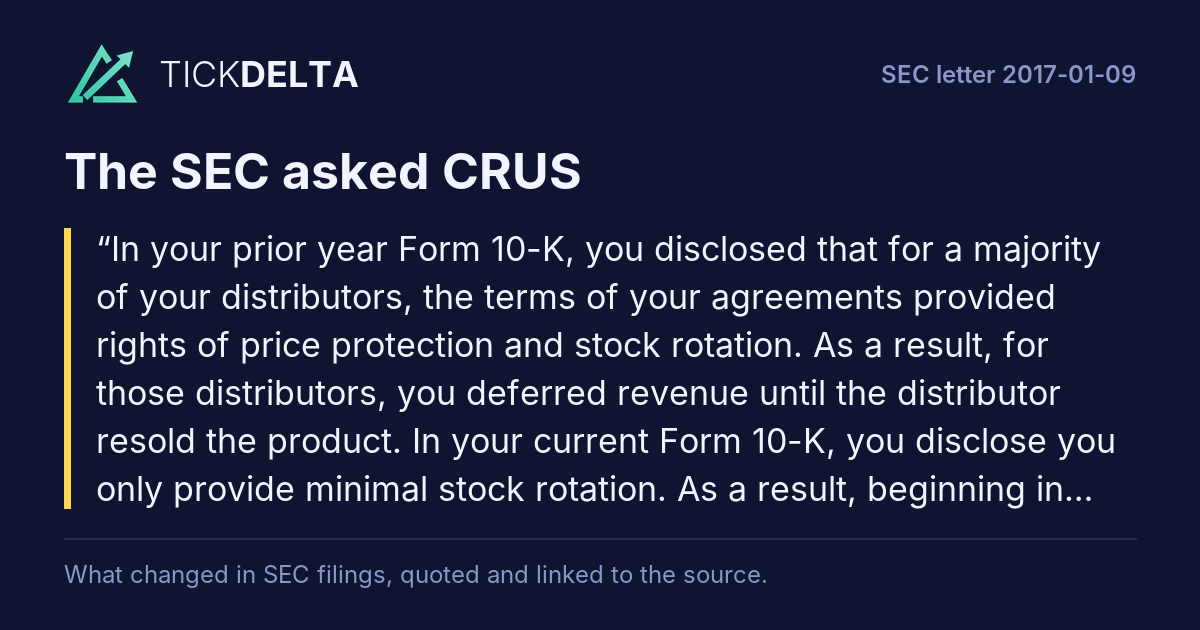
In your prior year Form 10-K, you disclosed that for a majority of your distributors, the terms of your agreements provided rights of price protection and stock rotation. As a result, for those distributors, you deferred revenue until the distributor resold the product. In your current Form 10-K, you disclose you only provide minimal stock rotation.Rest of the question
As a result, beginning in the fourth quarter of fiscal 2016, you now recognize revenue upon delivery to the distributor and record an estimate for returns. Please tell us why the disclosure of the terms of your distributor agreements changed. For example, tell us whether and when you entered into new agreements with all of these distributors that eliminated price protection provisions and changed stock rotation rights. The response should provide support for the change in your revenue recognition policy in the fourth quarter of fiscal 2016.
We recognize revenue when all of the following criteria are met: persuasive evidence that an arrangement exists, delivery of goods has occurred, the sales price is fixed or determinable and collectability is reasonably assured. We evaluate our distributor arrangements, on a distributor by distributor basis, with respect to each of the four criteria above.Read in the reply
Prior to the fourth quarter of fiscal year 2016, we had a number of arrangements with distributors whereby we deferred revenue at the time of shipment of our products to those distributors.Rest of the answer
As part of those arrangements, when a distributor resold those products to an end customer, the Company would credit the distributor the difference between (1) the original distributor price and the distributor’s agreed upon margin and (2) the final sales price to the end customer (known as the “Ship and Debit Arrangement”). For those transactions, revenue was deferred until the product was resold by the distributor and we determined that the final sales price to the distributor was fixed or determinable. For certain of our smaller distributors, we did not have similar Ship and Debit Arrangements and the distributors were billed at a fixed upfront price. For those transactions, revenue was recognized upon delivery to the distributor based upon the distributor’s individual shipping terms, less an allowance for estimated returns, as the Company determined that the revenue recognition criteria were met.
In light of the fact that the distributor program had been declining as a portion of the overall business for several years, in fiscal year 2016 the Company performed a review of all distributor arrangements in an effort to streamline our distribution program and reduce overhead costs. Based upon this review, the Company terminated its Ship and Debit Arrangements with Distributors during the fourth quarter of fiscal year 2016. Subsequent to the termination of the Ship and Debit Arrangements, the Company began recognizing revenue for all distributors upon delivery to the distributor based upon the distributor’s individual shipping terms, less an allowance for estimated returns, as the Company’s final sales price to the distributor was fixed and determinable and the Company determined that all four criteria for revenue recognition were met.
Although the Company terminated its Ship and Debit Arrangements with all distributors along with certain ancillary agreements related to the
Ship and Debit Arrangements, the Company continues to grant varying levels of stock rotation and price protection rights based on individual distributor agreements. To the extent these rights are implicated in any transaction with a distributor, we continue to evaluate their effect on when the revenue recognition criteria have been met.
First report after the company's reply of Jan 19, 2017: 10-Q filed Feb 1, 2017 ↗, against the 10-Q filed Oct 27, 2016 ↗.
Tickdelta does not hold the text of both reports, so they are not compared here.
Also, please tell us whether you continue to evaluate your distributor arrangements on a distributor by distributor basis and why you record revenue upon delivery and not shipment to the distributor.
Cirrus continues to review arrangements on a distributor by distributor basis, and records revenue when all four criteria for revenue recognition are met, including delivery. Per SAB Topic 13.A.3, delivery generally is not considered to have occurred unless the distributor has taken title and assumed the risks and rewards of ownership of the products. Typically, this occurs when a product is received by the distributor (if the terms of the sale are “FOB destination”) or when a product is shipped to the distributor (if the terms are “FOB shipping point”).Read in the replyRest of the answer
Cirrus reviews terms of deliveries to ensure accurate revenue recognition.
First report after the company's reply of Jan 19, 2017: 10-Q filed Feb 1, 2017 ↗, against the 10-Q filed Oct 27, 2016 ↗.
Tickdelta does not hold the text of both reports, so they are not compared here.
Please amend your Form 10-K to revise the conclusions of your principal executive and principal financial officers to include a clear statement disclosing whether your disclosure controls and procedures were or were not effective as of the end of the period covered by the report. Refer to Item 307 of Regulation S-K.
The Evaluation of Disclosure Controls and Procedures text was revised for the 2016 Form 10-K and the key statement as to whether the disclosure controls and procedures were effective was inadvertently omitted, even though the controls were evaluated to be effective as of March 26, 2016. The omission of this statement was noted and corrected for the June 25, 2016 Form 10-Q and subsequent filings. We will amend the 2016 Form 10-K on Form 10-K/A as shown below:Read in the reply
ITEM 9A.Rest of the answer
Controls and Procedures
Evaluation of Disclosure Controls and Procedures (As restated)
As required by Rule 13a-15(b) of the Exchange Act, we have evaluated, under the supervision and with the participation of our management, including our chief executive officer (CEO) and chief financial officer (CFO), the effectiveness of the design and operation of our disclosure controls and procedures (as defined in Rules 13a-15(e) and 15d-15(e) of the Exchange Act) as of the end of the period covered by this Form 10-K. Our disclosure controls and procedures are designed to provide reasonable assurance that the information required to be disclosed by us in reports that we file or submit under the Exchange Act is (i) recorded, processed, summarized and reported within the time periods specified in the Securities and Exchange Commission rules and forms and (ii) accumulated and communicated to our management, including our CEO and CFO, as appropriate, to allow timely decisions regarding required disclosure. Based upon the evaluation, our management, including our CEO and CFO has concluded that our disclosure controls and procedures were effective as of March 26, 2016.
Management’s Annual Report on Internal Control Over Financial Reporting
Our management is responsible for establishing and maintaining adequate internal control over financial reporting, as such term is defined under Rule 13a-15(f). Under the supervision and with the participation of our management, including our CEO and CFO, we assessed the effectiveness of our internal control over financial reporting as of the end of the period covered by this report based on the criteria set forth in Internal Control-Integrated Framework issued by the Committee of Sponsoring Organizations of the Treadway Commission (2013 framework).
Because of its inherent limitation, internal control over financial reporting may not prevent or detect all errors and all fraud. In addition, projections of any evaluation of effectiveness to future periods are subject to the risk that controls may become inadequate because of changes in conditions and that the degree of compliance with the policies or procedures may deteriorate.
Based on its assessment of internal control over financial reporting, management has concluded that our internal control over financial reporting was effective as of March 26, 2016, to provide reasonable assurance regarding the reliability of our financial reporting and the preparation of our financial statements for external purposes in accordance with U.S. generally accepted accounting principles. Our independent registered public accounting firm, Ernst &
Young LLP, has issued an attestation report on management’s assessment of our internal control over financial reporting as of March 26, 2016, included in Item 8 of this report.
Changes in Internal Control Over Financial Reporting
There has been no change in the Company’s internal control over financial reporting during the quarter ended
March 26, 2016, that has materially affected, or is reasonably likely to materially affect, the Company’s internal control over financial reporting. The Wolfson acquisition was migrated to the corporate ERP and financial reporting application instance in the quarter ended June 27, 2015.
To expedite any further communication of these matters, please contact me at (512)851-4000 with any further questions or comments. In addition, please send any follow-up correspondence to my attention at the address on file.
First report after the company's reply of Jan 19, 2017: 10-Q filed Feb 1, 2017 ↗, against the 10-Q filed Oct 27, 2016 ↗.
Tickdelta does not hold the text of both reports, so they are not compared here.
In future filings please clarify the underlying cause of the change in your revenue policy similar to your response to comment 1.
No reply letter found.
First report after the SEC's letter of Jan 26, 2017: 10-Q filed Feb 1, 2017 ↗, against the 10-Q filed Oct 27, 2016 ↗.
Tickdelta does not hold the text of both reports, so they are not compared here.
We note your response to comment 3. Please file the requested amendment with all the requested changes.
No reply letter found.
First report after the SEC's letter of Jan 26, 2017: 10-Q filed Feb 1, 2017 ↗, against the 10-Q filed Oct 27, 2016 ↗.
Tickdelta does not hold the text of both reports, so they are not compared here.
Also in this review: closing letter, 2017-02-06