7 paragraphs in Risk Factors of the 10-K filed Mar 5, 2026
with nothing like them in the 10-K filed Mar 10, 2025. Quoted exactly.
Paragraphs that were only edited are under 10-K change.
Compared with the Risk Factors in the latest 10-K of the other 74 Technology companies:
a paragraph with at least half its words the same at another company is called similar, and the companies are listed under it.
A paragraph most of them have is marked boilerplate. No line means no other company has one like it.
This counts text; it does not say how serious a risk is.
or data of our customers would be especially detrimental to our reputation, customer confidence in our solution, and our business.
Read in the 10-K ↗
jurisdictions in which we operate, such procedures and controls may not be effective in ensuring compliance or preventing unauthorized transfers of personal data.
Read in the 10-K ↗
In June 2025, we announced that our board of directors authorized a program under which we are authorized to repurchase up to $1.0 billion of our outstanding shares of common stock (the “Share Repurchase Program”). Such repurchases may be made from time to time using a variety of methods, including open market purchases, privately negotiated transactions and trading plans intended to qualify under Rule 10b5-1 under the Exchange Act. The Share Repurchase Program does not have a fixed expiration date and may be suspended or discontinued at any time. We are not obligated to use the Share Repurchase Program to acquire any specific amount of common stock. We intend to use the Share Repurchase Program opportunistically depending on market prices and other factors.
Similar paragraph at 2 of 74 other Technology companies:
TWLO,
WDAYThe timing and amount of any repurchases will be subject to liquidity, market and economic conditions, any applicable restrictions under future credit facilities, compliance with applicable legal requirements, and other relevant factors. Repurchases of shares of our common stock under the Share Repurchase Program will reduce the amount of cash we have available to fund working capital, repay debt, make capital expenditures and strategic acquisitions or pursue business opportunities, and for other general corporate purposes. The Share Repurchase Program may not enhance long-term stockholder value because the market price of our common stock may decline below the levels at which we repurchased shares and short-term stock price fluctuations could reduce the effectiveness of this program.
Similar paragraph at 3 of 74 other Technology companies:
GDDY,
TWLO,
WDAY
sustained, we could be required to pay additional taxes, interest and penalties, which could result in one-time tax charges, higher effective tax rates, reduced cash flows and lower overall profitability of our operations.
Similar paragraph at 1 of 74 other Technology companies:
P
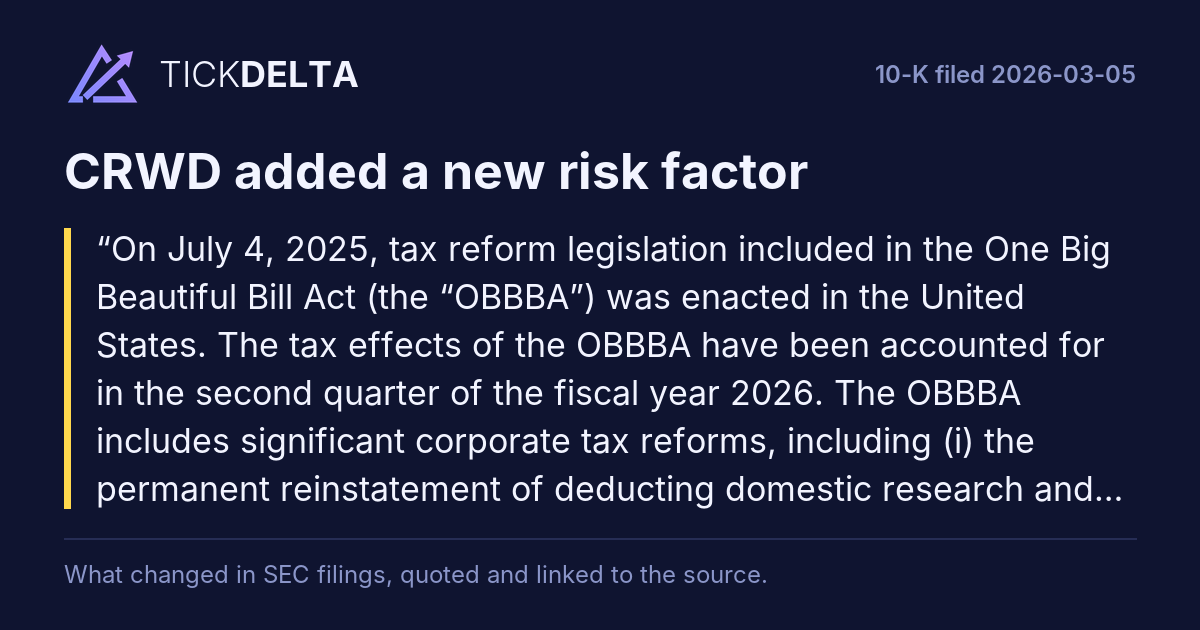
On July 4, 2025, tax reform legislation included in the One Big Beautiful Bill Act (the “OBBBA”) was enacted in the United States. The tax effects of the OBBBA have been accounted for in the second quarter of the fiscal year 2026. The OBBBA includes significant corporate tax reforms, including (i) the permanent reinstatement of deducting domestic research and development expenditures as incurred beginning in fiscal 2026 (under prior law such expenditures were capitalized and amortized over five years); (ii) the option to claim 100% accelerated depreciation deductions on qualified property; and (iii) international tax provisions modifying global intangible low-taxed income (“GILTI”), foreign-derived intangible income (“FDII”), and base erosion and anti-abuse tax (“BEAT”).
Read in the 10-K ↗
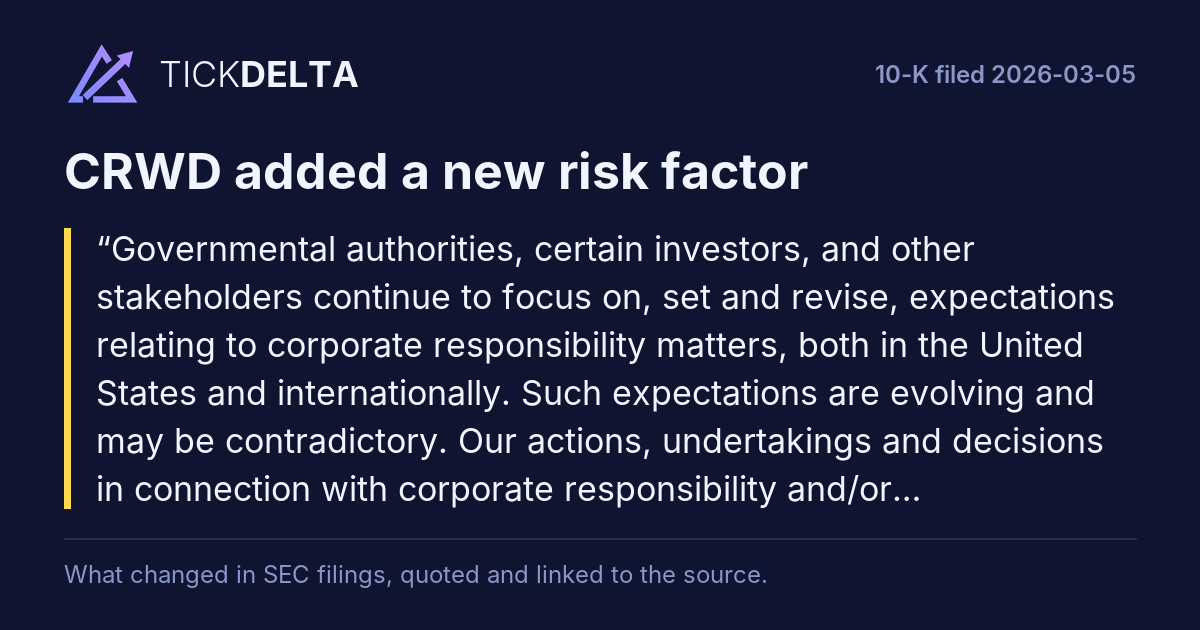
Governmental authorities, certain investors, and other stakeholders continue to focus on, set and revise, expectations relating to corporate responsibility matters, both in the United States and internationally. Such expectations are evolving and may be contradictory. Our actions, undertakings and decisions in connection with corporate responsibility and/or sustainability-related initiatives, goals, or commitments, including whether to pursue them, and/or the extent to which we achieve them, may be challenged and could harm our reputation, adversely impact our ability to attract and retain employees or customers and expose us to increased scrutiny from investors, governmental authorities and others, or subject us to liability. Additionally, compliance with current or future legal requirements or stakeholder expectations regarding corporate responsibility and/or sustainability matters, including disclosure and reporting obligations, may result in increased costs and legal and operational risks. For example, the proliferation of regulations and guidance addressing corporate responsibility topics at various government levels has required and may continue to require significant effort and resources, and our efforts may not ensure compliance with evolving standards. Any such damage to our reputation, adverse impact to our ability to attract and retain employees or customers, increased scrutiny, exposure to liability and increased compliance costs may adversely impact our business, financial condition, or results of operations.
Similar paragraph at 1 of 74 other Technology companies:
TWLO
New in the latest 10-Q
23 paragraphs in the 10-Q filed Aug 27, 2026 with nothing like
them in the 10-Q filed Jun 4, 2026 (at least half the words must differ; new numbers alone do not count).
Quoted exactly, grouped by the item heading above them. This is text that changed, not a judgement of how serious it is.
Financial statements and notes
The Company’s cash is placed with high-credit-quality financial institutions and issuers, and at times exceeds federally insured limits.
Read in the 10-Q ↗
Derivative transactions expose the Company to credit risk to the extent that the counterparties are unable to meet the terms of the arrangements. The Company mitigates this exposure by transacting with highly-rated counterparties under master netting arrangements that permit net settlement. The Company is not required to pledge, nor does it receive collateral in connection with these instruments.
Read in the 10-Q ↗
Derivative Contracts: The Company records derivative contracts at fair value as either assets or liabilities on its condensed consolidated balance sheets. For derivative contracts entered into in order to hedge a portion of the Company’s forecasted foreign currency denominated cash flow, which are designated as cash flow hedges, the unrealized gain or loss on the derivative instrument is reported as a component of accumulated other comprehensive income (loss) and reclassified into the financial statement line item associated with the underlying hedged transaction on the Company’s condensed consolidated statements of operations when the underlying hedged transaction is recognized in earnings. Cash flows from these hedges are classified on the condensed consolidated statements of cash flows in the same manner as the underlying transaction, which is within cash flows from operating activities.
Read in the 10-Q ↗
The Company formally documents all relationships between hedging instruments and hedged items, as well as its risk management objective and strategy for undertaking various hedge transactions. The Company also formally assesses, both at the inception of the hedge, and on an ongoing basis, whether each derivative is highly effective in offsetting changes in cash flows of the hedged item. If the Company determines that a derivative is not highly effective as a hedge, or that a derivative has ceased to be a highly effective hedge, the Company will discontinue hedge accounting prospectively for the affected derivative.
Read in the 10-Q ↗
During the second quarter of fiscal 2027, the Company entered into foreign currency forward contracts to hedge a portion of its forecasted foreign currency denominated cash flow, with a maximum maturity of 3 months. These foreign currency forward contracts are recorded at fair value. As of July 31, 2026, the notional amount of the Company’s outstanding foreign currency forward contracts designated as cash flow hedges was $ 57.9 million.
Read in the 10-Q ↗
As of July 31, 2026, there were $ 0.5 million of unrealized gains in accumulated other comprehensive income (loss) related to the Company’s cash flow hedges, all of which are expected to be recognized into earnings within the next 12 months.
Read in the 10-Q ↗
Losses related to the Company’s cash flow hedges reclassified from accumulated other comprehensive income (loss) into the condensed consolidated statements of operations consisted of the following (in thousands):
Read in the 10-Q ↗
There was no ineffectiveness in the Company’s cash flow hedging program for the three months ended July 31, 2026.
Read in the 10-Q ↗
• On August 5, 2024, a putative class action was filed against CrowdStrike, Inc. in the Western District of Texas in relation to passenger airline flight disruptions allegedly caused by the July 19 Incident. On August 19, 2024, a second putative class action was filed against the Company and CrowdStrike, Inc. in the Western District of Texas, making similar allegations in relation to passenger airline flight disruptions. On November 6, 2024, these
Read in the 10-Q ↗
In July 2026, the Company signed a definitive agreement to acquire the technology assets of XM Cyber Ltd., a Schwarz Digits company recognized for its advanced attack path visualization and offensive simulation technologies. At closing, the Company expects to pay consideration of $ 145.0 million in a combination of cash and shares of the Company’s Class A common stock, plus additional shares of the Company’s Class A common stock in an amount to be determined on the closing date. The transaction is expected to close in the second half of fiscal 2027, subject to customary closing conditions and regulatory requirements.
Read in the 10-Q ↗
Three Months Ended July 31, Change Change Six Months Ended July 31, Change Change
Read in the 10-Q ↗
Subsequent to July 31, 2026, we have committed to an additional $2.9 billion of non-cancelable purchase obligations from fiscal 2027 to fiscal 2034.
Read in the 10-Q ↗
In July 2026, we signed a definitive agreement to acquire the technology assets of XM Cyber Ltd., a Schwarz Digits company recognized for its advanced attack path visualization and offensive simulation technologies. At closing, we expect to pay consideration of $145.0 million in a combination of cash and shares of our Class A common stock, plus additional shares of our Class A common stock in an amount to be determined on the closing date. The transaction is expected to close in the second half of fiscal 2027, subject to customary closing conditions and regulatory requirements.
Read in the 10-Q ↗
Market risk
Historically, nearly all of our sales contracts have been denominated in U.S. dollars. A portion of our operating expenses are incurred outside the United States, denominated in foreign currencies, and subject to fluctuations due to changes in foreign currency exchange rates. The functional currencies of our foreign subsidiaries are generally the country’s local currency. Foreign currency transaction gains and losses are recorded to other income (expense), net.
Read in the 10-Q ↗
To manage the risk of cash flow variability of these operating expenses, we enter into derivative contracts to hedge a portion of our forecasted foreign currency denominated cash flow. These foreign currency forward contracts have a maximum maturity of 3 months as of July 31, 2026 and are designated as cash flow hedges to protect our earnings subjected to foreign currency risk.
Read in the 10-Q ↗
A hypothetical 10% appreciation in the relative value of the U.S. dollar against such foreign currencies as of July 31, 2026 would not have a material impact to our results of operations or cash flows.
Read in the 10-Q ↗
Risk Factors
To expand our customer base, we need to convince potential customers to allocate a portion of their discretionary budgets to purchase our Falcon platform. Our sales efforts often involve educating our prospective customers about the uses and benefits of our Falcon platform. Enterprises and governments that use legacy security products, such as signature-based or malware-based products, firewalls, intrusion prevention systems, and antivirus, for their IT security may be hesitant to purchase our Falcon
Read in the 10-Q ↗
such errors or other problems that may be identified, could damage our reputation, negatively affect our relationship with our customers or otherwise harm our business, results of operations and financial condition.
Read in the 10-Q ↗
Our future growth is dependent upon our ability to continue to meet the needs of new customers and the expanding needs of our existing customers as their use of our solutions grow. As our customers gain more experience with our solutions, the number of endpoints and events, the amount of data transferred, processed and stored by us, the number of locations where our platform
Read in the 10-Q ↗
Other information
During the three months ended July 31, 2026, certain of our directors and officers (as defined in Rule 16a-1(f) under the Exchange Act) adopted a “Rule 10b5-1 trading arrangement” (as defined in Regulation S-K Item 408) for the sale of shares of our common stock, as set forth below, in amounts and prices determined in accordance with a formula set forth in each such plan:
Read in the 10-Q ↗
Plans Name and Title Action Date Rule 10b5-1(1) Non-Rule 10b5-1(2) Number of Shares to be Sold (3) Expiration(4) Michael Sentonas, President Adoption July 1, 2026 X Up to 241,944 Earlier of when all shares under the plan are sold and July 1, 2027 Burt Podbere, Chief Financial Officer Adoption June 24, 2026 X Up to 480,000 Earlier of when all shares under the plan are sold and September 27, 2027 Anurag Saha, Chief Accounting Officer Adoption July 2, 2026 X Up to 114,868 Earlier of when all shares under the plan are sold and July 7, 2027 Gerhard Watzinger, Chairman Adoption June 17, 2026 X Up to 120,000 Earlier of when all shares under the plan are sold and September 16, 2027 Johanna Flower, Director Adoption July 6, 2026 X Up to 30,704 Earlier of when all shares under the plan are sold and August 30, 2027 Sameer K. Gandhi, Director Adoption June 25, 2026 X Up to 208,000 Earlier of when all shares under the plan are sold and September 30, 2027
Read in the 10-Q ↗
(2) Not intended to satisfy the affirmative defense conditions of Rule 10b5-1(c).
Read in the 10-Q ↗
(4) Subject to further early termination for certain specified events as set forth therein.
Read in the 10-Q ↗
The 10-Q's risk factors against the 10-K
Item 1A of the 10-Q filed Aug 27, 2026 against Item 1A of the 10-K filed Mar 5, 2026.
A 10-Q repeats only the risks that changed, so a 10-K paragraph that is missing from it is not counted as removed.
Added is a paragraph with nothing like it in the 10-K, Reworded a sentence that is in both with several words changed,
Quiet changes a sentence in both where one to four words changed and one is a hedge or a modal
(cut words struck through, new words highlighted and underlined).
Text on the page, not a score; each links to the filing at sec.gov.
Added10-Q 2026-08-27 vs 10-K 2026-03-05
such errors or other problems that may be identified, could damage our reputation, negatively affect our relationship with our customers or otherwise harm our business, results of operations and financial condition.
Read it in the 10-Q at sec.gov ↗
Added10-Q 2026-08-27 vs 10-K 2026-03-05
• developments relating to our valuation allowances for our deferred tax assets;
Read it in the 10-Q at sec.gov ↗
Added10-Q 2026-08-27 vs 10-K 2026-03-05
Our future growth is dependent upon our ability to continue to meet the needs of new customers and the expanding needs of our existing customers as their use of our solutions grow. As our customers gain more experience with our solutions, the number of endpoints and events, the amount of data transferred, processed and stored by us, the number of locations where our platform
Read it in the 10-Q at sec.gov ↗
Added10-Q 2026-08-27 vs 10-K 2026-03-05
U.K. GDPR can result in significant fines and other liability, including, under the GDPR, fines of up to EUR 20 million (or GBP 17.5 million under the U.K. GDPR) or four percent (4%) of annual global revenue, whichever is greater. European data protection authorities have already imposed fines for GDPR violations of up to, in some cases, hundreds of millions of Euros.
Read it in the 10-Q at sec.gov ↗
Added10-Q 2026-08-27 vs 10-K 2026-03-05
disclosing risks concerning cybersecurity and data privacy. Such scrutiny from the SEC increases the risk of investigations into the cybersecurity practices, and related disclosures, of companies within its jurisdiction. Any of the foregoing could harm our reputation, distract our management and technical personnel, increase our costs of doing business, adversely affect the demand for our products and services, and ultimately result in the imposition of liability, any of which could have a material adverse effect on our business, financial condition and results of operations.
Read it in the 10-Q at sec.gov ↗
Added10-Q 2026-08-27 vs 10-K 2026-03-05
delays in customer purchasing decisions and/or legal liability. Our continued incorporation of AI, including generative and agentic AI, into our products and operations requires us to expend significant resources. If such investments do not deliver anticipated benefits or are not otherwise successful, our business and results of operations may be harmed.
Read it in the 10-Q at sec.gov ↗
Added10-Q 2026-08-27 vs 10-K 2026-03-05
agreeing to settlement agreements. Because litigation is inherently unpredictable, we cannot assure you that the results of any of these actions will not have a material adverse effect on our business, financial condition, results of operations, and prospects. Any of these consequences could adversely affect our business and results of operations.
Read it in the 10-Q at sec.gov ↗
Added10-Q 2026-08-27 vs 10-K 2026-03-05
• rumors and market speculation involving us or other companies in our industry;
Read it in the 10-Q at sec.gov ↗
Added10-Q 2026-08-27 vs 10-K 2026-03-05
within the time periods specified in SEC rules and forms, and information required to be disclosed in reports under the Exchange Act is accumulated and communicated to our principal executive and financial officers.
Read it in the 10-Q at sec.gov ↗
Reworded10-Q 2026-08-27 vs 10-K 2026-03-05
Enterprises and governments that use legacy security products, such as signature-based or malware-based products, firewalls, intrusion prevention systems, and antivirus, for their IT security may be hesitant to purchase our Falcon platform if they believe that these products are more cost effective, provide substantially the same functionality as our Falcon platform or provide a level of IT security that is sufficient to meet their needs.
Read it in the 10-Q at sec.gov ↗ · The 10-K sentence ↗
Reworded10-Q 2026-08-27 vs 10-K 2026-03-05
We are continuing to develop and refine our disclosure controls, internal control over financial reporting and other procedures that are designed to ensure information required to be disclosed by us in our condensed consolidated financial statements and in the reports that we file with the SEC is recorded, processed, summarized and reported within the time periods specified in SEC rules and forms, and information required to be disclosed in reports under the Exchange Act is accumulated and communicated to our principal executive and financial officers.
Read it in the 10-Q at sec.gov ↗ · The 10-K sentence ↗
Reworded10-Q 2026-08-27 vs 10-K 2026-03-05
The occurrence of any of these factors, or if we are unable to rapidly and cost-effectively fix such errors or other problems that may be identified, could damage our reputation, negatively affect our relationship with our customers or otherwise harm our business, results of operations and financial condition.
Read it in the 10-Q at sec.gov ↗ · The 10-K sentence ↗
Reworded10-Q 2026-08-27 vs 10-K 2026-03-05
In addition, As another example, we identified a transport layer security issue path traversal vulnerability that impacted certain Falcon Linux sensors, versions of LogScale, which led us to release a security fix and publish a security advisory to remediate the matter in February 2025. April 2026.
Read it in the 10-Q at sec.gov ↗ · The 10-K sentence ↗
Reworded10-Q 2026-08-27 vs 10-K 2026-03-05
Since our business is focused on providing reliable security services to our customers, we believe that an actual or perceived security incident affecting our internal systems or data or data of our customers would be especially detrimental to our reputation, customer confidence in our solution, and our business.
Read it in the 10-Q at sec.gov ↗ · The 10-K sentence ↗
Reworded10-Q 2026-08-27 vs 10-K 2026-03-05
We derived approximately 33%, 32%, 32%, 33% and 32% 35% of our total revenue from our international customers for fiscal 2026, 2024, fiscal 2025, fiscal 2026 and fiscal 2024, the six months ended July 31, 2026, respectively.
Read it in the 10-Q at sec.gov ↗ · The 10-K sentence ↗
Reworded10-Q 2026-08-27 vs 10-K 2026-03-05
For example, the proliferation of regulations and guidance addressing corporate responsibility topics at various government levels has required and may continue to require significant effort and resources, and our efforts may not ensure compliance with evolving standards.
Read it in the 10-Q at sec.gov ↗ · The 10-K sentence ↗
Reworded10-Q 2026-08-27 vs 10-K 2026-03-05
Other states, including Texas, Colorado Colorado, Illinois, New York, and Utah, have also enacted AI-related laws, and several more there have proposed enacting been widespread proposals to enact such laws.
Read it in the 10-Q at sec.gov ↗ · The 10-K sentence ↗
Reworded10-Q 2026-08-27 vs 10-K 2026-03-05
In addition, we have in the past worked, and continue to work, with high profile private and public customers as well as assist in analyzing and remediating high profile cyberattacks, which sometimes involve nation-state actors.
Read it in the 10-Q at sec.gov ↗ · The 10-K sentence ↗
Reworded10-Q 2026-08-27 vs 10-K 2026-03-05
Many of the risks associated with use of open source software cannot be eliminated and could negatively affect our business.
Read it in the 10-Q at sec.gov ↗ · The 10-K sentence ↗
Reworded10-Q 2026-08-27 vs 10-K 2026-03-05
While we have experienced significant growth in revenue in recent periods, and have achieved profitability during certain periods, including the first and second quarters of fiscal 2027 and fiscal 2024, we cannot assure you when or whether we will reach sustained profitability.
Read it in the 10-Q at sec.gov ↗ · The 10-K sentence ↗
Reworded10-Q 2026-08-27 vs 10-K 2026-03-05
Further, the use of AI presents emerging ethical, social, legal and other issues, and if we enable or offer solutions that draw scrutiny or controversy due to perceived or actual risks or impacts on customers or on society as a whole, we may experience brand or reputational harm, competitive harm, delays in customer purchasing decisions and/or legal liability.
Read it in the 10-Q at sec.gov ↗ · The 10-K sentence ↗
Quiet changes10-Q 2026-08-27 vs 10-K 2026-03-05
We also expect our operating expenses to increase in the future as we continue to invest for our future growth, which will negatively affect our results of operations if our total revenue does not increase.
Read it in the 10-Q at sec.gov ↗ · The 10-K sentence ↗
The first 22 of 29 are shown (at most 12 of each type).