Form 10-K
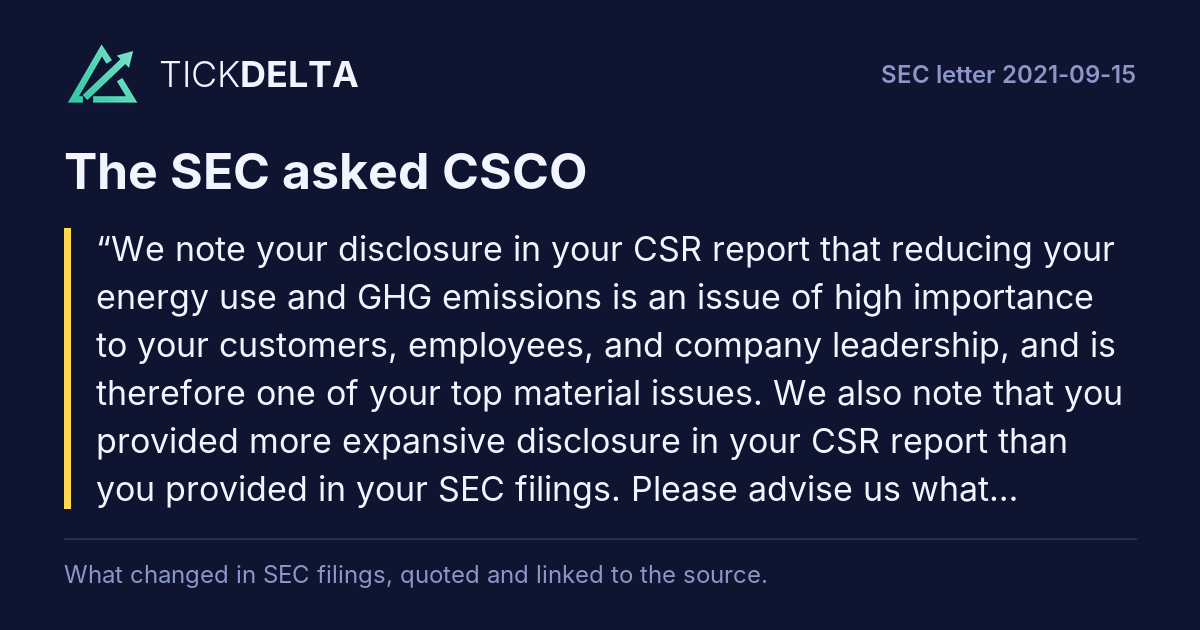
We note your disclosure in your CSR report that reducing your energy use and GHG emissions is an issue of high importance to your customers, employees, and company leadership, and is therefore one of your top material issues. We also note that you provided more expansive disclosure in your CSR report than you provided in your SEC filings.Rest of the question
Please advise us what consideration you gave to providing the same type of climate-related disclosure in your SEC filings as you provided in your CSR report. Risk Factors, page 13
In preparing the
Company’s SEC filings, including the Form 10-K, the Company carefully considers the requirements applicable to each filing, including, as applicable, Commission guidance regarding those requirements.
Thus, with respect to climate change-related matters, the Company considered the 2010 Guidance and included information consistent with the existing rules and the 2010 Guidance, as summarized in response to comments
2-7 below.
The Company’s CSR reporting includes extensive details about climate change-related information prepared to meet the requests of the Company’s wideRead in the reply ↗Rest of the answer
range of stakeholders. While the Company voluntarily provides this information for its stakeholders, the information included in the 2020 CSR report is substantially more detailed than climate change-related disclosures required under existing Commission rules.
The climate change-related information included in the Company’s 2020 CSR report is responsive to the requests, inquiries or expectations of a wide range of stakeholders received in response to the Company’s 2020 stakeholder engagement. As outlined in the 2020 CSR report, the stakeholder groups include customers, partners, investors, employees and CSR thought leaders. The Company uses inputs from stakeholder groups to determine what issues are most important to stakeholders both inside and outside the Company. The 2020
CSR report explains that the ESG materiality assessment helps the Company prioritize investments, executive sponsorship, risk management and stakeholder engagement.
The disclosure in the 2020 CSR report that reducing the Company’s energy use and GHG emissions is an issue of high importance to customers, employees, and Company leadership, and is therefore one of the Company’s “top material issues,” reflects the ESG materiality analysis applied for CSR reporting, as discussed above. The focus for CSR reporting is based on the views of stakeholders and, as also described above, the reference to materiality relates to the concept of “ESG materiality” and for CSR reporting purposes is not aligned with the term for securities law reporting purposes.
Finally, the Company notes that in this year’s Form 10-K in its Part I, Item 1—Business section, the Company added disclosure regarding environmental sustainability consistent with the 2020 CSR report, explaining that
“sustainability and protecting the environment are both top priorities for Cisco.” This section includes further information on the Company’s efforts in this regard and provides investors with details on how to access the
Company’s CSR reporting.
First report after the company's reply of 2021-10-12: 10-Q filed 2021-11-23 ↗, against the 10-Q filed 2021-05-25 ↗.
Tickdelta does not hold the text of both reports, so they are not compared here.
Disclose any material litigation risks related to climate change and the potential impact to the company.
The Company believes the risk factors in this year’s Form 10-K appropriately reflect its material litigation risks. The Company actively monitors and assesses its material litigation risks in advance of each relevant filing with the Commission. The result of such assessments to date is that the Company is not subject to material litigation risks related to climate change. Accordingly, risk factor disclosure on this topic is not required. Read in the reply ↗
First report after the company's reply of 2021-10-12: 10-Q filed 2021-11-23 ↗, against the 10-Q filed 2021-05-25 ↗.
Tickdelta does not hold the text of both reports, so they are not compared here.
Please discuss any material impact of pending or existing climate change-related legislation, regulations, and international accords on your business, financial condition, and results of operations.
As noted at the outset of this letter, the Company has prioritized environmental sustainability and reduction of its GHG emissions for many years. As a result, at present, the Company does not believe that pending or existing climate change-related legislation, regulations, or international accords could reasonably be expected to have a material impact on the Company’s financial condition or results of operations.Read in the reply ↗Rest of the answer
The Company cannot predict whether new laws or regulations that may be proposed and implemented in the future related to climate change could impose material costs or otherwise materially impact its business, but this remains a risk. The Company discloses this risk in “Risk Factors – Risks Related to Cybersecurity and Regulations – Our business, operating results and financial condition could be materially harmed by regulatory uncertainty applicable to our products and services.”
First report after the company's reply of 2021-10-12: 10-Q filed 2021-11-23 ↗, against the 10-Q filed 2021-05-25 ↗.
Tickdelta does not hold the text of both reports, so they are not compared here.
In your CSR report and Environment Technical Review, you refer to climate-related projects that you have undertaken. If material, please provide additional detail regarding these projects and quantify the related capital expenditures in your SEC filing.
The Company includes examples of projects it has undertaken to further its sustainability goals for illustrative purposes in the context of the detailed reporting included in the 2020 CSR report and the Environmental Technical Review. While the Company believes describing these projects is meaningful for stakeholders reviewing these reports, the climate-related projects included in these reports have not required material capital expenditures, individually or in the aggregate, or otherwise been material to the Company. Read in the reply ↗
First report after the company's reply of 2021-10-12: 10-Q filed 2021-11-23 ↗, against the 10-Q filed 2021-05-25 ↗.
Tickdelta does not hold the text of both reports, so they are not compared here.
To the extent material, discuss the indirect consequences of climate-related regulation or business trends, such as the following: • decreased demand for goods or services that produce significant greenhouse gas emissions or are related to carbon-based energy sources; • increased demand for goods that result in lower emissions than competing products; • increased competition to develop innovative new products thatRest of the question
result in lower emissions; • increased demand for generation and transmission of energy from alternative energy sources; and • any anticipated reputational risks resulting from operations or products that produce material greenhouse gas emissions.
The Company is a technology leader, developing products and services to meet the needs of its customers. This includes developing products with lower emissions and conducting its business in ways that continuously reduce its GHG emissions. Although these actions are important to the Company, they have not materially impacted the matters listed in the Staff’s comment 5. While the
Company has not experienced material impacts to date, the Company notes that it includes disclosure in Risk Factors about potential risks from future climate-related regulation.Read in the reply ↗Rest of the answer
See “Risk Factors – Risks Related to Cybersecurity and
Regulations – Our business, operating results and financial condition could be materially harmed by regulatory uncertainty applicable to our products and services.”
First report after the company's reply of 2021-10-12: 10-Q filed 2021-11-23 ↗, against the 10-Q filed 2021-05-25 ↗.
Tickdelta does not hold the text of both reports, so they are not compared here.
If applicable and to the extent material, discuss the significant physical effects of climate change on your operations and results. This disclosure may include the following: • quantification of material weather-related damages to your property or operations; • potential for indirect weather-related impacts that have affected or may affect your major customers; and • any weather-related impacts on the cost orRest of the question
availability of insurance.
The Company has not experienced material impacts from the matters listed in the Staff’s comment 6. The Company notes that it includes disclosure in Risk Factors about the risks related to various catastrophic events, including as a result of climate change. See
“Risk Factors – Risks Related to our Business and Industry – Our business and operations are especially subject to risks of earthquakes, floods, and other natural catastrophic events (including as a result of global climate change).” In this risk factor, the Company provides specific information about risks arising from the locationsRead in the reply ↗Rest of the answer
of its operations, and also notes that some of the Company’s suppliers are located in places that have been affected by earthquake, tsunami or flooding activity, which has in the past and may in the future disrupt the flow of components and delivery of products. To date, these conditions have not had a material impact on the Company.
First report after the company's reply of 2021-10-12: 10-Q filed 2021-11-23 ↗, against the 10-Q filed 2021-05-25 ↗.
Tickdelta does not hold the text of both reports, so they are not compared here.
We note you refer to increased compliance costs related to new laws and regulations in response to climate change on pages 26-27 of your filing. If material, please quantify any such costs.
While there are risks that the costs arising from increased compliance costs related to new laws and regulations in response to climate change could materially impact the Company (as noted in the risk factor referenced in comment 7), the Company has not experienced material costs to date. Read in the reply ↗
First report after the company's reply of 2021-10-12: 10-Q filed 2021-11-23 ↗, against the 10-Q filed 2021-05-25 ↗.
Tickdelta does not hold the text of both reports, so they are not compared here.
Your response to prior comment 2 states that you actively monitor and assess your material litigation risks in advance of each filing and that your assessments to date have concluded that you are not subject to material litigation risks related to climate change.Rest of the question
Please tell us about any litigation risks related to climate change that were included in your most recent assessment and explain how you analyzed the materiality of these risks.
When assessing whether disclosure is required under Item 105 of Regulation S-K, the Company assesses the material factors that make an investment in the Company speculative or risky. Additionally, as it relates to climate change-related disclosure, the Company’s assessment includes the considerations outlined in the Commission’s
Guidance Regarding Disclosure Related to Climate Change (Securities Act Rel. 33-9106, Feb.Read in the reply ↗Rest of the answer
2, 2010) (“2010 Guidance”).
As noted in the Company’s response to the Staff’s prior comment 2, the Company actively monitors and assesses its litigation risks in advance of each relevant filing with the Commission to determine whether it has material litigation risks that should be considered for disclosure. To clarify the Company’s previous response for the Staff, the Company’s assessment, to date, is that it has not experienced any actual or threatened litigation against the Company related to climate change, and is not otherwise aware of any litigation risk facing the Company related to climate change. As such, the result of such assessments to date is that the Company is not subject to litigation risks related to climate change, material or otherwise. Accordingly, the Company believes risk factor disclosure on this topic is not required at this time.
First report after the company's reply of 2021-11-24: 10-Q filed 2022-02-22 ↗, against the 10-Q filed 2021-05-25 ↗.
Tickdelta does not hold the text of both reports, so they are not compared here.
Your response to prior comment 3 refers to pending and existing climate change-related legislation, regulations, or international accords. Explain in greater detail how you determined whether these laws and regulations are reasonably likely to have a material effect on you and how you assessed your compliance with any requirements thereunder.Rest of the question
Also, tell us how you considered providing disclosure regarding the difficulties involved in assessing the timing and effect of pending climate-related laws or regulations.
When assessing whether disclosure is required under Item 303 of Regulation S-K, the Company assesses whether a trend, demand, commitment, event or uncertainty is both presently known to management and reasonably likely to have a material impact on the Company’s financial condition or results of operations.Read in the reply ↗Rest of the answer
Additionally, as it relates to climate change-related disclosure, the Company’s assessment includes the considerations outlined in the 2010 Guidance.
To assist the Staff with context specific to the Company, and as also described in greater detail in the Introduction to the Company’s response to the Staff’s initial comments, the Company has been involved with environmental sustainability and reduction of its greenhouse gas (“GHG”) emissions for many years—since 2006, in fact. This means that the Company has, for over 15 years, voluntarily gathered and reported climate change-related data to measure commitments and report its progress. As described in greater detail below, the Company believes that the requirements of each current environmental-related or pending climate change-related law and/or regulation, as presently enacted or drafted, as applicable, incurs no more than insignificant incremental cost to the Company related to its costs for existing compliance programs or voluntary climate change-related data gathering and reporting efforts. To date, the Company has concluded that the costs related to compliance with each existing environmental-related or pending climate change-related law and/or regulation have not, nor does the Company believe that they are reasonably likely to, result in a material impact to the Company’s financial condition or results of operations.
In undertaking its assessment with respect to pending climate change-related laws and/or regulations known to management and whether such laws and/or regulations would be reasonably likely to have a material impact on the Company’s financial condition or results of operations, the Company compares what the costs are or are anticipated to be in order to comply with the requirements of such laws and/or regulations and compares such costs to the Company’s consolidated financial statements for the relevant period and also assesses whether compliance with such laws and/or regulations would require a significant change to the Company’s existing operations or strategy. When comparing the Company’s existing compliance programs and existing climate change-related data gathering and reporting processes to the requirements of the pending climate change-related laws and/or regulations presently known to management, the Company believes that compliance with such laws and/or regulations would require insignificant adjustments to existing programs and processes that the Company already has in place for its compliance programs and/or its voluntary climate change-related data gathering and reporting. Additionally, the Company considers anticipated costs related to compliance with pending climate change-related laws and/or regulations and assesses whether such costs are reasonably likely to have a material impact on the Company’s financial condition or results of operations. To date, the actual costs and impacts of the Company’s compliance with pending climate change-related laws and/or regulations have not been, and the expected costs are not anticipated to be, material to the Company’s financial condition or results of operations, as such, the Company believes disclosure is not required at this time.
Furthermore, in terms of disclosure considerations with respect to the timing or effect of any pending climate change-related laws and/or regulations, the Company is unaware of any such law or regulation the timing or effect of which would cause the Company significant cost to comply with, when comparing such actual or anticipated costs to the Company’s consolidated financial statements. Additionally, as described above, the Company already has internal processes for data gathering and reporting related to its voluntary climate change reporting. The pending climate change-related laws and/or regulations that the Company anticipates being subject to will generally require the Company to report data it either already voluntarily collects and reports or can easily collect or report with insignificant adjustments to its already existing processes and, as such, the Company notes that the timing or effect of pending climate change-related laws and/or regulations would require no significant adjustment to the Company’s existing operations or strategy. Because the Company does not anticipate any significant costs or changes required to its operations or strategy, the Company does not believe the timing or effect of pending climate-related laws or regulations is reasonably likely to have a material effect on the Company’s financial condition or results of operations, as such, the Company believes disclosure is not required at this time.
The Company anticipates being subject to future climate change-related laws and/or regulations as countries begin to set their own climate-related commitments. As previously noted in the Company’s response to the Staff’s prior comment 3, the Company cannot predict whether new laws or regulations related to climate change that may be proposed and implemented in the future could impose material costs or otherwise materially impact its business, but this remains a risk. The Company discloses this risk in “Risk Factors – Risks Related to Cybersecurity and
Regulations – Our business, operating results and financial condition could be materially harmed by regulatory uncertainty applicable to our products and services” and believes that placement of the disclosure of potential future risk in
“Risk Factors” is the most suitable location in its Form 10-K filing with the Commission.
First report after the company's reply of 2021-11-24: 10-Q filed 2022-02-22 ↗, against the 10-Q filed 2021-05-25 ↗.
Tickdelta does not hold the text of both reports, so they are not compared here.
Your response to prior comment 4 states that your climate-related projects have not required material capital expenditures, individually or in the aggregate, or otherwise been material. In order to better understand your response, please tell us about your capital expenditures related to climate-related projects (including quantification of amounts incurred) and explain how you assessed the materiality of theseRest of the question
expenditures. In addition, please tell us more about how you considered providing disclosure quantifying the estimated costs of reaching net zero greenhouse gas emissions, which you discuss in the introduction of your response, and explain how you analyzed the materiality of these costs.
As noted in the Company’s response to the Staff’s initial comment 4 and as discussed in further detail below, to date, the climate-related projects included in the Company’s Corporate Social Responsibility (“CSR”) reports have not required material capital expenditures, individually or in the aggregate, or otherwise been material to the Company, when comparing such costs, individually or in the aggregate, to the Company’s consolidated financial statements for the relevant period.
As described in the Company’s 2020 CSR report, the Company implemented a variety of climate-related projectsRead in the reply ↗Rest of the answer
categorized in two main categories: energy efficiency projects and renewable energy procurement projects. Between fiscal year 2016 and fiscal year 2020, the Company implemented 443 energy efficiency projects with an aggregate implementation cost of approximately
$55 million, which cost the Company does not believe was significant when comparing such costs to the aggregate capital expenditures of $4.6 billion between fiscal year 2016 and fiscal year 2020. Notably, the implementation costs of such projects were fully recouped by the Company, as the projects provided the Company a return on its investment as a result of the energy efficiencies created. Examples of the energy efficiency projects include improving airflow in the Company’s laboratories, installing LED lighting in the Company’s buildings, and optimizing the Company’s mechanical equipment.
The Company’s renewable energy procurement projects are designed to reduce the Company’s reliance on energy grid power across its global operations. In fiscal year 2020, the Company invested an aggregate of approximately $8.7 million across 44 renewable energy procurement projects related to its global real estate portfolio, which cost the Company does not believe was significant, when comparing such costs to the Company’s total costs and expenses of $35.7 billion for fiscal year 2020 or otherwise when comparing such costs to the Company’s consolidated financial statements for the relevant period. Additionally, the Company notes that the renewable energy procurement projects have also provided the Company a return on its investment, and the Company expects to fully recoup its investment in such projects over the course of the next few years.
In assessing the materiality of such climate-related project costs, the Company determines whether the related costs of such projects are reasonably likely to result in a material impact to the Company’s financial condition or results of operations. To date, the Company has not incurred any significant costs, individually or in the aggregate, for its climate-related projects and does not believe any currently planned projects will incur significant costs, individually or in the aggregate. For these reasons, the Company believes that the costs related to its climate-related projects have not and are not reasonably likely to result in a material impact to the Company’s financial condition or results of operations, as such, the Company believes disclosure is not required at this time.
With respect to the Company’s net zero commitments, the Company considers disclosure of a commitment pursuant to Item 303 of Regulation S-K and the 2010 Guidance when it believes that a cost of a commitment is reasonably likely to result in a material impact to the Company’s financial condition or results of operations. In assessing whether disclosure is required for the Company’s net zero commitments, the Company considers what the actual costs are to date and what the expected costs are reasonably likely to be in the future and whether such costs have or are reasonably likely to result in a material impact to the Company’s financial condition or results of operations. What future costs are reasonably likely to be includes an assessment of the Company’s estimates and assumptions that underly the commitments, taking into consideration how the Company has previously performed against related estimates and assumptions, and how those estimates and assumptions are performing as time goes on as the Company continues to assess its commitments.
The Company notes that, to date, it has had a long track record of success with its estimates and assumptions related to climate change goals. Over the last decade, the Company has been setting 5-year goals related to its climate change initiatives. For example, the Company met its previous 5-year Scope 1 and 2-related goal one year early, in fiscal year 2021, and it also met its previous 5-year goal of using energy generated from renewable sources one year early, also in fiscal year 2021, and in each case, the Company believes the underlying estimates and assumptions related to these goals were accurate. These examples are indicative of the Company’s history, to date, of success in achieving its climate change-related goals, with costs of such goals well within the Company’s estimates it had budgeted for such goals. Furthermore, this track record of success has helped to inform the Company as to the appropriate timing of achieving its net zero commitments and, while the Company notes that past accuracy of its estimates and assumptions does not guarantee future accuracy as external factors underlying current estimates and assumptions could change over time, the historical track record of success does help to inform the Company when it assesses whether a material impact is reasonably likely to result from such commitments.
To date, the Company anticipates that costs related to achieving its 2025 net zero commitment aggregate to approximately $20 million per year, which costs the Company believes are insignificant when compared to the Company’s consolidated financial statements. For example, if the anticipated annual $20 million of costs for the 2025 net zero commitment had been incurred in fiscal year 2021, the Company believes such costs would have been insignificant when compared to its total costs and expenses of $37.0 billion for fiscal year 2021 or when otherwise comparing such costs to the Company’s consolidated financial statements for the relevant period. With respect to the Company’s 2040 net zero commitment, such costs are likely to increase over time as the Company implements new related projects and initiatives. Notwithstanding such likely increases, the Company currently does not expect that such costs are reasonably likely to result in a material impact, both in absolute terms and because the Company expects that many of the additional costs will ultimately be offset by efficiencies that the Company expects to create, as has been the case with many of the Company’s projects to date (as described above). The Company’s 2025 net zero commitment includes, among others, estimates and assumptions around renewable energy, site modernization and fleet electrification. The Company’s 2040 net zero commitment also includes, among others, estimates and assumptions around enhanced power efficiency of the Company’s products, adoption of renewable energy at customer sites, and adoption of certain of the Company’s products and services. To date, the Company has no reason to believe its estimates and assumptions nor its anticipated costs of achieving its commitments are inaccurate. Additionally, to date, the actual costs of both of the Company’s net zero commitments have not, and the Company believes the expected costs are not reasonably likely to, result in a material impact to the Company’s financial condition or results of operations, as such, the Company believes disclosure is not required at this time.
First report after the company's reply of 2021-11-24: 10-Q filed 2022-02-22 ↗, against the 10-Q filed 2021-05-25 ↗.
Tickdelta does not hold the text of both reports, so they are not compared here.
Your response to prior comment 5 states that you have not experienced material indirect consequences of climate-related regulation or business trends. It appears that your response is conclusory in nature and does not adequately address the individual items in our prior comment. Please describe the indirect consequences you considered in your analysis and explain how you concluded they were not material.
The Company has not seen, to date, any material indirect consequences of climate-related regulation or business trends. As requested by the
Staff, set forth below is the Company’s response to each of the individual items referenced in the Staff’s prior comment 5:
• decreased demand for goods or services that produce significant greenhouse gas emissions or are related to carbon-based energy sources;
As an initial matter, the Company notes that it has not experienced decreased demand for goods or services as a result of customers indicating that the Company’s products produce significantRead in the reply ↗Rest of the answer
greenhouse gas emissions or are related to carbon-based energy sources. The Company also notes that there are many underlying business reasons why customers may have demand for its products. The Company believes that demand is largely dependent on the type of customer and, to date, there is not a significant discernable demand related to whether the Company’s products produce significant greenhouse gas emissions or are related to carbon-based energy sources. As one example, the Company believes that its customers who purchase its campus switching products, which are the largest family of products offered by the Company, purchase such products primarily for reasons related to the performance, feature-set, reliability and cost of a particular product in that family and, while the energy consumption of a particular product is a related consideration for some of these customers, it is not believed to be a primary consideration, nor does the Company believe that overall demand for such products is driven by GHG emissions or whether such products are related to carbon-based energy sources.
increased demand for goods that result in lower emissions than competing products;
As discussed above, the Company notes that there are many underlying business reasons why customers may demand its products and those demands are largely dependent on the type of customer. The Company believes that currently the GHG emissions of its products are not one of the primary considerations of a majority of its customers have for its products. The Company notes that there is and has always been some level of demand from certain of its customers for certain of its products to use the least amount of energy technically possible, especially as it relates to data center networking products offered to the Company’s mass-scale data center customers, whose demand for such products is primarily driven by data center power density requirements and the energy costs associated with operating such products. Additionally, some demand can be attributed to customers desiring certain products that have certifications from energy efficiency programs;
however, the Company does not believe, to date, that this demand is significant. Furthermore, the Company notes that there are many underlying business reasons for customers to seek its products, as described above, but the Company does not believe there is a discernable trend of customers increasing (or decreasing) their demand for products that result in lower emissions than competing products based on the feedback the Company has received, to date, from its customers.
increased competition to develop innovative new products that result in lower emissions;
To date, the Company is not aware of any increased competition to develop new products that result in lower emissions to address climate change. As described above, there is and has always been some level of demand from customers for products that use less energy, especially as it relates to certain networking products, but the primary considerations of the majority of the Company’s customers are unrelated to the energy usage of its products, and, to date, the Company does not believe that there is any significant increase in competition to design products that result in lower emissions. Rather, there is continued and expected competition to design products with feature-sets, reliability, and cost as the primary considerations of new product design innovation, and the Company expects such design features to continue to drive such design innovation. While this design innovation competition ultimately has the added benefit of helping to contribute to a reduction in overall GHG emissions, to date, the Company does not believe such competition directly results from any climate change-related regulation or business trend.
increased demand for generation and transmission of energy from alternative energy sources; and
To date, the Company is unaware of any increased demand for generation and transmission of energy from alternative sources as it relates to its products or services. Additionally, as it relates to the Company’s operations, the Company notes that, for many years, it has publicly reported its commitment to achieve at least 85% of its global electricity usage generated from renewable sources by the end of fiscal year 2022. As of fiscal year 2021, the Company has achieved this goal. Additionally, in December 2020, the Company announced that it had achieved its goal of 100% renewable energy for its
U.S.-based operations one year early. As a result of the Company’s existing and continuing efforts to achieve an increasing percentage of its global electricity usage from renewable sources, it does not reasonably anticipate any significant increased demand for generation and transmission of energy from alternative energy sources related to its operations.
any anticipated reputational risks resulting from operations or products that produce material greenhouse gas emissions.
As described above and in the Introduction to the Company’s response to the Staff’s initial comments, the Company has long sought to be a leader in supporting climate change efforts. Since 2006, the Company has been voluntarily reporting data on its GHG emissions and has been working, incrementally over time, to reduce its own GHG emissions. The Company notes that it does not manufacture the bulk of its own products and relies on independent third-party companies to provide services related to printed-circuit board assembly, in-circuit test, product repair, and product assembly and thus does not own or operate any of its own large-scale manufacturing facilities. Additionally, the Company’s service offerings are operated primarily from a single data center owned by the Company and multiple data centers owned and operated by third parties. As the Company has been working to reduce its own GHG emissions for over 15 years and has a proven track record of success with its past commitments related to reducing its own emissions, the Company does not anticipate reputational risk related to emissions from its own operations. Additionally, the Company does not believe that its products contribute to any customer’s GHG emissions in a way that is significantly different than any of its competitors’ products and thus does not anticipate there to be any significant reputational risk related to GHG emissions of its products.
For all of the reasons discussed above, the Company believes it has not seen any material indirect consequences of climate-related regulation or business trends, as such, the Company believes disclosure is not required at this time.
First report after the company's reply of 2021-11-24: 10-Q filed 2022-02-22 ↗, against the 10-Q filed 2021-05-25 ↗.
Tickdelta does not hold the text of both reports, so they are not compared here.
Your response to prior comment 6 states that you have not experienced material impacts from the matters listed in our comment. Please explain whether you have experienced physical effects of climate change on your operations or results and, if so, how you assessed the materiality of such effects.Rest of the question
Please quantify weather-related damages to your property or operations, discuss how weather-related impacts have affected or may affect your customers and suppliers and discuss any weather-related impacts on the cost or availability of insurance.
The physical effects that may be related to climate change that the Company has experienced in the periods covered by the Company’s Form 10-K involved an immaterial supply chain disruption to certain of the Company’s customers and suppliers resulting from a winter freeze in Texas in February 2021 (“Texas Weather Event”) and, in a prior period, the Company is aware of physical effects that may be related to climate change which involved an immaterial supply chain disruption to the Company’s customers and suppliers caused by flooding in Thailand in 2011 (“Thailand Flooding”).Read in the reply ↗Rest of the answer
The Texas Weather Event directly impacted four of the Company’s facilities in Texas and caused shipping delays to customers located in Texas. The Company incurred approximately $7.6 million in additional cost as a result of operating certain of the facilities on generator power or on the Texas energy grid during surge pricing caused by the Texas Weather
Event. The Company believes these costs were insignificant when comparing such costs to the Company’s total costs and expenses of $37.0 billion for fiscal year 2021 or otherwise when comparing such costs to the Company’s consolidated financial statements for the relevant period.
The Thailand Flooding caused an immaterial disruption to the Company’s supply chain and downstream customers related to the delayed delivery of certain hard drive components for use in certain of the Company’s products. The Company believes its costs of approximately $50 million related to the Thailand Flooding were insignificant when comparing such costs to the Company’s costs of goods sold of $17.9 billion in fiscal year 2012 or otherwise when comparing such costs to the Company’s consolidated financial statements for the relevant period, and, in any event, nearly the entirety of such costs was recovered by the Company under a contingent business interruption insurance policy.
In assessing the materiality of physical effects that may have resulted from climate change, the Company determines whether the related costs of such effects are reasonably likely to result in a material impact to the Company’s financial condition or results of operations. The Company notes that it has purposefully designed a distributed supply chain that has built-in flexibility for when disruptions may occur, and that the resulting impact from the disruptions that were caused by the Texas Weather Event and Thailand Flooding were insignificant (for the reasons discussed above) and neither disruption resulted in any significant costs. Additionally, the Company is unaware of any weather-related impacts that have affected its customers and suppliers where such impacts had a significant effect on the Company; however, the Company is aware of insignificant impacts that its customers and suppliers have experienced, as discussed above. As a result, the Company believes that the physical effects related to climate change that it has experienced and the weather-related impacts that its customers and suppliers have experienced, to date, have not resulted in a material impact to the Company’s financial condition or results of operations, as such, the Company believes disclosure is not required at this time.
To the Company’s knowledge, the weather-related damage to its properties or operations in the periods covered by its Form 10-K involved: (i) the cost, approximately $6.5 million, to replace the roof of one of the Company’s buildings in Texas as the result of a hailstorm in 2019 (the Company notes that the roof was already in need of replacement and that the hailstorm necessitated an accelerated timeline for replacement), and (ii) storm damage that caused solar panels to be displaced at a leased facility in Vimercate, Italy in 2020 (which the
Company’s landlord repaired at no known cost to the Company). Additionally, the Company is aware of weather-related damage to the Company’s property or operations that it has experienced in a prior period unrelated to the Company’s
Form 10-K, which involved storm damage that caused air conditioning units to tip over at a leased facility in Copenhagen, Denmark in 2015 (which the Company’s landlord repaired at no known cost to the
Company).
In assessing the materiality of such weather-related damages, the Company determines whether the costs of such damages resulted in a material impact to the Company’s financial condition or results of operations. The Company believes that the costs described in (i) in the paragraph above were insignificant, when comparing such costs to the Company’s total costs and expenses of $37.7 billion for fiscal year 2019 or otherwise when comparing such costs to the Company’s consolidated financial statements for the relevant period. As the Company either had no cost or an insignificant cost for weather-related damage to date, the Company believes that such costs have not resulted in a material impact to the Company’s financial condition or results of operations, as such, the Company believes disclosure is not required at this time.
The Company notes that it includes disclosure in “Risk Factors” about the risks related to various catastrophic events, including as a result of climate change. See “Risk Factors – Risks Related to our Business and Industry – Our business and operations are especially subject to risks of earthquakes, floods, and other natural catastrophic events (including as a result of global climate change).” In this risk factor, the Company provides specific information about risks arising from the locations of its operations, and notes that some of the Company’s suppliers are located in places that have been or may be affected by earthquake, tsunami or flooding activity (as described above), which has in the past and may in the future disrupt the flow of components and delivery of products.
To date, the Company does not believe there have been any material weather-related impacts on the cost or availability of its insurance. The cost of the Company’s insurance premiums is directly tied to the cost of insurance in the overall insurance market, and the Company does not believe that any of its insurance costs include weather-related premiums specific to the Company’s operations. The Company notes that, generally, insurance premiums may rise in a given year due to many reasons, including as a result of weather-related impacts (such as a hurricane, flood, drought or other weather-related event), which are not specific to the Company. Additionally, the Company’s aggregate insurance costs have not increased significantly over the past several years and are immaterial as a percentage of the Company’s operating expenses each year or otherwise when comparing such costs to the Company’s consolidated financial statements for the relevant period. Furthermore, the Company is unaware of any weather-related impact on its availability of insurance. The Company does not believe any weather-related impacts on the cost or availability of insurance have caused or are reasonably likely to cause a material impact on the Company’s financial condition or results of operations, as such, the Company believes disclosure is not
First report after the company's reply of 2021-11-24: 10-Q filed 2022-02-22 ↗, against the 10-Q filed 2021-05-25 ↗.
Tickdelta does not hold the text of both reports, so they are not compared here.
Your response to prior comment 7 states that you have not experienced any material compliance costs related to new laws and regulations in response to climate change. Please tell us about compliance costs related to new laws and regulations in response to climate change that you have incurred and explain how you analyzed the materiality of these costs.
As also discussed above in the Company’s response to comment 2, to date, the Company’s assessment is that it has not experienced any material compliance costs related to new laws and regulations in response to climate change. Further, the Company does not anticipate that new climate change-related laws and/or regulations presently known to management are reasonably likely to cause the Company to incur a significant amount of cost to comply with the requirements of such laws and/or regulations.
The
Company’s actual and anticipated costs that it has incurred or anticipates incurring relatedRead in the reply ↗Rest of the answer
to compliance with new climate change-related laws and/or regulations are largely comprised of costs related to its existing internal compliance programs and its existing voluntary climate change-related data gathering and reporting program. To date, each of these programs involves mostly costs for personnel and, in some instances, external service provider fees and other miscellaneous expenses, none of which costs, individually or in the aggregate, are significant when comparing such costs to the Company’s consolidated financial statements for the relevant period, and the Company believes monitoring and compliance of any new climate change laws and/or regulations would largely be shared with its existing compliance costs.
In assessing whether there are material compliance costs related to new laws and/or regulations in response to climate change, the Company assesses the current and anticipated costs related to compliance with such laws and/or regulations and compares it to the Company’s financial condition and results of operations and determines whether it believes such costs have resulted or are reasonably likely to result in a material impact. As the Company does not believe these compliance costs, generally, are significant, nor does it believe any incremental cost of compliance for new climate change-related laws and/or regulations would cause it to incur a significant cost, to date, the cost of compliance with such laws and/or regulations has not and the Company believes that such costs are not reasonably likely to have a material impact on the Company’s financial condition or results of operations, as such, the Company believes disclosure is not required at this time.
As was noted in the Company’s response to the Staff’s initial comment 7, the Company explicitly acknowledges that there is a potential risk that the costs arising from increased compliance costs related to future laws or regulations in response to climate change could materially impact the Company (as noted in the Company’s risk factor titled “Risk Factors
– Risks Related to Cybersecurity and Regulations – Our business, operating results and financial condition could be materially harmed by regulatory uncertainty applicable to our products and services.”). Such costs as they relate to future laws or regulations are presently unknown as such laws or regulations have yet to be created. The Company believes it has adequately addressed the potential risk for compliance with future laws or regulations related to climate change in its risk factor described above and believes that placement of the disclosure of potential future risk in “Risk Factors” is the most suitable location in its Form 10-K filing with the Commission.
First report after the company's reply of 2021-11-24: 10-Q filed 2022-02-22 ↗, against the 10-Q filed 2021-05-25 ↗.
Tickdelta does not hold the text of both reports, so they are not compared here.
Also in this review: request for more time, 2021-09-17, request for more time, 2021-11-02, closing letter, 2022-01-24