Paragraphs with nothing like them in last year's 10-K
Quoted exactly
9 paragraphs in Risk Factors of the 10-K filed May 26, 2026
with nothing like them in the 10-K filed May 22, 2025. Quoted exactly.
Paragraphs that were only edited are under 10-K change.
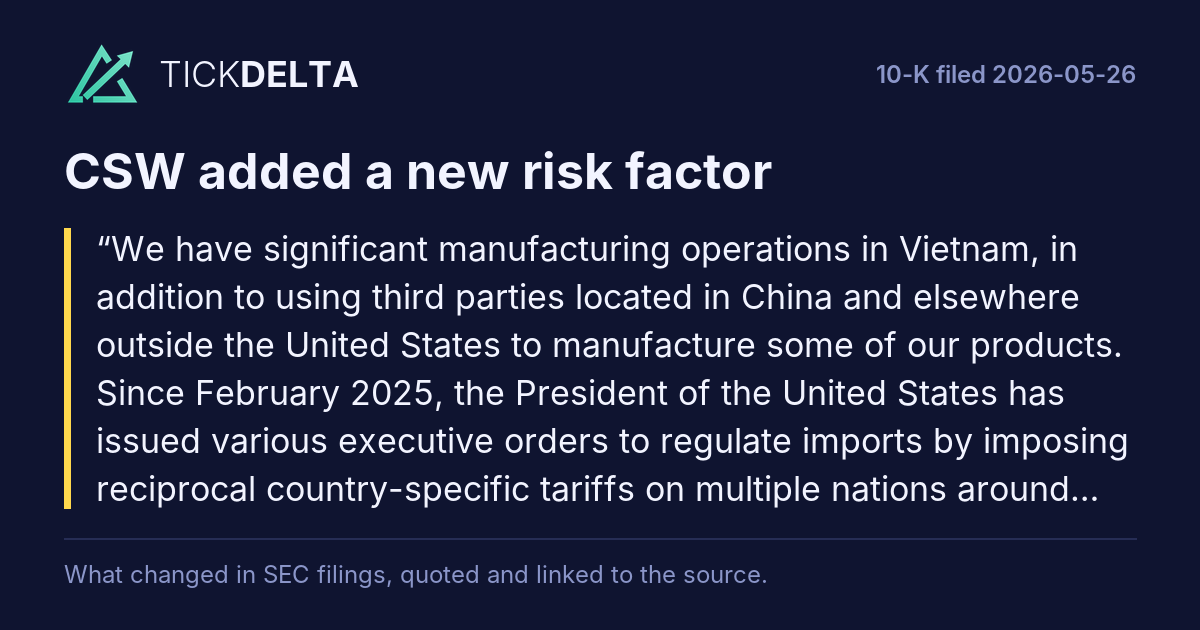
We have significant manufacturing operations in Vietnam, in addition to using third parties located in China and elsewhere outside the United States to manufacture some of our products. Since February 2025, the President of the United States has issued various executive orders to regulate imports by imposing reciprocal country-specific tariffs on multiple nations around the world, including Vietnam and China (among other jurisdictions). In addition, the United States has imposed and/or reimposed certain commodity-specific tariffs, including tariffs on steel, aluminum and copper, which are used as inputs for some of our products. We have responded by negotiating cost reductions with certain suppliers, transitioning certain sources of supply, and by raising prices to our customers on certain products across our three segments to partially offset the impact. In February 2026, the U.S. Supreme Court issued a decision invalidating tariffs imposed under the IEEPA, which include many of the tariffs imposed by the President of the United States since February 2025. The ruling may allow for recovery of IEEPA tariff amounts previously paid, although the timing and administration of any potential IEEPA tariff refunds is uncertain and may be subject to further legal and regulatory developments. We are assessing our potential refund rights and are pursuing a recovery of amounts paid; however this recovery will likely be subject to applicable procedures and may add complexity and uncertainty into our operations. Additionally, the current presidential administration has imposed tariffs on goods imported into the United States pursuant to legislative authorities other than IEEPA, and has indicated that it may continue to pursue these policies in the future.
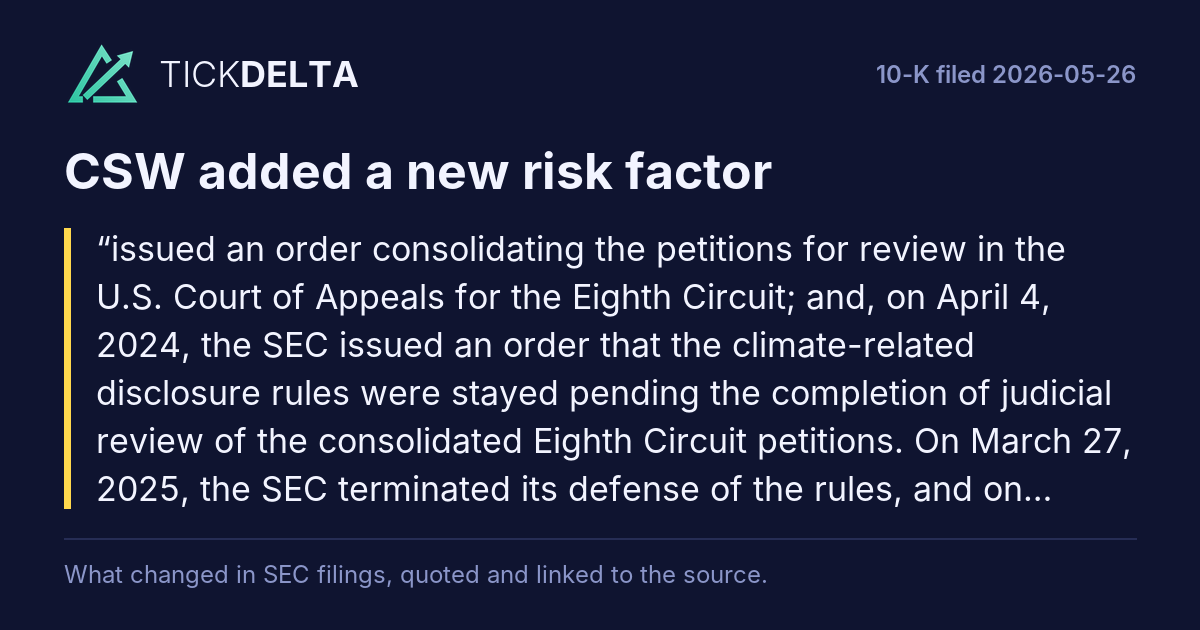
issued an order consolidating the petitions for review in the U.S. Court of Appeals for the Eighth Circuit; and, on April 4, 2024, the SEC issued an order that the climate-related disclosure rules were stayed pending the completion of judicial review of the consolidated Eighth Circuit petitions. On March 27, 2025, the SEC terminated its defense of the rules, and on April 24, 2025, the Eighth Circuit paused the litigation and directed the SEC to explain its plan for the rules in a July 2025 status report. In the July 2025 status report, the SEC stated that it did not intend to review or reconsider the rules at that time and requested that the Eighth Circuit proceed to resolve the litigation on the merits but declined to state whether it would enforce or adhere to the rules if they survived judicial review. On September 12, 2025, the Eighth Circuit ordered that the litigation would again be held in abeyance until the SEC reconsiders or renews its defense of the rules. If the rules become effective, we will be required to provide the enhanced climate-related disclosures.
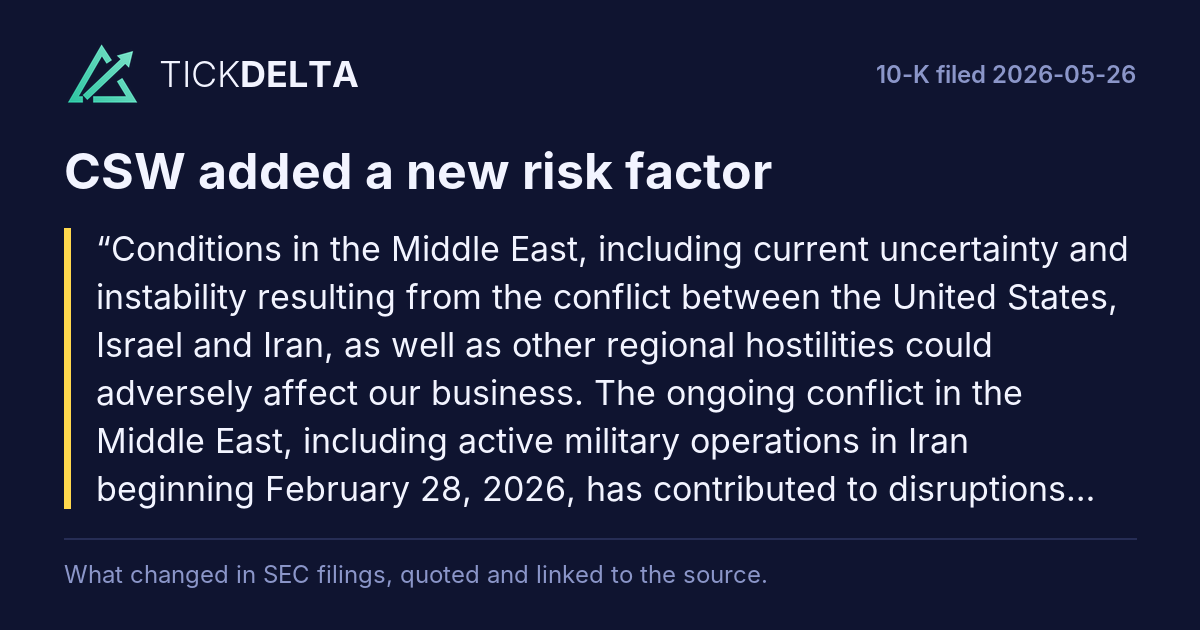
Conditions in the Middle East, including current uncertainty and instability resulting from the conflict between the United States, Israel and Iran, as well as other regional hostilities could adversely affect our business.
The ongoing conflict in the Middle East, including active military operations in Iran beginning February 28, 2026, has contributed to disruptions in global shipping lanes, particularly through the Strait of Hormuz and the broader Persian Gulf region. While we do not source materials directly from Iran or the Gulf region, the conflict has contributed to elevated freight costs and extended lead times from Asian suppliers as carriers reroute through alternative passages including the Cape of Good Hope. Such conflict could continue to result in supply disruptions, increased shipping and insurance costs, delays or rerouting of cargos, heightened security risks, and increased volatility in commodity prices, all of which could affect our customers and our ability to do business with them. We are working with our logistics partners to mitigate these impacts and do not currently believe they will have a material adverse effect on our ability to meet customer demand, though we continue to monitor the situation closely.
The intensity and duration of this active conflict are difficult to predict. Although the current hostilities have not materially impacted our business or operations as of the date of this Annual Report, the conflict is rapidly evolving and developing and it is not possible to predict its long-term consequences on us or our customers. Any escalation and expansion of this conflict could have a negative impact on both global and regional conditions and may adversely affect our business, financial condition and results of operations.
or cash flows. In certain international jurisdictions, distributors are conferred certain legal rights that could limit our ability to modify or terminate distribution relationships.
Artificial Intelligence Technologies Could Present Business, Compliance, and Reputational Risks.
Recent technological advances in artificial intelligence (“AI”) and machine-learning technology both present opportunities and pose risks to us. If we fail to keep pace with rapidly evolving technological developments in AI, our competitive position and business results may suffer. We face risk of competitive disadvantage if our competitors more effectively use AI to better serve customers, drive internal efficiencies, and/or create new or enhanced products or services. We have begun to incorporate AI capabilities into our operations and the introduction of these technologies, particularly generative AI, into internal processes, customer engagements, and/or new and existing product offerings may result in new or expanded risks and liabilities, including due to enhanced governmental or regulatory scrutiny, litigation, compliance issues, ethical concerns, confidentiality or security risks, as well as other factors that could adversely affect our business, reputation, and financial results. In addition, our personnel could, unbeknownst to us and despite strict governance protocols, improperly utilize AI and machine learning-technology while carrying out their responsibilities. The use of AI in the development of our products and services could also cause loss of intellectual property, as well as subject us to risks related to intellectual property infringement or misappropriation, data privacy and cybersecurity. The use of AI can lead to unintended consequences, including generating content that appears correct but is factually inaccurate, misleading or otherwise flawed, or that results in unintended biases and discriminatory outcomes, which could harm our reputation and business and expose us to risks related to inaccuracies or errors in the output of such technologies. Finally, multiple jurisdictions have either already put in place laws and regulations governing the use of AI, or are considering such laws and regulations. Compliance with these laws, regulations, and industry frameworks may limit our ability to leverage AI or require us to substantially revise our approach to its use.
Show the other 1
our accounting policies related to goodwill, see our discussion under Note 1 to our consolidated financial statements in Item 8 of this Annual Report.
Paragraphs in the 10-Q filed Oct 29, 2026 that were not in the one before
New in the latest 10-Q
4 paragraphs in the 10-Q filed Oct 29, 2026 with nothing like
them in the 10-Q filed Jul 30, 2026 (at least half the words must differ; new numbers alone do not count).
Quoted exactly, grouped by the item heading above them. This is text that changed, not a judgement of how serious it is.
Financial statements and notes
Transferable Tax Credits - The Company accounts for purchased transferable income tax credits under ASC 740, “Income Taxes”. We recognize purchased transferable tax credits at their face amount and record the difference between the face amount and purchase price as a deferred credit. The deferred credit is recognized as a reduction of income tax expense as the related tax credits are utilized. Purchased transferable tax credits are presented as a reduction of current income taxes payable to the extent of the related current income tax liability, with any excess presented as prepaid income taxes or deferred tax assets.
Read in the 10-Qopen_in_new
As of September 30, 2026, the Company had an outstanding commitment to purchase approximately $ 20.0 million of additional transferable federal energy tax credits before the end of fiscal 2027. The Company expects to utilize the credits to satisfy U.S. federal income tax liabilities for fiscal 2027.
Read in the 10-Qopen_in_new
• During the six months ended September 30, 2026, $0.6 million was paid for a product acquisition with an additional $2.7 million in deferred consideration.
Read in the 10-Qopen_in_new
Market risk
$0.1 million and $0.1 million for the six months ended September 30, 2026 and 2025, respectively, which are included in accumulated other comprehensive income (loss).
Read in the 10-Qopen_in_new
The 10-Q's risk factors against the 10-K
Item 1A of the 10-Q filed Oct 29, 2026 against Item 1A of the 10-K filed May 26, 2026.
A 10-Q repeats only the risks that changed, so a 10-K paragraph that is missing from it is not counted as removed.
Added is a paragraph with nothing like it in the 10-K, Reworded a sentence that is in both with several words changed,
Quiet changes a sentence in both where one to four words changed and one is a hedge or a modal
(cut words struck through, new words highlighted).
Text on the page, not a score; each links to the filing at sec.gov.
What the 10-Q itself says about its risk factors:There are numerous factors that affect our business and results of operations, many of which are beyond our control. In addition to other information set forth in this Quarterly Report, careful consideration should be given to “Item 1A. Risk Factors” in Part I and “Item 7. Management’s Discussion and Analysis of Financial Condition and Results of Operations” in Part II of our Annual Report, which contain descriptions of significant factors that may cause the actual results of operations in future periods to differ materially from those currently expected or desired.
Read in the 10-Qopen_in_new
Added10-Q Oct 29, 2026 vs 10-K May 26, 2026
There have been no material changes in the risk factors discussed in our Annual Report and subsequent SEC filings. The risks described in this Quarterly Report, our Annual Report and in our other SEC filings or press releases from time to time are not the only risks we face. Additional risks and uncertainties are currently deemed immaterial based on management’s assessment of currently available information, which remains subject to change; however, new risks that are currently unknown to us may arise in the future that could materially adversely affect our business, financial condition, results of operations or cash flows.
Read it in the 10-Q at sec.govopen_in_new
Sources
Item 1A of each 10-K and 10-Q on EDGAR, quoted exactly. Each paragraph links to the filing at sec.gov.
Also
10-K change: what was reworded or cut, section by section.
Work with it
Excel workbook · CSV. Google Sheet that stays up to date: paste =IMPORTDATA("https://tickdelta.com/company/CSW/export.csv") into a cell.