tickdelta
Sign in

Tickdelta is free for now. Sign up and get Pro free

← Screener

CTASCintas

Industrials · Apparel · Nasdaq
Headquarters
Cincinnati, OH
CEO
Todd M. Schneider
Next results
around Dec 17, 2026
Compare with peers → Embed

When the SEC's staff reviews a filing, it writes to the company with numbered questions, and the company answers each one in a letter. SEC publishes the exchange once the review is over, at least 20 business days later. Below: what the staff asked CTAS, and the company's answer to each question, quoted from the letters. A question is not an accusation; most reviews end with the company adding detail to its next filing.

Form 10-K for the Fiscal Year Ended May 31, 2021

2021-09-16 to 2022-01-14 · 8 questions · 2 letters from the SEC, 2 from the company
Review closed 2022-01-14
ClimateResults discussion (MD&A)
After reviewing your response to these comments, we may have additional comments. General
SEC asked (1)
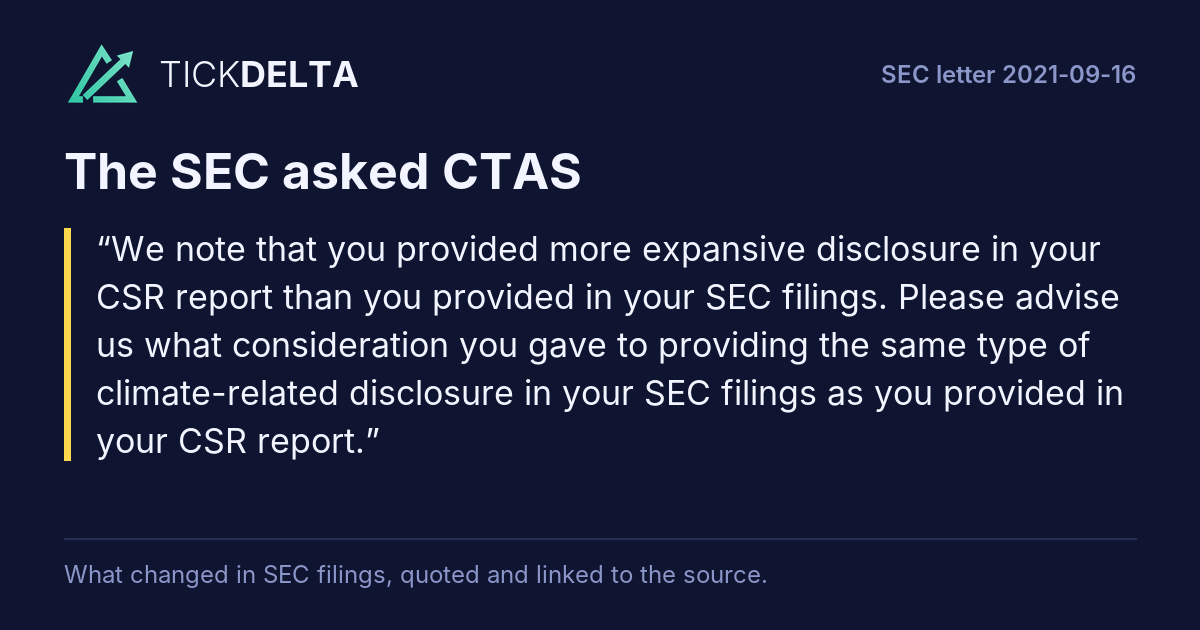
We note that you provided more expansive disclosure in your CSR report than you provided in your SEC filings. Please advise us what consideration you gave to providing the same type of climate-related disclosure in your SEC filings as you provided in your CSR report.
CTAS answered
In response to the Staff’s comment, the Company respectfully advises the Staff that the Company’s Environmental, Social and

Governance Report (“ESG Report”) is designed to provide selected information regarding the Company’s ESG performance to a broad audience that includes investors, employee-partners, customers, communities, suppliers and other interested parties.
Rest of the answer

As a result, the ESG Report may include detailed information, such as information regarding the Company’s efforts to reduce energy use and greenhouse gas (“GHG”) emissions, that is beyond the scope of the information that is required to be disclosed pursuant to applicable

SEC rules and/or regulations. When considering whether to include climate-related disclosure in its SEC filings, including the type of climate-related disclosure provided in the ESG Report, the Company takes into account applicable SEC rules and regulations, including

Item 101, Item 103, Item 105 and Item 303 of Regulation S-K, as well as the SEC’s Compliance and Disclosure Interpretations, available guidance from the Staff (including the SEC’s 2010 Commission Guidance Regarding Disclosure Related to Climate Change) and applicable standards of materiality. The Company also considers that, while certain climate-related information may be of interest to readers of the ESG Report, such information may not be material to investors in the context of an SEC filing, while SEC filings may otherwise include separate climate-related disclosure required pursuant to Regulation S-K and other applicable SEC rules, regulations and guidance. The Company respectfully advises the Staff that it will, in response to the Staff’s comment, and historical practice, continue to evaluate its climate-related disclosure in SEC filings in light of applicable SEC rules, regulations and guidance and applicable standards of materiality.

Read in the reply ↗
In its next report

First report after the company's reply of 2021-09-28: 10-Q filed 2021-10-07 ↗, against the 10-Q filed 2021-04-06 ↗.

Tickdelta does not hold the text of both reports, so they are not compared here.

After reviewing your response to these comments, we may have additional comments. General
SEC asked (2)
In your CSR report, you state that you are committed to lowering the total amount of energy that you consume in your operations and reducing your greenhouse gas emissions. Please revise your disclosure to identify any material past and/or future capital expenditures for climate-related projects related to these initiatives. If material, please quantify these expenditures.
CTAS answered
In response to the Staff’s comment, the Company respectfully advises the Staff that the Company considers applicable SEC disclosure rules, regulations and guidance, including Item 101, Item 105 and Item 303 of Regulation S-K, when preparing its SEC filings and, as applicable and to the extent material, evaluates disclosure regarding capital expenditures for environmental compliance.
Rest of the answer

For example, in the Form 10-K, the Company disclosed that “[w]hile environmental compliance is not a material component of our costs, Cintas makes capital expenditures and associated operating costs, primarily for water treatment and waste removal, on a regular basis in order to comply with environmental laws and regulations, to promote employee safety and to carry out its environmental sustainability principles.”

In the Form 10-K, the Company also provided quantitative disclosure regarding environmental spending related to water treatment and waste removal, as well as capital expenditures to limit or monitor hazardous substances. As of the filing of the Form 10-K, however, the Company had not identified any material capital expenditures related to the Company’s efforts to lower its energy use and GHG emissions. The Company respectfully advises the Staff that it will, in response to the Staff’s comment, and historical practice, continue to evaluate its climate-related disclosure in SEC filings, including disclosure regarding material capital expenditures for these initiatives, in light of applicable SEC rules, regulations and guidance and applicable standards of materiality.

Read in the reply ↗
In its next report

First report after the company's reply of 2021-09-28: 10-Q filed 2021-10-07 ↗, against the 10-Q filed 2021-04-06 ↗.

Tickdelta does not hold the text of both reports, so they are not compared here.

After reviewing your response to these comments, we may have additional comments. General
SEC asked (3)
To the extent material, discuss the indirect consequences of climate-related regulation or business trends, such as the following: • decreased demand for goods or services that produce significant greenhouse gas emissions or are related to carbon-based energy sources; • increased demand for goods or services that result in lower emissions than competing products; • increased competition to develop innovative new
Rest of the question

services that result in lower emissions; and • any anticipated reputational risks resulting from operations or products that produce material greenhouse gas emissions.

CTAS answered
In response to the Staff’s comment, the Company respectfully advises the Staff that the Company considers applicable SEC disclosure rules, regulations, and guidance, including Item 101, Item 105 and Item 303 of Regulation S-K, when preparing its SEC filings and, as applicable and to the extent material, evaluates disclosure regarding indirect consequences of climate-related regulation or business trends. As of the filing of the Form 10-K, however, the Company had not identified any material indirect consequences of climate-related regulation or business trends.
Rest of the answer

The Company respectfully advises the Staff that it will, in response to the Staff’s comment, and historical practice, continue to evaluate its climate-related disclosure in SEC filings, including disclosure regarding the indirect consequences of climate-related regulation or business trends, in light of applicable SEC rules, regulations and guidance and applicable standards of materiality.

Read in the reply ↗
In its next report

First report after the company's reply of 2021-09-28: 10-Q filed 2021-10-07 ↗, against the 10-Q filed 2021-04-06 ↗.

Tickdelta does not hold the text of both reports, so they are not compared here.

After reviewing your response to these comments, we may have additional comments. General
SEC asked (4)
If material, discuss the significant physical effects of climate change on your operations and results. This disclosure may include the following: • quantification of material weather-related damages to your property or operations; • potential for indirect weather-related impacts that have affected or may affect your major customers or suppliers; and • any weather-related impacts on the cost or availability of
Rest of the question

insurance.

CTAS answered
In response to the Staff’s comment, the Company respectfully advises the Staff that the Company considers applicable SEC disclosure rules, regulations, and guidance, including Item 101, Item 105 and Item 303 of Regulation S-K, when preparing its SEC filings and, as applicable and to the extent material, evaluates disclosure regarding any significant physical effects of climate change on its operations and results.
Rest of the answer

As of the filing of the Form 10-K, however, the Company had not identified any significant physical effects of climate change on its operations and results that were material to the Company. The Company respectfully advises the Staff that it will, in response to the Staff’s comment, and historical practice, continue to evaluate its climate-related disclosure in SEC filings, including disclosure regarding the significant physical effects of climate change on its operations and results, in light of applicable SEC rules, regulations and guidance and applicable standards of materiality.

Read in the reply ↗
In its next report

First report after the company's reply of 2021-09-28: 10-Q filed 2021-10-07 ↗, against the 10-Q filed 2021-04-06 ↗.

Tickdelta does not hold the text of both reports, so they are not compared here.

After reviewing your response to these comments, we may have additional comments. General
SEC asked (5)
Disclose the material effects of transition risks related to climate change that may affect your business, financial condition, and results of operations, such as policy and regulatory changes that could impose operational and compliance burdens, market trends that may alter business opportunities, credit risks, or technological changes.
CTAS answered
In response to the Staff’s comment, the Company respectfully advises the Staff that the Company considers applicable SEC disclosure rules, regulations, and guidance, including Item 101, Item 105 and Item 303 of Regulation S-K, when preparing its SEC filings and, as applicable and to the extent material, evaluates disclosure regarding the material effects of transition risks related to climate change.

As of the filing of the Form 10-K, however, the Company had not identified any effects of transition risks related to climate change that were material to the Company.
Rest of the answer

The Company respectfully advises the Staff that it will, in response to the Staff’s comment, and historical practice, continue to evaluate its climate-related disclosure in SEC filings, including disclosure regarding the material effects of transition risks related to climate change, in light of applicable SEC rules, regulations and guidance and applicable standards

Read in the reply ↗
In its next report

First report after the company's reply of 2021-09-28: 10-Q filed 2021-10-07 ↗, against the 10-Q filed 2021-04-06 ↗.

Tickdelta does not hold the text of both reports, so they are not compared here.

General
SEC asked (1)
Your response to prior comment 3, which states that you have not identified any material indirect consequences of climate-related regulation or business trends, appears to be conclusory without providing sufficient detail. Please provide us with additional support for your conclusion, including with regard to the individual items noted in our prior comment.
CTAS answered
As background for the Staff, the Company respectfully advises the Staff that the Company provides certain products and services that generally enhance its customers’ image and help keep customers’ facilities and employees clean and safe. These products and services include uniforms through rental and sales programs, mats, mops, restroom supplies, first aid and safety products, fire extinguishers and testing and safety training. None of these products produce significant greenhouse gas emissions.
Rest of the answer

The Company generally provides these products to customers via approximately 11,000 local delivery routes. These local delivery routes are run by Company employees on Company-owned trucks. These trucks do create greenhouse gas (“GHG”) emissions in compliance with current regulatory emissions requirements.

Many of the Company’s products, such as uniforms, mats, mops and other rentable products, are laundered in Company-owned laundry facilities. The laundering process uses water and energy to run the washers, dryers and other processing equipment.

In response to the Staff’s comment, the Company respectfully advises the Staff that, at the time of the filing of the Form 10-K and to date, aside from the general economic effects of the COVID-19 pandemic on its customers, the Company did not experience and has not experienced any significant decreased demand for products or services, whether such products or services might produce significant GHG emissions or are related to carbon-based energy sources, or significant demand for products or services that might result in lower emissions than competing products or services. The

Company did not identify and has not identified any significant changes in competition due to innovative new services that result in lower emissions. While the Company has had inquiries from customers and investors about its fleet and laundry processes with regards to GHG emissions and other carbon-based energy impacts, the Company did not identify and has not identified any material reputational risks resulting from these inquiries.

Read in the reply ↗
General
SEC asked (2)
In response to prior comment 4, you indicate that you have not identified any significant physical effects of climate change on your operations and results that are material. Your response appears to be conclusory in nature, but does not address the specific elements of our prior comment.
Rest of the question

Please tell us about the physical effects of climate change considered in your response, address the factors from our prior comment, and provide an analysis of materiality.

CTAS answered
As background for the

Staff, the Company respectfully advises the Staff that the Company has a diverse geographic presence within the United States and Canada.

The Company operates within 473 facilities throughout the United States and Canada, and the Company had no concentration of its consolidated fiscal 2021 revenue exceeding nine percent in any one state within the United States and had less than six percent of its consolidated fiscal 2021 revenue derived in Canada.
Rest of the answer

Additionally, the Company did not have any one particular customer that accounted for more than one percent of its consolidated fiscal 2021 revenue.

In response to the Staff’s comment, the Company respectfully advises the Staff that, as a result of the Company’s geographic and customer revenue diversity, local and regional climate change and weather-related disasters, such as tornadoes, hurricanes, fires or snow storms, have not materially adversely impacted the Company’s financial performance. While these types of disasters have certainly occurred in the United States in the last several years, they have not materially adversely impacted the Company’s financial performance or caused any material damages to the Company’s property or operations. For example, during the Company’s third quarter of fiscal 2021, winter and ice storms occurred in Texas. Although these storms did create challenges, the Company was able to transfer processing volumes within its surrounding plants and continue to visit most customers in a timely manner. As a result, these storms did not have a significant impact on the Company’s third fiscal quarter of 2021 financial performance as evidenced in the

Company’s Quarter Report on Form 10-Q for the quarterly period ended February 28, 2021.

With respect to the potential for indirect weather-related impacts that have affected or may affect the Company’s suppliers, the Company respectfully advises the Staff that it did disclose in “Item 1A. Risk Factors” of the Form 10-K in the risk factor entitled “Unexpected events could negatively impact our operations and adversely affect our consolidated results of operations” that unexpected events, such as severe weather conditions and natural disasters such as hurricanes or tornadoes, could result in supply disruptions that could adversely affect the Company’s consolidated results of operations. At the time of the filing of the Form 10-K and to date, the Company did not view and has not viewed the potential for indirect weather-related impacts that have affected or may affect the Company’s customers given the Company’s geographic and customer revenue diversity.

Lastly, the Company respectfully advises that Staff that at the time of the filing of the Form 10-K, it did not and has not identified any material weather-related impacts on the cost or availability of insurance.

Read in the reply ↗
General
SEC asked (3)
Your response to prior comment 5 states that you have not identified any effects of transition risks related to climate change that are material to the company. Please describe the transition risks you have identified and explain how you concluded their effects were not material.
CTAS answered
In response to the

Staff’s comment, the Company respectfully advises the Staff that the Company did disclose in “Item 1A. Risk Factors” of the Form 10-K” certain transition risks that could potentially, materially and adversely affect its business and financial performance.

These risks included:

· “An inability to open new, cost effective operating facilities may adversely affect our expansion efforts.” Within this risk factor, the Company indicates, ”Our ability to open new operating facilities depends on our ability to identify attractive locations…and obtain adequate utility and water
Rest of the answer

sources and comply with environmental regulations, zoning laws and other similar factors.”

· “Unexpected events could negatively impact our operations and adversely affect our consolidated results of operations.” Within this risk factor, the Company indicates, “Unexpected events, including fires or explosions at facilities, severe weather conditions, natural disaster such as hurricanes and tornadoes…could adversely affect our consolidated results of operations.”

· “Changes in the fuel and energy industry could adversely affect our consolidated financial condition and consolidated results of operations.” Within this risk factor, the Company indicates, “The price of fuel and energy needed to run our vehicles and equipment is unpredictable and fluctuates based on events outside our control, including…environmental concerns…”

· “Failure to comply with federal and state regulations to which we are subject could result in penalties or costs that could adversely affect our consolidated results of operations.” Within this risk factor, the Company indicates, “Our business is subject to complex and stringent state and federal regulations, including…transportation and other laws and regulations.” The Company further indicates, “We have incurred, and will continue to incur, capital and operating expenditures and other costs in the ordinary course of our business in complying with USDOT regulations, the OSHA Act and other laws and regulations to which we are subject. Changes in laws or regulations that may be enacted by the current U.S. presidential administration and Congress, may alter the landscape in which we do business and may affect our costs of doing business. The impact of new laws and regulations cannot be predicted. Compliance with new laws and regulations may increase our operating costs or require significant capital expenditures.”

· “Compliance with environmental laws and regulations could result in significant costs that adversely affect our consolidated results of operations.” Within this risk factor, the Company indicates, “Our operating locations are subject to environmental laws and regulations relating to the protection of the environment and health and safety matters, including those governing discharges of pollutants to the air and water, the management and disposal of hazardous substances and wastes and the clean-up of contaminated sites. The operation of our businesses entails risks under environmental laws and regulations. We could incur significant costs…under these laws and regulations.” The Company further indicates, “In addition, potentially significant expenditures could be required to comply with environmental laws and regulations, including requirements that may be adopted or imposed in the future.”

While the Company disclosed in the Form

10-K that certain transition risks could potentially, materially and adversely affect its business and financial performance, at the time of the filing of the Form 10-K and to date, the Company did not identify and has not identified any specific and quantifiable material effects of transition risks related to climate change. As disclosed in the Form 10-K, the Company is subject to complex and stringent state and federal regulations. The Company works hard to understand these existing laws and regulations, and the operational impact of those are incorporated into its current financial performance. Predicting future policy and regulatory changes in connection with climate change, and the specific details of those changes, is very difficult and challenging.

As the Company assesses its future within the constructs of climate change, though, it has identified potential transition risks associated with its fleet and with its laundry operations. The risk associated with the Company’s fleet relates to the possible transition to alternative fuel as opposed to gasoline or diesel. The Company has researched alternative fuel vehicles, but none had been identified at the time of the filings of the Form 10-K or has been identified to date that could perform in the necessary manner to complete the Company’s service routes. The Company recognizes that it will need to purchase and/or replace trucks within its fleet from time to time as the Company grows and as trucks exhaust their useful lives. Recognizing that no alternative vehicle solution exists today that can meet the Company’s performance requirements, the Company cannot predict if the future costs of trucks will change materially, although the Company does not view this a material risk.

The potential risks associated with the Company’s laundry operations relate to the future availability of water and possible transition to alternative fuel used to operate its laundry equipment as opposed to natural gas or electricity. The Company continuously searches for more efficient processes, uses of water and alternative fuels in order to improve its operational performance and to reduce its carbon intensity. At the time of the filing of the Form 10-K and to date, however, the Company was not and is not aware of any requirement to transition away from water usage, natural gas and electricity, was not and is not aware of any existing laws or regulations that would materially increase the costs of operating its laundry facilities, and was not and is not aware of any alternatives or technological changes to its current operating procedures that could result in material transition effects on its laundry operations. Lastly, the Company did not identify and has not identified any credit transition risks related to climate change.
Read in the reply ↗

Also in this review: closing letter, 2022-01-14
Form 10-K for the Fiscal Year Ended May 31, 2019

2020-02-07 to 2020-02-26 · 9 questions · 1 letter from the SEC, 1 from the company
Review closed 2020-02-26
InventorySegmentsResults discussion (MD&A)Critical estimatesLegal and contingenciesGoodwill and impairmentReserves and insurance
After reviewing your response to these comments, we may have additional comments. Item 1. Business, page 3
SEC asked (1)
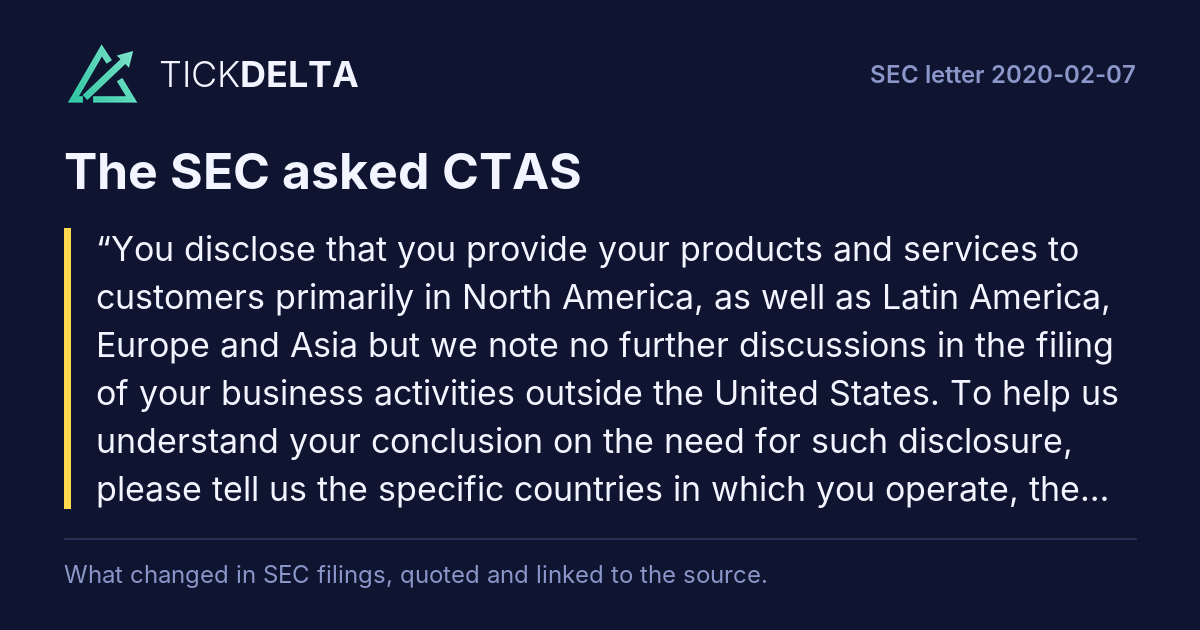
You disclose that you provide your products and services to customers primarily in North America, as well as Latin America, Europe and Asia but we note no further discussions in the filing of your business activities outside the United States.
Rest of the question

To help us understand your conclusion on the need for such disclosure, please tell us the specific countries in which you operate, the types of services and products you offer, the channels through which you provide these services and products, and a measure of your long-lived assets and employees in each country. Also, describe to us any risks attendant to these operations. Please refer to Item 101 of Regulation S-K.

CTAS answered
In response to the Staff’s comment, we respectfully advise the Staff that substantially all of our business activities are in the United States. We provide customers outside of the United States with a wide range of products and services including uniforms, floor care, restroom supplies, first aid and safety products, fire extinguishers and testing, and safety and compliance training. These foreign customers are primarily located in Canada. Customers and business activities outside the United States, in the aggregate, represent less than 10% of our consolidated revenue and long-lived assets.
Rest of the answer

Based on the fact that our business activities outside the United States represent a small portion of our overall operations, we do not believe there to be any significant risks unique to our operations outside the United States that are not already addressed in Item 1A. Risk Factors of our Annual Report on Form 10-K for the year ended May 31, 2019 (the “2019 Form 10-K”). We will continue to monitor the significance of customers and business activities outside of the United States and will revise the disclosure in our future filings to the extent required.

Additionally, in response to the Staff’s comment, we will revise the disclosure in future filings to read “Cintas Corporation… helps more than one million businesses of all types and sizes, primarily in the United States, as well as Canada, Latin America, Europe and Asia, get Ready™ to open their doors with confidence every day by providing a wide range of products and services that enhance our customers’ image and help keep their facilities and employees clean, safe and looking their best.”

Cintas Corporation 6800 Cintas Boulevard P.O. Box 625737 Cincinnati, OH 45262-5737 Office 513.459.1200 www.cintas.com

Read in the reply ↗
In its next report

First report after the company's reply of 2020-02-19: 10-Q filed 2020-03-31 ↗, against the 10-Q filed 2020-01-09 ↗.

Tickdelta does not hold the text of both reports, so they are not compared here.

Note 1. Significant Accounting Policies · Inventories, net, page 41
SEC asked (2)
We note the disclosure of your use of inventory turns and that the judgments and estimates used to calculate inventory turns will have an impact on the valuation of inventories. Please revise the Critical Accounting Estimates section of MD&A in future filings to include a discussion of the methodologies, key assumptions and judgments used in accounting for your inventory, and explain how changes in these assumptions
Rest of the question

could impact your accounting estimates. Also, clearly describe your policies for writing down impaired inventory.

CTAS answered
In response to the Staff’s comment, we respectfully advise the Staff that as disclosed in Note 1. Significant Accounting Policies in the 2019 Form 10-K, the Company’s accounting policy with respect to the valuation of inventories does utilize inventory turns, which requires judgments and estimates. However, these key assumptions, individually and collectively, do not meet the threshold for a Critical Accounting Estimate as the range of outcomes do not have the ability to materially impact the consolidated financial statements.
Rest of the answer

In future filings, we will revise the Inventories, net section in Note 1. Significant Accounting Policies to read substantially as follows:

Inventories, net. Inventories are valued at the lower of cost (first-in, first-out) or net realizable value. Inventory is comprised of the following amounts at May 31:

(In thousands)

2019

2018

Raw materials

$

17,812

17,042

Work in process

28,820

27,350

Finished goods

287,957

235,955

334,589

280,347

Inventories are recorded net of reserves for obsolete inventory of $32.7 million and $37.0 million at May 31, 2019 and 2018, respectively. The inventory obsolescence reserve is determined by specific identification, as well as an estimate based on Cintas' historical rates of obsolescence. Once a specific inventory item is written down to the lower of cost or net realizable value, a new cost basis has been established, and that inventory item cannot subsequently be marked up.

Read in the reply ↗
In its next report

First report after the company's reply of 2020-02-19: 10-Q filed 2020-03-31 ↗, against the 10-Q filed 2020-01-09 ↗.

Tickdelta does not hold the text of both reports, so they are not compared here.

Note 1. Significant Accounting Policies · Inventories, net, page 41
SEC asked (3)
Explain to us how your accounting for impaired inventory complies with ASC 330-10-3514 and SAB Topic 5.BB and revise this note in future filings to clearly indicate such compliance.
CTAS answered
In response to the Staff’s comment, we respectfully advise the Staff that we account for impaired inventory in accordance with ASC 330-10-35-14 and SAB Topic 5.BB. The Company’s accounting policies indicate that once a specific inventory item is written down to the lower of cost or net realizable value, a new cost basis has been established, and that inventory item cannot subsequently be marked up.

In future filings, we will revise the Inventories, net section in Note 1. Significant Accounting Policies to read substantially as follows:

Inventories, net.
Rest of the answer

Inventories are valued at the lower of cost (first-in, first-out) or net realizable value. Inventory is comprised of the following amounts at May 31:

Inventories are recorded net of reserves for obsolete inventory of $32.7 million and $37.0 million at May 31, 2019 and 2018, respectively. The inventory obsolescence reserve is determined by specific identification, as well as an estimate based on Cintas' historical rates of obsolescence. Once a specific inventory item is written down to the lower of cost or net realizable value, a new cost basis has been established, and that inventory item cannot subsequently be marked up.

Read in the reply ↗
In its next report

First report after the company's reply of 2020-02-19: 10-Q filed 2020-03-31 ↗, against the 10-Q filed 2020-01-09 ↗.

Tickdelta does not hold the text of both reports, so they are not compared here.

Litigation and other contingencies, page 44
SEC asked (4)
We note the policy presented in this section and no further discussions of your contingencies in the filing, although we note news articles relating to matters that would normally give rise to contingencies for the company. Please tell us how you considered the requirements of ASC 450-20-50, in particular ASC 450-20-50-3 through 50-5, in concluding on the adequacy of your disclosure.
Rest of the question

Otherwise, confirm that you will revise your future filings to provide the more detailed disclosures required by that guidance.

CTAS answered
In response to the Staff’s comment, we respectfully advise the Staff that in considering whether or not specific contingencies, including litigation, should be disclosed, we evaluate the likelihood that there is at least a reasonable possibility that a material loss may have been incurred related to these matters. We review the procedural status of any known case or allegation and the nature of allegations made in each complaint as of the consolidated balance sheet date and through the date of our filing of the consolidated financial statements.
Rest of the answer

Based on our review and in consideration of the impact on the consolidated financial statements, we determined that neither an accrual for a loss contingency nor consolidated financial statement disclosure was required to be disclosed in the 2019 Form 10-K under FASB ASC 450-20-50.

Read in the reply ↗
In its next report

First report after the company's reply of 2020-02-19: 10-Q filed 2020-03-31 ↗, against the 10-Q filed 2020-01-09 ↗.

Tickdelta does not hold the text of both reports, so they are not compared here.

Note 12. Earning per Share, page 62
SEC asked (5)
Please revise this note in future filings to describe the participating securities outstanding that necessitates your use of the two-class method for computing earnings per share, or to refer the reader to a note where you provide that information. See ASC 260-10-50-1.
CTAS answered
In response to the Staff’s comment, we respectfully advise the Staff that in future filings, we will add the following statement in Note 12. Earnings Per Share, “Cintas uses the two-class method to calculate basic and diluted earnings per share as a result of outstanding participating securities in the form of restricted stock awards. See Note 13 entitled Stock-Based Compensation for additional information on restricted stock awards.” Read in the reply ↗
In its next report

First report after the company's reply of 2020-02-19: 10-Q filed 2020-03-31 ↗, against the 10-Q filed 2020-01-09 ↗.

Tickdelta does not hold the text of both reports, so they are not compared here.

Note 15. Operating Segment Information, page 67
SEC asked (6)
You disclose two reportable operating segments in this note and also refer to your Fire Protection Services and Uniform Direct Sales businesses that are presented in the All Other category. Please clarify for us, and revise the note in future filings to identify each of your operating segments and to disclose whether operating segments have been aggregated into the reportable segments. Refer to ASC 280-10-50-21.
CTAS answered
In response to the Staff’s comment, we respectfully advise the Staff that we have disclosed all four of our operating segments, with two of those operating segments being identified as reportable operating segments (Uniform Rental and Facility Services and First Aid and Safety Services). Our Fire Protection Services and Uniform Direct Sales businesses represent operating segments. We do not aggregate any of our operating segments into a single reportable segment.
Rest of the answer

Consistent with ASC 280-10-50-12 through 15, because our Fire Protection Services and Uniform Direct Sales operating segments are not required to be reportable, we will continue to combine and disclose those operating segments in an “All Other” category. To provide clarity that each of our operating segments are disclosed, we will update our disclosure in future filings to replace the term “businesses” with “operating segments” for the Fire Protection Services and Uniform Direct Sales operating segments.

Read in the reply ↗
In its next report

First report after the company's reply of 2020-02-19: 10-Q filed 2020-03-31 ↗, against the 10-Q filed 2020-01-09 ↗.

Tickdelta does not hold the text of both reports, so they are not compared here.

Note 15. Operating Segment Information, page 67
SEC asked (7)
We note the eight groups of products and services displayed on the company's website, namely, (i) Uniforms & Apparel, (ii) Facility Services, (iii) Tile & Carpet Cleaning, (iv) Restroom & Hygiene Solutions, (v) Training & Compliance, (vi) Flame Resistant Clothing, (vii) First Aid & Safety, and (viii) Fire Protection.
Rest of the question

Please address the following: • Explain to us how these eight lines of business are reflected in your two reportable segments and the All Other category. • Tell us whether the lines of business represent operating segments for which discrete financial information is available. • If so, explain to us your conclusion that they exhibited similar economic characteristics and met the other criteria outlined in ASC 280-10-50-11 to be aggregated. • Tell us who is your chief operating decision maker and briefly describe the information he reviews and when.

CTAS answered
In response to the Staff’s comment, we respectfully advise the Staff that our website presents eight unique categories of products and services that we provide to our customers. This website information is primarily used for marketing and informational purposes to communicate to customers and potential customers our products and services for improving their corporate image and improving safety and cleanliness in the workplace.

These eight categories of products and services exist within our operating segments as follows:

The Uniform Rental and Facility Services operating segment consists of
Rest of the answer

Uniforms & Apparel, including Flame Resistant Clothing, that are primarily rented to our customers, Facility Services, Tile & Carpet Cleaning, and Restroom & Hygiene Solutions.

The First Aid and Safety Services operating segment consists of First Aid & Safety and Training & Compliance.

The Fire Protection Services operating segment consists of fire protection services.

The Uniform Direct Sales operating segment consists of Uniforms & Apparel that are directly sold to our customers.

We do not consider these eight categories of products and services to be separate lines of business. Instead these are categories of revenue within the respective operating segments. These categories of revenue do not represent operating segments because discrete financial information is not available. Each of the four operating segments has discrete financial information, and each operating segment’s financial results, specifically revenue (including internal growth), cost of goods sold, gross margin, selling, general and administrative expenses and operating income, are assessed and reviewed on a regular basis by our chief executive officer, who we have concluded is the chief operating decision maker.

Read in the reply ↗
In its next report

First report after the company's reply of 2020-02-19: 10-Q filed 2020-03-31 ↗, against the 10-Q filed 2020-01-09 ↗.

Tickdelta does not hold the text of both reports, so they are not compared here.

Note 15. Operating Segment Information, page 67
SEC asked (8)
To the extent each line of business does not represent an operating segment, describe to us the similarities in the businesses, including the nature of the services and products, the types or classes of customers, the distribution methods, etc., and any other factors you considered in concluding that they could be grouped into one or more operating segments.
CTAS answered
In response to the Staff’s comment, we respectfully advise the Staff that these eight categories of products and services are categories of revenue within the respective operating segments noted above, but do not represent operating segments because discrete financial information is not available. Within each operating segment, the respective categories of revenue are sold to shared customers through shared sales channels, delivered through shared distribution channels from shared physical locations and managed through shared general and administrative functions. Read in the reply ↗
In its next report

First report after the company's reply of 2020-02-19: 10-Q filed 2020-03-31 ↗, against the 10-Q filed 2020-01-09 ↗.

Tickdelta does not hold the text of both reports, so they are not compared here.

Schedule II - Valuation and Qualifying Accounts and Reserves, page 85
SEC asked (9)
Please remove the information relating to the Reserve for Obsolete Inventory from this schedule in future filings. Note that amounts recorded in separate accounts to recognize obsolete and slow-moving inventory are not considered reserves for the purpose of this schedule because those amounts in substance represent normal adjustments / impairment of inventory rather than true "reserves”.
Rest of the question

Refer to Rule 12-09 of Regulation S-X, SAB Topic 5.BB and ASC 330-10-35-14.

CTAS answered
In response to the Staff’s comment, we respectfully advise the Staff that the Company will revise future filings to remove the information relating to the reserve for obsolete inventory in its Schedule II - Valuation and Qualifying Accounts. Read in the reply ↗
In its next report

First report after the company's reply of 2020-02-19: 10-Q filed 2020-03-31 ↗, against the 10-Q filed 2020-01-09 ↗.

Tickdelta does not hold the text of both reports, so they are not compared here.

Also in this review: closing letter, 2020-02-26

Form 10-K for the fiscal year ended May 31, 2010

2011-03-07 to 2011-03-14 · 1 question · 1 letter from the SEC, 0 from the company
Review closed 2011-03-14
SEC letter of 2011-03-07 ↗ no reply letter on EDGAR
Item 9.01. Financial Statements and Exhibits
SEC asked
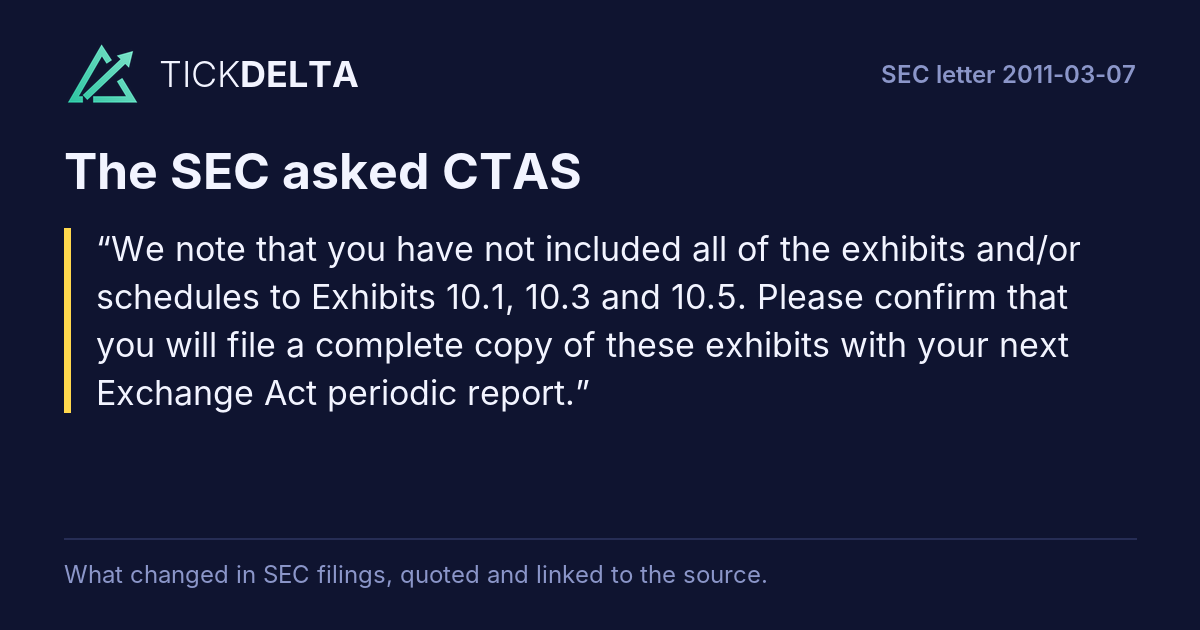
We note that you have not included all of the exhibits and/or schedules to Exhibits 10.1, 10.3 and 10.5. Please confirm that you will file a complete copy of these exhibits with your next Exchange Act periodic report.
CTAS answered

No reply letter found.

In its next report

First report after the SEC's letter of 2011-03-07: 10-Q filed 2011-04-08 ↗, against the 10-Q filed 2011-01-07 ↗.

Tickdelta does not hold the text of both reports, so they are not compared here.

Also in this review: closing letter, 2011-03-14

Form 10-K

2009-11-05 to 2009-12-23 · 1 question · 1 letter from the SEC, 2 from the company
Review closed 2009-12-23
Goodwill and impairment
Notes to Consolidated Financial Statements
SEC asked
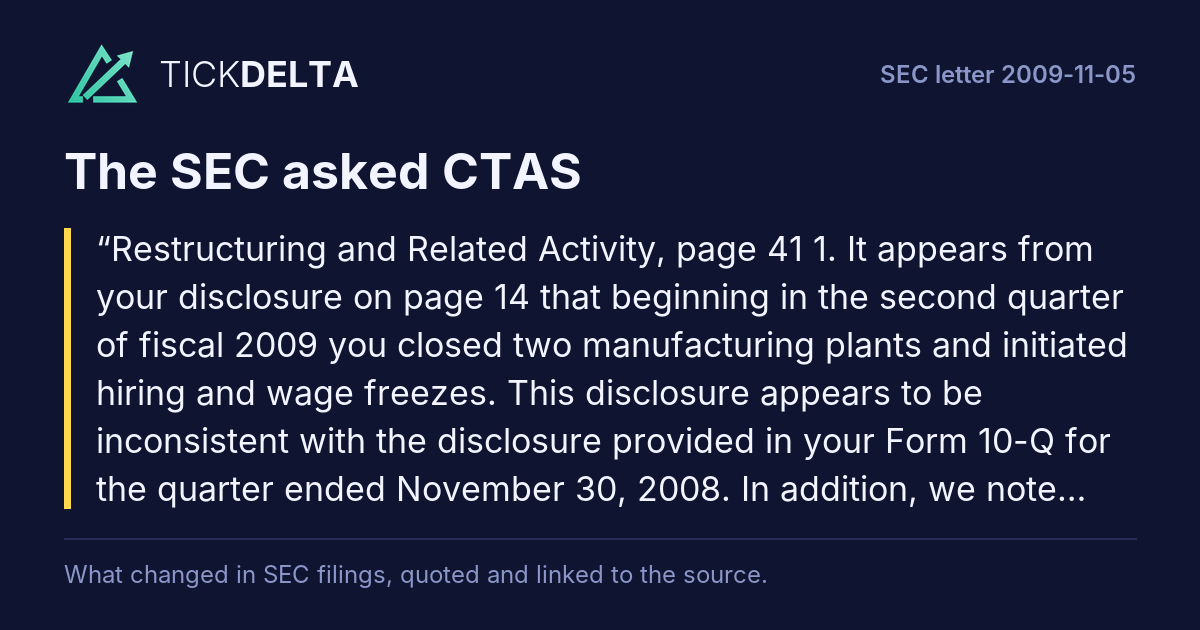
Restructuring and Related Activity, page 41 1. It appears from your disclosure on page 14 that beginning in the second quarter of fiscal 2009 you closed two manufacturing plants and initiated hiring and wage freezes. This disclosure appears to be inconsistent with the disclosure provided in your Form 10-Q for the quarter ended November 30, 2008.
Rest of the question

In addition, we note that you initiated restructuring activities in the fourth quarter to close or convert 16 rental processing plants, resulting in the recognition of restructuring charges and an impairment charge for long-lived assets. Please clarify for us if there were any charges recorded during the second quarter as a result of the closing of two manufacturing facilities. If not, please provide a detailed discussion of the impact of these closings on the financial statements during your second quarter. As appropriate, please amend your filing and respond to these comments within 10 business days or tell us when you will provide us with a response. You may wish to provide us with marked copies of the amendment to expedite our review. Please furnish a cover letter with your amendment that keys your responses to our comments and provides any requested information. Detailed cover letters greatly facilitate our review. Please understand that we may have additional comments after reviewing your amendment and responses to our comments.

CTAS answered

No numbered answer found in the reply. Read the reply ↗

Also in this review: company letter, 2009-11-10, closing letter, 2009-12-23

Form 10-K

2008-04-10 to 2008-05-08 · 1 question · 1 letter from the SEC, 1 from the company
No closing letter
Executive pay
Item 11. Executive Compensation · Compensation Discussion and Analysis
SEC asked
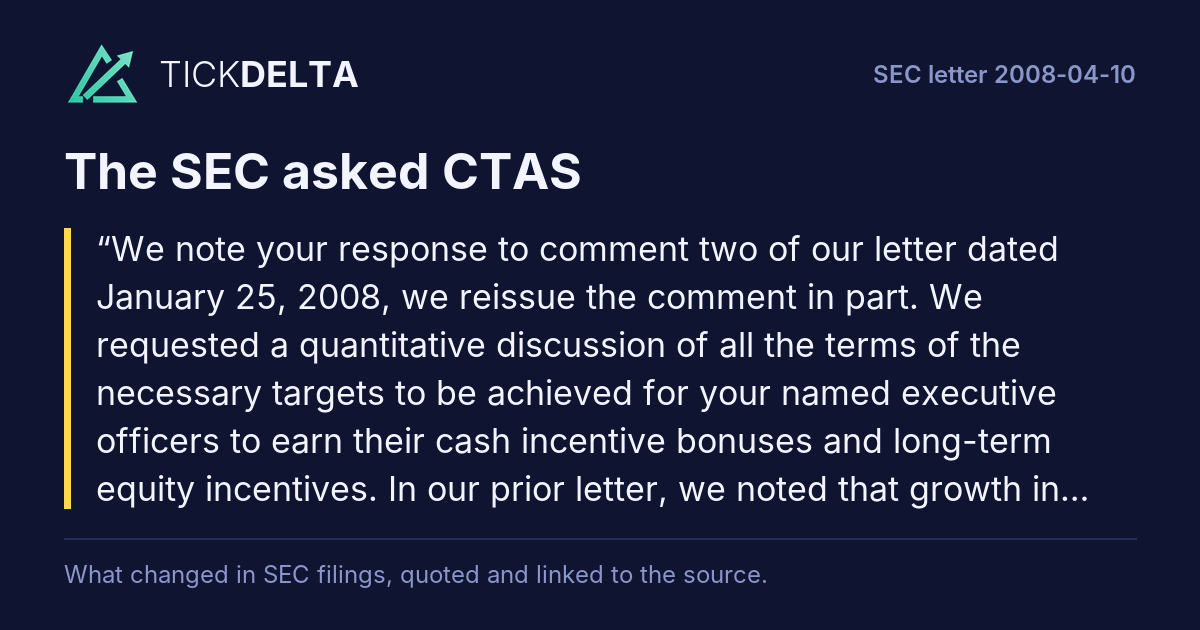
We note your response to comment two of our letter dated January 25, 2008, we reissue the comment in part. We requested a quantitative discussion of all the terms of the necessary targets to be achieved for your named executive officers to earn their cash incentive bonuses and long-term equity incentives.
Rest of the question

In our prior letter, we noted that growth in earnings per share, sales growth, and other performance goals were used to determine executive incentive-based income. Your response indicates that disclosure of the earnings per share and sales growth thresholds would cause competitive harm to Cintas Corporation because it would allow “existing or future competitors … to gain or retain market share by reducing prices.” In particular we note that your actual EPS growth and sales growth for the company are known for fiscal 2007. Given that the actual growth in earning per share and growth in sales are known, please disclose the specific performance targets used to determine the incentive amounts or provide us with detailed discussion of how the disclosure of each specific target would cause the company competitive harm. Specifically address why the disclosure of the specific targets would cause competitors to reduce prices and gain or retain market share. Additionally, we note your response only discusses the earnings per share and sales growth targets. Supplementally advise us if there are any other quantitative “performance goals” used the company’s incentive-based compensation programs outside of the earnings per share and sales growth targets discussed in your response letter. * * * * * Closing Comments As appropriate, please respond to this comment within 10 business days or tell us when you will provide us with a response.

CTAS answered

No numbered answer found in the reply. Read the reply ↗

In its next report

First report after the company's reply of 2008-05-08: 10-K filed 2008-07-30 ↗.

No earlier 10-K before the SEC's letter is in Tickdelta, so there is nothing to compare with.

5 other letters: notices that a filing will not be reviewed, requests to declare a registration effective, and the like

From the SEC's correspondence on EDGAR: staff letters (form UPLOAD) and company letters (form CORRESP), 21 letters filed since 2008-04-10. Questions and answers are matched by their numbers; topics come from words in each question. The reports are compared word for word (same form, before the first SEC letter against the first report after the company's reply). No AI.

Work on CTAS in a spreadsheet: Excel workbook (a sheet per section, ten years by column, charts, links to the filings) · CSV. For a Google Sheet that stays up to date, paste =IMPORTDATA("https://tickdelta.com/company/CTAS/export.csv") into a cell.