This Quarterly Report on Form 10-Q contains historical Consolidated Financial Statements for Corteva as of September 30, 2026, December 31, 2025 and September 30, 2025, and for the three- and nine-month periods ended September 30, 2026 and 2025.
Read in the 10-Qopen_in_new
Financial statements and notes
In September 2026, Corteva issued $ 700 million of 6.00 percent Senior Notes due in August 2036 (“Corteva 2036 Notes”). The proceeds of this offering are intended to be used for general corporate purposes, including the repayment of commercial paper borrowings.
Read in the 10-Qopen_in_new
In August 2026, Vylor issued $ 1.1 billion aggregate principal amount of senior notes in a private offering, consisting of $ 550 million aggregate principal amount of Senior Notes due 2031 (“Vylor 2031 Notes”) and $ 550 million aggregate principal amount of Senior Notes due 2036 (“Vylor 2036 Notes”). The Vylor 2031 Notes bear interest at a rate of 5.125 percent per year and mature in August 2031. The Vylor 2036 Notes bear interest at a rate of 5.625 percent per year and mature in August 2036.
Read in the 10-Qopen_in_new
In August 2026, Vylor commenced private offers to exchange any and all of the outstanding $ 500 million principal amount of 2.30 percent Senior Notes due 2030 (the “EIDP 2030 Notes”), the $ 500 million principal amount of 5.125 percent Senior Notes due 2032 (the “EIDP 2032 Notes”), and the $ 600 million principal amount of 4.80 percent Senior Notes due 2033 (the “EIDP 2033 Notes”), in each case, issued by EIDP, Inc., (collectively, the “EIDP Notes”), to the extent held by eligible holders (“Eligible Noteholders”), for a corresponding series of notes to be newly issued by Vylor (collectively, the “Vylor Notes”), having the same interest payment dates, maturity date and interest rate as the respective EIDP Notes (with respect to each series, an “Exchange Offer" and together, the “Exchange Offers”). Concurrently with the Exchange Offers, with respect to each series of EIDP Notes, Vylor solicited the consents of Eligible Noteholders, on behalf of EIDP, to amend the indentures governing the EIDP Notes (together, the “Consent Solicitations”) to eliminate substantially all of the restrictive covenants and events of default (other than payment and bankruptcy related events of default) therefrom.
Read in the 10-Qopen_in_new
On October 1, 2026, Vylor settled the Exchange Offers and obtained the corresponding Consent Solicitations. Under the Exchange Offers, $ 1,439 million aggregate principal amount of EIDP Notes, comprising $ 435 million aggregate principal amount of the EIDP 2030 Notes, $ 476 million aggregate principal amount of the EIDP 2032 Notes and $ 528 million aggregate principal amount of the EIDP 2033 Notes were exchanged and are no longer debt obligations of Corteva.
Read in the 10-Qopen_in_new
The Exchange Offers and Consent Solicitations were made upon the terms and conditions set forth in an exchange offer memorandum and consent solicitation statement, dated August 6, 2026 (the “Offering Memorandum”). The Vylor Notes are subject to covenants and events of default that are typical for companies with similar credit ratings, and which are described in the Offering Memorandum.
Read in the 10-Qopen_in_new
indebtedness to total capitalization for Corteva and its consolidated subsidiaries not exceed 0.60. At September 30, 2026, the company was in compliance with these covenants.
Read in the 10-Qopen_in_new
In August 2026, the Company entered into a $ 1 billion delayed draw term facility (the “Delayed Draw Term Facility”). The maturity date of the Delayed Draw Term Facility is approximately one year from its closing date. Borrowings under the Delayed Draw Term Facility have an interest rate equal to Term SOFR plus the applicable margin. The Delayed Draw Term Facility was intended to serve as a backstop to the Corteva 2036 Senior Notes. The commitments under the Delayed Draw Term Facility were automatically and permanently reduced, on a dollar-for-dollar basis, by an amount equal to the aggregate principal amount of the Corteva 2036 Senior Notes issued in the September 2026 Debt Offering. The balance of the capacity was voluntarily and permanently reduced on September 30, 2026. The Delayed Draw Term Facility was subject to mandatory prepayment (and, prior to funding, automatic and permanent commitment reduction) requirements from the net cash proceeds of debt and equity issuances by Corteva. Corteva was permitted to voluntarily prepay delayed draw term loans, and to voluntarily reduce undrawn commitments, without a penalty. The Delayed Draw Term Loan Credit Agreement contained covenants and events of default substantially similar in scope and terms to those described above for the Revolving Credit Facilities.
Read in the 10-Qopen_in_new
In August 2026, Vylor entered into (i) a five -year senior unsecured revolving credit facility in an aggregate principal amount equal to $ 3.0 billion (the “Vylor Five-Year Revolving Credit Facility”), (ii) a 364 -day senior unsecured revolving credit facility in an aggregate principal amount equal to $ 1.5 billion (the “Vylor 364-Day Revolving Credit Facility” and, together with the Vylor Five -Year Revolving Credit Facility, the “Vylor Revolving Credit Facilities”), and (iii) a senior unsecured delayed draw term loan facility in an original principal amount equal to $ 2.75 billion (the “Vylor Delayed Draw Term Facility” and, together with the Vylor Revolving Credit Facilities, the “Vylor Credit Facilities”).
Read in the 10-Qopen_in_new
Vylor, along with its subsidiary, Pioneer Hi-Bred International, Inc. (“PHI”), are initially co-borrowers under the Vylor Five -Year Revolving Credit Facility. Prior to the Five -Year RCF PHI Release Date (as defined below), each of Vylor and PHI is entitled to request loans under the Vylor Five -Year Revolving Credit Facility, in each case subject to the terms and conditions thereof, and each of Vylor and PHI guarantees, on a joint and several basis, obligations of the other co-borrower under the Vylor Five -Year Revolving Credit Facility. The Vylor Five -Year Revolving Credit Facility became effective on October 1, 2026.
Read in the 10-Qopen_in_new
Upon the earlier of (i) December 31, 2026 and (ii) the first date on which all obligations of PHI under the Vylor Five -Year Revolving Credit Facility are paid in full in cash (such date, the “Five-Year RCF PHI Release Date”), PHI will automatically cease to be a borrower under the Vylor Five -Year Revolving Credit Facility and will be automatically released as a guarantor thereunder. From and after the Five -Year RCF PHI Release Date, Vylor will be the sole borrower under the Vylor Five -Year Revolving Credit Facility, and immediately thereafter no subsidiaries of Vylor will guarantee such facility.
Read in the 10-Qopen_in_new
Proceeds of the Vylor Five -Year Revolving Credit Facility are otherwise intended to be used for general corporate purposes of Vylor and its subsidiaries. The Vylor Five -Year Revolving Credit Facility is also intended to serve as a backstop to its commercial paper program. The maturity date of the Vylor Five -Year Revolving Credit Facility is five years from its closing date. Amounts borrowed under the Vylor Five -Year Revolving Credit Facility are subject to an interest rate per annum equal to
Read in the 10-Qopen_in_new
Term SOFR plus the applicable margin. On October 1, 2026, Vylor borrowed $ 1,578 million under the Vylor Five -Year Revolving Credit Facility to repay borrowings outstanding under the PHI Bilateral Facility (as defined below).
Read in the 10-Qopen_in_new
Vylor, along with its subsidiary, PHI, are initially co-borrowers under the Vylor 364 -Day Revolving Credit Facility. Prior to the Vylor 364 -Day Revolving Credit Facility PHI Release Date (as defined below), each of Vylor and PHI is entitled to request loans under the Vylor 364 -Day Revolving Credit Facility, in each case subject to the terms and conditions thereof, and each of Vylor and PHI guarantees, on a joint and several basis, obligations of the other co-borrower under the Vylor 364 -Day Revolving Credit Facility. The Vylor 364 -Day Revolving Credit Facility became effective on October 1, 2026.
Read in the 10-Qopen_in_new
Upon the earlier of (i) December 31, 2026 and (ii) the first date on which all obligations of PHI under the Vylor 364 -Day Revolving Credit Facility are paid in full in cash (such date, the “364-Day RCF PHI Release Date”), PHI will automatically cease to be a borrower under the Vylor 364 -Day Revolving Credit Facility and will be automatically released as a guarantor thereunder. From and after the 364 -Day RCF PHI Release Date, Vylor will be the sole borrower under the Vylor 364 -Day Revolving Credit Facility, and immediately thereafter no subsidiaries of Vylor will guarantee such facility.
Read in the 10-Qopen_in_new
Proceeds of the Vylor 364 -Day Revolving Credit Facility are intended to be used for general corporate purposes of Vylor and its subsidiaries. The Vylor 364 -Day Revolving Credit Facility is also intended to serve as a backstop to its commercial paper program. The maturity date of the Vylor 364 -Day Revolving Credit Facility is 364 days from its closing date. Amounts borrowed under the Vylor 364 -Day Revolving Credit Facility are subject to an interest rate per annum equal to Term SOFR plus the applicable margin. On October 1, 2026, Vylor borrowed $ 1,500 million under the Vylor 364 -Day Revolving Credit Facility to repay borrowings outstanding under the PHI Bilateral Facility (as defined below).
Read in the 10-Qopen_in_new
The Vylor Delayed Draw Term Facility, with a capacity of up to $ 2.75 billion, was intended to serve as a backstop to the Exchange Offers and the issuance of the Vylor 2031 Notes and the Vylor 2036 Notes. The commitments under the Vylor Delayed Draw Term Facility were automatically and permanently reduced, on a dollar-for-dollar basis, by an amount equal to the aggregate principal amount of Vylor Notes issued in the Exchange Offers and by the aggregate principal amount of the Vylor 2031 Notes and the Vylor 2036 Notes. Vylor was the sole borrower under the Vylor Delayed Draw Term Facility.
Read in the 10-Qopen_in_new
Proceeds of loans under the Vylor Delayed Draw Term Facility were intended to be used to finance the Vylor Separation and to pay fees, costs and expenses related thereto. The maturity date of the Vylor Delayed Draw Term Facility was approximately one year from its closing date. Amounts borrowed under the Vylor Delayed Draw Term Facility were subject to an interest rate per annum equal to Term SOFR plus the applicable margin. There were no borrowings outstanding under the Vylor Delayed Draw Term Facility, and the facility was terminated on October 1, 2026.
Read in the 10-Qopen_in_new
The Vylor Delayed Draw Term Facility was subject to mandatory prepayment (and, prior to funding, automatic and permanent commitment reduction) requirements from the net cash proceeds of debt and equity issuances by Vylor. Vylor was permitted to voluntarily prepay delayed draw term loans, and to voluntarily reduce undrawn commitments, without a penalty. The Vylor Delayed Draw Term Loan Credit Agreement contained covenants and events of default substantially similar in scope and terms to those described above for the Vylor Revolving Credit Facilities.
Read in the 10-Qopen_in_new
PHI entered into a loan facility up to an aggregate principal amount of $ 3.5 billion with Banco Bilbao Vizcaya Argentaria, S.A. New York Branch in August 2026 (the “PHI Bilateral Facility”), which was used for the repayment of a portion of the outstanding borrowings under EIDP’s commercial paper program. The PHI Bilateral Facility had commitments from September 1, 2026 through September 5, 2026, after which commitments were automatically terminated. The PHI Bilateral Facility was
Read in the 10-Qopen_in_new
expected to serve as a bridge to the Vylor Five -Year Revolving Credit Facility and Vylor 364 -Day Revolving Credit Facility, each of which were drawn upon consummation of the Vylor Separation to repay borrowings outstanding on the PHI Bilateral Facility. Following this repayment, on October 1, 2026, the PHI Bilateral Facility ceased to be effective.
Read in the 10-Qopen_in_new
PHI is the sole borrower under the PHI Bilateral Facility. Amounts borrowed under the PHI Bilateral Facility are subject to an interest rate per annum equal to Term SOFR plus the applicable margin. The PHI Bilateral Credit Agreement contains covenants and events of default substantially similar in scope and terms to those described above for the Vylor Revolving Credit Facilities.
Read in the 10-Qopen_in_new
In September 2026, in conjunction with the North Carolina settlement discussed below under “Other PFOA Matters”, Chemours, DuPont and Corteva reached the following understandings relating to the MOU. For purposes of calculating the amount of qualified spend applied against the MOU’s $ 4 billion aggregate qualified spend cap, the parties have agreed to use a net present value methodology for potential future settlements with multi-year payments whereby settlement payments are spread equally over a twenty-five-year period from the date the settlement becomes final (rather than the actual timing of the payments) and using an 8 percent discount rate. In addition, since the aggregate payments to be made in connection with the New Jersey and North Carolina settlements will qualify for withdrawal from the MOU Escrow Account and exceed the parties’ future escrow contribution obligations, all future contributions required by the parties to the MOU Escrow Account will be considered satisfied by the parties’ New Jersey and North Carolina settlement payments.
Read in the 10-Qopen_in_new
Ohio. EIDP is a defendant in two lawsuits, including an action by the State of Ohio based on alleged damage to natural resources. The natural resources damage claim was preliminarily resolved in December 2023. As of the third quarter of 2026,
Read in the 10-Qopen_in_new
receive a credit up to the amount of the payment if the state seeks natural resource damage claims against the companies outside the scope of the settlement’s release of claims.
Read in the 10-Qopen_in_new
Turn-out Gear Cases. The company is subject to several personal injury lawsuits alleging personal injuries related to PFAS exposure from firefighter turn-out gear. A separate federal multi-district litigation has been established in the District of Minnesota (“MN MDL”).
Read in the 10-Qopen_in_new
Brunswick County, that seek actual and punitive damages as well as injunctive relief. EIDP and Chemours filed a motion for summary judgment on this consolidated action in March 2025.
Read in the 10-Qopen_in_new
Chemours, DuPont, Corteva, and EIDP were subject to natural resources damage claims in North Carolina alleging that direct discharges from the Fayetteville Works facility are a source of PFOA contamination. Cumberland County, North Carolina and certain other counties in North Carolina, which are not part of the consolidated CFPUA action or the Nationwide Water District Settlement, also filed actions for alleged PFOA contamination to its groundwater sources used in drinking water and seeking recovery for costs associated with water filtration, monitoring, and compliance costs. In September 2026, Chemours, DuPont, Corteva, and EIDP reached a settlement with State of North Carolina, by and through the North Carolina Attorney General, and Bladen County, Brunswick County, Columbus County, Cumberland County, New Hanover County, Robeson County, Sampson County, Town of Wrightsville Beach, City of Lumberton, Village of Bald Head Island, and the Lower Cape Fear Water and Sewer Authority of statewide PFAS claims; Fayetteville Works site related claims, as well as for the Company and DuPont all claims related to historical discharges from the Fayetteville Works site and any obligations under the Chemours 2019 consent order with the North Carolina Department of Environmental Quality (“NC Consent Order”). Under the settlement the companies will collectively pay $ 455 million to the State of North Carolina and applicable state subdivisions over 15 years, with Corteva’s share being approximately $ 66 million. Additionally, as part of the settlement, Corteva and DuPont, on a 29 percent and 71 percent basis, respectively, are required to guarantee Chemours’ share of the settlement payments, as well as establish a reserve fund via a line of credit, letter of credit, and/or a surety bond capped at $ 135 million that the State of North Carolina may access in the event Chemours does not comply with its NC Consent Order. Arrangements for these financial assurances remain subject to finalization. As of September 30, 2026, an accrual has been established for these claims.
Read in the 10-Qopen_in_new
In connection with the Vylor Separation, Corteva and Vylor entered into various agreements to effect the Vylor Separation and provide a framework for their relationship after the Vylor Separation, including the Separation and Distribution Agreement, Tax Matters Agreement, Employee Matters Agreement, Transition Services Agreements, Commercial Agreements, Intellectual Property Matters Agreement and other ancillary agreements. These agreements provide for the allocation between Corteva and Vylor of assets, employees, liabilities and obligations (including property and employee benefits and tax-related assets and liabilities) attributable to periods prior to, at, and after the Vylor Separation from Corteva and govern certain relationships between Corteva and Vylor after the Vylor Separation.
Read in the 10-Qopen_in_new
On October 1, 2026, in connection with the consummation of the Vylor Separation, Corteva transferred the Seed Business to Vylor, in exchange for, among other consideration, a cash distribution from Vylor of $ 761 million. Corteva used the proceeds to pay down the $ 600 million balance outstanding under the 364 -Day Revolving Credit Facility and its outstanding commercial paper balance of $ 161 million. Refer to Note 11 - Short Term Borrowings, Long-Term Debt and Available Credit Facilities, to the interim Consolidated Financial Statements, for additional information regarding the debt transactions related to the Vylor Separation. Subsequent to the Vylor Separation, Vylor transferred $ 183 million to Corteva in settlement of an intercompany note that was issued by Vylor to Corteva as part of pre-separation arrangements associated with the establishment of the Vylor and Corteva starting capital structures. Additionally, Corteva transferred $ 82 million to Vylor subsequent to the Vylor Separation in finalizing the opening balance sheets of the companies.
Read in the 10-Qopen_in_new
research, field, lab and facilities costs, and unfavorable currency impacts, partially offset by cost recoveries received from third parties.
Read in the 10-Qopen_in_new
In August 2026, the Company entered into a $1 billion delayed draw term facility (the “Delayed Draw Term Facility”). The maturity date of the Delayed Draw Term Facility is approximately one year from its closing date. Borrowings under the Delayed Draw Term Facility have an interest rate equal to Term SOFR plus the applicable margin. The Delayed Draw Term Facility was intended to serve as a backstop to the Corteva 2036 Notes. The commitments under the Delayed Draw Term Facility were automatically and permanently reduced, on a dollar-for-dollar basis, by an amount equal to the aggregate principal amount of the Corteva 2036 Notes issued in the September 2026 Debt Offering. The balance of the capacity was voluntarily and permanently reduced on September 30, 2026. The Delayed Draw Term Facility was subject to mandatory prepayment (and, prior to funding, automatic and permanent commitment reduction) requirements from the net cash proceeds of debt and equity issuances by Corteva. Corteva was permitted to voluntarily prepay delayed draw term loans, and to voluntarily reduce undrawn commitments, without a penalty. The Delayed Draw Term Loan Credit Agreement contained covenants and events of default substantially similar in scope and terms to those described above for the Revolving Credit Facilities.
Read in the 10-Qopen_in_new
In August 2026, Vylor entered into (i) a five-year senior unsecured revolving credit facility in an aggregate principal amount equal to $3.0 billion (the “Vylor Five-Year Revolving Credit Facility”), (ii) a 364-day senior unsecured revolving credit facility in an aggregate principal amount equal to $1.5 billion (the “Vylor 364-Day Revolving Credit Facility” and, together with the Vylor Five-Year Revolving Credit Facility, the “Vylor Revolving Credit Facilities”), and (iii) a senior unsecured delayed draw term loan facility in an original principal amount equal to $2.75 billion (the “Vylor Delayed Draw Term Facility” and, together with the Vylor Revolving Credit Facilities, the “Vylor Credit Facilities”).
Read in the 10-Qopen_in_new
Vylor, along with its subsidiary, Pioneer Hi-Bred International, Inc. (“PHI”), are initially co-borrowers under the Vylor Five-Year Revolving Credit Facility. Prior to the Five-Year RCF PHI Release Date (as defined below), each of Vylor and PHI is entitled to request loans under the Vylor Five-Year Revolving Credit Facility, in each case subject to the terms and conditions thereof, and each of Vylor and PHI guarantees, on a joint and several basis, obligations of the other co-borrower under the Vylor Five-Year Revolving Credit Facility.
Read in the 10-Qopen_in_new
Upon the earlier of (i) December 31, 2026 and (ii) the first date on which all obligations of PHI under the Vylor Five-Year Revolving Credit Facility are paid in full in cash (such date, the “Five-Year RCF PHI Release Date”), PHI will automatically cease to be a borrower under the Vylor Five-Year Revolving Credit Facility and will be automatically released as a guarantor thereunder. From and after the Five-Year RCF PHI Release Date, Vylor will be the sole borrower under the Vylor Five-Year Revolving Credit Facility, and immediately thereafter no subsidiaries of Vylor will guarantee such facility.
Read in the 10-Qopen_in_new
Proceeds of the Vylor Five-Year Revolving Credit Facility are otherwise intended to be used for general corporate purposes of Vylor and its subsidiaries. The Vylor Five-Year Revolving Credit Facility is also intended to serve as a backstop to its commercial paper program. The maturity date of the Vylor Five-Year Revolving Credit Facility is five years from its closing date. Amounts borrowed under the Vylor Five-Year Revolving Credit Facility are subject to an interest rate per annum equal to Term SOFR plus the applicable margin. On October 1, 2026, Vylor borrowed $1,578 million under the Vylor Five-Year Revolving Credit Facility to repay borrowings outstanding under the PHI Bilateral Facility (as defined below).
Read in the 10-Qopen_in_new
Vylor, along with its subsidiary, PHI, are initially co-borrowers under the Vylor 364-Day Revolving Credit Facility. Prior to the Vylor 364-Day Revolving Credit Facility PHI Release Date (as defined below), each of Vylor and PHI is entitled to request loans under the Vylor 364-Day Revolving Credit Facility, in each case subject to the terms and conditions thereof, and each of Vylor and PHI guarantees, on a joint and several basis, obligations of the other co-borrower under the Vylor 364-Day Revolving Credit Facility.
Read in the 10-Qopen_in_new
Upon the earlier of (i) December 31, 2026 and (ii) the first date on which all obligations of PHI under the Vylor 364-Day Revolving Credit Facility are paid in full in cash (such date, the “364-Day RCF PHI Release Date”), PHI will automatically cease to be a borrower under the Vylor 364-Day Revolving Credit Facility and to be automatically released as a guarantor thereunder. From and after the 364-Day RCF PHI Release Date, Vylor will be the sole borrower under the Vylor 364-Day Revolving Credit Facility, and immediately thereafter no subsidiaries of Vylor will guarantee such facility.
Read in the 10-Qopen_in_new
Proceeds of the Vylor 364-Day Revolving Credit Facility are intended to be used for general corporate purposes of Vylor and its subsidiaries. The Vylor 364-Day Revolving Credit Facility is also intended to serve as a backstop to its commercial paper program. The maturity date of the Vylor 364-Day Revolving Credit Facility is 364 days from its closing date. Amounts borrowed under the Vylor 364-Day Revolving Credit Facility are subject to an interest rate per annum equal to Term SOFR plus the applicable margin. On October 1, 2026, Vylor borrowed $1,500 million under the Vylor 364-Day Revolving Credit Facility to repay borrowings outstanding under the PHI Bilateral Facility (as defined below).
Read in the 10-Qopen_in_new
contains a financial covenant requiring that the ratio of total indebtedness to total capitalization for Vylor and its consolidated subsidiaries not exceed 0.60.
Read in the 10-Qopen_in_new
The Vylor Delayed Draw Term Facility, with a capacity of up to $2.75 billion, was intended to serve as a backstop to the Exchange Offers and the issuance of the Vylor 2031 Notes and the Vylor 2036 Notes. The commitments under the Vylor Delayed Draw Term Facility were automatically and permanently reduced, on a dollar-for-dollar basis, by an amount equal to the aggregate principal amount of Vylor Notes issued in the Exchange Offers and by the aggregate principal amount of the Vylor 2031 Notes and the Vylor 2036 Notes. Vylor was the sole borrower under the Vylor Delayed Draw Term Facility.
Read in the 10-Qopen_in_new
Proceeds of loans under the Vylor Delayed Draw Term Facility were intended to be used to finance the Vylor Separation and to pay fees, costs and expenses related thereto. The maturity date of the Vylor Delayed Draw Term Facility was approximately one year from its closing date. Amounts borrowed under the Vylor Delayed Draw Term Facility were subject to an interest rate per annum equal to Term SOFR plus the applicable margin. There were no borrowings outstanding under the Vylor Delayed Draw Term Facility, and the facility was terminated on October 1, 2026.
Read in the 10-Qopen_in_new
The Vylor Delayed Draw Term Facility was subject to mandatory prepayment (and, prior to funding, automatic and permanent commitment reduction) requirements from the net cash proceeds of debt and equity issuances by Vylor. Vylor was permitted to voluntarily prepay delayed draw term loans, and to voluntarily reduce undrawn commitments, without a penalty. The Vylor Delayed Draw Term Loan Credit Agreement contained covenants and events of default substantially similar in scope and terms to those described above for the Vylor Revolving Credit Facilities.
Read in the 10-Qopen_in_new
PHI entered into a loan facility up to an aggregate principal amount of $3.5 billion with Banco Bilbao Vizcaya Argentaria, S.A. New York Branch in August 2026 (the “PHI Bilateral Facility”), which was used for the repayment of a portion of the outstanding borrowings under EIDP’s commercial paper program. The PHI Bilateral Facility had commitments from September 1, 2026 through September 5, 2026, after which commitments were automatically terminated. The PHI Bilateral Facility was expected to serve as a bridge to the Vylor Five-Year Revolving Credit Facility and Vylor 364-Day Revolving Credit Facility, each of which were drawn upon consummation of the Vylor Separation to repay borrowings outstanding on the PHI Bilateral Facility. Following this repayment, on October 1, 2026, the PHI Bilateral Facility ceased to be effective.
Read in the 10-Qopen_in_new
PHI is the sole borrower under the PHI Bilateral Facility. Amounts borrowed under the PHI Bilateral Facility are subject to an interest rate per annum equal to Term SOFR plus the applicable margin. The PHI Bilateral Credit Agreement contains covenants and events of default substantially similar in scope and terms to those described above for the Vylor Revolving Credit Facilities.
Read in the 10-Qopen_in_new
In August 2026, Vylor commenced private offers to exchange any and all of the outstanding $500 million principal amount of 2.300% Senior Notes due 2030 (the “EIDP 2030 Notes”), the $500 million principal amount of 5.125% Senior Notes due 2032 (the “EIDP 2032 Notes”), and the $600 million principal amount of 4.800% Senior Notes due 2033 (the “EIDP 2033 Notes”), in each case, issued by EIDP, Inc., (collectively, the “EIDP Notes”), to the extent held by eligible holders (“Eligible Noteholders”), for a corresponding series of notes to be newly issued by Vylor (collectively, the “Vylor Notes”), having the same interest payment dates, maturity date and interest rate as the respective EIDP Notes (with respect to each series, an “Exchange Offer" and together, the “Exchange Offers”). Concurrently with the Exchange Offers, with respect to each series of EIDP Notes, Vylor solicited the consents of Eligible Noteholders, on behalf of EIDP, to amend the indentures governing the EIDP Notes (together, the “Consent Solicitations”) to eliminate substantially all of the restrictive covenants and events of default (other than payment and bankruptcy related events of default) therefrom.
Read in the 10-Qopen_in_new
On October 1, 2026, Vylor settled the Exchange Offers and obtained the corresponding Consent Solicitations. Under the Exchange Offers, $1,439 million aggregate principal amount of EIDP Notes, comprising $435 million aggregate principal amount of the EIDP 2030 Notes, $476 million aggregate principal amount of the EIDP 2032 Notes and $528 million aggregate principal amount of the EIDP 2033 Notes were exchanged and are no longer debt obligations of Corteva.
Read in the 10-Qopen_in_new
The Exchange Offers and Consent Solicitations were made upon the terms and conditions set forth in an exchange offer memorandum and consent solicitation statement, dated August 6, 2026 (the “Offering Memorandum”). The Vylor Notes are subject to covenants and events of default that are typical for companies with similar credit ratings, and which are described in the Offering Memorandum.
Read in the 10-Qopen_in_new
In September 2026, Corteva issued $700 million of 6.000 percent Senior Notes due in August 2036 (“Corteva 2036 Senior Notes”). The proceeds of this offering are intended to be used for general corporate purposes, including the repayment of commercial paper borrowings.
Read in the 10-Qopen_in_new
In August 2026, Vylor issued $1.1 billion aggregate principal amount of senior notes in a private offering, consisting of $550 million aggregate principal amount of Senior Notes due 2031 (“Vylor 2031 Notes”) and $550 million aggregate principal amount of Senior Notes due 2036 (“Vylor 2036 Notes”). The Vylor 2031 Notes bear interest at a rate of 5.125 percent per year and mature in August 2031. The Vylor 2036 Notes bear interest at a rate of 5.625 percent per year and mature in August 2036.
Read in the 10-Qopen_in_new
Risk Factors
Corteva may not be able to obtain or maintain the necessary regulatory approvals for some of its products, which could restrict its ability to sell those products in some markets.
Read in the 10-Qopen_in_new
Regulatory and legislative requirements affect the development, manufacture and distribution of Corteva’s products, and non-compliance with these requirements can harm Corteva’s sales and profitability.
Read in the 10-Qopen_in_new
Our products must be extensively tested for safety, efficacy and environmental impact before they can be registered for production, use, sale or commercialization in a given market. In certain jurisdictions, Corteva must periodically renew its approvals for its crop protection products, which typically require Corteva to demonstrate compliance with then-current standards which generally are more stringent since the prior registration. The regulatory approvals process is lengthy, costly, complex and in some markets unpredictable, with requirements that can vary by product, technology, industry and country. The regulatory approvals process for products that incorporate novel modes of action or new technologies can be particularly unpredictable and uncertain due to the then-current state of regulatory guidelines and objectives, as well as governmental policy considerations and non-governmental organization and other stakeholder considerations. The uncertainty and increased length of regulatory approvals may reduce Corteva’s return on its research and development investments, and impede its ability to meet its sales, profitability, or sustainability expectations.
Read in the 10-Qopen_in_new
Furthermore, the detection of chemical residues from a crop protection product not approved in the country in which Corteva sells its product, or in a country to which Corteva imports its product, may affect Corteva’s ability to supply or export its products, or even result in crop destruction, product recalls trade disruptions, or disputes with customers and distributors.
Read in the 10-Qopen_in_new
Additionally, the regulatory environment may be impacted by the activities of non-governmental organizations and special interest groups and stakeholder reaction to actual or perceived impacts of new and existing technology, products or processes on safety, health and the environment. Obtaining and maintaining regulatory approvals requires submitting a significant amount of information and data, which may require participation from technology providers. Regulatory standards and trial procedures are continuously changing. In addition, Corteva has seen an increase in recent years in the number of lawsuits filed by those who identify themselves as public or environmental interest groups seeking to invalidate pesticide product registrations, including those for Enlist One®, and/or challenge the way federal or state governmental entities apply the rules and regulations governing pesticide produce use. The pace of change together with the lack of regulatory harmony could result in unintended noncompliance. Responding to these changes and meeting existing and new requirements may involve significant costs or capital expenditures or require changes in business practice that could result in reduced profitability. The failure to receive necessary permits or approvals, or the invalidation thereof, could have near- and long-term effects on Corteva’s ability to produce and sell some current and future products.
Read in the 10-Qopen_in_new
The successful development and commercialization of Corteva’s pipeline products will be necessary for Corteva’s growth.
Read in the 10-Qopen_in_new
Corteva conducts research into biological and chemical products to protect farmers’ crops from pests and diseases and enhance plant productivity. However, new product concepts may be abandoned for many reasons, including greater anticipated development costs, technical difficulties, lack of efficacy, regulatory obstacles or inability to market under regulatory frameworks, competition, inability to prove the original concept, lack of demand and the need to divert focus, from time to time, to other initiatives with perceived opportunities for better returns. The processes of active ingredient development or discovery is lengthy, and a very small percentage of the chemicals or biologicals Corteva tests are selected for commercialization. Commercial transitions to the company’s new technologies can take several years to complete, and weed and insect resistance may develop faster than Corteva can respond with new technologies or enhancements to existing technologies. Even when initial commercialization efforts have been promising, there are no guarantees that anticipated levels of product acceptability within Corteva’s markets will be achieved or that higher quality products will not be developed by Corteva’s competitors in the future.
Read in the 10-Qopen_in_new
Speed in discovering, developing, protecting and responding to new technologies, including artificial intelligence and new technology-based distribution channels that accelerate Corteva’s product development timelines and could facilitate its ability to engage with customers and end users, and bringing related products to market is a significant competitive advantage. Commercial success frequently depends on being the first company to the market, and many of Corteva’s competitors are also making considerable investments in similar biological and chemical products.
Read in the 10-Qopen_in_new
The degree of public understanding and acceptance or perceived public acceptance of Corteva’s products and technologies can affect Corteva’s sales and results of operations by affecting labelling approvals, regulatory requirements and customer purchase decisions.
Read in the 10-Qopen_in_new
Concerns and claims regarding the safe use of crop protection products and their potential impact on health and the environment reflect a growing trend in societal demands for increasing levels of product safety and environmental protection. These include concerns and claims that increased use of crop protection products, drift, inversion, volatilization and the use of biotechnology traits meant to reduce the resistance of weeds or pests to control by crop protection products, could increase or accelerate such resistance and otherwise negatively impact health and the environment. These and other concerns could manifest themselves in delays or failures in obtaining or retaining regulatory approvals, delayed product launches, lack of market acceptance, product discontinuation, litigation, continued pressure for and adoption of more stringent regulatory intervention, termination of raw material supply agreements, legal claims, preferred purchases and stockholder proposals. These and other concerns could also influence public perceptions, the viability or continued sales of certain of Corteva’s products, Corteva’s reputation and the cost to comply with regulations. As a result, such concerns could have a material adverse effect on Corteva’s business, results of operations, financial condition and cash flows.
Read in the 10-Qopen_in_new
Corteva’s business is subject to various competition and antitrust, rules and regulations around the world, and as the size of its business grows, scrutiny of its business by legislators and regulators in these areas may intensify.
Read in the 10-Qopen_in_new
In 2026, Corteva, without admitting any wrongdoing, entered into settlement agreements with the FTC and the attorney generals of several states related to allegations of anti-competitive conduct resulting from its customer loyalty programs. Scrutiny from regulators in the U.S. and abroad may intensify as Corteva’s business presence grows, industry concentration increases, or as social political concerns related to the cost of food and farming inputs rises.. This scrutiny and related investigations, even absent enforcement action or other litigation, may result in damage to a company’s reputation, significant defense expense, as well as become a distraction to management. Antitrust and competition enforcement actions against Corteva has resulted in regulators imposing fines, penalties, or restrictions on a company’s business practices in a manner and any such future actions may significantly impact our results of operations and business practices. Actions taken by regulatory or enforcement authorities may increase the regulation and regulatory costs associated with the agriculture industry in the future and restrict the company from pursuing certain growth opportunities, including mergers and acquisitions.
Read in the 10-Qopen_in_new
The costs of complying with evolving regulatory requirements could negatively impact Corteva’s business, results of operations and financial condition. Actual or alleged violations of environmental laws or permit requirements could result in restrictions or prohibitions on plant operations, substantial civil or criminal sanctions, as well as the assessment of strict liability and/or joint and several liability.
Read in the 10-Qopen_in_new
Corteva is subject to extensive federal, state, local and foreign laws, regulations, rules and ordinances relating to pollution, protection of the environment, waste water discharges, the generation, storage, handling, transportation, treatment, disposal and remediation of hazardous substances and waste materials and the use of crop protection active ingredients by growers.
Read in the 10-Qopen_in_new
Environmental and health and safety laws, regulations and standards, including those with respect to PFAS and other substances, expose Corteva to the risk of substantial costs and liabilities, including liabilities associated with Corteva’s business and the discontinued and divested businesses and operations of EIDP. As is typical for businesses like Corteva’s, soil and groundwater contamination has occurred in the past at certain sites and may be identified at other sites in the future. Disposal of waste from Corteva’s business at off-site locations also exposes it to potential remediation costs. Consistent with past practice, these sites continue to be monitored, investigated and remediated for soil and groundwater contamination, as applicable.
Read in the 10-Qopen_in_new
Costs and capital expenditures relating to environmental, health or safety matters are subject to evolving regulatory requirements and depend on the timing of the promulgation and enforcement of specific standards which impose the requirements. Moreover, changes in environmental regulations, including those related to climate change, could inhibit or interrupt Corteva’s operations, or require modifications to its facilities in the future. Accordingly, environmental, health or safety regulatory matters could result in significant unanticipated costs or liabilities, which may be materially higher than Corteva’s accruals.
Read in the 10-Qopen_in_new
Corteva participates in an industry that is highly competitive and has undergone consolidation, which could increase competitive pressures.
Read in the 10-Qopen_in_new
Corteva currently faces significant competition in the markets in which it operates. In most segments of the market, the number of products available to the grower is steadily increasing as new products are introduced. At the same time, certain products are
Read in the 10-Qopen_in_new
coming off patent and are thus available to generic manufacturers for production and commercialization. Upon the loss or expiration of patent protection for one of Corteva’s products or of a product that Corteva licenses, or upon the “at- risk” launch (despite pending patent infringement litigation against the generic product) by a generic manufacturer of a generic version of one of Corteva’s patented products or of a product that Corteva licenses, Corteva can lose a major portion of revenues for that product, which can have a material adverse effect on Corteva’s business. Additionally, data analytic tools and web-based new direct purchase models offer increased transparency and comparability, which creates price pressures. Corteva cannot predict the pricing or promotional actions of its competitors. Aggressive marketing or pricing by Corteva’s competitors could adversely affect Corteva’s business, results of operations and financial condition. As a result, Corteva continues to face significant competitive challenges.
Read in the 10-Qopen_in_new
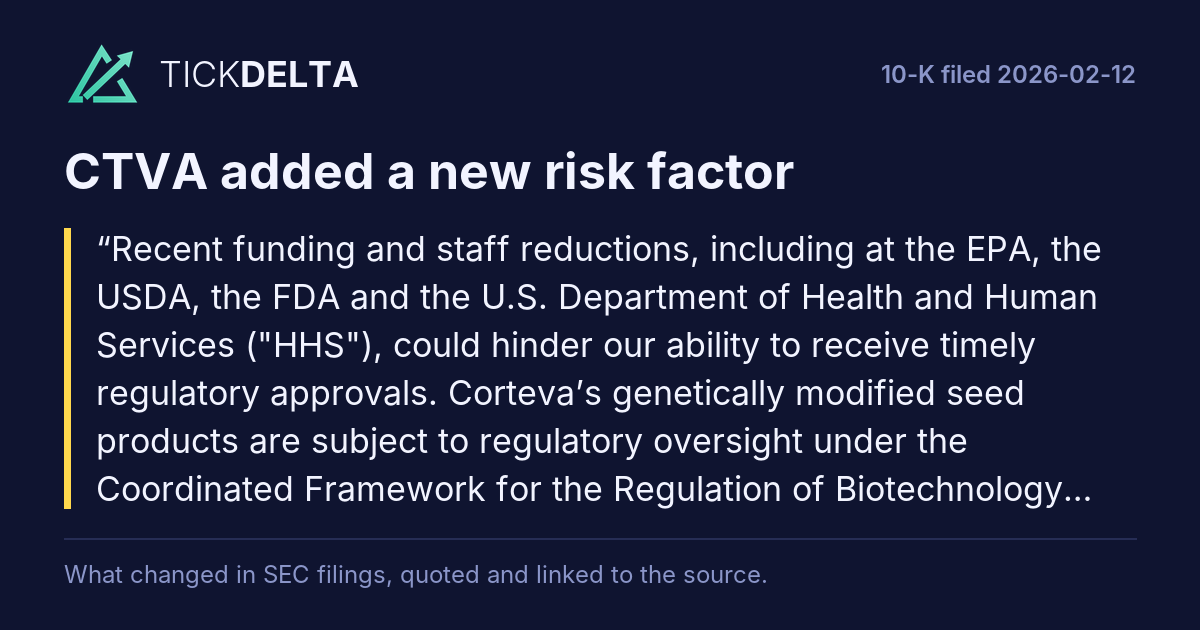
Recent funding and staff reductions, including at the EPA, the USDA, the FDA and the U.S. Department of Health and Human Services ("HHS"), could hinder our ability to receive timely regulatory approvals.
Read in the 10-Qopen_in_new
Corteva’s pesticidal crop protection products are regulated by the EPA to verify that there is no unreasonable adverse effect to the environment. For Corteva’s crop protection products, the EPA is responsible for registering and overseeing the approval and marketing of pesticides, while the USDA and the FDA monitor levels of pesticide residue permitted on or in crops. See "Part I - Item 1 - Business - Regulatory Considerations" of our Annual Report on Form 10-K for more information on the regulation of our business.
Read in the 10-Qopen_in_new
Significant staff or funding reductions, along with any extended shutdown of the federal government, may significantly impact the timelines for reviewing our regulatory submissions and re-registrations. Longer-term structural changes at relevant federal agencies, including shifts in enforcement focus, review processes, evidentiary standards and resource allocation, may extend the time it takes to commercialize our products, thereby having a material adverse effect on our business, results of operations, and the value of our intellectual property.
Read in the 10-Qopen_in_new
Climate change and unpredictable seasonal and weather factors could impact Corteva’s sales and earnings.
Read in the 10-Qopen_in_new
The agriculture industry is subject to seasonal and weather factors, which can vary unpredictably from period to period. Weather factors can affect the presence of disease and pests on a regional basis and, accordingly, can positively or adversely affect the demand for crop protection products, including the mix of products used or the level of returns. Climate change may also affect the availability and suitability of arable land and contribute to unpredictable shifts in the average growing season, pest pressures and types of crops produced. If Corteva’s product offerings cannot respond to these changes, its sales and earnings may be negatively impacted.
Read in the 10-Qopen_in_new
Changes in agricultural and related policies of governments and international organizations may prove unfavorable.
Read in the 10-Qopen_in_new
In many markets there are various pressures to reduce government subsidies to farmers, which may inhibit the growth in these markets of products used in agriculture. In addition, government programs that provide financial support or create incentives for farmers, including those established by the U.S. Farm Bill, can be temporary in nature, or may be modified or discontinued.
Read in the 10-Qopen_in_new
However, it is difficult to predict accurately whether, and if so when, such changes will occur. Corteva expects that the policies of governments and international organizations will continue to affect the planting choices made by growers as well as the income available to growers to purchase products used in agriculture and, accordingly, the operating results of the agriculture industry.
Read in the 10-Qopen_in_new
Corteva’s business, results of operations and financial condition could be adversely affected by environmental, litigation and other commitments and contingencies.
Read in the 10-Qopen_in_new
As a result of Corteva’s operations, including past operations and those related to divested businesses and discontinued operations of EIDP, Corteva incurs environmental operating costs for pollution abatement activities including waste collection and disposal, installation and maintenance of air pollution controls and wastewater treatment, emissions testing and monitoring and obtaining permits. Corteva also incurs environmental operating costs related to environmental related research and development activities including environmental field and treatment studies as well as toxicity and degradation testing to evaluate the environmental impact of products and raw materials. In addition, Corteva maintains and periodically reviews and adjusts its accruals for probable environmental remediation and restoration costs.
Read in the 10-Qopen_in_new
Corteva expects to continue to incur environmental operating costs since it will operate global manufacturing, product handling and distribution facilities that are subject to a broad array of environmental laws and regulations. These rules are subject to change by the implementing governmental agency, which Corteva monitors closely. Corteva’s environmental policy requires that its operations fully meet or exceed legal and regulatory requirements. In addition, Corteva expects to continue certain voluntary programs, and could consider additional voluntary actions, to reduce air emissions, minimize the generation of hazardous waste, decrease the volume of water use and discharges, increase the efficiency of energy use and reduce the generation of persistent, bioaccumulative and toxic materials. Costs to comply with complex environmental laws and regulations, as well as internal voluntary programs and goals, are significant and Corteva expects these costs will continue to be significant for the foreseeable future. Over the long-term, such expenditures are subject to considerable uncertainty and could fluctuate significantly.
Read in the 10-Qopen_in_new
Corteva accrues for environmental matters when it is probable that a liability has been incurred and the amount can be reasonably estimated. As remediation activities vary substantially in duration and cost from site to site, it is difficult to develop precise estimates of future site remediation costs. Corteva expects to base such estimates on several factors, including the complexity of the geology, the nature and extent of contamination, the type of remedy, the outcome of discussions with regulatory agencies and other Potentially Responsible Parties (“PRPs”) at multi-party sites and the number of, and financial viability of, other PRPs. Considerable uncertainty exists with respect to environmental remediation costs and, under adverse changes in circumstances, the potential liability may be materially higher than Corteva’s accruals.
Read in the 10-Qopen_in_new
Corteva faces risks arising from various unasserted and asserted litigation matters arising out of the normal course of its current and former business operations, including intellectual property, commercial, product liability, environmental and antitrust lawsuits. Corteva has noted a trend in public and private suits being filed on behalf of states, counties, cities and utilities alleging harm to the general public and the environment, including waterways and watersheds. Claims alleging harm to the public and the environment may be brought against Corteva, notwithstanding years of scientific evidence and regulatory determinations supporting the safety of crop protection products. The litigation involving Monsanto’s Roundup® non-selective glyphosate containing weedkiller products has resulted in negative publicity and sentiment and may lead to similar suits with respect to glyphosate-containing products and/or other established crop protection products. Claims and allegations that Corteva’s products or products that Corteva manufactures or markets on behalf of third parties are not safe could result in litigation, damage to Corteva’s reputation and have a material adverse effect on Corteva’s business. It is not possible to predict the outcome of these various proceedings and any potential impact on Corteva. An adverse outcome in any one or more of these matters may result in losses not fully covered by Corteva’s insurance policies, and could be material to Corteva’s financial results. Various factors or developments can lead to changes in current estimates of liabilities. Such factors and developments may include, but are not limited to, additional data, safety or risk assessments, as well as a final adverse judgment, significant settlement or changes in applicable law. A future adverse ruling or unfavorable development could result in future charges that could have a material adverse effect on Corteva.
Read in the 10-Qopen_in_new
The company, pursuant to the respective Separation Agreements, is entitled to cost sharing and indemnification from The Chemours Company ("Chemours"), Dow and DuPont, as applicable, for certain litigation, environmental, workers’ compensation and other liabilities related to its historical operations. In connection with the recognition of liabilities related to these matters, Corteva records an indemnification asset when recovery is deemed probable. These estimates of recovery are subject to various factors and developments that could result in differences from future estimates or the actual recovery. As of December 31, 2025, the indemnification assets pursuant to the Chemours Separation Agreement and the Corteva Separation Agreement are in aggregate $242 million within accounts and notes receivable - net and $733 million within other assets in the company’s Consolidated Balance Sheets. Any failure by, or inability to pay, these liabilities in line with the indemnification provisions of the Separation Agreements may have a material adverse effect on Corteva and its financial condition and results of operations.
Read in the 10-Qopen_in_new
In the ordinary course of business, Corteva may make certain commitments, including representations, warranties and indemnities relating to current and past operations, including those related to divested businesses and issue guarantees of third-party obligations. If Corteva were required to make payments as a result, they could exceed the amounts accrued, thereby adversely affecting Corteva’s financial condition and results of operations.
Read in the 10-Qopen_in_new
Our business, financial condition and results of operations could be materially affected by disruptions in the global economy caused by geopolitical and military conflicts.
Read in the 10-Qopen_in_new
Military conflict or related geopolitical tensions and disputes including increased trade barriers or restrictions on global trade, could result in, among other things, cyberattacks, further supply disruptions, and changes to foreign exchange rates and financial markets, any of which may adversely affect our business and supply chains. Such geopolitical instability and uncertainty has negatively impacted our ability to sell to, ship products to, collect payments from, and support customers in
Read in the 10-Qopen_in_new
certain regions. Logistics restrictions, including closures of air space and shipping ports, the reduction of the availability of farmable land, and the destruction of facilities could further increase these adverse impacts and negatively impact demand for our products in impacted regions. The global economy was negatively impacted by the military conflict between Russia and Ukraine and we experienced shortages in materials, the inability to insure shipments, and increased costs for transportation, energy, and raw material and other inputs due in part to the negative impact of this conflict. Further escalation of the military conflict or related geopolitical tensions, including increased trade barriers or restrictions on global trade, could result in, among other things, cyberattacks, further supply disruptions, and changes to foreign exchange rates and financial markets, any of which may adversely affect our business and supply chains.
Read in the 10-Qopen_in_new
Similar or more severe disruptions, trade barriers, business risks, asset seizures, and volatility in foreign exchange and financial markets could occur if tensions or conflicts between China and Taiwan, or other countries, escalate, or if the United States would become a party to such a military conflict. Currently, a material portion of the company’s crop protection inputs are sourced directly or indirectly from China. While the company utilizes dual- or multi- source supply chains to minimize business disruptions, these strategies may not be adequate to address the scope of disruptions created by such a conflict. Further escalation or expansion of economic disruption or in the scope of global or regional conflicts could have a material adverse effect on our results of operations.
Read in the 10-Qopen_in_new
Volatility in Corteva’s input costs, which include raw materials and production costs, could have a significant impact on Corteva’s business, results of operations and financial condition.
Read in the 10-Qopen_in_new
Corteva’s input costs are variable based on the costs associated with production or with raw materials Corteva uses. In addition, Corteva’s manufacturing processes consume significant amounts of raw materials, the costs of which are subject to worldwide supply and demand as well as other factors beyond Corteva’s control. Corteva refers to these costs collectively as input costs. Significant variations in input costs affect Corteva’s operating results from period to period.
Read in the 10-Qopen_in_new
When possible, Corteva purchases raw materials through negotiated long-term contracts to minimize the impact of price fluctuations. Corteva also enters into over-the-counter and exchange traded derivative commodity instruments to hedge its exposure to price fluctuations on certain purchases. In addition, Corteva takes actions to offset the effects of higher input costs through selling price increases, productivity improvements and cost reduction programs. Success in offsetting higher input costs with price increases is largely influenced by competitive and economic conditions and could vary significantly depending on the market served. If Corteva is not able to fully offset the effects of higher input costs, it could have a significant impact on its financial results.
Read in the 10-Qopen_in_new
Corteva’s operations outside the United States are subject to risks and restrictions, which could negatively affect Corteva’s business, results of operations and financial condition.
Read in the 10-Qopen_in_new
Corteva’s operations outside the United States are subject to risks and restrictions, including fluctuations in foreign currency exchange rates; inflation; exchange and price control regulations; corruption risks; competitive restrictions; changes in local political or economic conditions; import and trade restrictions; import or export licensing requirements and trade policy; and other potentially detrimental domestic and foreign governmental practices or policies affecting U.S. companies doing business abroad. In addition, Corteva’s international operations are sometimes in countries with unstable governments, economic or fiscal challenges, military or political conflicts, local epidemics or pandemics, significant levels of crime and organized crime, or developing legal systems. This may increase the risk to the company’s employees, subcontractors or other parties, and to other liabilities, such as property loss or damage to the company’s products, and may affect Corteva’s ability to safely operate in, or import into, or receive raw materials from these countries.
Read in the 10-Qopen_in_new
Additionally, Corteva’s ability to export its products and its sales outside the United States has been, and may continue to be adversely affected by significant changes in trade, tax or other policies, including other countries retaliating by purchasing less from the United States and the imposition of their own trade restrictions and/or increased tariffs in response to substantial changes to U.S. tariff, trade and tax policies. Furthermore, significant changes in trade, tax, and other related policies or enforcement may pose business and financial risks, including raising the cost of manufacturing inputs and altering customer demands.
Read in the 10-Qopen_in_new
Although Corteva has operations throughout the world, Corteva’s sales outside the United States in 2025 were principally to customers in Brazil, Eurozone countries, and Canada. Further, Corteva’s largest currency exposures are the Brazilian real, Euro, Canadian dollar and Argentine peso. Inflation, market uncertainty or an economic downturn in these geographic areas could reduce demand for Corteva’s products and result in decreased sales volume, which could have a negative impact on Corteva’s results of operations. In addition, changes in exchange rates may affect Corteva’s results of operations, financial condition and
Read in the 10-Qopen_in_new
cash flows in future periods. Corteva actively manages currency exposures that are associated with net monetary asset positions and committed purchases.
Read in the 10-Qopen_in_new
Corteva’s business, results of operations and financial condition could be adversely affected by industrial espionage and other disruptions to its supply chain, information technology or network systems.
Read in the 10-Qopen_in_new
Business and/or supply chain disruptions, plant and/or power outages and information technology system and/or network disruptions, regardless of cause including acts of sabotage, employee error or other actions, geopolitical activity, military conflict, local epidemics or pandemics, weather events and natural disasters could seriously harm Corteva’s operations as well as the operations of its customers and suppliers. For example, a pandemic in locations where Corteva has significant operations, sales, or key suppliers could have a material adverse effect on Corteva’s results of operations. In addition, terrorist attacks and natural disasters have increased stakeholder concerns about the security and safety of chemical production and distribution.
Read in the 10-Qopen_in_new
Business and/or supply chain disruptions may also be caused by security breaches, which could include, for example, ransomware attacks and attacks on information technology and infrastructure by hackers, viruses, breaches due to employee error or actions or other disruptions. Corteva and/or its suppliers may fail to effectively prevent, detect and recover from these or other security breaches and, as a consequence, such breaches could result in misuse of Corteva’s assets, business disruptions, loss of property including trade secrets and confidential business information, legal claims or proceedings, reporting errors, processing inefficiencies, negative media attention, loss of sales and interference with regulatory and data privacy compliance.
Read in the 10-Qopen_in_new
Like most major corporations, Corteva is the target of industrial espionage, including cyber-attacks, from time to time. Corteva has determined that these incidents have resulted, and could result in the future, in unauthorized parties gaining access to certain confidential business information. Although management does not believe that Corteva has experienced any material losses to date related to industrial espionage and security breaches, including cybersecurity incidents, there can be no assurance that Corteva will not suffer such losses in the future.
Read in the 10-Qopen_in_new
Corteva actively manages the risks within its control that could lead to business disruptions and security breaches. As these threats continue to evolve, particularly around cybersecurity and artificial intelligence, Corteva may be required to expend significant resources to enhance its control environment, processes, practices and other protective measures. Despite these efforts, such events could also have a material adverse effect on Corteva’s business, financial condition, results of operations and reputation. Additionally, any losses from such an event may be excluded from, or in excess of the coverages provided by Corteva’s insurance policies.
Read in the 10-Qopen_in_new
Corteva is dependent on its relationships or contracts with third parties with respect to certain of its raw materials or licenses and commercialization.
Read in the 10-Qopen_in_new
Corteva is dependent on third parties in the research, development and commercialization of its products and enters into transactions including, but not limited to, supply agreements, licensing agreements, and manufacturing agreements in connection with Corteva’s business. If Corteva loses its rights under such licenses, it could negatively impact Corteva’s ability to obtain future licenses on competitive terms, commercialize new products and generate sales from existing products. Corteva may elect to out-license its technology. There can be no guarantee that such out-licensing will not ultimately strengthen Corteva’s competition thereby adversely impacting Corteva’s results of operations.
Read in the 10-Qopen_in_new
While Corteva relies heavily on third parties for multiple aspects of its business and commercialization activities, Corteva does not control many aspects of such third parties’ activities. Third parties may not complete activities on schedule or in accordance with Corteva’s expectations. Failure by one or more of these third parties to meet their contractual or other obligations to Corteva or to comply with applicable laws or regulations, or any disruption in the relationship between Corteva and one or more of these third parties could delay or prevent the development, approval or commercialization of Corteva’s products and could also result in non-compliance or reputational harm, all with potential negative implications for Corteva’s business.
Read in the 10-Qopen_in_new
In addition, Corteva’s agreements with third parties may obligate it to meet certain contractual or other obligations to third parties. For example, Corteva may be obligated to meet certain thresholds or abide by certain boundary conditions. If Corteva were to fail to meet such obligations to the third parties, its relationship with such third parties may be disrupted. Such a disruption could negatively impact certain of Corteva’s licenses on which it depends, could cause reputational harm, and could negatively affect Corteva’s business, results of operations and financial condition.
Read in the 10-Qopen_in_new
Corteva’s customers may be unable to pay their debts to Corteva, which could adversely affect Corteva’s results.
Read in the 10-Qopen_in_new
Corteva offers its customers barter programs and financing programs with credit terms generally less than one year from invoicing in alignment with the growing season. Due to these credit practices as well as the seasonality of Corteva’s operations, Corteva may need to issue short-term debt at certain times of the year to fund its cash flow requirements. Corteva’s customers may be exposed to a variety of conditions that could adversely affect their ability to pay their debts or deliver the products subject to their respective barter contracts.. For example, customers in economies experiencing an economic downturn or in a region experiencing adverse growing conditions may be unable to repay their obligations to Corteva or deliver product under their barter contracts to Corteva, which could adversely affect Corteva’s results.
Read in the 10-Qopen_in_new
Failure to effectively manage acquisitions, divestitures, strategic investments, restructurings, cost savings initiatives and other portfolio actions may not have the results anticipated.
Read in the 10-Qopen_in_new
From time-to-time, Corteva evaluates acquisition candidates that may strategically fit Corteva’s business and/or growth objectives, along with making investments in strategic technologies through its Corteva Catalyst platform. If Corteva is unable to successfully integrate and develop acquired businesses, including its growth in biologicals, Corteva could fail to achieve expected increases in revenues and operating results, as well as anticipated investment returns, synergies and cost savings, which could have a material adverse effect on Corteva’s financial results. Corteva continually reviews its portfolio of assets for contributions to its objectives and alignment with its strategy. However, Corteva may not be successful in separating underperforming or non-strategic assets and gains or losses on the divestiture of, or lost operating income from, such assets, may affect Corteva’s earnings. Moreover, Corteva might incur asset impairment charges related to its investments and acquisitions, or divestitures that reduce its earnings. In addition, if the execution of these transactions, investments, or portfolio actions is not successful, it could adversely impact Corteva’s financial condition, results of operations and cash flows.
Read in the 10-Qopen_in_new
Corteva’s liquidity, business, results of operations and financial condition could be impaired if it is unable to raise capital through the capital markets or short-term debt borrowings.
Read in the 10-Qopen_in_new
Any limitation on Corteva’s ability to raise money in the capital markets or through short-term debt borrowings could have a substantial negative effect on Corteva’s liquidity. Corteva’s ability to affordably access the capital markets and/or borrow short- term debt in amounts adequate to finance its activities could be impaired as a result of a variety of factors, including factors that are not specific to Corteva, such as a severe disruption of the financial markets and, in the case of debt securities or borrowings, interest rate fluctuations. Due to the seasonality of Corteva’s business and the credit programs Corteva may offer its customers, net working capital investment and corresponding debt levels will fluctuate over the course of the year.
Read in the 10-Qopen_in_new
Corteva regularly extends credit to its customers to enable them to purchase products at the beginning of the growing season. The customer receivables may be used as collateral for short-term financing programs. Any material adverse effect upon Corteva’s ability to own or sell such customer receivables, including seasonal factors that may impact the amount of customer receivables Corteva owns, may materially impact Corteva’s access to capital.
Read in the 10-Qopen_in_new
Corteva has additional agreements with financial institutions to establish programs that provide financing for select customers of Corteva’s crop protection products in the United States, Latin America, Europe and Asia. The programs are renewed on an annual basis. In most cases, Corteva guarantees the extension of such credit to such customers. If Corteva is unable to renew these agreements or access the debt markets to support customer financing, Corteva’s sales may be negatively impacted, which could result in increased borrowing needs to fund working capital.
Read in the 10-Qopen_in_new
Corteva’s earnings, operations and business, among other things, will impact its credit ratings, costs and availability of financing. There can be no assurance that Corteva or EIDP will maintain its current or prospective credit ratings. A decrease in the ratings assigned to Corteva or EIDP by the ratings agencies may negatively impact Corteva’s liquidity, access to the debt capital markets and increase Corteva’s cost of borrowing and the financing of its seasonal working capital.
Read in the 10-Qopen_in_new
Increases in pension and other post-employment benefit plan funding obligations may adversely affect Corteva’s results of operations, liquidity or financial condition.
Read in the 10-Qopen_in_new
Through Corteva's ownership of EIDP, Corteva maintains the EIDP defined benefit pension and other post-employment benefit plans. For some of these plans, including EIDP’s principal U.S. pension plan, Corteva continues as sponsor for the entire plan regardless of whether participants, including retirees, are or were associated with EIDP’s agriculture business. Corteva uses many assumptions in calculating the expected future payment obligations under these plans. Significant adverse changes in credit or market conditions could result in actual rates of returns on pension investments being lower than assumed. While there
Read in the 10-Qopen_in_new
is no anticipated required contribution for 2027, Corteva may be required to make contributions in the future. These contributions could be significant and adversely affect Corteva’s results of operations, liquidity and financial condition.
Read in the 10-Qopen_in_new
Global or regional health pandemics or epidemics could negatively impact the company’s business, financial condition and results of operations.
Read in the 10-Qopen_in_new
Corteva’s business, financial condition, and results of operations could be negatively impacted by human or animal pandemics or epidemics. The severity, magnitude and duration of the pandemics is uncertain, rapidly changing and difficult to predict. Future pandemics or epidemics and resulting illness, travel restrictions and workforce and operational disruptions could impact Corteva’s global supply chain, its operations and its routes to market or those of its suppliers, co-manufacturers, or customers/distributors. These disruptions or the company’s failure to effectively respond to them could increase product or distribution costs, alter the timing of recognizing manufacturing costs, or impact the delivery of products to customers or their ability to pay.
Read in the 10-Qopen_in_new
Government-pandemic or epidemic responses can significantly impact economic activity and markets around the world. Future outbreaks or pandemics could negatively impact customer demand and the company’s business, financial condition, and results of operations in numerous ways, including but not limited to increased market volatility that impacts the company’s hedging, financial forecasting, and liquidity, including its access to capital markets and delays or modifications to the company’s strategic plans and productivity initiatives.
Read in the 10-Qopen_in_new
Sentiment towards sustainability matters could adversely affect our stock price, results of operations, and access to capital.
Read in the 10-Qopen_in_new
Corteva has established certain strategies, commitments and initiatives as part of its sustainability programs. Execution of these strategies and the achievements of Corteva’s sustainability commitments are subject to certain risks and uncertainties, including regulatory action or inaction, changes in public or investor sentiment, and resource availability, many of which are out of its control. Failure to achieve its sustainability commitments within the expected timeframes and cost effectively could damage Corteva’s reputation, customer and investor relationships, or its access to financing. Further, dissatisfaction with such a failure could cause stockholders to reduce their ownership holdings, all of which, in turn could adversely affect Corteva’s business, financial condition, results of operations and cash flows and reduce its stock price.
Read in the 10-Qopen_in_new
Enforcing Corteva’s intellectual property rights, or defending against intellectual property claims asserted by others, could materially affect Corteva’s business, results of operations and financial condition.
Read in the 10-Qopen_in_new
Intellectual property rights, including patents, plant variety protection, trade secrets, confidential information, trademarks, trade names and other forms of trade dress, are important to Corteva’s business. Corteva endeavors to protect its intellectual property rights in jurisdictions in which its products are produced or used and in jurisdictions into which its products are imported. However, Corteva may be unable to obtain protection for its intellectual property in key jurisdictions. Further, changes in government policies and regulations, including changes made in reaction to pressure from non-governmental organizations, or the public generally, could impact the extent of intellectual property protection afforded by such jurisdictions.
Read in the 10-Qopen_in_new
Competitors are increasingly challenging intellectual property positions and the outcomes to these challenges can be highly uncertain and negatively impact the value of Corteva’s intellectual property and investment return on its research and development. Additionally, Corteva has been subject to claims that its products violate third party intellectual property rights. Defending such claims, even those without merit, is time-consuming and expensive. In addition, any such claim could result in Corteva’s having to enter into, or continue, license agreements, develop non-infringing products or engage in litigation that could be costly. If challenges are resolved adversely, it could negatively impact Corteva’s ability to obtain licenses on competitive terms, develop and commercialize new products, generate sales from existing products or reduce its reliance on licensed technologies.
Read in the 10-Qopen_in_new
Corteva has designed and implemented internal controls to restrict use of, access to and distribution of its intellectual property. Despite these precautions, Corteva’s intellectual property is vulnerable to infringement, misappropriation and other unauthorized access, including through employee or licensee error or actions, theft and cybersecurity incidents, and other security breaches. When unauthorized access and use or counterfeit products are discovered, Corteva may report such situations to governmental authorities for investigation, as appropriate, and takes measures to mitigate any potential impact.
Read in the 10-Qopen_in_new
In addition, because of the rapid pace of technological change, the confidentiality of patent applications in some jurisdictions and/or the uncertainty in predicting the outcome of complex proceedings relating to ownership and the scope of patents relating to certain emerging technologies, competitors may be issued patents related to Corteva’s business unexpectedly. These patents
Read in the 10-Qopen_in_new
could reduce the value of Corteva’s commercial or pipeline products or, to the extent they cover key technologies on which Corteva has relied, require Corteva to seek to obtain licenses (and Corteva cannot ensure it would be able to obtain such a license on acceptable terms) or cease using the technology, no matter how valuable to Corteva’s business.
Read in the 10-Qopen_in_new
Legislation and jurisprudence on patent protection is evolving and changes in laws could affect Corteva’s ability to obtain or maintain patent protection for, and otherwise enforce Corteva’s patents related to, its products.
Read in the 10-Qopen_in_new
Corteva’s business may be adversely affected by the availability of counterfeit products.
Read in the 10-Qopen_in_new
A counterfeit product is one that has been deliberately and fraudulently mislabeled as to its identity and source. A counterfeit Corteva product, therefore, is one manufactured by someone other than Corteva, but which appears to be the same as an authentic Corteva product. The prevalence of counterfeit products is a significant and growing industry-wide issue due to a variety of factors, including, but not limited to, the following: the widespread use of the Internet, which has greatly facilitated the ease by which counterfeit products can be advertised, purchased and delivered to individual consumers; the availability of sophisticated technology that makes it easier for counterfeiters to make counterfeit products; and the relatively modest risk of penalties faced by counterfeiters compared to the large profits that can be earned by them from the sale of counterfeit products. Further, laws against counterfeiting vary greatly from country to country, and the enforcement of existing laws varies greatly from jurisdiction to jurisdiction. For example, in some countries, counterfeiting is not a crime; in others, it may result in only minimal sanctions. In addition, those involved in the distribution of counterfeit products use complex transport routes to evade customs controls by disguising the true source of their products.
Read in the 10-Qopen_in_new
Corteva’s global reputation makes its products prime targets for counterfeiting organizations. Counterfeit products pose a risk to consumer health and safety because of the conditions under which they are manufactured (often in unregulated, unlicensed, uninspected and unsanitary sites) as well as the lack of regulation of their contents. Failure to mitigate the threat of counterfeit products, which is exacerbated by the complexity of the supply chain, could adversely impact Corteva’s business by, among other things, causing the loss of consumer confidence in Corteva’s name and in the integrity of its products, potentially resulting in lost sales and an increased threat of litigation.
Read in the 10-Qopen_in_new
Corteva undertakes significant efforts to counteract the threats associated with counterfeit products, including, among other things, working with regulatory authorities and multinational coalitions to combat the counterfeiting of products and supporting efforts by law enforcement authorities to prosecute counterfeiters; assessing new and existing technologies to seek to make it more difficult for counterfeiters to copy Corteva’s products and easier for consumers to distinguish authentic from counterfeit products; working diligently to raise public awareness about the dangers of counterfeit products; working collaboratively with wholesalers, customs offices and law enforcement agencies to increase inspection coverage, monitor distribution channels and improve surveillance of distributors; and working with other members of an international trade association of agrochemical companies to promote initiatives to combat counterfeiting activity. No assurance can be given, however, that Corteva’s efforts and the efforts of others will be entirely successful, and the presence of counterfeit products may continue to increase.
Read in the 10-Qopen_in_new
In connection with the Corteva Separation the company has assumed, and agreed to indemnify DuPont and Dow for, certain liabilities. If the company is required to make payments pursuant to these indemnities, the company may need to divert cash to meet those obligations and its financial results could be negatively impacted. In addition, DuPont and Dow have agreed to indemnify Corteva for certain liabilities. These indemnities may not be sufficient to insure the company against the full amount of liabilities it incurs, and DuPont and/or Dow, and/or their historical separated businesses, may not be able to satisfy their indemnification obligations in the future.
Read in the 10-Qopen_in_new
Pursuant to the Separation Agreement, the Employee Matters Agreement and the Tax Matters Agreement with DuPont and Dow, the company agreed to assume, and indemnify DuPont and Dow for, certain liabilities for uncapped amounts, which may include, among other items, associated defense costs, settlement amounts and judgments, as discussed further in Note 15 - Commitments and Contingent Liabilities, to the Consolidated Financial Statements, and Part I - Item 3 - Legal Proceedings. Payments pursuant to these indemnities may be significant and could negatively impact the company’s business, particularly indemnities relating to certain litigation for Historical DuPont operations or its actions that could impact the tax-free nature of the Corteva Distribution. Third parties could also seek to hold the company responsible for any of the liabilities allocated to DuPont and Dow, including those related to DowDuPont’s specialty products and/or materials science businesses, respectively, and those related to discontinued and/or divested businesses and operations of Historical Dow, which have been allocated to Dow. DuPont and/or Dow, as applicable, have agreed to indemnify Corteva for such liabilities, but such indemnities may not be sufficient to protect the company against the full amount of such liabilities. In addition, DuPont and/or Dow, as applicable, may not fully satisfy their indemnification obligations with respect to the liabilities the company incurs. Even if the company
Read in the 10-Qopen_in_new
ultimately succeeds in recovering from DuPont and/or Dow, as applicable, any amounts for which the company is held liable, the company may be temporarily required to bear these losses itself.
Read in the 10-Qopen_in_new
Additionally, the company generally has assumed and is responsible for the payment of its share of (i) certain liabilities of DowDuPont relating to, arising out of or resulting from certain general corporate matters of DowDuPont, (ii) certain liabilities of Historical DuPont relating to, arising out of or resulting from general corporate matters of Historical DuPont and discontinued and/or divested businesses and operations of Historical DuPont, including its Performance Chemicals spin-off, Chemours, and (iii) certain separation expenses not otherwise allocated to DuPont or Dow (or allocated specifically to Corteva) pursuant to the Corteva Separation Agreement, and third parties could seek to hold Corteva responsible for DuPont’s or Dow’s share of any such liabilities. For more information, see Note 12 - Commitments and Contingent Liabilities, to the interim Consolidated Financial Statements, and Part II - Item 1 - Legal Proceedings. DuPont and/or Dow, as applicable, will indemnify Corteva for their share of any such liabilities; however, such indemnities may not be sufficient to protect Corteva against the full amount of such liabilities, and/or DuPont and/or Dow may not fully satisfy their respective indemnification obligations. In addition, even if the company ultimately succeeds in recovering from DuPont and/or Dow any amounts for which the company is held liable in excess of its agreed share, the company may be temporarily required to bear these losses itself and may not be able to fully insure itself to cover these risks.
Read in the 10-Qopen_in_new
Risks related to the satisfaction of these indemnification obligations and temporarily bearing losses may be increased if DuPont’s electronics business spin-off, Qnity Electronics, Inc., or if other divested businesses of Historical DuPont (including Chemours) or Historical Dow do not or are unable to cover their liabilities or satisfy their indemnification obligations. Even if Corteva takes legal action to protect its rights with respect to such a transaction, these legal costs may be significant. Each of the above risks could materially affect the company’s business, financial condition, results of operations and cash flows.
Read in the 10-Qopen_in_new
The company is subject to continuing contingent tax-related liabilities of DowDuPont following the Distribution.
Read in the 10-Qopen_in_new
There are several significant areas where the liabilities of DowDuPont may become Corteva’s obligations either in whole or in part. For example, under the Code and the related rules and regulations, each corporation that was a member of DowDuPont’s consolidated tax reporting group during any taxable period or portion of any taxable period ending on or before the effective time of the Distribution is jointly and severally liable for the U.S. federal income tax liability of the entire consolidated tax reporting group for such taxable period. Additionally, to the extent that any subsidiary of Corteva was included in the consolidated tax reporting group of either Historical DuPont or Historical Dow for any taxable period or portion of any taxable period ending on or before the effective date of the Merger, such subsidiary is jointly and severally liable for the U.S. federal income tax liability of the entire consolidated tax reporting group of Historical DuPont or Historical Dow, as applicable, for such taxable period. On April 1, 2019, the company entered into the Tax Matters Agreement with DuPont and Dow that allocates the responsibility for prior period consolidated taxes among Corteva, DuPont and Dow. If DuPont or Dow were unable or unwilling to pay any prior period taxes for which it is responsible, however, the company could be required to pay the entire amount of such taxes, and such amounts could be significant. Other provisions of federal, state, local, or foreign law may establish similar liability for other matters, including laws governing tax-qualified pension plans, as well as other contingent liabilities.
Read in the 10-Qopen_in_new
We believe that, following the spin-off, we will be better positioned to, among other things, allocate financial, operational and capital resources in a manner that reflects the distinct growth outlooks and strategic priorities of our business, pursue differentiated strategies and operating models aligned with our markets and value propositions, sharpen strategic and operational focus across core strengths, establish a tailored capital structure that supports the future capital needs of our business, and adapt more effectively to evolving industry dynamics. However, we may be unable to achieve some or all of these benefits. Following the spin-off, Corteva is a smaller, less diversified enterprise and, as a result, we may be more exposed to industry-specific risks and changing market conditions than we were before the spin-off. The spin-off may also prompt existing stockholders to divest holdings that no longer align with their investment objectives, potentially affecting the trading value of our common stock.
Read in the 10-Qopen_in_new
If the spin-off were to fail to qualify as tax-free for U.S. federal income tax purposes, Corteva, and stockholders receiving Vylor common stock in connection with the distribution, could be subject to significant tax liabilities.
Read in the 10-Qopen_in_new
The tax opinion issued for the spin-off of Vylor will relied on certain facts, assumptions and undertakings, and certain representations from Corteva and Vylor, regarding the past and future conduct of each business, respectively, and other matters.
Read in the 10-Qopen_in_new
Notwithstanding the receipt of the Tax Opinion, the Internal Revenue Service (“IRS”) could determine on audit that the spin-off (or a portion thereof) should be treated as a taxable transaction if it determines that any of these facts, assumptions, undertakings or representations are not correct or have been violated, or that the spin-off should be taxable for other reasons, including if the IRS were to disagree with the conclusions of the tax opinion.
Read in the 10-Qopen_in_new
If the spin-off (or any portion thereof) ultimately is determined to be taxable under U.S. federal, state, local tax and/or foreign tax law, then Corteva and Corteva stockholders could incur significant income tax liabilities under U.S. federal, state, local and/or foreign tax law.
Read in the 10-Qopen_in_new
Specifically, if the distribution ultimately is determined to be taxable, then a Corteva stockholder that received shares of Vylor common stock in connection therewith would be treated as having received a distribution of property in an amount equal to the fair market value of such shares (including any fractional shares sold on behalf of such stockholder) on the distribution date and could incur significant income tax liabilities. Such distribution would be taxable to such stockholder as a dividend to the extent of Corteva’s current and accumulated earnings and profits, which would include any earnings and profits attributable to the gain recognized by Corteva on the taxable distribution and could include earnings and profits attributable to certain internal transactions preceding the distribution. Any amount that exceeded Corteva’s earnings and profits would be treated first as a non-taxable return of capital to the extent of such stockholder’s tax basis in its shares of Corteva common stock with any remaining amount being taxed as a gain on the Corteva stock. In the event the distribution is ultimately determined to be taxable, Corteva would recognize corporate-level taxable gain on the distribution in an amount equal to the excess, if any, of the fair market value of Vylor common stock distributed to Corteva stockholders on the distribution date over Corteva’s tax basis in such stock.
Read in the 10-Qopen_in_new
Generally, taxes resulting from the failure of the spin-off to qualify for non-recognition treatment for U.S. federal income tax purposes would be imposed on Corteva or Corteva stockholders. While under the Tax Matters Agreement, Vylor will be obligated to indemnify Corteva against such taxes imposed on Corteva in certain circumstances, there is no guarantee such indemnification will be paid or be sufficient to cover all such Corteva obligations.
Read in the 10-Qopen_in_new
We agreed to numerous restrictions to preserve the tax-free treatment of the spin-off for U.S. federal income tax purposes, which may reduce our strategic and operating flexibility.
Read in the 10-Qopen_in_new
Our ability to engage in certain transactions could be limited or restricted after the distribution to preserve, for U.S. federal income tax purposes, the tax-free nature of the spin-off. Even if the distribution otherwise qualifies for tax-free treatment to Corteva stockholders, the distribution may result in corporate-level taxable gain to Corteva if the transaction does not meet certain requirements of Section 355(e) of the Code. The process for determining whether an acquisition or issuance of shares triggering these provisions has occurred, the extent to which any such acquisition or issuance results in a change of ownership and the cumulative effect of any such acquisition or issuance together with any prior acquisitions or issuances is complex, inherently factual and subject to interpretation of the facts and circumstances of a particular case. These restrictions may significantly limit our ability to pursue certain strategic transactions or other transactions that we may believe to otherwise be in the best interests of our stockholders or that might increase the value of our business.
Read in the 10-Qopen_in_new
We may be held liable to Vylor if we fail to perform under our agreements with Vylor, and the performance of such services may negatively affect our business and operations.
Read in the 10-Qopen_in_new
In connection with the spin-off, we and Corteva (which we refer to, after the spin-off, as New Corteva), and/or certain of our respective affiliates, will enter into various agreements, including but not limited to, the Tax Matters Agreement, the Employee Matters Agreement, the Transition Services Agreements, the Intellectual Property Matters Agreement, and certain other commercial agreements. These agreements will provide for the performance of certain services or the provision of goods by each of Vylor and New Corteva for the benefit of the other for a period of time after the spin-off. If we do not satisfactorily perform our obligations under these agreements, we may be held liable for any resulting losses suffered by Vylor subject to certain limits. In addition, during the transition support periods under the transition arrangements, our management and employees may be required to divert their attention away from our business in order to provide services to Vylor, which could adversely affect our business.
Read in the 10-Qopen_in_new
Restrictions under the Intellectual Property Matters Agreement will limit our ability to develop and commercialize certain products and services and/or prosecute, maintain and enforce certain intellectual property.
Read in the 10-Qopen_in_new
We will be dependent on Vylor to maintain and enforce the intellectual property licensed to us under the Intellectual Property Matters Agreement. For example, Vylor will be responsible for filing, prosecuting and maintaining (at their discretion) their intellectual property licensed to us. Vylor will also have the first right to enforce their intellectual property licensed to us. If
Read in the 10-Qopen_in_new
Vylor fails to fulfill its obligations or chooses not to enforce the intellectual property licensed to us under the Intellectual Property Matters Agreement, we may not be able to prevent competitors from making, using and selling competitive products and services.
Read in the 10-Qopen_in_new
In addition, our use of the intellectual property licensed to us under the Intellectual Property Matters Agreement is restricted to certain fields, which could limit our ability to develop and commercialize certain products and services. For example, the licenses granted to us under the Intellectual Property Matters Agreement will not extend to all fields of use that we may in the future decide to enter into. These restrictions may make it more difficult, time consuming and/or expensive for us to develop and commercialize certain new products and services, or may result in certain of our products or services being later to market than those of our competitors.
Read in the 10-Qopen_in_new
We and Vylor will be allocated, and we and Vylor will mutually indemnify each other for, certain liabilities in connection with the spin-off, the payments in respect of which could be significant and could negatively impact our business.
Read in the 10-Qopen_in_new
Pursuant to the Separation and Distribution Agreement between and certain other agreements entered into in connection with the spin-off, we are allocated, and must indemnify Vylor for, certain liabilities for uncapped amounts, which could include, among other items, associated defense costs, settlement amounts and judgments. Payments pursuant to these indemnities could be significant and could negatively impact our business.
Read in the 10-Qopen_in_new
Third parties could also seek to hold us responsible for any of the liabilities allocated to Vylor. Vylor will agree in such agreements to indemnify us for any such liabilities, but such indemnities may not be sufficient to protect us against the full amount of all such liabilities. Even if we ultimately succeed in recovering from Vylor any amounts for which we are held liable, we may be temporarily required to bear these losses ourselves. Each of these risks could negatively affect our business, financial condition, results of operations and cash flows.
Read in the 10-Qopen_in_new
The spin-off, including certain internal reorganization transactions undertaken by us in connection therewith, will expose us to potential liabilities arising out of state and federal fraudulent conveyance laws and legal distribution requirements.
Read in the 10-Qopen_in_new
Although each of the Corteva board of directors, EIDP board of directors and Vylor board of directors received a solvency opinion from an independent appraisal firm the spin-off, including certain internal reorganization transactions undertaken by Corteva in connection therewith, has and could continue to be challenged under various state and federal fraudulent conveyance laws. Fraudulent conveyances or transfers are generally defined to include transfers made or obligations incurred with the actual intent to hinder, delay or defraud current or future creditors or transfers made or obligations incurred for less than reasonably equivalent value when the debtor was insolvent, or that rendered the debtor insolvent, inadequately capitalized or unable to pay its debts as they become due. Any unpaid creditor could claim that Corteva, EIDP or Vylor did not receive fair consideration or reasonably equivalent value in the spin-off or related transactions and that the spin-off or related transactions left Corteva, EIDP or Vylor, as applicable, insolvent, inadequately capitalized or unable to pay its debts as they become due, or that Corteva, EIDP or Vylor intended or believed that it would incur debts beyond its ability to pay such debts as they mature. Additionally, the solvency opinions received by Corteva, EIDP and Vylor will be based on the facts and circumstances known at the time of their issuance. Any subsequent changes to the environmental, litigation or other liabilities allocated to Corteva in the spin-off could increase the chance of a fraudulent conveyance claims.
Read in the 10-Qopen_in_new
None of historical Corteva’s financial information are necessarily representative of the results, we would have achieved as an independent, publicly traded company and may not be a reliable indicator of our future results.
Read in the 10-Qopen_in_new
The historical information about Corteva in this report includes the Seed business as part of Corteva. The historical financial information of Corteva, the Crop Protection Business supplemental financial information, and the unaudited pro forma financial information included in our reports may not reflect what our financial condition, results of operations and cash flows would have been had we been an independent, publicly traded company comprised solely of the Crop Protection business during the periods presented or what our financial condition, results of operations and cash flows will be in the future when we are an independent company.
Read in the 10-Qopen_in_new
This is primarily because prior to the spin-off, the Seed Business was operated under the umbrella of Corteva’s corporate organization. This integration has historically permitted our business (or portions thereof) to enjoy economies of scope and scale in costs, employees, vendor relationships and customer relationships. Although we entered into the Transition Services Agreements that will govern certain commercial and other relationships between us and Vylor, those temporary arrangements
Read in the 10-Qopen_in_new
may not capture the benefits we have enjoyed in the past as a result of this integration. The loss of these benefits could have an adverse effect on our business, results of operations and financial condition following the spin-off. Other significant changes may occur in our cost structure, management, financing and business operations as a result of the spin-off and our operating as a company separate business. In addition, the unaudited pro forma financial information included in our reports is based on the best information available, which in part includes a number of estimates and assumptions. These estimates and assumptions may prove to be inaccurate, and accordingly, our unaudited pro forma financial information should not be assumed to be indicative of what our financial condition or results of operations will be as a standalone company during the time periods presented nor to be a reliable indicator of what our financial condition or results of operations actually may be in the future.
Read in the 10-Qopen_in_new