Screener / SEC EDGAR /CIK 0001298675 /Numbers from the XBRL of the 10-Ks
NYSE Real estate · REIT

CubeSmart CUBE

Compare with peers Embed
SEC comment letters, last 20 years

3 reviews of CUBE's filings by SEC staff

UPLOAD and CORRESP
Reviews 3 latest letter Jun 23, 2015
Questions asked 10 each answered in the company's own letter
No closing letter 0 reviews without a letter saying the staff completed it

When the SEC's staff reviews a filing, it writes to the company with numbered questions, and the company answers each one in a letter. SEC publishes the exchange once the review is over, at least 20 business days later. A question is not an accusation; most reviews end with the company adding detail to its next filing.

How the reviews went

Every review on EDGAR, from the first staff letter to the letter that closes it

  1. 1. Staff letters 4 UPLOAD
  2. 2. Questions in them 10 numbered comments
  3. 3. Company replies 3 CORRESP
  4. 4. Reviews closed 3 of 3 closing letter

Half the closed reviews took 23 days or less from the first letter to the closing letter.

Form 10-K for the Year Ended December 31, 2014

2015-06-23 to 2015-07-16 · 4 questions · 1 letter from the SEC, 1 from the company
Review closed 2015-07-16
RevenueNon-GAAP measuresExecutive pay
Operations · Revenues, page 50
SEC asked (1)
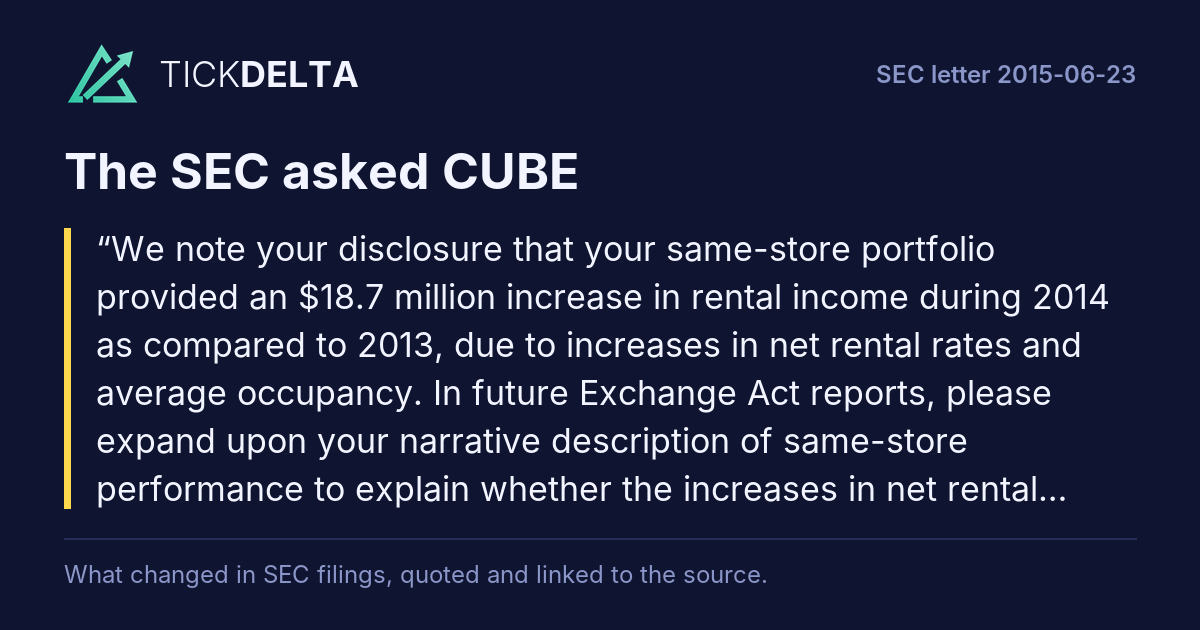
We note your disclosure that your same-store portfolio provided an $18.7 million increase in rental income during 2014 as compared to 2013, due to increases in net rental rates and average occupancy. In future Exchange Act reports, please expand upon your narrative description of same-store performance to explain whether the increases in net rental rates were a result of increased rates on new tenants or existing
Rest of the question

tenants, reduced promotional discounts, or otherwise.

CUBE answered
In response to the Staff’s comment, in future reports filed by us pursuant to the Securities Exchange Act of 1934, as amended, (“Exchange Act reports”) in which we discuss same-store performance, we will include an explanation of whether changes in net rental rates are the result of changes in rates on new tenants or existing tenants, changes to promotional discounts, or otherwise.
Read in the reply
Non-GAAP Financial Measures · FFO, as adjusted, page 55
SEC asked (2)
We note that your presentation of FFO appears to represent “FFO attributable to common shareholders and Operating Partnership unitholders”. Please advise and revise your label accordingly in future filings.
CUBE answered
We confirm that the presentation of funds from operations (“FFO”) in the Filings does represent FFO attributable to common shareholders and Operating Partnership unitholders. In our future Exchange Act reports where FFO is presented, we will label the presentation of FFO accordingly.
Read in the reply
In its next report

First report after the company's reply of Jul 8, 2015: 10-Q filed Aug 7, 2015 ↗, against the 10-Q filed May 1, 2015 ↗.

Tickdelta does not hold the text of both reports, so they are not compared here.
Definitive Proxy Statement filed on April 17, 2015 · Compensation Discussion and Analysis, page 23
SEC asked (3)
We note your disclosure on pages 23through 24 regarding the 2014 peer group your Compensation Committee used “for benchmarking purposes.” In future Exchange Act reports, please provide more detail about how you benchmark compensation against the compensation of your peer group. Please refer to Item 402(b)(2)(xiv) of Regulation S-K.
CUBE answered
In response to the Staff’s comment, in future Exchange Act reports where we disclose information regarding the peer group our Compensation Committee uses for benchmarking purposes, we will provide additional detail regarding how our Compensation Committee benchmarks the compensation of our management against the compensation of similarly situated management in the peer group.
Read in the reply
In its next report

First report after the company's reply of Jul 8, 2015: 10-Q filed Aug 7, 2015 ↗, against the 10-Q filed May 1, 2015 ↗.

Tickdelta does not hold the text of both reports, so they are not compared here.

Annual Incentive Compensation, page 26
SEC asked (4)
We note your disclosure on page 26 that the Annual Incentive Compensation is measured in part by your funds from operations growth, same-store net operating income growth, and the achievement of “strategic goals consisting of external growth.” In future Exchange Act reports, please identify the strategic goals for external growth.
Rest of the question

Please also disclose your target levels with respect to these metrics, or provide us with your analysis for concluding that the disclosure of such targets is not required because it would result in competitive harm and that such disclosure may be omitted pursuant to Instruction 4 to Item 402(b) of Regulation S-K. To the extent you omit disclosure of targets because it will result in competitive harm, please include a discussion in future Exchange Act reports of how difficult it will be for the executive or how likely it will be for the company to achieve the undisclosed target level or other factor or criteria. Please see Instruction 4 to Item 402(b) and Regulation S-K Compliance & Disclosure Interpretation 118.04.

CUBE answered
In response to the Staff’s comment, in future Exchange Act reports where we include a discussion of annual incentive compensation (or other, similar compensation based upon the achievement of specific performance metrics), we will identify the goals or performance metrics and disclose target levels with respect to such metrics.
Rest of the answer

However, to the extent we believe that the disclosure of the target levels of such goals or performance metrics will cause us competitive harm, we will not disclose such target levels, but rather will provide an analysis of why we concluded that disclosure of such target levels will cause us competitive harm, allowing us to forgo such disclosure of the target levels. Further, to the extent we do not disclose the target levels of relevant goals and performance metrics, we will include a discussion of how difficult it will be for the executive, or how likely it will be for the Company, to achieve the undisclosed target levels of such goals and performance metrics.

In responding to the Staff’s comments, the Company acknowledges that:

· the Company is responsible for the adequacy and accuracy of the disclosure in the Filings;

· the Staff’s comments or changes to disclosure in response to the Staff’s comments do not foreclose the Commission from taking any action with respect to the Filings; and

· the Company may not assert the Staff’s comments as a defense in any proceeding initiated by the Commission or any person under the federal securities laws of the United States.

Read in the reply
In its next report

First report after the company's reply of Jul 8, 2015: 10-Q filed Aug 7, 2015 ↗, against the 10-Q filed May 1, 2015 ↗.

Tickdelta does not hold the text of both reports, so they are not compared here.

Also in this review: closing letter, 2015-07-16
Form 10-K

2013-05-15 to 2013-06-03 · 1 question · 1 letter from the SEC, 0 from the company
Review closed 2013-06-03
Controls
SEC letter of May 15, 2013 ↗ no reply letter on EDGAR
Mangement’s Report on CubeSmart Internal Control over Financial Reporting, page F-2
SEC asked
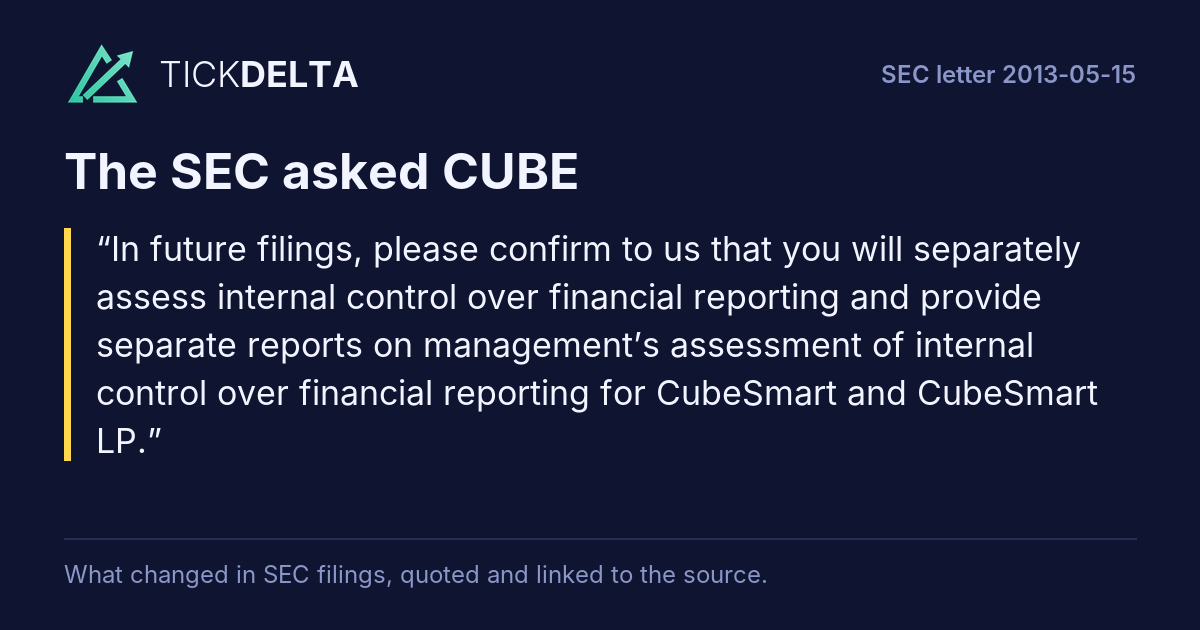
In future filings, please confirm to us that you will separately assess internal control over financial reporting and provide separate reports on management’s assessment of internal control over financial reporting for CubeSmart and CubeSmart LP.
CUBE answered

No reply letter found.

In its next report

First report after the SEC's letter of May 15, 2013: 10-Q filed Aug 9, 2013 ↗, against the 10-Q filed May 6, 2013 ↗.

Tickdelta does not hold the text of both reports, so they are not compared here.

Also in this review: closing letter, 2013-06-03

Form 10-K

2012-03-28 to 2012-06-05 · 5 questions · 2 letters from the SEC, 2 from the company
Review closed 2012-06-05
Results discussion (MD&A)Revenue
General
SEC asked (1)
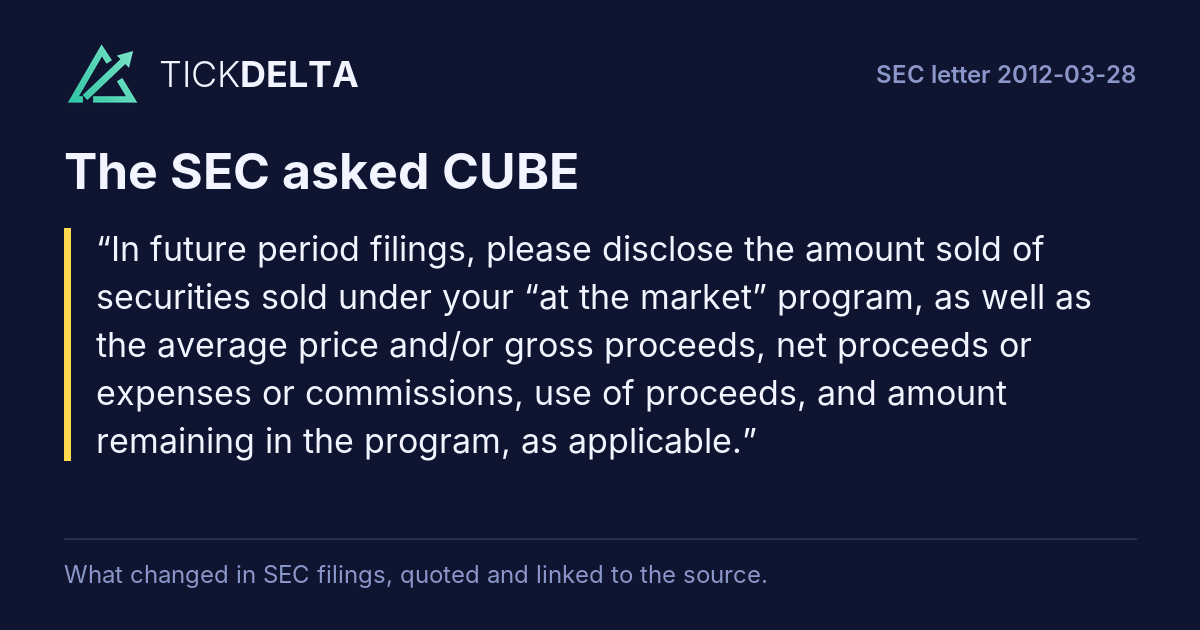
In future period filings, please disclose the amount sold of securities sold under your “at the market” program, as well as the average price and/or gross proceeds, net proceeds or expenses or commissions, use of proceeds, and amount remaining in the program, as applicable.
CUBE answered
In response to the Staff’s comment, we will, in our future filings, provide the more detailed disclosure requested with respect to our “at the market” program.
Read in the reply
Our Facilities, page 25
SEC asked (2)
We note the annual rent per occupied square foot disclosed on page 32 is determined by dividing the aggregate rental revenue for each twelve-month period by the average of the month-end occupied square feet for the period. We note that rental revenue includes customer rental revenues, access, administrative and late fees and revenues from auctions.
Rest of the question

Please tell us the portion of rental revenue derived from access, administrative and late fees and revenues from auctions. In future filings, please revise to clarify (i) what you mean by access fees and revenues from auctions and (ii) whether annual rent reflects the impact of promotional discounts or concessions.

CUBE answered
In our future filings, we will provide additional information regarding the portion of rental revenue derived from the ancillary sources identified in the Staff’s comment. For the twelve-month period ended December 31, 2011, the revenues derived from all of these ancillary sources aggregated $11.5 million, representing 5.1% of our total revenues for the year.
Rest of the answer

In future filings, we will remove reference to “access fees” (which are fees paid by customers to access a facility after hours) and to “revenues from auctions” (which are fees accrued on a delinquent customer’s account in conjunction with the listing for auction of such customer’s goods in storage). Individually and collectively, these items represent an insignificant component of rental revenue. In addition, in our future filings we will clarify that promotional discounts or concessions reduce rental income over the promotional or concession period.

Read in the reply
In its next report

First report after the company's reply of Apr 11, 2012: 10-Q filed May 7, 2012 ↗, against the 10-Q filed Nov 7, 2011 ↗.

Tickdelta does not hold the text of both reports, so they are not compared here.

Management’s Discussion and Analysis of Financial Condition and Results of Operations, page
SEC asked (3)
In future periodic filings, please disclose historical same store occupancy and average market rents trends, including the impact of concessions such as free rents.
CUBE answered
In response to the Staff’s comment, we will expand our “same store” disclosure in our future filings to include: (i) the weighted average occupancy percentage of our same store facilities over the entire period presented as well as at the end of the period presented and (ii) realized rent per occupied square foot for the period presented as well as in-place annual rents per occupied square foot as of the end of the period presented, together with appropriate disclosure of these terms. Our disclosure will clarify, as applicable, the exclusion of promotional discounts or concessions.
Rest of the answer

In addition, we will include additional disclosure as may be necessary or appropriate to enhance investor understanding of average market rent trends, including the impact of promotional concessions such as free rents.

Read in the reply
In its next report

First report after the company's reply of Apr 11, 2012: 10-Q filed May 7, 2012 ↗, against the 10-Q filed Nov 7, 2011 ↗.

Tickdelta does not hold the text of both reports, so they are not compared here.

Management’s Discussion and Analysis of Financial Condition and Results of Operations, page
SEC asked (4)
You state on page 45 that you consider your same-store portfolio to consist only of those facilities owned and operated on a stabilized basis at the beginning and at the end of the applicable years presented. Please quantify those facilities that were not considered owned and operated on a stabilized basis and tell us the reasons such facilities were not considered owned and operated on a stabilized basis.
Rest of the question

In addition, please clarify when you consider a facility to be operated on a stabilized basis, such that a development or acquired property would be added to the same-store pool.

CUBE answered
In our analysis of operating results, particularly to make comparisons of net operating income between periods meaningful, we believe it is important to provide information for properties that were stabilized and owned by us throughout each period presented. In response to the Staff’s comment, we will clarify that we consider a property to be stabilized once it has achieved an occupancy rate representative of similar self-storage assets in the respective markets for a full year measured as of the most recent January 1 or has otherwise been placed in-service and has not been significantly
Rest of the answer

damaged by natural disaster or undergone significant renovation. We did not have any such lease-up or damaged properties in our non-same-store portfolio as of December 31, 2011, and all of our non-same-store properties as of December 31, 2011were acquired by us in 2010 or 2011.

In responding to the Staff’s comments, the Company acknowledges that:

· the Company is responsible for the adequacy and accuracy of the disclosure in the filing;

· Staff comments or changes to disclosure in response to Staff comments do not foreclose the Commission from taking any action with respect to the filing; and

· the Company may not assert Staff comments as a defense in any proceeding initiated by the Commission or any person under the federal securities laws of the United States.

Read in the reply
In its next report

First report after the company's reply of Apr 11, 2012: 10-Q filed May 7, 2012 ↗, against the 10-Q filed Nov 7, 2011 ↗.

Tickdelta does not hold the text of both reports, so they are not compared here.

Our Facilities, page 25
SEC asked
We note your response to comment 2 of our letter dated March 28, 2012 that you will clarify that promotional discounts or concessions reduce rental income over the promotional or concession period. Please confirm that in future periodic filings you will quantify the promotional discounts or concessions that reduce rental income over the promotional or concession period.
CUBE answered
In our future periodic filings, we will clarify that we recognize rental income when earned in the amounts to which we are contractually entitled from tenants and that these amounts fully account for promotional discounts and concessions.

In responding to the Staff’s comments, the Company acknowledges that:

· the Company is responsible for the adequacy and accuracy of the disclosure in the filing;

· Staff comments or changes to disclosure in response to Staff comments do not foreclose the Commission from taking any action with respect to the filing; and

· the Company may not assert Staff
Rest of the answer

comments as a defense in any proceeding initiated by the Commission or any person under the federal securities laws of the United States.

Read in the reply
In its next report

First report after the company's reply of May 15, 2012: 10-Q filed Aug 6, 2012 ↗, against the 10-Q filed Nov 7, 2011 ↗.

Tickdelta does not hold the text of both reports, so they are not compared here.

Also in this review: closing letter, 2012-06-05

Letters without questions

Other letters

UPLOAD and CORRESP
1 other letter: notices that a filing will not be reviewed, requests to declare a registration effective, and the like
  • Dec 31, 2012 · CUBE: letter to the SEC · CubeSmart · Form 10-K for Fiscal Year Ended December 31, 2012 · Filed February 28,...

From the SEC's correspondence on EDGAR: staff letters (form UPLOAD) and company letters (form CORRESP), 11 letters filed since 2012-03-28. Questions and answers are matched by their numbers; topics come from words in each question. The reports are compared word for word (same form, before the first SEC letter against the first report after the company's reply). No AI.

Sources

The SEC's correspondence on EDGAR: staff letters (form UPLOAD) and company letters (form CORRESP), matched question by question. No AI.

Also

Filings: the letters in the filing list.

Work with it

Excel workbook · CSV. Google Sheet that stays up to date: paste =IMPORTDATA("https://tickdelta.com/company/CUBE/export.csv") into a cell.

Next in Owners and insiders:Insider trades
Esc

Type a ticker such as AAPL, a name, an investor such as Buffett, or a topic such as tariffs. ↑ ↓ to move, Enter to open.