Added10-Q Oct 22, 2026 vs 10-K Feb 10, 2026
Item 2. UNREGISTERED SALES OF EQUITY SECURITIES, USE OF PROCEEDS, AND ISSUER PURCHASES OF EQUITY SECURITIES
Each branch is a paragraph in Risk Factors with nothing like it in the 10-K filed Feb 21, 2025. A box jumps to the paragraph as filed, below.
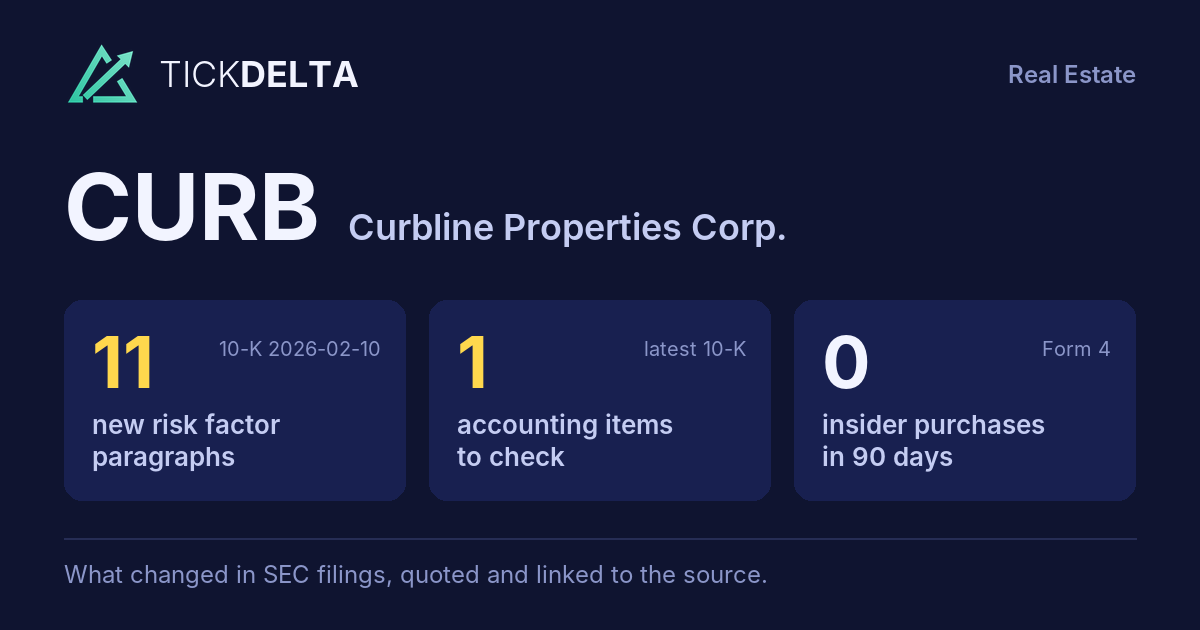
11 paragraphs in Risk Factors of the 10-K filed Feb 10, 2026 with nothing like them in the 10-K filed Feb 21, 2025. Quoted exactly. Paragraphs that were only edited are under 10-K change.
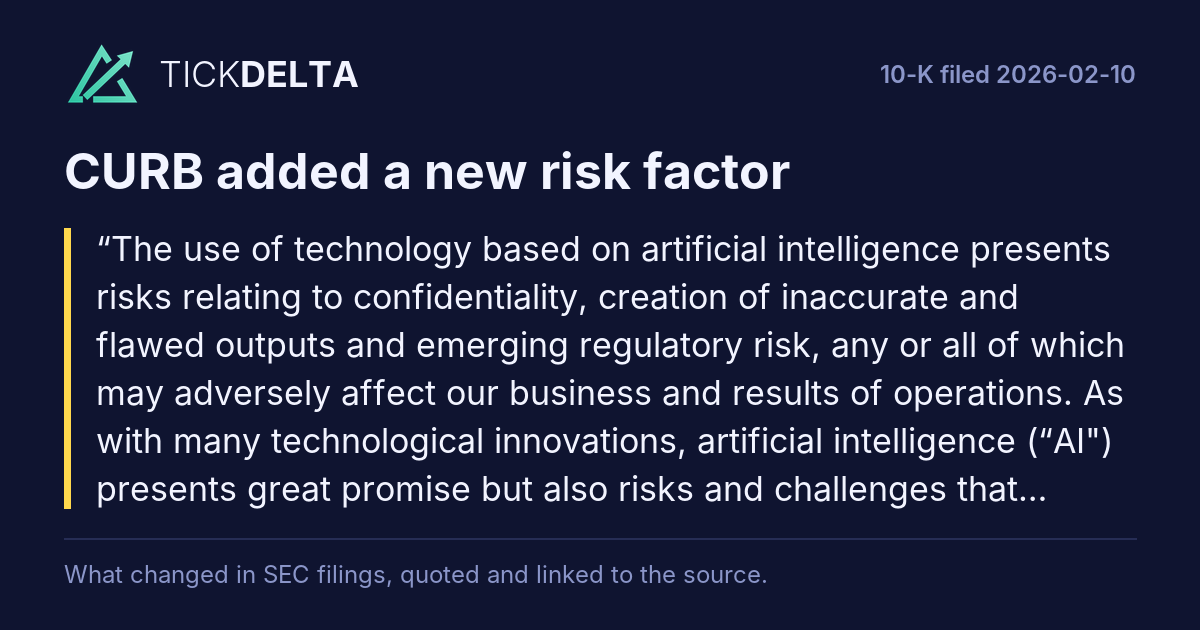
The use of technology based on artificial intelligence presents risks relating to confidentiality, creation of inaccurate and flawed outputs and emerging regulatory risk, any or all of which may adversely affect our business and results of operations.
As with many technological innovations, artificial intelligence (“AI") presents great promise but also risks and challenges that could adversely affect our business. Sensitive, proprietary, or confidential information of the Company, our tenants, employees and business partners could be leaked, disclosed, or revealed as a result of or in connection with the use of generative AI technologies by our employees or vendors. Any such information input into a third-party generative AI or machine learning platform could be revealed to others, including if information is used to train the third party's generative AI or machine learning models. Additionally, where a generative AI or machine learning model ingests personal information and makes connections using such data, those technologies may reveal other sensitive, proprietary, or confidential information generated by the model. Moreover, generative AI or machine learning models may create incomplete, inaccurate, or otherwise flawed outputs, which may appear correct. Due to these issues, these models could lead us to make flawed decisions that could result in adverse consequences to us, including exposure to reputational and competitive harm, customer loss, and legal liability. In addition, uncertainty in the legal and regulatory regime relating to AI may require significant resources to modify and maintain business practices to comply with applicable law, the nature of which cannot be determined at this time. Several jurisdictions have already proposed or enacted laws governing AI and may decide to adopt similar or
more restrictive legislation that may render the use of such technologies challenging. These obligations may prevent or limit our ability to use AI in our business, lead to regulatory fines or penalties, or require us to change our business practices. If we cannot use AI, or that use is restricted, our business may be less efficient, or we may be at a competitive disadvantage. Any of these factors could adversely affect our business, financial condition, and results of operations.
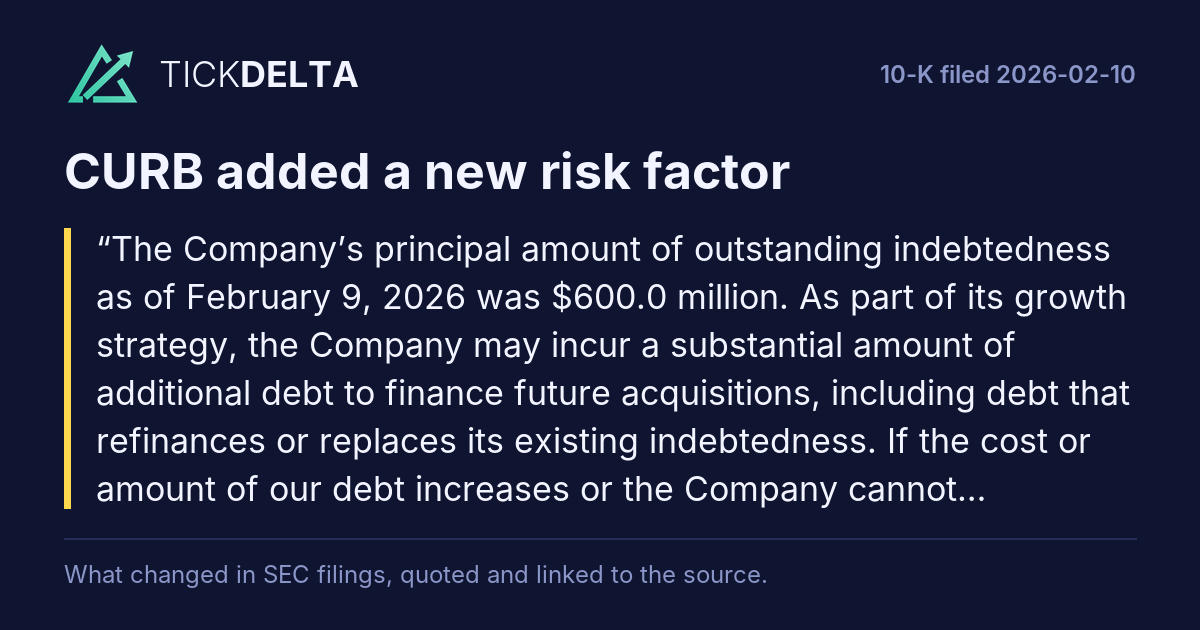
The Company’s principal amount of outstanding indebtedness as of February 9, 2026 was $600.0 million. As part of its growth strategy, the Company may incur a substantial amount of additional debt to finance future acquisitions, including debt that refinances or replaces its existing indebtedness. If the cost or amount of our debt increases or the Company cannot refinance its debt in sufficient amounts or on acceptable terms, we are at risk of default on our obligations, which could have a material adverse effect on the Company, including its ability to make distributions to its stockholders.
Incurring additional debt or other obligations, such as preferred equity, including any refinancing or replacement thereof, could
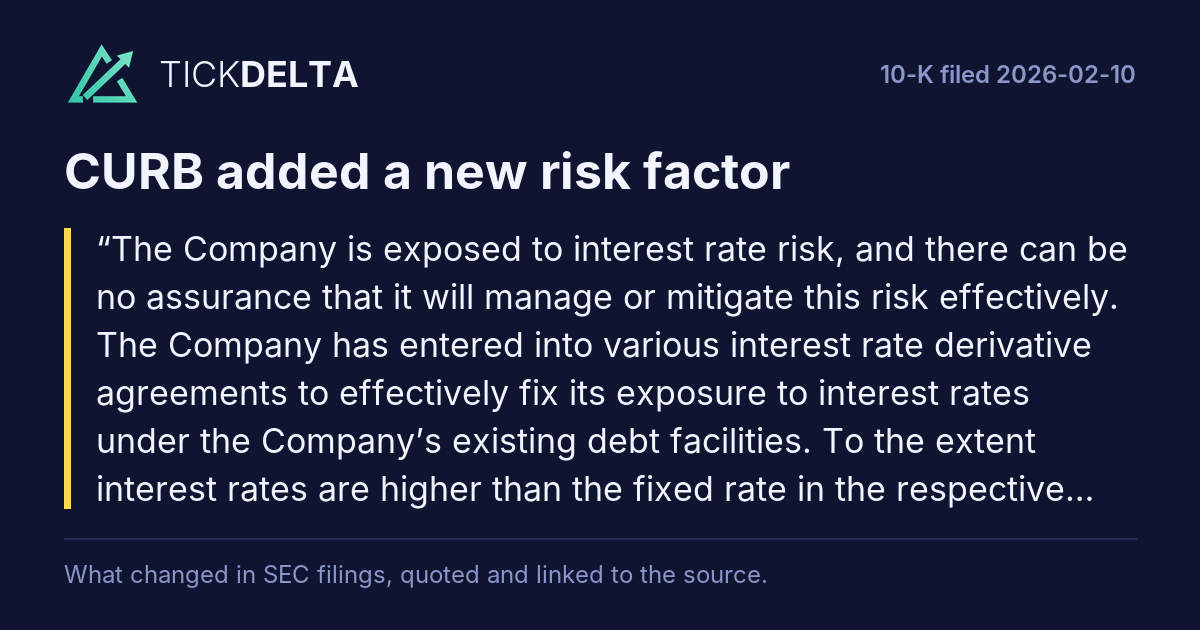
The Company is exposed to interest rate risk, and there can be no assurance that it will manage or mitigate this risk effectively.
The Company has entered into various interest rate derivative agreements to effectively fix its exposure to interest rates under the Company’s existing debt facilities. To the extent interest rates are higher than the fixed rate in the respective contract, the Company would realize cash savings as compared to other market participants. However, to the extent interest rates are below the fixed rate in the respective contract, the Company would make higher cash payments than other similar market participants, which would have an adverse effect on its cash flows as compared to other market participants.
Additionally, there is counterparty risk associated with entering into interest rate derivative contracts. Should market conditions lead to default, insolvency or make a merger necessary for one or more of the Company’s counterparties, or potential future counterparties, it is possible that the terms of the interest rate derivative contracts will not be honored in their current form with a replacement counterparty. The potential termination or renegotiation of the terms of the interest rate derivative contracts as a result of changing counterparties through default, insolvency or merger could result in an adverse impact on the Company’s results of operations and cash flows.
The Company’s financial condition and operating activities could be adversely affected by financial covenants which may curtail investment activities, require the Company to sell securities or alter or restrict distributions.
The instruments governing the Company’s debt contain, and the Company expects that similar agreements in the future will contain, financial covenants, including, among other things, leverage ratios and debt service coverage and fixed-charge coverage ratios, as well as limitations on the Company’s ability to sell all or substantially all of the Company’s assets and engage in certain mergers and acquisitions. These covenants may affect the Company’s distribution and operating policies, its ability to incur additional debt and its ability to pursue certain business initiatives or certain transactions that might otherwise be advantageous. In addition, failure to meet certain of these financial covenants could cause an event of default, which, if not cured or waived, could accelerate some or all of such indebtedness which could have a material adverse effect on us.
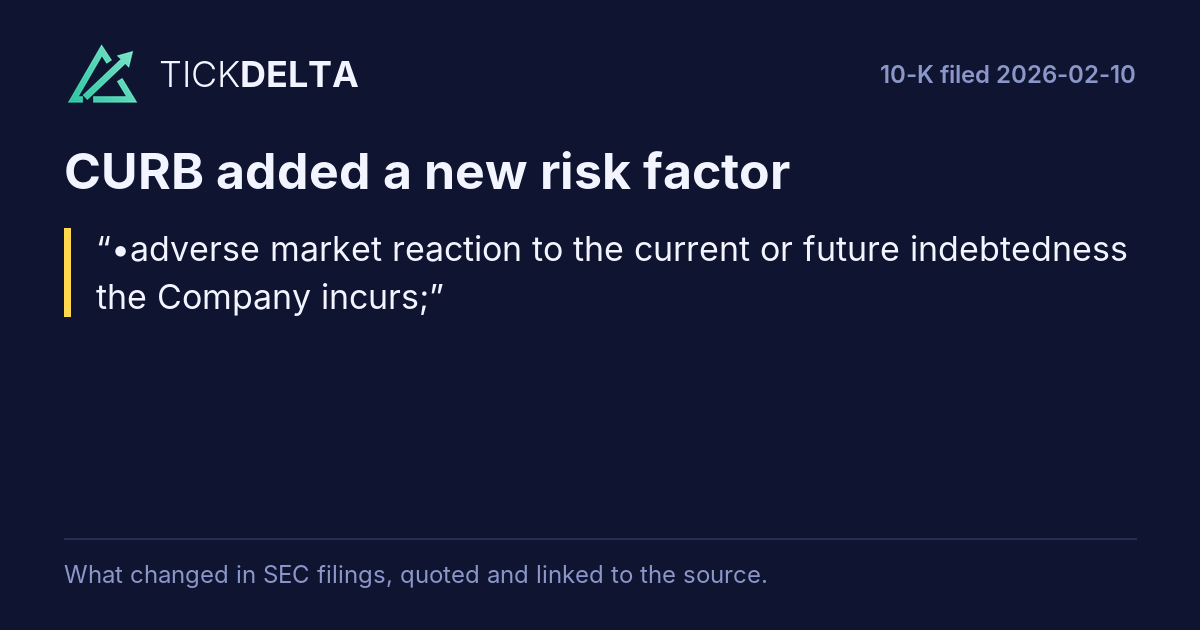
•adverse market reaction to the current or future indebtedness the Company incurs;
New in the latest 10-Q
15 paragraphs in the 10-Q filed Oct 22, 2026 with nothing like them in the 10-Q filed Jul 29, 2026 (at least half the words must differ; new numbers alone do not count). Quoted exactly, grouped by the item heading above them. This is text that changed, not a judgement of how serious it is.
In September 2026, the Company entered into a forward interest rate swap agreement to fix the variable-rate component at 4.43% for $50 million of a delayed draw term loan currently anticipated to close in the fourth quarter (“2026 Term Loan”). The closing of the 2026 Term Loan is subject to the negotiation of definitive agreements and customary closing conditions, and there can be no assurance that the 2026 Term Loan will be completed. The effective date of the swap is based on the expected funding which is anticipated to be in the first quarter of 2027.
Read in the 10-Q
The 2026 Term Loan is a delayed draw term loan that the Company anticipates closing in the fourth quarter of 2026 with an expected funding in the first quarter of 2027. (Note 5)
Read in the 10-Q
On February 22, 2025, the Company granted a total of 30,924 shares of service-based restricted stock to its executive officers and other employees with an aggregate value of $0.8 million, which will vest ratably over a four-year period with the first vesting date being February 22, 2026, subject to the continued employment of the applicable executive officer or employee. The awards to the executive officers were made pursuant to their respective employment agreements.
Read in the 10-Q
On February 22, 2026, the Company granted a total of 39,472 shares of service-based restricted stock to its executive officers and other employees with an aggregate value of $1.1 million, which will vest ratably over a four-year period with the first vesting date being February 22, 2027, subject to the continued employment of the applicable executive officer or employee. The awards to the executive officers were made pursuant to their respective employment agreements.
Read in the 10-Q
On June 25, 2026, the Company granted a total of 94,377 shares of service-based restricted stock to two of its executive officers with an aggregate value of $3.0 million. The shares will vest over a five-year period with the first shares vesting on June 25, 2028, subject to continued employment of the applicable executive officer. The vesting schedule over the five-year period is as follows: 0%, 15%, 15%, 20% and 50%. The awards to the executive officers were made pursuant to their respective amended employment agreements. The grant values were equal to the market value of the Company’s common stock on the date of the grants.
Read in the 10-Q
On February 22, 2025, the CEO was granted service-based LTIP Units pursuant to his employment agreement with a value of $0.8 million, which equated to 32,391 LTIP Units, which will vest ratably over a three-year period with the first vesting date being February 22, 2026, subject to his continued employment. On February 22, 2026, the CEO and an executive officer were granted service-based LTIP Units pursuant to their employment agreements with a value of $3.3 million and $0.2 million, respectively, which equated to 122,373 LTIP Units and 5,740 LTIP Units, respectively, which will vest ratably over a three-year period and four-year period, respectively, with the first vesting date being February 22, 2027, subject to their continued employment. The grant values were equal to the market value of the Company’s common stock at the dates of the grants.
Read in the 10-Q
Non-Cash Compensation Expense The amounts recorded in general and administrative expenses in the Company’s consolidated statements of operations for the amortization of all of the outstanding stock-based awards and LTIP Units for the three and nine months ended September 30, 2026 and 2025, consisted of the following (in thousands): Three Months Ended September 30, Nine Months Ended September 30, Non-Cash Compensation Expense 2026 2025 2026 2025 ────────────────────────────────────────────────────────────────────────────────────────────────────────────────────────────────────────────────────────────────────────────────────────────────── Restricted stock units (“RSUs”) and $ 1,291 $ 1,739 $ 3,935 $ 5,760
Read in the 10-Q
Restricted stock awards ("RSAs") Service-based LTIP Units 542 423 1,441 1,221 Performance-Based Restricted Stock Awards (“PRSAs”) 324 135 961 400 Performance-Based LTIP Units (“PB LTIPs”) 804 804 2,386 2,386 Total non-cash compensation expense $ 2,961 $ 3,101 $ 8,723 $ 9,767
Read in the 10-Q
During the three and nine months ended September 30, 2026, the Company settled 7.3 million and 15.7 million shares of common stock, respectively, that were sold on a forward basis. These agreements were not outstanding at September 30, 2025.
Read in the 10-Q
• In September and October 2026, entered into forward interest rate swap agreements to fix the variable-rate component at 4.43% and 4.54%, respectively, for two separate $50 million portions of a delayed draw term loan currently anticipated to close in the fourth quarter (the “2026 Term Loan”). The closing of the 2026 Term Loan is subject to the negotiation of definitive agreements and customary closing conditions, and there can be no assurance that the 2026 Term Loan will be completed;
Read in the 10-Q
The increase was primarily attributable to expenses recognized under the Shared Services Agreement (Note 11).
Read in the 10-Q
The increase was primarily attributable to income recognized under the Shared Services Agreement (Note 11).
Read in the 10-Q
extend its maturity to January 2031 at the Operating Partnership’s option and subject to the satisfaction of certain customary conditions.
Read in the 10-Q
In September and October 2026, the Company entered into two forward interest rate swap agreements to fix the variable-rate component at 4.43% and 4.54%, respectively, for two separate $50 million portions of the 2026 Term Loan, a delayed draw term loan currently anticipated to close in the fourth quarter. The closing of the 2026 Term Loan is subject to the negotiation of definitive agreements and customary closing conditions, and there can be no assurance that the 2026 Term Loan will be completed. The effective date of the swaps are based on the expected funding timing which is anticipated to be in the first quarter of 2027.
Read in the 10-Q
There were no unregistered sales of equity securities during the third quarter of 2026.
Read in the 10-Q
Item 1A of the 10-Q filed Oct 22, 2026 against Item 1A of the 10-K filed Feb 10, 2026.
A 10-Q repeats only the risks that changed, so a 10-K paragraph that is missing from it is not counted as removed.
Added is a paragraph with nothing like it in the 10-K, Reworded a sentence that is in both with several words changed,
Quiet changes a sentence in both where one to four words changed and one is a hedge or a modal
(cut words struck through, new words highlighted).
Text on the page, not a score; each links to the filing at sec.gov.
What the 10-Q itself says about its risk factors:There have been no material changes to the risk factors set forth in the Company’s Annual Report on Form 10-K for the year ended December 31, 2025.
Read in the 10-Q
Two-word phrases in Risk Factors of the 10-K filed Feb 10, 2026 that are in none of the 1 earlier 10-Ks stored, back to Feb 21, 2025
Used at least twice, small words left out. Counted, not picked: a phrase can be new because the company renamed something.
7 paragraphs of last year's Risk Factors with nothing like them now. The longest are quoted.
Item 1A of each 10-K and 10-Q on EDGAR, quoted exactly. Each paragraph links to the filing at sec.gov.
10-K change: what was reworded or cut, section by section.
Excel workbook · CSV. Google Sheet that stays up to date: paste =IMPORTDATA("https://tickdelta.com/company/CURB/export.csv") into a cell.