CVB Financial Corp CVBF
New risk paragraphs, branching off last year
Each branch is a paragraph in Risk Factors with nothing like it in the 10-K filed Feb 28, 2025. A box jumps to the paragraph as filed, below.
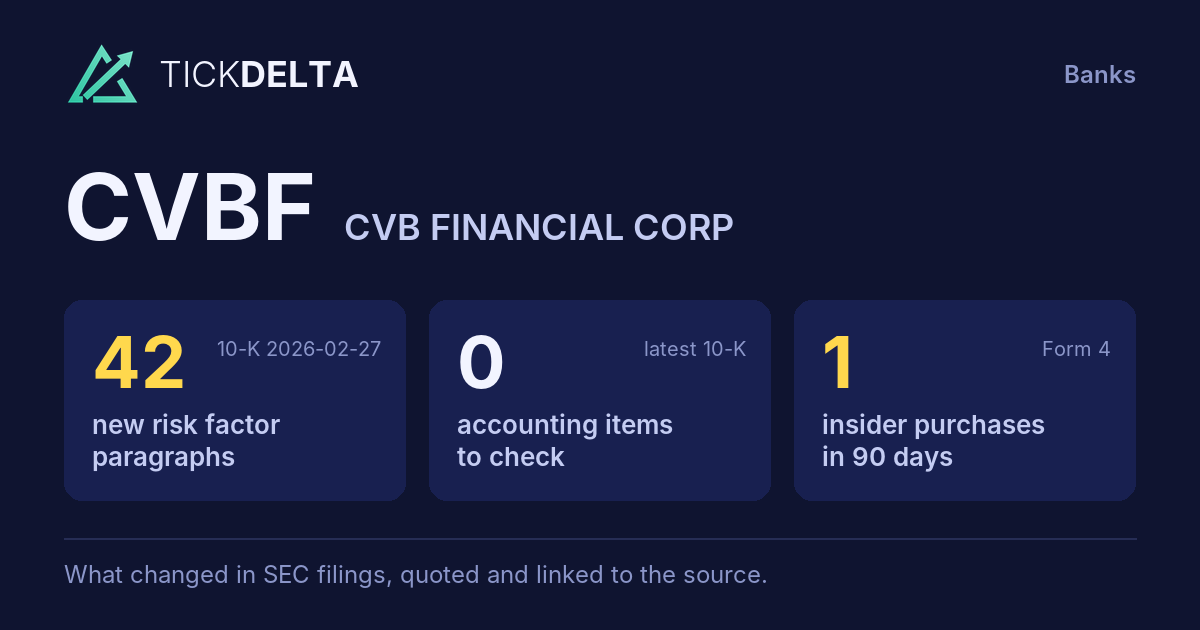
Paragraphs with nothing like them in last year's 10-K
42 paragraphs in Risk Factors of the 10-K filed Feb 27, 2026 with nothing like them in the 10-K filed Feb 28, 2025. Quoted exactly. Paragraphs that were only edited are under 10-K change.
•The development and use of AI presents risks and challenges that may adversely impact our business.
•Combining with Heritage may be more difficult, costly or time-consuming than expected, and the Company may fail to realize the anticipated benefits of the merger.
•The combined company may be unable to retain the Company’s and/or Heritage’s personnel successfully after the merger is completed.
•The Company will be subject to business uncertainties and contractual restrictions while the merger with Heritage is pending.
•The Company has incurred and is expected to incur substantial costs related to the merger and integration.
•The merger agreement between the Company and Heritage may be terminated in accordance with its terms and the merger may not be completed.
•Regulatory approvals may not be received, may take longer than expected or may impose conditions that are not presently anticipated or that could have an adverse effect on the Company following the merger.
•The future results of the Company following the completion of the mergers may suffer if the Company does not effectively manage its expanded business and operations.
•Issuance of shares of the Company’s common stock in connection with the merger may adversely affect the market price of such common stock.
•Consumers may decide not to use banks to complete their financial transactions.
The development and use of AI presents risks and challenges that may adversely impact our business.
We, or our third party vendors, clients or counterparties may develop or incorporate Artificial Intelligence (AI) technology in certain business processes, services, or products including deploying AI in the areas of fraud detection and prevention, cybersecurity, credit risk and underwriting, regulatory compliance, process automation, data analysis, and customer marketing and product customization. We have adopted an AI Policy that establishes a governance framework for developing, deploying, and managing AI and Generative AI (GenAI) solutions and initiatives, including those involving vendors. We may rely on AI models developed by third parties, and, to that extent, would be dependent in part on the manner in which those third parties develop and train their models. AI models, particularly generative AI models, may produce output or take action that is incorrect, include unauthorized material in the training data for their models, result in the release of private, confidential, or proprietary information, reflect biases included in the data on which they are trained, infringe on the intellectual property rights of others, or are otherwise harmful. Any of these risks could expose us to liability or adverse legal or regulatory consequences and harm our reputation and the public perception of our business or the effectiveness of our security measures. In addition, the complexity of many AI models makes it challenging to understand why they are generating particular outputs. This limited transparency increases the challenges associated with assessing the proper operation of AI models, understanding and monitoring the capabilities of the AI models, reducing erroneous output, eliminating bias, and complying with regulations that require documentation or explanation of the basis on which decisions are made. In addition to our use of AI technologies, we are exposed to risks arising from the use of AI technologies by bad actors to commit fraud and misappropriate funds and to facilitate cyberattacks.
The legal and regulatory environment relating to AI is uncertain and rapidly evolving, both in the U.S. and internationally, and includes regulatory schemes targeted specifically at AI as well as provisions in intellectual property, privacy, consumer protection, employment, and other laws applicable to the use of AI. These evolving laws and regulations could require changes in our implementation of AI technology and increase our compliance costs and the risk of non-compliance.
As of the date of this report, our proposed merger with Heritage is pending completion. Risks specifically associated with this pending merger can be found below under the heading “Risks Relating to our Pending Merger with Heritage.” The merger may not have the anticipated positive results, including results relating to: correctly assessing the asset quality of the assets being acquired; the total cost of integration including management attention and resources; the time required to complete the integration successfully; the amount of longer-term cost savings; being able to profitably deploy funds acquired in an acquisition; or the overall performance of the combined entity.
If the merger with Heritage is not completed for any reason there may be various adverse consequences and the Company may experience negative reactions from the financial markets and from its customers and employees. For example, the Company’s business may have been impacted adversely by the failure to pursue other beneficial opportunities due to the focus of management on the merger, the benefits from which may not be realized. Additionally, if the merger agreement is terminated, the market price of the Company’s common stock could decline to the extent that current market prices reflect a market assumption that the merger will be beneficial and will be completed. The Company also could be subject to litigation related to any failure to complete the merger or to proceedings commenced against the Company to perform its obligations under the merger agreement. If the merger agreement is terminated under certain circumstances. The Company may be required to pay a termination fee of $32.45 million to Heritage.
Combining with Heritage may be more difficult, costly or time-consuming than expected, and the Company may fail to realize the anticipated benefits of the merger.
The success of the merger will depend, in part, on the ability to realize the anticipated cost savings from combining the businesses of the Company and Heritage. To realize the anticipated benefits and cost savings from the merger, the Company and Heritage must successfully integrate and combine their businesses in a manner that permits those cost savings to be realized without adversely affecting current revenues and future growth. If the Company and Heritage are not able to successfully achieve these objectives, the anticipated benefits of the merger may not be realized fully or at all or may take longer to realize than expected. In addition, the actual cost savings of the merger could be less than anticipated, and integration may result in additional and unforeseen expenses.
An inability to realize the full extent of the anticipated benefits of the merger and the other transactions contemplated by the merger agreement, as well as any delays encountered in the integration process, could have an adverse effect upon the revenues, levels of expenses and operating results of the combined company following the completion of the merger, which may adversely affect the value of the common stock of the combined company following the completion of the merger.
The Company and Heritage have operated and, until the completion of the merger, must continue to operate, independently. It is possible that the integration process could result in the loss of key employees, the disruption of each company’s ongoing businesses or inconsistencies in standards, controls, procedures and policies that adversely affect the companies’ ability to maintain relationships with clients, customers, depositors and employees or to achieve the anticipated benefits and cost savings of the merger. Integration efforts between the companies may also divert management attention and resources. These integration matters could have an adverse effect to the Company during this transition period and for an undetermined period after completion of the merger on the combined company.
Furthermore, the board of directors and executive leadership of the combined company will consist of former directors and executive officers from each company. Combining the boards of directors and management teams of each company into a single board and a single management team could require the reconciliation of differing priorities and philosophies.
The combined company may be unable to retain the Company/s and/or Heritage’s personnel successfully after the merger is completed.
The success of the merger will depend in part on the combined company’s ability to retain the talent and dedication of key employees currently employed by the Company or Heritage. It is possible that these employees may decide not to remain with the Company or Heritage, as applicable, while the merger is pending or with the combined company after the merger is consummated. If the Company and Heritage are unable to retain key employees, including management, who are critical to the successful integration and future operations of the companies, the Company and Heritage could face disruptions in their operations, loss of existing customers, loss of key information, expertise or know-how and unanticipated additional recruitment costs. In addition, following the merger, if key employees terminate their employment, the combined company’s business activities may be adversely affected, and management’s attention may be diverted from successfully hiring suitable replacements, all of which may cause the combined company’s business to suffer. The Company and Heritage also may not be able to locate or retain suitable replacements for any key employees who leave either company.
The Company will be subject to business uncertainties and contractual restrictions while the merger with Heritage is pending.
Uncertainty about the effect of the merger on employees and customers may have an adverse effect to the Company. These uncertainties may impair the Company’s ability to attract, retain and motivate key personnel until the merger is completed, and could cause customers and others that deal with the Company to seek to change existing business relationships with the Company. In addition, subject to certain exceptions, the Company has agreed to operate its business in the ordinary course in all material respects and to refrain from taking certain actions that may adversely affect its ability to consummate the transactions contemplated by the merger agreement on a timely basis without the consent of Heritage. These restrictions may prevent the Company from pursuing attractive business opportunities that may arise prior to the completion of the merger.
The Company has incurred and is expected to incur substantial costs related to the merger and integration.
The Company has incurred and expects to incur a number of non-recurring costs associated with the merger. These costs include financial advisory, legal, accounting, consulting and other advisory fees, retention, severance and employee benefit-related costs, public company filing fees and other regulatory fees, financial printing and other printing costs, closing, integration and other related costs. Some of these costs are payable by the Company regardless of whether or not the merger is completed.
The merger agreement between the Company and Heritage may be terminated in accordance with its terms and the merger may not be completed.
The merger agreement is subject to a number of conditions which must be fulfilled in order to complete the merger. Those conditions include, among other things: (i) approval by each of the Company and Heritage shareholders of certain matters relating to the merger at each company’s respective special meeting, (ii) the receipt of required regulatory approvals from OCC as well as the approval of the FRB and (iii) the absence of any order, injunction, decree or other legal restraint preventing the completion of the merger, the bank merger or any of the other transactions contemplated by the merger agreement or making the completion of the merger, the bank merger or any of the other transactions contemplated by the merger agreement illegal.
Each party’s obligation to complete the merger is also subject to certain additional customary conditions, including (a) subject to applicable materiality standards, the accuracy of the representations and warranties of the other party set forth in the merger agreement, (b) the performance in all material respects by the other party of its obligations under the merger agreement and (c) the receipt by each party of an opinion from its counsel to the effect that the merger will qualify as a reorganization within the meaning of Section 368(a) of the Internal Revenue Code of 1986.
These conditions to the closing may not be fulfilled in a timely manner or at all, and, accordingly, the merger may not be completed. In addition, the parties can mutually decide to terminate the merger agreement at any time, before or after the requisite shareholder approvals, or Heritage or the Company may elect to terminate the merger agreement in certain other circumstances.
Regulatory approvals may not be received, may take longer than expected or may impose conditions that are not presently anticipated or that could have an adverse effect on the Company following the merger.
Before the merger may be completed, various approvals, consents and non-objections must be obtained from the Federal Reserve, the OCC and other regulatory authorities without the imposition of any materially burdensome regulatory condition. In determining whether to grant these approvals, the regulators consider a variety of factors, including the
regulatory standing of each party. These approvals could be delayed or not obtained at all, including due to any or all of the following: an adverse development in either party’s regulatory standing; governmental, political, community or supervisory inquiries or opposition; or changes in legislation, regulatory policy or the political environment, including changes in the leadership of regulatory agencies. Any approvals that are granted may impose terms, conditions, limitations, obligations or costs, or place restrictions on the conduct of the surviving corporation’s business or require changes to the terms of the transactions contemplated by the merger agreement. There can be no assurance that regulators will not impose any such conditions, limitations, obligations or restrictions, or that any such conditions, limitations, obligations or restrictions will not have the effect of delaying the completion of the merger, imposing additional material costs on or materially limiting the revenues of the surviving corporation following the merger, or otherwise reducing the anticipated benefits of the merger. In addition, there can be no assurance that any such conditions, limitations, obligations or restrictions will not result in the delay or abandonment of the merger. Completion of the merger is also conditioned on the absence of certain orders, injunctions or decrees by any governmental entity that would prohibit or make illegal the completion of the merger. Although the parties have agreed to use their commercially reasonable efforts to obtain the required regulatory approvals, neither the Companynor Heritage is required under the merger agreement to agree to any condition or restriction that would reasonably be expected to result in a materially burdensome regulatory condition.
Show the other 5
Management makes various assumptions and judgments about the collectability of acquired loans, including the credit worthiness of borrowers and the value of the real estate and other assets serving as collateral for the repayment of secured loans. If our assumptions are incorrect, significant earnings volatility can occur and credit loss provisions may be needed to respond to different economic conditions or adverse developments in the acquired loan portfolio. Any increase in future loan losses could have a material adverse impact on our business, financial condition, results of operations and prospects.
The future results of the Company following the completion of the mergers may suffer if the Company does not effectively manage its expanded business and operations.
Following the mergers, the size of the business of the Company will increase beyond the current size of either the Company’s or Heritage’s current business. The Company’s future success will depend, in part, upon its ability to manage this expanded business size, which may pose challenges for management, including challenges related to the management and monitoring of new operations and associated increased costs and complexity. The Company may also face increased scrutiny from governmental entities as a result of the increased size of its business and geographic footprint. There can be no assurances that the Company will be successful or that it will realize the expected operating efficiencies, revenue enhancement or other benefits currently anticipated from the merger.
Issuance of shares of the Company’s common stock in connection with the merger may adversely affect the market price of such common stock.
In connection with the payment of the merger consideration, the Company has stated that it expects to issue approximately 40.6 million shares of the Company’s common stock to Heritage shareholders. The issuance of these new shares of the Company’s common stock may result in fluctuations in the market price of such common stock, including a stock price decrease.
circumvention or overriding of controls and fraud, even effective internal controls may not prevent or detect all misstatements.
On December 15, 2025 the Bank converted from a California state-chartered bank to a national banking association. While we are already accustomed to federal regulatory requirements, this conversion to a national banking association could pose some regulatory transition risk. The Company remains subject to supervision by the Federal Reserve Bank (“FRB”). Regulatory agencies, including the OCC, FRB, and the CFPB, periodically monitor and conduct examinations of our business, including compliance with laws and regulations. If, as a result of an examination, a regulatory agency was to determine in its discretion that the financial condition, capital resources, asset quality, earnings prospects, management, liquidity, or other aspects of our operations had become unsatisfactory, or that the Company or its management was in violation of any law or regulation, it could take a number of different remedial actions as it deems appropriate. These actions include the power to enjoin “unsafe or unsound” practices, to require affirmative actions to correct any conditions resulting from any violation or practice, to issue an administrative order that can be judicially enforced, to direct an increase in our capital, to restrict our growth, to assess civil monetary penalties against the Bank or our officers or directors, to remove officers and directors and, if it is concluded that such conditions cannot be corrected or there is an imminent risk of loss to depositors, to terminate our deposit insurance. If we become subject to such regulatory actions, our business, financial condition, results of operations, and reputation may be negatively impacted.
The Bank Secrecy Act, the USA PATRIOT Act of 2001, and other laws and regulations require financial institutions, among other duties, to institute and maintain an effective anti-money laundering program and file suspicious activity and currency transaction reports as appropriate. The federal Financial Crimes Enforcement Network is authorized to impose
results of operations, financial reporting and reputation could be materially adversely affected if we rely on materially misleading, false, inaccurate or fraudulent information.
Paragraphs in the 10-Q filed Nov 6, 2026 that were not in the one before
New in the latest 10-Q
19 paragraphs in the 10-Q filed Nov 6, 2026 with nothing like them in the 10-Q filed Aug 7, 2026 (at least half the words must differ; new numbers alone do not count). Quoted exactly, grouped by the item heading above them. This is text that changed, not a judgement of how serious it is.
Financial statements and notes
respectively. Due to the integration of systems and operations following the acquisition, disclosure of Heritage's revenue and net earnings included in the consolidated statements of earnings is impracticable.
Read in the 10-Q
It is the Company's policy to discontinue accruing interest when principal or interest payments are 90 days or more past due, unless the loan is both well secured and in the process of collection, or when full collection of principal and interest is not expected. The following table presents nonaccrual loans, including loans with no related allowance for credit losses, by loan type as of September 30, 2026 and December 31, 2025. September 30, 2026 (Dollars in thousands) Nonaccrual with No Allowance for Credit Losses Total Loans Past Due Over 89 Days Still Accruing
Read in the 10-Q
December 31, 2025 Number of Loans (Dollars in thousands) Real Estate Business Assets Other Dependent on
Read in the 10-Q
The tables below present the amortized cost of loans to borrowers experiencing financial difficulty that were modified as of September 30, 2025 by loan class and modification type.
Read in the 10-Q
(Dollars in thousands) Amortized Cost Basis % of Total Class of Financing Receivables Financial Effect
Read in the 10-Q
Show the other 14
Commercial real estate $ 7,754 0.09% Added a weighted-average 1.8 years to the life of loans, which reduced monthly payment amounts for the borrowers.
Read in the 10-Q
Commercial and industrial 1,149 0.01% Added a weighted-average 1.4 years to the life of loans, which reduced monthly payment amounts for the borrowers.
Read in the 10-Q
Dairy & livestock and agribusiness 395 0.00% Added a weighted-average 1.6 years to the life of loans, which reduced monthly payment amounts for the borrowers.
Read in the 10-Q
Commercial real estate $ 675 0.01% Added a weighted-average 7.6 years to the life of loans, which reduced monthly payment amounts for the borrowers; reduced weighted-average contractual interest rate from 10.00% to 7.25%.
Read in the 10-Q
Commercial and industrial 783 0.01% Added a weighted-average 1.6 years to the life of loans, which reduced monthly payment amounts for the borrowers; reduced weighted-average contractual interest rate from 8.50% to 7.75%.
Read in the 10-Q
The following table depicts the payment status of the loans that were modified in the past 12 months as of the dates indicated.
Read in the 10-Q
Assets and Liabilities Measured at Fair Value on a Non-Recurring Basis We may be required to measure certain assets at fair value on a non-recurring basis in accordance with GAAP. These adjustments to fair value usually result from application of lower of cost or fair value accounting or impairment write-downs of individual assets. For assets measured at fair value on a non-recurring basis that were held on the balance sheet at September 30, 2026 and December 31, 2025, the following tables provide the level of valuation assumptions used to determine each adjustment and the carrying value of the related assets that had losses during the period. (Dollars in thousands) Carrying value Quoted Prices in Active Markets for Identical Assets (Level 1) Significant Other Observable Inputs (Level 2) Significant Unobservable Inputs (Level 3) Total Losses For The Nine Months Ended September 30, 2026 September 30, 2026 ─────────────────────────────────────────────────────────────────────────────────────────────────────────────────────────────────────────────────────────────────────────────────────────────────────────────────────────────────────────────────────────────────────────────────────────────────────────────────────── Financial assets Loans: Commercial real estate $ 3,212 $ $ $ 3,212 $ 21 SBA 646 646 - Commercial and industrial 1,193 1,193 1,160 Total assets $ 5,051 $ $ $ 5,051 $ 1,181 (Dollars in thousands) Carrying value Quoted Prices in Active Markets for Identical Assets (Level 1) Significant Other Observable Inputs (Level 2) Significant Unobservable Inputs (Level 3) Total Losses For The Year Ended December 31, 2025 December 31, 2025 ─────────────────────────────────────────────────────────────────────────────────────────────────────────────────────────────────────────────────────────────────────────────────────────────────────────────────────────────────────────────────────────────────────────────────────────────────────────────── Financial assets Loans: Commercial real estate $ 12,614 $ $ $ 12,614 $ 2 SBA 24 24 - Commercial and industrial 8,953 8,953 254 Other real estate owned 163 163 - Total assets $ 21,754 $ $ $ 21,754 $ 256
Read in the 10-Q
Nine Months Ended September 30, 2026 Compared to Nine Months Ended September 30, 2025
Read in the 10-Q
Nine Months Ended September 30, 2026 Compared to Nine Months Ended September 30, 2025
Read in the 10-Q
Nine Months Ended September 30, 2026 Compared to Nine Months Ended September 30, 2025
Read in the 10-Q
September 30, 2026 (Dollars in thousands) Balance Percent of Total Commercial Real Percent of Total
Read in the 10-Q
December 31, 2025 (Dollars in thousands) Balance Percent of Total Commercial Real Percent of Total
Read in the 10-Q
The following table summarizes the off-balance sheet items at September 30, 2026.
Read in the 10-Q
Legal proceedings
The Company evaluates legal proceedings and records accruals for loss contingencies in accordance with applicable accounting guidance. Management reviews outstanding matters on a quarterly basis and adjusts accruals and disclosures as additional information becomes available.
Read in the 10-Q
The 10-Q's risk factors against the 10-K
Item 1A of the 10-Q filed Nov 6, 2026 against Item 1A of the 10-K filed Feb 27, 2026.
A 10-Q repeats only the risks that changed, so a 10-K paragraph that is missing from it is not counted as removed.
Added is a paragraph with nothing like it in the 10-K, Reworded a sentence that is in both with several words changed,
Quiet changes a sentence in both where one to four words changed and one is a hedge or a modal
(cut words struck through, new words highlighted).
Text on the page, not a score; each links to the filing at sec.gov.
What the 10-Q itself says about its risk factors:There have been no material changes to the risk factors previously disclosed in Item 1A, “Risk Factors”, to Part I of our Annual Report on Form 10-K for the year ended December 31, 2025.
Read in the 10-Q
1 paragraph in the 10-Q's Item 1A, and none of them adds, rewords or quietly edits a paragraph of the 10-K's.
Phrases used for the first time
Two-word phrases in Risk Factors of the 10-K filed Feb 27, 2026 that are in none of the 1 earlier 10-Ks stored, back to Feb 28, 2025
Where each one is used
- merger agreement: •The merger agreement between the Company and Heritage may be terminated in accordance with its terms and the merger may not be completed.
- company’s common: •Issuance of shares of the Company’s common stock in connection with the merger may adversely affect the market price of such common stock.
- transactions contemplated: An inability to realize the full extent of the anticipated benefits of the merger and the other transactions contemplated by the merger agreement, as well as any delays encountered in the integration process, could have an adverse effect upon the revenues, levels of expenses and operating results of the combined...
- conditions limitations: regulatory standing of each party. These approvals could be delayed or not obtained at all, including due to any or all of the following: an adverse development in either party’s regulatory standing; governmental, political, community or supervisory inquiries or opposition; or changes in legislation, regulatory...
- limitations obligations: regulatory standing of each party. These approvals could be delayed or not obtained at all, including due to any or all of the following: an adverse development in either party’s regulatory standing; governmental, political, community or supervisory inquiries or opposition; or changes in legislation, regulatory...
- take longer: •Regulatory approvals may not be received, may take longer than expected or may impose conditions that are not presently anticipated or that could have an adverse effect on the Company following the merger.
- combined company’s: The success of the merger will depend in part on the combined company’s ability to retain the talent and dedication of key employees currently employed by the Company or Heritage. It is possible that these employees may decide not to remain with the Company or Heritage, as applicable, while the merger is pending or...
- presents risks: •The development and use of AI presents risks and challenges that may adversely impact our business.
Used at least twice, small words left out. Counted, not picked: a phrase can be new because the company renamed something.
What was taken out
3 paragraphs of last year's Risk Factors with nothing like them now. The longest are quoted.
Sources
Item 1A of each 10-K and 10-Q on EDGAR, quoted exactly. Each paragraph links to the filing at sec.gov.
Also
10-K change: what was reworded or cut, section by section.
Work with it
Excel workbook · CSV. Google Sheet that stays up to date: paste =IMPORTDATA("https://tickdelta.com/company/CVBF/export.csv") into a cell.