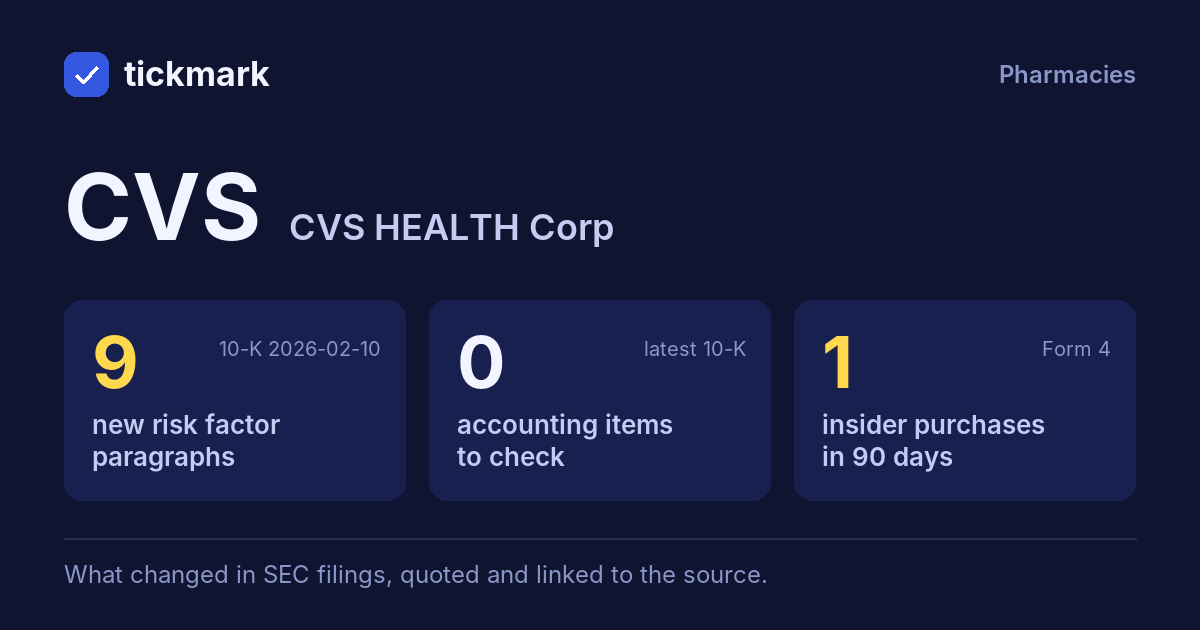
10-K 0000064803-26-000010 (2026-02-10) vs 10-K 0000064803-25-000007 (2025-02-12)
| Section | Compared text | Words now | Changed |
|---|
| Risk Factors | Item 1A | 19,588 |
19.0% |
| MD&A | Item 7 | 13,017 |
20.8% |
| Legal Proceedings | Item 3, via Note 18 – Commitments and Contingencies | 4,304 |
32.7% |
| Accounting Policies | Item 8, Note 1 – Significant Accounting Policies | 13,906 |
9.6% |
The redline: what was cut and what was added
In each section, the paragraph that changed most, marked against last year's 10-K:
cut words struck through, new words highlighted and underlined.
Risk Factors 248 words changed in this paragraph; it is 30% similar to last year's version.
•In April 2024, 2025, CMS issued its final notice detailing final 2025 2026 Medicare Advantage payment rates. Based on CMS’ notice, Medicare Advantage rates resulted in an expected average increase in revenue for the Medicare Advantage industry of 3.70%, which includes a risk score trend increase of 3.86%. Risk scores vary among Medicare Advantage plans depending on the specific population served, so this increase does not represent an actual guaranteed payment increase. Without including the risk score trend increase, the 2025 rates result in an expected average decrease in revenue for the Medicare Advantage industry of 0.16%, though the rates may vary widely depending on the provider group and patient demographics. On January 10, 2025, CMS issued an advance notice detailing proposed 2026 Medicare Advantage payment rates. The 2026 Medicare Advantage rates, if finalized as proposed, will result in an expected average increase in revenue for the Medicare Advantage industry of 4.33%, 7.16%, which includes a risk score trend increase of 2.10%. Without including the risk score trend increase, the advance 2026 rates will result in an expected average increase in revenue for the Risk scores vary among Medicare Advantage industry of 2.23%, though the rates may vary widely plans depending on the provider group and patient demographics. CMS intends to publish the final 2026 rate announcement no later than April 7, 2025. The Company faces challenges from the impact of the increasing cost of medical care (including prescription medications), changes to methodologies for determining payments and CMS local and national coverage decisions that require the Company to pay for services and supplies that are not factored into the Company’s bids. We cannot predict how the rates will be finalized, future Medicare funding levels, the impact of future federal budget actions or ensure that such changes or actions will not have a material adverse effect on our Medicare operating results.
Source: Item 1A, 10-K 0000064803-26-000010 vs Item 1A, 10-K 0000064803-25-000007
Legal Proceedings 194 words changed in this paragraph; it is 45% similar to last year's version.
U.S. ex rel. Bassan et al. v. Omnicare, Inc. and CVS Health Corp. (U.S. District Court for the Southern District of New York). In December 2019, the U.S. Attorney’s Office for the Southern District of New York filed a complaint-in-intervention in this previously sealed qui tam case. The complaint alleges that for certain non-skilled nursing facilities, Omnicare improperly filled prescriptions beyond one year where a valid prescription did not exist and that these dispensing events violated the federal False Claims Act. In April 2025, the jury found both Omnicare and CVS Health Corporation liable. The jury awarded approximately $136 million due to Omnicare’s conduct. This amount is automatically required to be tripled by statute to approximately $407 million. Accordingly, a litigation reserve was recorded related to this matter in the three months ended March 31, 2025. The jury found no damages attributable to CVS Health Corporation. In July 2025, the Court awarded penalties against Omnicare for $542 million, for which the Company recorded an incremental litigation reserve in the three months ended June 30, 2025. The Court also found CVS Health Corporation to be jointly and severally liable for $165 million of the $542 million in penalties. The Company is defending itself against these claims. has filed an appeal to the Second Circuit. As discussed in Note 1 ‘‘Significant Accounting Policies’’, on September 22, 2025, Omnicare initiated a voluntary court-supervised Chapter 11 bankruptcy process and was deconsolidated in the three months ended September 30, 2025. The litigation reserve of $165 million that CVS Health Corporation was jointly and severally liable for remained as a liability on the consolidated balance sheet at December 31, 2025.
Source: Item 3, via Note 18 – Commitments and Contingencies, 10-K 0000064803-26-000010 vs Item 3, via Note 18 – Commitments and Contingencies, 10-K 0000064803-25-000007
MD&A 134 words changed in this paragraph; it is 64% similar to last year's version.
Although the Company believes the financial projections used to determine the fair value of the Government Health Care Delivery reporting unit were reasonable and achievable, continued utilization pressure within pressure, insufficient CMS Medicare rate increases relative to underlying medical cost trend or further reductions to the Medicare product line and continued higher acuity in Medicaid number of existing primary care centers or new primary care center openings may affect the Company’s ability to increase operating income results in the Government Health Care Delivery reporting unit at the rate estimated when such goodwill impairment test was performed. Some of the key assumptions included in the Company’s financial projections to determine the estimated fair value of its Government Health Care Delivery reporting unit include future health care costs, changes in medical membership, revenue growth rates, operating margins including the impact of annual new primary care center openings, and operating expense ratios. income. The estimated fair value of the Government Health Care Delivery reporting unit is also dependent on multiples of market participants in the health insurance care delivery industry, as well as the risk-free interest rate environment which impacts the discount rate used in the discounted cash flow method. As If the Company does not achieve its forecasts, given that the fair value and the carrying value of December 31, 2024, the Health Care Delivery reporting unit were the same following the goodwill balance in impairment charge recorded during the Government reporting unit was approximately $21.2 billion. third quarter of 2025, it is reasonably
Source: Item 7, 10-K 0000064803-26-000010 vs Item 7, 10-K 0000064803-25-000007
Accounting Policies 105 words changed in this paragraph; it is 39% similar to last year's version.
During the years ended December 31, 2024, 2023, and 2022, the The Company recorded office real estate optimization charges of $30 million, $46 million, and $117 million, respectively, primarily related to the abandonment of leased real estate and the related right-of-use assets and property and equipment in connection with the planned reduction of continuously evaluates its corporate office real estate space in response to its ongoing flexible work arrangement. arrangement and changes in employee work arrangement requirements to ensure it has the appropriate space to support the business. As a result of its assessment, the Company determined that it would vacate and abandon certain leased corporate office spaces. During the years ended December 31, 2025, 2024 and 2023, the Company recorded $10 million, $30 million, and $46 million, respectively, of office real estate optimization charges primarily related to operating lease right-of-use assets and property and equipment. The office real estate optimization charges were recorded in operating expenses within each segment.
Source: Item 8, Note 1 – Significant Accounting Policies, 10-K 0000064803-26-000010 vs Item 8, Note 1 – Significant Accounting Policies, 10-K 0000064803-25-000007
Every change, by type
Sentences and paragraphs of CVS's Risk Factors and MD&A, 10-K 2026-02-10 against 10-K 2025-02-12.
Each links to the text at sec.gov.
Quiet changes are sentences kept from last year with one to four words changed, at least one of them a hedge, a modal or a qualifier
(may, could, will, not, significant, material…). A year or date rolling forward is not counted.
The full word list
adverse, adversely, all, although, anticipate, anticipates, any, approximately, believe, believes, can, cannot, certain, could, expect, expects, generally, however, if, intend, intends, largely, likely, many, material, materially, may, might, most, must, never, no, not, possible, primarily, probable, should, significant, significantly, some, substantial, substantially, unlikely, will, would
AddedRisk Factors
•We may face increased regulatory risks related to our vertical integration strategy, such as legislation prohibiting state licensure of pharmacies affiliated with a PBM.
Read it in 10-K 2026-02-10 at sec.gov ↗
AddedRisk Factors
•Our Health Care Benefits segment’s operating results and competitiveness is heavily impacted, in the case of Medicaid programs, by the sufficiency of the rates the states determine are actuarially sound based on experience from previous years. Such rate levels may not be representative of actual experience, and insufficient rates will negatively impact our revenues and operating results.
Read it in 10-K 2026-02-10 at sec.gov ↗
AddedRisk Factors
•Direct-to-consumer (“DTC”) sales of prescription drugs by pharmaceutical companies is a growing trend in the United States. By implementing DTC sales platforms, pharmaceutical companies can advertise, or sell, their own branded drugs directly to patients, bypassing traditional distribution channels and intermediaries, including pharmacies and PBMs. DTC platforms may also increase demand for expensive, brand-name drugs that may not provide significant clinical benefit over more cost-effective alternatives. As a result, the DTC trend may increase overall health care costs for consumers and adversely impact the performance of the Company’s Pharmacy & Consumer Wellness and Health Services segments.
Read it in 10-K 2026-02-10 at sec.gov ↗
AddedRisk Factors
•In April 2025, CMS issued its final notice detailing final 2026 Medicare Advantage payment rates. Based on CMS’ notice, Medicare Advantage rates resulted in an expected average increase in revenue for the Medicare Advantage industry of 7.16%, which includes a risk score trend increase of 2.10%. Risk scores vary among Medicare Advantage plans depending
Read it in 10-K 2026-02-10 at sec.gov ↗
AddedRisk Factors
•State Medicaid agencies regularly audit, and state officials regularly investigate, the Company’s performance across all areas of its contractual obligations to the state to determine compliance and quality of services. The Company may be subject to, among other penalties, significant fines, sanctions, corrective actions, and enrollment freezes depending on the findings of these audits and reviews. The Company’s ongoing performance and compliance with program requirements can impact our ability to expand and retain Medicaid business. State Medicaid agencies are also increasingly using the audit process to challenge the legality of PBM practices, such as guaranteed effective rate reconciliations with retail pharmacies and transmission fees.
Read it in 10-K 2026-02-10 at sec.gov ↗
AddedRisk Factors
•The “Working Families Tax Cut Act,” formerly the “One Big Beautiful Bill Act,” of 2025 makes changes to Medicaid eligibility rules and financing which will lead to reduced eligibility for Medicaid beneficiaries, particularly expansion populations, and reduced state funding, which will impact Medicaid benefits and payment rates. Given these changes, states that have not already done so are unlikely to consider Medicaid expansion.
Read it in 10-K 2026-02-10 at sec.gov ↗
AddedRisk Factors
our control, including general economic conditions, continuing government efforts to contain health care costs and budgetary constraints at the federal or applicable state or local level and general political issues and priorities.
Read it in 10-K 2026-02-10 at sec.gov ↗
AddedRisk Factors
There can be no assurance that we have been able to, or will be able to, adequately prevent, detect, and/or remediate such data security incidents.
Read it in 10-K 2026-02-10 at sec.gov ↗
AddedRisk Factors
The use of AI and related technology may also increase exposure to reputational, cybersecurity, data privacy, legal, regulatory and operational risks as AI technology rapidly evolves along with public opinion concerning the use of AI and the associated legal and regulatory framework. These risks include, but are not limited to, heightened exposure to cybersecurity incidents or the misuse of data during the integration of AI models and large data sets; increased potential liability and costs associated with complying with rapidly emerging regulatory frameworks; costs and competitive disadvantages associated with the failure to properly integrate AI into existing operations; and reputational harm caused by actual or perceived failures in the performance of AI or AI-related technology.
Read it in 10-K 2026-02-10 at sec.gov ↗
RemovedRisk Factors
•We can provide no assurance that we will be able to compete successfully and profitably on Public Exchanges.
Read it in 10-K 2025-02-12 at sec.gov ↗
RemovedRisk Factors
•A cyberattack or other information security incident could significantly disrupt our operations.
Read it in 10-K 2025-02-12 at sec.gov ↗
RemovedRisk Factors
•Pursuing multiple information technology improvement initiatives simultaneously could make continued development and implementation significantly more challenging.
Read it in 10-K 2025-02-12 at sec.gov ↗
RemovedRisk Factors
•If our suppliers or service providers fail to meet their contractual obligations to us or to comply with applicable laws or regulations, we may be exposed to brand and reputational harm, litigation and/or regulatory action.
Read it in 10-K 2025-02-12 at sec.gov ↗
RemovedRisk Factors
•We may experience increased medical and other benefit costs, litigation risk and customer and member dissatisfaction when providers that do not have contracts with us render services to our Health Care Benefits members.
Read it in 10-K 2025-02-12 at sec.gov ↗
RemovedRisk Factors
While the public health emergency related to COVID-19 expired in May 2023, COVID-19 still exists and it may, like many other respiratory viruses, wax and wane depending on geography and seasonality. The future impact COVID-19 will have on the Company and its ability to accurately forecast health care and other benefit costs is uncertain, and will depend on geographies impacted, whether new variants emerge and their severity, the availability and costs of testing, vaccination and treatment, and legal and regulatory actions. COVID-19 may also impact provider behavior, utilization trends, membership, and overall economic conditions. These impacts could be adverse and material.
Read it in 10-K 2025-02-12 at sec.gov ↗
RemovedRisk Factors
•The operating results and margins of our LTC business are further affected by the increased efforts of health care payors to negotiate reduced or capitated pricing arrangements and by the financial health of, and purchases and sales of, our LTC customers.
Read it in 10-K 2025-02-12 at sec.gov ↗
RemovedRisk Factors
•participation in CMS Innovation Center models, such as ACO REACH, which are subject to changes annually, generally in ways meant to reduce available payments to participants, including benchmarks that can be changed after the end of the performance year, and which has an end date without a plan for ongoing participation in a model by those participating;
Read it in 10-K 2025-02-12 at sec.gov ↗
RemovedRisk Factors
•impacts of fraud or anomalous billing on shared savings in CMS Innovation Center models;
Read it in 10-K 2025-02-12 at sec.gov ↗
RemovedRisk Factors
•success in large, national ACOs is dependent on the collective efforts and compliance of a wide range of participating clients, and for those clients to be able to meet new and changing requirements such as changes to interoperability and reporting requirements; and
Read it in 10-K 2025-02-12 at sec.gov ↗
RemovedRisk Factors
•challenges in rural and post-acute reimbursement due to their significant dependence on fee-for-service revenue.
Read it in 10-K 2025-02-12 at sec.gov ↗
RemovedRisk Factors
Our Oak Street Health business is subject to additional risks including, but not limited to, the following:
Read it in 10-K 2025-02-12 at sec.gov ↗
RewordedRisk Factors
It is reasonably possible that our business operations and operating results could be materially adversely affected by legislative, enforcement, regulatory and public policy changes at the federal or state level, including, but not limited to: changes to the regulatory environment for health care and related benefits, including Medicare, Medicare Advantage, the ACA, and related Public Exchange regulations; changes in the 340B program, including the resumption of the Pilot and any expansion thereof; efforts to amend the ACA and related regulations, including through litigation aimed at challenging the ability to enforce portions of the ACA, such as the preventative services mandate; changes to laws or regulations governing drug reimbursement, pricing, purchasing and/or importation; changes to or adoption of laws or regulations governing PBMs, including those related to prohibiting pharmacy licensure for pharmacies affiliated with a PBM, network restrictions, formulary management, affiliate reimbursement, contractual guarantees and reconciliations, reimbursement mandates, required reporting, compensation, purchase discount and/or rebate arrangements with drug manufacturers and/or other PBM services; changes to the laws and regulations governing PBMs’, PDPs’ and/or Managed Medicaid organizations’ interactions with government funded health care programs; changes to or adoption of laws and/or regulations relating to claims processing and billing; changes to immigration policies; changes to patent laws; changes with respect to tax and trade policies, tariffs and other government regulations affecting trade between the U.S. and other countries; and other public policy initiatives.
Read it in 10-K 2026-02-10 at sec.gov ↗
RewordedRisk Factors
A legislative or regulatory change to the ability of Medicare Advantage plans to use home visits as a means to evaluate and diagnosis diagnose their members’ health conditions, or substantial changes in the risk adjustment mechanism, including those mechanism or other changes that may result from enforcement or audit actions, could: materially affect the final Part C contract-level Risk Adjustment amount of our Medicare reimbursement, require us to raise prices or reduce the benefits we offer to Medicare beneficiaries, impact the services provided by, or the financial performance of, Oak Street Health and Signify Health and potentially limit our (and the industry’s) participation in the Medicare program.
Read it in 10-K 2026-02-10 at sec.gov ↗
RewordedRisk Factors
Negative publicity may come as a result of adverse media coverage, litigation against us and other industry participants, the ongoing public debates over drug pricing, PBMs, government involvement in drug pricing and purchasing, changes to the ACA, governmental hearings and/or investigations, actual or perceived shortfalls regarding our industries’ or our own products, including Medicare Advantage plans in general, and/or business practices (including PBM operations, drug pricing and insurance coverage determinations) and social media and other media relations activities.
Read it in 10-K 2026-02-10 at sec.gov ↗
RewordedRisk Factors
For example, during the third first quarter of 2024, 2025, we recorded a premium deficiency reserves reserve of approximately $1.1 billion $448 million related to our Medicare, individual exchange product line and Medicaid during the second quarter of 2025, we recorded a premium deficiency reserve of $471 million related to our Group Medicare Advantage product lines line within the Health Care Benefits segment, primarily related to anticipated losses for the 2024 remainder of the 2025 coverage year.
Read it in 10-K 2026-02-10 at sec.gov ↗
RewordedRisk Factors
Our health care delivery businesses, which we expanded with acquisitions to include health risk assessments, value-based assessments and primary care and provider enablement services through our Signify Health business, and additional services, including senior-focused value-based primary care services for Medicare eligible patients through our Oak Street Health business, patients, face unique risks. risks which include, but are not limited to, the following:
Read it in 10-K 2026-02-10 at sec.gov ↗
RewordedRisk Factors
Based on the 2024 ratings, 88% Company’s membership as of December 2025, more than 81% of the Company’s Medicare Advantage members are were in 2025 2026 Medicare Advantage plans that are rated 4 stars or higher. higher and more than 63% of the Company’s Medicare Advantage members were in a 4.5-star plan for 2026.
Read it in 10-K 2026-02-10 at sec.gov ↗
RewordedRisk Factors
Our businesses, profitability and growth also may be adversely affected by (i) judicial and regulatory decisions that change and/or expand the interpretations of existing statutes and regulations, expand fiduciary obligations, impose medical or bad faith liability, increase our responsibilities under ERISA or the remedies available under ERISA, or reduce the scope of ERISA and Medicare Part D preemption of state law claims or (ii) other legislation and regulations.
Read it in 10-K 2026-02-10 at sec.gov ↗
RewordedRisk Factors
The occurrence of natural disasters or extreme weather events, such as hurricanes, tropical storms, floods, wildfires, earthquakes, tsunamis, cyclones, typhoons, extended winter storms, droughts and tornadoes; droughts, tornadoes, epidemics, pandemics or disease outbreaks and other extreme events and man-made disasters, such as nuclear or biological attacks or other acts of violence, such
Read it in 10-K 2026-02-10 at sec.gov ↗
RewordedRisk Factors
Our risk profile is changing as we offer new products and services and expand in business areas beyond our historical businesses, and we We may face increased regulatory risks related to our vertical integration strategy.
Read it in 10-K 2026-02-10 at sec.gov ↗
RewordedRisk Factors
Programs funded in whole or in part by the U.S. federal government account for a significant portion of our revenues, are particularly sensitive to reduced government funding and we expect that percentage to increase. regulatory changes.
Read it in 10-K 2026-02-10 at sec.gov ↗
RewordedRisk Factors
The lack of detail provided with respect to how CMS will select contracts and claims to audit, audit and the methodology CMS will use, and how it will extrapolate as part of the RADV Audit Rule use may impact future Medicare Advantage bids and result in other implications.
Read it in 10-K 2026-02-10 at sec.gov ↗
RewordedRisk Factors
As one of the largest national retail, mail order, specialty and LTC pharmacy, PBM and health care and related benefits providers, companies in the nation, we frequently are subject to regular and special governmental market conduct and other audits, investigations and reviews by, and we receive subpoenas and other requests for information from, various federal and state agencies, regulatory authorities, Attorneys General, committees, subcommittees and members of the U.S.
Read it in 10-K 2026-02-10 at sec.gov ↗
Quiet changesRisk Factors
Without including the risk score trend increase, the advance 2026 rates will result in an expected average increase in revenue for the Medicare Advantage industry of 2.23%, 5.06%, though the rates may vary widely depending on the provider group and patient demographics.
Read it in 10-K 2026-02-10 at sec.gov ↗
Quiet changesRisk Factors
However, our remaining Our international operations present political, legal, compliance, operational, regulatory, economic and other risks that we do not face or that are more significant than in our domestic operations.
Read it in 10-K 2026-02-10 at sec.gov ↗
AddedMD&A
•Operating expenses increased $3.3 billion, or 7.8%, in 2025 compared to 2024. The increase in operating expenses was primarily due to approximately $1.2 billion of legacy litigation charges related to two court decisions associated with the Company’s past business practices, a $320 million opioid litigation charge related to a change in the Company’s accrual for ongoing opioid litigation matters and $288 million of pre-tax losses on Accountable Care assets, all recorded in 2025, as well as increased investments in colleagues and capabilities in 2025.
Read it in 10-K 2026-02-10 at sec.gov ↗
AddedMD&A
•The Company’s effective income tax rate decreased to 19.1% in 2025 compared to 25.4% in the prior year due to a worthless stock deduction associated with a subsidiary that filed for bankruptcy in 2025, partially offset by the impact of the goodwill impairment charge and the legacy litigation charges recorded during 2025 described above, both of which were not deductible for income tax purposes.
Read it in 10-K 2026-02-10 at sec.gov ↗
AddedMD&A
(4)In 2025, the goodwill impairment charge relates to the Health Care Delivery reporting unit within the Health Services segment.
Read it in 10-K 2026-02-10 at sec.gov ↗
AddedMD&A
(5)In 2025, the Health Care Delivery clinic closure charge primarily relates to the write down of long-lived assets in connection with the planned closure of certain existing Oak Street Health clinics in 2026, as well as associated severance and employee-related costs expected to be incurred. The Health Care Delivery clinic closure charge is reflected in operating expenses within the Health Services segment.
Read it in 10-K 2026-02-10 at sec.gov ↗
AddedMD&A
(8)In 2025, the Company recorded legacy litigation charges related to two court decisions associated with its past business practices.
Read it in 10-K 2026-02-10 at sec.gov ↗
AddedMD&A
In April 2025, a jury found Omnicare and CVS Health Corporation liable in connection with alleged violations of the federal False Claims Act related to dispensing practices by Omnicare from 2010, prior to its acquisition by the Company in 2015, through 2018. Damages were found only with respect to Omnicare. Accordingly, the Company recorded a litigation charge of $387 million during the first quarter of 2025. During the second quarter of 2025, the Company recorded a charge of $542 million, reflecting penalties assessed under the False Claims Act. These litigation charges are reflected in operating expenses within the Pharmacy & Consumer Wellness segment.
Read it in 10-K 2026-02-10 at sec.gov ↗
AddedMD&A
In June 2025, a court found certain subsidiaries of CVS Health Corporation liable for damages in connection with a complaint filed in February 2014, in which the government declined to intervene, related to PBM direct and indirect remuneration reporting practices for two clients from 2010 through 2016, which the Company has since modified. In connection with this court decision, the Company recorded a litigation charge of $291 million during the second quarter of 2025. This litigation charge is reflected in operating expenses within the Health Services segment.
Read it in 10-K 2026-02-10 at sec.gov ↗
AddedMD&A
•Adjusted operating income increased $2.6 billion in 2025 compared to 2024 primarily driven by improved underlying performance in the Government business and higher favorable prior year development.
Read it in 10-K 2026-02-10 at sec.gov ↗
AddedMD&A
During 2025, the Health Care Delivery reporting unit continued to experience challenges, including the impact of persistent elevated utilization levels. In order to best respond to these challenges, the Company made a number of changes to its Health Care Delivery management team during 2025. During the third quarter of 2025, this new management team finalized certain strategic changes, including the determination that it would reduce the number of new primary care clinics it would open in 2026 and annually thereafter. The Company also determined that it would close certain existing Oak Street Health clinics in 2026. The strategy changes were presented to CVS Health Corporation’s Board of Directors in September 2025.
Read it in 10-K 2026-02-10 at sec.gov ↗
AddedMD&A
possible in the near term that the goodwill of the Health Care Delivery reporting unit could be deemed to be impaired again by a material amount. As of December 31, 2025, the remaining goodwill balance in the Health Care Delivery reporting unit was approximately $4.2 billion.
Read it in 10-K 2026-02-10 at sec.gov ↗
RemovedMD&A
•The Company’s effective income tax rate increased to 25.4% in 2024 compared to 25.1% in the prior year. The increase was primarily due to the mix of pre-tax income and certain non-deductible expenses, partially offset by basis differences on the disposition of certain investments and utilization of tax credits in the year ended December 31, 2024 compared to the prior year.
Read it in 10-K 2025-02-12 at sec.gov ↗
RemovedMD&A
•The Company expects medical membership declines in its Medicare and individual exchange products. Medical membership disruptions may result in volatility in the Company’s financial results.
Read it in 10-K 2025-02-12 at sec.gov ↗
RemovedMD&A
•Increases in utilization beyond the Company’s projections may also result in the Company having to record premium deficiency reserves within in the Health Care Benefits segment during 2025.
Read it in 10-K 2025-02-12 at sec.gov ↗
RemovedMD&A
•The Company’s Medicaid business is experiencing medical cost pressures, largely driven by higher than expected acuity following the resumption of member redeterminations. While the Company continues to work closely with its state partners to ensure the underlying trends are reflected in its premium rates going forward, it is uncertain when these pressures will be fully offset by state rate updates.
Read it in 10-K 2025-02-12 at sec.gov ↗
RemovedMD&A
•The Company’s individual exchange business is subject to a risk adjustment program whereby the Company estimates its ultimate risk adjustment receivable or payable based on the risk of its qualified plan members relative to the average risk of members of other qualified plans in comparable markets. Changes in the Company’s risk relative to the markets’ risk, including changes resulting from volatility in membership, could adversely impact the Company’s estimate of its risk adjustment receivable or payable.
Read it in 10-K 2025-02-12 at sec.gov ↗
RemovedMD&A
•Glucagon-like peptide 1 (“GLP-1”) supply disruptions, and the associated impact on product mix, could pressure the Company’s ability to deliver savings to clients and could impact the Company’s results.
Read it in 10-K 2025-02-12 at sec.gov ↗
RemovedMD&A
•Regulatory changes or consumer sentiment shift for immunizations may negatively impact national demand impacting financial results.
Read it in 10-K 2025-02-12 at sec.gov ↗
RemovedMD&A
•Future financial performance will be influenced by a number of factors including competitive demand for products and services, legislative and regulatory considerations, and labor and other market dynamics, including inflation. The Company evaluates and adjusts its approach in each of the markets it serves, considering all relevant factors.
Read it in 10-K 2025-02-12 at sec.gov ↗
RemovedMD&A
•The Company expects benefits from ongoing enterprise-wide cost savings initiatives and investments in efficiencies, which aim to reduce the Company’s operating cost structure in a way that improves the consumer experience and is sustainable. During the third quarter of 2024, the Company finalized an enterprise-wide restructuring plan intended to streamline and simplify the organization, improve efficiency and generate expected cost savings of over $500 million in 2025. Refer to Note 3 ‘‘Restructuring’’ for actions implemented under the plan.
Read it in 10-K 2025-02-12 at sec.gov ↗
RemovedMD&A
•Changes in conditions in the U.S. and global capital markets can significantly and adversely affect interest rates and capital market conditions which could result in increased financing costs.
Read it in 10-K 2025-02-12 at sec.gov ↗
RemovedMD&A
•Actions taken by ratings agencies, including changes in the Company’s debt ratings, could impact the Company’s future borrowing costs, access to capital markets and new store operating lease costs.
Read it in 10-K 2025-02-12 at sec.gov ↗
RemovedMD&A
•As you review the Health Services segment’s performance in this area, you should consider the following important information about the business:
Read it in 10-K 2025-02-12 at sec.gov ↗
RewordedMD&A
Year Ended December 31, 2024 2025 In millions Health Care Health Pharmacy & Corporate/ Consolidated Benefits Services Consumer Other Totals Wellness Operating income (loss) (GAAP measure) $ (984) 1,793 $ 6,937 220 $ 4,770 4,860 $ (2,207) (2,213) $ 8,516 4,660 Amortization of intangible assets (1) 1,175 595 253 2 2,025 1,155 569 249 3 1,976 Net realized capital (gains) losses (2) 97 (289) (13) (25) — 75 (117) 82 44 Acquisition-related integration costs (3) — — — 243 243 Restructuring charges 117 117 Goodwill impairment (4) — 5,725 — 747 432 1,179 — 5,725 Health Care Delivery clinic closure charge (5) — 83 — — 83 Opioid litigation charge (6) — — — 320 320 Office real estate optimization charges (5) 19 (7) 4 — 2 4 7 30 Opioid 10 Legacy litigation charges (6) (8) — 291 929 — 1,220 Loss on Accountable Care assets (9) — 288 — — — 100 100 288 Adjusted operating income (loss) $ 307 2,939 $ 7,243 7,151 $ 5,774 6,040 $ (1,348) (1,687) $ 11,976 14,443
Read it in 10-K 2026-02-10 at sec.gov ↗
RewordedMD&A
On May 9, 2024, August 15, 2025, the Company issued $1.0 $750 million aggregate principal amount of 5.0% senior notes due September 2032, $1.5 billion aggregate principal amount of 5.4% 5.45% senior notes due June 2029, $1.0 billion aggregate principal amount of 5.55% senior notes due June 2031, September 2035, $1.25 billion aggregate principal amount of 5.7% 6.2% senior notes due June 2034, $750 September 2055 and $500 million aggregate principal amount of 6.0% 6.25% senior notes due June 2044 and $1.0 billion aggregate principal amount of 6.05% senior notes due June 2054 September 2065 for total proceeds of approximately $5.0 $4.0 billion, net of discounts and underwriting fees.
Read it in 10-K 2026-02-10 at sec.gov ↗
RewordedMD&A
In millions Total Current Long-Term Operating lease liabilities (1) $ 21,189 19,387 $ 2,683 2,626 $ 18,506 16,761 Finance lease liabilities (1) 2,038 144 1,894 1,960 139 1,821 Contractual lease obligations with Target (2) 2,217 2,268 — 2,217 Commercial paper (3) 2,119 2,119 — 2,268 Long-term debt (3) 63,268 3,559 59,709 63,709 4,007 59,702 Interest payments on long-term debt (3) 42,240 2,892 39,348 44,003 2,933 41,070 Opioid litigation settlement obligations (4) 4,792 814 3,978 3,975 648 3,327 Other long-term liabilities on the consolidated balance sheets (5) Future policy benefits (6) 4,560 371 4,189 4,477 360 4,117 Unpaid claims (6) 993 280 713 801 202 599 Policyholders’ funds (6) (7) 1,270 869 401 937 615 322 Total $ 144,686 141,517 $ 13,731 11,530 $ 130,955 129,987
Read it in 10-K 2026-02-10 at sec.gov ↗
RewordedMD&A
Although the Company believes the financial projections used to determine the fair value of the Government Health Care Delivery reporting unit were reasonable and achievable, continued utilization pressure within pressure, insufficient CMS Medicare rate increases relative to underlying medical cost trend or further reductions to the Medicare product line and continued higher acuity in Medicaid number of existing primary care centers or new primary care center openings may affect the Company’s ability to increase operating income results in the Government Health Care Delivery reporting unit at the rate estimated when such goodwill impairment test was performed.
Read it in 10-K 2026-02-10 at sec.gov ↗
RewordedMD&A
The Health Services segment’s clients and customers are primarily employers, insurance companies, unions, government employee groups, health plans, PDPs, Medicaid managed care plans, CMS, plans offered on public and private health insurance exchanges and other sponsors of health benefit plans throughout the U.S., patients who receive care in the Health Services segment’s medical clinics, virtually or in the home, as well as Covered Entities. U.S.
Read it in 10-K 2026-02-10 at sec.gov ↗
RewordedMD&A
In connection with its commercial paper program, the Company maintains a three $2.5 billion, five-year unsecured back-up revolving credit facility, facilities, which expires on expire in May 11, 2027, a $2.5 billion, five-year unsecured back-up revolving credit facility, which expires on May 16, 2028, 2029 and a $2.5 billion, five-year unsecured back-up revolving credit facility, which expires on May 16, 2029. 2030.
Read it in 10-K 2026-02-10 at sec.gov ↗
RewordedMD&A
Upon assessment of the impact of Based on these factors on the Company’s year-to-date 2024 results and its expectations for the full year, the Company updated projections, management determined that there were indicators that the Government Health Care Delivery reporting unit’s goodwill may be impaired, and impaired and, accordingly, performed an interim goodwill impairment test was performed during the third quarter of 2024. 2025.
Read it in 10-K 2026-02-10 at sec.gov ↗
RewordedMD&A
Year Ended December 31, 2024 In millions Health Care Health Pharmacy & Corporate/ Consolidated Benefits Services Consumer Other Totals Wellness Operating income (loss) (GAAP measure) $ (984) $ 6,937 $ 4,770 $ (2,207) $ 8,516 Amortization of intangible assets (1) 1,175 595 253 2 2,025 Net realized capital (gains) losses (2) 97 (289) — 75 (117) Acquisition-related integration costs (3) — — — 243 243 Restructuring charges (4) — — 747 432 1,179 Office real estate optimization charges (5) 19 — 4 7 30 Opioid litigation charges charge (6) — — — 100 100 Office real estate optimization charges (7) 19 — 4 7 30 Restructuring charges (10) — — 747 432 1,179 Adjusted operating income (loss) $ 307 $ 7,243 $ 5,774 $ (1,348) $ 11,976
Read it in 10-K 2026-02-10 at sec.gov ↗
RewordedMD&A
The senior notes purchased include: $226 million of its 4.1% senior notes due March 2025, $398 million of its 4.125% senior notes due April 2040, $883 million of its 2.7% senior notes due August 2040, $274 million of its 4.125% senior notes due November 2042, $463 million of its 3.875% senior notes due August 2047 and $351 million of its 4.25% senior notes due April 2050.
Read it in 10-K 2026-02-10 at sec.gov ↗
RewordedMD&A
The senior notes purchased include: $226 million of its 4.1% senior notes due March 2025, $398 million of its 4.125% senior notes due April 2040, $883 million of its 2.7% senior notes due August 2040, $274 million of its 4.125% senior notes due November 2042, $463 million of its 3.875% senior notes due August 2047 and $351 million of its 4.25% senior notes due April 2050.
Read it in 10-K 2026-02-10 at sec.gov ↗
RewordedMD&A
The Health Centers for Medicare & Medicaid Services segment’s clients and customers are primarily employers, insurance companies, unions, government employee groups, health plans, PDPs, Medicaid managed care plans, CMS, (“CMS”), plans offered on public and private health insurance exchanges and other sponsors of health benefit plans throughout the U.S., patients who receive care in the Health Services segment’s medical clinics, virtually or in the home, as well as Covered Entities.
Read it in 10-K 2026-02-10 at sec.gov ↗
RewordedMD&A
(7)In 2023 and 2022, (11)In 2023, the loss on assets held for sale relates to the LTC business long-term care pharmacy (“LTC”) business, which was included within the Pharmacy & Consumer Wellness segment. segment prior to the deconsolidation of the Omnicare Entities in September 2025.
Read it in 10-K 2026-02-10 at sec.gov ↗