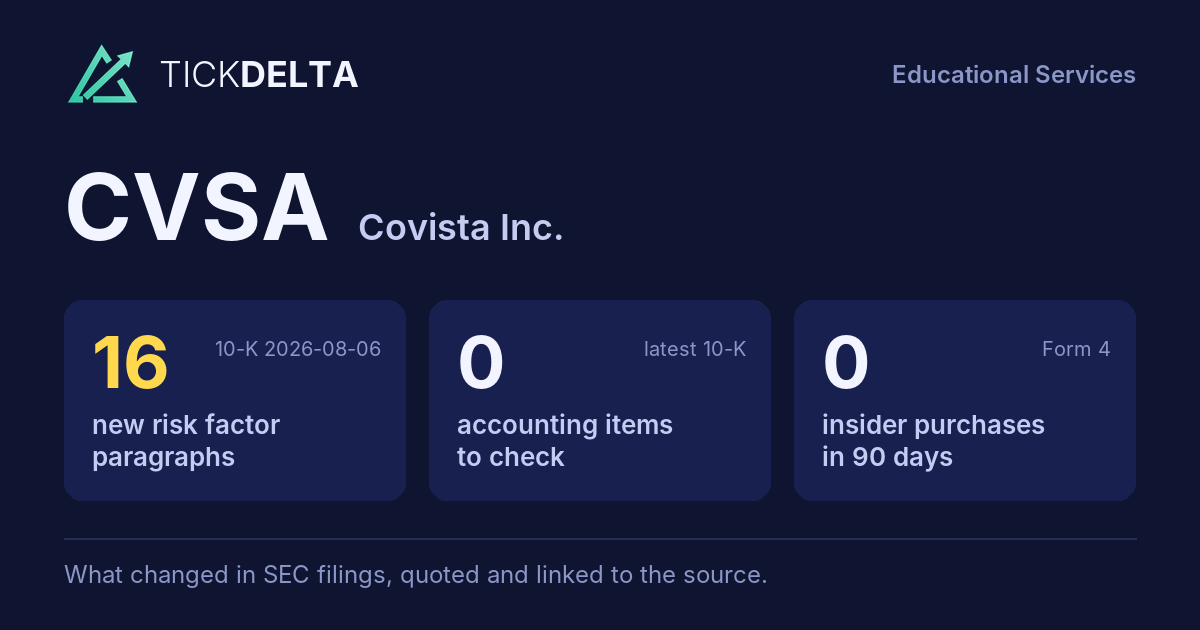
Screener / SEC EDGAR /CIK 0000730464 /10-K filed Aug 6, 2026, compared with Aug 7, 2025 /Numbers from the XBRL of the 10-Ks
NYSE Consumer discretionary · Educational Services

Covista Inc. CVSA

Compare with peers Embed
The 10-K against last year's

145 changes: 24 added, 19 removed, 101 reworded, 1 quiet changes

10-K Aug 6, 2026 vs Aug 7, 2025

10-K 0001104659-26-092044 (Aug 6, 2026) vs 10-K 0001558370-25-010780 (Aug 7, 2025)

Every paragraph, and how much of it changed

One bar per paragraph, in the order of the 10-K. Height and colour show the share of its words not in the closest paragraph a year earlier; the tallest bars are new paragraphs.

Risk Factors

133 paragraphs · 16 new · 50 reworded · 4 gone · 10-K Aug 6, 2026 against Aug 7, 2025
New paragraph Reworded (5% of its words or more) Same or nearly
Paragraph 116 · 46% changed Every version of it
Our effective tax rate could be subject to volatility or be adversely impacted by changes to federal may fluctuate as a result of evolving U.S. and international tax laws governing the taxation of foreign earnings of U.S. based companies. For example, recent changes to U.S. tax laws significantly impacted how U.S. multinational corporations are taxed on foreign earnings. Numerous countries are evaluating their existing tax laws, due in part to recommendations made by rules, including those stemming from the Organization for Economic Co-operation and Development’s (“OECD’s”) Base Erosion and Profit Shifting (“BEPS”) project. initiative. This project includes a two-pillar approach to global taxation focusing on global project profit allocation (Pillar One) and a global minimum tax rate of 15% (Pillar Two). Certain jurisdictions in which we operate enacted legislation consistent The implementation of Pillar Two’s 15% global minimum tax, along with one or more of related coordination frameworks such as the OECD Pillar Two model rules, which, in general, are applicable for our fiscal year 2025. We are continuing to evaluate emerging developments related to the Pillar Two model rules and related legislation in recently introduced “side-by-side” approach, is ongoing across multiple jurisdictions in which we operate. As countries adopt these rules, we may experience increased compliance costs, greater complexity in our tax profile, and higher cash taxes. These changes increase tax uncertainty and may developments could adversely impact our effective tax rate and results of operations in future years.
Paragraph 124 · 46% changed Every version of it
Our ability to make scheduled payments on or to refinance our debt obligations depends on our and our subsidiaries’ financial condition and operating performance, which is subject to prevailing economic and competitive conditions and to certain financial, business, competitive, legislative, regulatory, and other factors beyond our control. As a result, we may not be able to maintain a level of cash flows from operating activities sufficient to permit us to pay the principal and interest on our indebtedness. In addition, because we conduct a significant portion of our operations through our subsidiaries, repayment of our indebtedness is also dependent on the generation of cash flow by our subsidiaries and their ability to make such cash available to us by dividend, debt repayment, or otherwise. Our subsidiaries are distinct legal entities and other than the guarantors on our indebtedness, they do not have any obligation to pay amounts due on the Notes or to make funds available for that purpose or for other obligations. Pursuant to applicable state limited liability company laws and other laws and regulations, our non-guarantor subsidiaries may not be able to, or may not be permitted to, make distributions to us in order to enable us to make payments in respect of the Notes (as defined in Note 13 “Debt” to the Consolidated Financial Statements in Item 8. “Financial Statements and Supplementary Data”) and our Term Loan B (as defined in Note 13 “Debt” to the Consolidated Financial Statements in Item 8. “Financial Statements and Supplementary Data”). debt obligations. In the event that we do not receive distributions from our non-guarantor subsidiaries, we may be unable to make required principal and interest payments on our indebtedness.
Paragraph 119 · 45% changed Every version of it
Our future effective tax rates could be subject to volatility or adversely affected by: earnings being lower than anticipated in countries where we have lower statutory rates and higher than anticipated earnings in countries where we have higher statutory rates; changes in the valuation of our deferred tax assets and liabilities; expiration of or lapses in various tax law provisions; tax treatment of stock-based compensation; costs related to intercompany or other restructurings; or other changes in tax rates, laws, regulations, accounting principles, or interpretations thereof. In addition, we We are also subject to examination of our income tax returns by the Internal Revenue Service and other tax authorities. authorities, which may result in adjustments to our tax liabilities that could be material. We regularly assess the likelihood of adverse outcomes resulting from these examinations to determine in determining the adequacy of our provision for income taxes. Although tax provision. While we have accrued tax taxes and related interest for potential adjustments to tax liabilities for prior years, there can be no assurance that prior-year adjustments, the outcomes from ultimate resolution of these continuous examinations will not matters could have a material effect, impact, either positive favorable or negative, unfavorable, on our business, financial condition, and results of operations.
Paragraph 53 · 43% changed Every version of it
In the event of a bankruptcy filing by Adtalem, Covista, all of our Title IV institutions would lose their eligibility to participate in Title IV programs, pursuant to statutory provisions of the HEA, notwithstanding the automatic stay provisions of federal bankruptcy law, which would make any reorganization difficult to implement. Similarly, in the event of a bankruptcy filing by any of Adtalem’s subsidiaries that own a Title IV institution, such institution would lose its eligibility to participate in Title IV programs. In the event of any bankruptcy affecting one or more of our Title IV institutions, ED could hold our other Title IV institutions jointly liable for any Title IV program liabilities, whether asserted or unasserted at the time of such bankruptcy, of the institution whose Title IV program eligibility was terminated.
Paragraph 28 · 38% changed Every version of it
The U.S. Congress can change the laws affecting Title IV programs in annual federal appropriations bills and other laws it enacts between the HEA reauthorizations, as it did in the recent OBBBA, as discussed in detail in Item 7. “Management’s Discussion OBBBA. We are continuing to evaluate and Analysis of Financial Condition implement the changes made by OBBBA and Results of Operations.” the effect those changes may have on Covista.
Paragraph 44 · 29% changed Every version of it
Each of our Title IV institutions operates under a PPA. There can be no assurance that ED will recertify an institution any of our institutions after its PPA expires or that ED will not limit the period of recertification to participate in Title IV programs to less than six years, place the institution on provisional certification, or impose conditions or other restrictions on the institution as a condition of granting our application for recertification. If ED does not renew or withdraws the certification to participate in Title IV programs for one or more of our institutions at any time, students at such institution would no longer be able to receive Title IV program funds. Alternatively, ED could (1) renew the certifications for an institution, but restrict or delay receipt of Title IV funds, limit the number of students to whom an institution could disburse such funds, or place other restrictions on that institution, or (2) delay recertification after an institution’s PPA expires, in which case the institution’s certification would continue on a month-to-month basis, any of which could have a material adverse effect on the businesses, financial condition, results of operations, and cash flows of the institution or Adtalem as a whole and could result in the imposition of significant restrictions on the ability of the institution or Adtalem as a whole to operate. See “Program Participation Agreement” in Item 1. “Business” for additional information.
Paragraph 68 · 25% changed Every version of it
In addition, the reduction or elimination of these non-Title IV non-federal sources of student funding may adversely affect our 90/10 Rule percentage. See “The 90/10 Rule” in Item 1. “Business” for additional information.
Paragraph 90 · 24% changed Every version of it
Natural disasters or other extraordinary events events, political disruptions, armed conflicts or political disruptions wars may interrupt our operations, cause us to close some of our schools schools, or suffer casualty losses.

MD&A

100 paragraphs · 8 new · 63 reworded · 15 gone · 10-K Aug 6, 2026 against Aug 7, 2025
New paragraph Reworded (5% of its words or more) Same or nearly
Paragraph 20 · 44% changed
Long-Term Debt – As On March 2, 2026, we entered into Amendment No. 5 to Credit Agreement and Incremental Assumption Agreement (the “Term Loan B Amendment”) to incur new term loans under Term Loan B in an aggregate principal amount of June 30, 2025, $510.0 million with a maturity date of March 2, 2033. In addition, on March 2, 2026, we have repaid the previously outstanding $103.3 million principal balances amount of Term Loan B and the remaining $405.0 million outstanding principal amount of 5.50% the Senior Secured Notes due 2028 (the “Notes”), which mature on March 1, 2028 and $153.3 million of Term Loan B under our Credit Facility, which matures on August 12, 2028 and requires interest payments. As a result of previous Term Loan B prepayments, we are no longer required to make quarterly principal installment payments on the Term Loan B. 2028. See Note 13 “Debt” to the Consolidated Financial Statements in Item 8. “Financial Statements and Supplementary Data” for additional information on the Notes and our Credit Agreement. information.
Paragraph 62 · 43% changed
In the event of unexpected market conditions or negative economic changes that could negatively affect Adtalem’s Covista’s earnings and/or operating cash flow, Adtalem maintained our Credit Facility includes a $400.0 $500.0 million revolving credit facility Revolver with availability available capacity of $400.0 $337.0 million as of June 30, 2025. On August 6, 2025, we entered into Amendment No. 4 to Credit Agreement and Incremental Assumption Agreement (the “Amendment”), which increased 2026. With the revolving credit facility to $500.0 million. See Note 13 “Debt” to the Consolidated Financial Statements in Item 8. “Financial Statements and Supplementary Data” for additional information $163.0 million repayment on the Amendment. Revolver referenced above, the available capacity was $500.0 million as of July 1, 2026.
Paragraph 92 · 43% changed
Write-off of debt discount and issuance costs related to prepayments of debt, reserves related to significant litigation, asset Asset impairments related to adjusting certain operating lease assets and property and equipment as a result of adjusting carrying values to fair values, loss on assets held for sale related to adjusting those assets to estimated fair value less costs to sell, and debt modification costs related to refinancing our Term Loan B loan. values.
Paragraph 82 · 41% changed
We believe that certain non-GAAP financial measures provide investors with useful supplemental information regarding the underlying business trends and performance of Adtalem’s Covista’s ongoing operations as seen through the eyes of management and are useful for period-over-period comparisons. We use these supplemental non-GAAP financial measures internally in our assessment of performance and budgeting process. However, these non-GAAP financial measures should not be considered as a substitute for, or superior to, measures of financial performance prepared in accordance with GAAP. The following are non-GAAP financial measures used in this Annual Report on Form 10-K:
Paragraph 42 · 38% changed
Segment adjusted operating income increased 40.6%, or $53.0 million, to $183.6 million in fiscal year 2025 compared to the prior year. The adjusted operating income increase in fiscal year 2025 was primarily driven by an increase in revenue, partially offset by increases in labor and other costs to support increased enrollment, stock-based compensation, marketing expense, and investments to support growth initiatives.
Paragraph 23 · 37% changed
Adtalem Chamberlain revenue increased 12.9%, 3.4%, or $203.6 $24.4 million, to $1,788.3 $750.2 million in fiscal year 2025 2026 compared to the prior year driven by higher tuition rates and enrollment. Enrollment increased revenue across in pre-licensure nursing programs in all of our segments. fiscal year 2026 sessions; however, enrollment has declined in post-licensure nursing programs during fiscal year 2026. Chamberlain
Paragraph 68 · 35% changed
The allowance for credit losses represents an estimate of the lifetime expected credit losses inherent in our accounts and financing receivable balances as of each balance sheet date. In evaluating the collectability of our accounts and financing receivable balances, we utilize historical events, current conditions, and reasonable and supportable forecasts about the future. The estimate of our credit losses involves a significant level of uncertainty as it requires significant judgment to estimate the amount we will collect in the future on our accounts and financing receivable balances. See Note 9 “Accounts and Financing Receivables” to the Consolidated Financial Statements in Item 8. “Financial Statements and Supplementary Data” for additional information on our credit losses.
Paragraph 40 · 30% changed
Net Consolidated operating income increased 73.3%, 12.2%, or $100.3 $41.8 million, to $237.1 $383.4 million in fiscal year 2025 2026 compared to the prior year. This The operating income increase in fiscal year 2026 was primarily driven by an increase in revenue along with decreases and a reduction in interest expense, business integration expense, amortization of acquired intangible assets, and litigation reserves, asset impairments, partially offset by a reduction in litigation reserves in the prior year, and increases in asset impairments, strategic advisory costs, labor and other costs to support increased enrollment, marketing expense, and investments to support growth initiatives, initiatives. The reduction in litigation reserves in fiscal year 2025 represented a $5.6 million receipt in the provision second quarter of fiscal year 2025 from a claim made for bad debts, stock-based compensation, and indemnification under the provision for income taxes. Membership Interest Purchase Agreement with Laureate Education, Inc.

A paragraph is matched with the one last year that shares the most of its words; under half in common makes it new. The paragraphs shown are the 8 reworded the most in each section.

The paragraph that changed most in each section

The redline

Marked against last year's 10-K: cut words struck through, new words highlighted.

Risk Factors175 words changed in this paragraph; it is 42% similar to last year's version.
Our effective tax rate could be subject to volatility or be adversely impacted by changes to federal may fluctuate as a result of evolving U.S. and international tax laws governing the taxation of foreign earnings of U.S. based companies. For example, recent changes to U.S. tax laws significantly impacted how U.S. multinational corporations are taxed on foreign earnings. Numerous countries are evaluating their existing tax laws, due in part to recommendations made by rules, including those stemming from the Organization for Economic Co-operation and Development’s (“OECD’s”) Base Erosion and Profit Shifting (“BEPS”) project. initiative. This project includes a two-pillar approach to global taxation focusing on global project profit allocation (Pillar One) and a global minimum tax rate of 15% (Pillar Two). Certain jurisdictions in which we operate enacted legislation consistent The implementation of Pillar Two’s 15% global minimum tax, along with one or more of related coordination frameworks such as the OECD Pillar Two model rules, which, in general, are applicable for our fiscal year 2025. We are continuing to evaluate emerging developments related to the Pillar Two model rules and related legislation in recently introduced “side-by-side” approach, is ongoing across multiple jurisdictions in which we operate. As countries adopt these rules, we may experience increased compliance costs, greater complexity in our tax profile, and higher cash taxes. These changes increase tax uncertainty and may developments could adversely impact our effective tax rate and results of operations in future years.

Source: Item 1A, 10-K 0001104659-26-092044 vs Item 1A, 10-K 0001558370-25-010780

Legal Proceedings142 words changed in this paragraph; it is 72% similar to last year's version.
In late January 2024 and early February 2024, ED sent notice notices to Chamberlain, RUSM, RUSVM, and Walden that it had received approximately 3,225, 1,700, 1,900, and 7,740 Borrower Defense to Repayment (“BDR”) applications filed by students at Chamberlain, RUSM, RUSVM, and Walden respectively between June 23, 2022 and November 15, 2022. 2022, which ED subsequently sent to each institution for awareness and optional response. Without a similar notice, in June 2025, AUC also received BDR claims that had been filed during the same 2022 timeframe. Each application seeks forgiveness of federal student loans made to these students. In the notices received, ED indicated that: (1) the notification was occurring prior to any substantive review of the application as well as its adjudication; (2) it would send the applications to each institution in batches of 500 per week; (3) it is optional for institutions to respond to the applications; and (4) not responding will result in no negative inference by ED. ED has also explained that it will separately decide whether to seek recoupment on any approved claim and that any recoupment actions ED chooses to initiate will have their own notification and response processes, which include an opportunity to provide additional evidence to by the institutions. applicable institution. ED has indicated that an institution will learn of ED’s determination to forgive student loans only if it approves a Borrower Defense to Repayment BDR application and ED seeks recoupment. As of June 30, 2026, AUC, Chamberlain, RUSM, RUSVM, and Walden respectively have received 390, 3,224, 1,958, 2,020, and 9,031 BDR claims. Each institution has responded to all of the applications received and they believe that none properly stated a claim for loan forgiveness. In June 2025, ED sent notice to AUC that it had received approximately 330 similar Borrower Defense to Repayment applications filed by students at AUC. Each application seeks forgiveness of federal student loans made to these students. AUC will timely respond to the applications received. or

Source: Item 3, via Note 18 – Commitments and Contingencies, 10-K 0001104659-26-092044 vs Item 3, via Note 18 – Commitments and Contingencies, 10-K 0001558370-25-010780

Accounting Policies133 words changed in this paragraph; it is 49% similar to last year's version.
In November 2023, December 2025, the Financial Accounting Standards Board (“FASB”) issued Accounting Standards Update (“ASU”) No. 2023-07: “Segment 2025-11: “Interim Reporting (Topic 280): Improvements to Reportable Segment Disclosures.” 270): Narrow-Scope Improvements.” The guidance was issued to improve the guidance in Topic 270, Interim Reporting, by improving the navigability of the required interim disclosures about reportable segments and addresses requests from investors for additional, more detailed information about a reportable segment’s expenses by requiring entities to provide clarifying when that guidance is applicable. The guidance also provides additional guidance on what disclosures of significant segment expenses and other segment items. should be provided in interim reporting periods. The guidance is effective on a prospective or retrospective basis for financial statements issued for fiscal years beginning after December 15, 2023 2027, and interim reporting periods within fiscal years beginning after December 15, 2024. The amendments should be applied retrospectively. 2028. Early adoption of the amendments guidance is permitted, including adoption in an interim period. permitted. We adopted this do not expect the guidance during the year ended June 30, 2025. The amendments impacted our disclosures, but did not otherwise will have a material impact Adtalem’s on Covista’s Consolidated Financial Statements. Statements or disclosures.

Source: Item 8, Note 2 – Summary of Significant Accounting Policies, 10-K 0001104659-26-092044 vs Item 8, Note 2 – Summary of Significant Accounting Policies, 10-K 0001558370-25-010780

MD&A115 words changed in this paragraph; it is 40% similar to last year's version.
In the event of unexpected market conditions or negative economic changes that could negatively affect Adtalem’s earnings and/or operating cash flow, Adtalem maintained a $400.0 million revolving credit facility with availability of $400.0 million as of June 30, 2025. On August 6, 2025, March 2, 2026, we entered into Amendment No. 4 5 to Credit Agreement and Incremental Assumption Agreement (the “Amendment”), which increased “Term Loan B Amendment”) to incur new term loans under Term Loan B in an aggregate principal amount of $510.0 million with a maturity date of March 2, 2033. In addition, on March 2, 2026, we repaid the revolving credit facility to $500.0 million. previously outstanding $103.3 million principal amount of Term Loan B and the remaining $405.0 million outstanding principal amount of the Senior Secured Notes due 2028. See Note 13 “Debt” to the Consolidated Financial Statements in Item 8. “Financial Statements and Supplementary Data” for additional information on the Amendment. information.

Source: Item 7, 10-K 0001104659-26-092044 vs Item 7, 10-K 0001558370-25-010780

Sentences and paragraphs added, removed or reworded

Every change, by type

Sentences and paragraphs of CVSA's Risk Factors and MD&A, 10-K Aug 6, 2026 against 10-K Aug 7, 2025. Each links to the text at sec.gov.

Quiet changes are sentences kept from last year with one to four words changed, at least one of them a hedge, a modal or a qualifier (may, could, will, not, significant, material…). A year or date rolling forward is not counted.

The full word list

adverse, adversely, all, although, anticipate, anticipates, any, approximately, believe, believes, can, cannot, certain, could, expect, expects, generally, however, if, intend, intends, largely, likely, many, material, materially, may, might, most, must, never, no, not, possible, primarily, probable, should, significant, significantly, some, substantial, substantially, unlikely, will, would

AddedRisk Factors
affected. Management cannot predict all the possible risks and uncertainties that may arise. Risks and uncertainties that may affect Covista’s business include the following:
Read it in 10-K Aug 6, 2026 at sec.gov
AddedRisk Factors
Due to the regulatory and enforcement efforts at times directed at all Title IV participating institutions and adverse publicity arising from such efforts, we may face additional government and regulatory investigations and actions, lawsuits from private plaintiffs, and shareholder class actions and derivative claims. We may incur significant costs and other
Read it in 10-K Aug 6, 2026 at sec.gov
AddedRisk Factors
Recent changes to federal student loan programs that reduce annual, aggregate, and lifetime borrowing limits and limit federal student aid for part-time students may limit students’ ability to finance their education, which may in turn materially and adversely affect our results of operations.
Read it in 10-K Aug 6, 2026 at sec.gov
AddedRisk Factors
There have been recent changes to federal student loan programs under the HEA, including the imposition of new annual, aggregate, and lifetime borrowing limits across multiple loan programs, eliminating or restricting certain loan options previously available to graduate and professional students such as Grad PLUS, and limiting federal student aid for part-time students. Many of these changes took effect July 1, 2026, with certain provisions applying prospectively to new borrowers, subject to further implementation through ED regulations and guidance.
Read it in 10-K Aug 6, 2026 at sec.gov
AddedRisk Factors
These changes may materially reduce the amount of loan funding available to students. Students who are unable to access sufficient federal loan funds may be required to rely more heavily on personal savings, private loans, or other sources of financing, which may be unavailable, more expensive, or less predictable. As a result, some prospective students
Read it in 10-K Aug 6, 2026 at sec.gov
AddedRisk Factors
may choose not to enroll, delay enrollment, enroll part-time, select shorter or lower-cost programs, or discontinue their studies before completion. Other students may choose to enroll full-time to avoid part-time Title IV limits.
Read it in 10-K Aug 6, 2026 at sec.gov
AddedRisk Factors
Any sustained reduction in students’ ability or willingness to finance their education through federal loan programs could materially reduce student enrollments, persistence, and completion rates, and adversely affect our revenue, operating results, and growth prospects. We are informing prospective students about private financing alternatives available in the market. We cannot predict the extent to which reduced federal loan availability may influence prospective student demand.
Read it in 10-K Aug 6, 2026 at sec.gov
AddedRisk Factors
In addition, if one of our Title IV institutions were to close, we could be subject to liabilities arising from closed school discharge claims. Under applicable regulations, students who do not complete their programs due to a qualifying institutional closure may be eligible for loan discharges, and ED may seek to recover the amount of such discharges from the institution or, in certain circumstances, from other institutions under common ownership. Any such liabilities could be material and could adversely affect our business, financial condition, results of operations, and cash flows.
Read it in 10-K Aug 6, 2026 at sec.gov
Show the other 53
AddedRisk Factors
If we, or one of the companies that service our credit programs, do not comply with laws applicable to the financing programs that assist our students in affording our educational offerings, including Truth in Lending and Fair Debt
Read it in 10-K Aug 6, 2026 at sec.gov
AddedRisk Factors
Our future effective tax rates may be subject to volatility due to a number of factors, including the geographic mix of earnings, with lower than expected income in jurisdictions with favorable tax rates and higher than expected income in higher tax jurisdictions; changes in the valuation of deferred tax assets and liabilities; the expiration, modification, or lapses of various tax law provisions; the tax treatment of stock-based compensation; and costs associated with intercompany transactions or business restructurings. In addition, changes in tax rates, laws, regulations, accounting principles, or interpretations thereof could further impact our tax position.
Read it in 10-K Aug 6, 2026 at sec.gov
AddedRisk Factors
We use and are working to further incorporate AI technologies into our operations, products, and services. While we expect that our use of AI will help grow our business and benefit our students and employees, it is not certain that we will realize our desired or anticipated benefits. Any actual or perceived misuse of AI technologies could adversely affect student trust, our reputation, and our business results.
Read it in 10-K Aug 6, 2026 at sec.gov
RemovedRisk Factors
We cannot guarantee that our share repurchase program will be utilized to the full value approved or that it will enhance long-term stockholder value. Repurchases we consummate could increase the volatility of the price of our common stock and could have a negative impact on our available cash balance.
Read it in 10-K Aug 7, 2025 at sec.gov
RemovedRisk Factors
Our Board authorized a share repurchase program pursuant to which we may repurchase up to $150.0 million of our common stock through May 6, 2028. As of June 30, 2025, $150.0 million of authorized share repurchases were remaining under this share repurchase program. The manner, timing, and amount of any share repurchases may fluctuate and will be determined by us based on a variety of factors, including the market price of our common stock, our priorities for the use of cash to support our business operations and plans, general business and market conditions, tax laws, and alternative investment opportunities. The share repurchase program authorization does not obligate us to acquire any specific number or dollar value of shares. Further, our share repurchases could have an impact on our share trading prices, increase the
Read it in 10-K Aug 7, 2025 at sec.gov
RemovedRisk Factors
volatility of the price of our common stock, or reduce our available cash balance. Our share repurchase program may be modified, suspended, or terminated at any time, which may result in a decrease in the trading prices of our common stock. Even if our share repurchase program is fully implemented, it may not enhance long-term stockholder value.
Read it in 10-K Aug 7, 2025 at sec.gov
RewordedRisk Factors
If these pressures and uncertainty uncertainties continue in the future, or if one or more of our institutions are unable to offer programs in one or more states, it could have a material adverse impact on our enrollment, revenue, results of operations, and cash flows and result in the imposition of significant restrictions on us and our ability to operate.
Read it in 10-K Aug 6, 2026 at sec.gov
RewordedRisk Factors
If we, or one of the companies that service our credit programs, do not comply with laws applicable to the financing programs that assist our students in affording our educational offerings, including Truth in Lending and Fair Debt Collections Practices laws and the Unfair, Deceptive or Abusive Acts or Practices provisions of Title X of the Dodd-Frank Act, we could be subject to fines, penalties, obligations to discharge the debts, and other injunctive requirements, which could have a material adverse effect on our business, financial condition, results of operations, and cash flows and result in the imposition of significant restrictions on us and our ability to operate.
Read it in 10-K Aug 6, 2026 at sec.gov
RewordedRisk Factors
Although While we have accrued tax taxes and related interest for potential adjustments to tax liabilities for prior years, there can be no assurance that prior-year adjustments, the outcomes from ultimate resolution of these continuous examinations will not matters could have a material effect, impact, either positive favorable or negative, unfavorable, on our business, financial condition, and results of operations.
Read it in 10-K Aug 6, 2026 at sec.gov
RewordedRisk Factors
In addition, we We are also subject to examination of our income tax returns by the Internal Revenue Service and other tax authorities. authorities, which may result in adjustments to our tax liabilities that could be material.
Read it in 10-K Aug 6, 2026 at sec.gov
RewordedRisk Factors
As a result, the suspension, limitation, or termination of the eligibility of any of our institutions to participate in Title IV programs could have a material adverse effect on our business, financial condition, results of operations, and cash flows and result in the imposition of significant restrictions on us and our ability to operate.
Read it in 10-K Aug 6, 2026 at sec.gov
RewordedRisk Factors
Pursuant to applicable state limited liability company laws and other laws and regulations, our non-guarantor subsidiaries may not be able to, or may not be permitted to, make distributions to us in order to enable us to make payments in respect of the Notes (as defined in Note 13 “Debt” to the Consolidated Financial Statements in Item 8. our debt obligations.
Read it in 10-K Aug 6, 2026 at sec.gov
RewordedRisk Factors
If we cannot make scheduled payments on our indebtedness, we will be in default, and holders investors of the Notes our debt obligations could declare all outstanding principal and interest to be due and payable, the lenders under the credit facilities could terminate their commitments to loan money, our secured lenders (including the lenders under the credit facilities and the holders of the Notes) facilities) could foreclose against the assets securing their loans and the Notes and we could be forced into bankruptcy or liquidation.
Read it in 10-K Aug 6, 2026 at sec.gov
RewordedRisk Factors
“Financial Statements and Supplementary Data”) could serve as form the basis for claims by students or ED under the Borrower Defense to Repayment regulations, the posting of substantial letters of credit, liability to ED for recoupment of forgiven federal student loans, or the termination of eligibility of our institutions to participate in the Title IV program based on ED’s institutional administrative capability assessment, any of which could, individually or in the aggregate, have a material adverse effect on our business, financial condition, results of operations, and cash flows and result in the imposition of significant restrictions on us and our ability to operate.
Read it in 10-K Aug 6, 2026 at sec.gov
RewordedRisk Factors
ED regulations applicable to institutions participating in effect for federal Stafford loans Title IV programs prohibit any “substantial misrepresentation” by our Title IV institutions, employees, and agents regarding the nature of the institution’s educational programs, its financial charges, or the employability of its graduates.
Read it in 10-K Aug 6, 2026 at sec.gov
RewordedRisk Factors
Natural disasters or other extraordinary events events, political disruptions, armed conflicts or political disruptions wars may interrupt our operations, cause us to close some of our schools schools, or suffer casualty losses.
Read it in 10-K Aug 6, 2026 at sec.gov
RewordedRisk Factors
Our subsidiaries are distinct legal entities and other than the guarantors on our indebtedness, they do not have any obligation to pay amounts due on the Notes our debt obligations or to make funds available for that purpose or for other obligations.
Read it in 10-K Aug 6, 2026 at sec.gov
RewordedRisk Factors
If certain accreditation is suspended or withdrawn with respect to any of our Title IV institutions, they would not be eligible to participate in Title IV programs until the accreditation is reinstated or is obtained from another appropriate accrediting body.
Read it in 10-K Aug 6, 2026 at sec.gov
Quiet changesRisk Factors
If we fail to maintain any of our state authorizations, we would lose our ability to operate in that state and could lose eligibility to participate in Title IV programs in that state.
Read it in 10-K Aug 6, 2026 at sec.gov
AddedMD&A
On August 6, 2025, we entered into Amendment No. 4 to Credit Agreement and Incremental Assumption Agreement (the “Revolver Amendment”), to (i) increase available commitments under our revolving facility by $100.0 million (resulting in aggregate outstanding commitments of $500.0 million under the revolving facility after giving effect to the Revolver Amendment), (ii) extend the maturity and commitment termination date of our revolving facility to August 6, 2030, and (iii) reduce the pricing on any drawn revolving loans to the Secured Overnight Financing Rate (“SOFR”) plus an applicable margin ranging from 2.25% to 3.00% or an alternate base rate (“ABR”) plus an applicable margin ranging from 1.25% to 2.00% depending on Covista’s net first lien leverage ratio for such period.
Read it in 10-K Aug 6, 2026 at sec.gov
AddedMD&A
is achieving pre-licensure growth by optimizing investments in student enrollment and experience while leveraging scale through a national footprint with in-person and online curriculum delivery modalities. Management is focused on optimizing marketing and enrollment operations to address post-licensure enrollment.
Read it in 10-K Aug 6, 2026 at sec.gov
AddedMD&A
In July 2025, the One Big Beautiful Bill Act (“OBBBA”) was signed into law, which introduced substantial changes to U.S. tax provisions. The most relevant provisions to Covista for fiscal year 2026 include allowing accelerated tax deductions for qualified property and research and development expenditures. The impacts of OBBBA were not material to the income tax provision for fiscal year 2026.
Read it in 10-K Aug 6, 2026 at sec.gov
AddedMD&A
We have engaged in and continue to engage in the review and planning of strategies to refinance or otherwise optimize our capital structure, which may include issuing debt, equity or other securities, or entering into new credit facilities. This review and planning could result in our pursuing one or more significant corporate transactions. There can be no assurance as to when or whether we will determine to pursue any such transaction, whether any such transaction will be successful, or the effects the failure to undertake any such transaction may have on our business, including our ability to achieve our operational, strategic, and financial goals.
Read it in 10-K Aug 6, 2026 at sec.gov
AddedMD&A
Significant judgments and assumptions were used in determining the fair value of the AUC reporting unit’s indefinite-lived intangible assets. The relief from royalty method of the income approach and the with and without method of the
Read it in 10-K Aug 6, 2026 at sec.gov
RemovedMD&A
In July 2025, the U.S. Congress passed the One Big Beautiful Bill Act (“OBBBA”). The U.S. Department of Education (“ED”) has announced its intent to conduct negotiated rulemaking regarding the education-related provisions of OBBBA but has yet to issue necessary enabling regulations and guidance with respect to these provisions. Due to the complexity of OBBBA, including yet to be promulgated implementing regulations (including how to implement the “Do No Harm” provision discussed below) and lack of interpretive guidance, the impact of OBBBA on our institutions and our business is not yet fully known.
Read it in 10-K Aug 7, 2025 at sec.gov
RemovedMD&A
increasing the annual unsubsidized loan limit for students in professional programs from $20,500 to $50,000. The annual limit for students in non-professional graduate programs remains at the current level of $20,500;
Read it in 10-K Aug 7, 2025 at sec.gov
RemovedMD&A
eventually phasing out of the Grad PLUS loan program, which is available to and used by students at Adtalem’s institutions. Existing Grad PLUS borrowers as of June 30, 2026 are grandfathered for the remaining program length or three years, whichever is shorter;
Read it in 10-K Aug 7, 2025 at sec.gov
RemovedMD&A
establishing new aggregate federal loan caps for new students starting on or after July 1, 2026 as follows: a $100,000 cap for graduate students and a $200,000 cap for professional students, both excluding undergraduate borrowing, and a $257,500 lifetime borrowing limit on all Title IV student loans, excluding Parent Plus loans;
Read it in 10-K Aug 7, 2025 at sec.gov
RemovedMD&A
reducing the amount of a loan that a student may borrow for an academic year if the student is enrolled part-time, in proportion to the degree to which the student is not enrolled full-time; and
Read it in 10-K Aug 7, 2025 at sec.gov
RemovedMD&A
adding “Do No Harm” provisions applicable to all Title IV participating institutions providing that an undergraduate program may lose Title IV eligibility if the earnings of a programmatic cohort of its completers as defined in OBBBA are no greater than earnings of a population with a high school diploma, and a graduate program may lose Title IV eligibility if the earnings of a programmatic cohort of its completers as defined in OBBBA are no greater than the earnings of a population with a bachelor’s degree, in each case for two years in a three-year period.
Read it in 10-K Aug 7, 2025 at sec.gov
RemovedMD&A
We are currently analyzing the changes made by OBBBA and what effect they may have on Adtalem and our programs. These changes could have a material adverse effect on our business, financial condition, cash flows, or results of operations.
Read it in 10-K Aug 7, 2025 at sec.gov
RemovedMD&A
Certain aspects of OBBBA may have a positive effect on our business. By applying the same rules to all Title IV participating institutions, OBBBA puts proprietary higher education on a level playing field with other segments of the higher education market regarding such rules.
Read it in 10-K Aug 7, 2025 at sec.gov
RemovedMD&A
The federal student aid limits described above apply to all institutions, encouraging other financing sources to enter the student market. We are in discussions with other financing sources who can provide loans to our students. We anticipate that potential relationships with one or more of these financing sources will result in loan programs for our students which will replace some or all the funding which will be limited by OBBBA.
Read it in 10-K Aug 7, 2025 at sec.gov
RemovedMD&A
Business integration expense was $34.2 million in fiscal year 2024. We did not incur business integration expense in fiscal year 2025. In the prior year, we incurred certain costs relating to transformation initiatives to accelerate growth and organizational agility that were included in business integration expense in the Consolidated Statements of Income.
Read it in 10-K Aug 7, 2025 at sec.gov
RewordedMD&A
This The operating income increase in fiscal year 2026 was primarily driven by an increase in revenue along with decreases and a reduction in interest expense, business integration expense, amortization of acquired intangible assets, and litigation reserves, asset impairments, partially offset by a reduction in litigation reserves in the prior year, and increases in asset impairments, strategic advisory costs, labor and other costs to support increased enrollment, marketing expense, and investments to support growth initiatives, the provision for bad debts, stock-based compensation, and the provision for income taxes. initiatives.
Read it in 10-K Aug 6, 2026 at sec.gov
RewordedMD&A
Net cash used in financing activities in fiscal year 2025 and 2024 2026 was $316.0 million and $301.8 $180.1 million, respectively, and was primarily driven by share repurchases of $213.1 million $239.9 million, employee taxes paid on withholding shares of $42.4 million, and $262.0 payment of debt issuance and extinguishment costs of $12.0 million, respectively, and partially offset by net borrowings under long-term debt repayments obligations of $100.0 million and $50.0 million, respectively. $112.2 million.
Read it in 10-K Aug 6, 2026 at sec.gov
RewordedMD&A
Tuition Current tuition rates in the current fiscal year 2026 increased compared to the prior fiscal year for the BSN Bachelor of Science in Nursing (“BSN”) onsite and online degree, MSN Master of Science in Nursing (“MSN”), Master of Social Work (“MSW”) and Master of Public Health (“MPH”) online degree, and Doctor of Nursing Practice (“DNP”) degree programs.
Read it in 10-K Aug 6, 2026 at sec.gov
RewordedMD&A
Net cash used in investing activities in fiscal year 2026 and 2025 and 2024 was $41.9 $83.7 million and $47.9 $41.9 million, respectively, and was primarily driven by capital expenditures of $50.3 $77.7 million and $48.9 $50.3 million, respectively, partially offset by proceeds of $7.3 million received in fiscal year 2025 from the sale of a building in Naperville, Illinois. respectively.
Read it in 10-K Aug 6, 2026 at sec.gov
RewordedMD&A
This decrease was primarily driven by lower interest expense on our Term Loan B due to decreased borrowings and a lower interest rate on our Term Loan B, and lower letters of credit fees, partially offset by an increase in a loss on debt extinguishment from the write-off of debt issuance costs (as discussed in Note 13 “Debt” to the Consolidated Financial Statements in Item 8.
Read it in 10-K Aug 6, 2026 at sec.gov
RewordedMD&A
This increase was primarily driven by an increase in revenue along with decreases in interest expense, business integration expense, amortization of acquired intangible assets, expense and litigation reserves, asset impairments, partially offset by a loss from discontinued operations and increases in asset impairments, strategic advisory costs, labor and other costs to support increased enrollment, marketing expense, investments to support growth initiatives, the provision for bad debts, stock-based compensation, and the provision for income taxes.
Read it in 10-K Aug 6, 2026 at sec.gov
RewordedMD&A
The effective tax rate for fiscal year 2025 2026 increased compared to the prior year primarily due to taxes on foreign earnings net of U.S. foreign tax credits, partially offset by an increase in the percentage of earnings from operations in higher lower taxed jurisdictions and a limitation of tax benefits on certain executive compensation. jurisdictions.
Read it in 10-K Aug 6, 2026 at sec.gov
RewordedMD&A
The adjusted operating income increase in fiscal year 2025 2026 was primarily driven by an increase in revenue, partially offset by increases in labor and other costs to support increased enrollment, stock-based compensation, marketing expense, and investments to support growth initiatives.
Read it in 10-K Aug 6, 2026 at sec.gov
RewordedMD&A
Medical and Veterinary revenue increased 3.7%, 8.1%, or $13.3 $29.9 million, to $369.1 $398.9 million in fiscal year 2025 2026 compared to the prior year, year driven by an increase in enrollment and higher tuition rate increases at all three institutions in this segment. rates.
Read it in 10-K Aug 6, 2026 at sec.gov
RewordedMD&A
We had a loss from discontinued operations in fiscal year 2026 of $15.8 million and income from discontinued operations in fiscal year 2025 of $4.4 million and loss from discontinued operations in fiscal year 2024 of $0.9 million.
Read it in 10-K Aug 6, 2026 at sec.gov
RewordedMD&A
The adjusted operating income decrease increase in fiscal year 2025 2026 was primarily driven by an increase in revenue, partially offset by increases in investments to support initiatives to drive future growth, investments in academic support, and stock-based compensation, partially offset by an increase in revenue. marketing expense.
Read it in 10-K Aug 6, 2026 at sec.gov
RewordedMD&A
Adtalem Chamberlain revenue increased 12.9%, 3.4%, or $203.6 $24.4 million, to $1,788.3 $750.2 million in fiscal year 2025 2026 compared to the prior year driven by increased revenue across all of our segments. higher tuition rates and enrollment.
Read it in 10-K Aug 6, 2026 at sec.gov

Sources

The two latest 10-Ks on EDGAR, section by section. Each change links to the text at sec.gov.

Also

New risk factors: paragraphs with nothing like them last year, quoted in full.

Work with it

Excel workbook · CSV. Google Sheet that stays up to date: paste =IMPORTDATA("https://tickdelta.com/company/CVSA/export.csv") into a cell.

Next:Related parties
Esc

Type a ticker such as AAPL, a name, an investor such as Buffett, or a topic such as tariffs. ↑ ↓ to move, Enter to open.