Paragraph 35 · 48% changed
Every version of it
Screener
/
SEC EDGAR
/CIK 0000026324
/10-K filed Feb 12, 2026, compared with Feb 13, 2025
/Numbers from the XBRL of the 10-Ks
NYSE
Industrials · Industrial Machinery
Curtiss Wright Corp CW
The 10-K against last year's
130 changes: 9 added, 9 removed, 111 reworded, 1 quiet changes
10-K Feb 12, 2026 vs Feb 13, 2025
Risk Factors
19.0%
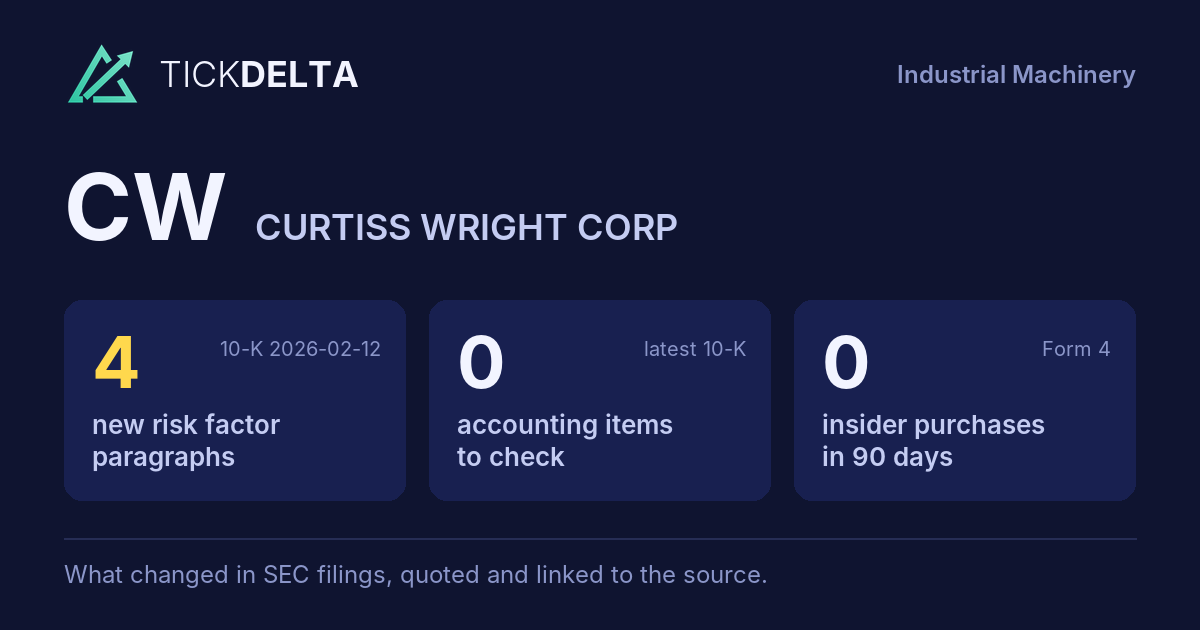
of the text changed · 10,198 words now · 4 new paragraphs, 0 gone
MD&A
27.7%
of the text changed · 8,616 words now · 5 new paragraphs, 9 gone
Legal Proceedings
0.0%
of the text changed · 227 words now
Accounting Policies
14.8%
of the text changed · 1,333 words now
10-K 0001628280-26-007587 (Feb 12, 2026) vs 10-K 0000026324-25-000015 (Feb 13, 2025)
Every paragraph, and how much of it changed
One bar per paragraph, in the order of the 10-K. Height and colour show the share of its words not in the closest paragraph a year earlier; the tallest bars are new paragraphs.
Risk Factors
102 paragraphs · 4 new · 43 reworded · 0 gone · 10-K Feb 12, 2026 against Feb 13, 2025
New paragraph
Reworded (5% of its words or more)
Same or nearly
Paragraph 55 · 46% changed
Every version of it
Paragraph 4 · 45% changed
Every version of it
We may be exposed to liabilities for personal injury, death, or property damage due to the failure of a product that we have sold. We typically agree to indemnify our customers against certain liabilities resulting from the products we sell, and any third-party indemnification we seek from our suppliers and our liability insurance may not fully cover our indemnification obligations to customers. We may also not be able to maintain insurance coverage in the future at an acceptable cost. Any liability for which third-party indemnification is not available and not covered by insurance could have a material adverse effect on our business, financial condition, and results of operations. In addition, the failure of a product that we have sold could also result in a recall of, or safety alert relating to, such product which could ultimately result, in certain cases, in the removal of such product from the marketplace and claims regarding costs associated therewith. third-
Paragraph 79 · 43% changed
Every version of it
Accounting for contracts that apply over-time revenue recognition requires judgment relative to assessing risks, estimating contract net sales and costs, and making assumptions for schedule and technical issues. Due to the size and nature of many of our contracts, the estimation of total net sales and costs at completion is complicated and subject to many variables. For example, assumptions must be made regarding the length of time to complete the contract, as costs also include expected increases in wages and prices for materials and allocated fixed costs. Similarly, assumptions must be made regarding the future impact of efficiency initiatives and cost reduction efforts. Incentives, awards, price escalations, liquidated damages, or penalties related to performance on contracts are considered in estimating revenue and profit rates using either the expected value method or most likely amount method. It is possible that materially different amounts could be obtained, because of the significance of the judgments and estimation processes described above, if different assumptions were used or if the underlying circumstances were to change. Changes in underlying assumptions, circumstances, or estimates may have a material adverse effect upon future period financial reporting and performance. See “Critical Accounting Estimates and Policies” in Part II, Item 7 of this Form 10-K.
Paragraph 93 · 40% changed
Every version of it
Paragraph 37 · 38% changed
Every version of it
Paragraph 52 · 38% changed
Every version of it
Any significant disruption in the commercial nuclear power industry industry, including delays in the development of small modular reactors, could adversely affect our business. results of operations or future outlook.
Paragraph 64 · 38% changed
Every version of it
Paragraph 35 · 48% changed
Every version of it
10-K Feb 13, 2025Failure to successfully implement our acquisition strategy, including successfully integrating acquired businesses, could have a material adverse effect on our business, financial condition, and results of operations.
10-K Feb 12, 2026
in the allocation of defense spending, or the expiration or termination of certain aerospace and defense programs on which we have content could result in a reduction in our revenues and earnings and could have a material adverse effect on our business, financial condition, and results of operations.
Paragraph 55 · 46% changed
Every version of it
10-K Feb 13, 2025Our Naval & Power segment manufactures components for, and provide services to, customers in the nuclear power market, including utilities and certain governmental entities, and subjects us to various safety related requirements imposed by the U.S. Government, the Department of Energy, the Nuclear Regulatory Commission, and other agencies in foreign jurisdictions. In the event of non-compliance, these agencies might increase regulatory oversight, impose fines or shut down operations, depending on their assessment of the severity of the noncompliance. In addition, new or revised security and safety requirements promulgated by these agencies could necessitate substantial capital and other expenditures.
10-K Feb 12, 2026
on their assessment of the severity of the noncompliance. In addition, new or revised security and safety requirements promulgated by these agencies could necessitate substantial capital and other expenditures.
Paragraph 4 · 45% changed
Every version of it
10-K Feb 13, 2025
We may be exposed to liabilities for personal injury, death, or property damage due to the failure of a product that we have sold. We typically agree to indemnify our customers against certain liabilities resulting from the products we sell, and any third-party indemnification we seek from our suppliers and our liability insurance may not fully cover our indemnification obligations to customers. We may also not be able to maintain insurance coverage in the future at an acceptable cost. Any liability for which third-party indemnification is not available and not covered by insurance could have a material adverse effect on our business, financial condition, and results of operations. In addition, the failure of a product that we have sold could also result in a recall of, or safety alert relating to, such product which could ultimately result, in certain cases, in the removal of such product from the marketplace and claims regarding costs associated therewith.
10-K Feb 12, 2026
We may be exposed to liabilities for personal injury, death, or property damage due to the failure of a product that we have sold. We typically agree to indemnify our customers against certain liabilities resulting from the products we sell, and any third-
Paragraph 79 · 43% changed
Every version of it
10-K Feb 13, 2025
Accounting for contracts that apply over-time revenue recognition requires judgment relative to assessing risks, estimating contract net sales and costs, and making assumptions for schedule and technical issues. Due to the size and nature of many of our contracts, the estimation of total net sales and costs at completion is complicated and subject to many variables. For example, assumptions must be made regarding the length of time to complete the contract, as costs also include expected increases in wages and prices for materials and allocated fixed costs. Similarly, assumptions must be made regarding the future impact of efficiency initiatives and cost reduction efforts. Incentives, awards, price escalations, liquidated damages, or penalties related to performance on contracts are considered in estimating revenue and profit rates using either the expected value method or most likely amount method. It is possible that materially different amounts could be obtained, because of the significance of the judgments and estimation processes described above, if different assumptions were used or if the underlying circumstances were to change. Changes in underlying assumptions, circumstances, or estimates may have a material adverse effect upon future period financial reporting and performance. See “Critical Accounting Estimates and Policies” in Part II, Item 7 of this Form 10-K.
10-K Feb 12, 2026
Accounting for contracts that apply over-time revenue recognition requires judgment relative to assessing risks, estimating contract net sales and costs, and making assumptions for schedule and technical issues. Due to the size and nature of many of our contracts, the estimation of total net sales and costs at completion is complicated and subject to many variables. For example, assumptions must be made regarding the length of time to complete the contract, as costs also include expected
Paragraph 93 · 40% changed
Every version of it
10-K Feb 13, 2025The United States and other countries have levied tariffs and taxes on certain goods, such as those implemented by the United States and China in recent years. Some of our products are included in these tariffs. The imposition of new or increased tariffs, duties, border adjustment taxes or other trade restrictions by the United States could also result in the adoption of new or increased tariffs or other trade restrictions by other countries. The tariffs may in the future increase our cost of materials and may cause us to increase prices to our customers which we believe may reduce demand for our products in the U.S. and abroad. Media and political reactions in the affected countries could potentially exacerbate the impact on our operations in those countries. Our price increases may not be sufficient to fully offset the impact of the tariffs and result in lowering our margin on products sold. If the U.S. government increases or implements additional tariffs, or if additional tariffs or trade restrictions are implemented by other countries, the resulting trade barriers could have a significant adverse impact on our suppliers, our customers and on our business. We are not able to predict future trade policy of the U.S. or of any foreign countries in which we operate or purchase goods, or the terms of any renegotiated trade agreements, or their impact on our business.
10-K Feb 12, 2026
or trade restrictions are implemented by other countries, the resulting trade barriers could have a significant adverse impact on our suppliers, our customers and on our business. We are not able to predict future trade policy of the U.S. or of any foreign countries in which we operate or purchase goods, or the terms of any renegotiated trade agreements, or their impact on our business.
Paragraph 37 · 38% changed
Every version of it
10-K Feb 13, 2025Any significant disruption in the commercial nuclear power industry could adversely affect our business.
10-K Feb 12, 2026
A downturn in the commercial aircraft market could adversely affect our business.
Paragraph 52 · 38% changed
Every version of it
10-K Feb 13, 2025
Any significant disruption in the commercial nuclear power industry could adversely affect our business.
10-K Feb 12, 2026
Any significant disruption in the commercial nuclear power industry, including delays in the development of small modular reactors, could adversely affect our results of operations or future outlook.
Paragraph 64 · 38% changed
Every version of it
10-K Feb 13, 2025Environmental laws generally impose liability for investigation, remediation, and removal of hazardous materials and other waste products on property owners and those who dispose of materials at waste sites, whether or not the waste was disposed of legally at the time in question. We are currently addressing environmental remediation at certain current and former facilities, and we have been named as a potentially responsible party along with other organizations in a number of environmental clean-up sites and may be named in connection with future sites. We are required to contribute to the costs of the investigation and remediation and to establish reserves in our financial statements for future costs deemed probable and estimable. Although we have estimated and reserved for future environmental remediation costs, the final resolution of these liabilities may significantly vary from our estimates and could potentially have an adverse effect on our results of operations and financial position.
10-K Feb 12, 2026
remediation and to establish reserves in our financial statements for future costs deemed probable and estimable. Although we have estimated and reserved for future environmental remediation costs, the final resolution of these liabilities may significantly vary from our estimates and could potentially have an adverse effect on our results of operations and financial position.
MD&A
98 paragraphs · 5 new · 57 reworded · 9 gone · 10-K Feb 12, 2026 against Feb 13, 2025
New paragraph
Reworded (5% of its words or more)
Same or nearly
Paragraph 20 · 50% changed
There are a number of global forces driving a resurgence in nuclear power, as it is becoming continues to become more widely accepted as a critical source to meet rising future energy demand and decarbonization commitments, benefiting both commitments through the energy creation of clean, reliable, and process industries. affordable energy, and more recently through its potential to meet surging data-center power demand driven by AI. Within the U.S., nuclear power has continues to benefit from both strong public and bi-partisan bipartisan government support, support. In May 2025, the President signed a series of Executive Orders ("EOs") titled "Reinvigorating the Nuclear Industrial Base," which is driving legislation focused on the importance of commercial nuclear to decarbonize U.S. national security, as well as the country’s leadership in global nuclear power development and AI. Among the many highlights, these EOs are focused on stimulating growth in the industry by quadrupling U.S. nuclear capacity by 2050 from 100 gigawatts ("GW") to 400 GW; reforming and modernizing NRC regulations to promote faster licensing; prioritizing the DOE to work with the nuclear energy industry to facilitate 5 GW of power uprates to existing energy infrastructure nuclear reactors; restarting stalled projects and create clean, reliable, half-built reactors; accelerating the deployment of advanced nuclear technologies; and affordable energy. supporting the construction of 10 new large reactors by 2030. In addition, October 2025, U.S. new reactor construction was further supported by the U.S. government’s announcement that it entered into a strategic partnership to provide at least $80 billion to support the construction of new Westinghouse nuclear reactors and reinvigorate the nuclear power industrial base. Outside of the U.S., following the Russian invasion of Ukraine and the disruption that it has caused to European energy markets, nuclear power is being seen viewed as a pathway towards energy independence and an opportunity for European economies to break free from Russian natural gas and oil.
Paragraph 8 · 47% changed
In the global environment, which is typically influenced by international trade, economic conditions, as well as geopolitical and geopolitical tariff uncertainty, GDP had also been greatly impacted by the pandemic in 2020, before it rebounded in 2021. In 2024, global GDP is expected to grow between 2.5% and 3.0%, according to various forecasts. Global GDP is expected to grow at a similar pace approximately 2.9% in 2025, given optimism for a continued reduction decrease to 2.7% in inflation, but 2026, and remain well below 3% for the foreseeable future, based on uncertainty regarding the long-term impacts of potentially higher tariffs and trade uncertainty, particularly in China. future.
Paragraph 10 · 46% changed
Curtiss-Wright maintains a is well-positioned to grow in strong presence across U.S. defense budget environments. In more challenging budget years, or those impacted by funding delays, the naval, aerospace, and ground defense markets with vast platform and Company is well-insulated from specific program diversity, where we support over 400 platforms and 3,000 programs worldwide. Our portfolio of products and services supplies all branches of funding decisions due to the U.S. military, where our content is on critical high-performance programs and platforms, and also supports a growing international defense business. A significant portion breadth of our portfolio, which consists of unique, sole-source positions and larger, multi-year opportunities that provide continued stability. We also endeavor to capitalize on work typically outsourced from defense business operations is comprised of long-term programs and fixed-price contracts driven primarily by U.S. DoD primes when budgets and funding levels. The are more fiscally restrained. As a result, the Company has historically demonstrated solid growth in our defense markets, this market, particularly when including acquisitions, and has exceeded the average growth rate of the base U.S. defense budget over the past 20 years through various cycles and administrations. In addition, the Company Our performance is well-insulated from periods of U.S. defense budget flatness or trimming due to the breadth of our portfolio, unique, sole-source positions and opportunities to capitalize on work outsourced from defense primes, while we continue to expand our potential for growth supported by a strong backlog, especially in non-U.S. military spending. naval defense.
Paragraph 7 · 46% changed
Many of Curtiss-Wright’s commercial businesses are driven in large part by global economic growth, primarily led by operations in the U.S., Canada, Europe, and China. In March 2020, the World Health Organization characterized the global outbreak of COVID-19 China, and as a pandemic, which resulted in significant disruption to travel, transportation of goods and services, and financial markets globally, and caused adverse and residual impacts to both industry supply chains and production levels. Following the events of 2020, U.S. economic activity rebounded sharply in 2021, due in part to the availability of vaccines, increased government support to rebuild the country’s infrastructure, increased U.S. consumer spending and continued low levels of unemployment. In 2021, U.S. measured by real gross domestic product (GDP) increased at nearly 6% and at ("GDP"). Our major geographical markets have seen economic growth rates weaken considerably over the fastest pace since 1984, led by an acceleration past few years, due in industrial activity. However, the pace of year-over-year GDP growth has slowed in recent years based on high levels of large part to heightened macro uncertainty including rising inflation and rising interest rates and, as a result, it increased 1.9% in 2022 and 2.5% in 2023. the implementation of tariffs. In 2024, U.S. and Global GDP both grew 2.8%. In 2025, U.S. GDP is expected to grow between 2.5% and 2.8%, approximately 2.2% according to various forecasts, driven by healthy employment and income growth, strong U.S. consumer spending and easing of prior supply chain disruptions, despite the a slightly less impactful headwind of rising inflation that has only recently lessened as a result of resulting from interest rate reductions. In 2025, 2026, based on a range of forecasts, growth in the U.S. economy is expected to be at or slightly below 2024 levels, exceed 2025 levels despite continued economic uncertainty, as most economists expect the U.S. Federal Reserve to implement further easing on interest rates to control inflation.
Paragraph 9 · 44% changed
Curtiss-Wright maintains a strong presence across the naval, aerospace, and ground defense markets with markets, which collectively represent approximately 58% of our annual net sales. Curtiss Wright provides vast platform and program diversity, where we support over 400 platforms and 3,000 programs worldwide. Our portfolio of products and services supplies supports critical high-performance programs and platforms serving all branches of the U.S. military, where our content is on critical high-performance programs in addition to a strong and platforms, and also supports a growing international defense business. A presence. The most significant portion of our defense business operations revenues is comprised of long-term programs and primarily fixed-price contracts driven primarily mainly by U.S. DoD DoW budgets and funding levels. The Company has historically demonstrated solid growth in our defense markets, We have strong alignment to U.S. military priorities and long-term visibility on high priority platforms, most particularly when including acquisitions, shipbuilding. As a supplier of COTS and has exceeded the average growth rate of the U.S. defense budget over the past 20 years through various cycles and administrations. In addition, the Company is well-insulated from periods of U.S. defense budget flatness or trimming due to the breadth of our portfolio, unique, sole-source positions and opportunities to capitalize on work outsourced from defense primes, while COTS+ solutions, we continue to expand demonstrate that defense electronics technology will enhance our potential ability to design and develop future generations of advanced systems and products for growth in non-U.S. military spending. high performance applications.
Paragraph 62 · 42% changed
Commercial sales increased $11 $96 million, or 1%, 10%, to $951 $1,047 million. Sales in the power & process market increased primarily benefited due to the incremental impact from our I&C Solutions acquisition, as well as higher organic sales of commercial nuclear aftermarket sales products supporting the maintenance of existing operating reactors and the development of next-generation advanced reactors. Sales in North America, partially offset by the wind-down on the China Direct AP1000 program. The general industrial market was negatively impacted by lower sales of industrial vehicle products to off-highway vehicle platforms. were essentially flat.
Paragraph 11 · 40% changed
Paragraph 15 · 40% changed
Paragraph 20 · 50% changed
10-K Feb 13, 2025
There are a number of global forces driving a resurgence in nuclear power, as it is becoming more widely accepted as a critical source to meet rising future energy demand and decarbonization commitments, benefiting both the energy and process industries. Within the U.S., nuclear power has both strong public and bi-partisan government support, which is driving legislation to decarbonize the existing energy infrastructure and create clean, reliable, and affordable energy. In addition, following the Russian invasion of Ukraine and the disruption it has caused to European energy markets, nuclear power is being seen as a pathway towards energy independence and an opportunity to break free from Russian natural gas and oil.
10-K Feb 12, 2026
There are a number of global forces driving a resurgence in nuclear power, as it continues to become more widely accepted as a critical source to meet rising future energy demand and decarbonization commitments through the creation of clean, reliable, and affordable energy, and more recently through its potential to meet surging data-center power demand driven by AI. Within the U.S., nuclear power continues to benefit from both strong public and bipartisan government support. In May 2025, the President signed a series of Executive Orders ("EOs") titled "Reinvigorating the Nuclear Industrial Base," which focused on the importance of commercial nuclear to U.S. national security, as well as the country’s leadership in global nuclear power development and AI. Among the many highlights, these EOs are focused on stimulating growth in the industry by quadrupling U.S. nuclear capacity by 2050 from 100 gigawatts ("GW") to 400 GW; reforming and modernizing NRC regulations to promote faster licensing; prioritizing the DOE to work with the nuclear energy industry to facilitate 5 GW of power uprates to existing nuclear reactors; restarting stalled projects and half-built reactors; accelerating the deployment of advanced nuclear technologies; and supporting the construction of 10 new large reactors by 2030. In October 2025, U.S. new reactor construction was further supported by the U.S. government’s announcement that it entered into a strategic partnership to provide at least $80 billion to support the construction of new Westinghouse nuclear reactors and reinvigorate the nuclear power industrial base. Outside of the U.S., following the Russian invasion of Ukraine and the disruption that it caused to European energy markets, nuclear power is being viewed as a pathway towards energy independence and an opportunity for European economies to break free from Russian natural gas and oil.
Paragraph 8 · 47% changed
10-K Feb 13, 2025
In the global environment, which is typically influenced by international trade, economic conditions, and geopolitical uncertainty, GDP had also been greatly impacted by the pandemic in 2020, before it rebounded in 2021. In 2024, global GDP is expected to grow between 2.5% and 3.0%, according to various forecasts. Global GDP is expected to grow at a similar pace in 2025, given optimism for a continued reduction in inflation, but remain below 3% for the foreseeable future, based on uncertainty regarding the long-term impacts of potentially higher tariffs and trade uncertainty, particularly in China.
10-K Feb 12, 2026
In the global environment, which is influenced by international trade, economic conditions, as well as geopolitical and tariff uncertainty, global GDP is expected to grow approximately 2.9% in 2025, decrease to 2.7% in 2026, and remain well below 3% for the foreseeable future.
Paragraph 10 · 46% changed
10-K Feb 13, 2025
Curtiss-Wright maintains a strong presence across the naval, aerospace, and ground defense markets with vast platform and program diversity, where we support over 400 platforms and 3,000 programs worldwide. Our portfolio of products and services supplies all branches of the U.S. military, where our content is on critical high-performance programs and platforms, and also supports a growing international defense business. A significant portion of our defense business operations is comprised of long-term programs and fixed-price contracts driven primarily by U.S. DoD budgets and funding levels. The Company has historically demonstrated solid growth in our defense markets, particularly when including acquisitions, and has exceeded the average growth rate of the U.S. defense budget over the past 20 years through various cycles and administrations. In addition, the Company is well-insulated from periods of U.S. defense budget flatness or trimming due to the breadth of our portfolio, unique, sole-source positions and opportunities to capitalize on work outsourced from defense primes, while we continue to expand our potential for growth in non-U.S. military spending.
10-K Feb 12, 2026
Curtiss-Wright is well-positioned to grow in strong U.S. defense budget environments. In more challenging budget years, or those impacted by funding delays, the Company is well-insulated from specific program funding decisions due to the breadth of our portfolio, which consists of unique, sole-source positions and larger, multi-year opportunities that provide continued stability. We also endeavor to capitalize on work typically outsourced from defense primes when budgets are more fiscally restrained. As a result, the Company has historically demonstrated solid growth in this market, particularly when including acquisitions, and has exceeded the average growth rate of the base U.S. defense budget over the past 20 years through various cycles and administrations. Our performance is supported by a strong backlog, especially in naval defense.
Paragraph 7 · 46% changed
10-K Feb 13, 2025
Many of Curtiss-Wright’s commercial businesses are driven in large part by global economic growth, primarily led by operations in the U.S., Canada, Europe, and China. In March 2020, the World Health Organization characterized the global outbreak of COVID-19 as a pandemic, which resulted in significant disruption to travel, transportation of goods and services, and financial markets globally, and caused adverse and residual impacts to both industry supply chains and production levels. Following the events of 2020, U.S. economic activity rebounded sharply in 2021, due in part to the availability of vaccines, increased government support to rebuild the country’s infrastructure, increased U.S. consumer spending and continued low levels of unemployment. In 2021, U.S. real gross domestic product (GDP) increased at nearly 6% and at the fastest pace since 1984, led by an acceleration in industrial activity. However, the pace of year-over-year GDP growth has slowed in recent years based on high levels of inflation and rising interest rates and, as a result, it increased 1.9% in 2022 and 2.5% in 2023. In 2024, U.S. GDP is expected to grow between 2.5% and 2.8%, according to various forecasts, driven by healthy employment and income growth, strong U.S. consumer spending and easing of prior supply chain disruptions, despite the headwind of rising inflation that has only recently lessened as a result of interest rate reductions. In 2025, based on a range of forecasts, growth in the U.S. economy is expected to be at or slightly below 2024 levels, as most economists expect the U.S. Federal Reserve to implement further easing on interest rates to control inflation.
10-K Feb 12, 2026
Many of Curtiss-Wright’s commercial businesses are driven in large part by global economic growth, primarily led by operations in the U.S., Canada, Europe, and China, and as measured by real gross domestic product ("GDP"). Our major geographical markets have seen economic growth rates weaken considerably over the past few years, due in large part to heightened macro uncertainty including rising inflation and the implementation of tariffs. In 2024, U.S. and Global GDP both grew 2.8%. In 2025, U.S. GDP is expected to grow approximately 2.2% according to various forecasts, despite a slightly less impactful headwind of rising inflation resulting from interest rate reductions. In 2026, based on a range of forecasts, growth in the U.S. economy is expected to slightly exceed 2025 levels despite continued economic uncertainty, as economists expect the U.S. Federal Reserve to implement further easing on interest rates to control inflation.
Paragraph 9 · 44% changed
10-K Feb 13, 2025
Curtiss-Wright maintains a strong presence across the naval, aerospace, and ground defense markets with vast platform and program diversity, where we support over 400 platforms and 3,000 programs worldwide. Our portfolio of products and services supplies all branches of the U.S. military, where our content is on critical high-performance programs and platforms, and also supports a growing international defense business. A significant portion of our defense business operations is comprised of long-term programs and fixed-price contracts driven primarily by U.S. DoD budgets and funding levels. The Company has historically demonstrated solid growth in our defense markets, particularly when including acquisitions, and has exceeded the average growth rate of the U.S. defense budget over the past 20 years through various cycles and administrations. In addition, the Company is well-insulated from periods of U.S. defense budget flatness or trimming due to the breadth of our portfolio, unique, sole-source positions and opportunities to capitalize on work outsourced from defense primes, while we continue to expand our potential for growth in non-U.S. military spending.
10-K Feb 12, 2026
Curtiss-Wright maintains a strong presence across the naval, aerospace, and ground defense markets, which collectively represent approximately 58% of our annual net sales. Curtiss Wright provides vast platform and program diversity, where we support over 400 platforms and 3,000 programs worldwide. Our portfolio of products and services supports critical high-performance programs and platforms serving all branches of the U.S. military, in addition to a strong and growing international defense presence. The most significant portion of our defense revenues is comprised of long-term programs and primarily fixed-price contracts driven mainly by U.S. DoW budgets and funding levels. We have strong alignment to U.S. military priorities and long-term visibility on high priority platforms, most particularly shipbuilding. As a supplier of COTS and COTS+ solutions, we continue to demonstrate that defense electronics technology will enhance our ability to design and develop future generations of advanced systems and products for high performance applications.
Paragraph 62 · 42% changed
10-K Feb 13, 2025
Commercial sales increased $11 million, or 1%, to $951 million. Sales in the power & process market primarily benefited from higher commercial nuclear aftermarket sales supporting the maintenance of operating reactors in North America, partially offset by the wind-down on the China Direct AP1000 program. The general industrial market was negatively impacted by lower sales of industrial vehicle products to off-highway vehicle platforms.
10-K Feb 12, 2026
Commercial sales increased $96 million, or 10%, to $1,047 million. Sales in the power & process market increased primarily due to the incremental impact from our I&C Solutions acquisition, as well as higher organic sales of commercial nuclear products supporting the maintenance of existing operating reactors and the development of next-generation advanced reactors. Sales in the general industrial market were essentially flat.
Paragraph 11 · 40% changed
10-K Feb 13, 2025We derive a portion of our revenues from the naval defense, aerospace defense, and ground defense markets, which collectively represent approximately 57% of our annual net sales. In the naval defense market, we expect continued funding for U.S. shipbuilding programs which have received strong bipartisan support from Congress. Of note, we are recognizing significant production revenues on the Ford class aircraft carrier, along with the Columbia class and Virginia class submarines, as well as development revenues on the future generation SSN(X) submarine. We have a long legacy of providing products that support nuclear propulsion systems on naval vessels. In addition, through our service centers, we are a provider of ship repair and maintenance for the U.S. Navy’s Atlantic and Pacific fleets. In the aerospace defense market, we expect to benefit from
10-K Feb 12, 2026
In the naval defense market, we expect continued funding for U.S. shipbuilding programs, which have received strong bipartisan support from Congress, in addition to supplemental maritime industrial base funding to support facility expansion and technology modernization initiatives. Of note, we are recognizing significant production revenues on the Ford class aircraft carrier, Columbia class and Virginia class submarines, and numerous surface ship platforms, as well as development revenues on the future generation SSN(X) submarine. We have a long legacy of providing products that support nuclear propulsion systems on naval vessels. In addition, through our service centers, we are a provider of ship repair and maintenance for the U.S. Navy’s Atlantic and Pacific fleets. In the aerospace defense market, we expect to benefit from increased funding levels supporting the global market for manned and unmanned military aircraft, particularly Command, Control, Computers, Communications, Cyber, Intelligence, Surveillance, and Reconnaissance ("C5ISR"), electronic warfare, encryption, unmanned systems, and communications programs. We also design and manufacture high-technology data acquisition and comprehensive flight test instrumentation systems, as well as critical aircraft arresting systems equipment. In the ground defense market, we are a supplier of advanced tactical communications solutions for battlefield network management, including COTS-based rugged, small form factor communications systems and integrated network communications management software. We are also well positioned with our electronics stabilization systems equipment supporting ground combat and tactical vehicles, particularly in the international ground defense market. Through continued innovation as well as incremental research and development
Paragraph 15 · 40% changed
10-K Feb 13, 2025Beyond the U.S., we have seen a renewed, global focus on defense spending in light of Russia’s invasion of Ukraine and the continued threat from China. International markets represent a growing portion of overall sales for defense prime contractors, creating additional growth opportunities for Curtiss-Wright as NATO countries throughout Europe commit to ramping up their spending to 2% or more of annual GDP, with nearly 70% thus far announcing their intentions to meet those spending levels. As a result, and including recent acquisitions, Curtiss-Wright’s total direct foreign military sales represent approximately 9% of the Corporation’s total revenues.
10-K Feb 12, 2026
We also see continued strong growth in non-U.S. military spending, supported by a renewed, global focus from NATO and allied countries in light of Russia’s invasion of Ukraine, as well as the continued threat from China. NATO’s Secretary outlined a ten-year commitment to ramp up NATO allies’ investment to 5.0% of GDP per year on defense (previously 2.0%), with a goal to reach 3.5% of GDP spent on core (or hard) military spending and 1.5% of GDP for critical infrastructure, cybersecurity, and other defense measures. Today, Curtiss-Wright’s total direct foreign military sales represent approximately 10% of the Corporation’s total revenues. International markets also represent a growing portion of overall sales for defense prime contractors, creating additional growth opportunities for Curtiss-Wright.
A paragraph is matched with the one last year that shares the most of its words; under half in common makes it new. The paragraphs shown are the 8 reworded the most in each section.
The paragraph that changed most in each section
The redline
Marked against last year's 10-K: cut words struck through, new words highlighted.
Risk Factors249 words changed in this paragraph; it is 63% similar to last year's version.
Our businesses depend on suppliers and subcontractors for raw materials and components. At times subcontractors perform components, as well as services that we provide to our customers. Our supply chain has been and may continue to be impacted by a wide variety of factors, including supplier capacity constraints, sanctions and trade restrictions and other governmental regulatory actions or inactions, labor and material shortages as well as tariffs and other geopolitical events, such as the Russia-Ukraine war, war and China’s relationship with the United States and Taiwan. Because we strive to limit the volume of raw materials and component parts on hand, our business could be adversely affected if we were unable to obtain these raw materials and components from our suppliers in the quantities that we require. We also depend on subcontractors and suppliers to meet their contractual obligations in full compliance with customer requirements. Nonperformance or underperformance by subcontractors and suppliers could materially impact our ability to perform obligations to our customers, which could result in a customer terminating our contract for default, expose us to liability, and substantially impair our ability to compete for future contracts and orders. Generally, raw materials and purchased components are available from a number of different suppliers, though several suppliers are our sole source of certain components. If a sole-source supplier is delayed or should cease or otherwise be unable to deliver such components, we may not be able to produce the related product in a timely manner or in sufficient quantities, if at all, which could adversely affect our operating results. A sole-source supplier of a key component could also potentially exert significant bargaining power over price, quality, warranty claims, or other terms relating to these materials, which could have a material adverse effect on our financial condition, results of operations, and cash flows. In addition, supply chain constraints and improving economic conditions have resulted in sustained increases in the prices we pay for many of the components and raw materials used in our products. Furthermore, we are experiencing higher labor costs due to increased competition for personnel in many regions in which we operate as well as general inflationary conditions, including higher shipping costs, labor shortages, and rising energy prices. Our ability to perform our obligations as a prime contractor may be adversely affected if one or more of these suppliers is unable to provide the agreed-upon supplies or perform the agreed-upon services in a timely and cost-effective manner. While we have attempted to mitigate the effects of increased costs through price increases, there are no assurances that higher prices can effectively be passed through to our customers, or that we will be able to fully offset the effects of higher raw materials costs through price increases on a timely basis.
Source: Item 1A, 10-K 0001628280-26-007587 vs Item 1A, 10-K 0000026324-25-000015
MD&A228 words changed in this paragraph; it is 43% similar to last year's version.
There are a number of global forces driving a resurgence in nuclear power, as it is becoming continues to become more widely accepted as a critical source to meet rising future energy demand and decarbonization commitments, benefiting both commitments through the energy creation of clean, reliable, and process industries. affordable energy, and more recently through its potential to meet surging data-center power demand driven by AI. Within the U.S., nuclear power has continues to benefit from both strong public and bi-partisan bipartisan government support, support. In May 2025, the President signed a series of Executive Orders ("EOs") titled "Reinvigorating the Nuclear Industrial Base," which is driving legislation focused on the importance of commercial nuclear to decarbonize U.S. national security, as well as the country’s leadership in global nuclear power development and AI. Among the many highlights, these EOs are focused on stimulating growth in the industry by quadrupling U.S. nuclear capacity by 2050 from 100 gigawatts ("GW") to 400 GW; reforming and modernizing NRC regulations to promote faster licensing; prioritizing the DOE to work with the nuclear energy industry to facilitate 5 GW of power uprates to existing energy infrastructure nuclear reactors; restarting stalled projects and create clean, reliable, half-built reactors; accelerating the deployment of advanced nuclear technologies; and affordable energy. supporting the construction of 10 new large reactors by 2030. In addition, October 2025, U.S. new reactor construction was further supported by the U.S. government’s announcement that it entered into a strategic partnership to provide at least $80 billion to support the construction of new Westinghouse nuclear reactors and reinvigorate the nuclear power industrial base. Outside of the U.S., following the Russian invasion of Ukraine and the disruption that it has caused to European energy markets, nuclear power is being seen viewed as a pathway towards energy independence and an opportunity for European economies to break free from Russian natural gas and oil.
Source: Item 7, 10-K 0001628280-26-007587 vs Item 7, 10-K 0000026324-25-000015
Accounting Policies62 words changed in this paragraph; it is 60% similar to last year's version.
In December 2023, the FASB issued ASU 2023-09, Income Taxes (Topic 740), Improvement to Income Tax Disclosures, Disclosures ("ASU 2023-09"), which requires enhanced income tax disclosures, including disaggregation of information in the rate reconciliation table and disaggregated information related to income taxes paid. The ASU is effective for annual reporting periods beginning with the year ending Company adopted this standard as of December 31, 2025. Early adoption is permitted. The Company is currently evaluating 2025 and included revised disclosures within Note 12 of the impact of adopting this standard on its Consolidated Financial Statements. The adoption of this standard did not have a material effect on the Consolidated Financial Statements.
Source: Item 8, Note 1 – SUMMARY OF SIGNIFICANT ACCOUNTING POLICIES, 10-K 0001628280-26-007587 vs Item 8, Note 1 – SUMMARY OF SIGNIFICANT ACCOUNTING POLICIES, 10-K 0000026324-25-000015
Sentences and paragraphs added, removed or reworded
Every change, by type
Sentences and paragraphs of CW's Risk Factors and MD&A, 10-K Feb 12, 2026 against 10-K Feb 13, 2025. Each links to the text at sec.gov.
Quiet changes are sentences kept from last year with one to four words changed, at least one of them a hedge, a modal or a qualifier (may, could, will, not, significant, material…). A year or date rolling forward is not counted.
The full word list
adverse, adversely, all, although, anticipate, anticipates, any, approximately, believe, believes, can, cannot, certain, could, expect, expects, generally, however, if, intend, intends, largely, likely, many, material, materially, may, might, most, must, never, no, not, possible, primarily, probable, should, significant, significantly, some, substantial, substantially, unlikely, will, would
AddedRisk Factors
Additionally, we have incurred, and expect to continue to incur, additional costs to comply with increased cybersecurity protections and information control requirements for our customers, including the U.S. government. A failure to comply with these requirements could negatively impact our business and financial condition.
Read it in 10-K Feb 12, 2026 at sec.gov
AddedRisk Factors
We also depend on subcontractors and suppliers to meet their contractual obligations in full compliance with customer requirements. Nonperformance or underperformance by subcontractors and suppliers could materially impact our ability to perform obligations to our customers, which could result in a customer terminating our contract for default, expose us to liability, and substantially impair our ability to compete for future contracts and orders.
Read it in 10-K Feb 12, 2026 at sec.gov
AddedRisk Factors
newly identified markets as we currently anticipate. Furthermore, while we do not currently use artificial intelligence (“AI”) in the design and development of our products, we may seek to utilize AI in the future. The development, deployment, and integration of AI technologies presents risks, challenges, and potential unintended consequences that could affect our business. Given that laws and regulations around AI are continuously evolving, our obligation to comply with them could entail significant costs, negatively affect our business, or hinder our ability to incorporate certain AI capabilities into our operations and products.
Read it in 10-K Feb 12, 2026 at sec.gov
AddedRisk Factors
Historically, we have not been significantly impacted by inflation, with increases in raw material costs or payroll costs generally offset through lean manufacturing activities or pricing initiatives. However, in recent history, we have experienced heightened pressures in our costs of material, services, and especially labor, consistent with the overall high rates of inflation. We have consistently focused on mitigating inflation through pricing and operational excellence initiatives, and generally have been able to offset these cost increases, as a portion of our contracts contain terms and conditions that enable us to pass inflationary price increases to our customers. In those cases whereby inflationary increases are not contractually stipulated, we aim to actively negotiate price increases. We have consistently made annual investments in capital that deliver efficiencies and cost savings, while continuing to focus on negotiating better contract terms, especially on long-term agreements. While the historical benefits of these efforts have generally offset the margin impact of competitive pricing conditions in the markets that we serve, there are no assurances that higher prices can effectively be passed through to our customers or that we will be able to fully offset the effects of higher costs through price increases on a timely basis.
Read it in 10-K Feb 12, 2026 at sec.gov
RewordedRisk Factors
RewordedRisk Factors
These actions and proceedings may involve claims for, among other things, asbestos and environmental exposures, intellectual property matters, copyright infringement, compensation for alleged personal injury, workers’ compensation, employment discrimination, and employee benefit matters, government contract issues, commercial or breach of contract. contract disputes, and acquisitions or divestitures.
Read it in 10-K Feb 12, 2026 at sec.gov
RewordedRisk Factors
For a discussion regarding how our financial statements can be affected by pension and other postretirement benefit plans accounting policies, see “Management’s Discussion and Analysis—Critical Accounting Estimates and Policies—Pension and Other Postretirement Benefits” in Part II, Item 7 of this Form 10-K.
Read it in 10-K Feb 12, 2026 at sec.gov
RewordedRisk Factors
If an accident were to be caused by one of our products, or if we were to otherwise fail to maintain a satisfactory record of safety and reliability, our ability to retain and attract customers may be materially adversely affected.
Read it in 10-K Feb 12, 2026 at sec.gov
Show the other 35
RewordedRisk Factors
We typically agree to indemnify our customers against certain liabilities resulting from the products we sell, and any third-party indemnification we seek from our suppliers and our liability insurance may not fully cover our indemnification obligations to customers. third-
Read it in 10-K Feb 12, 2026 at sec.gov
RewordedRisk Factors
Our supply chain has been and may continue to be impacted by a wide variety of factors, including supplier capacity constraints, sanctions and trade restrictions and other governmental regulatory actions or inactions, labor and material shortages as well as tariffs and other geopolitical events, such as the Russia-Ukraine war, war and China’s relationship with the United States and Taiwan.
Read it in 10-K Feb 12, 2026 at sec.gov
RewordedRisk Factors
Any significant disruption in the commercial nuclear power industry industry, including delays in the development of small modular reactors, could adversely affect our business. results of operations or future outlook.
Read it in 10-K Feb 12, 2026 at sec.gov
RewordedRisk Factors
A violation of specific laws and regulations could also result in the imposition of fines and penalties, the termination of our contracts, or debarment from bidding on contracts. contracts, harm to our business reputation, or result in our progress payments being withheld.
Read it in 10-K Feb 12, 2026 at sec.gov
RewordedRisk Factors
We are required to contribute to the costs of the investigation and remediation and to establish reserves in our financial statements for future costs deemed probable and estimable.
Read it in 10-K Feb 12, 2026 at sec.gov
RewordedRisk Factors
Government contract laws and regulations affect how we do business with our customers and, contracts, which in some instances, impose added costs on our business.
Read it in 10-K Feb 12, 2026 at sec.gov
RewordedRisk Factors
As part of our capital allocation strategy, we aim to grow our business by selectively pursuing acquisitions and technologies that supplement our organic growth. growth, some of which may be material to our business and financial performance.
Read it in 10-K Feb 12, 2026 at sec.gov
RewordedRisk Factors
Government generally has the right to not exercise option periods and may not exercise an option period if the agency is not satisfied with our performance on the contract or does not receive funding to continue the program.
Read it in 10-K Feb 12, 2026 at sec.gov
AddedMD&A
Curtiss-Wright’s end market strategy is to grow leading market positions through the development of highly engineered products and services to deliver long-term profitable growth. We are well positioned on high performance platforms and benefit
Read it in 10-K Feb 12, 2026 at sec.gov
AddedMD&A
from decades of engineering expertise and knowledge transfer. We are committed to investing in technologies and aligning our core competencies with new applications and evolving market trends.
Read it in 10-K Feb 12, 2026 at sec.gov
AddedMD&A
The Company’s global portfolio spans across the defense, commercial aerospace, commercial nuclear power & process, and general industrial markets. Our end market diversification provides opportunities to drive growth in new products and markets through ongoing innovation and collaboration across the portfolio. It also helps mitigate the impact of volatility caused by industry and economic cycles.
Read it in 10-K Feb 12, 2026 at sec.gov
AddedMD&A
investments, Curtiss-Wright maintains strong alignment with numerous high growth U.S. military priorities, modernization efforts and emerging technological trends, including security, cyber, hypersonics, and the net-centric connected battlefield. In addition, as a leading supplier of MOSA-based solutions, Curtiss-Wright remains well aligned with the best-in-class open standards-based architectures within the industry, and the critical mandates supporting major defense acquisition programs.
Read it in 10-K Feb 12, 2026 at sec.gov
AddedMD&A
The U.S. government began its FY2025 fiscal year on October 1, 2024 under a continuing resolution ("CR"), which eventually led to a historic full-year CR with a base budget of approximately $840 billion, up slightly year-over-year, and a fully discretionary budget of approximately $895 billion. In addition to the longest shutdown in modern history, the government began its FY2026 fiscal year on October 1, 2025 under a CR to allow for more time to negotiate a full-year funding deal. The FY2026 Defense Appropriations Act was officially passed in February 2026, with base levels consistent with FY25 budget funding. In addition, the President’s FY2026 Budget Request included $150 billion in overall funding approved by Congress under the OBBBA, $113 billion of which is anticipated to support FY2026. This funding has the potential to drive more than 13% topline growth over the FY2025 enacted budget to a discretionary defense budget approaching $1 trillion. Key priorities include naval shipbuilding, with a focus on improving the maritime industrial base, tactical battlefield communications and networking, vehicle modernization, tactical aircraft modernization, and Golden Dome, all of which are anticipated to receive strong funding and provide numerous growth opportunities for Curtiss-Wright in 2026 and beyond.
Read it in 10-K Feb 12, 2026 at sec.gov
RemovedMD&A
RemovedMD&A
RemovedMD&A
RemovedMD&A
RemovedMD&A
RemovedMD&A
RemovedMD&A
RemovedMD&A
RemovedMD&A
RewordedMD&A
RewordedMD&A
Operating income increased $3 $18 million, or 2%, 12%, to $148 $166 million from the comparable prior year period, while and operating margin decreased 50 increased 110 basis points to 15.9%, as 17.0%, primarily due to favorable overhead absorption on higher sales was sales, the benefits of the Company's restructuring initiatives, and favorable foreign currency translation, partially offset by current period restructuring costs and higher investment in research and development. unfavorable mix.
Read it in 10-K Feb 12, 2026 at sec.gov
RewordedMD&A
Sales in the power & process market increased $33 $99 million primarily due to the incremental impact from our I&C Solutions acquisition as well as higher organic sales of commercial nuclear aftermarket sales products supporting the maintenance of existing operating reactors in North America, partially offset by and the wind-down on the China Direct AP1000 program. development of next-generation advanced reactors.
Read it in 10-K Feb 12, 2026 at sec.gov
RewordedMD&A
International markets also represent a growing portion of overall sales for defense prime contractors, creating additional growth opportunities for Curtiss-Wright as NATO countries throughout Europe commit to ramping up their spending to 2% or more of annual GDP, with nearly 70% thus far announcing their intentions to meet those spending levels. Curtiss-Wright.
Read it in 10-K Feb 12, 2026 at sec.gov
RewordedMD&A
There are a number of global forces driving a resurgence in nuclear power, as it is becoming continues to become more widely accepted as a critical source to meet rising future energy demand and decarbonization commitments, benefiting both commitments through the energy creation of clean, reliable, and process industries. affordable energy, and more recently through its potential to meet surging data-center power demand driven by AI.
Read it in 10-K Feb 12, 2026 at sec.gov
RewordedMD&A
Year Ended December 31, Percent Change (In thousands, except percentages) 2025 2024 2023 2025 vs. 2024 vs. 2023 Sales $ 932,133 $887,228 976,760 $932,133 5 % Operating income 166,166 148,023 145,278 2 12 % Operating margin 15.9 17.0 % 16.4% (50 bps) 15.9% 110 bps New orders $ 982,395 $895,332 10 1,038,932 $982,395 6 % Backlog $ 434,455 $387,248 12 505,429 $434,455 16 %
Read it in 10-K Feb 12, 2026 at sec.gov
RewordedMD&A
Year Ended December 31, Percent Change (In thousands, except percentages) 2025 2024 2023 2025 vs. 2024 vs. 2023 Sales $ 910,706 $815,912 1,018,610 $910,706 12 % Operating income 278,016 224,739 191,775 17 24 % Operating margin 24.7 27.3 % 23.5% 120 24.7% 260 bps New orders $ 1,056,388 $936,329 13 % 974,072 $1,056,388 (8 %) Backlog $ 986,899 $886,317 11 991,372 $986,899 — %
Read it in 10-K Feb 12, 2026 at sec.gov
RewordedMD&A
Operating income increased $33 $53 million, or 17%, 24%, to $225 $278 million compared with the same period in 2023, 2024, and operating margin increased 120 260 basis points to 24.7%, 27.3%, primarily due to favorable overhead absorption on higher A&D sales. sales, the benefits from both our operational excellence and restructuring initiatives, and favorable mix on defense electronics products.
Read it in 10-K Feb 12, 2026 at sec.gov
RewordedMD&A
RewordedMD&A
Our growth in these markets is typically aligned with the performance of the U.S. and global economies, with changes in global GDP rates and industrial production driving production, with the majority of our sales, particularly for our surface treatment services. sales driven by customers in North America and Europe.
Read it in 10-K Feb 12, 2026 at sec.gov
RewordedMD&A
The effective tax rate of 22.4% 21.9% for the year ended December 31, 2023, 2025, decreased as compared to an effective tax rate of 23.4% 22.4% in the prior year period, primarily due to the tax benefits of a associated with our legal entity restructuring as well as lower provisional tax expense associated with foreign withholding taxes. in the prior year period.
Read it in 10-K Feb 12, 2026 at sec.gov
RewordedMD&A
Interest expense for the year decreased $7 $2 million, or 13%, 4%, to $45 $43 million, primarily due to lower borrowings under our revolving Credit Agreement (the “Credit Agreement” or “credit facility”) as well as the repayment of our 2013 $90 million 3.85% Senior Notes in February 2023. 2025.
Read it in 10-K Feb 12, 2026 at sec.gov
Quiet changesMD&A
We supply our products and services to numerous OEMs and aftermarket industrial customers, including the transportation, commercial trucking, off-road equipment, agriculture, construction, material handling and automotive industries, which lowers the risk associated with any specific headwinds or economic cycles across the various markets in which we compete.
Read it in 10-K Feb 12, 2026 at sec.gov
Sources
The two latest 10-Ks on EDGAR, section by section. Each change links to the text at sec.gov.
Also
New risk factors: paragraphs with nothing like them last year, quoted in full.
Work with it
Excel workbook · CSV. Google Sheet that stays up to date: paste =IMPORTDATA("https://tickdelta.com/company/CW/export.csv") into a cell.