Casella Waste Systems Inc CWST
New risk paragraphs, branching off last year
Each branch is a paragraph in Risk Factors with nothing like it in the 10-K filed Feb 18, 2025. A box jumps to the paragraph as filed, below.
Paragraphs with nothing like them in last year's 10-K
8 paragraphs in Risk Factors of the 10-K filed Feb 20, 2026 with nothing like them in the 10-K filed Feb 18, 2025. Quoted exactly. Paragraphs that were only edited are under 10-K change.
financing, including debt, to pursue certain acquisitions. We may not be able to incur additional debt on terms favorable to us or at all. Furthermore, we may be unable to obtain the necessary regulatory approvals to complete potential acquisitions.
The provision of resource management services, including the operation of landfills, a substantial fleet of trucks and other waste-related assets, involves risks. These risks include, among others, the risk of truck accidents, equipment defects, malfunctions and failures, improper use of dangerous equipment, the release of hazardous substances, natural disasters, fire and
Alternatives to landfill disposal could reduce our disposal volumes and adversely affect our revenues and operating results.
Many of the states and local jurisdictions in which we operate require counties and municipalities to adopt solid waste management plans designed to reduce landfill disposal through source reduction, recycling, composting, organics diversion, and similar programs. Certain jurisdictions also restrict or prohibit the disposal of specific waste streams, such as yard waste and organics, in landfills. In addition, many of our customers are voluntarily increasing diversion to alternatives to landfill disposal and reducing the amount of waste they generate. Large commercial and industrial customers increasingly have adopted zero-waste or landfill-diversion goals, and some jurisdictions have enacted, or are considering, regulations such as extended producer responsibility, organics diversion, and minimum recycled content requirements.
While these initiatives support environmental sustainability and climate goals, they have reduced, and are expected to continue to reduce, landfill disposal volumes and may adversely affect demand for and pricing of landfill disposal services. As a result, we may not be able to operate our landfills at historical volumes or maintain current pricing levels. If we are unable to expand or adapt our service offerings to manage diverted waste streams or support customers’ waste reduction objectives, our financial condition and results of operations could be adversely affected.
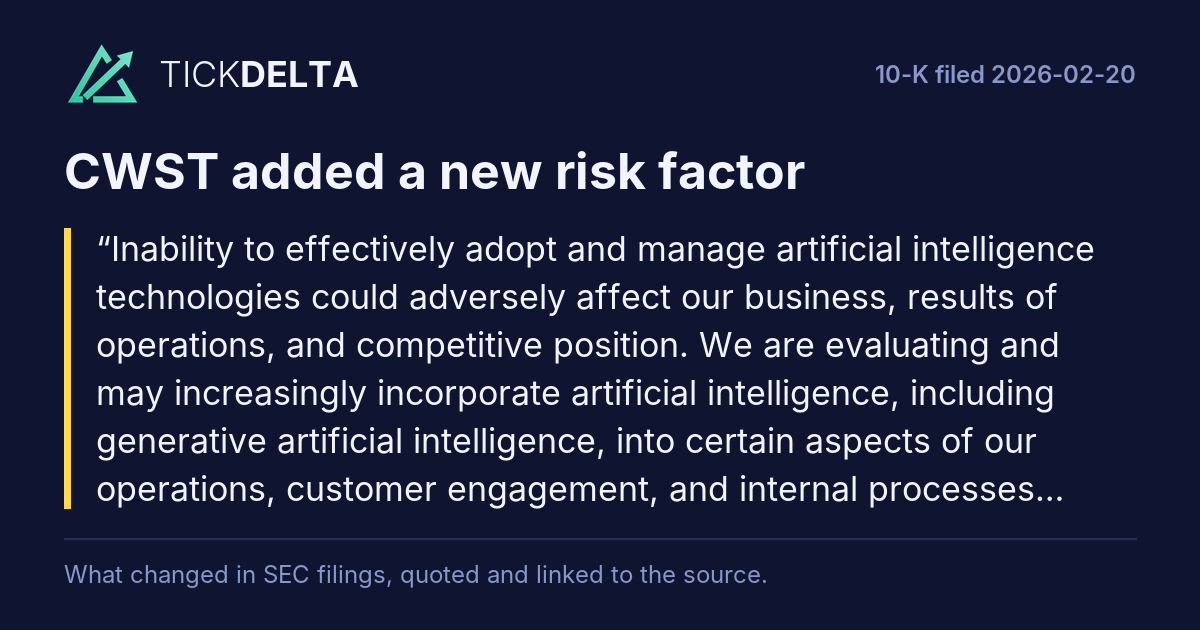
Inability to effectively adopt and manage artificial intelligence technologies could adversely affect our business, results of operations, and competitive position.
We are evaluating and may increasingly incorporate artificial intelligence, including generative artificial intelligence, into certain aspects of our operations, customer engagement, and internal processes, including route optimization, asset utilization, pricing, forecasting and decision support. The development, adoption, and use of artificial intelligence technologies are evolving rapidly and remain subject to uncertainty. If we are unable to effectively integrate artificial intelligence into our systems and processes, realize anticipated efficiencies or insights, or otherwise adapt to the use of artificial intelligence, our ability to compete and operate efficiently could be adversely affected. Further, emerging technologies may require substantial investment and present risks to our existing business model.
The use of artificial intelligence also presents risks, including the potential for inaccurate, biased, or inconsistent outputs; privacy, data protection, and cybersecurity concerns; risks associated with automated or assisted decision-making; and the potential exposure or misuse of confidential or proprietary information. In addition, artificial intelligence technologies are subject to existing and evolving laws and regulations, including those relating to intellectual property, privacy, data protection, and cybersecurity, and may give rise to increased compliance costs, litigation, or reputational harm. Ineffective or inadequate development, testing, deployment, or oversight of artificial intelligence systems by us or our third-party vendors could result in unintended consequences and increased operating costs. If we are unable to effectively manage the benefits and risks of artificial intelligence, our business, financial condition and results of operations could be adversely affected.
Paragraphs in the 10-Q filed Nov 9, 2026 that were not in the one before
New in the latest 10-Q
17 paragraphs in the 10-Q filed Nov 9, 2026 with nothing like them in the 10-Q filed Aug 7, 2026 (at least half the words must differ; new numbers alone do not count). Quoted exactly, grouped by the item heading above them. This is text that changed, not a judgement of how serious it is.
Financial statements and notes
(1) Relates to a change in estimates and assumptions concerning anticipated waste flow, costs and timing of future final capping, closure and post-closure activities at our Subtitle D landfill located in Bethlehem, New Hampshire, which will stop accepting waste on December 31, 2026 rather than the end of the fiscal year ending December 31, 2027 as previously anticipated. We modified such timing after an evaluation of the remaining permitted airspace, current and projected fill rates and other operational factors.
Read in the 10-Q
Environmental Project due to cost constraints, and directed NCES to propose alternative projects within 60 days or otherwise, provide a final accounting of costs incurred in connection with the Saco River stabilization project and remit the remaining civil penalty in accordance with the Consent Decree.
Read in the 10-Q
On April 3, 2025, NHDES denied the October 31, 2023 application of our subsidiary, Granite State Landfill, LLC (“GSL”), for the development of a new solid waste landfill on a greenfield site in an industrial area in Dalton, New Hampshire. The GSL project design consists of an approximately 70-acre lined landfill footprint and an estimated 18 years of disposal capacity, together with supporting infrastructure and renewable-energy projects.
Read in the 10-Q
In the three and nine months ended September 30, 2026, we wrote off $ 13,593 of previously deferred project development costs related to the GSL greenfield landfill project that were included in other non-current assets, as we believe the denial of GSL’s Motion to Reconsider, the changes in legislation and the unsupportive political environment will prevent us from recovering these costs through future operations. See Note 11, Other Items and Charges for disclosure over the charge related to the write-off.
Read in the 10-Q
In the three and nine months ended September 30, 2026, we recorded a charge of $ 13,593 for the complete write-off of deferred costs associated with the GSL greenfield landfill project no longer deemed viable. See Note 8, Commitments and Contingencies for further disclosure regarding the GSL greenfield landfill project.
Read in the 10-Q
Show the other 12
In the three and nine months ended September 30, 2026, we recorded organizational transformation costs of $ 1,407, comprised of certain costs related to employee severance and other employee compensation associated with initiatives to optimize our organizational structure and business operations. We expect to incur additional expenses related to these initiatives, potentially including third-party consulting, employee related compensation, information technology, legal and other costs.
Read in the 10-Q
In the three and nine months ended September 30, 2026, we recorded organizational transformation costs of $1.4 million, comprised of certain costs related to employee severance and other employee compensation associated with initiatives to optimize our organizational structure and business operations. We expect to incur additional expenses related to these initiatives, potentially including third-party consulting, employee related compensation, information technology, legal and other costs.
Read in the 10-Q
Risk Factors
We may be unable to obtain or maintain required permits or to expand existing permitted capacity of our landfills, which could decrease our revenue and increase our costs.
Read in the 10-Q
We are required to obtain government permits to operate our facilities, including all of our landfills. There is no guarantee that we will be able to obtain the requisite permits and, even if we could, that any permit (and any existing permits we currently hold) will be renewed or modified as needed to fit our business needs. Permitting processes are often lengthy, costly, and subject to regulatory scrutiny, public participation, and political pressures. Local communities and citizen groups, adjacent landowners, governmental agencies, and other stakeholders have opposed and may in the future oppose the issuance, renewal, or modification of permits or approvals, allege violations of permits or applicable laws or regulations, or seek to impose liability for environmental impacts, any of which could delay or prevent permitting, increase costs, or adversely affect our reputation and ability to do business. Localities where we operate generally seek to regulate some or all landfill and transfer station operations, including siting and expansion of operations. The laws and regulations adopted by municipalities in which our landfills and transfer stations are located may limit or prohibit the expansion of a landfill or transfer station, as well as the amount of solid waste that we can accept at the landfill or transfer station on a daily, quarterly or annual basis, and any effort to acquire or expand landfills and transfer stations, which typically involves a significant amount of time and expense. In addition, state laws applicable to certain of our landfills require that the state determine whether acceptance at the landfill of waste not generated within the state provides a substantial public benefit. In addition, the potential for increased regulation of per- and polyfluoroalkyl substances (commonly referred to as “PFAS”) and other emerging contaminants could also lead to increased financial impacts such as additional capping requirements, increased closure/post-closure care costs and obligations, enhanced leachate treatment requirements, waste disposal limits, and transport limitations.
Read in the 10-Q
Despite our best efforts, we may not be successful in obtaining new landfill or transfer station sites or expanding the permitted capacity of any of our current landfills and transfer stations. If we are unable to develop additional disposal and transfer station capacity, our ability to achieve economies of scale from the internalization of our waste stream will be limited. If we fail to receive new landfill permits or renew existing permits, we may incur landfill asset impairment and other charges associated with accelerated closure.
Read in the 10-Q
For example, based on an evaluation of remaining permitted airspace and current and projected fill rates, we now expect our Subtitle D landfill located in in Bethlehem, New Hampshire (“NCES Landfill”) to stop accepting waste on December 31, 2026, rather than during fiscal year ending December 31, 2027 as previously disclosed. In the three months ended September 30, 2026, we determined that the Granite State Landfill, LLC (“GSL”) greenfield landfill project in Dalton, New Hampshire was no longer viable in light of the outcome of legal proceedings, the changes in legislation and the unsupportive political environment and wrote off $13.6 million of deferred project development costs. As a result, we will have no operating landfill capacity in New Hampshire after December 31, 2026, and we expect to redirect waste currently disposed at the NCES Landfill to other disposal facilities, including facilities owned by third parties, which may increase our transportation and disposal costs and reduce disposal revenues in our Eastern region. Also, on December 5, 2024, the Board of Supervisors of Ontario County, New York approved a motion to close the Subtitle D landfill located in Seneca, New York at the end of the fiscal year ending December 31, 2028 upon the expiration of the 25-year OMLA, at which time we intend to cease operations at the Ontario County Landfill.
Read in the 10-Q
Our results of operations and financial condition may be negatively affected if we inadequately accrue for final capping, closure and post-closure costs or by the timing of these costs for our waste disposal facilities.
Read in the 10-Q
We have material financial obligations relating to final capping, closure and post-closure costs of our existing owned or operated landfills and will have material financial obligations with respect to any disposal facilities that we may own or operate in the future. Once the permitted capacity of a particular landfill is reached and additional capacity is not authorized, or a determination is made to cease operations at a landfill due to other considerations, the landfill must be closed and capped, and we must begin post-closure maintenance. We establish accruals for the estimated costs associated with such final capping, closure and post-closure obligations over the anticipated useful life of each landfill on a per ton basis. We have provided and expect that we will in the future provide accruals for financial obligations relating to final capping, closure and post-closure costs of our owned or operated landfills, generally for a term of 30 years after closure of a landfill. Our financial obligations for final capping, closure or post-closure costs could exceed the amounts accrued or amounts otherwise receivable pursuant to trust funds established for this purpose. Such a circumstance could result in significant unanticipated charges that would have an adverse effect on our business.
Read in the 10-Q
In addition, the timing of any such final capping, closure or post-closure costs, which exceed established accruals or are required to be accelerated if a landfill closure occurs earlier than anticipated, may further negatively affect our business. Since we will be unable to control the timing and amounts of such costs, we may be forced to delay investments or planned improvements in other parts of our business or we may be unable to meet applicable financial assurance requirements. Any of the foregoing would negatively affect our business and results of operations. For example, based on an evaluation of remaining permitted airspace and current and projected fill rates, we now expect the NCES Landfill to stop accepting waste on December 31, 2026, rather than during fiscal year ending December 31, 2027 as previously disclosed. As a result, we had a revision in estimates related to our accrued final capping, closure and post-closure costs as of September 30, 2026.
Read in the 10-Q
We may be required to write off or impair capitalized costs or intangible assets in the future or we may incur restructuring costs or other charges, each of which could harm our earnings.
Read in the 10-Q
In accordance with generally accepted accounting principles in the United States, we capitalize certain expenditures and advances relating to our acquisitions, landfills, cost method investments and development projects. In addition, we have considerable unamortized assets, including goodwill. From time to time in future periods, we may be required to incur a charge against earnings in an amount equal to any unamortized capitalized expenditures and advances, net of any portion thereof that we estimate will be recoverable, through sale or otherwise, relating to: (1) any operation or other asset that is being sold, permanently shut down or impaired or has not generated or is not expected to generate sufficient cash flow; (2) any landfill or development project, or growth oriented investment that is not expected to be successfully completed or generate a sufficient return on investment; or (3) any goodwill or other intangible assets that are determined to be impaired. For example, in the three months ended September 30, 2026, we determined that the GSL greenfield landfill project in Dalton, New Hampshire was no longer viable in light of the outcome of legal proceedings, the changes in legislation and the unsupportive political environment and wrote off $13.6 million of deferred project development costs.
Read in the 10-Q
In response to such charges and costs and other market factors, we may be required to implement restructuring plans in an effort to reduce the size and cost of our operations and to better match our resources with our market opportunities. As a result of such actions, we would expect to incur restructuring expenses and accounting charges which may be material. Several factors could cause a restructuring to adversely affect our business, financial condition and results of operations, including potential disruption of our operations, the development of our landfill capacity and recycling technologies and other aspects of our business. Employee morale and productivity could also suffer and result in unintended employee attrition. Any restructuring would require substantial management time and attention and may divert management from other important work. Moreover, we could encounter delays in executing any restructuring plans, which could cause further disruption and additional unanticipated expense.
Read in the 10-Q
The 10-Q's risk factors against the 10-K
Item 1A of the 10-Q filed Nov 9, 2026 against Item 1A of the 10-K filed Feb 20, 2026.
A 10-Q repeats only the risks that changed, so a 10-K paragraph that is missing from it is not counted as removed.
Added is a paragraph with nothing like it in the 10-K, Reworded a sentence that is in both with several words changed,
Quiet changes a sentence in both where one to four words changed and one is a hedge or a modal
(cut words struck through, new words highlighted).
Text on the page, not a score; each links to the filing at sec.gov.
What the 10-Q itself says about its risk factors:Our business is subject to a number of risks, including those identified in Item 1A. “Risk Factors” of our Annual Report on Form 10-K for the fiscal year ended December 31, 2025, and the updated risk factors set forth below, that could have a material effect on our business, results of operations, financial condition and/or liquidity and that could cause our operating results to vary significantly from period to period. We may disclose additional changes to our risk factors or disclose additional factors from time to time in our future filings with the Securities and Exchange Commission.
Read in the 10-Q
Phrases used for the first time
Two-word phrases in Risk Factors of the 10-K filed Feb 20, 2026 that are in none of the 1 earlier 10-Ks stored, back to Feb 18, 2025
Where each one is used
- artificial intelligence: Inability to effectively adopt and manage artificial intelligence technologies could adversely affect our business, results of operations, and competitive position.
- landfill disposal: Alternatives to landfill disposal could reduce our disposal volumes and adversely affect our revenues and operating results.
- customer engagement: Upgrades to our technology infrastructure are ongoing and include a comprehensive Lead to Cash solution, on-board computers, dynamic route optimization, procurement optimization, e-commerce platforms, digital customer engagement platforms, cybersecurity initiatives, and other systems that we believe will improve...
- intelligence technologies: Inability to effectively adopt and manage artificial intelligence technologies could adversely affect our business, results of operations, and competitive position.
- applicable laws: We are required to obtain government permits to operate our facilities, including all of our landfills. There is no guarantee that we will be able to obtain the requisite permits and, even if we could, that any permit (and any existing permits we currently hold) will be renewed or modified as needed to fit our...
- year ending: Despite our best efforts, we may not be successful in obtaining new landfill or transfer station sites or expanding the permitted capacity of any of our current landfills and transfer stations. If we are unable to develop additional disposal and transfer station capacity, our ability to achieve economies of scale...
- ending december: Despite our best efforts, we may not be successful in obtaining new landfill or transfer station sites or expanding the permitted capacity of any of our current landfills and transfer stations. If we are unable to develop additional disposal and transfer station capacity, our ability to achieve economies of scale...
- disposal volumes: Alternatives to landfill disposal could reduce our disposal volumes and adversely affect our revenues and operating results.
Used at least twice, small words left out. Counted, not picked: a phrase can be new because the company renamed something.
What was taken out
3 paragraphs of last year's Risk Factors with nothing like them now. The longest are quoted.
Sources
Item 1A of each 10-K and 10-Q on EDGAR, quoted exactly. Each paragraph links to the filing at sec.gov.
Also
10-K change: what was reworded or cut, section by section.
Work with it
Excel workbook · CSV. Google Sheet that stays up to date: paste =IMPORTDATA("https://tickdelta.com/company/CWST/export.csv") into a cell.