Screener / SEC EDGAR /CIK 0001035201 /10-K filed Feb 27, 2026, compared with Feb 27, 2025 /Numbers from the XBRL of the 10-Ks
NYSE Utilities · Water Utilities

California Water Service Group CWT

Compare with peers Embed
The 10-K against last year's

115 changes: 13 added, 16 removed, 81 reworded, 5 quiet changes

10-K Feb 27, 2026 vs Feb 27, 2025

10-K 0001628280-26-012444 (Feb 27, 2026) vs 10-K 0001035201-25-000003 (Feb 27, 2025)

Every paragraph, and how much of it changed

One bar per paragraph, in the order of the 10-K. Height and colour show the share of its words not in the closest paragraph a year earlier; the tallest bars are new paragraphs.

Risk Factors

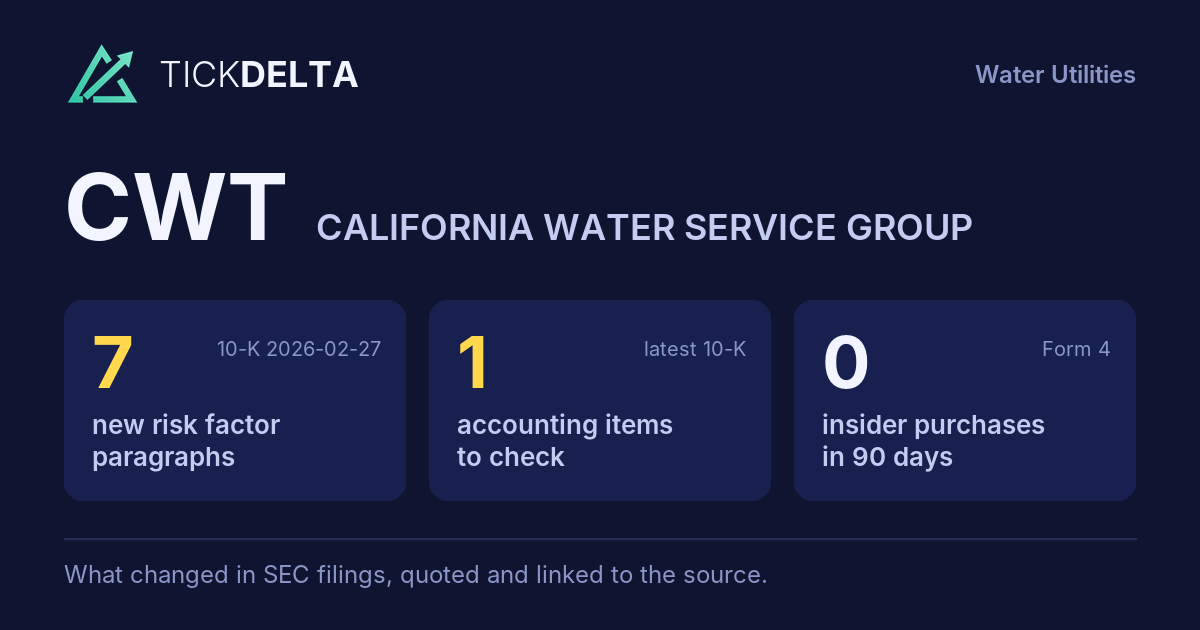
154 paragraphs · 7 new · 55 reworded · 7 gone · 10-K Feb 27, 2026 against Feb 27, 2025
New paragraph Reworded (5% of its words or more) Same or nearly
Paragraph 69 · 40% changed Every version of it
There is strong scientific consensus that human activity including carbon and methane emissions is impacting many generates greenhouse gas emissions, which can impact planetary systems systems, such as the heat-trapping capacity of the atmosphere; ocean temperature, circulation, acidity, and volume; weather patterns including the severity and frequency of severe weather events; ambient temperatures; and planetary ice cover. Because scientific investigations have been focused globally, there There is tremendous uncertainty over the timing, extent, and types of impacts global climate change may have on our service areas and in our water supplies. Moreover, studies of tree ring data show long periods of drought conditions have occurred prior to significant human impacts in California and prior to our operation. Finally, in the last fifty years, California has experienced at least three severe multi-year droughts. We can give no assurance that any of our plans for water reliability and water shortages, including incorporating projected and potential climate change risks into our water supply planning activities, will be adequate or capable of effectively addressing any droughts or longer periods of drought conditions or other conditions affecting water quality and availability. Acute physical risks could affect our operations and intensify over time as climate change worsens. Flooding (surface water, coastal, river, or groundwater), wildfires, storms, and extreme heat, could disrupt our operations or damage our assets, including pressurized mains and other pipelines, wells, treatment facilities, and other infrastructure. Wildfires and flooding may also affect water quality, and extreme heat and wildfires can pose risks to employee safety. Farther into the mid-century and late-century horizon, changing temperatures (air temperature, freshwater, or marine) may cause increased algal blooms and eutrophication. Water stress, characterized by declines in snowpack storage and droughts, could decrease surface water supply availability and groundwater recharge while causing increased outdoor demands, potentially increasing operational expenses and causing challenges in maintaining affordable and reliable water service. We may also experience increased exposure to litigation associated with water quality impacts or inverse condemnation events resulting from physical climate change risks.
Paragraph 16 · 40% changed Every version of it
Finally, state and local jurisdictions may impose new ordinances, laws, fees, and regulations that could increase costs or limit our operations, which affect future operating results. For example, as a result of the recent wildfires that devastated communities in southern California, the Governor of California signed Assembly Bill 367 into law that went into effect on January 1, 2026. The bill creates additional requirements for water utilities in Ventura County, or our Westlake district, related to fire protection. Cal Water is required to have access to sufficient backup energy to operate wells and water pumps that are critical for supplying water for fire suppression in the high or very high fire hazard severity zone beginning July 1, 2030. Cal Water is also required to prepare an emergency preparedness plan for responding to red flag warnings, extreme weather events, and major power outages. Cities may impose or amend franchise requirements, impose conditions on underground construction or land use, impose various taxes and fees, or restrict our hours for construction, among other things. In the last decade, more More cities have imposed are imposing excavation moratoria or paving rules, which has resulted in delays and required more costly construction than anticipated.
Paragraph 128 · 38% changed Every version of it
We believe our labor relations are good, but in light of rising costs for health care, pensions, and general inflation, our future contract negotiations may be difficult. Furthermore, changes in applicable law or regulations could have an adverse effect on management’s negotiating position with respect to our currently unionized employees and/or employees that decide to unionize in the future. We are subject to a risk of work stoppages and other labor relations matters as we negotiate with the unions to address these issues, which could affect our results of operations and financial condition. We can give no assurance that issues with our labor forces will be resolved favorably to us in the future or that we will not experience work stoppages.
Paragraph 49 · 38% changed Every version of it
•power loss, computer systems failures, including hardware equipment and software applications, application failures, and internet, internet or telecommunications or data network failures; outages;
Paragraph 138 · 31% changed Every version of it
Our success depends significantly on the continued individual and collective contributions of our management team. The loss of the services of any member of our management team could have an adverse effect on our business as our management team has knowledge of our industry and customers and would be difficult to replace. replace as there is significant competition for such personnel in our industry. We believe we offer competitive compensation and benefits as well as provide opportunities for continued development. There can be no assurance, however, that we will continue to be successful in retaining the members of our management team.
Paragraph 149 · 29% changed Every version of it
We have announced, and may from time to time announce, certain initiatives, including goals, targets, and other objectives, related to ESG sustainability matters. These statements reflect our current plans and do not constitute a guarantee that they will be achieved. achieved or maintained. Our failure or perceived failure to accomplish or accurately track and report on these goals on a timely basis, goals, comply with evolving standards, or at all, satisfy reporting requirements could adversely affect our reputation, financial performance, and growth, and expose us to increased scrutiny from the investment community as well as enforcement authorities. In addition, statements about our sustainability goals, targets, and other objectives, and progress against those goals, targets, and other objectives, are or may be based on standards for measuring progress that are still developing, internal controls and processes that continue to evolve, and assumptions that are subject to change in the future. Our selection of voluntary disclosure frameworks and standards, and the interpretation or application of those frameworks and standards, have changed and may change from time to time, or differ from those of others. Methodologies for reporting this data have been and may from time to time be updated and previously reported data has been or may be adjusted, as applicable, to reflect improvement in availability and quality of third-party data, changing assumptions, changes in the nature and scope of our operations, and other changes in circumstances, which could result in significant revisions to our current goals, reported progress in achieving such goals, or ability to achieve such goals in the future.
Paragraph 101 · 28% changed Every version of it
We seek to acquire or invest in other companies, technologies, services, or products companies that complement our business from time to time. For example, in February of 2026, we entered into an agreement to purchase Nexus’ Nevada and Oregon water and wastewater systems, which remains subject to regulatory approvals and other customary closing conditions. The execution of our growth strategy exposes us to different risks than those associated with our utility operations. We can give no assurance that we will succeed in finding attractive acquisition candidates or investments, or that we would be able to reach mutually agreeable terms with such parties. In addition, as consolidation becomes more prevalent in the water and wastewater industries, industries and competition from other regulated utilities, governmental entities and other strategic and financial buyers continues to increase, the prices for suitable acquisition candidates may increase to unacceptable levels and limit our ability to grow through acquisitions. Consummation of any proposed acquisition at any time may also be subject to various conditions to closing as well as regulatory approvals, and there can be no assurance that we will be able to complete proposed transactions on a timely basis or at all. If we are unable to find acquisition candidates or investments, complete acquisitions of suitable candidates on attractive terms or realize the expected benefits from proposed transactions, our ability to grow may be limited.
Paragraph 25 · 26% changed Every version of it
For example, in April of 2024, the EPA finalized MCLs, MCLs for six PFAS in drinking water. Under the PFAS regulation, water utilities across the country are required to complete initial PFAS monitoring by 2027 and to implement treatment for sources exceeding the MCL by 2029. In May of 2025, the EPA announced its intention to rescind the regulations for four of the PFAS compounds, and to extend the compliance date to 2031. On January 20, 2026, a three-judge panel of the U.S. Court of Appeals for the District of Columbia unanimously denied an EPA request to vacate and remove MCLs on four PFAS. Multi-party litigation continues with regard to PFAS MCLs. We estimate a capital investment of approximately $226.0 $269.1 million will be required to comply with the currently effective regulation, but this amount could be higher or lower depending on factors out of our control such as unforeseen supply issues that may arise as public water systems across the country compete to procure necessary treatment supplies. Some of the capital investment requirements are offset and will continue to be offset by settlement and grant proceeds we have received and expect to continue to receive (see “Water Supply” above for more details).

MD&A

84 paragraphs · 6 new · 37 reworded · 9 gone · 10-K Feb 27, 2026 against Feb 27, 2025
New paragraph Reworded (5% of its words or more) Same or nearly
Paragraph 54 · 48% changed
Long-term financing is accomplished using both debt and equity. Cal Water was authorized to issue $1.3 billion of new debt and equity to finance capital projects and operations by a CPUC decision dated August 2, 2024. In addition, the decision retained approximately $179.0 million of prior financing authority and determined that refinancing long-term debt did not count against the authorization. The CPUC requires that any loans from Cal Water to the Company be at arm’s length. This restriction did not materially affect the Company’s ability to meet its cash obligations in 2024. 2025. Management does not expect this restriction to have a material impact on the Company’s ability to meet its cash obligations in 2025 2026 and beyond.
Paragraph 43 · 46% changed
During 2024, 2025, we generated cash flow from operations of $290.9 $302.6 million, compared to $217.8 $290.9 million during 2023. 2024. The increase in 2024 2025 was primarily due to an increase in net income primarily cash collections due to an increase in customer rates and the recording recovery of $123.9 million of operating revenue for the MWRAM and IRMA due to receivables. This was partially offset by a decrease in customer usage and the resolution receipt of the 2021 GRC. There was an associated increase to regulatory assets related to MWRAM $83.0 million from California’s Extended Water and IRMA operating revenue. The Company has started billing for the recovery of these regulatory assets Wastewater Arrearages Payment Program in the 2024 that did not recur in 2025.
Paragraph 36 · 42% changed
For 2024, 2025, other operations expense increased $6.0 $11.6 million, or 5.3%, 9.8%, compared to 2023. 2024. The increase was primarily due to an a $2.8 million increase in employee wage expense of $2.3 million, labor expense, $2.5 million increase in bad debt expense, $1.8 million increase in software expenses, a $1.8 million increase in miscellaneous office expenses, $1.3 million increase in conservation expenses, and a $1.0 million increase in water treatment costs costs. The increase in bad debt expense was primarily due to lower bad debt expense in 2024 as a result of $1.8 million primarily related applying arrearage funds to the HOH Water Utilities system acquisition that closed in December of 2023, and software licensing fees of $1.3 million. eligible, previously written-off accounts.
Paragraph 61 · 41% changed
For finance and operating lease obligations, see See Note 15 of the Notes to Consolidated Financial Statements. Statements for details on settlement proceeds from PFAS manufacturers.
Paragraph 33 · 37% changed
For 2024, income tax expense 2025, administrative and general expenses increased $51.1 $2.1 million, or 336.6%, to $35.9 million 1.5%, compared to an income tax benefit of $15.2 million for 2023. 2024. The increase in 2024 was primarily due to an increase increases of $4.6 million in pre-tax operating income employee related costs, $2.3 million in 2024 attributable to the recognition of income related to the 2021 GRC decision legal fees, $1.1 million in 2024. other general
Paragraph 41 · 27% changed
For 2024, 2025, net interest expense increased $7.7 $9.1 million, or 15.5%, 15.9%, compared to 2023. 2024. The increase was primarily due to higher average short-term borrowing rates and higher outstanding borrowings on our short-term credit facilities. borrowings, partially offset by lower interest rates.
Paragraph 76 · 25% changed
For 2025, 2026, the Company is estimating its capital expenditures to be between $450.0 $580.0 million and $550.0 $640.0 million based on the 2024 CA GRC in California and normal capital needs in the other subsidiaries. This range includes an estimated PFAS compliance cost of $79.2 million. See “Water Supply” in Part I - Item 1 above for details on the currently effective regulation. We expect our annual capital expenditure expenditures to increase during the next five years due to increasing needs to replace and maintain infrastructure.
Paragraph 5 · 24% changed
The net income benefit of the 2021 CA GRC from 2023 interim rate relief was approximately $64.0 million million, or $1.09 earnings per diluted common share, that is included in 2024 results.

A paragraph is matched with the one last year that shares the most of its words; under half in common makes it new. The paragraphs shown are the 8 reworded the most in each section.

The paragraph that changed most in each section

The redline

Marked against last year's 10-K: cut words struck through, new words highlighted.

Risk Factors204 words changed in this paragraph; it is 56% similar to last year's version.
There is strong scientific consensus that human activity including carbon and methane emissions is impacting many generates greenhouse gas emissions, which can impact planetary systems systems, such as the heat-trapping capacity of the atmosphere; ocean temperature, circulation, acidity, and volume; weather patterns including the severity and frequency of severe weather events; ambient temperatures; and planetary ice cover. Because scientific investigations have been focused globally, there There is tremendous uncertainty over the timing, extent, and types of impacts global climate change may have on our service areas and in our water supplies. Moreover, studies of tree ring data show long periods of drought conditions have occurred prior to significant human impacts in California and prior to our operation. Finally, in the last fifty years, California has experienced at least three severe multi-year droughts. We can give no assurance that any of our plans for water reliability and water shortages, including incorporating projected and potential climate change risks into our water supply planning activities, will be adequate or capable of effectively addressing any droughts or longer periods of drought conditions or other conditions affecting water quality and availability. Acute physical risks could affect our operations and intensify over time as climate change worsens. Flooding (surface water, coastal, river, or groundwater), wildfires, storms, and extreme heat, could disrupt our operations or damage our assets, including pressurized mains and other pipelines, wells, treatment facilities, and other infrastructure. Wildfires and flooding may also affect water quality, and extreme heat and wildfires can pose risks to employee safety. Farther into the mid-century and late-century horizon, changing temperatures (air temperature, freshwater, or marine) may cause increased algal blooms and eutrophication. Water stress, characterized by declines in snowpack storage and droughts, could decrease surface water supply availability and groundwater recharge while causing increased outdoor demands, potentially increasing operational expenses and causing challenges in maintaining affordable and reliable water service. We may also experience increased exposure to litigation associated with water quality impacts or inverse condemnation events resulting from physical climate change risks.

Source: Item 1A, 10-K 0001628280-26-012444 vs Item 1A, 10-K 0001035201-25-000003

Accounting Policies156 words changed in this paragraph; it is 39% similar to last year's version.
Regulatory balancing account revenue is revenue related to revenue mechanisms authorized in California by the California Public Utilities Commission (CPUC). For certain revenue mechanisms, the Company recognizes revenue when it is objectively determinable, probable of recovery and expected to be collected within 24 months following the end of the accounting period. To the extent that revenue is estimated to be collectible beyond 24 months, recognition is deferred. These mechanisms include the Monterey-Style Water Revenue Adjustment Mechanism (MWRAM), which was approved in Cal Water’s 2021 General Rate Case (GRC) filing (2021 GRC) in March of 2024. The MWRAM tracks the difference between the revenue received for actual metered sales through the tiered volumetric rate and the revenue that would have been received with the same actual metered sales if a uniform rate had been in effect. The MWRAM is effective retroactive to January 1, 2023. The MWRAM fluctuates with the seasonality of the water business. During the warm, dry summer months when water use is typically highest, the MWRAM will reflect an overcollection of revenue compared to the cool, wet winter months when less water is typically used, the MWRAM will reflect an undercollection of revenue. In 2024, the Company recorded $35.3 million of MWRAM revenue.

Source: Item 8, Note 2 – SUMMARY OF SIGNIFICANT ACCOUNTING POLICIES, 10-K 0001628280-26-012444 vs Item 8, Note 2 – SUMMARY OF SIGNIFICANT ACCOUNTING POLICIES, 10-K 0001035201-25-000003

MD&A121 words changed in this paragraph; it is 31% similar to last year's version.
During 2024, 2025, we issued $170.0 million of Senior Unsecured Notes and $200.0 million of First Mortgage Bonds (see Note 8 of the Notes to Consolidated Financial Statements). We also borrowed $505.0 million, and paid down $480.0 $550.0 million on our unsecured revolving credit facilities for general corporate purposes. We also facilities, received $30.4 PFAS settlement proceeds of $40.9 million after fees and expenses, and received $37.5 million of advances and contributions in aid of construction, which was reduced construction. These increases were partially offset by a pay down of $625.0 million on our unsecured revolving credit facilities, dividend payments of $73.9 million, retirement of long-term debt of $70.9 million primarily for First Mortgage Bonds that matured during the year, and refunds of advances of $9.5 million to developers of $9.4 million. In addition, we issued $89.0 million of Company common stock through our at-the-market equity plan and our employee stock purchase plan. developers.

Source: Item 7, 10-K 0001628280-26-012444 vs Item 7, 10-K 0001035201-25-000003

Legal Proceedings38 words changed in this paragraph; it is 88% similar to last year's version.
The right-of-use (ROU) assets that are recorded represent the Company’s right to use an underlying asset for the lease term and lease liabilities represent the Company’s obligation to make lease payments arising from the lease. Lease ROU assets and liabilities are recognized at commencement date based on the present value of lease payments over the lease term. As most of the Company’s operating leases do not provide an implicit rate, the Company uses an incremental borrowing rate based on the information available at commencement date in determining the present value of lease payments. The ROU asset and lease liability may include options to extend or terminate the lease when it is reasonably certain that the Company will exercise that option. Variable lease payments that are based on changes in CPI are included in the measurement of ROU asset and lease liability on the basis of the rate at lease commencement. Subsequent changes to the payments as a result of changes to the CPI rate are recognized in the period in which the obligation of these payments is incurred.

Source: Item 3, via Note 15 – CONTINGENCIES AND COMMITMENTS, 10-K 0001628280-26-012444 vs Item 3, via Note 15 – CONTINGENCIES AND COMMITMENTS, 10-K 0001035201-25-000003

Sentences and paragraphs added, removed or reworded

Every change, by type

Sentences and paragraphs of CWT's Risk Factors and MD&A, 10-K Feb 27, 2026 against 10-K Feb 27, 2025. Each links to the text at sec.gov.

Quiet changes are sentences kept from last year with one to four words changed, at least one of them a hedge, a modal or a qualifier (may, could, will, not, significant, material…). A year or date rolling forward is not counted.

The full word list

adverse, adversely, all, although, anticipate, anticipates, any, approximately, believe, believes, can, cannot, certain, could, expect, expects, generally, however, if, intend, intends, largely, likely, many, material, materially, may, might, most, must, never, no, not, possible, primarily, probable, should, significant, significantly, some, substantial, substantially, unlikely, will, would

AddedRisk Factors
We periodically file rate increase applications with the Commissions. The ensuing administrative and hearing process may be lengthy and costly. Statutory advocates and certain customers have in the past opposed and may in the future oppose our rate increase applications with the objective of limiting rate increases or even reducing rates, which can impact our ability to obtain rate increases on a timely basis, including our 2024 CA GRC, and can adversely influence the outcome of rate increase applications ultimately approved by the Commissions. We expect such opposition activities to continue in connection with current and future rate increase applications, particularly during periods of high inflation or other adverse macroeconomic conditions.
Read it in 10-K Feb 27, 2026 at sec.gov
AddedRisk Factors
These events may result in physical and/or electronic loss or compromise of customer, employee, operational, or financial data; security breaches; misappropriation; disruption of service to our customers; loss of revenues, response costs, and other
Read it in 10-K Feb 27, 2026 at sec.gov
AddedRisk Factors
Additional climate-related risks may influence our approach as we support the transition to a low-carbon economy. Transition risks include changes in customer behavior, such as residential and non-residential relocations and variations in water needs by customer groups. Regulatory risks, such as carbon pricing mechanisms, like emission trading systems or carbon taxes, may also financially affect our business. Additionally, evolving regulations impacting air, water, land use, wildlife conservation, and waste disposal due to climate change, may increase compliance costs and restrict operations, which could lead to higher operational burdens and reduced flexibility in delivering existing services. Transitioning to lower emissions technology or implementing fleet electrification requirements could lead to increased operational costs. Slow responses to physical or transitional climate risks may also affect our reputation and increase pressure to deliver affordable water.
Read it in 10-K Feb 27, 2026 at sec.gov
AddedRisk Factors
30.5% and 29.7% of our total operating costs in 2025 and 2024, respectively. Water purchased from suppliers will require renewal of our contracts upon expiration and may result in significant price increases under any such renewed contracts.
Read it in 10-K Feb 27, 2026 at sec.gov
AddedRisk Factors
that continue to evolve, and assumptions that are subject to change in the future. Methodologies for reporting this data have been and may from time to time be updated and previously reported data has been or may be adjusted, which could result in significant revisions to our current goals, reported progress in achieving such goals, or ability to achieve such goals in the future.
Read it in 10-K Feb 27, 2026 at sec.gov
RemovedRisk Factors
broadly halt federal funding, seeking to aggressively downsize the U.S. federal government’s workforce and instructing federal agencies to reprioritize or to cease operating or enforcing certain laws or regulations. We are unable to predict the extent to which the current U.S. federal administration may impose or seek to impose leadership or policy changes at the U.S. federal regulatory agencies responsible for regulating our business, including changes or proposed changes at the EPA or SEC, or changes or proposed changes to rules and policies impacting our operations. Any such changes could impose additional costs, require the attention of senior management or result in other changes to or limitations on our business.
Read it in 10-K Feb 27, 2025 at sec.gov
Show the other 50
RemovedRisk Factors
We operate in areas that are prone to earthquakes, urban fires, wildfires, landslides, mudslides, and other natural disasters. A significant seismic event, urban or wildfire outbreak, or other natural disaster in California where our operations are concentrated could adversely affect our ability to deliver water and adversely affect our costs of operations. A major disaster
Read it in 10-K Feb 27, 2025 at sec.gov
RemovedRisk Factors
Additional climate-related risks may influence our approach as we support the transition to a low-carbon economy. Transition risks include changes in the market and consumer demands, such as differences in generational behaviors, shifts in population locations due to different weather patterns, and variations in water needs and customer groups. Regulatory risks, such as emission trading systems and carbon taxes, may also financially affect our business. Additionally, federal and state regulations present requirements for managing water supplies and limiting impacts on local wildlife, while regional plans and legislation may directly affect how we address water issues.
Read it in 10-K Feb 27, 2025 at sec.gov
RemovedRisk Factors
at levels permitting us to earn a reasonable rate of return. In the event we are unable to obtain sufficient capital, our expansion efforts could be curtailed, which may affect our growth and may affect our future results of operations.
Read it in 10-K Feb 27, 2025 at sec.gov
RemovedRisk Factors
to the prior claims of creditors of that subsidiary. If we are unable to obtain funds from our subsidiaries in a timely manner, we may be unable to meet our obligations or pay dividends.
Read it in 10-K Feb 27, 2025 at sec.gov
RemovedRisk Factors
Investor and political advocacy groups, certain institutional investors, investment funds, other market participants, stockholders, and customers have focused increasingly on ESG initiatives, including the goals, targets, and objectives that we announce, and our methodologies and timelines for pursuing them. At the same time, stakeholders and regulators have
Read it in 10-K Feb 27, 2025 at sec.gov
RewordedRisk Factors
Additional factors that could cause fluctuations in the trading price of our stock include regulatory developments, such as the delay in the CPUC’s final decision regarding the 2021 2024 CA GRC, general economic conditions and trends, including inflationary pressures, general economic slowdown or a recession, changes in monetary policy, adverse capital markets activity or those discussed under “Our business and financial performance may be adversely affected by high inflation and other macroeconomic conditions as a result of geopolitical conflicts, and the prospect of a shutdown of the U.S. federal government; conditions”; price and volume fluctuations in the overall stock market; actual or anticipated changes or fluctuations in our results of operations; actual or anticipated changes in the expectations of investors or securities analysts; actual or anticipated developments in other utilities’ businesses or the competitive landscape generally; litigation involving us or our industry; major catastrophic events, events; or sales of large blocks of our stock.
Read it in 10-K Feb 27, 2026 at sec.gov
RewordedRisk Factors
We may also be similarly impacted by stagnating or worsening business and economic conditions, including general economic slowdown or a recession, changes in or uncertainty regarding tariff policy, including tariffs on U.S. imports, such as those imports recently implemented on steel and aluminum, higher the interest rates for a prolonged period of time, instability of certain financial institutions, rate environment, changes in monetary policy, adverse capital markets activity or macroeconomic conditions as a result of geopolitical conflicts, and the prospect of actions or changes effected, proposed or threatened by, or a shutdown of of, the U.S. federal government.
Read it in 10-K Feb 27, 2026 at sec.gov
RewordedRisk Factors
For example, the CPUC did has not issue issued its final decision on our 2021 GRC until March 2024, over a year later than expected, 2024 CA GRC, which has caused uncertainty around around, and may cause volatility in in, our financial and operating results until that time. for our Company.
Read it in 10-K Feb 27, 2026 at sec.gov
RewordedRisk Factors
We can give no assurance that any of our plans for water reliability and water shortages, including incorporating projected and potential climate change risks into our water supply planning activities, will be adequate or capable of effectively addressing any droughts or longer periods of drought conditions or other conditions affecting water quality and availability.
Read it in 10-K Feb 27, 2026 at sec.gov
RewordedRisk Factors
As a result, we were precluded from requesting a full decoupling WRAM from the time of in the 2021 GRC application until the California Supreme Court’s decision on July 8, 2024 voiding the WRAM provisions in the August 27, 2020 CPUC decision. CA GRC.
Read it in 10-K Feb 27, 2026 at sec.gov
RewordedRisk Factors
For example, as a regulated utility, we must obtain approval from our Commissions for our cost structure and capital investments, including capital expenditures for implementing ESG programs, and any Any changes that may affect customer rates need to be approved within the rate case process with the Commissions.
Read it in 10-K Feb 27, 2026 at sec.gov
RewordedRisk Factors
In addition, the recent change in current U.S. federal administration has led effected and is expected to continue to lead seek to effect, propose, or threaten changes in the leadership of various U.S. federal regulatory agencies and changes or proposed or threatened changes to U.S. federal government policy that have policy, which has led to, in some cases, legal challenges as well as uncertainty around the funding, functioning and policy priorities of U.S. federal regulatory agencies and the status of current and future regulations.
Read it in 10-K Feb 27, 2026 at sec.gov
RewordedRisk Factors
For example, as a regulated utility, we must obtain approval from our Commissions for our cost structure and capital investments, including capital expenditures for implementing ESG programs, and any changes that may affect customer rates need to be approved within the rate case process with the Commissions. sustainability-related programs.
Read it in 10-K Feb 27, 2026 at sec.gov
RewordedRisk Factors
In addition, as consolidation becomes more prevalent in the water and wastewater industries, industries and competition from other regulated utilities, governmental entities and other strategic and financial buyers continues to increase, the prices for suitable acquisition candidates may increase to unacceptable levels and limit our ability to grow through acquisitions.
Read it in 10-K Feb 27, 2026 at sec.gov
RewordedRisk Factors
The number of environmental Environmental and service-related lawsuits have frequently been filed against other water utilities has increased in frequency in recent years. utilities.
Read it in 10-K Feb 27, 2026 at sec.gov
RewordedRisk Factors
Our failure or perceived failure to accomplish or accurately track and report on these goals on a timely basis, goals, comply with evolving standards, or at all, satisfy reporting requirements could adversely affect our reputation, financial performance, and growth, and expose us to increased scrutiny from the investment community as well as enforcement authorities.
Read it in 10-K Feb 27, 2026 at sec.gov
RewordedRisk Factors
We rely on our IT and OT networks and applications to bill customers, process orders, provide customer service, manage construction projects, manage our financial records, track assets, remotely monitor certain of our plants and facilities treatment facilities, support human resources, and manage human resources, inventory and accounts receivable collections. receivable.
Read it in 10-K Feb 27, 2026 at sec.gov
Quiet changesRisk Factors
If we are subject to additional environmental or service-related lawsuits, we might could incur significant legal costs costs, and it is uncertain whether we would be able to recover the legal costs from customers or other third parties.
Read it in 10-K Feb 27, 2026 at sec.gov
AddedMD&A
Administrative and general expenses include payroll related to administrative and general functions, all employee benefits charged to expense accounts, insurance expenses, legal fees, expenses associated with being a public company, and general corporate expenses.
Read it in 10-K Feb 27, 2026 at sec.gov
AddedMD&A
corporate expenses, and $0.7 million in travel. This was partially offset by a $6.4 million increase in the allocations to construction activities due to additional resources focused on capital delivery.
Read it in 10-K Feb 27, 2026 at sec.gov
AddedMD&A
During 2025, we issued $170.0 million of Senior Unsecured Notes and $200.0 million of First Mortgage Bonds (see Note 8 of the Notes to Consolidated Financial Statements). We also borrowed $550.0 million on our unsecured revolving credit facilities, received PFAS settlement proceeds of $40.9 million after fees and expenses, and received $37.5 million of advances and contributions in aid of construction. These increases were partially offset by a pay down of $625.0 million on our unsecured revolving credit facilities, dividend payments of $73.9 million, retirement of long-term debt of $70.9 million primarily for First Mortgage Bonds that matured during the year, and refunds of advances of $9.5 million to developers.
Read it in 10-K Feb 27, 2026 at sec.gov
AddedMD&A
In November of 2025, we entered into an agreement to purchase the remaining membership interests of BVRT for $45.0 million. The acquisition of the remaining membership interests is subject to satisfaction of customary closing conditions in addition to PUCT and our Board of Director’s approval. We expect to fund the purchase with cash from operations (see “Regulated Business” in Part I - Item 1 above for more details).
Read it in 10-K Feb 27, 2026 at sec.gov
AddedMD&A
In February of 2026, we agreed to purchase Nexus’s Nevada and Oregon water and wastewater systems for approximately $218.0 million, subject to the finalization of closing adjustments. Our Board of Directors has approved the acquisition. We expect to fund the purchase with a combination of cash from operations and debt and equity capital raises (see “Regulated Business” in Part I - Item 1 above for more details).
Read it in 10-K Feb 27, 2026 at sec.gov
RemovedMD&A
The California Water and Wastewater Arrearages Payment Program was created by the California Legislature to be administered by the Water Board in order to provide relief to community water and wastewater systems for unpaid bills (arrearages) related to the COVID-19 pandemic.
Read it in 10-K Feb 27, 2025 at sec.gov
RemovedMD&A
In 2023, the California Extended Water and Wastewater Arrearages Payment Program (Extended Program) was established and extended the relief period to include arrearages accrued from June 16, 2021 to December 31, 2022. In response to the Extended Program, Cal Water submitted an application for $82.0 million in eligible customer arrearages and $1.0 million in program administrative costs, which was approved by the Water Board. Cal Water received the funds in April of 2024 and applied $57.5 million of the funds to eligible past due customer balances during the second quarter of 2024. The remaining balance was returned to the Water Board in the third quarter of 2024 in accordance with the program terms.
Read it in 10-K Feb 27, 2025 at sec.gov
RemovedMD&A
2024 2023 Dollars in millions Net change due to rate changes, usage, and other (1) $ 122.1 $ 17.9 IRMA revenue (2) 88.6 — MWRAM revenue (3) 35.3 — WRAM revenue — (74.3) MCBA revenue — 7.4 Other balancing account revenue — 4.9 Deferral of revenue (4) (3.8) (7.7) Net change $ 242.2 $ (51.8)
Read it in 10-K Feb 27, 2025 at sec.gov
RemovedMD&A
The following is a summary of 2024 rate filings that impacted revenue requirement. A description of the “Type of Filing” can be found in the “Item 1 - Rates and Regulation” section above. California decisions and resolutions may be found on the CPUC website at www.cpuc.ca.gov.
Read it in 10-K Feb 27, 2025 at sec.gov
RemovedMD&A
Type of Filing Decision/Resolution Effective Date Increase in CA District/ Annual Revenue Subsidiary GRC and Offset Filings 2024 Expense Offset AL 2501 Jan. 2024 $5.1 million 6 Districts Cost of Capital AL 2502 Jan. 2024 $10.0 million All Districts 2024 Rate Base Offset AL 2514 May 2024 $5.8 million All Districts 2021 GRC and 2024 Escalations* AL 2515 May 2024 $42.5 million All Districts
Read it in 10-K Feb 27, 2025 at sec.gov
RemovedMD&A
During 2024, we borrowed $505.0 million, and paid down $480.0 million on our unsecured revolving credit facilities for general corporate purposes. We also received $30.4 million of advances and contributions in aid of construction, which was reduced by refunds to developers of $9.4 million. In addition, we issued $89.0 million of Company common stock through our at-the-market equity plan and our employee stock purchase plan.
Read it in 10-K Feb 27, 2025 at sec.gov
RemovedMD&A
On October 22, 2024, Cal Water completed the sale and issuance of $125.0 million in First Mortgage Bonds (the Bonds) in a private placement. The Bonds, relating to Series 2, bear an interest rate of 5.22% per annum payable quarterly, and mature on October 22, 2054. The Bonds rank equally with all of Cal Water’s other First Mortgage Bonds and are secured by liens on Cal Water’s properties, subject to certain exceptions and permitted liens. Cal Water used the net proceeds from the sale of the Bonds to refinance existing indebtedness and for general corporate purposes. The Bonds were not registered under the Securities Act of 1933 and may not be offered or sold in the United States absent registration or an applicable exemption from registration requirements.
Read it in 10-K Feb 27, 2025 at sec.gov
RemovedMD&A
On March 31, 2023, the Company and Cal Water entered into the Company and Cal Water credit facilities, which provide for unsecured revolving credit facilities of up to an initial aggregate amount of $600.0 million for a term of five years. The Company and subsidiaries that it designates may borrow up to $200.0 million under the Company’s revolving credit facility (the Company facility). Cal Water may borrow up to $400.0 million under the Cal Water revolving credit facility (the Cal Water facility). Additionally, the credit facilities may be increased by up to an incremental $150.0 million under the Cal Water facility and $50.0 million under the Company facility, subject in each case to certain conditions.
Read it in 10-K Feb 27, 2025 at sec.gov
RewordedMD&A
The decrease increase was due primarily to a $4.4 $2.4 million decrease increase in other components of net periodic benefit credit and a $1.3 million decrease in the unrealized gains from certain non-qualified benefit plan investments due to market conditions, which was partially offset by a $1.4 $0.8 million increase in allowance for equity funds used during construction and an construction, which was partially offset by a $1.3 million increase in interest income of $1.0 million. tax expense on other income and expenses.
Read it in 10-K Feb 27, 2026 at sec.gov
RewordedMD&A
The total operating expense increase was primarily due to an increase in water production costs, which include purchased water, purchased power, costs of $11.5 million, an increase in administrative and pump tax expenses, general expenses of $22.1 $2.1 million, increases an increase in other operations expenses of $6.0 million, an increase in income tax expense of $51.1 $11.6 million, an increase in depreciation and amortization expenses of $10.7 $12.5 million, and an increase in property and other taxes of $4.3 $3.7 million.
Read it in 10-K Feb 27, 2026 at sec.gov
RewordedMD&A
The $138.9 $62.6 million increase decrease in net income was primarily due to an increase a decrease in operating revenue of $242.2 $36.7 million primarily as a result of a decrease in customer usage of $12.7 million and the cumulative adjustment for the impacts of the 2021 CA GRC, retroactive to January 1, 2023, and higher that was recorded in 2024, partially offset by an increase in rates and increased consumption. of $69.6 million.
Read it in 10-K Feb 27, 2026 at sec.gov
RewordedMD&A
The increase in 2024 2025 was primarily due to an increase in net income primarily cash collections due to an increase in customer rates and the recording recovery of $123.9 million of operating revenue for the MWRAM and IRMA due to the resolution of the 2021 GRC. receivables.
Read it in 10-K Feb 27, 2026 at sec.gov
RewordedMD&A
At the January The 2025 meeting, the Board declared the quarterly dividend, increasing it for the 58th consecutive year, and annual dividend included a one-time special dividend in the amount of $0.04 per common share.
Read it in 10-K Feb 27, 2026 at sec.gov
RewordedMD&A
The increase decrease in 2024 2025 was primarily due to an increase a decrease in pre-tax operating income in 2024 attributable to the recognition of income related to income, which resulted from the 2021 CA GRC decision in 2024.
Read it in 10-K Feb 27, 2026 at sec.gov
RewordedMD&A
Short-term liquidity is provided by the bank lines of Company’s unsecured revolving credit described above facility (the Company facility) and the Cal Water unsecured revolving credit facility (the Cal Water facility) and by internally generated funds.
Read it in 10-K Feb 27, 2026 at sec.gov
RewordedMD&A
At the In January 2025 meeting, 2026, the Board declared the quarterly dividend, increasing it for the 58th 59th consecutive year, and a one-time special dividend in the amount of $0.04 per common share. year.
Read it in 10-K Feb 27, 2026 at sec.gov
RewordedMD&A
As a result, we have reclassified our record the changes in the funded status for the SERP regulatory asset, net of associated deferred income taxes, for Cal Water to accumulated other comprehensive loss in accordance with generally accepted accounting principles.
Read it in 10-K Feb 27, 2026 at sec.gov
RewordedMD&A
(1)In 2024, 2025, the net change due to rate changes, usage, changes and other items in the above table was primarily due to rate increases of $98.5 million and an increase in consumption and new customers of $17.5 $69.6 million.
Read it in 10-K Feb 27, 2026 at sec.gov
RewordedMD&A
The increase was primarily due to higher average short-term borrowing rates and higher outstanding borrowings on our short-term credit facilities. borrowings, partially offset by lower interest rates.
Read it in 10-K Feb 27, 2026 at sec.gov
Quiet changesMD&A
We also assess the likelihood that deferred tax assets will be recovered in future taxable income and, to the extent recovery is not probable, a valuation allowance would be is recorded.
Read it in 10-K Feb 27, 2026 at sec.gov

Sources

The two latest 10-Ks on EDGAR, section by section. Each change links to the text at sec.gov.

Also

New risk factors: paragraphs with nothing like them last year, quoted in full.

Work with it

Excel workbook · CSV. Google Sheet that stays up to date: paste =IMPORTDATA("https://tickdelta.com/company/CWT/export.csv") into a cell.

Next:Related parties
Esc

Type a ticker such as AAPL, a name, an investor such as Buffett, or a topic such as tariffs. ↑ ↓ to move, Enter to open.