Cytokinetics Inc CYTK
New risk paragraphs, branching off last year
Each branch is a paragraph in Risk Factors with nothing like it in the 10-K filed Feb 27, 2025. A box jumps to the paragraph as filed, below.
Paragraphs with nothing like them in last year's 10-K
13 paragraphs in Risk Factors of the 10-K filed Feb 26, 2026 with nothing like them in the 10-K filed Feb 27, 2025. Quoted exactly. Paragraphs that were only edited are under 10-K change.
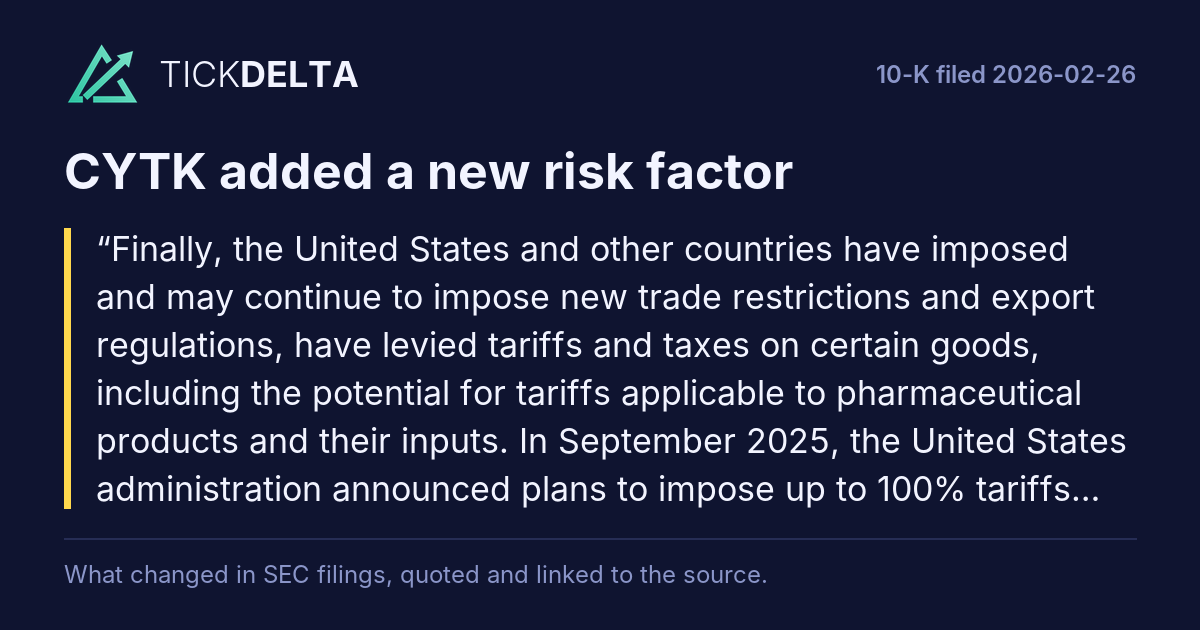
Finally, the United States and other countries have imposed and may continue to impose new trade restrictions and export regulations, have levied tariffs and taxes on certain goods, including the potential for tariffs applicable to pharmaceutical products and their inputs. In September 2025, the United States administration announced plans to impose up to 100% tariffs on imported branded or patented pharmaceutical products, subject to certain exceptions. There is substantial uncertainty as to when such tariffs may go into effect and whether such tariffs would apply to the importation of registered starting materials, active pharmaceutical ingredients or bulk drug products that we use in our business, and, more generally, about the duration of existing tariffs, implementation of announced tariffs, litigation challenging tariffs and whether additional tariffs or other retaliatory measures may be imposed, modified or suspended. If additional tariffs, trade restrictions or other barriers are imposed or expanded, our costs for raw materials, active pharmaceutical ingredients, finished drug product or other inputs could increase materially, and our supply chain could be disrupted, which could materially adversely affect our business, financial condition and results of operations.
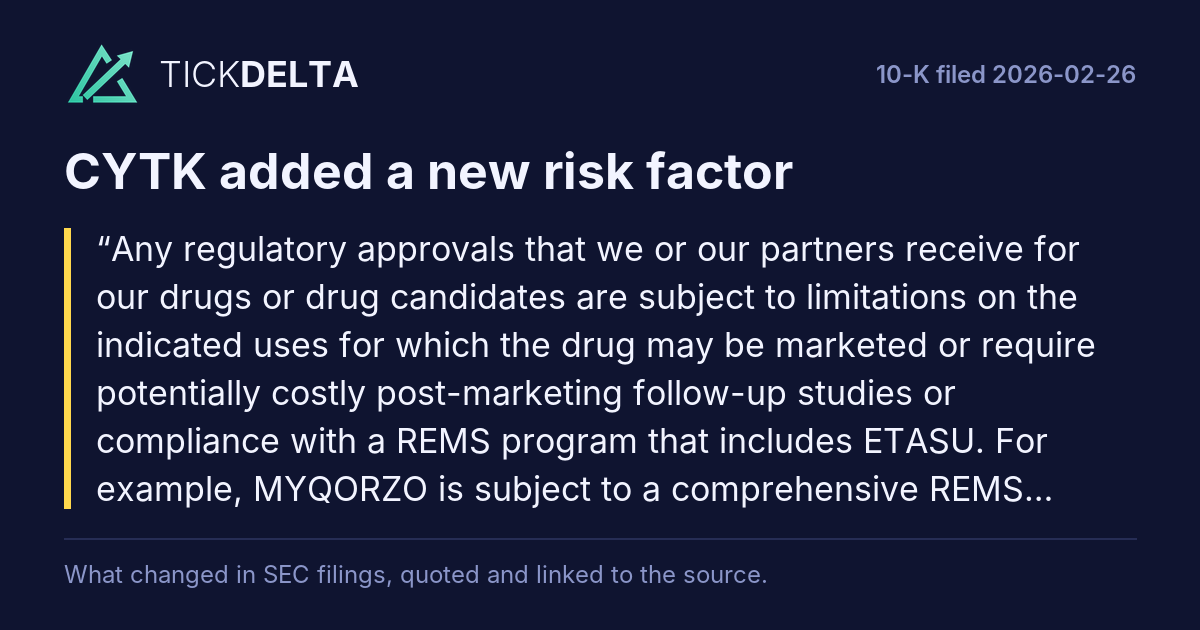
Any regulatory approvals that we or our partners receive for our drugs or drug candidates are subject to limitations on the indicated uses for which the drug may be marketed or require potentially costly post-marketing follow-up studies or compliance with a REMS program that includes ETASU. For example, MYQORZO is subject to a comprehensive REMS program that includes, among other things, restrictions and qualifications on pharmacies that dispense the drug and certification, record-keeping, ongoing monitoring and patient counseling obligations on physicians who prescribe the drug. In addition, in connection with the approval of MYQORZO the FDA requires the conduct of the following post-marketing studies: (i) a worldwide descriptive study that collects prospective and retrospective data in women exposed to MYQORZO during pregnancy to assess risks of pregnancy and maternal complications, and adverse effects on the developing fetus, the neonate, and the infant, as well as to assess infant outcomes through at least the first year of life and (ii) a milk-only lactation study in lactating women who have received MYQORZO to measure concentrations of MYQORZO in breast milk using a validated assay, as well as to assess the effects on the breastfed infant, if available, based on study population.
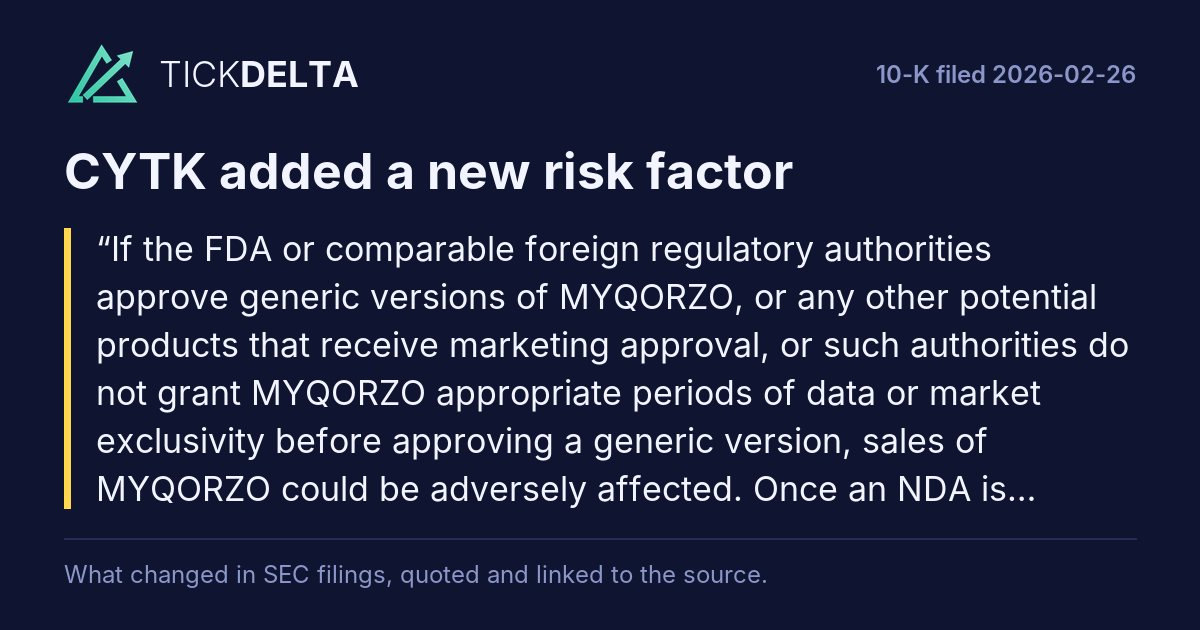
If the FDA or comparable foreign regulatory authorities approve generic versions of MYQORZO, or any other potential products that receive marketing approval, or such authorities do not grant MYQORZO appropriate periods of data or market exclusivity before approving a generic version, sales of MYQORZO could be adversely affected.
Once an NDA is approved, the drug covered thereby becomes a “reference-listed drug” in the FDA’s publication, “Approved Drug Products with Therapeutic Equivalence Evaluations.” Manufacturers may seek marketing approval of generic versions of reference-listed drugs through submission of Abbreviated New Drug Applications (“ANDAs”) in the United States. Generic drugs may be significantly less costly to bring to market than the reference-listed drug and companies that produce generic drugs are generally able to offer them at lower prices. Thus, following the introduction of a generic drug, a significant percentage of the sales of any branded product or reference-listed drug is typically lost to the generic drug.
The FDA may not approve an ANDA or a 505(b)(2) NDA for a generic drug until any applicable period of non-patent exclusivity for the reference-listed drug has expired. The FDCA provides a period of five years of non-patent exclusivity for a new drug containing a new chemical entity. During the exclusivity period, the FDA may not accept for review an ANDA or a 505(b)(2) NDA submitted by another company for another version of such product candidate where the applicant does not own or have a legal right of reference to all the data required for approval. However, an application may be submitted after four years if it contains a certification of patent invalidity or non-infringement. The FDCA also provides three years of marketing exclusivity for an NDA, 505(b)(2) NDA or supplement to an approved NDA if new clinical investigations, other than bioavailability studies, that were conducted or sponsored by the applicant are deemed by the FDA to be essential to the approval of the application, for example, for new indications, dosages or strengths of an existing product candidate. This three-year exclusivity covers only the conditions associated with the new clinical investigations and does not prohibit the FDA from approving ANDAs for product candidates containing the original active agent for other conditions of use. Five-year and three-year exclusivity will not delay the submission or approval of a full NDA. However, an applicant submitting a full NDA would be required to conduct or obtain a right of reference to all of the nonclinical studies and adequate and well-controlled clinical trials necessary to demonstrate safety and effectiveness. Manufacturers may seek to launch generic drugs following the expiration of the marketing exclusivity period, even if we still have patent protection for such drugs.
Competition that MYQORZO, or any other potential product candidates, may face from generic drugs could materially and adversely impact our future revenue, profitability and cash flows and substantially limit our ability to obtain a return on the investments we have made in those products. Our future revenues, profitability and cash flows could also be materially and adversely affected and our ability to obtain a return on the investments we have made in MYQORZO or other product candidates may be substantially limited if MYQORZO, or any other potential products, product candidates, are not afforded the appropriate periods of non-patent exclusivity.
Disruptions at the FDA, including due to a reduction in the FDA’s workforce and/or inadequate funding for the FDA, could prevent the FDA from performing normal functions on which our business relies, which could negatively impact our business.
The ability of the FDA to review and approve new products or review other regulatory submissions can be affected by a variety of factors, including statutory, regulatory and policy changes, inadequate government budget and funding levels, a reduction in the FDA’s workforce and its ability to hire and retain key personnel. Disruptions at the FDA and other agencies may also increase the time to meet with and receive agency feedback, review and/or approve our submissions, conduct inspections, issue regulatory guidance, or take other actions that facilitate the development, approval and marketing of regulated products, which would adversely affect our business. For example, over the last several years the U.S. government has shut down several times and certain regulatory agencies, such as the FDA, have had to furlough critical employees and stop critical activities. Most recently, during the U.S. government shut down in October 2025, the FDA was not able to accept applications for new drugs, generics, biologics, biosimilars or medical devices that require payment of a user fee. In addition, government proposals to reduce or eliminate budgetary deficits may include reduced allocations to the FDA and other related government agencies. For example, the current United States administration established the now-disbanded Department of Government Efficiency, which implemented a federal government hiring freeze and announced certain additional efforts to reduce federal government employee headcount, including by eliminating 3,500 employees from the FDA, and the size of the federal government. The reductions in the FDA’s workforce and budgetary pressures could significantly impact the ability of the FDA to timely review and process our regulatory submissions or take other actions critical to the marketing of any of our product candidates that are ultimately approved. Any delay in the acceptance, review or approval of our investigational new drug applications, clinical trial applications, marketing applications, facility inspections or lot-release/testing activities could delay or increase the cost of our clinical trials, manufacturing scale-up, product launches or post-approval changes, which could have a material adverse effect on our business.
Drug candidates that have similar mechanisms of actions to ours have been subject to clinical trials that have failed to meet their primary endpoints. For example, Camzyos® (mavacamten), a small molecule myosin inhibitor commercialized by Bristol-Myers Squibb Company has a similar mechanism of action to aficamten and failed to meet its dual primary endpoints in ODYSSEY-HCM, a Phase 3 clinical trial assessing its efficacy for the treatment of nHCM. Although such result is not dispositive on the eventual results of our clinical trial of aficamten in nHCM, ACACIA-HCM, the results of ODYSSEY-HCM may suggest that a myosin inhibitor is not effective for the treatment of nHCM notwithstanding the positive results in clinical trials of such drugs in oHCM. In addition, the nHCM patient population presents distinct physiological differences from the oHCM population and those differences may require different dosing strategies to achieve a functional benefit, if at all. As compared to our oHCM trials, this difference in disease pathology and dosing strategy, among other things, could result in a different magnitude of functional benefit, if any, in ACACIA-HCM; it could also result in more treatment interruptions or it could alter the safety profile of aficamten observed in ACACIA-HCM. In the event such differences in functional benefit are observed, regulatory agencies may not approve the nHCM indication or such regulatory approvals may be delayed.
The regulatory pathway for approval also depends on the totality of clinical data and regulatory agencies’ interpretations of what constitutes a minimally important clinical difference in these functional endpoints, which can be subjective because there is no universally established standard. There are a wide range of possible outcomes (e.g., positive, negative or mixed) for the results of ACACIA-HCM, including that we do not demonstrate either a magnitude of functional benefit that regulators deem satisfactory for approval or a magnitude of functional benefit that physicians deem sufficient to prescribe MYQORZO for their patients. In such cases, regulatory agencies may not approve the nHCM indication or may delay such approval, or physicians may not prescribe MYQORZO for their patients, respectively.
Our failure to demonstrate that our drugs are safe and efficacious can result in additional development costs and preclude us from realizing commercial sales for our drug candidates.
Show the other 2
We cannot be sure whether additional legislation or rulemaking related to these developments will be issued or enacted, or what impact, if any, such changes will have on the profitability of MYQORZO, or any of our drug candidates, if approved for commercial use, in the future.
We have been, and may in the future become, party to lawsuits including, without limitation, actions, claims and proceedings in the ordinary course of business relating to our directors, officers, stockholders, intellectual property, and employment matters and policies, which will cause us to incur legal fees and other costs related thereto, including potential expenses for the reimbursement of legal fees of officers and directors under indemnification obligations. The expense of defending against such claims or litigation may be significant and there can be no assurance that we will be successful in any defense. Further, the amount of time that may be required to resolve such claims or lawsuits is unpredictable, and these actions may divert management’s attention from the day-to-day operations of our business, which could adversely affect our business, results of operations, and cash flows. Litigation is subject to inherent uncertainties, and an adverse result in such matters that may arise from time to time could have a material adverse effect on our business, results of operations, and financial condition.
Paragraphs in the 10-Q filed Nov 4, 2026 that were not in the one before
New in the latest 10-Q
16 paragraphs in the 10-Q filed Nov 4, 2026 with nothing like them in the 10-Q filed Aug 6, 2026 (at least half the words must differ; new numbers alone do not count). Quoted exactly, grouped by the item heading above them. This is text that changed, not a judgement of how serious it is.
Financial statements and notes
Nine Months Ended September 30, 2026 September 30, 2025 ───────────────────────────────────────────────────────────────────────────────────────────────────────────────────────────────────────────────────────────────────────────────────── Cash flows from operating activities: Net loss $ (594,862) $ (601,924) Adjustments to reconcile net loss to net cash used in operating activities: Non-cash interest expense on liabilities related to revenue participation right purchase agreements 62,659 42,306 Stock-based compensation expense 100,826 81,780 Non-cash lease expense 4,974 4,038 Depreciation of property and equipment 10,657 7,264 Change in fair value of derivative liabilities 200 (3,300) Change in fair value of liabilities related to RPI Transactions (1,000) 13,500 Realized gain on investment, net (184) (17) Interest receivable and amortization on investments (10,507) (12,902) Non-cash interest expense related to debt 26,161 14,431 Debt conversion expense — 121,249 Changes in operating assets and liabilities: Accounts receivable (16,125) 14,842 Prepaid and other assets (7,899) 1,264 Inventories (15,112) — Accounts payable 6,741 2,972 Deferred revenue 41 (50,758) Accrued and other liabilities 24,112 7,235 Operating lease liabilities (6,583) (6,616) Other non-current liabilities (13,417) (2,722) Net cash used in operating activities (429,318) (367,358) Cash flows from investing activities: Purchases of investments (986,253) (717,523) Investment in non-marketable equity security — (5,000) Maturities of investments 703,642 823,551 Sales of investments — 5,993 Purchases of property and equipment (10,964) (19,163) Net cash (used in) provided by investing activities (293,575) 87,858 Cash flows from financing activities: Repayment of finance lease liabilities — (204) Repayment of term loans (11,736) (8,087) Payments of royalty obligations (1,500) — Repayment of convertible debt — (402,500) Proceeds from issuance of convertible debt, net — 729,460 Proceeds from borrowing under term loans — 75,000 Proceeds from issuance of common stock related to public offering, net of issuance costs 760,148 — Proceeds from issuance of common stock under equity incentive and stock purchase plans 61,757 21,331 Taxes paid related to net share settlement of equity awards (3,242) (1,247) Net cash provided by financing activities 805,427 413,753 Effect of exchange rate changes on cash (1,637) (906) Net increase in cash, cash equivalents, and restricted cash 80,897 133,347 Cash, cash equivalents, and restricted cash, beginning of period 125,632 95,232 Cash, cash equivalents, and restricted cash, end of period $ 206,529 $ 228,579 Supplemental cash flow disclosures: Cash paid for interest $ 12,546 $ 19,874 Non-cash investing and financing activities: Right-of-use assets recognized in exchange for operating lease obligations $ 663 $ 6,427 Amounts unpaid for purchases of property and equipment $ 410 $ 2,088 Conversion of 2026 Notes $ 21,067 $ — Issuance of common stock in connection with repurchase of convertible note $ — $ 107,920
Read in the 10-Q
Legal proceedings
On August 13, 2026, the Company filed a complaint in the United States District Court for the District of Delaware against Bristol-Myers Squibb Company (“BMS”) and its wholly owned subsidiary, MyoKardia, Inc. (“MyoKardia”), seeking a declaratory judgment of non-infringement and invalidity of U.S. Patent No. 12,616,697 (the “’697 Patent”) under the United States patent laws. The ’697 Patent, which issued on May 5, 2026 and is assigned to MyoKardia, claims methods of treating patients having cardiac hypercontractility, impaired cardiac relaxation and/or left ventricular hypertrophy who are undergoing beta blocker therapy by discontinuing or reducing the beta blocker therapy and administering a myosin inhibitor, and certain of its claims specifically recite aficamten, the active ingredient in MYQORZO.
Read in the 10-Q
The complaint alleges, among other things, that the claims of the ’697 Patent reciting aficamten were added by amendment in November 2025, shortly before the FDA approval of MYQORZO, that the defendants were not involved in the discovery, development or commercialization of aficamten and have no right to make or sell MYQORZO, and that the defendants have not provided assurance that they will not assert the ’697 Patent against MYQORZO. The complaint asserts that the Company does not directly or indirectly infringe any claim of the ’697 Patent and that the claims of the ’697 Patent are invalid, including for anticipation, obviousness and lack of adequate written description and enablement. The complaint seeks declarations of non-infringement and invalidity, an injunction prohibiting the defendants from threatening or initiating infringement litigation against the Company or the users, prescribers, distributors or customers of MYQORZO relating to the ’697 Patent, and an award of costs and attorneys’ fees.
Read in the 10-Q
The defendants have not yet responded to the complaint. The Company is unable to predict the outcome of this matter or the timing of its resolution.
Read in the 10-Q
Financial statements and notes
Based on the positive results from ACACIA-HCM, we plan to submit a supplemental NDA to the FDA for aficamten for the treatment of adult patients with symptomatic nHCM in the fourth quarter of 2026. This expectation is a forward-looking statement; the timing of any submission depends on, among other things, the completion of our analyses of the ACACIA-HCM data and the preparation of the required regulatory documentation, and any sNDA we submit will be subject to review by the FDA, which may not accept it for filing or approve it on the timeline we anticipate, or at all.
Read in the 10-Q
Show the other 11
We have entered into certain revenue participation right purchase agreements for omecamtiv mecarbil, aficamten, and ulacamten with affiliates of Royalty Pharma, pursuant to which such affiliates purchased rights to royalties from certain revenue streams. We typically account for such agreements as liabilities to be amortized under the effective interest rate method over the life of the related royalty stream, when we have continuing involvement with the underlying research and development activities. We typically account for such agreements as deferred income to be amortized under the units-of-revenue method, when there is no continuing involvement with the underlying research and development activities. We are required to update our estimates, each reporting period, related to the amount and timing of future royalty payments to be paid to the counterparties of the revenue participation right purchase agreements. The estimates of the future royalty payment determine the measurement of the non-cash interest expense and the carrying value of the liability.
Read in the 10-Q
Revenue participation right purchase agreements are measured using significant unobservable inputs. The estimates of future royalties requires the use of several assumptions such as: the probability of clinical success, the probability of regulatory approval, the estimated date of a product launch, estimates of eligible patient populations, estimates of prescribing behavior and patient behavior, estimates of pricing, payor reimbursement and coverage, and sales ramp. As MYQORZO sales have only commenced in 2026 and products containing omecamtiv mecarbil and ulacamten have not yet been approved as of September 30, 2026, the estimates are highly subjective.
Read in the 10-Q
As of September 30, 2026, we have a total carrying value of approximately $581.7 million of liabilities related to revenue participation right purchase agreements.
Read in the 10-Q
Legal proceedings
On August 13, 2026, the Company filed a complaint in the United States District Court for the District of Delaware against Bristol-Myers Squibb Company (“BMS”) and its wholly owned subsidiary, MyoKardia, Inc. (“MyoKardia”), seeking a declaratory judgment of non-infringement and invalidity of U.S. Patent No. 12,616,697 (the “’697 Patent”) under the United States patent laws. The ’697 Patent, which issued on May 5, 2026 and is assigned to MyoKardia, claims methods of treating patients having cardiac hypercontractility, impaired cardiac relaxation and/or left ventricular hypertrophy who are undergoing beta blocker therapy by discontinuing or reducing the beta blocker therapy and administering a myosin inhibitor, and certain of its claims specifically recite aficamten, the active ingredient in MYQORZO.
Read in the 10-Q
The complaint alleges, among other things, that the claims of the ’697 Patent reciting aficamten were added by amendment in November 2025, shortly before the FDA approval of MYQORZO, that the defendants were not involved in the discovery, development or commercialization of aficamten and have no right to make or sell MYQORZO, and that the defendants have not provided assurance that they will not assert the ’697 Patent against MYQORZO. The complaint asserts that the Company does not directly or indirectly infringe any claim of the ’697 Patent and that the claims of the ’697 Patent are invalid, including for anticipation, obviousness and lack of adequate written description and enablement. The complaint seeks declarations of non-infringement and invalidity, an injunction prohibiting the defendants from threatening or initiating infringement litigation against the Company or the users, prescribers, distributors or customers of MYQORZO relating to the ’697 Patent, and an award of costs and attorneys’ fees.
Read in the 10-Q
The defendants have not yet responded to the complaint. The Company is unable to predict the outcome of this matter or the timing of its resolution.
Read in the 10-Q
Risk Factors
Although ACACIA-HCM met both of its dual primary endpoints, the FDA and other regulatory agencies may not find the results of ACACIA-HCM sufficient to support approval of aficamten for the treatment of nHCM, and any such approval may be delayed, limited or denied.
Read in the 10-Q
In August 2026, we announced the primary results from ACACIA-HCM, our pivotal Phase 3 clinical trial of aficamten in patients with symptomatic nHCM. ACACIA-HCM met both of its dual primary endpoints, demonstrating statistically significant improvements from baseline to Week 36 compared to placebo in both KCCQ Clinical Summary Score and maximal exercise performance (pVO2), and statistically significant improvements compared to placebo were also observed in its key secondary endpoints. Based on these results, we plan to submit a supplemental NDA to the FDA for aficamten for the treatment of adult patients with symptomatic nHCM in the fourth quarter of 2026. However, there can be no assurance that the FDA or any other regulatory agency will find the results of ACACIA-HCM sufficient to support approval of aficamten for the treatment of nHCM.
Read in the 10-Q
Achieving statistical significance on the primary and secondary endpoints of a clinical trial does not by itself establish that a drug is effective for regulatory purposes. The FDA and other regulatory agencies will evaluate the totality of the clinical data from ACACIA-HCM, including the magnitude, durability and clinical relevance of the observed treatment effects, the consistency of those effects across endpoints and patient subgroups, and the adverse events and overall safety profile of aficamten in the nHCM population, in determining whether aficamten is efficacious for the treatment of nHCM and whether its benefits outweigh its risks in this patient population. Regulatory agencies’ interpretations of what constitutes a minimally important clinical difference in functional endpoints such as KCCQ Clinical Summary Score and pVO2 can be subjective because there is no universally established standard, and because there is no approved therapy for nHCM, there is no established benchmark against which the magnitude of the benefit observed in ACACIA-HCM can be measured. Accordingly, the FDA may conclude that the improvements observed in ACACIA-HCM, although statistically significant, are not clinically meaningful or are not of a sufficient magnitude to demonstrate that aficamten is efficacious for the treatment of nHCM, or may otherwise disagree with our interpretation of the data.
Read in the 10-Q
In addition, the nHCM patient population presents distinct physiological differences from the oHCM population, and drug candidates with mechanisms of action similar to aficamten have failed in nHCM. For example, Camzyos (mavacamten), a cardiac myosin inhibitor commercialized by Bristol-Myers Squibb Company, failed to meet its dual primary endpoints in ODYSSEY-HCM, a Phase 3 clinical trial assessing its efficacy for the treatment of nHCM. Regulatory agencies may consider the results of ACACIA-HCM in light of these prior results and the broader body of evidence regarding cardiac myosin inhibitors in nHCM. Furthermore, in ACACIA-HCM, left ventricular ejection fraction below 50% occurred more frequently in participants taking aficamten than in participants taking placebo, and certain participants taking aficamten experienced serious adverse events of heart failure. Regulatory agencies may weigh these safety findings against the observed efficacy in assessing the benefit-risk profile of aficamten in nHCM and, even if they approve aficamten for the treatment of nHCM, may require additional data or analyses, impose labeling restrictions, dose titration or monitoring requirements or modifications to the existing REMS program, or approve a narrower indication than the one we seek.
Read in the 10-Q
If the FDA or other regulatory agencies do not accept our supplemental NDA for filing, do not find the results of ACACIA-HCM sufficient to support approval, require additional clinical trials or data, or delay or limit any approval, we would be unable to commercialize aficamten for the treatment of nHCM on the timeline we anticipate, or at all. Any such outcome could materially and adversely affect our business, financial condition, results of operations and prospects, the market price of our common stock and our ability to achieve the objectives of our corporate strategy, which contemplates regulatory approvals of aficamten in nHCM in multiple geographies.
Read in the 10-Q
The 10-Q's risk factors against the 10-K
Item 1A of the 10-Q filed Nov 4, 2026 against Item 1A of the 10-K filed Feb 26, 2026.
A 10-Q repeats only the risks that changed, so a 10-K paragraph that is missing from it is not counted as removed.
Added is a paragraph with nothing like it in the 10-K, Reworded a sentence that is in both with several words changed,
Quiet changes a sentence in both where one to four words changed and one is a hedge or a modal
(cut words struck through, new words highlighted).
Text on the page, not a score; each links to the filing at sec.gov.
Show the other 1
Phrases used for the first time
Two-word phrases in Risk Factors of the 10-K filed Feb 26, 2026 that are in none of the 1 earlier 10-Ks stored, back to Feb 27, 2025
Where each one is used
- functional benefit: Drug candidates that have similar mechanisms of actions to ours have been subject to clinical trials that have failed to meet their primary endpoints. For example, Camzyos® (mavacamten), a small molecule myosin inhibitor commercialized by Bristol-Myers Squibb Company has a similar mechanism of action to aficamten...
- ulacamten rpa: Covenants in the RP Multi Tranche Loan Agreement, the RP OM Loan Agreement, the RP Ulacamten RPA, the RP Aficamten RPA, the RP OM RPA, and the indentures related to our Convertible Notes restrict our business and operations in many ways and if we do not effectively manage our covenants, our financial conditions and...
- cash flows: In evaluating our business, you should carefully consider the following risks in addition to the other information in this report. Any of the following risks could materially and adversely affect our business, results of operations, financial condition, cash flows, reputation or your investment in our securities,...
- single source: We have no manufacturing capabilities and depend on single source contract manufacturers to produce our commercial product and clinical trial materials, including our drug candidates, and will have continued reliance on contract manufacturers for the development and commercialization of our potential drugs.
- reference-listed drug: Once an NDA is approved, the drug covered thereby becomes a “reference-listed drug” in the FDA’s publication, “Approved Drug Products with Therapeutic Equivalence Evaluations.” Manufacturers may seek marketing approval of generic versions of reference-listed drugs through submission of Abbreviated New Drug...
- generic drugs: Once an NDA is approved, the drug covered thereby becomes a “reference-listed drug” in the FDA’s publication, “Approved Drug Products with Therapeutic Equivalence Evaluations.” Manufacturers may seek marketing approval of generic versions of reference-listed drugs through submission of Abbreviated New Drug...
- commercialization efforts: Our drug candidates and commercialized drugs, such as MYQORZO, require precise high-quality manufacturing. The failure to achieve and maintain high manufacturing standards in compliance with cGMP, including failure to document and detect, control, analyze and resolve anticipated or unanticipated manufacturing...
- generic drug: Once an NDA is approved, the drug covered thereby becomes a “reference-listed drug” in the FDA’s publication, “Approved Drug Products with Therapeutic Equivalence Evaluations.” Manufacturers may seek marketing approval of generic versions of reference-listed drugs through submission of Abbreviated New Drug...
Used at least twice, small words left out. Counted, not picked: a phrase can be new because the company renamed something.
What was taken out
8 paragraphs of last year's Risk Factors with nothing like them now. The longest are quoted.
Sources
Item 1A of each 10-K and 10-Q on EDGAR, quoted exactly. Each paragraph links to the filing at sec.gov.
Also
10-K change: what was reworded or cut, section by section.
Work with it
Excel workbook · CSV. Google Sheet that stays up to date: paste =IMPORTDATA("https://tickdelta.com/company/CYTK/export.csv") into a cell.