Screener / SEC EDGAR /CIK 0000026780 /10-K filed Feb 27, 2026, compared with Feb 20, 2025 /Numbers from the XBRL of the 10-Ks
NYSE Consumer discretionary · Auto Parts

DANA Inc DAN

Compare with peers Embed
SEC comment letters, last 20 years

2 reviews of DAN's filings by SEC staff

UPLOAD and CORRESP
Reviews 2 latest letter Mar 11, 2025
Questions asked 19 each answered in the company's own letter
No closing letter 0 reviews without a letter saying the staff completed it

When the SEC's staff reviews a filing, it writes to the company with numbered questions, and the company answers each one in a letter. SEC publishes the exchange once the review is over, at least 20 business days later. A question is not an accusation; most reviews end with the company adding detail to its next filing.

How the reviews went

Every review on EDGAR, from the first staff letter to the letter that closes it

  1. 1. Staff letters 4 UPLOAD
  2. 2. Questions in them 19 numbered comments
  3. 3. Company replies 3 CORRESP
  4. 4. Reviews closed 2 of 2 closing letter

Half the closed reviews took 88 days or less from the first letter to the closing letter.

Form 10-K for the Fiscal Year Ended December 31, 2024

2025-03-11 to 2025-03-14 · 4 questions · 1 letter from the SEC, 0 from the company
Review closed 2025-03-14
Non-GAAP measuresSegmentsLiquidity and cash
SEC letter of Mar 11, 2025 ↗ no reply letter on EDGAR
Note 1. Organization and Summary of Significant Accounting Policies · Supplier finance programs, page 38
SEC asked (1)
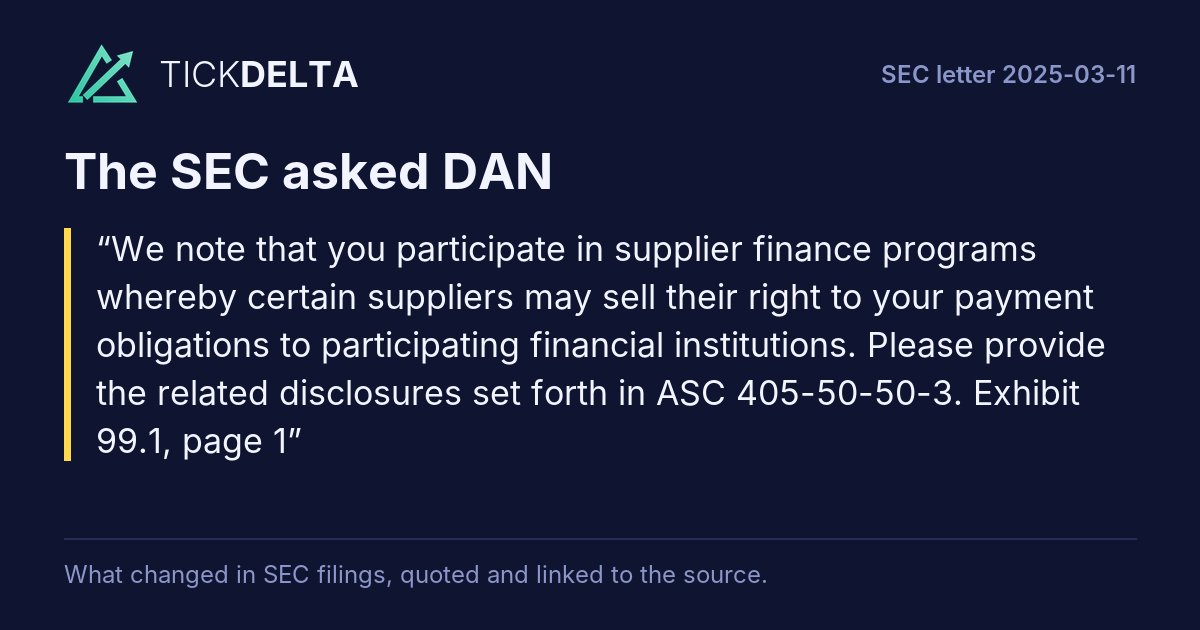
We note that you participate in supplier finance programs whereby certain suppliers may sell their right to your payment obligations to participating financial institutions. Please provide the related disclosures set forth in ASC 405-50-50-3. Exhibit 99.1, page 1
DAN answered

No reply letter found.

In its next report

First report after the SEC's letter of Mar 11, 2025: 10-Q filed Apr 30, 2025 ↗, against the 10-Q filed Oct 30, 2024 ↗.

Tickdelta does not hold the text of both reports, so they are not compared here.

Note 1. Organization and Summary of Significant Accounting Policies · Supplier finance programs, page 38
SEC asked (2)
We note that you present Adjusted EBITDA margin without presenting a comparative GAAP measure. Please revise future filings to present the GAAP measure, which appears to be net income (loss) margin, with equal or greater prominence. Refer to Item 10(e)(1)(i)(A) of Regulation S-K and Questions 102.10(a) of the Compliance and Disclosure Interpretations on Non-GAAP Financial Measures ("Non- GAAP C&DI's").
DAN answered

No reply letter found.

In its next report

First report after the SEC's letter of Mar 11, 2025: 10-Q filed Apr 30, 2025 ↗, against the 10-Q filed Oct 30, 2024 ↗.

Tickdelta does not hold the text of both reports, so they are not compared here.

Note 1. Organization and Summary of Significant Accounting Policies · Supplier finance programs, page 38
SEC asked (3)
For each non-GAAP measure, please ensure you present the most directly comparable GAAP measure with equal or greater prominence. Refer to instruction 2 to Item 2.02 of Form 8-K, Item 10(e)(1)(i)(A) of Regulation S-K, and Question 102.10(a)-(b) of the Non-GAAP C&DI's.
Rest of the question

We note that you present free cash flow in the introductory bullets without referencing operating cash flows, that you discuss Adjusted EBITDA on pages 1 and 2 prior to a discussion of GAAP net income (loss), and that certain non-GAAP reconciliations begin with a non-GAAP measure, such as total Segment EBITDA, instead of the GAAP measure. Apply this comment to the earnings conference call slides included in your earnings releases, including your disclosures on slides 4, 8-12, and 14-15.

DAN answered

No reply letter found.

In its next report

First report after the SEC's letter of Mar 11, 2025: 10-Q filed Apr 30, 2025 ↗, against the 10-Q filed Oct 30, 2024 ↗.

Tickdelta does not hold the text of both reports, so they are not compared here.

Note 1. Organization and Summary of Significant Accounting Policies · Supplier finance programs, page 38
SEC asked (4)
We note that you present Segment EBITDA on a consolidated and segment basis. Athough Segment EBITDA on a segment basis is a disclosure required by ASC 280 in the notes to the financial statements, the presentation on a consolidated basis outside of the segment footnote is a non-GAAP measure.
Rest of the question

Please revise to properly identify consolidated Segment EBITDA as a non-GAAP measure and ensure that you provide all related disclosures required by Item 10(e) of Regulation S-K. In closing, we remind you that the company and its management are responsible for the accuracy and adequacy of their disclosures, notwithstanding any review, comments, action or absence of action by the staff.

DAN answered

No reply letter found.

In its next report

First report after the SEC's letter of Mar 11, 2025: 10-Q filed Apr 30, 2025 ↗, against the 10-Q filed Oct 30, 2024 ↗.

Tickdelta does not hold the text of both reports, so they are not compared here.

Also in this review: closing letter, 2025-03-14
Form 10-K

2022-08-26 to 2022-11-22 · 15 questions · 3 letters from the SEC, 3 from the company
Review closed 2022-11-22
ClimateResults discussion (MD&A)Risk factorsLegal and contingencies
After reviewing your response to these comments, we may have additional comments. General
SEC asked (1)
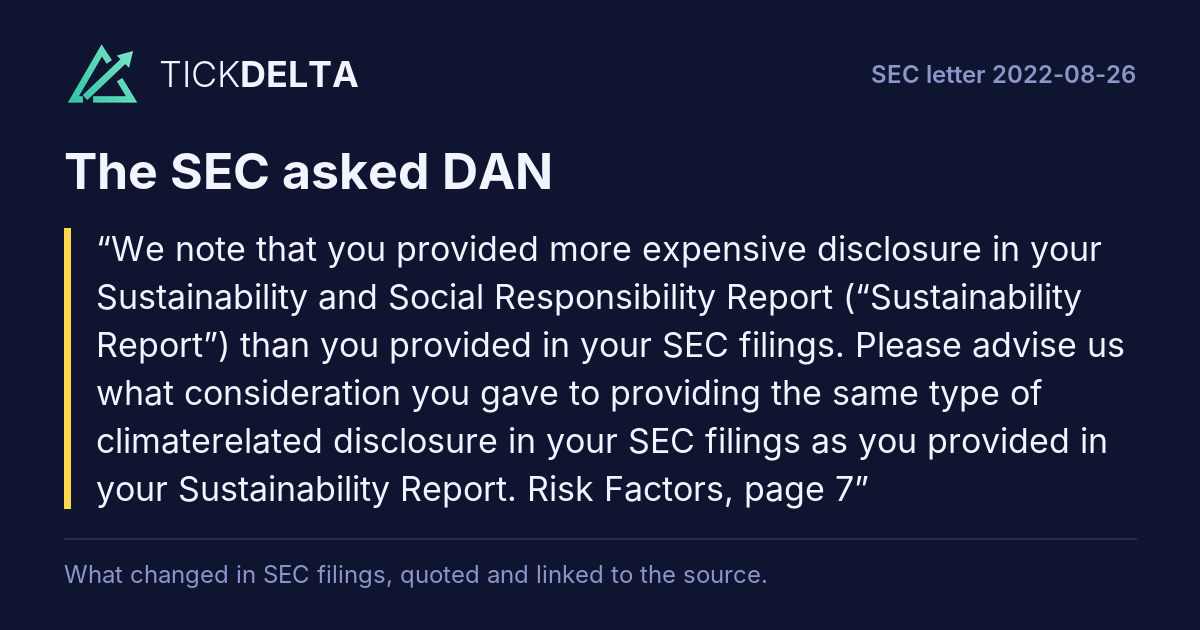
We note that you provided more expensive disclosure in your Sustainability and Social Responsibility Report (“Sustainability Report”) than you provided in your SEC filings. Please advise us what consideration you gave to providing the same type of climaterelated disclosure in your SEC filings as you provided in your Sustainability Report. Risk Factors, page 7
DAN answered
The Company's Sustainability and Social Responsibility Report (the

“Sustainability Report”) is designed to provide information regarding the Company's environmental, social, and governance performance to a broad audience that includes investors, employees, customers, communities, suppliers, and other interested parties. The Sustainability

Report was informed by principles, standards, and guidance from sources such as the Global Reporting Initiative, the Sustainability Accounting

Standards Board, and the Task Force on Climate-Related Financial Disclosures.
Rest of the answer

As a result, the Sustainability Report may include detailed information that may not be material for disclosure pursuant to applicable SEC rules and regulations. When considering whether to include climate-related disclosure in its SEC filings, including the type of climate-related disclosure provided in the Sustainability Report, the Company takes into account applicable SEC rules and regulations, including Item 101, Item 103, Item 105 and Item 303 of Regulation

S-K, as well as the SEC’s Compliance and Disclosure Interpretations, available guidance from the SEC staff (including the SEC’s

2010 Commission Guidance Regarding Disclosure Related to Climate Change) and applicable concept of materiality under the U.S. securities laws and/or disclosures required by the SEC. The Company also considers that, while certain climate-related information may be of interest to readers of the Sustainability Report, such information may not be material to investors in the context of an SEC filing, SEC filings may otherwise include separate climate-related disclosure required pursuant to Regulation S-K and other applicable SEC rules, regulations and guidance. The Company respectfully advises the Staff that it will, in response to the Staff’s comment, and historical practice, continue to evaluate its climate-related disclosure in SEC filings in light of applicable SEC rules, regulations and guidance and applicable standards of materiality.

Read in the reply
In its next report

First report after the company's reply of Sep 15, 2022: 10-Q filed Oct 27, 2022 ↗, against the 10-Q filed Aug 3, 2022 ↗.

Tickdelta does not hold the text of both reports, so they are not compared here.

After reviewing your response to these comments, we may have additional comments. General
SEC asked (2)
Disclose the material effects of transition risks related to climate change that may affect your business, financial condition, and results of operations, such as market trends that may alter business opportunities, credit risks, or technological changes.
DAN answered
The Company addresses the transition risks related to climate change within Part I, Item 1A, “Risk Factors,” of our Form 10-K. Please see the following risk factors in our 2021 Form 10-K:

· Our results of operations could be adversely affected by climate change, natural catastrophes or public health crises, in the locations in which we, our customers or suppliers operate.

· We could be adversely impacted by the loss of any of our significant customers, changes in their requirements for our products or changes in their financial condition.

· We may be adversely impacted by new laws,
Rest of the answer

regulations or policies of governmental organizations related to increased fuel economy standards and reduced greenhouse gas emissions, or changes in existing ones.

· An inability to provide products with the technology required to satisfy customer requirements would adversely impact our ability to successfully compete in our markets.

· Increased scrutiny from the public, investors, and others regarding our environmental, social, and governance practices (“ESG”) could impact our reputation.

· Developments in financial markets or downgrades to Dana's credit rating could restrict our access to capital and increase financing costs.

In addition to our risk factor disclosures the Company has provided disclosures related to the material investments it has made, and continues to make, to support the ongoing transition from traditional internal combustion engine-based vehicle platforms to electric vehicles. Please see the follow disclosures in our 2021 Form 10-K:

· Listing of products by operating segment, including electric vehicle related products, within Part I, Item 1, “Overview of Business.”

· Listing principal competitors, including those we compete with on electric vehicle related products, within Part I, Item 1, “Overview of Business.”

· Discussion of investments in key electrification initiatives, within Part

I, Item 1, “Engineering and Research and Development.”

· Discussion of vehicle electrification as it relates to our strategy, within

Part II, Item 7, “Operational and Strategic Initiatives.”

· Discussion of businesses acquired to support our electrification strategy, within Part II, Item 7, “Acquisitions” and Note 2 to our consolidated financial statements within Part II, Item 8.

We provided a breakdown of our net new business backlog split between traditional and electric vehicle related sales within Part II, Item 7, “Sales, Earnings and Cash Flow Outlook.”

The Company will continue to monitor the material transition risks associated with climate-related change, and if they are considered reasonably likely to have a material effect on its business, financial condition or results of operations, the Company will disclose such transition risks in future SEC filings as appropriate.

Read in the reply
In its next report

First report after the company's reply of Sep 15, 2022: 10-Q filed Oct 27, 2022 ↗, against the 10-Q filed Aug 3, 2022 ↗.

Tickdelta does not hold the text of both reports, so they are not compared here.

After reviewing your response to these comments, we may have additional comments. General
SEC asked (3)
Disclose any material litigation risks related to climate change and explain the potential impact to the company.
DAN answered
To date the Company has not experienced any actual or threatened litigation related to climate change. We continually assess the risk of material litigation related to climate change by reviewing threatened or asserted claims against us, monitoring trends and developments in litigation in the markets in which we participate, and monitoring trends and developments in government regulation. Based on this process, we have not identified material litigation risks related to climate change.
Read in the reply
In its next report

First report after the company's reply of Sep 15, 2022: 10-Q filed Oct 27, 2022 ↗, against the 10-Q filed Aug 3, 2022 ↗.

Tickdelta does not hold the text of both reports, so they are not compared here.

Management's Discussion and Analysis of Financial Condition and Results of Operations, page
SEC asked (4)
It appears you have identified climate-related projects in your Sustainability Report, such as projects to reduce greenhouse gas emissions and/or increase renewable energy usage. Tell us how you considered providing disclosure regarding past and future capital expenditures for climate-related projects.
Rest of the question

Include quantitative information for the periods covered by your Form 10-K and for future periods as part of your response.

DAN answered
The Company's Sustainability Report is designed to provide information regarding the Company's environmental, social, and governance performance to a broad audience that includes investors, employee, customers, communities, suppliers, and other interested parties. As a result, the Sustainability Report may include detailed information that may not be material for disclosure pursuant to applicable SEC rules and regulations.
Rest of the answer

The projects identified in the Company's Sustainability

Report represent our commitment to addressing environmental concerns as an integral part of our operational and manufacturing processes.

We are continually assessing our operations to identify areas of improvement and efficiency. As part of this process, we consider a wide range of factors including but not limited to safety; labor utilization; material costs; energy consumption; cost of capital; and environmental impact. By referencing projects in our Sustainability Report, we do not suggest that these projects were undertaken primarily, or exclusively, for the purposes of addressing climate change, nor does the inclusion of a project imply that the cost of the project is material for

SEC reporting purposes. Projects that were undertaken primarily, or exclusively, for the purpose of addressing climate change include expanded use of solar arrays. The only solar array project that required an upfront capital investment by the Company was its Sanand,

India array at a cost of approximately $0.082 million. The other solar array projects referenced in our Sustainability Report include solar arrays built and operated by third parties where Dana purchases the electricity produced by the solar array and solar arrays where

Dana leases roof space to third parties who build and operate solar arrays and sell the electricity generated by the solar array into the local electrical grid. The Company will continue to monitor material capital expenditures associated with climate-related projects, and if they are considered reasonably likely to have a material effect on its business, financial condition or results of operations, the Company will disclose such capital projects in future SEC filings as appropriate.

Read in the reply
In its next report

First report after the company's reply of Sep 15, 2022: 10-Q filed Oct 27, 2022 ↗, against the 10-Q filed Aug 3, 2022 ↗.

Tickdelta does not hold the text of both reports, so they are not compared here.

Management's Discussion and Analysis of Financial Condition and Results of Operations, page
SEC asked (5)
To the extent material, discuss the indirect consequences of climate-related regulations or business trends, such as the following: • decreased demand for goods that produce significant greenhouse gas emission or are related to carbon-based energy sources; • increased demand for goods that result in lower emissions than competing products; • increased competition to develop innovative new products that result in
Rest of the question

lower emissions; • increased demand for generation and transmission of energy from alternative energy sources; and • any anticipated reputational risks resulting from operations or products that produce material greenhouse gas emissions.

DAN answered
The Company addresses the indirect consequences of climate-related change on our business, including those resulting from changes in regulation and other business trends, and has disclosed risks related to such consequences within Part I, Item 1A, “Risk Factors,” of our Form 10-K. Please see the following risk factors in our

2021 Form 10-K:

· Our results of operations could be adversely affected by climate change, natural catastrophes or public health crises, in the locations in which we, our customers or suppliers operate.

· We could be adversely impacted by the loss of any of our
Rest of the answer

significant customers, changes in their requirements for our products or changes in their financial condition.

· We may be adversely impacted by new laws, regulations or policies of governmental organizations related to increased fuel economy standards and reduced greenhouse gas emissions, or changes in existing ones.

· An inability to provide products with the technology required to satisfy customer requirements would adversely impact our ability to successfully compete in our markets.

· Increased scrutiny from the public, investors, and others regarding our environmental, social, and governance practices (“ESG”) could impact our reputation.

In addition to our risk factor disclosures the company has provided disclosures related to the material investments it has made, and continues to make, to support the ongoing transition from traditional internal combustion engine-based vehicle platforms to electric vehicles. Please see the follow disclosures in our 2021 Form 10-K:

· Listing of products by operating segment, including electric vehicle related products, within Part I, Item 1, “Overview of Business.”

· Listing principal competitors, including those we compete with on electric vehicle related products, within Part I, Item 1, “Overview of Business.”

· Discussion of investment in key electrification initiatives, within Part I, Item 1, “Engineering and Research and Development.”

· Discussion of vehicle electrification as it relates to our strategy, within Part II, Item 7, “Operational and Strategic Initiatives.”

· Discussion of businesses acquired to support our electrification strategy, within Part II, Item 7, “Acquisitions” and Note

2 to our consolidated financial statements within Part II, Item 8.

Our electric vehicle related product sales are just beginning to ramp up. We provided a breakdown of our net new business backlog split between traditional and electric vehicle related sales within Part II,

Item 7, “Sales, Earnings and Cash Flow Outlook.”

The Company will continue to monitor the material indirect consequences of climate-related change, and if they are considered reasonably likely to have a material effect on its business, financial condition or results of operations, the Company will disclose such consequences in future SEC filings as appropriate.

Read in the reply
In its next report

First report after the company's reply of Sep 15, 2022: 10-Q filed Oct 27, 2022 ↗, against the 10-Q filed Aug 3, 2022 ↗.

Tickdelta does not hold the text of both reports, so they are not compared here.

Management's Discussion and Analysis of Financial Condition and Results of Operations, page
SEC asked (6)
We note your disclosure that the physical impacts of climate change might include extreme weather events and long-term changes in temperature levels and water availability. Please discuss the physical effects of climate events on your operations and results, such as weather-related damages to your property or operations, and weatherrelated impacts on the cost or availability of insurance.
Rest of the question

Include quantitative information with your response for each of the periods covered by your Form 10-K and explain whether increased amounts are expected in future periods, as applicable.

DAN answered
During the periods covered by the Form 10-K the Company has not experienced any material physical or operational disruptions related to severe weather or climate change. While in the ordinary course of business, individual properties may experience severe weather conditions, such as heavy snow or rainfall, and natural disasters, such as hurricanes and tornados, which may interrupt or disrupt operations, no such conditions have led to material physical damages resulting in material loss of business or operational disruption, either individually or in the aggregate for the periods covered by
Rest of the answer

the Form 10-K. During the period covered by the Form 10-K physical effects of climate events on the Company's operations and results were limited to roof damage at a single facility in 2021 caused by high winds associated with a tornado and flood damage at a single facility in 2019 caused by excessive rainfall. Total physical damages in 2021 were less than $0.2 million while the disruption to the facility's operations was limited to half of a day's production. Total physical damages in 2019 were limited to clean up costs of less than $0.5 million while the disruption to the facility's operations was limited to a day's production. During the periods covered by the Form 10-K weather-related impacts have increased the cost but not the availability of insurance. The Company's property insurance premiums have increased primarily due to general market drivers, including extreme weather events, as opposed to factors specific to the Company's operations or facility locations. The

Company's property insurance premiums were less than 0.1% of cost of sales in 2019, 2020 and 2021. The Company does not currently anticipate any difficulty in obtaining property insurance in the future and at this time continues to expect that the cost of insurance will not be material to the Company's results of operations.

Read in the reply
In its next report

First report after the company's reply of Sep 15, 2022: 10-Q filed Oct 27, 2022 ↗, against the 10-Q filed Aug 3, 2022 ↗.

Tickdelta does not hold the text of both reports, so they are not compared here.

Management's Discussion and Analysis of Financial Condition and Results of Operations, page
SEC asked (7)
We note your disclosure on page 10 regarding the costs to comply with environmental laws and regulations. Tell us about and quantify any compliance costs related to climate change for each of the last three fiscal years and explain whether increased amounts are expected to be incurred in future periods.
DAN answered
During the periods covered by the Form 10-K the Company did not incur any material compliance costs related to climate change. The Company's direct cost to comply with environmental laws and regulations, inclusive of compliance costs related to climate change, were less than 0.1% of cost of sales in 2019, 2020 and 2021.
Rest of the answer

The Company's direct cost to comply with environmental laws and regulations does not include the time allocation of internal resources whose primary responsibilities fall outside of dedicated environmental sustainability matters, such as legal, accounting and finance personnel. The Company will continue to evaluate its compliance costs related to climate change and to the extent material to the Company's business, financial condition and results of operations will make the relevant disclosures in future periods.

Read in the reply
In its next report

First report after the company's reply of Sep 15, 2022: 10-Q filed Oct 27, 2022 ↗, against the 10-Q filed Aug 3, 2022 ↗.

Tickdelta does not hold the text of both reports, so they are not compared here.

Management's Discussion and Analysis of Financial Condition and Results of Operations, page
SEC asked (8)
If material, provide disclosure about your purchase or sale of carbon credits or offsets and any material effects on your business, financial condition, and results of operations. Include quantitative information for the periods covered by your Form 10-K and for future periods as part of your response.
DAN answered
The Company did not engage in purchases or sales of carbon credits or offsets during periods covered by the Form 10-K. The Company, to the extent applicable and if material to the Company's business, financial condition and results of operations will disclose in future periods the purchase and sale of carbon credits.
Read in the reply
In its next report

First report after the company's reply of Sep 15, 2022: 10-Q filed Oct 27, 2022 ↗, against the 10-Q filed Aug 3, 2022 ↗.

Tickdelta does not hold the text of both reports, so they are not compared here.

Risk Factors, page 7
SEC asked (1)
Your response to prior comment two indicates that existing risk factor disclosure "addresses the transition risks related to climate change," yet this disclosure does not appear to address the climate change-related transition risks noted in our comment. Please tell us how you considered addressing other transition risks related to climate change, including those identified in our comment.
Rest of the question

Include information regarding the material effects of the transition risks related to climate change that you have considered.

DAN answered
Pursuant to the applicable disclosure standards, the Company does not expect transition risks related to climate change to materially affect our business, financial condition, and results of operations beyond those risks previously disclosed. We will continue to review the materiality of these transition risks and will disclose such risks in future filings if they become material to the Company.

We further note that the current transition of the mobility industry as it shifts from petroleum fuel vehicles (internal combustion engine vehicles) to alternative fuel vehicles (electric vehicles,
Rest of the answer

hybrid electric vehicles, hydrogen vehicles, etc.) presents a significant opportunity for the Company. Over the last several years, the Company has made strategic decisions to accelerate the electrification of its product portfolio and to position the Company to be a leader in the e-propulsion systems that will be at the center of the transition from internal combustion engine vehicles to electric vehicles. Please see the following disclosures in our Form 10-K: discussion of key electrification initiatives, within Part I, Item 1, "Engineering and Research and Development"; discussion of vehicle electrification as it relates to our strategy, within Part II, Item 7, "Operational and Strategic Initiatives"; discussion of businesses acquired to support our electrification strategy, within Part II, Item 7, "Acquisitions";

and Note 2 to our consolidated financial statements within Part II, Item 8.

Read in the reply
In its next report

First report after the company's reply of Oct 13, 2022: 10-Q filed Oct 27, 2022 ↗, against the 10-Q filed Aug 3, 2022 ↗.

Tickdelta does not hold the text of both reports, so they are not compared here.

Management's Discussion and Analysis of Financial Condition and Results of Operations, page
SEC asked (2)
We note your response to prior comment four and reissue it in part. As requested by our prior comment, please tell us about and quantify capital expenditures for your climaterelated projects for each of the periods covered by your Form 10-K and tell us about amounts you expect to incur in future periods.
DAN answered
For purposes of context and clarification, the Company considers capital projects undertaken with the primary purpose of reducing Scope 1 or Scope 2 greenhouse gas emissions to be climate-related capital projects.

While the Company considers environmental impact as a key factor when making capital expenditure decisions, the Company does not currently anticipate that climate-related capital expenditures will be material in future periods.
Rest of the answer

The Company, to the extent applicable and if material to the Company's business, financial condition and results of operations will disclose in future periods the climate-related capital expenditures.

Further, in specific response to your request to quantify capital expenditures for the Company's climate related projects in 2021, the previously referenced solar array project in Sanand, India required a capital investment of approximately $0.082 million.

Read in the reply
In its next report

First report after the company's reply of Oct 13, 2022: 10-Q filed Oct 27, 2022 ↗, against the 10-Q filed Aug 3, 2022 ↗.

Tickdelta does not hold the text of both reports, so they are not compared here.

Management's Discussion and Analysis of Financial Condition and Results of Operations, page
SEC asked (3)
We note the disclosure cited in your response, yet reissue prior comment five as it does not appear that each of the items identified in our prior comment is addressed in your response. Please provide us with additional analysis of the indirect consequences of climate-related regulations or business trends.
Rest of the question

Include information explaining how the disclosed risks related to such consequences specifically address developments regarding climate change or tell us how you concluded on the materiality of the items for which disclosure was not deemed necessary.

DAN answered
expect indirect consequences of climate-related regulations or business trends to materially affect our business, financial condition, and results of operations beyond those risks previously disclosed. We will continue to review the materiality of these risks and will disclose such risks in future filings if they become material to the Company.

as it shifts from petroleum fuel vehicles (internal combustion engine vehicles) to alternative fuel vehicles (electric vehicles, hybrid electric vehicles, hydrogen vehicles, etc.) presents a significant opportunity for the Company.
Rest of the answer

Over the last several years, the Company has made strategic decisions to accelerate the electrification of its product portfolio and to position the Company to be a leader in the e-propulsion systems that will be at the center of the transition from internal combustion engine vehicles to electric vehicles. Please see the following disclosures in our Form 10-K: discussion of key electrification initiatives, within Part I, Item 1, "Engineering and Research and Development"; discussion of vehicle electrification as it relates to our strategy, within Part II, Item 7, "Operational and Strategic Initiatives"; discussion of businesses acquired to support our electrification strategy, within Part II, Item 7, "Acquisitions";

Read in the reply
In its next report

First report after the company's reply of Oct 13, 2022: 10-Q filed Oct 27, 2022 ↗, against the 10-Q filed Aug 3, 2022 ↗.

Tickdelta does not hold the text of both reports, so they are not compared here.

Management's Discussion and Analysis of Financial Condition and Results of Operations, page
SEC asked (4)
We note your response to prior comment eight that you did not engage in purchases or sales of carbon credits or offsets during periods covered by your Form 10-K. Please tell us whether you expect to purchase carbon credits or offsets in future periods. Please contact Erin Donahue at 202-551-6063 or Jennifer Angelini at 202-551-3047 with any questions.
DAN answered
The Company currently has no plans to purchase carbon credits or offsets.
Read in the reply
In its next report

First report after the company's reply of Oct 13, 2022: 10-Q filed Oct 27, 2022 ↗, against the 10-Q filed Aug 3, 2022 ↗.

Tickdelta does not hold the text of both reports, so they are not compared here.

Risk Factors, page 7
SEC asked (1)
We note your response to prior comment one and reissue it as your response does not appear to have addressed transition risks related to climate change. Please tell us how you considered providing disclosure addressing the transition risks related to climate change identified in our previously issued comments, including with regard to your assessment of their effect on your business, financial condition, and results
Rest of the question

of operations.

DAN answered
We have assessed the materiality of the transition risks related to climate change, including market trends that may alter business opportunities, credit risks, and technological changes.

The current transition of the mobility industry as it shifts from petroleum fuel vehicles (“ICE vehicles”) to alternate fuel vehicles (as a group “EV-based vehicles”) represents a significant opportunity for the Company.
Rest of the answer

Over the last several years, the Company has made strategic decisions to accelerate the electrification of its product portfolio and to position the Company to be a leader in the e-propulsion systems that will be at the center of the transition from ICE vehicles to EV-based vehicles. As the market transitions from ICE vehicles to EV-based vehicles, the Company anticipates its content per vehicle opportunity will increase up to three-fold on a dollar basis. The Company’s primary driveline content on ICE vehicles includes axles and driveshafts. As the market transitions to EV-based vehicles we anticipate losing driveshaft content but adding additional driveline content in the form of gearboxes, e-motors, e-axles, power electronics, and software controls. We anticipate a similar three-fold opportunity in thermal and sealing products, as current ICE vehicle content is replaced with EV-based vehicle content including metallic bipolar plates, battery cold plates and power electronic cooling modules.

With the increased content opportunity on EV-based vehicles, we are beginning to see increased competition when it comes to bidding on new customer programs. The number of competitors bidding on EV-based vehicle programs is higher than what we historically experienced on ICE vehicle programs. In addition, the OEMs continue to assess which EV-based components they will vertically integrate and for which programs. We believe our current risk factors (e.g., “[w]e could be adversely impacted by the loss of any of our significant customers, changes in their requirements for our products or changes in their financial condition”) identify these risks; however, we will more clearly articulate the risk of increased competition for EV-based vehicle programs, including the potential expansion of vertical integration by our customers in future filings.

The Company’s acceleration of the electrification of its product portfolio was based on assessments of the markets in which we participate and on-going discussions with our customers. The

Company and our customers have made significant investments in the form of research and development and capital deployed to transition to the production of battery electric, hybrid electric and hydrogen vehicles. Based on current trends in the markets in which we participate, and the significant investments made by our customers to migrate to battery electric, hybrid electric and hydrogen vehicles, the Company does not believe it is currently exposed to a material risk of technological change related to transition risks related to climate change that would cause a shift away from EV-based vehicles. The Company believes the general risk that a disruptive technology could be introduced that would impact our markets is addressed in our current “An inability to provide products with the technology required to satisfy customer requirements would adversely impact our ability to successfully compete in our markets” risk factor. The Company will continue to monitor the impact climate change transition risk could have on technological changes and update our risk factors in future filings as appropriate.

Our ability to gain access to capital at competitive prices has historically been predicated on maintaining adequate financial performance and appropriate credit metrics, as well as macro-economic factors that are outside our control. Transition risk related to climate change could impact our access to capital if certain stakeholders were to pressure the financial markets to withhold credit from participants in certain industries due to their perceived negative impact on the environment.

The Company does not currently consider transition risk related to climate change to be a material credit risk based on the three successful senior notes sales the Company completed in 2021, including a $400 million green bond offering, as well as the increase and extension of our revolving credit facility in 2021. See Note 14 – Financing Agreements to our consolidated financial statement in Item 8 of our 2021 Form 10-K for additional information regarding these transactions. The Company will continue to monitor the impact climate change transition risk could have on our access to credit markets and update our current “Developments in the financial markets or downgrades to Dana’s credit rating could restrict our access to capital and increase financing costs” risk factor as appropriate.

Read in the reply
In its next report

First report after the company's reply of Nov 14, 2022: 10-K filed Feb 21, 2023 ↗, against the 10-K filed Feb 23, 2022 ↗.

Tickdelta does not hold the text of both reports, so they are not compared here.

Management's Discussion and Analysis of Financial Condition and Results of Operations, page
SEC asked (2)
We note your response to prior comment two quantifies expenditures for climate-related projects for 2021. Please provide quantification for each of the other periods covered by your Form 10-K, or affirmatively state if there were no such expenditures. Additionally tell us if amounts are expected to increase in future periods.
DAN answered
In response to the Staff’s request to quantify capital expenditures for the Company’s climate-related projects, in 2021, the previously referenced solar array project in Sanand, India required a capital investment of approximately $0.082 million. There were no capital investments for climate-related projects in 2020 or 2019. There are no specific plans for these expenditures to increase in future periods.
Read in the reply
In its next report

First report after the company's reply of Nov 14, 2022: 10-K filed Feb 21, 2023 ↗, against the 10-K filed Feb 23, 2022 ↗.

Tickdelta does not hold the text of both reports, so they are not compared here.

Management's Discussion and Analysis of Financial Condition and Results of Operations, page
SEC asked (3)
We note your response, yet reissue prior comment three as it does not appear that each of the items identified in our original comment (i.e., comment five of our letter dated August 26, 2022) is addressed in your response. Please provide us with your analysis of the indirect consequences of climate-related regulations or business trends for each of the items noted in our prior comment.
Rest of the question

Include information explaining how the disclosed risks related to such consequences specifically address developments regarding climate change or tell us how you concluded on the materiality of the items for which disclosure was not deemed necessary.

DAN answered
We have analyzed the indirect consequences of climate-related regulations and business trends, including each of the items identified in the Staff’s original comment letter, and do not expect these indirect consequences to materially affect our business, financial condition, and results of operations. In our analysis, we considered that unlike other automotive component part suppliers (e.g., suppliers of fuel tanks, exhaust systems, etc.) all our existing content on ICE vehicles will be required for alternative fuel vehicles.
Rest of the answer

Indeed, the current transition of the mobility industry as it shifts from ICE vehicles to alternative fuel vehicles (battery electric vehicles, hybrid electric vehicles, hydrogen vehicles, etc.) presents an opportunity for the Company to increase content per vehicle. As the market transitions from ICE vehicles to EV-based vehicles, the Company anticipates its content per vehicle opportunity will increase up to three-fold on a dollar basis.

For these reasons, the Company does not expect the indirect consequences of climate-related regulations or business trends to materially affect our business, financial condition, and results of operations beyond those risks previously discussed above. In future filings, we will provide further detail on the indirect consequences of the climate-related regulations or business trends in the Management’s Discussion and Analysis section, including specifically with respect to the potential impact of increased competition on the Company’s business and results of operations.

Read in the reply
In its next report

First report after the company's reply of Nov 14, 2022: 10-K filed Feb 21, 2023 ↗, against the 10-K filed Feb 23, 2022 ↗.

Tickdelta does not hold the text of both reports, so they are not compared here.

Also in this review: request for more time, Sep 2, 2022, closing letter, 2022-11-22

Letters without questions

Other letters

UPLOAD and CORRESP
1 other letter: notices that a filing will not be reviewed, requests to declare a registration effective, and the like
  • Mar 14, 2025 · DAN: letter to the SEC · Dana Incorporated · Form 10-K for the Fiscal Year Ended December 31, 2024 · Form 8-K...

From the SEC's correspondence on EDGAR: staff letters (form UPLOAD) and company letters (form CORRESP), 11 letters filed since 2022-08-26. Questions and answers are matched by their numbers; topics come from words in each question. The reports are compared word for word (same form, before the first SEC letter against the first report after the company's reply). No AI.

Sources

The SEC's correspondence on EDGAR: staff letters (form UPLOAD) and company letters (form CORRESP), matched question by question. No AI.

Also

Filings: the letters in the filing list.

Work with it

Excel workbook · CSV. Google Sheet that stays up to date: paste =IMPORTDATA("https://tickdelta.com/company/DAN/export.csv") into a cell.

Next in Owners and insiders:Insider trades
Esc

Type a ticker such as AAPL, a name, an investor such as Buffett, or a topic such as tariffs. ↑ ↓ to move, Enter to open.