Reworded10-Q Nov 10, 2026 vs 10-K Mar 3, 2026
The risks described in this report and uncertainties described below in our Annual Report on Form 10-K are not the only risks we face.
Each branch is a paragraph in Risk Factors with nothing like it in the 10-K filed Feb 25, 2025. A box jumps to the paragraph as filed, below.
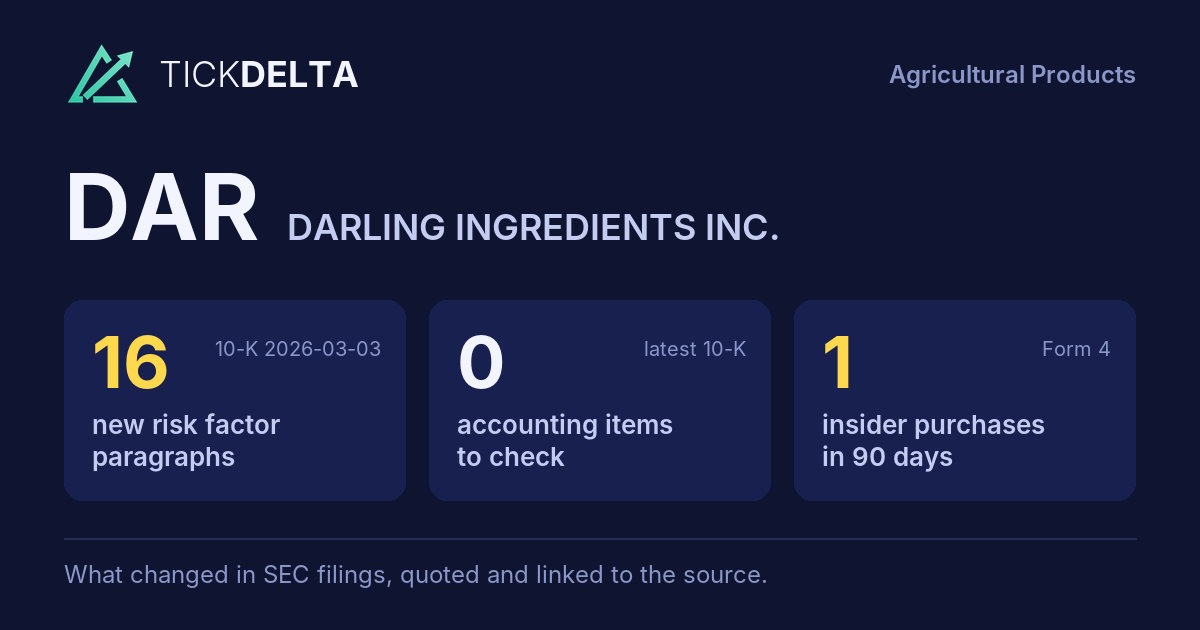
16 paragraphs in Risk Factors of the 10-K filed Mar 3, 2026 with nothing like them in the 10-K filed Feb 25, 2025. Quoted exactly. Paragraphs that were only edited are under 10-K change.
•The prices of many of our products are subject to significant volatility associated with commodities markets;
•Our renewable energy businesses, including the DGD Joint Venture, are highly dependent on government programs, incentives and regulatory frameworks, which are subject to change and uncertainty;
The prices of many of our products are subject to significant volatility associated with commodities markets.
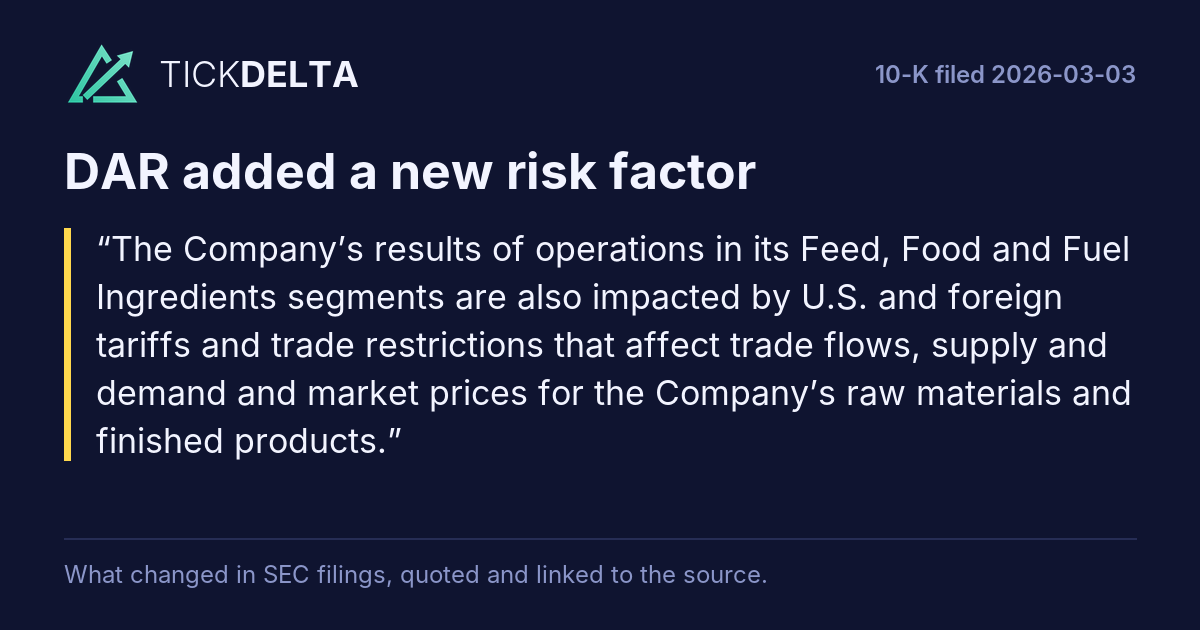
The Company’s results of operations in its Feed, Food and Fuel Ingredients segments are also impacted by U.S. and foreign tariffs and trade restrictions that affect trade flows, supply and demand and market prices for the Company’s raw materials and finished products.
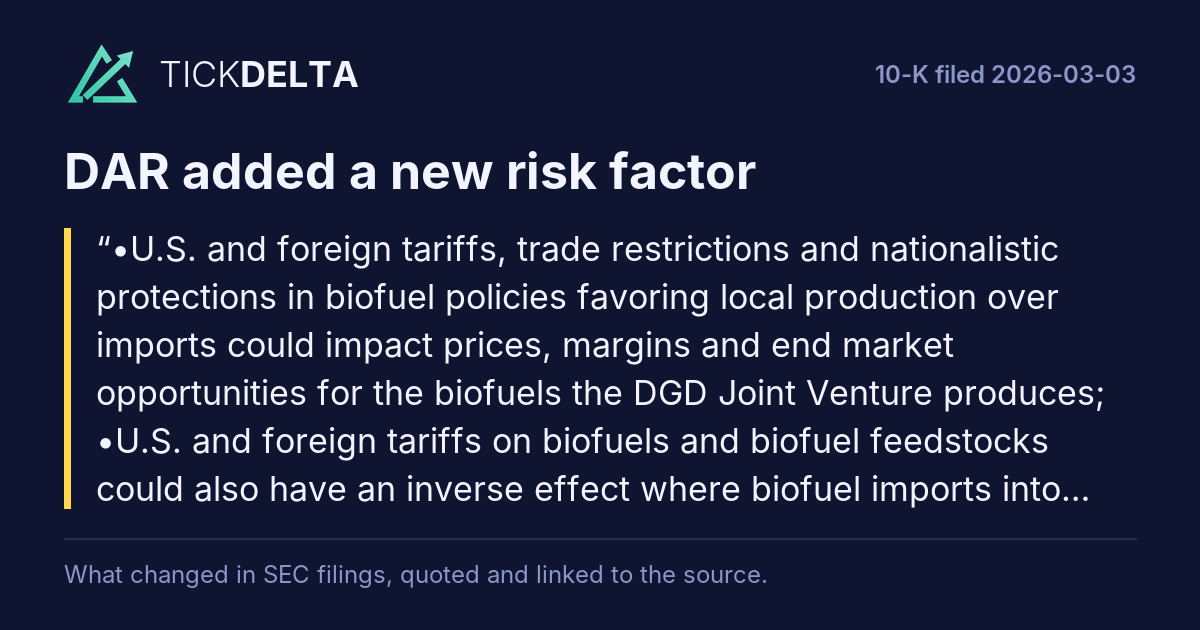
•U.S. and foreign tariffs, trade restrictions and nationalistic protections in biofuel policies favoring local production over imports could impact prices, margins and end market opportunities for the biofuels the DGD Joint Venture produces;
•U.S. and foreign tariffs on biofuels and biofuel feedstocks could also have an inverse effect where biofuel imports into certain countries could be beneficially positioned from a margin standpoint over local production;
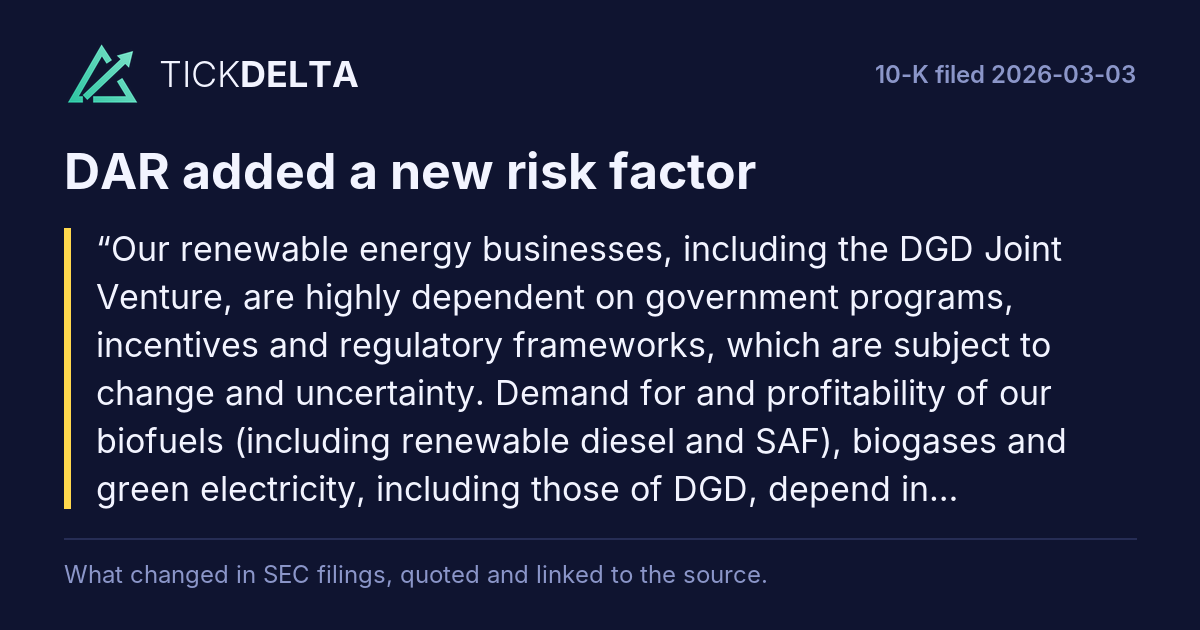
Our renewable energy businesses, including the DGD Joint Venture, are highly dependent on government programs, incentives and regulatory frameworks, which are subject to change and uncertainty.
Demand for and profitability of our biofuels (including renewable diesel and SAF), biogases and green electricity, including those of DGD, depend in significant part on government programs, mandates, tax credits and incentives in the U.S. and other jurisdictions, including renewable fuel standards, low carbon fuel programs and clean fuel tax credits. These programs are complex, subject to frequent legislative, regulatory and administrative change, and dependent on agency interpretation, guidance enforcement priorities and funding.
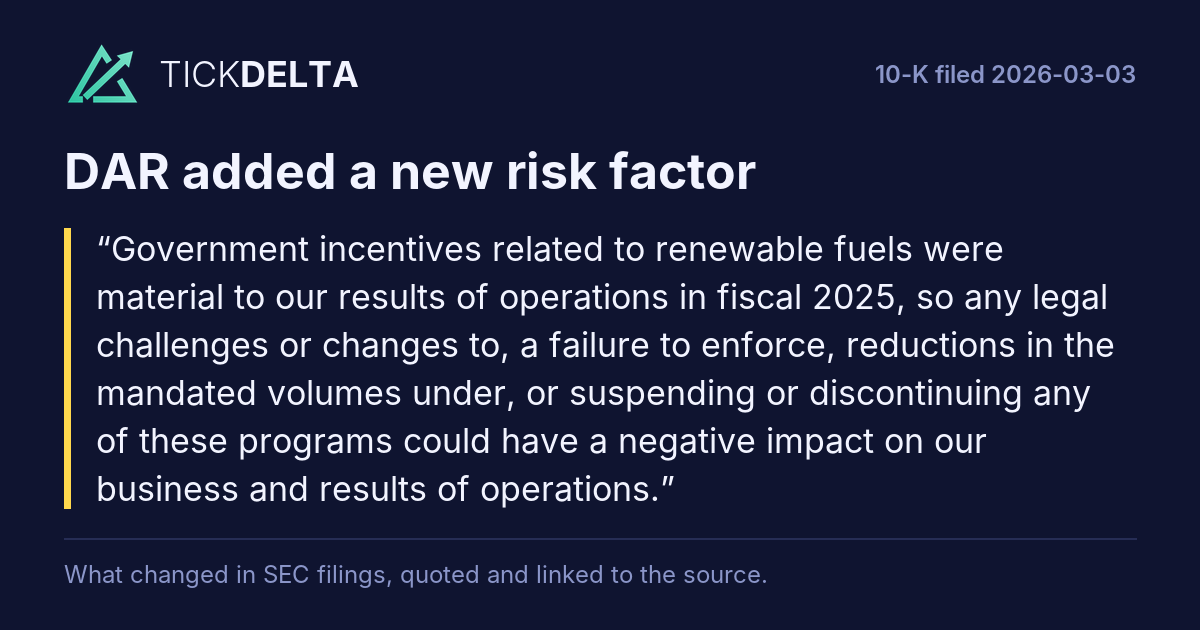
Government incentives related to renewable fuels were material to our results of operations in fiscal 2025, so any legal challenges or changes to, a failure to enforce, reductions in the mandated volumes under, or suspending or discontinuing any of these programs could have a negative impact on our business and results of operations.
•issues associated with intellectual property protections for the Company’s products and operations, such as defense of our intellectual property in foreign countries and/or, as the Company expands globally, use of our intellectual property on competing products in certain countries where our intellectual property is not registered;
•increasing the difficulty of satisfying our contractual and commercial commitments because of our obligations to our financial lenders;
imposed by any of our financing arrangements, provisions of applicable law and any other factors that our board of directors determines are relevant at that point in time.
ventures may be structured in such a manner that would result in the assumption of unknown liabilities not disclosed by the counterparty or uncovered during pre-acquisition due diligence.
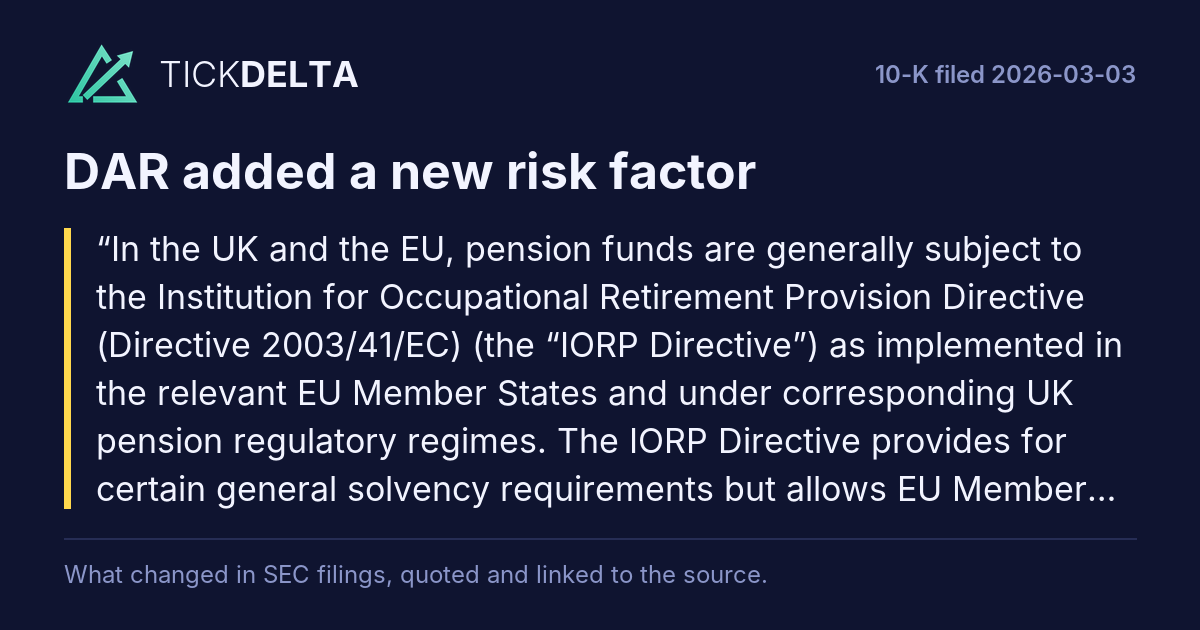
In the UK and the EU, pension funds are generally subject to the Institution for Occupational Retirement Provision Directive (Directive 2003/41/EC) (the “IORP Directive”) as implemented in the relevant EU Member States and under corresponding UK pension regulatory regimes. The IORP Directive provides for certain general solvency requirements but allows EU Member States discretion to impose specific national requirements. As a result, the solvency of EU pension funds is mostly regulated on a national level. On December 23, 2016, the new IORP Directive (“IORP Directive II”) was published on the Official Journal of the European Union and entered into force on January 12, 2017. Though IORP Directive II did not make substantive changes to the solvency requirements under the original IORP Directive, it did implement enhanced governance and
risk management standards, requirements relating to cross-border activity and cross-border transfers and disclosure obligations owed to participating employees, among others. EU Member States were required to implement IORP Directive II into national legislation by January 13, 2019, although implementation and enforcement of IORP Directive II continue to vary across EU Member States. We could be adversely affected if EU Member States interpret or implement IORP Directive II in ways that negatively affect our business, financial condition and results of operations. It is also possible that some EU Member States will impose stricter requirements than currently provided for under IORP Directive II, which may require us to expend significant resources to prepare for and comply with differing standards. We could be adversely affected if these stricter or differing standards require changes in our business practices.
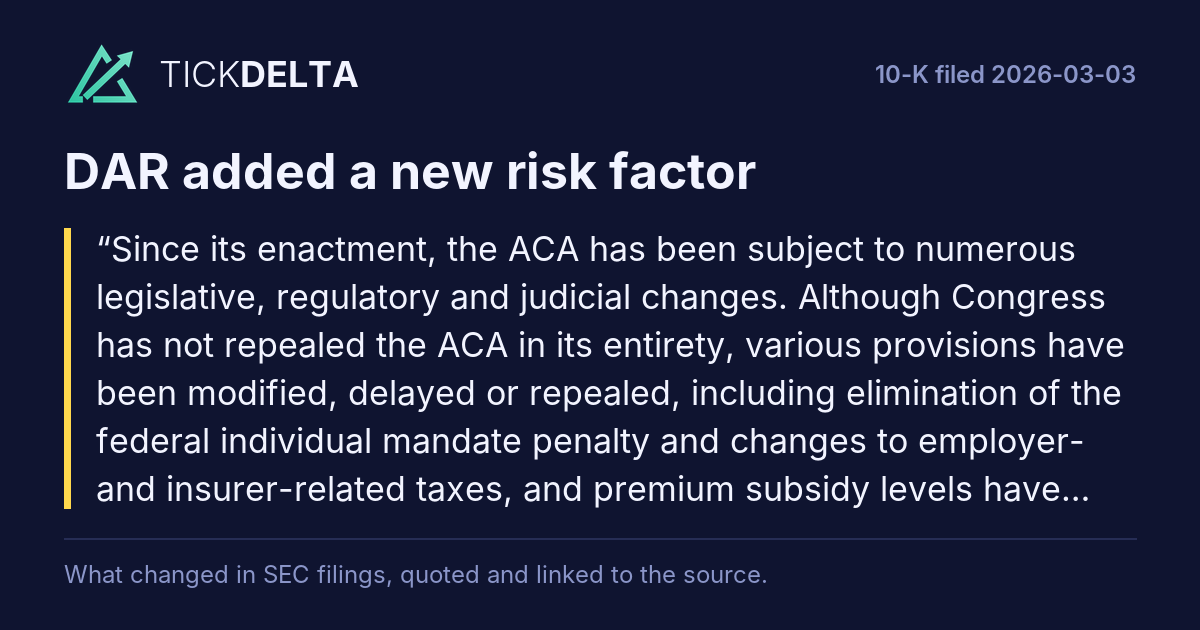
Since its enactment, the ACA has been subject to numerous legislative, regulatory and judicial changes. Although Congress has not repealed the ACA in its entirety, various provisions have been modified, delayed or repealed, including elimination of the federal individual mandate penalty and changes to employer- and insurer-related taxes, and premium subsidy levels have been expanded and extended through 2025. In addition, the ACA has been and continues to be subject to significant judicial challenges, including ongoing litigation regarding the requirement to provide certain preventive services without cost sharing. Future legislative, regulatory or judicial actions could further modify or invalidate portions of the ACA, which could affect the cost, structure or availability of health coverage and have an adverse effect on our business, financial condition and results of operations.
New in the latest 10-Q
9 paragraphs in the 10-Q filed Nov 10, 2026 with nothing like them in the 10-Q filed Aug 7, 2026 (at least half the words must differ; new numbers alone do not count). Quoted exactly, grouped by the item heading above them. This is text that changed, not a judgement of how serious it is.
Certain prior year amounts have been reclassified to conform to current year presentation. In the Consolidated Statement of Operations, an immaterial gain on sale of business has been separated from other expense, net and in the Consolidated Statement of Cash Flows an immaterial gain on sale of business has been reclassified in the operating cash flow section.
Read in the 10-Q
The interest rate applicable to any borrowings under the revolving credit facility will equal (i) the Canadian Overnight Repo Rate Average (CORRA) for borrowings denominated in Canadian dollars or the adjusted term secured overnight
Read in the 10-Q
During the third quarter of fiscal 2026, the Company sold its natural casings business which included a defined pension plan resulting in a settlement for financial reporting purposes. In addition, the Company partially terminated our last remaining domestic pension plan resulting in a partial termination and settlement for reporting purposes. Net pension cost for the three and nine months ended October 3, 2026 and September 27, 2025 includes the following components (in thousands):
Read in the 10-Q
and which are not individually significant, five plans have certified as critical or red zone as defined by the Pension Protection Act of 2006.
Read in the 10-Q
Three Months Ended October 3, 2026 Compared to Three Months Ended September 27, 2025
Read in the 10-Q
Gain on sale of businesses. Gain on sale of businesses is due to the net gain associated from the sale of a substantial portion of our U.S. grease trap environmental services business and the sale of our natural casings business as compared to a small gain in the same period of fiscal 2025.
Read in the 10-Q
Nine Months Ended October 3, 2026 Compared to Nine Months Ended September 27, 2025
Read in the 10-Q
Gain on sale of businesses. Gain on sale of businesses is due to the net gain associated from the sale of a substantial portion of our U.S. grease trap environmental services business and the sale of our natural casings business as compared to a small gain in the same period of fiscal 2025.
Read in the 10-Q
that restaurants participate in when their used cooking oil is collected by Darling. From a production standpoint, Darling now isolates used cooking oil from other fats to preserve identification to qualify for a lower carbon intensity value. As a result, the Company includes its equity in net income of the DGD Joint Venture as operating income.
Read in the 10-Q
Item 1A of the 10-Q filed Nov 10, 2026 against Item 1A of the 10-K filed Mar 3, 2026.
A 10-Q repeats only the risks that changed, so a 10-K paragraph that is missing from it is not counted as removed.
Added is a paragraph with nothing like it in the 10-K, Reworded a sentence that is in both with several words changed,
Quiet changes a sentence in both where one to four words changed and one is a hedge or a modal
(cut words struck through, new words highlighted).
Text on the page, not a score; each links to the filing at sec.gov.
Two-word phrases in Risk Factors of the 10-K filed Mar 3, 2026 that are in none of the 1 earlier 10-Ks stored, back to Feb 25, 2025
Used at least twice, small words left out. Counted, not picked: a phrase can be new because the company renamed something.
17 paragraphs of last year's Risk Factors with nothing like them now. The longest are quoted.
Item 1A of each 10-K and 10-Q on EDGAR, quoted exactly. Each paragraph links to the filing at sec.gov.
10-K change: what was reworded or cut, section by section.
Excel workbook · CSV. Google Sheet that stays up to date: paste =IMPORTDATA("https://tickdelta.com/company/DAR/export.csv") into a cell.