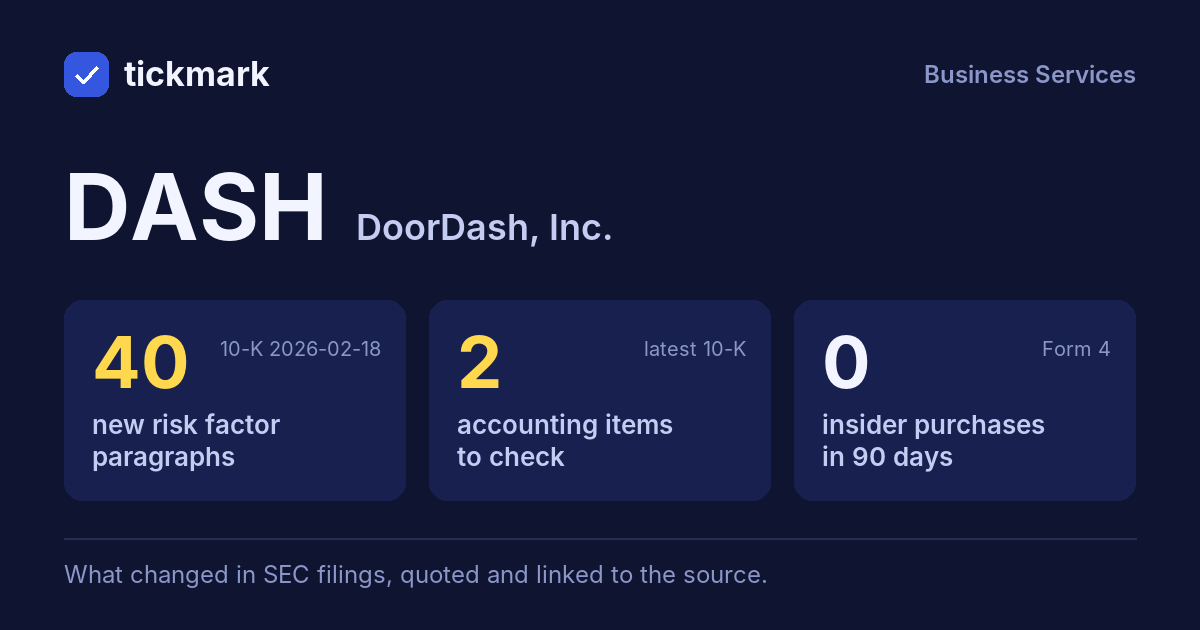
Sentences and paragraphs of DASH's Risk Factors and MD&A, 10-K 2026-02-18 against 10-K 2025-02-14.
Each links to the text at sec.gov.
AddedRisk Factors
Our reliance on third-party vendors, contractors, and SaaS providers creates additional cybersecurity risks. Many of our critical business operations depend on external providers for hosting, cloud services, data analytics, customer support, and other key functions. If these third parties experience a cybersecurity incident, fail to implement adequate security measures, misconfigure their systems, or otherwise do not comply with our security, privacy, or contractual requirements, our systems and data could be exposed to unauthorized access, loss, or misuse, resulting in significant operational disruption, regulatory scrutiny, financial losses, or reputational harm.
Read it in 10-K 2026-02-18 at sec.gov ↗
Show the other 14
AddedRisk Factors
existing seasonal trends that we experience may become more pronounced and contribute to greater fluctuations in our results of operations as we continue to scale and our growth slows. As such, we may not accurately forecast our results of operations and we may not be able to adjust our spending quickly enough if our revenue is less than expected, causing our results of operations to fail to meet our expectations or the expectations of investors.
Read it in 10-K 2026-02-18 at sec.gov ↗
AddedRisk Factors
at companies we acquire, which involves significant time and resources, and any failure to do so could impact our ability to meet our financial reporting obligations.
Read it in 10-K 2026-02-18 at sec.gov ↗
AddedRisk Factors
that our estimated insurance reserves are inadequate, we may be required to increase such reserves at the time of the determination, which could result in an increase to our net loss in the period in which the shortfall is determined and negatively impact our business, financial condition, and results of operations.
Read it in 10-K 2026-02-18 at sec.gov ↗
AddedRisk Factors
Several other jurisdictions where we operate have adopted or may be considering, or in the future may consider, adopting legislation, or we may propose or support legislation, ballot initiatives, other legislative processes, or voluntary agreements
Read it in 10-K 2026-02-18 at sec.gov ↗
AddedMD&A
We use the below financial and operational metrics to help us evaluate our business, identify trends affecting our business, formulate business plans, and make strategic decisions. As we grow our business and expand our offerings, our success and the financial performance of our business will be dependent upon many factors. These factors include, but are not limited to, those highlighted in this Annual Report on Form 10-K, as well as the success of our growth strategies and the timing and size of investments and expenditures that we choose to undertake, such as our recent and continued investment in our non-U.S. operations, in our global technology platform, and to increase system capacity for Dashers and in support of longer distance and higher effort deliveries. Certain of these and other factors may not be within our control.
Read it in 10-K 2026-02-18 at sec.gov ↗
AddedMD&A
Interest income, net primarily consists of interest earned on our cash, cash equivalents, and investments, net of interest costs, as well as interest earned on cash held in escrow under the Escrow Agreement as defined in Note 10 - "Commitments and Contingencies" included in Part II, Item 8, "Notes to Consolidated Financial Statements" of this Annual Report on Form 10-K.
Read it in 10-K 2026-02-18 at sec.gov ↗
AddedMD&A
On July 4, 2025, the U.S. enacted the One Big Beautiful Bill Act. Included in this legislation are provisions that allow for the immediate expensing of domestic U.S. research and development expenses, immediate expensing of certain capital expenditures, and other changes to the U.S. taxation of profits derived from foreign operations.
Read it in 10-K 2026-02-18 at sec.gov ↗
AddedMD&A
In 2025, the income tax expense decreased by $32 million compared to 2024. The decrease in income tax expense was primarily attributable to a one-time tax benefit from the release of a portion of the U.S. valuation allowance in connection with the SevenRooms Inc. and Symbiosys Corp. acquisitions, as well as the enactment of the One Big Beautiful Bill Act that occurred during the year.
Read it in 10-K 2026-02-18 at sec.gov ↗
AddedMD&A
2024 and 2025, no revolving loans were outstanding and $112 million and $61 million of letters of credit were issued under our revolving credit facility, respectively.
Read it in 10-K 2026-02-18 at sec.gov ↗
AddedMD&A
We have generated significant operating losses from our operations as reflected in our accumulated deficit of $4.3 billion as of December 31, 2025. We have historically funded our operations from cash from operations as well as the issuance of equity securities, including in our initial public offering in December 2020. We have also completed debt financings, such as our recent issuance of $2.75 billion aggregate principal amount of 0% Convertible Senior Notes due 2030 (the “2030 Notes”) in May 2025. We intend to use the net proceeds from the 2030 Notes for general corporate purposes. For additional information regarding the 2030 Notes, see Note 9 - "Convertible Notes, Net" included in Part II, Item 8, "Notes to Consolidated Financial Statements" of this Annual Report on Form 10-K.
Read it in 10-K 2026-02-18 at sec.gov ↗
AddedMD&A
we are unable to raise additional capital when desired, our business, financial condition, and results of operations could be adversely affected.
Read it in 10-K 2026-02-18 at sec.gov ↗
AddedMD&A
We account for our business combinations using the acquisition method of accounting, which requires, among other things, allocation of the fair value of purchase consideration to the tangible and intangible assets acquired and liabilities assumed at their estimated fair values on the acquisition date. The excess of the fair value of purchase consideration over the values of these identifiable assets and liabilities is recorded as goodwill. When determining the fair value of assets acquired and liabilities assumed, we make significant estimates and assumptions, especially with respect to intangible assets. Our estimates of fair value are based upon assumptions believed to be reasonable, but which are inherently uncertain and unpredictable, and as a result, actual results may differ from estimates. Acquisition costs, such as legal and consulting fees, are expensed as incurred.
Read it in 10-K 2026-02-18 at sec.gov ↗
AddedMD&A
We are subject to income taxes in the U.S. and in many foreign jurisdictions. Significant judgment is required in determining our provision for income taxes, our deferred tax assets and liabilities and any valuation allowance recorded against our net deferred tax assets that are not more-likely-than-not to be realized. The determination of the realizability of deferred tax assets requires significant judgment in assessing the likelihood of future tax consequences and evaluation of all available evidence in accordance with applicable accounting guidance. In completing our assessment of realizability of our deferred tax assets, we consider our history of losses measured at pre-tax income (loss) adjusted for permanent book-tax differences on a jurisdictional basis, volatility in actual earnings, excess tax benefits related to stock-based compensation in recent prior years, and impacts of the timing of reversal of existing temporary differences. We also rely on our assessment of the Company’s projected future results of business operations, including uncertainty in future operating results relative to historical results, volatility in the market price of our common stock and its performance over time, variable macroeconomic conditions impacting our ability to forecast future taxable income, and changes in business that may affect the existence and magnitude of future taxable income. Our valuation allowance assessment is based on our best estimate of future results considering all available information.
Read it in 10-K 2026-02-18 at sec.gov ↗
AddedMD&A
Furthermore, significant judgment is required in evaluating our tax positions. In the ordinary course of business, there are many transactions and calculations for which the ultimate tax result is uncertain. As a result, we recognize the effect of this uncertainty on our tax attributes or taxes payable in light of our estimates of the eventual outcome. These effects are recognized when, despite our belief that our tax return positions are supportable, we believe that it is more-likely-than-not that some of those positions may not be fully sustained upon review by tax authorities. We are required to file income tax returns in the U.S. and various foreign jurisdictions, many of which are unclear, uncertain, and lack authoritative interpretive guidance. Such returns are subject to audit by the various federal, state and local, and foreign taxing authorities, who may disagree with respect to our tax positions. We believe that our consideration is adequate for all open audit years based on our assessment of many factors, including past experience and interpretations of tax law. We review and update our estimates each quarter in light of changing facts and circumstances, such as the closing of a tax audit, the lapse of a statute of limitations or a change in estimate. This review could result in a change in our income tax expense. Similarly, to the extent that the final tax outcome of these matters differs from our estimates, as may be adjusted, such differences may impact income tax expense in the period in which such determination is made.
Read it in 10-K 2026-02-18 at sec.gov ↗