tickdelta
Sign in

Tickdelta is free for now. Sign up and get Pro free

← Screener

DASHDoorDash

Consumer discretionary · Business Services · Nasdaq

Our mission is to grow and empower local economies. 10-K, Item 1

Employees
31,400
Headquarters
San Francisco, CA
CEO
Tony Xu
Next results
around Feb 17, 2027
Compare with peers → Embed

When the SEC's staff reviews a filing, it writes to the company with numbered questions, and the company answers each one in a letter. SEC publishes the exchange once the review is over, at least 20 business days later. Below: what the staff asked DASH, and the company's answer to each question, quoted from the letters. A question is not an accusation; most reviews end with the company adding detail to its next filing.

Form 10-K for the Fiscal Year Ended December 31, 2025

2026-04-30 to 2026-05-12 · 1 question · 1 letter from the SEC, 1 from the company
Review closed 2026-05-12
AcquisitionsControls
Report of Independent Registered Public Accounting Firm, page 72
SEC asked
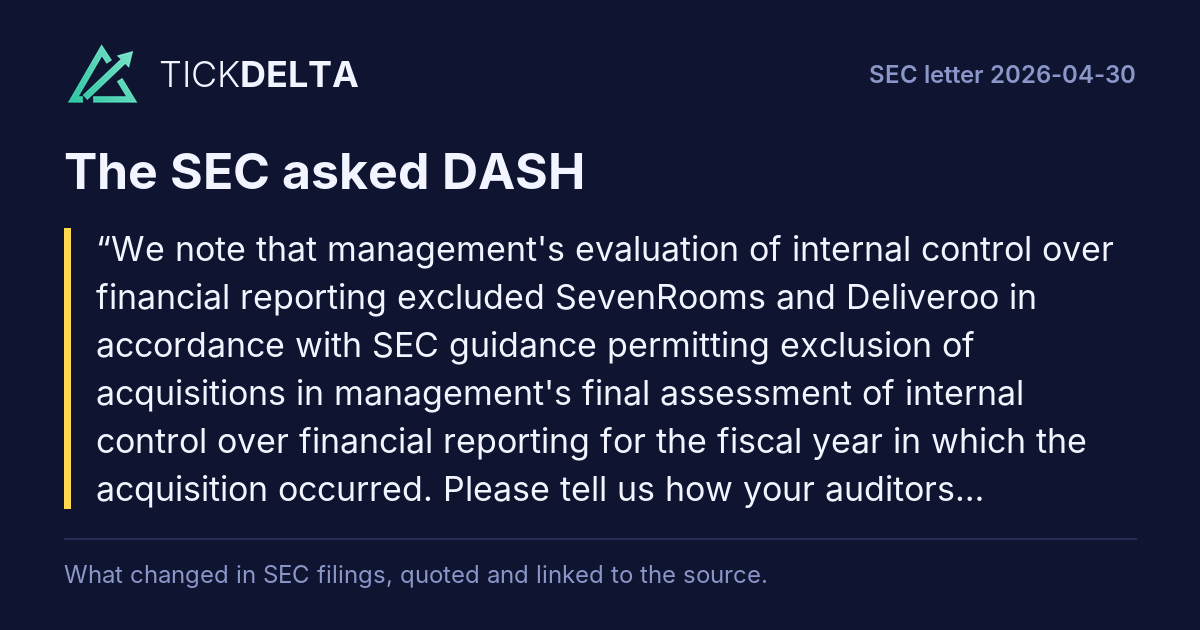
We note that management's evaluation of internal control over financial reporting excluded SevenRooms and Deliveroo in accordance with SEC guidance permitting exclusion of acquisitions in management's final assessment of internal control over financial reporting for the fiscal year in which the acquisition occurred.
Rest of the question

Please tell us how your auditors considered this information in providing their report pursuant to PCAOB AS 2201, including paragraph B16.

DASH answered
The Company respectfully acknowledges the Staff’s comment regarding the Report of Independent Registered Public

Accounting Firm and how the Company’s independent registered public accounting firm considered management’s exclusion of SevenRooms Inc. and Deliveroo plc from its assessment of internal control over financial reporting.

As disclosed in the Form 10-K, management excluded SevenRooms Inc.
Rest of the answer

and Deliveroo plc from its assessment of the effectiveness of the Company’s internal control over financial reporting as of December 31, 2025, consistent with SEC guidance permitting the exclusion of businesses acquired during the fiscal year of acquisition. In connection with its audit of internal control over financial reporting, the Company’s independent registered public accounting firm considered management’s exclusion of these acquired businesses in accordance with PCAOB Auditing Standard No. 2201, including paragraph B16.

Based on its consideration of management’s exclusion, including the relative significance of the excluded entities, the auditor determined that it was appropriate to include explanatory language in its report describing the exclusion of SevenRooms Inc. and Deliveroo plc from both management’s assessment and the auditor’s evaluation of internal control over financial reporting and that the omission of such language in their report was inadvertent. The Company has conferred with its independent registered public accounting firm, and the auditor has amended its Report of Independent Registered Public Accounting Firm accordingly. The amended report clarifies that the internal control over financial reporting of SevenRooms Inc. and Deliveroo plc associated with approximately 7% of total assets (excluding acquired goodwill and intangible assets) and approximately 3% of total revenues included in the Company’s consolidated financial statements for the year ended December 31, 2025 was excluded.

The auditor has informed the Company that no subsequently discovered facts or other circumstances were identified in connection with the discovery of the omission. Further, based on the auditor’s audit scope, considerations, and documentation, the auditor’s workpapers already reflected the explanatory language included in management’s assessment of internal control over financial reporting, and no new information was obtained nor were any additional audit procedures required. Accordingly, the audit documentation continues to stand as originally issued, and the update represents an administrative and clerical modification to the auditor’s report rather than a substantive audit matter.

The

Company has filed an amendment to its Form 10-K on Form 10-K/A to include the amended report, as well as Item 8 and updated certifications, and respectfully submits that the amended filing has addressed the Staff’s comment.

Read in the reply ↗
In its next report

First report after the company's reply of 2026-05-06: 10-Q filed 2026-08-05 ↗, against the 10-Q filed 2025-11-06 ↗.

The part of the filing the question names could not be found in both reports. Read them on sec.gov.
Also in this review: closing letter, 2026-05-12
Form 10-K for the Year Ended December 31, 2021

2022-05-19 to 2022-06-13 · 2 questions · 1 letter from the SEC, 1 from the company
Review closed 2022-06-13
Non-GAAP measuresResults discussion (MD&A)
Key Business and Non-GAAP Metrics, page 66
SEC asked (1)
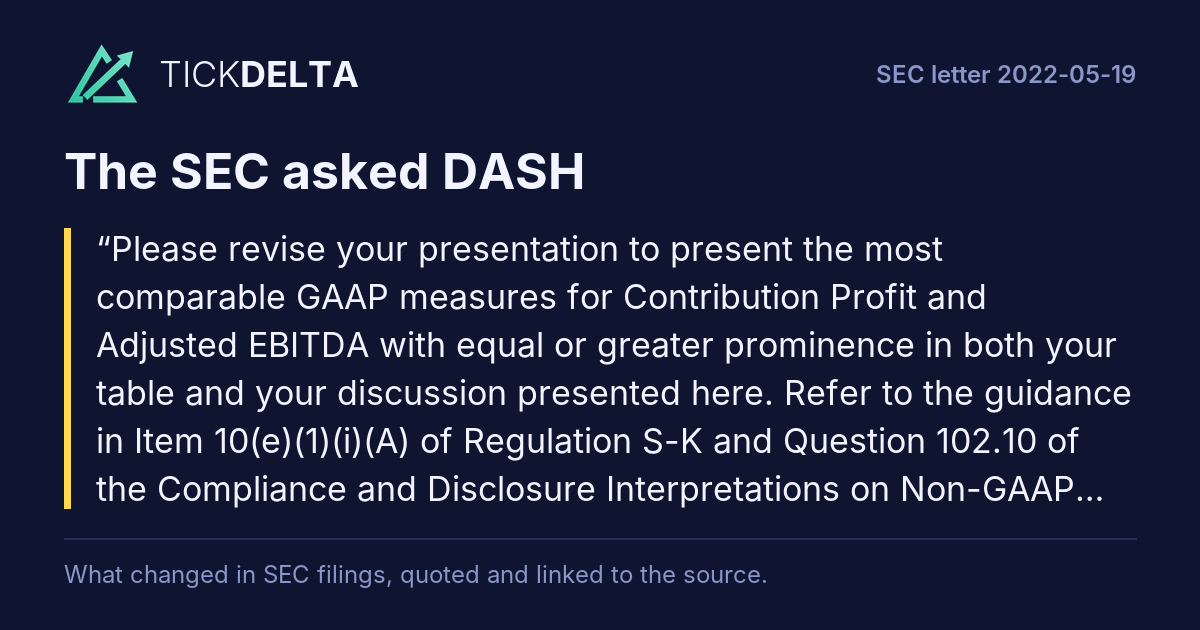
Please revise your presentation to present the most comparable GAAP measures for Contribution Profit and Adjusted EBITDA with equal or greater prominence in both your table and your discussion presented here. Refer to the guidance in Item 10(e)(1)(i)(A) of Regulation S-K and Question 102.10 of the Compliance and Disclosure Interpretations on Non-GAAP Measures.
DASH answered
The Company acknowledges the Staff’s comment and respectfully advises the Staff that in future filings the Company will present any Non-GAAP financial measures along with the most directly comparable GAAP measures with equal or greater prominence consistent with Item 10(e)(1)(i)(A) of Regulation S-K and Question 102.10 of the Compliance and Disclosure Interpretations on Non-GAAP

Measures. Read in the reply ↗
In its next report

First report after the company's reply of 2022-06-03: 10-Q filed 2022-08-05 ↗, against the 10-Q filed 2022-05-06 ↗.

Tickdelta does not hold the text of both reports, so they are not compared here.

Item 7. Management's Discussion and Analysis of Financial Condition and Results of Operations · Non-GAAP Financial Measures, page 72
SEC asked (2)
We note that all of your Non-GAAP measures presented here, except for Adjusted EBITDA, include an adjustment for "Allocated Overhead." Overhead appears to include normal, recurring, cash operating expenses necessary to operate your business. Please tell us why you believe these adjustments are permitted under Rule 100(b) of Regulation G.
Rest of the question

Refer to Question 100.01 of the Compliance and Disclosure Interpretations on Non-GAAP Measures.

DASH answered
The Company respectfully advises the Staff that, prior to preparing and including any non-GAAP measures in its Form 10-K, it reviewed the requirements of Rule 100(b) of Regulation G and the guidance in the Compliance and Disclosure Interpretations, including Question 100.01. The Company has further reviewed the rule and related guidance, and based upon such review, does not believe that the adjustments for allocated overhead violate Rule 100(b) of Regulation G.
Rest of the answer

The non-GAAP financial measures that adjust for allocated overhead, when considered with the information and other accompanying discussion of the Company’s GAAP and non-GAAP financial measures, do not contain an untrue statement of a material fact nor omit a material fact necessary in order to make the presentation of its non-GAAP financial measures, in light of the circumstances in which they are presented, not misleading.

As described in the Form 10-K, allocated overhead is determined based on an allocation of shared costs, such as facilities (including rent and utilities) and information technology costs, among all departments based on employee headcount. These costs tend to be fixed in nature and are not directly impacted by Total Orders or revenue. While allocated overhead is excluded from adjusted cost of revenue, adjusted sales and marketing expense, and adjusted research and development expense, all such excluded allocated overhead amounts have been included in adjusted general and administrative expense, in addition to any amounts that would otherwise be included in general and administrative expense. The purpose of these adjustments is to shift allocated overhead, which, as noted, is generally a fixed cost, to a category of operating expense that is also typically fixed in nature and does not tend to be sensitive to changes in Total Orders or revenue. Further, it permits investors to evaluate shared costs, such as facilities, which are incurred by the Company in the aggregate, on an aggregate basis and not divided among functions in a way that may vary from period to period. The Company believes that this presentation appropriately represents, and is more meaningful to an investor’s understanding of, the

Company’s business and performance, particularly its unit economics and its fixed costs.

Page

The Company further advises the Staff that it presents adjusted cost of revenue, adjusted sales and marketing expense, and adjusted research and development expense excluding allocated overhead because it believes that such presentation provides investors with important insights into the Company’s performance and provides comparability of the Company’s variable costs over various periods. As allocated overhead is not directly impacted by changes in Total Orders or revenue, excluding it from the foregoing non-GAAP measures enables investors to better understand the relationship of changes in Total Orders and revenue on the Company’s cost structure, and thereby provides investors with further insight on the unit economics of the Company’s business.

Additionally, separating out allocated overhead provides investors with incremental clarity on such fixed costs. Therefore, the Company believes that it is appropriate to exclude allocated overhead in the determinations of the foregoing non-GAAP measures as changes to allocated overhead are not necessarily reflective of the Company’s unit economics. Further, the Company believes that providing these non-GAAP financial measures with adjustments for allocated overhead enhances its overall financial disclosure and provides context within which its GAAP financial information should be analyzed.

The Company further submits that its treatment of allocated overhead in its presentation of non-GAAP measures in the Form 10-K is reflective of how management views and operates the Company’s business. The Company’s management focuses on how variable costs, Total Orders, and revenue vary from period to period, and the relationship between its variable costs, Total Orders, and revenue, and has presented these adjustments to allocated overhead to enable investors to see the Company’s business through management’s eyes.

Lastly, the Company further notes for the Staff that the amounts of allocated overhead excluded from adjusted cost of revenue, adjusted sales and marketing expense, and adjusted research and development expense and added to adjusted general and administrative expense have historically not been material, either individually or in the aggregate. For example, in the year ended

December 31, 2021, allocated overhead represented:

•

$25 million, or approximately 1% of cost of revenue;

$14 million, or less than 1% of sales and marketing expense;

$13 million, or approximately 3% of research and development expense; and

$11 million, or approximately 1% of general and administrative expense.

For all of the foregoing reasons, the Company believes that certain non-GAAP financial measures that adjust for allocated overhead are useful to investors, provide meaningful additional disclosure for investors, and are permitted under Rule 100(b) of Regulation G.

Read in the reply ↗
In its next report

First report after the company's reply of 2022-06-03: 10-Q filed 2022-08-05 ↗, against the 10-Q filed 2022-05-06 ↗.

Tickdelta does not hold the text of both reports, so they are not compared here.

Also in this review: closing letter, 2022-06-13

From the SEC's correspondence on EDGAR: staff letters (form UPLOAD) and company letters (form CORRESP), 6 letters filed since 2022-05-19. Questions and answers are matched by their numbers; topics come from words in each question. The reports are compared word for word (same form, before the first SEC letter against the first report after the company's reply). No AI.

Work on DASH in a spreadsheet: Excel workbook (a sheet per section, ten years by column, charts, links to the filings) · CSV. For a Google Sheet that stays up to date, paste =IMPORTDATA("https://tickdelta.com/company/DASH/export.csv") into a cell.