Form 10-K
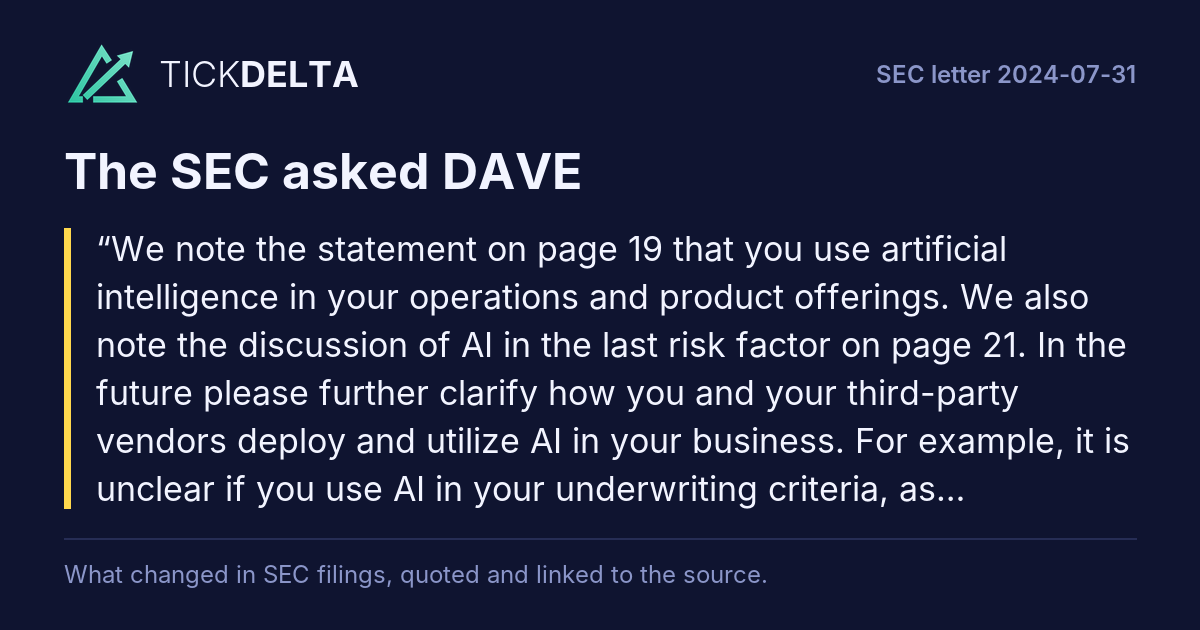
We note the statement on page 19 that you use artificial intelligence in your operations and product offerings. We also note the discussion of AI in the last risk factor on page 21. In the future please further clarify how you and your third-party vendors deploy and utilize AI in your business. For example, it is unclear if you use AI in your underwriting criteria, as discussed in the second risk factor on page 22.
The identity and ownership interest of each owner is ascertainable from the bank’s deposit account records or records maintained by the third party (or another person or entity that has agreed to maintain records on its behalf).Read in the reply
First report after the company's reply of Aug 28, 2024: 10-Q filed Nov 12, 2024 ↗, against the 10-Q filed May 7, 2024 ↗.
Tickdelta does not hold the text of both reports, so they are not compared here.
Reference is made to the sixth sentence of the first paragraph. In the future, clarify how you are "subject to bank regulators with supervisory authority over Evolve." If material, your revised disclosure should (1) further clarify the regulatory environment generally for nonbank operators as well as how regulations apply to your particular operations and (2) reconcile the statement on page 14 with your disclosureRest of the question
in the penultimate risk factor on page 35, where you state that you are "not currently directly subject to laws and regulations applicable to traditional banks."
to the Staff’s comment, the Company proposes to replace the last paragraph in the section entitledRead in the reply
“Regulation of our bank partnership model” on page 16 in its entirety with alternative language similar to the following:
Many laws and regulations that apply directly to Evolve indirectly impact us (and our products) as Evolve’s service provider.Rest of the answer
As such, we are subject to the supervision and enforcement authority as well as to potential direct or indirect examination as a service provider to Evolve, by its regulators, including the Federal Reserve, Evolve’s primary regulator, the FDIC and the Arkansas State Bank Department. Such examinations would be in respect to the marketing, account opening, customer screening (including Bank Secrecy Act, AML and Know Your Customer processes), transaction monitoring and servicing activities undertaken by the Company on Evolve’s behalf (“Bank Servicing Activities”). Some of the Bank Servicing
Activities may be outsourced by the Company (with Evolve’s permission) to third party vendors. In all cases the Company (in consultation with Evolve) sets the parameters and oversees the performance of the Bank Servicing Activities performed by third parties.
Additionally, in order to reconcile these and other statements about oversight by banking regulators with the language in the penultimate risk factor on page 35, the Company updated the risk factor in its Q2 2024 Form 10-Q as follows (deleted text is in strikethrough; added text is underlined):
If we were to become directly subject to banking regulations or be Due to our bank partnership model, we are and will continue to be subjected to additional third-party risk management obligations, our business model may need to be substantially altered and we may not be able to continue to operate our business as it is currently operated.
We are not currently directly subject to laws and regulations applicable to traditional banks.
However, bBanking products made available through us by our bank partner remain subject to regulation and supervision by our bank partner’s regulators and we, as a service provider to our bank partner, undertake certain compliance obligations. If we were to become directly subject to banking regulations or if the third-party risk management requirements applicable to us were to change, our business model may need to be substantially altered and we may not be able to continue to operate our business as it is currently operated. Failure by us, or any of our business partners, to comply with applicable laws and regulations could have a material adverse effect on our business, financial position and results of operations.
First report after the company's reply of Aug 28, 2024: 10-Q filed Nov 12, 2024 ↗, against the 10-Q filed May 7, 2024 ↗.
Tickdelta does not hold the text of both reports, so they are not compared here.
We note the statement that the application of state licensing requirements to your business model is not always clear. You also indicate that state regulators may request or require that you obtain licenses or otherwise comply with additional requirements in the future, and you state on page 35 that "[c]ertain" states have adopted laws regulating licensing, registration, notice filing, or other approval.Rest of the question
You also state that you have (1) received inquiries from state regulatory agencies regarding requirements to obtain licenses, (2) responded to inquiries from "various states," and (3) entered into a 2021 MOU with California. With a view to disclosure in future filings, please advise us whether there are any significant updates to the status of state regulatory requirements materially impacting you.
to the Staff’s comment, the Company updated the following risk factor in its Q2 2024 Form 10-Q (added text is underlined):Read in the reply
If we were found to be operating without having obtained necessary state or local licenses, it could adversely affect our business, results of operations, financial condition, and future prospects.
Certain states have adopted laws regulating and requiring licensing, registration, notice filing, or other approval by parties that engage in certain activities regarding consumer finance transactions.Rest of the answer
We have also received inquiries from state regulatory agencies regarding requirements to obtain licenses from or register with those states, including in states where we have determined that we are not required to obtain such a license or be registered with the state, and we expect to continue to receive such inquiries. The application of certain consumer financial licensing laws to our platform and the related activities it performs is not always clear, and regulatory agencies may not agree with our determinations on the applicability of such laws to us. In addition, state licensing requirements may evolve over time, including, in particular, recent trends in legislation seeking to impose licensing requirements and regulation of parties engaged in business to consumer advance products such as ExtraCash. For example, in 2023, the banking regulators in Connecticut and Maryland issued guidance (and in the case of Maryland, a regulatory change) (collectively, “State Regulatory Changes”) indicating that traditional “earned wage access” products would, under certain circumstances, be considered small loans under the state lending laws, and that optional fees and tips, under certain circumstances, would be finance charges for purposes of calculating the interest rate under the state’s applicable usury limit. These State Regulatory Changes would subject those covered by them to licensure and limitations or prohibitions on certain charges. Although we do not believe that our ExtraCash overdraft product offered through Evolve is covered by the State Regulatory Changes, we have recently received separate inquiries from the Connecticut and Maryland banking regulators as to whether the ExtraCash product is subject to the State Regulatory Changes, as well as a subpoena from the Maryland Attorney General requesting information regarding any earned wage access and related products that we offer in the state of Maryland. Although we believe that our practices and products offered at all times in Maryland and Connecticut have been in compliance with applicable law, the defense or resolution of these matters could involve significant monetary costs or penalties and have a significant impact on our financial results and operations.
If we were found to be in violation of applicable state licensing or other requirements by a court or a state, federal, or local enforcement agency, or agree to resolve such concerns by voluntary agreement, we could be subject to or agree to pay fines, damages, injunctive relief (including required modification or discontinuation of our business in certain areas), criminal penalties, and other penalties or consequences, and the advances facilitated through our platform could be rendered void in whole or in part, any of which could have an adverse effect on our business, results of operations, and financial condition. For example, we have received and responded to inquiries from various states, in each case regarding whether the advance products we offer in those states should subject us to state licensing and related requirements. In December 2021, we entered into a Memorandum of Understanding (“MOU”) with the California Department of Financial Protection and Innovation (“CA DFPI”). The MOU requires us to provide the CA DFPI with certain information as requested by the CA DFPI and adhere to certain best practices in connection with our ExtraCash advance product (including certain disclosures related to us not being licensed by the CA DFPI).
First report after the company's reply of Aug 28, 2024: 10-Q filed Nov 12, 2024 ↗, against the 10-Q filed May 7, 2024 ↗.
Tickdelta does not hold the text of both reports, so they are not compared here.
We note this risk factor discusses your reliance on Evolve Bank. Advise us whether you believe your risk factor should be updated in future filings to address the Cease and Desist Order of June 11, 2024 consented to by Evolve with its regulators. For example, it is unclear if the order significantly alters the likelihood that you could be subject to new "material limitations."
To date, the Cease and Desist Order of June 11, 2024 consented to by Evolve with its regulators has not significantly impacted our operations. As Evolve addresses the requirements under the Cease and Desist Order, we will continue to monitor and update our disclosures as appropriate.Read in the reply
In addition, in response to the Staff’s comment, the Company updated the following risk factor in its Q2 2024 Form
10-Q (deleted text is in strikethrough; added text is underlined):
We currently rely on a single bank partner, and iIf our present or any future key banking relationships are terminated and we areRest of the answer
not able to secure or successfully migrate client portfolios to a new bank partner or partners, or our bank partner becomes subject to regulatory restrictions or other operational disruptions, our business would be adversely affected.
We currently rely on agreements with Evolve, our only bank partner, to provide ExtraCash and other deposit accounts, debit card services and other transaction services to us and our Members. These agreements and corresponding regulations governing banks and financial institutions may give Evolve substantial discretion in approving certain aspects of our business practices, including our application and qualification procedures for Members and require us to comply with certain legal requirements. Evolve discretionary actions under these agreements could impose material limitations to, or have a material adverse effect on, our business, financial condition and results of operations. In addition, any disruptions or restrictions on Evolve’s operations could have an adverse effect on our business, financial condition and results of operations. For example, in
May 2024, Evolve experienced a cybersecurity incident that resulted in the leak of certain customer information, including information of some of our Members. If our relationship with Evolve Bank is terminated or Evolve becomes unable to provide the necessary services to us, we would need to find another financial institution to provide those services, which could be difficult and expensive. If we are unable to find a replacement financial institution to provide the services we receive from Evolve, we would not be able to offer ExtraCash advances, service our deposit accounts, debit cards and other services, which would have a material adverse effect on our business, financial condition and results of operations. Furthermore, our financial results could be adversely affected if our costs associated with using Evolve materially change or if any penalty or claim for damages is imposed as a result of our breach of our agreements with themEvolve.
In addition, state and federal agencies have broad discretion in their interpretation of laws and requirements related to bank partnership programs and may elect to alter standards or the interpretation of the standards applicable to these programs. The uncertainty of the federal and state regulatory environments around bank partnership programs means that our efforts to launch products and services through bank partners may not ultimately be successful, or may be restricted or challenged by legislation or regulatory action. If the legal structure underlying our relationship with
Evolve were to be successfully challenged or otherwise restricted, we would need to find an alternative bank relationship. Furthermore, Evolve or any other future bank partners could be subject to enforcement actions, civil monetary penalties, supervisory orders to cease and desist or other remedial actions, which, even if unrelated to our business, could impose restrictions on the bank partner’s ability to continue to extend credit on current terms or offer services that are required for certain of our products. For example, in June 2024, the Federal Reserve Board issued a cease and desist order against Evolve for alleged deficiencies in its anti-money laundering, risk management and consumer compliance programs.
Federal or state regulators may also subject us to increased compliance, legal and operational costs, and could subject our business model to scrutiny and otherwise increase our regulatory requirements, or may adversely affect our ability to expand our business.
First report after the company's reply of Aug 28, 2024: 10-Q filed Nov 12, 2024 ↗, against the 10-Q filed May 7, 2024 ↗.
Tickdelta does not hold the text of both reports, so they are not compared here.
In the future, please clarify the disclosure in the first sentence, including which "banking regulations and payment network rules" may subject you to liability. Revise "Other regulatory requirements" on page 16 in future filings to summarize whether and how your agreements with third parties designate individual or shared responsibility for the various bank and other regulatory oversight, such as KYC and AML.Rest of the question
In this regard, we note the statement on page 10 that Galileo "implements certain fraud control processes and procedures."
to the first part of the Staff’s comment, the Company proposes to update the risk factor on page 28 similar to the following (deleted text is in strikethrough; added text is underlined):Read in the reply
We are exposed to losses from Dave banking Member accounts.
Fraudulent activity involving our Dave banking accounts may lead to fraudulent or baseless Member disputed transactions, for which Evolve as the card issuer, and we, under our agreement with Evolve, are may be liable under banking regulations such as the Electronic Fund Transfer Act (EFTA) and its implementing Regulation
E, or under the rules setRest of the answer
by the payment processing networks through which the card was issued, such as Visa or Mastercard and payment network rules. Our fraud detection and risk control mechanisms may not prevent all fraudulent or illegal activity, and the regulations and payment network rules may become more onerous, causing additional losses for us. To the extent we incur losses from disputed transactions, our business, results of operations and financial condition could be materially and adversely affected. Additionally, our Members can incur charges in excess of the funds available in their accounts, and we may become liable for these overdrafts. While we decline authorization attempts for amounts that exceed the available balance in a Member’s account, the application of payment network rules and the timing of the settlement of transactions, among other things, can result in overdrawn accounts.
Our remaining overdraft exposure arises primarily from late-posting. A late-post occurs when a merchant posts a transaction within a payment network-permitted timeframe, but subsequent to our release of the authorization for that transaction, as permitted by payment network rules. Under payment network rules, we may be liable for the transaction amount even if the Member has made additional purchases in the intervening period and funds are no longer available in the Member’s account at the time the transaction is posted.
In response to the second part of the Staff’s comment, the Company proposes to update the section entitled “Regulation of our bank partnership model” on page 16 as noted in response to comment 3 above.
First report after the company's reply of Aug 28, 2024: 10-Q filed Nov 12, 2024 ↗, against the 10-Q filed May 7, 2024 ↗.
Tickdelta does not hold the text of both reports, so they are not compared here.
We note the reference on page 50 to "lower tip engagement" from members and "relatively flat" change in the percentage of members who chose to pay a processing fee for expedited advances. We also note the reference to member growth and activity on page 48 in the discussion of Key Factors Affecting Operating Results.Rest of the question
In future filings, please revise to provide an approximate quantification of the percentages of members who leave tips and/or choose to pay an optional instant transfer fee and, if the variability of such revenues differs materially compared to the other revenue streams, further clarify the key drivers for optional fees. In this regard, it is unclear what is meant by tip engagement.
The Company acknowledges the Staff’s comment and respectfully advises the Staff that the Company believes revising its future filings to include an approximate quantification of the optional fee and tip revenue as a percentage of total advance origination volume each period provides more decision-useful information to investors than quantifying the percentage of members choosing to pay such optional fees and/or leave optional tips.Read in the replyRest of the answer
Individual members may choose to initiate multiple advances within a given period, and their decisions regarding fees and tips may vary on each occasion, which makes the percentage of members who chose to pay such optional fees or leave optional tips not a useful disclosure. The Company believes that disclosing each revenue stream as a percentage of total origination volume, along with an explanation of any changes, adequately informs investors of trends and reasons for variability and the corresponding impact to respective tip and fee related revenues. This approach, whereby tip and processing fee revenue streams are analyzed as a percentage of origination volume, is also consistent with management’s approach to managing ExtraCash related revenue streams. Should the variability of these revenue streams differ materially when compared to other revenue streams, the Company will provide further clarification regarding the primary factors influencing its optional fees and optional tips. Tip engagement is defined as the proportion of ExtraCash disbursements that contain an optional tip in a period, and is one driver of ExtraCash related gross revenues.
First report after the company's reply of Aug 28, 2024: 10-Q filed Nov 12, 2024 ↗, against the 10-Q filed May 7, 2024 ↗.
Tickdelta does not hold the text of both reports, so they are not compared here.
Also in this review: request for more time, Aug 6, 2024, company letter, Jan 14, 2025, closing letter, 2025-01-22