Added10-Q Jun 2, 2026 vs 10-K Sep 26, 2025
Facet Filtration Acquisition - we could be subject to new risks, known and unknown, relating to the Facet acquisition.
Each branch is a paragraph in Risk Factors with nothing like it in the 10-K filed Sep 26, 2025. A box jumps to the paragraph as filed, below.
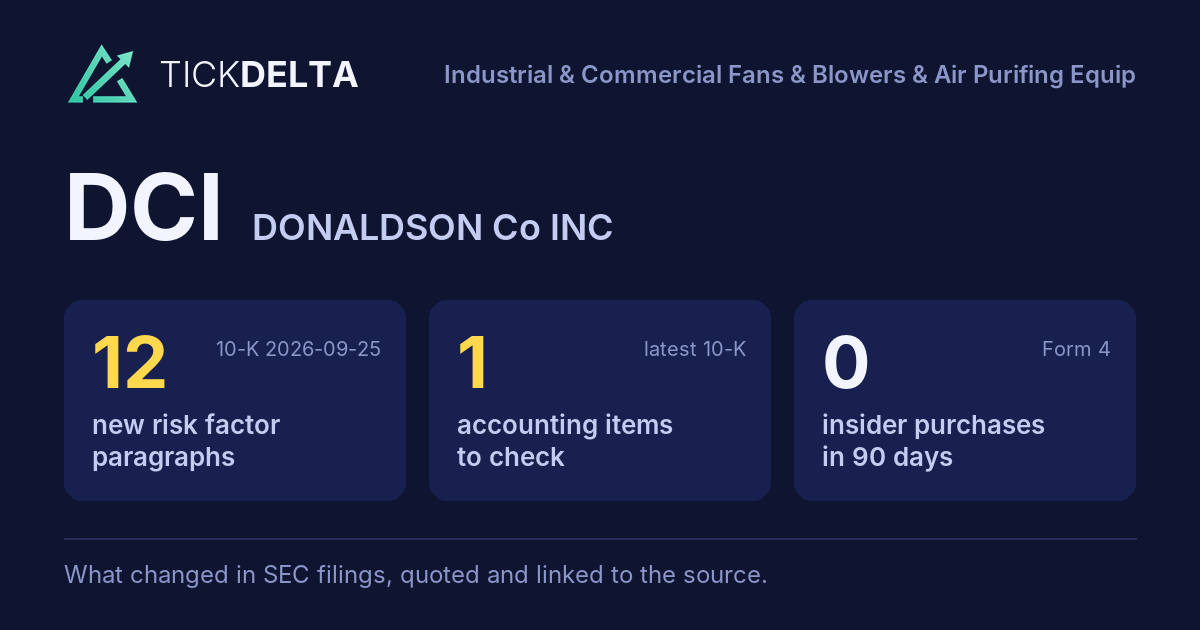
12 paragraphs in Risk Factors of the 10-K filed Sep 25, 2026 with nothing like them in the 10-K filed Sep 26, 2025. Quoted exactly. Paragraphs that were only edited are under 10-K change.
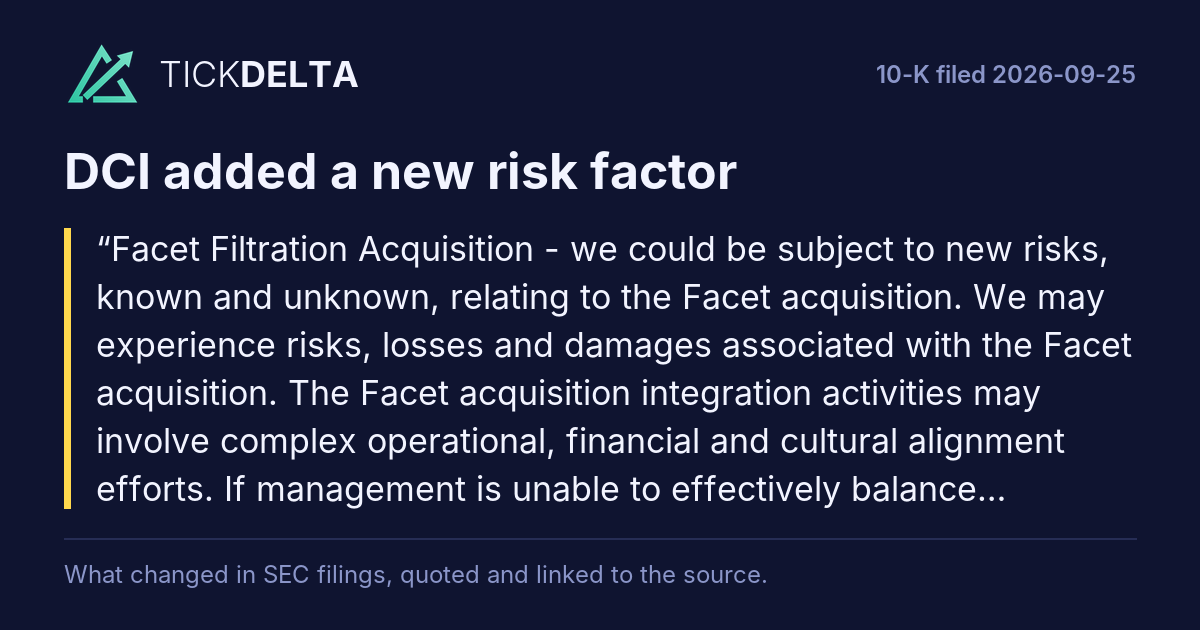
Facet Filtration Acquisition - we could be subject to new risks, known and unknown, relating to the Facet acquisition.
We may experience risks, losses and damages associated with the Facet acquisition. The Facet acquisition integration activities may involve complex operational, financial and cultural alignment efforts. If management is unable to effectively balance integration activities with ongoing business needs, we may experience increased operating costs, reduced financial performance or disruptions to our day‑to‑day operations. Any of these outcomes could materially and adversely affect our business, financial condition or results of operations.
The Facet acquisition involves the inherent risk of liabilities, and these liabilities may prove more costly or produce more adverse effects than we anticipate, such as actual or potential litigation and regulatory matters. In addition, in the course of the due diligence review of Facet, we may not have discovered, or may have been unable to quantify, undisclosed liabilities of Facet, and we may not be indemnified or have insurance for any of these liabilities. Any such liabilities could have an adverse effect on our business, results of operations, financial condition and cash flows.
We acquired $587.4 million of goodwill and $225.6 million in intangible assets as part of the Facet acquisition. If Facet fails to meet performance expectations, we could face future impairment charges that may have a material adverse effect on our reported results of operations and financial position.
Artificial Intelligence (AI) - the development, deployment, and use of AI technologies may not achieve the intended outcomes.
Our growing use of AI technologies across technology development activities and business operations may expose us to a range of competitive, legal, regulatory, operational and other risks, including the following:
•Operational and Technical Risks: AI technologies are complex and rapidly evolving and may not perform as intended. Deficiencies in AI algorithms, training methodologies, datasets, or system implementation could result in inaccurate outputs, operational disruptions, data loss or other adverse outcomes that impair the effectiveness of utilizing AI in our operations.
•Legal and Regulatory Risks: The legal and regulatory framework governing AI continues to evolve and varies across jurisdictions. Compliance with existing and emerging requirements may increase costs, restrict our use of AI technologies and expose us to legal, regulatory and reputational risks.
•Competitive Risks: Failure to keep pace with evolving AI advancements could weaken our market position and negatively impact business performance.
•Financial Risks: Investments in AI technologies may increase our costs and may not deliver the anticipated benefits.
•Cybersecurity Risks: AI technologies may be susceptible to cybersecurity threats, including unauthorized access, data breaches and other security incidents, which could result in financial losses, legal or regulatory liability and reputational harm. Additionally, the increasing use and advancement of AI may enhance the sophistication and effectiveness of cyberattacks, thereby increasing our cybersecurity risk exposure.
Our development and use of AI technologies may not effectively address all associated risks, and any failure to do so could materially adversely affect our business, results of operations, financial condition and cash flows.
New in the latest 10-Q
8 paragraphs in the 10-Q filed Jun 2, 2026 with nothing like them in the 10-Q filed Feb 26, 2026 (at least half the words must differ; new numbers alone do not count). Quoted exactly, grouped by the item heading above them. This is text that changed, not a judgement of how serious it is.
In the third quarter of fiscal 2025, the Company identified a triggering event related to certain asset groups and performed a valuation of certain long-lived intangible assets in accordance with ASC 360, Impairment and Disposal of Long-Lived Assets. The Company used a discounted cash flow analysis to estimate the fair value of each long-lived asset group. As a result of the valuation, the Company recorded $ 62.0 million of impairment expense related to intangible assets in the Company’s bioprocessing business within the Life Sciences segment. The impairment expense was included in Loss on impairment of intangible assets in the Condensed Consolidated Statements of Earnings. Of the impairment expense, $ 46.6 million was related to Univercells Technologies, reflecting lower-than-anticipated bioprocessing capital spending, particularly for early-stage assets, while drug development timelines are longer than previously anticipated. The remaining $ 15.4 million of impairment expense was related to Solaris as market demand for industrial bioreactors had significantly declined.
Read in the 10-Q
During the third quarter of fiscal 2026, the Company entered into a Term Loan Credit Agreement that created a new three-year committed, unsecured, delayed draw term loan credit facility in the amount of $ 400.0 million. The Term Loan Facility is available in U.S. Dollars. As of April 30, 2026, there was no outstanding balance under the Term Loan Facility.
Read in the 10-Q
On May 29, 2026, the Company’s Board of Directors declared a cash dividend in the amount of 32.0 cents per common share, payable June 30, 2026, to stockholders of record as of June 15, 2026.
Read in the 10-Q
In the third quarter of fiscal 2026, the Company recorded a pension settlement charge of $ 3.2 million as a result of lump sum distributions exceeding the service and interest cost components of the annual net periodic pension cost. The corresponding remeasurement resulted in an increase in the Company’s pension assets and a corresponding adjustment to other comprehensive loss in the Condensed Consolidated Statements of Comprehensive Income of $ 0.1 million. See Note 11.
Read in the 10-Q
On February 28, 2026, the United States and Israel began a military operation targeting Iranian nuclear sites, military infrastructure, and top leadership. Iran has retaliated with attacks on infrastructure assets and United States and Israeli military bases in the Middle East, as well as a blockade of the Strait of Hormuz, a key shipping route for oil and liquified natural gas, among other commodities. As a result of the conflict, prices for these and other impacted commodities have increased sharply, causing volatility in the global economic markets. If the conflict or geopolitical tensions continue or worsen, it could have a significant adverse effect on our business, financial condition, or results of operations. We are monitoring the regional and global ramifications of the events unfolding.
Read in the 10-Q
The three months ended April 30, 2025 included a loss on impairment of intangible assets of $62.0 million, or 6.6% of net sales. There was no loss on impairment of intangible assets for the three months ended April 30, 2026. The fiscal 2025 impairment expense included $46.6 million related to Univercells Technologies, reflecting lower-than-anticipated bioprocessing capital spending, particularly for early-stage assets, while drug development timelines are longer than previously anticipated. The remaining $15.4 million of impairment expense was related to Solaris as market demand for industrial bioreactors had significantly declined.
Read in the 10-Q
The nine months ended April 30, 2025 included a loss on impairment of intangible assets of $62.0 million, or 2.3% of net sales. There was no loss on impairment of intangible assets for the nine months ended April 30, 2026. The fiscal 2025 impairment expense included $46.6 million related to Univercells Technologies, reflecting lower-than-anticipated bioprocessing capital spending, particularly for early-stage assets, while drug development timelines are longer than previously anticipated. The remaining $15.4 million of impairment expense was related to Solaris as market demand for industrial bioreactors had significantly declined.
Read in the 10-Q
The Company financed the Facet acquisition, which closed in the fourth quarter of fiscal 2026, with a combination of cash on hand and proceeds from approximately $820.0 million of new debt, including the $400.0 million Term Loan Facility the Company entered during the third quarter of fiscal 2026. The new debt incurred in the fourth quarter of fiscal 2026 was at a rate of 4.6%. The new debt bears interest at a variable rate based on Term SOFR plus a spread that is based on the Company’s Leverage Ratio as defined by the agreements. The additional borrowings increased the long-term debt outstanding for the Company to approximately $1.4 billion. See Note 20 in the Notes to Condensed Consolidated Financial Statements included in Item 1 of this report for additional information on financing related to the Facet acquisition.
Read in the 10-Q
Item 1A of the 10-Q filed Jun 2, 2026 against Item 1A of the 10-K filed Sep 26, 2025.
A 10-Q repeats only the risks that changed, so a 10-K paragraph that is missing from it is not counted as removed.
Added is a paragraph with nothing like it in the 10-K, Reworded a sentence that is in both with several words changed,
Quiet changes a sentence in both where one to four words changed and one is a hedge or a modal
(cut words struck through, new words highlighted).
Text on the page, not a score; each links to the filing at sec.gov.
What the 10-Q itself says about its risk factors:There are inherent risks and uncertainties associated with the Company’s global operations that involve the manufacturing and sale of products for highly demanding customer applications throughout the world. These risks and uncertainties could adversely affect the Company’s business, reputation, financial condition or results of operations. In addition to the risk factor below, the “Risk Factors” section in the Company’s Annual Report on Form 10-K for the fiscal year ended July 31, 2025 outlines the risks and uncertainties the Company believes are the most material to its business.
Read in the 10-Q
Two-word phrases in Risk Factors of the 10-K filed Sep 25, 2026 that are in none of the 1 earlier 10-Ks stored, back to Sep 26, 2025
Used at least twice, small words left out. Counted, not picked: a phrase can be new because the company renamed something.
Item 1A of each 10-K and 10-Q on EDGAR, quoted exactly. Each paragraph links to the filing at sec.gov.
10-K change: what was reworded or cut, section by section.
Excel workbook · CSV. Google Sheet that stays up to date: paste =IMPORTDATA("https://tickdelta.com/company/DCI/export.csv") into a cell.