Marked against last year's 10-K:
cut words struck through, new words highlighted and underlined.
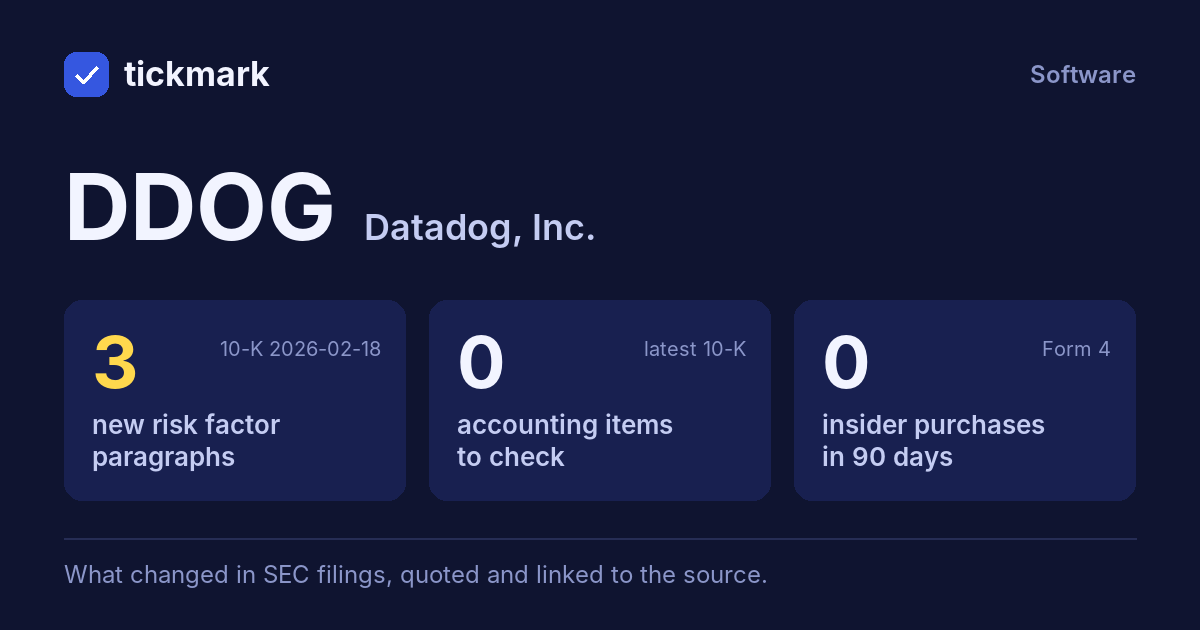
Risk Factors 139 words changed in this paragraph; it is 72% similar to last year's version.
Our platform and products involve the storage and transmission of data, including personal information, and security breaches or unauthorized access to our platform and products, or those of the third-parties with whom we work, could result in the unauthorized, unlawful, or accidental acquisition, modification, destruction, loss, alteration, encryption, disclosure of, or access to sensitive information including our customers' data. Consequently, we may be subject to significant litigation, indemnity obligations, fines, penalties, disputes, investigations and other liabilities. We have previously and may in the future become the target of cyber-attacks by third parties, including without limitation nation-state actors, seeking to gain unauthorized access to and exfiltrate our or our customers’ data, including confidential and personal information, or to disrupt our ability to provide our services. Cyber-attacks, computer malware, viruses, employee mistakes or malfeasance, social engineering (including through deep fakes and spear phishing), malicious code, denial-of-service attacks, credential harvesting and general hacking have become more prevalent in our industry, particularly against cloud services, and have become enhanced or facilitated by artificial intelligence. Ransomware attacks, including those from organized criminal threat actors, nation-states and nation-state supported actors, are prevalent and can lead to significant interruptions, delays, or outages in our operations, loss of data (including customer data), loss of income, significant extra expenses to restore data or systems, reputational loss and the diversion of funds. To alleviate the financial, operational and reputational impact of a ransomware attack it may be preferable to make extortion payments, but we may be unwilling or unable to do so (including, for example, if applicable laws or regulations prohibit such payments). In addition, many of our employees work remotely and utilize network connections, computers and devices outside our premises or network, which may pose additional data security risks (including, for example, the increasing number of phishing and malicious emails we continue to receive). The reliability and continuous availability of our platform is critical to our success.
Source: Item 1A, 10-K 0001628280-26-008819 vs Item 1A, 10-K 0001561550-25-000025
MD&A 120 words changed in this paragraph; it is 64% similar to last year's version.
We have also issued long-term debt to finance our business. In June 2020 and December 2024, we issued $747.5 million aggregate principal amount of the 2025 Notes and $1.0 billion aggregate principal amount of the 2029 Notes, respectively, Notes in a private placements placement to qualified institutional buyers pursuant to Rule 144A under the Securities Act. The total net proceeds from the sale of the 2025 Notes and the 2029 Notes, after deducting the initial purchasers’ discounts and debt issuance costs, were approximately $730.2 million and $979.1 million, respectively. million. The principal and future interest payments related to our 2025 Notes and 2029 Notes are $635.9 million and $1.0 billion, respectively. We used $196.8 million of the net proceeds from the offering of the 2029 Notes to repurchase approximately $112.0 million in aggregate principal amount of the 2025 Notes, including accrued and unpaid interest, in privately negotiated transactions. In connection with the partial retirement of the 2025 Notes, we entered into a termination agreement relating to a number of options corresponding to the number of 2025 Notes retired. We received approximately $54.7 million in connection with such termination agreements. billion. We may from time to time seek to retire or purchase our 2025 Notes or the 2029 Notes, through cash purchases and/or exchanges for equity securities, in open market purchases, privately negotiated transactions or otherwise.
Source: Item 7, 10-K 0001628280-26-008819 vs Item 7, 10-K 0001561550-25-000025
Accounting Policies 70 words changed in this paragraph; it is 66% similar to last year's version.
In December 2023, the FASB issued ASU No. 2023-09, Income Taxes (Topic 740): Improvements to Income Tax Disclosures (“ASU No. 2023-09”), which intends to increase the transparency of income tax disclosures, particularly disclosures. Under the new guidance, entities must categorize and provide greater disaggregation of information in the rate reconciliation table and disclosures about reconciliation. They must also further disaggregate income taxes paid. For public business entities, it is effective for annual periods beginning after December 15, 2024, and interim periods beginning after December 15, 2025, with early adoption permitted. The Company has not early adopted ASU No. 2023-09 as of this standard on a prospective basis in its consolidated financial statements for the year ended December 31, 2024 and is evaluating its impact. 2025. Refer to Note 14, Income Taxes, to the consolidated financial statements for further details.
Source: Item 8, Note 2 – Basis of Presentation and Summary of Significant Accounting Policies, 10-K 0001628280-26-008819 vs Item 8, Note 2 – Basis of Presentation and Summary of Significant Accounting Policies, 10-K 0001561550-25-000025
Legal Proceedings 34 words changed in this paragraph; it is 85% similar to last year's version.
Indemnification—The Company enters into indemnification provisions under some agreements with other parties in the ordinary course of business, including business partners, investors, contractors, customers, and the Company’s officers, directors and certain employees. The Company has agreed to indemnify and defend the indemnified party claims and related losses suffered or incurred by the indemnified party from actual or threatened third-party claim because of the Company’s activities or non-compliance with certain representations and warranties made by the Company. It is not possible to determine the maximum potential loss under these indemnification provisions due to the Company’s limited history of prior indemnification claims and the unique facts and circumstances involved in each particular provision. To date, losses recorded in the Company’s consolidated statements of operations in connection with the indemnification provisions have not been material.
Source: Item 3, via Note 9 – Commitments and Contingencies, 10-K 0001628280-26-008819 vs Item 3, via Note 9 – Commitments and Contingencies, 10-K 0001561550-25-000025