Screener / SEC EDGAR /CIK 0001364250 /10-K filed Feb 20, 2026, compared with Feb 14, 2025 /Numbers from the XBRL of the 10-Ks
NYSE Real estate · REIT

Douglas Emmett Inc DEI

Compare with peers Embed
SEC comment letters, last 20 years

9 reviews of DEI's filings by SEC staff

UPLOAD and CORRESP
Reviews 9 latest letter Mar 15, 2024
Questions asked 34 each answered in the company's own letter
No closing letter 0 reviews without a letter saying the staff completed it

When the SEC's staff reviews a filing, it writes to the company with numbered questions, and the company answers each one in a letter. SEC publishes the exchange once the review is over, at least 20 business days later. A question is not an accusation; most reviews end with the company adding detail to its next filing.

How the reviews went

Every review on EDGAR, from the first staff letter to the letter that closes it

  1. 1. Staff letters 12 UPLOAD
  2. 2. Questions in them 34 numbered comments
  3. 3. Company replies 12 CORRESP
  4. 4. Reviews closed 9 of 9 closing letter

Half the closed reviews took 31 days or less from the first letter to the closing letter.

Form 10-K

2024-03-15 to 2024-04-03 · 2 questions · 1 letter from the SEC, 1 from the company
Review closed 2024-04-03
Legal and contingencies
Note 6. Investment in Unconsolidated Fund, page F-22
SEC asked (1)
Your disclosure describes your interest in Partnership X as unconsolidated. Please tell us how you considered whether you obtained a controlling financial interest now that you own a 53.8% equity interest in Partnership X as a result of purchasing an additional 20.2% equity interest on December 31, 2023. Please cite the applicable accounting guidance in your response.
DEI answered
The Company respectfully advises the Staff that in determining whether to consolidate Partnership X (the “Fund”) as of December 31, 2023, we first determined that the Partnership was not a variable interest entity in accordance with ASC 810-10, based on the following:

a)The Fund has sufficient equity at risk for it to finance its activities without additional subordinated financial support. At December 31, 2023, the Fund had fair value of equity of $34 million.

b)The equity investors at risk, as a group, have the characteristics of a controlling financial interest.
Rest of the answer

Under ASC 810-10, a limited partnership or similar entity is not a variable interest entity and should be evaluated for consolidation under the voting model if a single limited partner, partners with a simple majority of voting interests or partners with a smaller voting interest with equity at risk are able to exercise substantive kick-out rights. The Fund is not a variable interest entity because the limited partners of the Fund other than the general partner (and any affiliates of the general partner) have the substantive ability to remove the general partner without cause (“kick-out rights”). In particular, the Fund’s Limited Partnership Agreement states that the general partner can be removed, with or without cause, at any time by a majority vote of the limited partners excluding both the general partner and any affiliates of the general partner from both the numerator and the denominator.

c)The legal entity is not structured with disproportionate voting rights, nor are substantially all of the activities conducted on behalf of an investor with disproportionately few voting rights.

As the Fund is not a variable interest entity, consolidation must be evaluated under the Voting Interest Model in accordance with ASC 810-10. As indicated above, the limited partners of the Fund other than the general partner and its affiliates continue to have substantive kick-out rights. Therefore, even after we have obtained a greater than 50% equity interest, we do not have a controlling financial interest under ASC 810-10-15-8A and will continue to account for the Fund as an unconsolidated entity using the equity method.

Read in the reply
In its next report

First report after the company's reply of Mar 29, 2024: 10-Q filed May 10, 2024 ↗, against the 10-Q filed Nov 3, 2023 ↗.

Tickdelta does not hold the text of both reports, so they are not compared here.
Note 17. Commitments, Contingencies and Guarantees · Legal Proceedings, page F-36
SEC asked (2)
Your disclosure indicates that you are currently in litigation with the insurance providers in 2020 for Barrington Plaza to recover certain costs associated with reconstruction. Please tell us how you determined that it was not necessary to disclose any lawsuit(s) brought by tenants of Barrington Plaza to block the evictions.
DEI answered
The Company respectfully advises the Staff that the referenced lawsuit brought by the tenants seeks to delay certain tenant relocations from Barrington Plaza. Under our analysis of an adverse outcome of this lawsuit, the potential damages, whether in the form of a delay in our construction schedule or additional monetary expenditures for the reconstruction, are not projected to exceed 10% of the current assets of the Company and its subsidiaries on a consolidated basis.
Rest of the answer

In Item 7 (Management’s Discussion and Analysis of Results of Operations and Financial Condition) we do state that legal or regulatory actions could impact our construction schedule:

“As of December 31, 2023, a significant majority of the tenants have vacated. Tenants occupying 154 units have the right to remain until May 2024, and we expect them to move out at an uneven pace over the intervening period. That schedule could be impacted by legal or regulatory actions. During any period when the property is unoccupied, we will not generate any revenue from it.”

Since our filing, tenants continue to vacate, further reducing our potential exposure from an adverse outcome of the lawsuit.

In our future filings, we will continue to evaluate whether events, including lawsuits brought by tenants, have or are reasonably likely to have a material favorable or unfavorable impact on our financials and provide appropriate disclosure.

If you should have any additional questions, please contact me directly at (310) 255-7749.

Read in the reply
In its next report

First report after the company's reply of Mar 29, 2024: 10-Q filed May 10, 2024 ↗, against the 10-Q filed Nov 3, 2023 ↗.

Tickdelta does not hold the text of both reports, so they are not compared here.

Also in this review: closing letter, 2024-04-03
Form 10-K for the year ended December 31, 2020

2021-11-02 to 2021-11-23 · 2 questions · 1 letter from the SEC, 1 from the company
Review closed 2021-11-23
Results discussion (MD&A)Critical estimatesPensions
Critical Accounting Policies, page 50
SEC asked (1)
We note that you capitalized development costs of $186.4 million, $75.3 million and $78.7 million in 2020, 2019 and 2018, respectively. Given the temporary suspension of repositioning work due to Covid-19, your disclosures which highlight the continued West Los Angeles development which has been ongoing since 2017 and the conversion of the office tower in downtown Honolulu which has been ongoing since 2018, please
Rest of the question

tell us more about the factors that led to the significant increase in capitalized development costs during fiscal 2020. Please ensure that MD&A disclosures fully address the facts and circumstances that drove the change and whether disproportionate fluctuations in trends are expected to recur. See Item 303(b)(2)(i) and (ii) of Regulation S-K.

DEI answered
The Company respectfully advises the Staff that during 2020, the significant increase in costs at our development projects (which were not suspended), was primarily due to the Brentwood and Honolulu developments entering their major construction phase in 2020. The capital invested in our development projects far exceeded the savings from the temporary suspension of our repositioning projects that began part way through the year (the suspension did not occur until the impact of Covid became clear, and it took time for costs to slow after the suspension).
Rest of the answer

In our 2020 10-K (see page 38), we disclosed that our development projects are expected to cost an aggregate of about $260-300 million not including the cost of the park at the Brentwood development. In addition, our 2020 10-K (see page 38) disclosed that units from our development projects were expected to be delivered in 2020 for our Hawaii project and in 2022 for our Brentwood project (now accelerated to the fourth quarter of 2021), both benefiting from the significant work undertaken during the major construction occurring in 2020.

In our future filings, we will continue to consider item 303(b)(2)(i) and (ii) of Regulation S-K and describe known trends or uncertainties, including those relating to our development and repositioning projects, that have had or that are reasonably likely to have a material favorable or unfavorable impact on our revenues or income from continuing operations.

Read in the reply
In its next report

First report after the company's reply of Nov 12, 2021: 10-K filed Feb 18, 2022 ↗, against the 10-K filed Feb 22, 2021 ↗.

Tickdelta does not hold the text of both reports, so they are not compared here.

Note 1. Overview · Basis of Presentation, page F-12
SEC asked (2)
We note that you consolidate certain VIEs as a result of being the primary beneficiary. We further note from page F-20 that you acquired an additional 16.3% equity in Fund X, resulting in consolidation of that JV. Please tell us your consideration of presenting the assets and liabilities of consolidated VIEs separately on the face of the consolidated balance sheets in accordance with ASC 810-10-45-25.
DEI answered
The Company respectfully advises the Staff that virtually all of our business is conducted through our Operating Partnership which is consolidated by the Company under the VIE consolidation model. Our Operating Partnership similarly consolidates our three JV’s under the VIE consolidation model. As a result, the consolidated assets and liabilities of our consolidated VIEs, other than dividends payable and some other de minimis amounts, are substantially the same as the assets and liabilities presented on our consolidated balance sheet.
Rest of the answer

After further considering ASC 810-10-45-25, we believe that disclosing the information related to our consolidated VIEs on the face of the consolidated balance sheet would be duplicative because substantially all our assets and liabilities are held by our consolidated VIEs. Alternatively, we believe that separately disclosing the three consolidated JV’s assets and liabilities in Note 1 “Overview” – “Basis of Presentation” section of our consolidated financial statement footnotes in addition to continuing to disclose that we consolidate our Operating Partnership and that substantially all our assets and liabilities are owned through the Operating Partnership, would be most useful to investors.

In future filings, we intend to revise our current disclosure in Note 1 “Overview” – “Basis of Presentation” to our consolidated financial statements with the underlined language below:

Basis of Presentation

The accompanying consolidated financial statements are the consolidated financial statements of Douglas Emmett, Inc. and its subsidiaries, including our Operating Partnership and our consolidated JVs. All significant intercompany balances and transactions have been eliminated in our consolidated financial statements.

We consolidate entities in which we are considered to be the primary beneficiary of a VIE or have a majority of the voting interest of the entity. We are deemed to be the primary beneficiary of a VIE when we have (i) the power to direct the activities of that VIE that most significantly impact its economic performance, and (ii) the obligation to absorb losses or the right to receive benefits that could potentially be significant to the VIE. We do not consolidate entities in which the other parties have substantive kick-out rights to remove our power to direct the activities, most significantly impacting the economic performance, of that VIE. In determining whether we are the primary beneficiary, we consider factors such as ownership interest, management representation, authority to control decisions, and contractual and substantive participating rights of each party.

We consolidate our Operating Partnership through which we conduct substantially all of our business, and own, directly and through subsidiaries, substantially all of our assets, and are obligated to repay substantially all of our liabilities, including $3.19 billion of consolidated debt. See Note 8. We also consolidate three JVs (four JVs before December 31, 2020 - see "2020 Property Disposition" in Note 3 for more information regarding the dissolution of one of our JVs before December 31, 2020) through our Operating Partnership. We consolidate our Operating Partnership and our three JVs because they are VIEs and we or our Operating Partnership are the primary beneficiary for each. As of December 31, 2020, our consolidated VIE entities, excluding our Operating Partnership, had aggregate consolidated assets of $3.6 billion (of which $3.4 billion related to investment in real estate) and aggregate consolidated liabilities of $1.7 billion (of which $1.6 billion related to debt).

If you should have any additional questions please contact me directly at (310) 255-7749.

Read in the reply
In its next report

First report after the company's reply of Nov 12, 2021: 10-K filed Feb 18, 2022 ↗, against the 10-K filed Feb 22, 2021 ↗.

Tickdelta does not hold the text of both reports, so they are not compared here.

Also in this review: closing letter, 2021-11-23

Form 10-K for the year ended December 31, 2018

2019-08-02 to 2019-09-26 · 1 question · 1 letter from the SEC, 1 from the company
Review closed 2019-09-26
Note 1. Overview · Basis of Presentation, page F-9
SEC asked
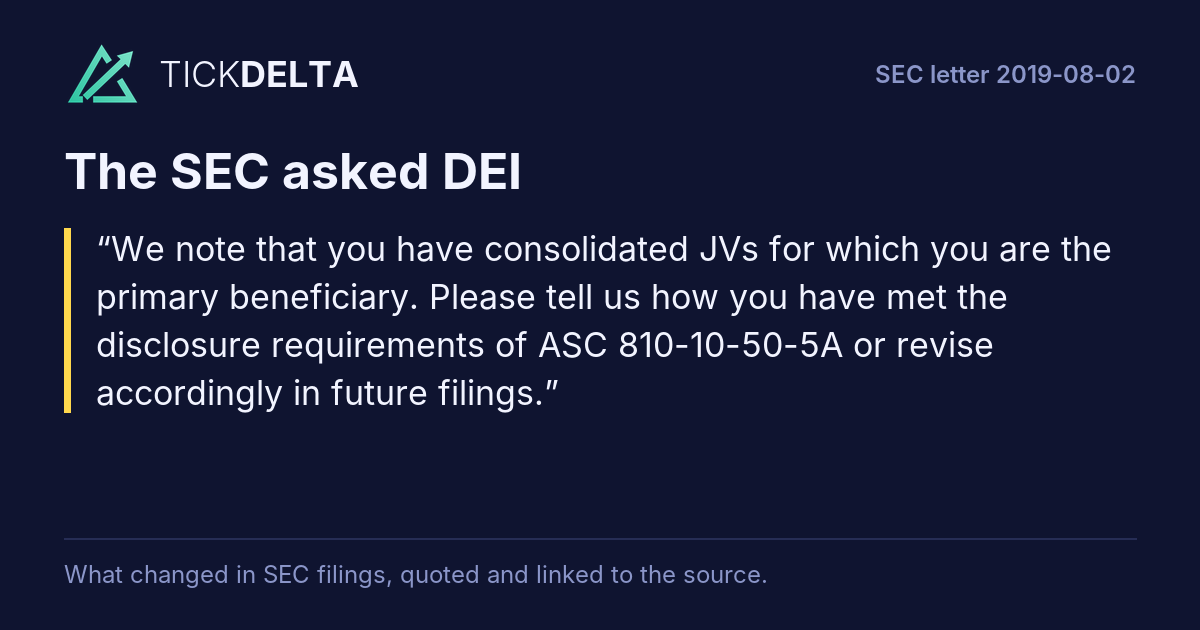
We note that you have consolidated JVs for which you are the primary beneficiary. Please tell us how you have met the disclosure requirements of ASC 810-10-50-5A or revise accordingly in future filings.
DEI answered
In future filings, we will include additional disclosure in accordance with ASC 810-10-50-5A. Using the period ended June 30, 2019 as an example, such disclosure would have been as follows:

Basis of Presentation

The accompanying financial statements are the consolidated financial statements of Douglas Emmett, Inc. and its subsidiaries, including our Operating Partnership and our consolidated JVs.
Rest of the answer

All significant intercompany balances and transactions have been eliminated in our consolidated financial statements.

We consolidate entities in which we are considered to be the primary beneficiary of a variable interest entity (“VIE”) or have a majority of the voting interest of the entity. We are deemed to be the primary beneficiary of a VIE when we have (i) the power to direct the activities of that VIE that most significantly impact its economic performance, and (ii) the obligation to absorb losses or the right to receive benefits that could potentially be significant to the VIE. We do not consolidate entities in which the other parties have substantive kick-out rights to remove our power to direct the activities, most significantly impacting the economic performance, of that VIE. In determining whether we are the primary beneficiary, we consider factors such as ownership interest, management representation, authority to control decisions, and contractual and substantive participating rights of each party.

We consolidate our Operating Partnership through which we conduct substantially all of our business, and own, directly and through subsidiaries, substantially all of our assets, and are obligated to repay substantially all of our liabilities, including $3.20 billion of consolidated debt. See Note 8. We also consolidate three JVs. As of June 30, 2019, these consolidated entities had aggregate total consolidated assets of $8.68 billion (of which $8.09 billion related to investment in real estate), aggregate total consolidated liabilities of $4.63 billion (of which $4.30 billion related to debt), and aggregate total consolidated equity of $4.05 billion (of which $1.56 billion related to noncontrolling interests).

If you should have any additional questions please contact me directly at (310) 255-7749.

Read in the reply
In its next report

First report after the company's reply of Aug 15, 2019: 10-Q filed Nov 8, 2019 ↗, against the 10-Q filed May 6, 2019 ↗.

Tickdelta does not hold the text of both reports, so they are not compared here.

Also in this review: closing letter, 2019-09-26

Form 10-K

2018-06-11 to 2018-07-12 · 2 questions · 1 letter from the SEC, 1 from the company
Review closed 2018-07-12
LeasesLegal and contingencies
Schedule 14A · Director Independence, page 14
SEC asked (1)
We note that the company’s board of directors determined that Mr. O’Hern is an independent director and that he is the Chair of your audit committee. We are unable to locate disclosure responsive to Item 407(a)(3) regarding the lease transaction between Douglas Emmett and Macerich, litigation between Macerich and Douglas Emmett, Mr.
Rest of the question

O’Hern’s position as CFO of Macerich, and whether the board of directors considered these transactions/relationships in determining that Mr. O’Hern is an independent director. In this regard, Item 407(a)(3) requires disclosure of transactions and relationships “for each director . . . that is identified as independent . . . [that were] considered by the board of directors under the applicable independence definitions in determining that the director is independent.” Your disclosure explains that the board considers relationships and transactions, including “employment or tenant relationships” but fails to convey the fact that Mr. O’Hern has known relationships and/or transactions that were considered. In future filings, please specifically tie any Item 407(a)(3) disclosure to specific directors identified as independent. Please also describe the litigation referenced above, to the extent considered by the board in determining independence. Refer to Release No. 33-8732A (Aug. 29, 2006).

DEI answered
In future filings, we will specifically tie any Item 407(a)(3) disclosures to specific directors identified as independent, with consideration given to the guidance provided in Release No. 33-8732A. We will also describe the litigation referenced above, to the extent considered by the board in determining independence.

The Company supplementally advises the staff that the litigation/arbitration with Macerich was part of the process contemplated by the existing lease.
Rest of the answer

When Macerich exercised its option to extend the lease term for an additional five years, the lease provides that the rental rate must be set at market based on the result of a process that included litigation (to determine certain legal issues) followed by arbitration (to determine the market rate). As noted below, Mr. Tom O’Hern was not involved in this process, nor did he receive any direct or indirect personal benefit from, or hold any interest in, the outcome of this process.

Read in the reply
In its next report

First report after the company's reply of Jun 15, 2018: 10-Q filed Aug 3, 2018 ↗, against the 10-Q filed May 9, 2018 ↗.

Tickdelta does not hold the text of both reports, so they are not compared here.

Schedule 14A · Director Independence, page 14
SEC asked (2)
We note from your Form 10-K filed on February 27, 2015 that you entered into a lease with Macerich Partnership, LP that was set to expire in 2018 and that had an annualized rent of $ 4,940,295. We also note that Macerich sued the company on March 10, 2017 in a dispute over a five year lease extension. Given that Mr.
Rest of the question

Thomas O’Hern is a Director at Douglas Emmett and Senior Executive Vice President, Chief Financial Officer, and Treasurer at Macerich Company, please tell us what consideration you gave to disclosing Mr. O’Hern’s indirect interest in the transaction in your most recent Form 10-K or proxy. See Item 13 of Form 10-K and Item 404 of Regulation S-K.

DEI answered
The Company supplementally advises the staff as follows: In evaluating whether Mr. O’Hern had any interest in this transaction that required disclosure under Item 404 of Regulation S-K and Item 13 of Form 10-K, we considered the following facts: (1) the transaction (both the lease and the litigation) was financially immaterial to Macerich; (2) Mr. O’Hern had no direct interest in the transaction, and any indirect interest that Mr. O’Hern had, if any, was clearly de minimis because the transaction itself was immaterial to Macerich and Mr.
Rest of the answer

O’Hern’s stock ownership in Macerich is well below 1%; and (3) the transaction (both the lease and the litigation) was financially immaterial to Douglas Emmett. Based on these factors, Douglas Emmett determined that disclosure was not required in accordance with Item 404 of Regulation S-K or Item 13 of Form 10-K.

In connection with these responses, Douglas Emmett, Inc. acknowledges that:

•

We are responsible for the adequacy and accuracy of the disclosure in the filing;

Staff comments or changes to disclosure in response to staff comments do not foreclose the Commission from taking any action with respect to the filing; and

We may not assert staff comments as a defense in any proceeding initiated by the Commission or any person under the federal securities laws of the United States.

If you should have any additional questions please contact me directly at (310) 255-7763.

Read in the reply
In its next report

First report after the company's reply of Jun 15, 2018: 10-Q filed Aug 3, 2018 ↗, against the 10-Q filed May 9, 2018 ↗.

Tickdelta does not hold the text of both reports, so they are not compared here.

Also in this review: closing letter, 2018-07-12

Form 10-K for the fiscal year ended December 31, 2015

2016-05-18 to 2016-06-24 · 2 questions · 2 letters from the SEC, 2 from the company
Review closed 2016-06-24
Notes to Consolidated Financial Statements
SEC asked
Investments in Real Estate, page 13 1. We note that you have recorded the $240 million of bridge equity as noncontrolling interest. Please clarify for us the nature of the bridge equity and tell us how you determined it should be reflected as noncontrolling interest. Within your response, please reference the authoritative accounting literature management relied upon.
DEI answered
Before closing the acquisition of the Westwood Portfolio (the “Acquisition”) through a consolidated joint venture (the “Joint Venture”), we had publicly announced that we expected to ultimately retain 20% to 30% of the membership interests in the Joint Venture, with our final equity ownership expected to be determined in the second quarter.
Rest of the answer

At the time of the Acquisition, we had reached agreement with a third party to purchase 40% of the membership interests in the Joint Venture; while we were in on-going discussions with other third parties about acquiring an additional 30-40% of the membership interests we held1, no agreement had been reached. As a result, when the Acquisition closed on February 29, 2016, we contributed $480 million to the Joint Venture (out of the total equity of $800 million) in exchange for 60% of its membership interests. During the period we owned 60% of the membership interests, we accounted for the 40% (or $320 million) not owned by us as noncontrolling interest.

During the second quarter, we closed the sale of half of our membership interests (representing 30%) in the Joint Venture to an unaffiliated third party, reducing our ownership to 30%, which is discussed in the subsequent events note in our Form 10-Q. We will account for that sale in accordance with ASC 810-10-45-23.

Following the sale, the $560 million (70%) membership interests in the Joint Venture that are owned by unaffiliated third parties that we do not control will be properly treated as noncontrolling interests under ASC 810-10-45-15 (“the ownership interests in the subsidiary that are held by owners other than the parent is a noncontrolling interest. The noncontrolling interest in a subsidiary is part of the equity of the consolidated group”).

Given that as of the date of our filings on May 6, 2016, we had completed the expected agreement to sell half of the membership interests we initially acquired, we believe it was appropriate to disclose both the impact of the initial Acquisition as well as of that subsequent sale. Accordingly, in our disclosure of the sources and uses of funds for the Acquisition, we presented both the funding as it occurred on closing as well as a pro forma adjustment showing the impact of the sale of half of our membership interests to a third party: the total noncontrolling interests in the Joint Venture increased from the original $320 million to $560 million, reflecting the sale of the $240 million equity interest to the new owner and the borrowings under our credit line decreased by $240 million as a result of the application of the sale proceeds.

In connection with this response, Douglas Emmett, Inc. acknowledges that:

• we are responsible for the adequacy and accuracy of the disclosure in the filing;

staff comments or changes to disclosure in response to staff comments do not foreclose the Commission from taking any action with respect to the filing; and we may not assert staff comments as a defense in any proceeding initiated by the Commission or any person under the federal securities laws of the United States.

If you should have any additional questions please contact me directly at (310) 255-7763.

Read in the reply
Notes to Consolidated Financial Statements
SEC asked
Investments in Real Estate, page 13 1. We note your response to our prior comment 1. It appears that you continue to consolidate the joint venture after you reduced your ownership interest to 30%. Please tell us how you determined it is appropriate to consolidate this joint venture after you reduced your ownership interest to 30%.
Rest of the question

Within your response, please reference the authoritative accounting literature management relied upon.

DEI answered
During the second quarter of 2016, we closed the sale of half of our membership interests (representing 30%) in the above-referenced joint venture (the “Joint Venture”) to an unaffiliated third party, reducing our ownership to 30%, which is discussed in the subsequent events note in our Form 10-Q.

In determining whether to consolidate the Joint Venture, we considered ASC 810 Consolidation, updated by ASU 2015-02, which was adopted by us in Q1 2016.

Douglas Emmett, Inc.
Rest of the answer

(“DEI”) has concluded that in accordance with ASC 810-10-05-03, the Joint Venture is similar to a limited partnership based on governing provisions that are the functional equivalent of a limited partnership. Further, DEI, as the managing member, is the functional equivalent of a general partner. Therefore, we considered the criteria for limited partnerships and similar entities in evaluating consolidation treatment of the Joint Venture.

Because the Joint Venture lacks both substantive participating rights for the limited partners and substantive kick-out rights, and its structure meets the anti-abuse clause, the Joint Venture is a Variable Interest Entity (“VIE”) under the consolidation guidance and should be evaluated for consolidation under the VIE model.

We determined that DEI has a controlling financial interest in the Joint Venture under ASC 810-10-25-38A (and hence is its primary beneficiary) because:

1. Under the Joint Venture’s Operating Agreement, DEI, as the managing member, has the power to direct the activities of the Joint Venture that most significantly impact the Joint Venture’s economic performance (including leasing, budgeting, financing, and operating and maintaining the Joint Venture’s properties); and

2. DEI has the obligation to absorb losses of the Joint Venture that could potentially be significant to the Joint Venture and the right to receive benefits from the Joint Venture that could potentially be significant to the Joint Venture.

Accordingly, we concluded that DEI should consolidate the Joint Venture in accordance with ASC 810 (as updated).

In connection with this response, Douglas Emmett, Inc. acknowledges that:

•

We are responsible for the adequacy and accuracy of the disclosure in the filing;

Staff comments or changes to disclosure in response to staff comments do not foreclose the Commission from taking any action with respect to the filing; and

We may not assert staff comments as a defense in any proceeding initiated by the Commission or any person under the federal securities laws of the United States.

If you should have any additional questions please contact me directly at (310) 255-7763.

Read in the reply

Also in this review: closing letter, 2016-06-24

Form 10-K for the year ended December 31, 2012

2013-05-16 to 2013-06-03 · 1 question · 1 letter from the SEC, 1 from the company
Review closed 2013-06-03
Note 2. Summary of Significant Accounting Policies, page F-9 · Investment in Unconsolidated Real Estate Funds, page F-11
SEC asked
We note your disclosure that you hold a 65.09% equity interest in Douglas Emmett Fund X, LLC as of December 31, 2012. Given the significant ownership interest, please tell us why this Fund is not consolidated in your financial statements. Cite any relevant accounting literature in your response.
DEI answered
In determining whether to consolidate Douglas Emmett Fund X, LLC (the "Fund") as of December 31, 2012, we first determined that the Fund was not a variable interest entity in accordance with ASC 810-10, based on the following:

a)

The Fund has sufficient equity at risk for it to finance its activities without additional subordinated financial support.
Rest of the answer

At December 31, 2012, the Fund had fair value equity of $219 million, and in April 2013 refinanced all of its outstanding senior bank debt for five years without a guarantee.

b)

The Members of the Fund have the power, through their voting rights or similar rights, to direct the Funds activities that most significantly impact its economic performance, including property acquisitions and dispositions, obtaining financing and operating and managing its properties. The Fund's operating agreement provides its members with voting rights, pro-rata based on their ownership interests, substantially equivalent to common stock rights.

(c)

The Members of the Fund have the obligation to absorb any expected losses. Although losses are not expected, any that do occur will be shared by the Members in proportion to their ownership, with no guarantee of a return by the Fund or by other parties involved with the Fund.

(d) The Members of the Fund have the right to receive expected residual returns, as the return of the Members is not capped under the Fund's operating agreement.

(e)

The Funds activities neither involve, nor are they conducted on behalf of, a Member that has disproportionately few voting rights.

As the Fund is not a variable interest entity, consolidation must be evaluated in accordance with ASC 810-20. The presumption of control by the general partner or equivalent (in this case the manager of the Fund, as the governing provisions of the Fund's limited liability company structure is similar to a limited partnership) is overcome because the members of the Fund other than the manager have the substantive ability to remove the manager without cause (“kick-out rights”). In particular, the Fund's Operating Agreement states the manager can be removed, with or without cause, at any time by a vote of members holding 50% or more of the member percentages, excluding from both the numerator and denominator the manager and any affiliates of the manager.

In connection with this response, Douglas Emmett, Inc. acknowledges that:

• we are responsible for the adequacy and accuracy of the disclosure in the filing;

staff comments or changes to disclosure in response to staff comments do not foreclose the Commission from taking any action with respect to the filing; and we may not assert staff comments as a defense in any proceeding initiated by the Commission or any person under the federal securities laws of the United States.

If you should have any additional questions please contact me directly at (310) 255-7714.

Read in the reply
In its next report

First report after the company's reply of May 30, 2013: 10-Q filed Aug 7, 2013 ↗, against the 10-Q filed May 8, 2013 ↗.

Tickdelta does not hold the text of both reports, so they are not compared here.

Also in this review: closing letter, 2013-06-03

Form 10-K for the year ended December 31, 2011

2012-03-22 to 2012-05-14 · 7 questions · 2 letters from the SEC, 2 from the company
Review closed 2012-05-14
AcquisitionsRevenueResults discussion (MD&A)LeasesLiquidity and cashDerivatives and hedging
FORM 10-K FOR THE YEAR ENDED DECEMBER 31, 2011 · Results Of Operations, pages 35 – 38
SEC asked (1)
We note that historically over the last several years, decreases in office rental revenue have been attributed to decreases in occupancy and lower accretion from below-market leases in place at the time of your IPO as these below-market leases expire.
Rest of the question

Please tell us and revise future periodic filings to quantify the occupancy rates, the amount of accretion recognized for below-market leases, and the number of below-market leases that expired for all periods presented.

DEI answered
We are in receipt of your letter dated March 22, 2012 regarding comments to the above referenced filing. For your convenience, each of the comments contained in your letter is reprinted below in italics followed by our response: We note that historically over the last several years, decreases in office rental revenue have been attributed to decreases in occupancy and lower accretion from below-market leases in place at the time of your IPO as these below-market leases expire.
Rest of the letter

Please tell us and revise future periodic filings to quantify the occupancy rates, the amount of accretion recognized for below-market leases, and the number of below-market leases that expired for all periods presented. In past filings each quarter, we have disclosed our occupied rates (both office and multifamily) in our MD&A. The following sets forth data regarding the occupied rates for our consolidated office portfolio for each of the last three years: Occupancy in our multifamily portfolio has not varied materially during these periods. To the extent material, in future periodic filings we will include a similar comparison of any change in the average occupancy rates for the periods being compared. 1 Average occupancy represents the average of the occupancy at the end of the period and the preceding period. The following sets forth our net accretion from acquired lease intangibles for each of the last three years (dollars in millions): To the extent material, in future periodic filings we will include a comparison of any change in the amount of net accretion from acquired lease intangibles for the periods being compared. We do not think that the absolute number of below market leases expiring is meaningful, nor do we currently calculate it. Net accretion from acquired lease intangibles depends only incidentally on the number of leases, as it is substantially driven by the lease size and the amount by which each lease was above or below market rates at the time of acquisition. We note that for FFO purposes you recognize the full impact of the termination fee in the quarter in which the swap is terminated and therefore adjust for the amortization of swap termination fee to arrive at FFO. It is not clear how this adjustment is consistent with the standards established by NAREIT. Please clarify and/or revise future periodic filings to label this measure as “Modified” or “Adjusted” FFO and provide reconciliation between this measure and FFO calculated consistent with the standards established by NAREIT. We believe that recognizing the full swap termination fee in the quarter in which the swap is terminated is consistent with the standards established by NAREIT, although, as we specifically state in our MD&A, we recognize that this was a judgment call. Our industry treats fixed rate loans and swapped floating rate loans as having the same economic effect (indeed, when we refinance a loan, we solicit both types of loan proposals, and then choose which loan to take based on other terms). A swap termination fee is economically equivalent to the yield maintenance charge in the context of the more common fixed rate loan. Because yield maintenance charges are recognized for FFO in the period they are paid, we believe that the swap termination fee is appropriately treated in the same manner. We recognize our responsibility to specifically and clearly disclose this decision when disclosing FFO. Thus, Our MD&A states that “we calculate FFO in accordance with the standards established by the National Association of Real Estate Investment Trusts (NAREIT), although doing so may still involve some judgments (for example, amortization of the impact of swap terminations).” (emphasis added) Our Regulation G reconciliation specifically breaks out swap termination fees in a separate line item, which is footnoted as follows: “We terminated certain interest rate swaps in November 2010 and December 2011 by paying an amount based on the projected payments due under the swap. For FFO purposes, we recognize the full impact of the termination in the quarter in which the swap is terminated. In contrast, under GAAP, we amortize the impact over the remaining life of the swap.” The footnote then goes on to detail the precise amounts of these items. Please clarify your basis in GAAP for not considering acquisition-related expenses in arriving at operating income. We expense transaction costs as incurred in accordance with ASC 805-10-25-23. However, ASC 805 does not specify how to classify such transaction costs within the statement of operations, and we are not aware of any additional guidance on the topic issued by the FASB or the Staff. We believe that, for our business, investors are interested in the results of the operations of our properties without the impact of intermittent periodic acquisition related expenses. Breaking out these expenses in a separate line item before arriving at operating income (i) facilitates such a review; (ii) complies with the requirement of ASC 805; and (iii) provides clear disclosure to enable investors to make their own calculations as they deem appropriate. Based on disclosures on page 14 and elsewhere in your filing, we note you may engage in development and redevelopment activities with respect to certain of your properties. Please disclose your capitalization policy. Your disclosure should address the types of expenses that are potentially capitalized such as interest, taxes, salaries and other general and administrative expenses. In addition, please disclose the periods of capitalization including a discussion of when the capitalization period ends. Lastly, on your consolidated statements of cash flows, please revise future periodic filings to separately present amounts related to capital expenditures and property acquisitions. We have not engaged in any significant development and redevelopment activities and have not capitalized any interest or real estate taxes since our IPO. However, in our future Reports on Form 10K, we will include a statement of our capitalization policy relating to development and redevelopment activities. Our current policy is as follows: “We capitalize construction and improvement costs, including allocable salaries and related benefits, incurred in connection with development and redevelopment activities to the extent the total carrying amount of investment in real estate does not exceed the estimated fair value at completion. We also capitalize any real estate taxes and interest costs incurred during construction periods.” In our future periodic filings, we will also separately present amounts related to capital expenditures and property acquisitions on our consolidated statements of cash flows. You determined that your derivative valuations in their entirety are classified in Level 2. We also note that you incorporate credit value adjustments to appropriately reflect both your own nonperformance risk and the respective counterparty’s nonperformance risk. Please clarify how you considered whether these credit value adjustments utilize Level 3 unobservable inputs and the significance of these credit value adjustments to the overall fair value measurements of your derivatives. Your response should discuss the factors considered that support your conclusion. As noted by the Staff, we incorporate credit value adjustments to reflect both our own nonperformance risk and the respective counterparty’s nonperformance risk. While those credit value adjustments could utilize Level 3 unobservable inputs, in all recent periods we have used Level 2 inputs: the adjustments for our own nonperformance risk were based on the actual credit spreads in our substantially contemporaneous loan transactions and the adjustments for our counterparties (all financial institutions) were based on their Moody’s ratings. In any case, ASC 820 clarifies that the hierarchy classification of a fair value measurement should be based on the lowest level input that is significant to the fair value measurement. Credit value adjustments have not been significant in determining these values for recent years (dollars in millions): Thus, even if the entire credit value adjustment had been based on Level 3 inputs, we believe that our derivative valuations in their entirety would be properly classified in Level 2. In connection with the aforementioned responses, Douglas Emmett, Inc. acknowledges that: we are responsible for the adequacy and accuracy of the disclosure in the filing; staff comments or changes to disclosure in response to staff comments do not foreclose the Commission from taking any action with respect to the filing; and we may not assert staff comments as a defense in any proceeding initiated by the Commission or any person under the federal securities laws of the United States. If you should have any additional questions please contact me directly at (310) 255-7714.

One letter for all the questions, without numbered answers. Read the reply
In its next report

First report after the company's reply of Apr 19, 2012: 10-Q filed May 8, 2012 ↗, against the 10-Q filed Nov 4, 2011 ↗.

Tickdelta does not hold the text of both reports, so they are not compared here.

Funds From Operations, page 35
SEC asked (2)
We note that for FFO purposes you recognize the full impact of the termination fee in the quarter in which the swap is terminated and therefore adjust for the amortization of swap termination fee to arrive at FFO. It is not clear how this adjustment is consistent with the standards established by NAREIT.
Rest of the question

Please clarify and/or revise future periodic filings to label this measure as “Modified” or “Adjusted” FFO and provide reconciliation between this measure and FFO calculated consistent with the standards established by NAREIT.

DEI answered

See the reply above.

In its next report

First report after the company's reply of Apr 19, 2012: 10-Q filed May 8, 2012 ↗, against the 10-Q filed Nov 4, 2011 ↗.

Tickdelta does not hold the text of both reports, so they are not compared here.

Consolidated Statements of Operations, page F-5
SEC asked (3)
Please clarify your basis in GAAP for not considering acquisition-related expenses in arriving at operating income.
DEI answered

See the reply above.

In its next report

First report after the company's reply of Apr 19, 2012: 10-Q filed May 8, 2012 ↗, against the 10-Q filed Nov 4, 2011 ↗.

Tickdelta does not hold the text of both reports, so they are not compared here.

Note 2 – Summary of Significant Accounting Policies · Investments In Real Estate, page F-9
SEC asked (4)
Based on disclosures on page 14 and elsewhere in your filing, we note you may engage in development and redevelopment activities with respect to certain of your properties. Please disclose your capitalization policy. Your disclosure should address the types of expenses that are potentially capitalized such as interest, taxes, salaries and other general and administrative expenses.
Rest of the question

In addition, please disclose the periods of capitalization including a discussion of when the capitalization period ends. Lastly, on your consolidated statements of cash flows, please revise future periodic filings to separately present amounts related to capital expenditures and property acquisitions.

DEI answered

See the reply above.

In its next report

First report after the company's reply of Apr 19, 2012: 10-Q filed May 8, 2012 ↗, against the 10-Q filed Nov 4, 2011 ↗.

Tickdelta does not hold the text of both reports, so they are not compared here.

Note 10 – Interest Rate Contracts, pages F-18 – F-20
SEC asked (5)
You determined that your derivative valuations in their entirety are classified in Level 2. We also note that you incorporate credit value adjustments to appropriately reflect both your own nonperformance risk and the respective counterparty’s nonperformance risk.
Rest of the question

Please clarify how you considered whether these credit value adjustments utilize Level 3 unobservable inputs and the significance of these credit value adjustments to the overall fair value measurements of your derivatives. Your response should discuss the factors considered that support your conclusion.

DEI answered

See the reply above.

In its next report

First report after the company's reply of Apr 19, 2012: 10-Q filed May 8, 2012 ↗, against the 10-Q filed Nov 4, 2011 ↗.

Tickdelta does not hold the text of both reports, so they are not compared here.

FORM 10-K FOR THE YEAR ENDED DECEMBER 31, 2011 · Funds From Operations, page 35
SEC asked (1)
We have considered your response to comment two and are unable to agree with treatment of the swap termination fees for FFO purposes. In future periodic filings, if you wish to continue adjusting for amortization of the impact of swap terminations, please label this measure as “Modified” or “Adjusted” FFO and provide reconciliation between this measure and FFO calculated consistent with the standards established by
Rest of the question

NAREIT.

DEI answered
We are in receipt of your letter dated April 25, 2012 regarding comments to the above referenced filing. For your convenience, each of the comments contained in your letter is reprinted below in italics followed by our response: We have considered your response to comment two and are unable to agree with treatment of the swap termination fees for FFO purposes. In future periodic filings, if you wish to continue adjusting for amortization of the impact of swap terminations, please label this measure as “Modified” or “Adjusted” FFO and provide reconciliation between this measure and FFO calculated consistent with the standards established by NAREIT.
Rest of the letter

In future periodic filings where we include an adjustment for the impact of terminated swaps in calculating FFO, we will add a parenthetic label of this measure as “modified” or “adjusted” (for example, “FFO (adjusted for terminated swaps)”). In addition, our reconciliation of this measure to GAAP net income will first reconcile GAAP net income to FFO (without any adjustment for terminated swaps) and then to this measure. We have considered your response to comment four which includes your capitalization policy. Please expand your policy to also disclose the periods of capitalization including a discussion of when the capitalization period ends. Reference is made to paragraphs 835-20-25-2 and 3 and 970-340-25-8 of the Financial Accounting Standards Codification. We will expand the statement of our capitalization policy to include the following: “Cost capitalization of development and redevelopment activities begins during the predevelopment period, which we define as activities that are necessary to the development of the property. We cease capitalization upon substantial completion of the project, but no later than one year from cessation of major construction activity. We also cease capitalization when activities necessary to prepare the property for its intended use have been suspended." In connection with the aforementioned responses, Douglas Emmett, Inc. acknowledges that: · we are responsible for the adequacy and accuracy of the disclosure in the filing; staff comments or changes to disclosure in response to staff comments do not foreclose the Commission from taking any action with respect to the filing; and we may not assert staff comments as a defense in any proceeding initiated by the Commission or any person under the federal securities laws of the United States. If you should have any additional questions please contact me directly at (310) 255-7714.

One letter for all the questions, without numbered answers. Read the reply
In its next report

First report after the company's reply of May 8, 2012: 10-Q filed Aug 7, 2012 ↗, against the 10-Q filed Nov 4, 2011 ↗.

Tickdelta does not hold the text of both reports, so they are not compared here.

Note 2 – Summary of Significant Accounting Policies · Investments In Real Estate, page F-9
SEC asked (2)
We have considered your response to comment four which includes your capitalization policy. Please expand your policy to also disclose the periods of capitalization including a discussion of when the capitalization period ends. Reference is made to paragraphs 835-20-25-2 and 3 and 970-340-25-8 of the Financial Accounting Standards Codification.
DEI answered

See the reply above.

In its next report

First report after the company's reply of May 8, 2012: 10-Q filed Aug 7, 2012 ↗, against the 10-Q filed Nov 4, 2011 ↗.

Tickdelta does not hold the text of both reports, so they are not compared here.

Also in this review: closing letter, 2012-05-14

Form 10-K

2011-06-06 to 2011-08-24 · 14 questions · 2 letters from the SEC, 2 from the company
Review closed 2011-08-24
LeasesResults discussion (MD&A)AcquisitionsDebtKey metricsLiquidity and cashIncome taxes
Form 10-K for the year ended December 31, 2010 · General
SEC asked (1)
Please tell us whether management considers funds from operations, net operating income and same store net operating income as key performance indicators. We may have further comments.
DEI answered
We are in receipt of your fax transmittal dated July 15, 2011 regarding comments to the above referenced filing. We appreciate your assistance in enhancing both compliance and disclosure requirements with respect to our filing. For your convenience, the comment contained in your July 15th letter is reprinted below in italics followed by our response: We note your response to comment 1 of our comment letter dated June 6, 2011.
Rest of the letter

Please provide a more detailed analysis explaining why your management generally does not use FFO, net operating income or same store net operating income as key performance measures and describe what your management uses as key performance measures to manage your business. We manage our business by developing a detailed budget for each of the consolidated and unconsolidated properties we operate, before the beginning of each year. The group(s) responsible for each of the controllable portions of that budget are then responsible for managing to that portion of the budget. We also monitor percentage leased and percentage occupied, since in the short term those are the primary drivers of our revenues, as well as the movement of rental rates. Other aspects of our business, such as the results from our funds and various aspects of our G&A, are each managed against its own budget, while our interest expense and certain other items are largely determined by the agreements we negotiate from time to time and external events. For us, “FFO,” “net operating income” and “same store NOI” are of limited utility in making management decisions since they (i) do not fully reflect the results of any of our unconsolidated buildings, (ii) combine the results of our office and multifamily properties, and (iii) combine the results of all our properties and all categories of revenue and expense, so that individual results and responsibility are disguised. Thus, a report that our average NOI is up or down does not provide any real understanding on whether and how to make changes at one or more properties. In addition to these general principles, “same store NOI” is not very useful in our management process, as its purpose is to facilitate year over year comparisons, which we do not generally use, and FFO is not particularly useful as it has been substantially affected by interest expense and other factors largely beyond our control to manage on a quarterly or even annual basis. We do recognize that many investors consider these metrics, and accordingly we look at them for discussions investor relations purposes and include them in our Supplemental (along with the definitions we use in calculating them). In connection with the aforementioned responses, Douglas Emmett, Inc. acknowledges that: · we are responsible for the adequacy and accuracy of the disclosure in the filing; staff comments or changes to disclosure in response to staff comments do not foreclose the Commission from taking any action with respect to the filing; and we may not assert staff comments as a defense in any proceeding initiated by the Commission or any person under the federal securities laws of the United States. If you should have any additional questions please contact me directly at (310) 255-7714.

One letter for all the questions, without numbered answers. Read the reply
Form 10-K for the year ended December 31, 2010 · General
SEC asked (2)
In future periodic filings, please discuss embedded rent growth in your portfolio related to rent escalators in your leases. To the extent practicable, please quantify the percentage of leases that have escalators and provide a range of escalation.
DEI answered

See the reply above.

Form 10-K for the year ended December 31, 2010 · General
SEC asked (3)
In future periodic filings, to the extent applicable, please disclose the amount of securities sold, the average price and/or gross proceeds, net proceeds or expenses/commissions, use of proceeds and amount remaining in your ATM program.
DEI answered

See the reply above.

Form 10-K for the year ended December 31, 2010 · General
SEC asked (4)
In future periodic filings, please include capitalization rates for material acquisitions and/or dispositions of properties. Also include a clear description of how you calculate capitalization rates, including how you calculate NOI for these purposes.
DEI answered

See the reply above.

Form 10-K for the year ended December 31, 2010 · General
SEC asked (5)
On page 11, you state that as of December 31, 2010, leases representing approximately 11.6% of the square footage of the properties in your total office portfolio will expire in 2011, and an additional 11.4% of the square footage of properties in your total office portfolio was available for lease.
Rest of the question

In future periodic filings, please expand your disclosure in the applicable section to discuss the relationship between market/current asking rents and leases expected to expire in the next period, as well as the relationship between rents on leases that expired in the current reporting period and rents on executed renewals or new leases. Please also tell us how management assesses the portfolio for turnover, and how currently available office space is factored into such assessment.

DEI answered

See the reply above.

Item 2. Properties, page 19
SEC asked (6)
In future periodic filings, please disclose the average effective annual rental per square foot on a portfolio basis for the last five years. In this regard, please provide quantitative disclosure on the impact of concessions and tenant expense reimbursements, as applicable.
DEI answered

See the reply above.

In its next report

First report after the company's reply of Jul 29, 2011: 10-Q filed Aug 8, 2011 ↗, against the 10-Q filed May 6, 2011 ↗.

Tickdelta does not hold the text of both reports, so they are not compared here.

Office Portfolio, page 19
SEC asked (7)
For the disclosure of information pertaining to your total office portfolio, please provide to us separate disclosure for wholly-owned and/or consolidated properties and those office properties operated and indirectly owned through your equity interests held in unconsolidated Funds.
DEI answered

See the reply above.

In its next report

First report after the company's reply of Jul 29, 2011: 10-Q filed Aug 8, 2011 ↗, against the 10-Q filed May 6, 2011 ↗.

Tickdelta does not hold the text of both reports, so they are not compared here.

Item 7. Management’s Discussion and Analysis of Financial Condition and Results of · Operations, page 32
SEC asked (8)
In future periodic filings, please provide disclosure regarding rental rate trends on new and renewed leases.
DEI answered

See the reply above.

In its next report

First report after the company's reply of Jul 29, 2011: 10-Q filed Aug 8, 2011 ↗, against the 10-Q filed May 6, 2011 ↗.

Tickdelta does not hold the text of both reports, so they are not compared here.

Liquidity and Capital Resources, page 35
SEC asked (9)
We note that $2.30 billion in term loans mature on August 31, 2012 and that you are seeking to refinance your loans that have 2012 maturities during the first half of 2011. To the extent applicable if you are unable to refinance these loans, provide in future filings a detailed analysis of anticipated sources of cash verses uses of cash for the next year.
Rest of the question

In addition, please supplement your discussion in future filings of your liquidity requirements with a discussion of anticipated cash uses, including anticipated development and redevelopment costs, acquisition costs, debt principal and interest payments and equity dividend commitments.

DEI answered

See the reply above.

In its next report

First report after the company's reply of Jul 29, 2011: 10-Q filed Aug 8, 2011 ↗, against the 10-Q filed May 6, 2011 ↗.

Tickdelta does not hold the text of both reports, so they are not compared here.

Commitments, page 36
SEC asked (10)
We note that you have a significant amount of outstanding debt obligations as of December 31, 2010. In future periodic reports, please include disclosure of your cash requirements for interest on your debt obligations or tell us why such disclosure is not necessary. Refer to footnote 46 of SEC Interpretive Release 33-8350. Item 15.
Rest of the question

Exhibits and Financial Statement Schedules (a) Financial Statements Notes to Consolidated Financial Statements, page F-8 2. Summary of Significant Accounting Policies, page F-8

DEI answered

See the reply above.

In its next report

First report after the company's reply of Jul 29, 2011: 10-Q filed Aug 8, 2011 ↗, against the 10-Q filed May 6, 2011 ↗.

Tickdelta does not hold the text of both reports, so they are not compared here.

Investments in Real Estate, page F-9
SEC asked (11)
Please tell us how you considered any fixed rate renewal options into the calculation of the fair value of the below-market lease intangibles and the period over which your below market lease intangibles are amortized.
DEI answered

See the reply above.

In its next report

First report after the company's reply of Jul 29, 2011: 10-Q filed Aug 8, 2011 ↗, against the 10-Q filed May 6, 2011 ↗.

Tickdelta does not hold the text of both reports, so they are not compared here.

Investments in Real Estate, page F-9
SEC asked (12)
Please provide to us your analysis used to determine that you were not required to provide summarized financial information for your investment in Douglas Emmett Partnership X, LP pursuant to Rule 4-08(g) of Regulation S-X.
DEI answered

See the reply above.

In its next report

First report after the company's reply of Jul 29, 2011: 10-Q filed Aug 8, 2011 ↗, against the 10-Q filed May 6, 2011 ↗.

Tickdelta does not hold the text of both reports, so they are not compared here.

Schedule III – Consolidated Real Estate and Accumulated Depreciation, page F-31
SEC asked (13)
In future periodic reports, please provide the aggregate cost for Federal income tax purposes. Refer to endnote 6 contained within Rule 12-28 of Regulation S-X.
DEI answered

See the reply above.

In its next report

First report after the company's reply of Jul 29, 2011: 10-Q filed Aug 8, 2011 ↗, against the 10-Q filed May 6, 2011 ↗.

Tickdelta does not hold the text of both reports, so they are not compared here.

SEC letter of Jul 15, 2011 ↗ no reply letter on EDGAR
Form 10-K for the fiscal year ended December 31, 2010 · General
SEC asked
We note your response to comment 1 of our comment letter dated June 6, 2011. Please provide a more detailed analysis explaining why your management generally does not use FFO, net operating income or same store net operating income as key performance measures and describe what your management uses as key performance measures to manage your business.
DEI answered

No reply letter found.

Also in this review: company letter, Jul 1, 2011, closing letter, 2011-08-24

Form 10-K for the year ended December 31, 2007

2008-07-30 to 2008-08-22 · 3 questions · 1 letter from the SEC, 1 from the company
Review closed 2008-08-22
Risk factors
Form 10-K filed February 22, 2008
SEC asked (1)
You state on page 8 that the following section includes “some” of the material risk factors. Please advise us whether the most significant risk factors have been included in this filing, and, in future filings, please revise to state that you have included the most significant risk factors.
DEI answered
We are in receipt of your fax transmittal dated July 30, 2008 regarding comments to the above referenced filings. We appreciate your assistance in enhancing both compliance and disclosure requirements with respect to our filings. For the convenience of reference, each of the following comments contained in the July 30 letter is reprinted below in italics followed by our responses to your comments: You state on page 8 that the following section includes “some” of the material risk factors. Please advise us whether the most significant risk factors have been included in this filing, and, in future filings, please revise to state that you have included the most significant risk factors.
Rest of the letter

This letter shall confirm that the most significant risk factors were included in our Form 10-K for the year ended December 31, 2007, filed February 22, 2008. In future filings, we will state that we have included the most significant risk factors. We note Exhibits 10.11, 10.12, and 10.13. To the extent each of these agreements has been executed or has become effective, please file the final agreement in future filings as an exhibit in accordance with Item 601(a)(4) of Regulation S-K or tell us why you believe this section is not applicable. We have filed the final agreements as Exhibits 10.11, 10.12, and 10.13 to our Form 10-Q filed August 7, 2008. There were no substantive changes from the original filings. 10-Q filed May 8, 2008 note that paragraph 4 of the certifications included as Exhibits 31.1 and 31.2 to the Form 10-Q filed on May 8, 2008 does not appear to be in accordance with Item 601 (b)(31) of Regulation S-K. Please file an amendment to the Form 10-Q filed May 8, 2008 that includes the cover page, explanatory note, signature page and paragraphs 1, 2, 4 and 5 of the certifications. Concurrent with the filing of this correspondence, we have filed an amended Form 10-Q related to the 10-Q filed on May 8, 2008 to include the required language in paragraph 4 of the certifications filed as Exhibits 31.1 and 31.2. In connection with the aforementioned responses, Douglas Emmett, Inc. acknowledges that: · we are responsible for the adequacy and accuracy of the disclosure in the filing; staff comments or changes to disclosure in response to staff comments do not foreclose the Commission from taking any action with respect to the filing; and may not assert staff comments as a defense in any proceeding initiated by the Commission or any person under the federal securities laws of the If you should have any additional questions please contact me directly at (310)

One letter for all the questions, without numbered answers. Read the reply
Form 10-K filed February 22, 2008
SEC asked (2)
We note Exhibits 10.11, 10.12, and 10.13. To the extent each of these agreements has been executed or has become effective, please file the final agreement in future filings as an exhibit in accordance with Item 601(a)(4) of Regulation S-K or tell us why you believe this section is not applicable.
DEI answered

See the reply above.

Form 10-Q filed May 8, 2008
SEC asked (3)
We note that paragraph 4 of the certifications included as Exhibits 31.1 and 31.2 to the Form 10-Q filed on May 8, 2008 does not appear to be in accordance with Item 601(b)(31) of Regulation S-K. Please file an amendment to the Form 10-Q filed May 8, 2008 that includes the cover page, explanatory note, signature page and paragraphs 1, 2, 4 and 5 of the certifications.
Rest of the question

********** As appropriate, please amend your filing and respond to these comments within 10 business days or tell us when you will provide us with a response. You may wish to provide us with marked copies of the amendment to expedite our review. Please furnish a cover letter with your amendment that keys your responses to our comments and provides any requested information. Detailed cover letters greatly facilitate our review. Please understand that we may have additional comments after reviewing your amendment and responses to our comments.

DEI answered

See the reply above.

Also in this review: closing letter, 2008-08-22

From the SEC's correspondence on EDGAR: staff letters (form UPLOAD) and company letters (form CORRESP), 33 letters filed since 2008-07-30. Questions and answers are matched by their numbers; topics come from words in each question. The reports are compared word for word (same form, before the first SEC letter against the first report after the company's reply). No AI.

Sources

The SEC's correspondence on EDGAR: staff letters (form UPLOAD) and company letters (form CORRESP), matched question by question. No AI.

Also

Filings: the letters in the filing list.

Work with it

Excel workbook · CSV. Google Sheet that stays up to date: paste =IMPORTDATA("https://tickdelta.com/company/DEI/export.csv") into a cell.

Next in Owners and insiders:Insider trades
Esc

Type a ticker such as AAPL, a name, an investor such as Buffett, or a topic such as tariffs. ↑ ↓ to move, Enter to open.