Risk factorsRevenueIncome taxesResults discussion (MD&A)Non-GAAP measuresLiquidity and cashSegmentsDebtCritical estimatesInventoryExecutive payGoodwill and impairmentAcquisitions
Denali Holding Inc.’s Registration Statement on Form S-4 · General
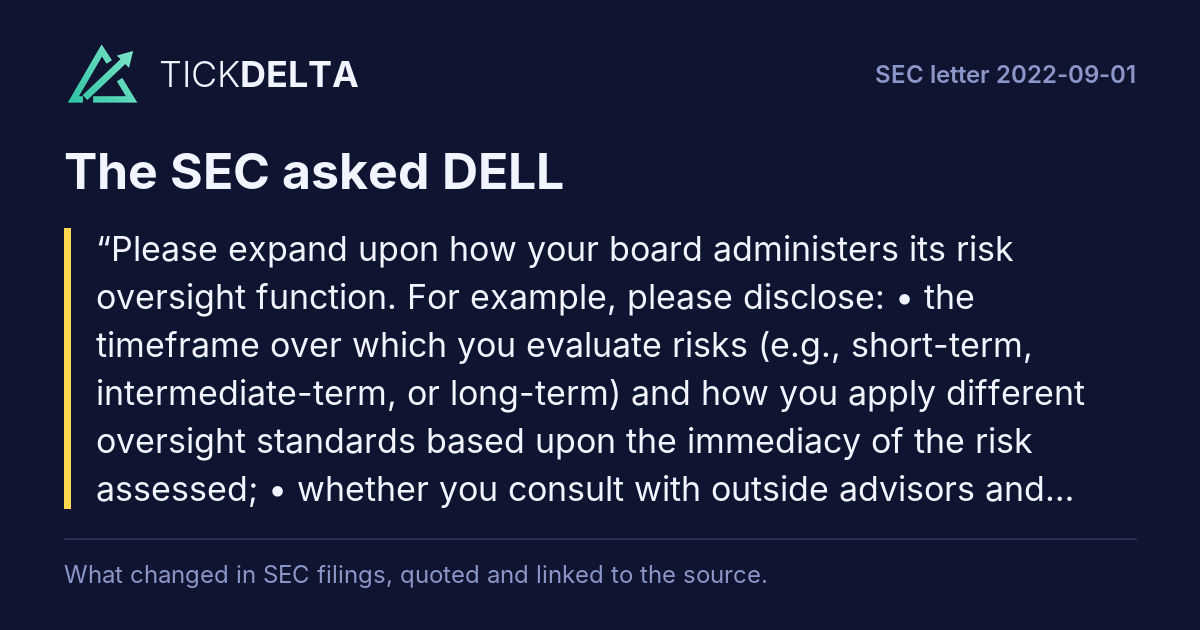
SEC asked (1)
In light of the complexity of the transaction, please present a plain English description of the material terms of the merger transaction most critical to EMC shareholders as a preface to the detailed Questions and Answers section.Rest of the question
At a minimum, you should discuss the following: the uncertainty of the total merger consideration, including the lack of a direct correlation between the market value of the Class V Common Stock and VMware’s Class A common stock; the uncertainty that the Class V Common Stock will track the performance of Denali’s economic interest in the VMware business; the possibility that Class V Common Stock may track assets and liabilities and/or businesses other than Denali’s economic interest in the VMware business; the possibility that the economic interests in the Class V Group may change upon reallocation of assets or liabilities; the material differences in the rights of an EMC shareholder and a Denali Class V stockholder (e.g., Denali is a controlled company); and the material differences between the rights of Denali Class V Common Stock and Class C Common Stock if Class V Common Stock is converted.
DELL answered
In response to the staff’s comment, the Company has revised the disclosure beginning on page 1 of the amended registration statement.
Read in the reply ↗
Denali Holding Inc.’s Registration Statement on Form S-4 · General
SEC asked (2)
Throughout the registration statement, you refer to “Groups” and “segments” and it is unclear how these two terms relate to each other and how an EMC shareholder should interpret them. Please describe for us how you will structure Denali’s business following the merger and how you will clearly distinguish between (a) the Class V Group and the DHI Group and (b) the company’s GAAP segments.Rest of the question
Include a diagram that identifies the assets and liabilities and/or businesses initially allocated to the DHI Group and the Class V Group. If the assets and liabilities and/or businesses do not align, initially or in the future, with the GAAP segments, then describe the information you will provide to enable Class V stockholders and other market participants to evaluate the performance of the Class V Group.
DELL answered
In response to the staff’s comment, the Company has revised the disclosure to include a diagram identifying the assets and businesses initially allocated to the DHI Group and the Class V Group on page 2 of the amended registration statement. Following the merger, the Company will own both Dell and EMC, and EMC will continue to own various businesses described in the registration statement and approximately 343 million shares of common stock of VMware. The Class V Group will initially be allocated only such 343 million shares of VMware common stock.Rest of the answer
The DHI Group will be allocated all of the assets and liabilities of Dell and EMC other than such shares, and a “retained interest” in the Class V Group representing approximately 35% of the Class V Group.
The Company advises the staff that the Company has not yet determined how it will report its operating segments, but to enable Class V stockholders and other market participants to evaluate the performance of the Class V Group, it intends to provide in its quarterly and annual reports unaudited financial information that will show the attribution of Denali’s assets, liabilities, revenue and expenses to the Class V Group in accordance with its tracking stock policy, and has revised the disclosure on page 322 of the registration statement accordingly.
Denali Holding Inc.’s Registration Statement on Form S-4 · General
SEC asked (3)
You present information about the Denali Tracking Stock Policy and the actions the Denali board and the Capital Stock Committee may take, such as allocating assets and liabilities to the DHI Group and the Class V Group. Please clarify how such actions may or may not affect a Class V stockholder’s interest in Denali.
DELL answered
In response to the staff’s comment, the Company has revised the disclosure on page 19 of the amended registration statement. Conforming changes have also been made on other pages where such disclosure is repeated.
Read in the reply ↗
Fee Table
SEC asked (4)
You seek to register an indeterminate number of Class C Common Stock that is issuable upon the conversion of Class V Common Stock. Please revise to include a good faith estimate of the maximum number of Class C Common Stock that may be issued upon conversion. Refer generally to Question 213.01 of Securities Act Rules Compliance and Disclosure Interpretations, available on our website, at www.sec.gov.
DELL answered
In response to the staff’s comment, the Company has revised the fee table of the amended registration statement to delete the Class C Common Stock from the fee table, as it expects that upon any conversion of the Class V Common Stock into shares of Class C Common Stock in accordance with the terms of the Class V Common Stock, it would be able to rely on an available exemption from registration, such as Securities Act Section 3(a)(9).
Read in the reply ↗
Letter to EMC Shareholders
SEC asked (5)
Please clarify that, although you intend for the Class V Common Stock to track the performance of Denali’s economic interest in the VMware business, there are no specific terms or features of the Class V Common Stock that ensure it will.
DELL answered
In response to the staff’s comment, the Company has revised the disclosure in the Letter to EMC Shareholders and on page 6 of the amended registration statement. Conforming changes have also been made on other pages where such disclosure is repeated.
Read in the reply ↗
Questions and Answers Regarding Denali’s Proposed Tracking Stock Structure · Q: How are Denali’s interests aligned with the interests of the holders of Class V Common Stock?, page 11
SEC asked (6)
You disclose on pages 11 and 12 that Denali will be the largest stockholder of VMware and that the MD stockholders and the MSD Partners stockholders will be able to control actions to be taken by Denali, including the election of the directors of VMware. Please disclose the ownership percentage and voting power in VMware that Denali is expected to hold after the merger.Rest of the question
Q: Can Denali allocate assets and liabilities to the Class V Common Stock that would not initially be part of the Class V Group?, page 14
DELL answered
In response to the staff’s comment, the Company has revised the disclosure on page 17 of the amended registration
Q: Can Denali allocate assets and liabilities to the Class V Common Stock that would not initially be part of the Class V Group?, page 14
Read in the reply ↗
Questions and Answers Regarding Denali’s Proposed Tracking Stock Structure · Q: How are Denali’s interests aligned with the interests of the holders of Class V Common Stock?, page 11
SEC asked (7)
Please revise the question to clarify that any allocation of assets or liabilities is to the Class V Group and not to the Class V Common Stock. Also discuss how a change in assets and liabilities and/or businesses being tracked by the Class V Group may impact an investor’s economic interest in the Class V Group. Q: How common is tracking stock? Do other tracking stocks exist?Rest of the question
When was the last time a tracking stock was issued?, page 15
DELL answered
In response to the staff’s comment, the Company has revised the disclosure on page 19 of the amended registration statement. Conforming changes have also been made on other pages where such disclosure is repeated.
Q: How common is tracking stock? Do other tracking stocks exist? When was the last time a tracking stock was issued?, page 15
Read in the reply ↗
Questions and Answers Regarding Denali’s Proposed Tracking Stock Structure · Q: How are Denali’s interests aligned with the interests of the holders of Class V Common Stock?, page 11
SEC asked (8)
You state that tracking stock is not as common as certain other financing structures. Please clearly state that tracking stocks are used infrequently. Also, given that Class V Common Stock is intended to “track” the performance of Denali’s economic interest in a publicly-traded company, please consider the relevance of the examples provided.
DELL answered
In response to the staff’s comment, the Company has revised the disclosure on page 20 of the amended registration statement. Although the Class V Common Stock is intended to track the performance of the Company’s economic interest in a publicly-traded company and while the precedents cited were intended to track the performance of wholly owned divisions or subsidiaries of the applicable issuers, the Company submits that the precedents cited are nonetheless relevant as examples of prior issuances of common stock with terms and provisions that are similar to those of Class V Common Stock.
Read in the reply ↗
Summary, page 16
SEC asked (9)
You disclose on page 44 that upon listing the shares of Class V Common Stock, Denali will be a “controlled company” within the meaning of the NYSE rules. Please explain here the significance of the controlled company exemptions to shareholders.
DELL answered
In response to the staff’s comment, the Company has revised the disclosure on page 21 of the amended registration statement. Conforming changes have also been made on other pages where such disclosure is repeated.
Read in the reply ↗
Interests of Certain EMC Directors and Officers, page 21
SEC asked (10)
Please quantify the aggregate compensation that each EMC director and executive officer will receive as a result of the merger as described in more detail starting on page 211.
DELL answered
In response to the staff’s comment, the Company has revised the disclosure on page 27 of the amended registration statement.
Read in the reply ↗
Redemption for Securities of Class V Group Subsidiary, page 31
SEC asked (11)
Your discussion of the redemption provisions is unclear. For example, you introduce the concept of a Class V Group Subsidiary without sufficient context. Please clarify, if true, that a Class V Group Subsidiary will only be established or designated for redemption purposes, or advise. Revise your disclosures here and on page 281 so that an investor can readily understand these provisions.
DELL answered
In response to the staff’s comment, the Company has revised the disclosure on pages 37 and 302 of the amended
Read in the reply ↗
Risk Factors · Risk Factors Relating to the Merger, page 35
SEC asked (12)
Please add a risk factor addressing the impact of the recent decline in the VMware Class A common stock trading price on the implied value of the merger consideration and the value of the cash payment to be paid in lieu of fractional shares of Class V Common Stock.
DELL answered
In response to the staff’s comment, the
Company has revised the disclosure on page 47 of the amended registration statement.
Read in the reply ↗
“The merger agreement subjects EMC to restrictions on its business activities,” page 37
SEC asked (13)
Please identify the material restrictions on EMC’s business activities.
DELL answered
In response to the staff’s comment, the Company has revised the disclosure on pages 44 and 45 of the amended registration
Read in the reply ↗
“Because there is no established trading market…,” page 39
SEC asked (14)
Please remove any implication that the market price of VMware’s Class A common stock would correlate to or be used as a benchmark for the market price of Class V Common Stock. Considering the different characteristics and rights of the two securities, as well as the fact that Class V Common Stock is only intended to track 65% of Denali’s economic interest in the VMware business, it appears such implication isRest of the question
inappropriate.
DELL answered
In response to the staff’s comment, the Company has revised the disclosure on page 46 of the amended registration statement. Conforming changes have also been made on other pages where the same or similar disclosure is included.
Read in the reply ↗
“There is a lack of certainty regarding the U.S. federal income tax treatment…,” page 41
SEC asked (15)
Please tell us what consideration you have given to quantifying the potential tax liability if EMC were required to recognize a gain for U.S. federal income tax purposes.
DELL answered
The Company advises the staff that the merger is anticipated to be a non-taxable transaction to EMC and, as a result, the
Company has not undertaken a detailed analysis of the potential tax liability if EMC were required to recognize a gain for U.S. federal income tax purposes.
Read in the reply ↗
Risk Factors Relating to the Combined Company · “After the closing of the merger…,” page 42
SEC asked (16)
We note that this risk factor discusses multiple risks, including the voting control of the MD stockholders and the MSD Partners stockholders, differential voting power among directors, varying interests among the different classes of stockholders and potential conflicts of interests. Please revise this risk factor to ensure that each material risk is addressed in a separate risk factor.
DELL answered
In response to the staff’s comment, the Company has revised the disclosure on pages 50 through 52 of the amended
Read in the reply ↗
“Upon the listing of the shares of Class V Common Stock on the NYSE…,” page 44
SEC asked (17)
Please disclose the total voting power to be held by the MD stockholders, the MSD Partners stockholders and the SLP stockholders after closing of the merger. Also state that EMC is not a controlled company, and therefore, if EMC shareholders become holders of Class V Common Stock, they would no longer be afforded the same corporate governance protections.
DELL answered
In response to the staff’s comment, the Company has revised the disclosure on pages 52 and 142 of the amended
Read in the reply ↗
“Denali may not be able to achieve its objective of reducing its indebtedness…,” page 45
SEC asked (18)
You disclose that you expect to reduce indebtedness using cash from the disposition of non-core businesses of the DHI Group, including EMC. Please describe what you consider to be a non-core business to provide shareholders with insight into the businesses that will remain with the combined entity.Rest of the question
Please also tell us whether any dispositions of non-core businesses have occurred or are probable, and if so, tell us what consideration you have given to presenting pro forma financial information relating to such dispositions.
DELL answered
The Company advises the staff that while it is evaluating or pursuing the potential divestiture of a number of businesses, no such divestitures have occurred nor has either the Company or EMC entered into any definitive agreements to effect any such potential divestitures. Given the status of such activities it is uncertain whether the Company will be able to accomplish its objective of using divestiture proceeds to pay down debt or which businesses it may in fact dispose of.Rest of the answer
In addition, the Company believes that identifying the businesses that it is considering divesting prior to entering into any such transactions could adversely impact such businesses’ relationships with employees, customers and others and therefore adversely impact such businesses and the ability of the Company to effect such sales. Given such facts and considerations, the Company believes that it is premature to publicly disclose the non-core businesses that it may potentially divest. The Company has also considered whether it is appropriate to present pro forma financial information relating to such potential divestitures in the amended registration statement and has determined that it is not appropriate to do so, in light of the Company’s conclusion that such divestitures are not probable at this time. If and when circumstances change in the future, the Company will reconsider if additional disclosure (including presentation of pro forma financial information) is appropriate.
Risk Factors Relating to Denali’s Proposed Tracking Stock Structure · “The Denali board of directors may in its sole discretion elect to convert…,” page 62
SEC asked (19)
Please expand this risk factor to describe the material differences in rights between Class V and Class C Common Stock. Consider including a cross-reference to what should be a more detailed discussion of these differences under “Conversion of Class V Common Stock into Class C Common Stock at the Option of Denali” on page 288.
DELL answered
In response to the staff’s comment, the Company has revised the disclosure on pages 71 and 310 through 312 of the amended
Read in the reply ↗
Information About Denali and Dell, page 73
SEC asked (20)
We note the penultimate risk factor on page 52. Please describe and quantify any material portion of the business that may be subject to renegotiation of profits or termination of contracts or subcontracts at the election of the Government. See Item 14(a) of Form S-4 and Item 101(c)(1)(ix) of Regulation S-K.
DELL answered
In response to the staff’s comment, the Company does not believe that any revision to the referenced risk factor is warranted.
Although, as disclosed, Dell’s government contracts are subject to termination due to convenience or non-appropriation, in the last three fiscal years, Dell’s government contracts representing only a de minimis portion of its aggregate government services revenue were terminated for such reasons or underwent a renegotiation of profits. Dell estimates that all revenue related to its contracts with U.S.Rest of the answer
federal and foreign governments represents less than 10% of its total annual consolidated net revenue. Accordingly, in the last three years, no material portion of Dell’s business was adversely affected by the potential effects described in the risk factors.
The Company notes that the scope of the referenced risk is broad because termination for convenience or non-appropriation clauses are included in all U.S. federal government contracts as a matter of law. Even if there is no express termination for convenience clause in a contract, courts have found such clauses to be present as a matter of public procurement policy, and, accordingly, all of Dell’s contracts with the federal government are subject to this risk. These termination clauses are routinely negotiated in Dell’s contracts with U.S. state and local governments as well as in its federal government contracts. In the Company’s experience, however, terminations of government contracts for convenience or non-appropriation have been infrequent. Most government customers operate under an approach to their obligated funding whereby any unused funding is forfeited. As a result, terminations of contracts with funding already in place could put that funding at risk, which makes such terminations more unlikely. In addition, many of Dell’s contracts with its government customers provide for indefinite demand, indefinite quantity purchases. Accordingly, rather than terminate a contract, the customer has the option to suspend purchases.
In light of the foregoing, while the Company believes that the risk factor is appropriate, it does not believe the proposed additional disclosure is warranted.
Denali · Non-GAAP Financial Measures, page 85
SEC asked (21)
Please provide us with a breakdown of the individual items that compose each of the purchase accounting non-GAAP adjustments for all periods presented.
DELL answered
In response to the staff’s comment, the Company refers the staff to the following tables, and footnotes (a) through
(k), regarding the purchase accounting non-GAAP adjustments for each of the periods presented:
(a)
(b)
(c)
(d)
(e)
(f)
Deferred
Revenue
FV Amort
Financing
Receivables
PP&E
Depreciation
Warranty
Liability
Charges
FV Adj
Derivative
Valuation
Adj
Other
Total Impact of Purchase
Accounting
Successor
For the three months ended July 31, 2015
137
(1
)
—
135
Gross margin
(3
(12
134
Operating expenses
(23
Operating income
157
Net incomeRest of the answer
(loss)
EBITDA
130
For the three months ended August 1, 2014
263
(4
270
(9
(5
269
292
For the six months ended July 31, 2015
291
288
(7
(25
286
(49
(47
333
278
For the six months ended August 1, 2014
569
(10
581
(18
580
(48
(46
(2
626
632
574
(g)
FV
Amort
Profit
Total
Impact of
Purchase
For the fiscal year ended January 30, 2015
954
976
(30
(27
1,025
(95
(91
111
1,116
1,122
1,011
(h)
(i)
(j)
(k)
Day One
Charge
Acceleration of Stock
Based
Compensation
Awards
Customer
Shipments in Transit
Inventory
Pro Forma
For the fiscal year ended January 31, 2014
1,080
106
1,222
(35
(20
366
204
176
1,963
(94
(64
(157
110
2,120
(42
2,088
EBITDA - Corrected
175
2,010
The Company advises the staff that the amount of the EBITDA adjustment attributable to the impact of purchase accounting for pro forma Fiscal 2014 set forth in the initial filing of the registration statement was $2,171. The Company has revised this amount to (1) remove property, plant and equipment depreciation which was already included as an “above the line” adjustment and (2) remove the effect of pre-LBO purchase accounting adjustments related to Dell’s Fiscal 2013 acquisitions of SonicWall and Quest Software. The Company has revised the adjusted
EBITDA amounts on pages 101 and 113 of the amended registration statement to reflect the foregoing.
For the fiscal year ended
February 1, 2013, the amount of the EBITDA adjustment attributable to the impact of purchase accounting was $189 million. This amount represents the amortization of the fair value adjustment related to deferred revenue acquired in connection with the acquisitions of SonicWall and Quest during that fiscal year.
Deferred Revenue FV Amort – the amortization of the deferred revenue fair value adjustment. Amortization is over the estimated useful life of one to three years.
Financing Receivables FV Amort – the amortization of the fair value adjustment related to the gross customer financing receivables balance. Amortization is over the three year weighted average useful life of the loan portfolio.
PP&E Depreciation – the impact to depreciation and amortization of the fair value adjustment to property, plant and equipment.
Warranty Liability FV Amort – Amortization of the purchase accounting adjustment related to the fulfillment of extended warranty service obligations. The amortization is over the estimated useful life of 2.5 years.
Deferred Charges FV Adj – Amortization of the purchase accounting adjustment related to deferred charges (capitalized contract costs) primarily for the Dell Services business unit.
Derivative Valuation Adj – the impact of the mark to market adjustment for de-designated cash flow hedges, triggered by a change of control in the going-private transaction.
Deferred Profit FV Adj – amortization of the fair value adjustment of the liability for deferred profit relating to products transferred to and from the Company’s original design manufacturers.
Financing Receivables Day One Charge – recognition of the allowance for doubtful accounts on the consumer and commercial lease and loan portfolio, reflected on day one of the successor period.
Acceleration of Stock Based Compensation Awards – compensation costs related to cash settlement of employee stock options, triggered by the going-private transaction.
Customer Shipments in Transit – amortization of fair value adjustments on customer shipments in transit, classified as a part of “other current assets”. Amortized fully in the first quarter following the going-private transaction.
Inventory FV Adj – Amortization of fair value adjustment to work-in-process and finished goods inventory.
Liquidity · Key Performance Metrics, page 120
SEC asked (22)
Please present a reconciliation of the most recent quarterly non-GAAP net revenue and non-GAAP cost of sales used in calculating your DSO, DSI and DPO metrics to the most directly comparable GAAP measures. Refer to Item 10(e)(1)(i) of Regulation S-K.
DELL answered
In response to the staff’s comment, the
Company has expanded the disclosure on pages 131 and 132 of the amended registration statement under “Management’s Discussion and Analysis of Financial Condition and Results of Operations of Denali—Liquidity, Capital Commitments, and Contractual Cash Obligations—Liquidity— Key Performance Metrics” to present a reconciliation of the non-GAAP net revenue and non-GAAP cost of sales used in calculating the DSO, DSI and DPO metrics to GAAP net revenue and GAAP costs of sales, respectively, for each of the periods presented.
Read in the reply ↗
Proposal 1: Approval of the Merger Agreement · Background of the Merger, page 156
SEC asked (23)
We note that the EMC board of directors considered various strategic alternatives, including a spin-off of EMC’s shares in VMware to EMC shareholders, a potential transaction with another company, possible sale of assets or of EMC as a whole, various “Federation 2.X” enhancements, and the creation of a managed cloud services business, among others.Rest of the question
Please discuss why each alternative was ultimately rejected in favor of the merger transaction with Denali.
DELL answered
In response to the staff’s comment, the Company has revised the disclosure on pages 173,
174, 176 through 178, 185 and 187 of the amended registration statement.
Read in the reply ↗
Proposal 1: Approval of the Merger Agreement · Background of the Merger, page 156
SEC asked (24)
Describe in greater detail the nature and substance of the negotiations during the meetings, including the material issues discussed, the key negotiated terms, and the positions taken by those involved. The disclosure should provide shareholders with an understanding of how, when, and why the material terms of your proposed transaction evolved during the course of discussions.Rest of the question
For example, discuss the negotiations and material developments regarding the consideration offered, including the tracking stock component; the significant indebtedness to finance the merger; and the tax consequences of the transaction. You should reconsider the background section in its entirety when evaluating your disclosure.
DELL answered
In response to the staff’s comment, the Company has revised the disclosure on pages
171, 175, 178, 179 through 184 and 186 of the amended registration statement.
Read in the reply ↗
Proposal 1: Approval of the Merger Agreement · Background of the Merger, page 156
SEC asked (25)
Please provide us with copies of all materials prepared by Morgan Stanley, Evercore and McKinsey and shared with the EMC board of directors, including copies of all board books.
DELL answered
The Company advises the staff that the requested materials are being provided to the staff under separate cover by counsel to
EMC on a confidential and supplemental basis pursuant to Rule 12b-4 under the Exchange Act of 1934, as amended, and Rule 418 under the Securities Act of 1933, as amended. By separate letter, counsel to EMC is also requesting confidential treatment of these materials pursuant to the provisions of 17 C.F.R. § 200.83.
Read in the reply ↗
Proposal 1: Approval of the Merger Agreement · Background of the Merger, page 156
SEC asked (26)
You disclose on page 172 that “EMC’s management team and representatives of Skadden and Morgan Stanley were able to negotiate transaction terms that were more favorable to EMC shareholders….” Please discuss in more detail the differences between the initial and final terms and how the final terms were more favorable to EMC shareholders.
DELL answered
In response to the staff’s comment, the Company has revised the disclosure on page 186 of the amended registration
Read in the reply ↗
EMC’s Reasons for the Merger; Recommendation of the EMC Board of Directors, page 173
SEC asked (27)
Given your statements in risk factors that the Class V Common Stock may not directly correlate to the market price of VMware Class A common stock, discuss how the board determined that it is appropriate to calculate an implied value of the merger consideration and the “premium” based on the market price of VMware Class A common stock.Rest of the question
Disclose the implied merger consideration and premium, if any, using the market price of VMware Class A common stock as of the most recent practicable date. Also, revise to discuss what consideration the board gave to analyzing the anticipated value of the merger consideration assuming that the Class V Common Stock would likely trade at a discount to the VMware Class A common stock given the “different characteristics of the two securities.”
DELL answered
In response to the staff’s comment, the Company has revised the disclosure on pages 188 and 193 of the amended
Read in the reply ↗
EMC’s Reasons for the Merger; Recommendation of the EMC Board of Directors, page 173
SEC asked (28)
In citing to the financial advisors’ analyses and opinions as factors that support the merger, disclose what consideration the board gave to the fact that Morgan Stanley and Evercore performed their analyses based on an implied merger consideration assuming a direct correlation between the Class V Common Stock and the VMware Class A common stock that you warn may not exist.Rest of the question
Please discuss how the EMC board considered the recent decline in the market price of VMware Class A common stock in determining not to obtain an updated fairness opinion from Morgan Stanley and Evercore and how this impacts its recommendation to EMC shareholders, if at all.
DELL answered
In response to the staff’s comment, the Company has revised the disclosure on pages 188 and 193 of the amended
Read in the reply ↗
EMC’s Reasons for the Merger; Recommendation of the EMC Board of Directors, page 173
SEC asked (29)
Please discuss the consideration, if any, that the board gave to the nature and characteristics of the tracking stock portion of the merger consideration in comparison with the EMC common stock, including the uncertain valuation, the significant differences in voting rights, etc.
DELL answered
In response to the staff’s comment, the Company has revised the disclosure on pages 189, 190, 191 and 192 of the amended registration statement.
Read in the reply ↗
EMC’s Reasons for the Merger; Recommendation of the EMC Board of Directors, page 173
SEC asked (30)
You indicate that the Class V Common Stock is intended to give EMC shareholders the opportunity to benefit from synergies anticipated to be realized by VMware following the transaction. Please elaborate on the nature of these synergies and quantify them if possible.
DELL answered
In response to the staff’s comment, the Company has revised the disclosure on pages 188 and 189 of the amended registration statement.
Read in the reply ↗
EMC’s Reasons for the Merger; Recommendation of the EMC Board of Directors, page 173
SEC asked (31)
Disclose what conclusions the board made about the “potential shareholder value” attributable to the strategic alternatives listed in the sixth bullet point and how those values compared to the merger consideration.
DELL answered
In response to the staff’s comment, the Company has revised the disclosure on page
189 of the amended registration statement.
Read in the reply ↗
EMC’s Reasons for the Merger; Recommendation of the EMC Board of Directors, page 173
SEC asked (32)
You state on page 175 that a factor in favor of the transaction is that Denali’s board of directors will have fiduciary duties to holders of the Class V Common Stock. However, in a risk factor on page 59 you state that Denali’s tracking stock capital structure could create conflicts of interest and the Denali board may make decisions that could adversely affect or not be in the best interest of a particular group.Rest of the question
Please discuss how this potential conflict of interest was considered by the board in evaluating the proposed transaction.
DELL answered
In response to the staff’s comment, the Company has revised the disclosure on page 190 of the amended registration statement.
Read in the reply ↗
Opinions of EMC’s Financial Advisors · Premia Paid Analysis, page 185
SEC asked (33)
Discuss whether Morgan Stanley considered a potential decrease in market value of the VMware Class A common stock in analyzing the implied merger consideration of $33.15. Also discuss if Morgan Stanley considered whether the Class V Common Stock may trade at a discount to the trading price of VMware Class A common stock.
DELL answered
In response to the staff’s comment, the Company has revised the disclosure on pages 202 and 203 of the amended
Read in the reply ↗
Opinion of Evercore · Class V Common Stock Discount, page 197
SEC asked (34)
Discuss whether Evercore considered a trading discount greater than 10% in assessing the valuation ranges and, if not, why a maximum discount of 10% was appropriate.
DELL answered
The Company advises the staff that EMC has informed the Company that Evercore considered a number of factors in determining an appropriate range of potential discounts to the trading price of VMware Class A common stock on October 7, 2015 (the last trading date prior to press reports that Denali and EMC were engaged in discussions regarding a possible transaction) for the EMC board of directors to consider for illustrative purposes in connection with its review of the merger.Rest of the answer
Evercore reviewed and discussed with the EMC board of directors publicly available financial and market information regarding tracking stocks that are currently publicly traded, and similar information relating to certain other tracking stocks that were previously publicly traded. In addition, Evercore reviewed and discussed with the EMC board of directors academic research and analyst commentary with respect to the performance of tracking stock. Evercore was not able to identify any current or historical example of a publicly traded tracking stock that tracks a business or company that itself has publicly traded stock (other than the proposed Class V Common Stock), and observed that there have been relatively few current and historical tracking stocks of any kind. Evercore observed that tracking stocks often trade at a discount to the estimated value of the assets or business being tracked and noted that the amount of that discount is subject to numerous variables and uncertainties.
The Company also advises the staff that EMC has also informed the Company that, in connection with its review, Evercore noted that the complexity of the tracking stock structure and the implicit exposure to the credit profile of Denali suggested that the Class V Common Stock may be valued at a discount to the VMware Class A common stock. Evercore also took into account certain countervailing factors, including the fact that the Class V Common Stock was intended to track a company with publicly traded stock with a market-determined price, the potential positive effect of certain expected revenue synergies arising from the merger on the value of VMware that were not reflected in the unaffected price of the VMware Class A common stock, the liquidity of the Class V Common Stock and Denali’s indication that following the completion of the merger it intended to consider opportunities to repurchase shares of Class V Common Stock from time to time.
The Company also advises the staff that EMC has also informed the Company that, based on this review, the analysis described above and Evercore’s experience and professional judgment, Evercore considered that a 0 - 10% discount from the unaffected price of the VMware
Class A common stock on October 7, 2015 would be an appropriate illustrative discount range for the EMC board of directors to consider. Evercore also observed that even at substantially higher discount ranges, the value of the merger consideration would be within or exceed each of the implied valuation ranges for its analyses other than its sum of the parts discounted cash flow analyses where stock based compensation was not treated as an expense of EMC, which, as described in the proxy statement/prospectus, Evercore viewed as less relevant to its analysis.
Further, in response to the staff’s comment, the
Company has revised the disclosure on page 214 of the amended registration statement.
Interests of Certain EMC Directors and Officers · Golden Parachute Compensation, page 218
SEC asked (35)
Please revise footnote (4) to quantify each separate form of compensation included in the aggregate total reported. Refer to Item 18(a)(7) of Form S-4 and Instruction 4 to Item 402(t)(2) of Regulation S-K.
DELL answered
In response to the staff’s comment, the Company has revised the disclosure on page 237 of the amended registration statement.
Read in the reply ↗
Material U.S. Federal Income Tax Consequences of the Merger to U.S. Holders, page 221
SEC asked (36)
We understand that the opinions to be filed will be subject to uncertainty as there are no Internal Revenue Code provisions, U.S. federal income tax regulations, court decisions, or published IRS rulings directly addressing the characterization of stock with characteristics similar to Class V Common Stock. As such, tax counsel is unable to provide a “will” opinion.Rest of the question
Ensure that the degree of uncertainty in the opinions is described here and elsewhere, such as in the risk factor disclosure on page 41. See Section III.C.4 of Staff Legal Bulletin No. 19.
DELL answered
The Company advises the staff that the Company has described that the tax opinions to be filed are subject to uncertainty because of the absence of direct tax authority regarding the treatment of tracking stock. For example, in the risk factor on page 49 of the amended registration statement, the Company states that:
“There are currently no Internal Revenue Code provisions, U.S. federal income tax regulations, court decisions or published IRS rulings directly addressing the characterization of stock with characteristics similar to those of the Class V Common Stock.Rest of the answer
Consequently, Denali cannot make any assurance that the IRS will not assert, or that a court will not sustain, a position contrary to any of the tax consequences set forth under “Proposal 1: Approval of the Merger Agreement—Material U.S. Federal Income Tax Consequences of the Merger to U.S. Holders” or any of the tax consequences described in the tax opinions.”
The Company also notes that, in tax disclosure on page 241 of the amended registration statement, the Company states that:
“Although counsels for EMC and Denali intend to deliver opinions that the Class V Common Stock should be treated as common stock of Denali, in the absence of authorities directly on point or an advance ruling from the IRS, this issue is not free from doubt and there is a risk that the IRS could assert that the Class V Common Stock is property other than stock of Denali.”
The Company advises the staff that it believes that the statements above address why counsel for EMC and counsel for the Company are not providing “will” level tax opinions with respect to the transaction.
Material U.S. Federal Income Tax Consequences of the Merger to U.S. Holders, page 221
SEC asked (37)
It is inappropriate to assume the receipt and accuracy of opinions. Please revise.
DELL answered
In response to the staff’s comment, the Company has deleted throughout the amended registration statement the assumptions regarding the receipt and accuracy of tax opinions.
Read in the reply ↗
Material U.S. Federal Income Tax Consequences of the Merger to U.S. Holders, page 221
SEC asked (38)
Under Sections 6.02 and 6.03 of the Agreement and Plan of Merger, both Denali and EMC have the right to waive the condition to receive the tax opinions. Please undertake to recirculate and resolicit if the condition is waived and the change in tax consequences is material. See Section III.D. 3 of Staff Legal Bulletin No. 19.Rest of the question
Denali Unaudited Pro Forma Condensed Combined Financial Statements Notes to Denali Unaudited Pro Forma Condensed Combined Financial Statements 4. Estimate of Consideration Transferred and Assets to be Acquired and Liabilities to be
DELL answered
In response to the staff’s comment, the Company has revised the disclosure on page 12 of the amended registration
Denali Unaudited Pro Forma Condensed
Combined Financial Statements
Notes to Denali Unaudited Pro Forma Condensed Combined Financial Statements
4. Estimate of Consideration Transferred and Assets to be Acquired and Liabilities to be Assumed, page 268
Read in the reply ↗
Assumed, page 268
SEC asked (39)
Considering the recent decline in the trading price of VMware’s common stock, tell us your consideration to use a more recent valuation for pro forma disclosure purposes. Also, please revise the sensitivity analysis to provide a range of possible outcomes that is more reflective of current market conditions. 6. Pro Forma Adjustments
DELL answered
In response to the staff’s comment, the Company has revised the disclosure on pages 288 and 289 of the amended registration statement.
Read in the reply ↗
Pro Forma Adjustments to the Statements of Income (Loss), page 270
SEC asked (40)
Please provide us with the pro forma earnings per share calculations to be included in Note (g) based on information that is currently known.
DELL answered
In response to the staff’s comment, the Company has revised the disclosure on pages 283, 284 and 292 of the amended
Read in the reply ↗
Pro Forma Adjustments to the Statements of Income (Loss), page 270
SEC asked (41)
Pursuant to the terms of the merger agreement, each currently outstanding EMC stock option will vest and become fully exercisable prior to the effective time of the merger and each currently outstanding EMC restricted stock unit will fully vest.Rest of the question
Tell us the amount of compensation expense that will be recorded upon acceleration of the vesting and whether you considered disclosing this charge in the notes to the unaudited pro forma financial statements. To the extent material, please also tell us whether you considered including a pro forma balance sheet adjustment to retained earnings for such charge.
DELL answered
The Company advises the staff that the Company is currently assessing the expected compensation expense that will be recorded upon acceleration of the vesting of currently outstanding EMC restricted stock units. When the Company’s analysis is complete, the Company intends to disclose this amount in a subsequent amendment to the registration statement. Furthermore, to the extent that this amount is material, the portion of this expense that is expected to be recorded by the acquirer after the acquisition will be included as a pro forma balance sheet adjustment to retained earnings.
Read in the reply ↗
Liquidation and Dissolution · Liquidation Units, page 290
SEC asked (42)
Please clarify what trading in the “regular way” market means in this context.
DELL answered
In response to the staff’s comment, the Company has revised the disclosure on page 313 of the amended registration statement to specify when the first day of regular way trading on the NYSE is expected to begin, rather than distinguish regular way trading from any potential when-issued trading that may or may not develop before such time.
Read in the reply ↗
Liquidation and Dissolution · Liquidation Units, page 290
SEC asked (43)
Please explain how the Denali board will determine the fair value of Class C Common Stock, absent a trading market.
DELL answered
In response to the staff’s comment, the Company has revised the disclosure on page 313 of the amended registration statement.
Read in the reply ↗
Liquidation and Dissolution · Liquidation Units, page 290
SEC asked (44)
Please clarify what role, if any, the Capital Stock Committee would have in determining the fair value of the Class C Common Stock, as it would impact the number of liquidation units of the Class V Common Stock.
DELL answered
In response to the staff’s comment, the Company has revised the disclosure on page 313 of the
Read in the reply ↗
Liquidation and Dissolution · Liquidation Units, page 290
SEC asked (45)
Please provide an illustrative example showing the number of liquidation units a holder of Class V Common Stock would receive based on hypothetical market prices and fair values.
DELL answered
In response to the staff’s comment, the Company has revised the disclosure on page 313 of the amended registration
Read in the reply ↗
Relationship between the DHI Group and the Class V Group · Other Transfer of Assets and Liabilities, page 295
SEC asked (46)
To the extent assets and/or liabilities, not attributable to the VMware business, are allocated or reallocated between the Groups, please explain what information will be provided to holders of Class V Common Stock to enable them to evaluate the performance of the Class V Group.
DELL answered
In response to the staff’s comment, the Company has revised the disclosure on page 320 of the amended registration statement.
Read in the reply ↗
Financial Reporting: Allocation Matters · Financial Reporting, page 298
SEC asked (47)
You state that you will provide segment information in respect of the DHI Group and the Class V Group in accordance with GAAP. Please describe further the intended segment structure of the business following the merger.Rest of the question
Tell us whether the DHI Group and the Class V Group will be considered separate operating and/or reporting segments, and if so, tell us how you applied the guidance in ASC 280 in identifying these Groups as segments. If these Groups will not be separate segments, revise your disclosures to clarify what you mean by “segment information in respect of the DHI Group and the Class V Group in accordance with GAAP.”
DELL answered
In response to the staff’s comment, the Company has revised the disclosure on page 322 of the amended registration statement. The Company advises the staff that, as of the time of the filing of the amended registration statement, the Company had not yet determined how it will report its operating segments. The Company expects to disclose its determination of how it will report its operating segments in a subsequent amendment to the registration statement.
Read in the reply ↗
Financial Reporting: Allocation Matters · Financial Reporting, page 298
SEC asked (48)
You also state that the Class V Common Stock, the DHI Group common stock and the Class V Group segment will be allocated the debt and preferred stock of VMware and its subsidiaries from time to time in accordance with GAAP. Please explain further your application of GAAP for the allocation of debt and preferred stock to a class of stock.
DELL answered
In response to the staff’s comment, the Company has deleted the reference to “in accordance with GAAP” on page 322 of the registration statement, as the allocation described will be part of its financial reporting tracking stock policy.
Read in the reply ↗
Denali Financial Statements · Consolidated Statements of Income (Loss), page F-5
SEC asked (49)
You disclose on page F-16 that revenue from third-party software sales is included within the “Services Revenue, including software related” line item. Please tell us how you considered Rule 5-03(b)(1) and (2) of Regulation S-X when combining product revenues with service revenues.
DELL answered
In response to the staff’s comment, the Company advises the staff that prior to fiscal 2010, Dell reported revenue and cost of goods sold in single income statement captions. Beginning in the first quarter of fiscal 2010, Dell began presenting subcaptions for net revenue and costs of goods sold for “Products” and “Services” as Dell’s management expected that services revenue would exceed 10% of total net revenue for fiscal 2010, requiring separate presentation under Rule 5-03.Rest of the answer
In connection with the change in Dell’s income statement presentation, Dell’s management also evaluated software license revenue, with post contract customer support, to assess the Rule 5-03 classification. First, Dell evaluated whether classification as product or services revenue was appropriate. Second, Dell considered whether this revenue source exceeded 10% of total net revenue for consideration as a separate caption, or if below 10%, whether the revenue source could be combined as provided by Rule 5-03.
The Company advises the staff that the relevant considerations for Dell’s analysis of
“software related” and its reason for classifying third-party software sales in the “services” caption are summarized below:
In connection with the change in the income statement presentation in fiscal 2010 to present a separation of product and services revenue and cost of goods sold, Dell analyzed third-party software revenue in more detail.
Dell determined that third-party software is often sold with post-contract customer support, referred to as PCS.
Dell noted that it typically accounts for arrangements containing the software license and PCS as a single unit of account, because it does not have vendor specific objective evidence, or VSOE, of fair value for PCS in most cases. Thus, the revenue for the tangible good sold (the software license) is recognized together with the service (PCS) over the life of the PCS contract as a “hybrid” revenue stream.
Based on the variety of different software products available for sale, Dell believed, and the Company continues to believe, that there is not a practical way of separating PCS revenue from software license revenue. Due to the high volume of software products available for sale and pricing diversity of software products sold, the Company does not believe it can devise a reliable and systematic way to separate PCS revenue from the software license revenue. This is also true for the cost of revenue, where the direct cost is not able to be separated and the indirect costs that are shared are not conducive to a reasonable allocation method between the software license and the PCS.
PCS is typically classified in services revenue by the software industry. As a result, the Company believes that it is using a classification methodology that, as it relates to the PCS element, is consistent with the manner in which the industry presents such revenue.
The single unit of account arrangement containing the software and PCS elements are recognized ratably over the service delivery period, so the revenue attribution for these arrangements is more like that of
“upsell” service revenue offerings, which are also recognized ratably over the delivery period and classified within the “services” category. As such, the Company has elected to classify the indivisible revenue and cost of goods sold streams for software license and PCS within the “services” category in the interest of establishing a consistent approach to similar issues across different offerings.
Dell and the Company have not changed the method used to allocate revenue and cost of goods sold to the products and services categories since
Dell developed its methodology in the first quarter of fiscal 2010.
For the year ended January 30, 2015, the Company’s third-party software revenue, including PCS, represented approximately 5% of total revenue and 26% of services revenue. For the year ended January 31, 2014, the Company’s third-party software revenue, including PCS, represented approximately 6% of total revenue and 28% of services revenue. Based on the relative size of the third-party software and PCS to total revenue, the Company believes that it is not distorting revenue and cost of goods sold in either caption by including the software license in the “Services, including software related” caption as a result of this method of classification.
The Company notes that the topic of including the software license fee with the services revenue was addressed by Dell with the staff in 2010 through the comment letter process (see Dell correspondence filed on EDGAR on August 10, 2010). The Company confirms that there have been no changes to the allocation methodologies since that time.
Denali Financial Statements · Consolidated Statements of Income (Loss), page F-5
SEC asked (50)
We note that you have both Series A and Series B common stock outstanding at each balance sheet date, as well as Series C common stock outstanding at December 1, 2015. Tell us what consideration you have given to the two-class method for computing basic and diluted earnings per share for each class of your common stock. We refer you to ASC 260-10-45-60B(d).Rest of the question
In addition, please enhance your disclosures in Note 19, as necessary, to describe the pertinent rights and privileges of your various series of common stock outstanding. We refer you to ASC 505-10-50-3.
DELL answered
In response to the first part of the staff’s comment, the Company advises the staff that it has considered the impact of the Denali Series A common stock, Series B common stock and Series C nonvoting common stock under the two-class method for computing and presenting net loss per share attributable to common shareholders - basic and diluted in accordance with ASC
260-10-45-60B(d). The three classes of common stock share equally in dividends declared or accumulated and have equal participation rights in undistributed earnings.Rest of the answer
In addition, in the event of a liquidation, dissolution, distribution of assets or winding-up of the Company, the holders of all classes of common stock have equal rights to receive the assets of the Company after the rights of the holders of any outstanding preferred stock have been satisfied. The Company has determined that there is no impact in the presentation of net loss per share attributable to common shareholders - basic and diluted because the dividend rates are the same for each share of common stock regardless of the class. Thus, the Company presents earnings per share on a combined basis. The Company has added disclosure under Note 13 in the Notes to the
Audited Consolidated Financial Statements of Denali on page F-51 of the amended registration statement and Note 11 in the Notes to the Unaudited Condensed Consolidated Financial Statements on page F-94 of the amended registration statement to disclose the Company’s use of the two-class method.
In response to the second part of the staff’s comment, the Company has revised the disclosure under Note 18 in the Notes to the Audited Financial Statements of Denali, on page F-65 of the amended registration statement, to provide additional detail about the pertinent rights and privileges of the various classes of common stock outstanding.
Note 6. Debt · Covenants and Restricted Net Assets, page F-32
SEC asked (51)
Tell us what consideration you have given to separately disclosing the amount of restricted net assets for your unconsolidated and consolidated subsidiaries as of the end of the most recently completed fiscal year. We refer you to Rule 4-08(e)(3)(ii) of Regulation S-X.
DELL answered
In response to the staff’s comment, the
Company refers to Rule 4-08(e)(3)(ii) which requires entities to disclose separately the amounts of such restricted net asset for unconsolidated subsidiaries and consolidated subsidiaries as of the end of the most recently completed fiscal year.
Denali does not have unconsolidated subsidiaries, and all consolidated subsidiaries were restricted during the successor periods presented in the Audited Consolidated Financial Statements of Denali.Rest of the answer
On page F-32 of the amended registration statement, the Company has revised Note 6 in the Notes to the Audited Financial Statements of Denali as follows expressly to address this matter: “All of Denali’s consolidated net assets, results of operations and cash flow, other than as discussed above in connection with the Microsoft Note, consist of its investments in Dell and Dell’s consolidated subsidiaries, all of which are restricted subsidiaries as of January 30, 2015.” The Company believes that this disclosure, as amended, clearly communicates to the reader the extent of the restrictions.
The Company advises the staff that it will continue to monitor its consolidated subsidiaries that may become unrestricted during fiscal 2016, and will consider whether or not expanded or quantified disclosures are then warranted under this rule.
EMC Corporation’s Preliminary Proxy Statement on Schedule 14A
SEC asked (52)
Please revise EMC Corporation’s Preliminary Proxy Statement in accordance with the above comments, as applicable.
DELL answered
The Company advises the staff that concurrently with the filing of the amended registration statement, EMC will be filing amendment no. 1 to its Preliminary Proxy Statement on Schedule 14A, filed by EMC on December 14, 2015, which has been revised in accordance with the above comments and the responses thereto.
If the staff has any questions or requires additional information concerning amendment no. 1 to the registration statement or related matters, please contact the undersigned at (650) 251-5060 or, in my absence, Christopher May of our firm at (713) 821-5666.
Read in the reply ↗
Denali Holding Inc.’s Amendment No. 1 to Registration Statement on Form S-4 · General
SEC asked (1)
In your response to prior comment 2, you state that you intend to provide in your quarterly and annual reports unaudited financial information that will show the attribution of Denali’s assets, liabilities, revenue and expenses to the Class V Group. Please provide us with a sample of such financial information as of December 31, 2015.
DELL answered
In response to the staff’s comment, the Company advises the staff that after the closing of the transaction, the Company intends to provide in its quarterly and annual reports a reconciliation of VMware’s income as disclosed in the Company’s segment reporting footnote to net income attributable to the Class V
Group.Rest of the answer
The Company is still in the process of determining the components of the performance metric that will be used in its segment reporting post-acquisition; for the purposes of the supplemental information provided below the Company has used
VMware’s income as disclosed in EMC’s historical segment disclosure as a proxy for VMware’s income expected to be disclosed in the Company’s segment reporting.
The Company also intends to provide comparative balance sheet information that will correspond to the periods presented in the related quarterly or annual report. This balance sheet information will include total assets and liabilities attributed to the Class V Group as well as a reconciliation of total net assets attributed to the Class V Group to the Class V stockholders’ allocated interest in the Class V Group. Furthermore, the Company intends to narratively describe any changes in the attribution of Denali assets/liabilities to the Class V Group in its supplemental financial information; for the purposes of this sample disclosure the Company has assumed no change in the attribution for the period presented.
The sample of the attribution of
Denali’s revenues, expenses, assets, and liabilities to the Class V Group as of December 31, 2015 is provided below:
(in millions)
VMware Virtual
Infrastructure within
Fiscal Year Ended
December 31, 2015
Adjustments /
Eliminations (1)
Pro Forma Class V
Group
January 29, 2016 (1)(2)
Revenue:
Products
$
2,723
(3
)
2,720
Services, including software related
3,902
(51
3,851
Total revenue
6,625
(54
6,571
Cost of revenues
845
173
1,018
Gross margin
5,780
(227
5,553
Operating expenses:
—
Selling, general, and administrative
2,606
444
3,050
Research, development, and engineering
1,066
240
1,306
Total operating expenses
3,672
684
4,356
Operating income (loss)
2,108
(911
1,197
Interest and other income (expense), net
(18
Income before income taxes
2,142
(929
1,213
Income tax provision
398
(182
216
Class V Group net income
1,744
(747
997
Net income (loss) attributable to non-controlling interests
(324
(191
Class V Group income attributable to Denali
1,420
806
Class V tracking share percentage of Denali’s economic interest in VMware
%
Net income attributable to Class V stockholders
524
(1)
Pro forma Class V Group net income represents EMC’s VMware segment net income adjusted to include unallocated costs, and to include intercompany profit for transactions between EMC and VMware. Pro forma Class V
Group net income is equal to VMware net income as reported in its public filings with the SEC. Purchase accounting or other adjustments arising from the merger and cost allocations from the DHI Group are not included.
(2)
As Denali’s fiscal year end differs from EMC’s fiscal year end, for the purposes of this disclosure all pro forma Denali information is presented using Denali’s fiscal year end of January 29, 2016.
Balance Sheet Information:
Class V Group as of
January 29, 2016 (1)
Total assets (1)(2)
15,746
Total liabilities (1)(2)
7,823
Total net assets
7,923
Less: non-controlling interests (3)
(1,482
Less: DHI Group’s retained interest in Class V Group (4)(5)
(2,254
Class V stockholders’ allocated interest in Class V Group (5)
4,187
Represent VMware’s unadjusted assets/liabilities as of December 31, 2015 as reported in its annual report on Form 10-K. As Denali’s fiscal year end differs from EMC’s fiscal year end, for the purposes of this disclosure all Denali information is presented using Denali’s fiscal year end of January 29, 2016.
There have been no changes to the attribution of assets/liabilities between the Class V Group and DHI Group in the current period.
(3)
Reflects EMC’s ownership interest of 81.3% of VMware’s outstanding common shares as of December 31, 2015.
(4)
Reflects the DHI Group’s 35% retained interest in the Class V Group.
(5)
Holders of DHI Group common stock and Class V Common Stock will be stockholders of a single company and subject to all risks associated with an investment in Denali and all of Denali’s businesses, assets and liabilities. The DHI Group common stock and the Class V Common Stock will not represent ownership interests in either group and will not entitle the holders of the stock to any special rights to receive specific assets of either group.
Questions and Answers · Summary of Certain Material Terms of the Merger and the Class V Common Stock, page 1
SEC asked (2)
Given the level of detail provided in response to prior comment 1, investors may not readily understand the most significant terms of the transaction. Please revise to summarize more succinctly the terms of the merger transaction most critical to EMC shareholders, particularly the characteristics of the Class V Common Stock, with crossreferences to more detailed discussion elsewhere in the filing.
DELL answered
In response to the staff’s comment, the Company has revised the disclosure on pages 1 through 4 of the amended registration statement.
Read in the reply ↗
Questions and Answers · Summary of Certain Material Terms of the Merger and the Class V Common Stock, page 1
SEC asked (3)
You state that the value of the Class V Common Stock is uncertain. However, elsewhere you refer to an implied value of the Class V Common Stock based on the market price of the VMware Class A common stock. Please state clearly at the forefront of the summary that there may not be a direct correlation in the potential market price of Class V Common Stock to the market price of VMware Class A common stock, andRest of the question
shareholders should not rely on the market value of the VMware Class A common stock to value to the Class V Common Stock. Because you use the market value of the VMware Class A common stock to assign an implied value, discuss the decline in VMware’s market value since October 7, 2015. Also inform shareholders that tracking stocks often trade at a discount to the estimated value of the assets or business being tracked. Consider including a cross-reference to the first risk factor on page 47.
DELL answered
In response to the staff’s comment, the Company has revised the disclosure on pages 1 through 4 and 5 of the amended registration statement.
Read in the reply ↗
Questions and Answers · Summary of Certain Material Terms of the Merger and the Class V Common Stock, page 1
SEC asked (4)
Please disclose that while businesses, assets and liabilities may be allocated to either the DHI Group or the Class V Group, no group is a separate legal entity, and therefore, no group can own assets. As discussed elsewhere, state clearly that holders of Class V Common Stock will have no direct claim to the businesses, assets and liabilities allocated to the Class V Group.Rest of the question
This comment also applies to your disclosure under “Description of Denali Capital Stock Following the Merger” on page 35.
DELL answered
In response to the staff’s comment, the Company has revised the disclosure on pages 1 through 4 and 35 of the amended registration statement.
Read in the reply ↗
Questions and Answers · Summary of Certain Material Terms of the Merger and the Class V Common Stock, page 1
SEC asked (5)
Please clarify whether Denali may reallocate assets and liabilities such that the Class V Group may no longer include the VMware business or include only a portion of the VMware business.
DELL answered
In response to the staff’s comment, the Company has revised the disclosure on pages 1 through 4 of the amended
Read in the reply ↗
Questions and Answers · Summary of Certain Material Terms of the Merger and the Class V Common Stock, page 1
SEC asked (6)
You state that upon conversion from Class V Common Stock to Class C Common Stock, holders of Class V Common Stock would hold one of four series of DHI Group common stock, which would then represent common equity interests in the business and operations of Denali as a whole.Rest of the question
Please revise to avoid the implication that holders of Class V Common Stock do not have equity interests in the business and operation of Denali as a whole while the tracking stock structure is in place.
DELL answered
In response to the staff’s comment, the Company has revised the disclosure on pages 1 through 4, 70 and 300 of the amended registration statement.
Read in the reply ↗
Questions and Answers · Summary of Certain Material Terms of the Merger and the Class V Common Stock, page 1
SEC asked (7)
On page 297, you indicate that the approximately 343 million shares of Class V Common Stock “authorized to be issued” under the Denali certificate initially will have a one-toone relationship to the number of shares of VMware common stock currently owned by EMC.Rest of the question
However, you state here and elsewhere that the approximately 223 million shares of Class V Common Stock “to be issued initially” will have the same one-to-one relationship. Please explain.
DELL answered
In response to the staff’s comment, the Company has revised the disclosure on pages 2, 5, 15, 23, 156 and 287 of the amended registration statement.
Read in the reply ↗
Questions and Answers Regarding the Merger and the Special Meeting, page 5
SEC asked (8)
Please consider adding a question and answer addressing how the relative economic interests of the holders of Class V Common Stock and the holders of the DHI Group common stock in the Class V Group can change. Q: What are your expectations about how the market price of the Class V Common Stock will correlate with the performance of the economic interest in the VMware business it is intended to track or with theRest of the question
market price of the VMware Class A common stock?, page 6
DELL answered
In response to the staff’s comment, the Company has revised the disclosure on page 18 of the amended
Q: What are your expectations about how the market price of the Class V Common Stock will correlate with the performance of the economic interest in the VMware business it is intended to track or with the market price of the VMware Class A common stock?, page 6
Read in the reply ↗
Questions and Answers Regarding the Merger and the Special Meeting, page 5
SEC asked (9)
Your revised disclosure states that you expect the different characteristics between the Class V Common Stock and the VMware Class A common stock to affect their respective market prices in distinct ways. Please also state that there may be no direct correlation between the market prices of VMware Class A common stock and Class V Common Stock, as disclosed in your initial filing.
DELL answered
In response to the staff’s comment, the Company has revised the disclosure on page 5 of the amended registration statement.
Read in the reply ↗
Questions and Answers Regarding the Merger and the Special Meeting, page 5
SEC asked (10)
Please disclose that tracking stocks often trade at a discount to the estimated value of the assets or business being tracked. Consider whether additional risk factor disclosure is necessary.
DELL answered
In response to the staff’s comment, the Company has revised the disclosure on pages 1 through 4, 5 and 65 of the amended
Read in the reply ↗
Q: What are the material U.S. federal income tax consequences of the merger to EMC shareholders?, page 12
SEC asked (11)
Please provide an initial statement that the tax treatment of the merger and the Class V Common Stock is uncertain.
DELL answered
In response to the staff’s comment, the Company has revised the disclosure on pages 11 and 28 of the amended registration
Read in the reply ↗
Q: What are the material U.S. federal income tax consequences of the merger to EMC shareholders?, page 12
SEC asked (12)
Please revise to remove the assumption that the exchange of shares of EMC common stock for common stock of Denali qualifies as an exchange described in Section 351 of the Internal Revenue Code. For additional guidance, please see Section III.C.3 of Staff Legal Bulletin No. 19.
DELL answered
In response to the staff’s comment, the Company has revised the disclosure on pages 11 and 28 of the amended registration statement.
Read in the reply ↗
Questions and Answers Regarding Denali’s Proposed Tracking Stock Structure · Q: How are Denali’s interests aligned with the interests of the holders of the Class V Common Stock?, page 16
SEC asked (13)
It appears from your diagram on page 2 that 100% of the VMware common stock owned by Denali at the completion of the merger is attributed to the Class V Group. However, your disclosure here indicates that 35% of the VMware common stock is not attributed to the Class V Group. Please revise to resolve this apparent inconsistency.
DELL answered
In response to the staff’s comment, the Company has revised the disclosure on page 15 of the amended registration
Read in the reply ↗
Q: How liquid will the Class V Common Stock be?, page 19
SEC asked (14)
Please explain how the current public float of VMware common stock is relevant to the potential liquidity of the Class V Common Stock. Q: How common is tracking stock? Do other tracking stocks exist? When was the last time a tracking stock was issued?, page 20
DELL answered
In response to the staff’s comment, the Company has revised the disclosure on page 18 of the amended registration
Q: How common is tracking stock? Do other tracking stocks exist? When was the last time a tracking stock was issued?, page 20
Read in the reply ↗
Q: How liquid will the Class V Common Stock be?, page 19
SEC asked (15)
We note your response to prior comment 8. Please disclose the unique nature of the Class V Common Stock, as it is intended to track the performance of an economic interest in a publicly-traded company, which according to Evercore appears to be the first of this kind.
DELL answered
In response to the staff’s comment, the Company has revised the disclosure on page 19 of the amended registration statement.
Read in the reply ↗
Summary · Termination Fees Under the Merger Agreement, page 33
SEC asked (16)
Please clarify whether Denali will be obligated to pay a reverse termination fee if the merger agreement is terminated by EMC solely as a result of Denali’s failure to obtain the debt financing.
DELL answered
In response to the staff’s comment, the Company has revised the disclosure on pages 34 and 265 of the amended registration statement.
Read in the reply ↗
Denali · Non-GAAP Financial Measures, page 96
SEC asked (17)
We note from your response to prior comment 21 that the non-GAAP adjustments for the “impact of purchasing accounting” include the amortization of fair value adjustments related to deferred revenue, deferred profit and inventory.Rest of the question
Please enhance your disclosures to explain further why you believe including these adjustments in your non- GAAP measures facilitates a more meaningful evaluation of your current operating performance and comparison to your past operating performance and why presenting these measures provides useful information to your investors. Similar revisions should be made to your discussion of adjusted EBITDA.
DELL answered
In response to the staff’s comment, the Company has revised the disclosure on pages 93 and 96 of the amended registration statement.
Read in the reply ↗
Denali · Non-GAAP Financial Measures, page 96
SEC asked (18)
We note various references throughout MD&A to non-GAAP product revenue, non- GAAP service revenue, and product and services gross margins on a non-GAAP basis without reconciliations to the most directly comparable GAAP measure. Please revise accordingly. Refer to Item 10(e)(1)(i)(B) of Regulation S-K.
DELL answered
In response to the staff’s comment, the Company has revised the disclosure on pages 95 and 96 of the amended registration statement.
Results of Operations
Third Quarter and First Nine Months of Fiscal 2016 Compared to Third Quarter and First Nine Months of Fiscal 2015
Read in the reply ↗
Months of Fiscal 2015 · Revenue, page 103
SEC asked (19)
You attribute the decrease in non-GAAP product revenue to a decrease in the positive effects from the Window XP refresh and the decline in non-GAAP services revenue to a decrease in revenue from your Dell Services business unit.Rest of the question
Please tell us whether these same factors impacted the change in your GAAP revenues, and revise your disclosures to indicate as such or include a discussion of the significant items that impacted your GAAP product and service revenues.
DELL answered
In response to the staff’s comment, the Company advises the staff that for the periods discussed in the Company’s prior disclosure, the decrease in the positive effects from the Windows XP refresh did contribute to the decrease in the Company’s GAAP product revenue and the decrease in revenue from the Dell Services business unit did contribute to the decline in the Company’s GAAP services revenue.Rest of the answer
The Company has revised the disclosure on pages 101 and 108 of the amended registration statement accordingly, but notes that the year-over-year comparisons in the amended registration statement have been updated in connection with the addition to the amended registration statement of the Company’s financial results for Fiscal 2016. For Fiscal 2016, services revenue increased on a GAAP basis compared to
Fiscal 2015, as reflected by, and for the reasons set forth in, the revised disclosure.
2013 · Overview, page 114
SEC asked (20)
Please revise the second paragraph of this section to clarify that during Fiscal 2015, operating loss on a GAAP basis decreased 85% when compared to pro forma Fiscal 2014.
DELL answered
In response to the staff’s comment, the Company advises the staff that the referenced disclosure has been replaced in its entirety in the amended registration statement in connection with the addition to the amended registration statement of the Company’s financial results for Fiscal 2016.
Read in the reply ↗
Proposal 1: Approval of the Merger Agreement · Background of the Merger, page 167
SEC asked (21)
We note your disclosure that EMC considered a take-private transaction, among other alternatives considered. Please discuss why the take-private transaction was rejected in favor of the merger with Denali.
DELL answered
In response to the staff’s comment, the Company has revised the disclosure on page 162 of the amended
Read in the reply ↗
Proposal 1: Approval of the Merger Agreement · Background of the Merger, page 167
SEC asked (22)
Please expand your disclosure to discuss any disadvantages of tracking stock Morgan Stanley identified. For example, you discuss only the advantages of tracking stock in the August 19, 2015 meeting.
DELL answered
In response to the staff’s comment, the Company has revised the disclosure on page 166 of the amended
Read in the reply ↗
Proposal 1: Approval of the Merger Agreement · Background of the Merger, page 167
SEC asked (23)
You state that on September 2, 2015, “[t]he EMC board of directors engaged in a lengthy discussion of the matters presented by management and Morgan Stanley, as well as the September 1 Letter.” Please include a summary of the material issues discussed.
DELL answered
In response to the staff’s comment, the
Company has revised the disclosure on page 167 of the amended registration statement.
Read in the reply ↗
Proposal 1: Approval of the Merger Agreement · Background of the Merger, page 167
SEC asked (24)
Please expand your discussion of the September 25, 2015 meeting to identify the key tracking stock and financing issues discussed between Denali and EMC.
DELL answered
In response to the staff’s comment, the Company has revised the disclosure on page 170 of the amended registration
Read in the reply ↗
EMC’s Reasons for the Merger; Recommendation of the EMC Board of Directors, page 187
SEC asked (25)
We note your response to prior comment 27 and reissue the comment, in part. Please discuss how the board determined that it is appropriate to calculate an implied value of the merger consideration and the “premium” based on the market price of VMware Class A common stock.Rest of the question
It is unclear why the implied merger consideration is characterized as representing a premium when you disclose elsewhere that the value of the Class V Common Stock is uncertain. Where you refer to this premium, state clearly that there may not be a direct correlation between the market price of VMware Class A common stock and the value of Class V Common Stock.
DELL answered
In response to the staff’s comment, the Company has revised the disclosure on page 177 of the amended registration
Read in the reply ↗
EMC’s Reasons for the Merger; Recommendation of the EMC Board of Directors, page 187
SEC asked (26)
We note your response to prior comment 28 and reissue the comment, in part. Discuss what consideration the board gave to the fact that Morgan Stanley and Evercore performed their analyses based on an implied merger consideration assuming a direct correlation between the Class V Common Stock and the VMware Class A common stock that you warn may not exist.
DELL answered
In response to the staff’s comment, the Company has revised the disclosure on page 177 of the amended registration statement.
Read in the reply ↗
EMC’s Reasons for the Merger; Recommendation of the EMC Board of Directors, page 187
SEC asked (27)
We refer to the third bullet point on page 188. Please clarify how the relationship of the potential trading price of Class V Common Stock to the trading price of VMware Class A common stock is a consideration in favor of the merger agreement.
DELL answered
In response to the staff’s comment, the Company has revised the disclosure on page 178 of the amended registration statement.
Read in the reply ↗
EMC’s Reasons for the Merger; Recommendation of the EMC Board of Directors, page 187
SEC asked (28)
We refer to the last bullet point on page 188. Please explain further how the board concluded that the precedent tracking stocks and the fact that the Class V Common Stock would initially be tracking an economic interest in a publicly-traded company were considerations in favor of the merger agreement.Rest of the question
In this regard, we note that Evercore observed that tracking stocks often trade at a discount and there have been relatively few current and historical tracking stocks of any kind. Evercore further noted that it was not able to identify any current or historical example of a publicly-traded tracking stock that tracks a business or company that itself has publicly-traded stock.
DELL answered
In response to the staff’s comment, the Company has revised the disclosure on page 178 of the amended
Read in the reply ↗
EMC’s Reasons for the Merger; Recommendation of the EMC Board of Directors, page 187
SEC asked (29)
Please explain how the EMC board of directors estimated the potential synergies to be realized by VMware to be approximately $1.1 billion to $1.3 billion.
DELL answered
In response to the staff’s comment, the Company has revised the disclosure on page 178 of the amended registration
Read in the reply ↗
EMC’s Reasons for the Merger; Recommendation of the EMC Board of Directors, page 187
SEC asked (30)
We note the revised disclosure in response to prior comment 31 and reissue the comment. Please discuss how the merger consideration compared to the “potential shareholder value” attributed to the strategic alternatives listed in the second bullet point on page 189.
DELL answered
In response to the staff’s comment, the Company has revised the disclosure on page 178 of the amended registration statement.
Read in the reply ↗
EMC’s Reasons for the Merger; Recommendation of the EMC Board of Directors, page 187
SEC asked (31)
Refer to prior comment 32. Your discussion of conflicts of interest focuses solely on how the Denali Tracking Stock Policy and the Capital Stock Committee may mitigate potential conflicts of interest. Please clarify whether the EMC board considered such conflicts as a negative factor.
DELL answered
In response to the staff’s comment, the Company has revised the disclosure on page 181 of the amended registration statement.
Read in the reply ↗
EMC’s Reasons for the Merger; Recommendation of the EMC Board of Directors, page 187
SEC asked (32)
Please refer to prior comment 28. Your revised disclosure on page 193 states that the EMC board has not considered changing its recommendation in respect of the merger agreement. Please disclose whether the board considered the decline in stock price and the reasons why it determined not to seek an updated opinion given your statement that the implied value of the per share merger consideration decreased from $33.15Rest of the question
per share to $29.01 per share.
DELL answered
In response to the staff’s comment, the Company has revised the disclosure on pages 182 and 183 of the amended registration statement.
Read in the reply ↗
Opinion of Morgan Stanley · Summary of Financial Analyses, page 195
SEC asked (33)
Please revise to disclose the Street Forecast and the Adjusted July Case (both with and without the M&A spend), as well as the VMware Street Forecast and VMware Adjusted July Case projections. In this regard, we note that Morgan Stanley relied on these projections when preparing the analyses used in rendering its fairness opinion.
DELL answered
In response to the staff’s comment, the Company has revised the disclosure on pages 205, 207 and 208 of the amended
Read in the reply ↗
Opinion of Evercore · Summary of Financial Analyses, page 207
SEC asked (34)
Please revise to disclose the 2.x Plan, as Evercore relied on this projection when preparing the Trading Multiples Analysis and the Discounted Cash Flow Analysis, among other analyses used in rendering its fairness opinion.
DELL answered
In response to the staff’s comment, the Company has revised the disclosure on pages 208 and 209 of the amended registration statement.
Read in the reply ↗
Material U.S. Federal Income Tax Consequences of the Merger to U.S. Holders · U.S. Federal Income Tax Treatment of the Merger Generally, page 240
SEC asked (35)
You state that the merger “should” qualify as an exchange described under Section 351 of the IRC and the Class V Common Stock “should” be treated as common stock of Denali. However, in other instances you state that it is anticipated that the merger “will generally” be treated as an exchange by EMC shareholders. Please clarify.Rest of the question
Further, please explain any differences in the degree of certainty in the tax treatment of the merger and the Class V Common Stock.
DELL answered
In response to the staff’s comment, the Company has revised the statements that the merger “will generally” be treated as an exchange on pages 11, 28 and 232 of the amended registration statement with statements that the merger “should” generally be treated as an exchange, which is consistent with the tax disclosure in other sections of the amended registration statement.Rest of the answer
As discussed in the Company’s prior response letter, as a result of the absence of direct tax authority regarding the treatment of tracking stock, counsel for the Company and EMC are providing “should” level tax opinions rather than “will” level tax opinions with respect to both the tax treatment of the merger transaction and the treatment of the Class V Common Stock.
Notes to Unaudited Condensed Consolidated Financial Statements · Note 15. Subsequent Events, page F-98
SEC asked (36)
On page 246 you disclose that purported stockholders of EMC and VMware have filed 15 putative class-action lawsuits, four of which were filed after October 31, 2015. Tell us your consideration to include a discussion of these additional matters in your subsequent events disclosures.Rest of the question
In addition, please revise the filing to disclose the date through which subsequent events have been evaluated, and state whether that date refers to when the financial statements were issued or when the financial statements were available for issuance pursuant to ASC 855-10-50-1.
DELL answered
In response to the first part of the staff’s comment, the Company advises the staff that because the financial statements in the amended registration statement have been updated to include the financial statements for Fiscal 2016, the filing of the litigation matters referred to by the staff now falls within the period covered by such financial statements.Rest of the answer
The Company has evaluated whether any events occurring after Fiscal 2016 should be described under “Note 20–Subsequent Events” to the Audited Consolidated Financial Statements of Denali, and has concluded that no such disclosure is required.
In response to the second part of the staff’s comment, the Company has revised the disclosure on page F-66 of the amended registration statement to indicate that subsequent events have been evaluated through March 11, 2016, the date of the issuance of the financial statements.
EMC Corporation’s Revised Preliminary Proxy Statement on Schedule 14A
SEC asked (37)
Please revise EMC Corporation’s Revised Preliminary Proxy Statement in accordance with the above comments, as applicable.
DELL answered
The Company advises the staff that concurrently with the filing of the amended registration statement, EMC will be filing a revised Preliminary Proxy Statement on Schedule 14A, which has been revised in accordance with the above comments and the responses thereto.
If the staff has any questions or requires additional information concerning amendment no. 2 to the registration statement or related matters, please contact the undersigned at (650) 251-5060 or, in my absence, Christopher May of our firm at (713) 821-5666.
Read in the reply ↗
Amendment No. 2 to Denali Holding Inc.’s Registration Statement on Form S-4 · General
SEC asked
We note the information provided in response to prior comment 1 regarding the attribution 1. of Denali’s revenues, expenses, assets and liabilities to the Class V Group that you intend to provide in your quarterly and annual reports. Since your attribution begins with “VMware Virtual Infrastructure within EMC” segment information, please confirm that this will continue to be a separate reportable segment of Denali.Rest of the question
Also, we note that the “Pro Forma Class V Group” column and the “Class V Group net 2. income” line item represent 100% of VMware’s business; however, the Class V Group will initially be composed of Denali’s post-closing economic interest in the VMware business, which is approximately 81%. Please revise your proposed disclosures in order to more clearly reflect the attributions to the Class V Group. We suggest the following revisions. Revenue and expense disclosures: Rename the “Pro Forma Class V Group” column to “VMware” and clarify that you do not intend to refer to this disclosure as “pro forma.” Rename the “Class V Group net income” line item to “VMware net income.” Include a separate section that begins with “VMware Net income” and exclude the “VMware Virtual Infrastructure within EMC” and “Adjustments/Eliminations” columns. This section should reconcile to “Class V Common Stock economic interest in VMware.” Rename “Class V Group income attributable to Denali” line item to “Denali’s economic interest in VMware.” Balance sheet information: Rename the “Class V Group” column to “VMware.” Retitle the “Total net assets” to “VMware total net assets.” Include a separate section below “VMware total net assets” that begins with that line item and reconciles to “Class V stockholders’ allocated interest in Class V Group.” This reconciliation should include the header “Class V Group January 29, 2016.” Please include an introductory paragraph clearly stating that this information is intended 3. solely to show the attribution of assets, liabilities, revenue and expenses to the Class V Group in accordance with the tracking stock policy. Clarify that the individual income and expense line items as reflected in the VMware column are for informational purposes and do not represent the actual income and expenses of the Class V Group. Also state that the Class V stockholders do not have any direct ownership interest in, or recourse against, the assets and liabilities as disclosed and include a statement that the financial information could change in the future based on allocations or reallocations of assets and liabilities to the Class V Group. You state that the merger agreement requires Denali to use reasonable best efforts to cause 4. the shares of Class V Common Stock to be approved for listing on the New York Stock Exchange (NYSE) or Nasdaq. In this regard, you disclose that you will apply for listing on the NYSE under the symbol “DVMT.” Please advise which listing standards of the NYSE you would qualify to list under and explain how you meet those requirements. Provide similar information should you decide, in the alternative, to list on Nasdaq. Please advise on the status of your listing application and whether you have been approved or pre-approved to list on any national securities exchange, with or without certain conditions being met. If you have received conditional listing approval, please advise of those conditions. Questions and Answers Summary of Certain Material Terms of the Merger and the Class V Common Stock, page 1 Please revise the penultimate sentence in the first sub-bullet point beginning on page 2 to 5. clarify that altering the assets or liabilities attributed to the Class V Group may result in a change to the amount of DHI Group’s retained interest in the Class V Group. We note the revised disclosure in response to prior comment 4. Please revise the first bullet 6. point on page 3 to state clearly that the DHI Group and the Class V Group are not separate legal entities and cannot own assets. Q: How many shares of Class V Common Stock will be outstanding following the completion of the merger and how does this compare to the current public float of VMware Class A common stock?, page 18 We note your revised disclosure in response to prior comment 14. It is still unclear why you 7. believe that comparing the liquidity of the Class V Common Stock to the VMware Class A common stock is necessary. Please explain why you believe this comparison is appropriate or remove any reference to the VMware Class A common stock when discussing the potential liquidity of the Class V Common Stock. Risk Factors Risk Factors Relating to the Combined Company “The MD stockholders and the SLP stockholders will be able to continue to strongly influence or effectively control decisions. . . ,” page 50 Please explain the term “Reference Number.” 8. Management of Denali after the Merger Management Information, page 129 Please identify the persons who will serve as the Group I Directors of Denali and provide all 9. of the information required by Item 18(a)(5)(ii) and (a)(7) of Form S-4. Your revised disclosure should include information responsive to Items 401, 402, 403 and 404 of Regulation S-K, as applicable. Executive Compensation Compensation Discussion and Analysis of Denali Executive Compensation Philosophy and Core Objectives, page 135 Please disclose that Messrs. Dell and Durban, current members of the executive committee, 10. will also serve on the compensation committee. Individual Compensation Components Individual Performance Modifier, page 137 Please describe the elements of individual performance and/or contributions that are taken 11. into account to determine the individual modifier. See Item 402(b)(2)(vii) of Regulation S- K. Similarly, discuss the specific achievements considered in determining each special incentive bonus. Proposal 1: Approval of the Merger Agreement Background of the Merger, page 156 We note the revised disclosure of the September 2, 2015 meeting on page 167 in response to 12. prior comment 23. Please revise further to discuss the material issues related to the comparative strategic merits, the execution risks, and stakeholder considerations. EMC’s Reasons for the Merger; Recommendation of the EMC Board of Directors, page 177 We note your revised disclosure in response to prior comments 25 and 26. Please clarify 13. whether the board considered as a negative factor that the Class V Common Stock may not directly correlate to the market price of the VMware Class A common stock, as discussed with each of Morgan Stanley and Evercore. We note your revised disclosure in response to prior comment 27. Please revise to outline 14. the board’s views and clarify whether it believes there is a likelihood that the trading price of Class V Common Stock will bear a relationship to the trading price of VMware Class A common stock. In addition, explain your reference to “the possibility of a premium or discount affecting the implied value of the merger consideration.” Denali Unaudited Pro Forma Condensed Combined Financial Statements Pro Forma Adjustments to the Statement of Loss Note (h), page 282 Please tell us how you determined the 155 million shares of DHI Group common stock for 15. purposes of your pro forma EPS calculations. Since the Class V stockholders do not have a direct interest in VMware’s business, please 16. remove the first two line items of the table and begin with “Pro forma Class V Group income attributable to Denali.” Description of Denali Capital Stock Following the Merger Denali Common Stock, page 287 You state that the 343 million shares of Class V Common Stock “authorized to be issued” 17. will initially have a one-to-one relationship to approximately 65% of the number of shares of VMware common stock currently owned by EMC. Please remove the reference to 65% or revise to refer to the 223 million share of Class V Common Stock initially to be issued. Certain Adjustments to the Number of Retained Interest Shares, page 295 Please discuss the circumstances under which a transfer or allocation of assets between the 18. DHI Group and the Class V Group would result in an increase or decrease in the Number of Retained Interest Shares. Please consider defining the term “retained interest” on page i. Security Ownership of Certain Beneficial Owners and Management Beneficial ownership as of March 1, 2016, page 335 Please remove the disclaimers of beneficial ownership in footnotes (2) and (7) relating to 19. shares held by the SLD Trust and MSD Partners (GP), LLC. Instruction 2 to Item 403 of Regulation S-K states that beneficial ownership pursuant to Item 403 is determined in accordance with Exchange Act Rule 13d-3, which states that beneficial ownership is based on voting and/or investment power, not pecuniary interest. This comment also applies to footnote (2) on page 337. Notes to Audited Consolidated Financial Statements Note 4 – Fair Value Measurements Common Stock Purchase Agreements, page F-25 We note that you determined the agreements with Michael S. Dell, the MSD Partner Funds, 20. and Silver Lake Partners are effectively capital commitments and not remeasured to fair value while the agreement with Temasek is recorded as an asset and marked to market. Please explain further the following: what impact, if any, the issuance of Class V Common Stock will have on the price protection provisions; how each party individually has control over when and at what price Parent will issue new shares; and why the accounting treatment differs and specifically, why the price protection feature would not have a similar impact for both the related and unrelated party agreements. Provide the specific accounting guidance you relied upon in your analysis. EMC Corporation’s Revised Preliminary Proxy Statement on Schedule 14A Please revise EMC Corporation’s Preliminary Proxy Statement in accordance with the above 21. comments, as applicable.
DELL answered
In response to the staff’s comment, the Company confirms that it intends for VMware to be a separate reportable segment of the Company.
Read in the reply ↗
General
SEC asked (1)
We note your response to prior comment 4. Please keep us apprised of the status of your listing application with the NYSE.
DELL answered
The Company will keep the staff apprised of the status of its listing application with the NYSE.
Read in the reply ↗
Notes to Denali Unaudited Pro Forma Condensed Combined Financial Statements
SEC asked (2)
Basis of Presentation, page 284 2. We note that you did not include the expected cash consideration to be received upon disposition of Dell Services as a pro forma adjustment to the balance sheet given that the amount will not be finalized until the disposition closes. You also indicate that estimates could materially change as the terms of the sale are finalized.Rest of the question
Please revise to include a range of cash considerations you anticipate receiving and a range of gains or losses you expect to recognize upon the sale. Refer to Rule 11-02(b)(8) of Regulation S-X. This comment also applies to EMC Corporation’s Preliminary Proxy Statement.
DELL answered
In response to the staff’s comment, the Company has revised the disclosure on pages 289, 290, 293, 296 and 298 of the amended registration statement. The Company also advises the staff that concurrently with the filing of the amended registration statement, EMC will be filing amendment no. 4 to its Preliminary Proxy Statement on Schedule 14A, which has been revised in accordance with the above comment and the response thereto.
Read in the reply ↗
Definitive Additional Proxy Soliciting Materials filed March 31, 2016 · Dell & EMC Frequently Asked Questions (FAQ) 3.0 (posted March 30, 2016)
SEC asked (3)
Please advise how you determined that Dell and EMC will create a business with approximately $80 billion in revenue and that the Enterprise Systems business is expected to be over $30 billion in size.
DELL answered
With respect to the first part of the staff’s comment, the pro forma total net revenue of the combined company disclosed in the registration statement was the basis of the Company’s determination that Dell and EMC will create a business with approximately $80 billion in revenue. The initial filing of this registration statement disclosed approximately $80.1 billion of pro forma total net revenue for the combined company for the fiscal year ended January 30, 2015 (“Fiscal 2015”) (as disclosed in the sections of the registration statement
“Selected Denali Unaudited Pro Forma Condensed CombinedRest of the answer
Financial Data” and “Denali Unaudited Pro Forma Condensed Combined Financial Statements”) and the first amendment to the registration statement revised this amount to approximately $79.9 billion.
Beginning with the second amendment to the registration statement, the Company updated the pro forma financial information included in the registration statement to include pro forma financial information for the combined company as of the fiscal year ended January 29, 2016 (“Fiscal 2016”). The second amendment to the registration statement disclosed pro forma total net revenue for the combined company for Fiscal 2016 of approximately $76.8 billion, and the third amendment to the registration statement revised this amount to approximately $74 billion. Because the pro forma total net revenue for Fiscal 2016 is less than the Fiscal 2015 amounts on which the $80 billion figure was based, the Company’s and EMC’s public statements concerning the revenue of the combined business following the completion of the merger will refer to the Fiscal 2016 pro forma amounts. EMC has revised its Frequently Asked Questions (FAQ) and External Talking Points accordingly, which may be found in the Form DEFA14A filed by EMC on May 10, 2016.
With respect to the second part of the staff’s comment, the reported revenue of the EMC Information Storage business segment (which was approximately $16.3 billion for the fiscal year ended 2015 and $16.5 billion for the fiscal year ended 2014), plus the reported revenue of the
Dell Enterprise Solutions Group business segment (which was approximately $15.0 billion for Fiscal 2016 and $14.7 billion for Fiscal 2015) was the basis for the statement that the Enterprise
Systems Business is expected to be over $30 billion in size. The Company intends to combine these two business segments together into a single enterprise systems business following the completion of the merger, and the individual revenue of these business segments for the most recent fiscal year, when added together, exceeds $30 billion.
If the staff has any questions or requires additional information concerning the amended registration statement or related matters, please contact the undersigned at (650) 251-5060 or, in my absence, Christopher May of our firm at (713) 821-5666.
General
SEC asked
Please expand your discussion of the NYSE’s proposed Equity Investment Tracking 1. Stock listing standards. Please specifically address the following: expand the summary discussion of the characteristics unique to the Class V Common Stock to reference briefly the proposed listing standards; expand the question and answer on page 14, “Will the Class V Common Stock issued to EMC shareholders at the time of theRest of the question
completion of the merger be traded on an exchange?” to discuss briefly the proposed listing standards and the potential impact on the company’s ability to list and maintain the listing of the Class V Common Stock on the NYSE; and provide more detailed disclosure of the proposed Equity Investment Tracking Stock listing standards on page 244 under “Listing of Shares of Class V Common Stock and Delisting and Deregistration of EMC Common Stock.” Your discussion in the Questions and Answers section should cross-reference those sections of your document where the proposed listing standards are discussed in greater detail. Denali Unaudited Pro Forma Condensed Combined Financial Statements, page 282 You state that Denali does not expect to incur material tax or other costs as a result of 2. repatriation of cash currently held in foreign jurisdictions that is likely to be required to close the merger transaction. Please tell us the basis for such assertions and explain how you are assessing materiality. Also, please clarify whether such assertions include any tax that may be incurred by EMC. Notes to Denali Unaudited Pro Forma Condensed Combined Financial Statements Note 4 – Estimate of Consideration Transferred and Assets to be Acquired and Liabilities to be Assumed, page 291 We note your revised disclosure in footnote (3). Please tell us whether the post-3. acquisition stock compensation expense is related to the acceleration of vesting for the outstanding EMC restricted stock units. If so, please tell us how you concluded that this expense would “decrease” the amount of goodwill. Alternatively, please disclose the expected compensation expense that will be recorded upon acceleration of the vesting of currently outstanding EMC restricted stock units. Please also include the amount of additional stock compensation expense that will be recorded in connection with this merger in the forepart of the filing such as in your answer to the question, “What will happen to outstanding EMC equity awards in the merger?” on page 12. Notes to Audited Consolidated Financial Statements Note 20 – Subsequent Events, page F-66 We note that on May 10, 2016 you commenced a private offering of multiple series of 4. First Lien Notes. Please disclose this matter as a subsequent event in the footnotes to your financial statements in accordance with ASC 855-10-50-2. Part II Information Not Required In Prospectus Item 21. Exhibits and Financial Statement Schedules, page II-2 Please file as exhibits the debt commitment letter from the lenders discussed on page 221. 5. See Item 21(a) of Form S-4 and Item 601(b)(10) of Regulation S-K.
DELL answered
In response to the staff’s comment, the Company has revised the disclosure on pages 3, 14 and 247 of the amended registration statement. The Company has also made additional conforming changes in other sections of the amended registration statement where similar disclosure is repeated.
Read in the reply ↗
Risk Factors Relating to Denali’s Proposed Tracking Stock Structure · “The NYSE has proposed new listing standards for a tracking stock…,” page 67
SEC asked
Please revise the risk factor caption to identify a specific risk to shareholders. Further, 1. please discuss the impact on the merger and EMC shareholders if the Class V Common Stock is not approved for listing on the NYSE. Denali Unaudited Pro Forma Condensed Combined Financial Statements, page 285 We note from your response to prior comment 2 that you do not expect the taxes and 2.Rest of the question
other costs that Denali and EMC will incur on a combined basis as a result of any repatriation will be material to the pro form results of the combined company. Please confirm whether EMC expects to incur taxes on a standalone basis. Tell us whether you anticipate such amounts will be material to EMC on a standalone basis and if so, revise to disclose the estimated tax or range of tax that EMC anticipates incurring as a result of repatriation. You state in your response to prior comment 2 that your conclusion that no material tax 3. liability would be incurred as a result of a repatriation is premised on an analysis of the tax attributes and tax profiles of Denali and EMC on a combined basis. It appears that EMC must make available a certain amount of cash on hand prior to closing of the merger. Please explain why it is appropriate to analyze the tax attributes and tax profiles on a combined basis rather than on standalone basis given the repatriation will occur prior to the merger. We note on page 196 that Morgan Stanley performed a discounted cash flow analysis, 4. which was designed to provide an implied value of EMC. Among the assumptions used was a 15% incremental repatriation tax rate on cash generated offshore, which rate was based on management’s guidance. Please explain the basis for the assumed incremental repatriation tax rate of 15% and how the facts changed such that no material tax liability would now result. Denali Holdings Inc. – Notes to Audited Consolidated Financial Statements Note 20 – Subsequent Events, page F-66 Please disclose the maturity dates and interest rates for each series of the First Lien Notes 5. discussed in this note. We refer you to ASC 855-10-50-2(b). Part II Information Not Required In Prospectus Item 21. Exhibits and Financial Statement Schedules, page II-2 Exhibits 8.1 and 8.2 It appears that you have elected to file long-form tax opinions as exhibits 8.1 and 8.2 to 6. the registration statement. As such, please file revised tax opinions to explain counsels’ reasons for rendering “should” opinions. Refer to Section III.C.4 of Staff Legal Bulletin No. 19 for guidance.
DELL answered
In response to the staff’s comment, the Company has revised the disclosure on pages 67 and 68 of the amended registration statement.
Read in the reply ↗
The Merger Agreement · Conditions to the Merger, page 272
SEC asked
Please undertake to resolicit shareholder approval if either EMC or Denali waives a 1. material condition to the merger, such as the condition that the Class V Common Stock be approved for listing on the NYSE, or advise. Also include a statement to this effect in the revised risk factor on page 67. We believe that resolicitation is generally required when parties waive material conditions to a merger.
DELL answered
In response to the staff’s comment, the Company has revised the disclosure on pages 14 and 68 of the amended registration statement. The Company has also made conforming changes in other sections of the amended registration statement where similar disclosure is repeated.
If the staff has any questions or requires additional information concerning the amended registration statement or related matters, please contact the undersigned at (650) 251-5060 or, in my absence, Christopher May of our firm at (713) 821-5666.
Read in the reply ↗
Also in this review:
company letter, 2016-06-06