Form 10-K For the fiscal year ended December 31, 2021
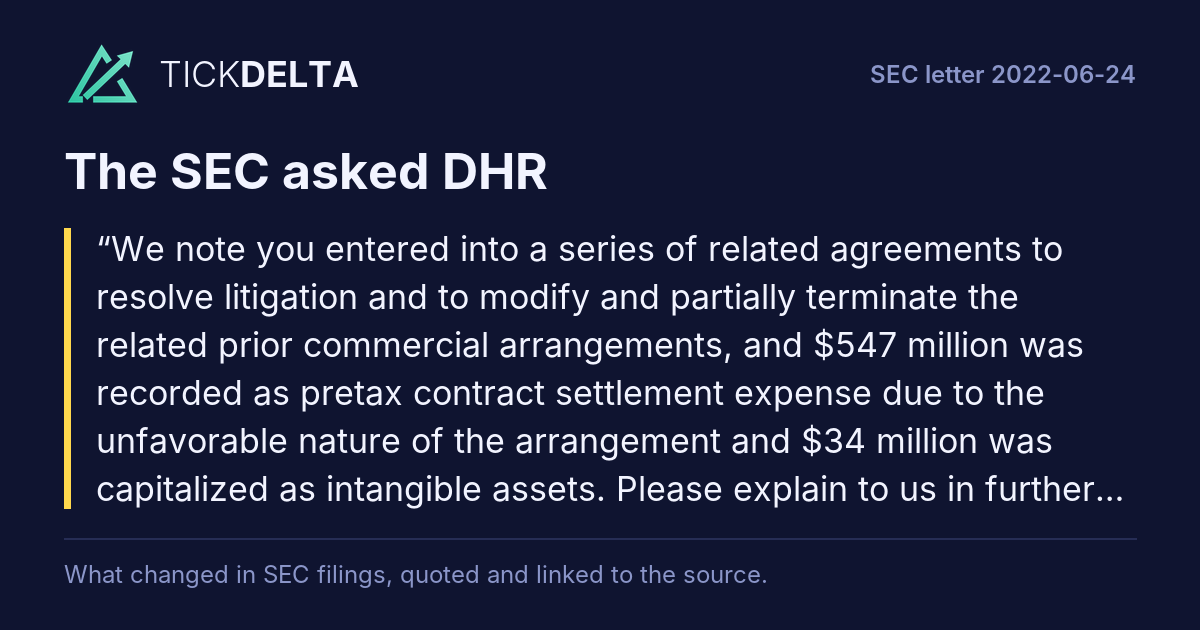
We note you entered into a series of related agreements to resolve litigation and to modify and partially terminate the related prior commercial arrangements, and $547 million was recorded as pretax contract settlement expense due to the unfavorable nature of the arrangement and $34 million was capitalized as intangible assets.Rest of the question
Please explain to us in further detail the basis for predominantly recording the arrangement as contract settlement expense. As part of your response, please provide details of the significant assumptions and methodologies in the valuation used to assist you in determining the value of each of the elements of the transaction. In addition, your response should also include: • details of the underlying litigation; • the significant terms of each of the agreements; • the reason why the payments were structured over a duration through 2029, and not all upfront; • how the non-fixed portion of the payments are to be determined; • the elements of the transaction and the specific unfavorable nature of the prior arrangement that resulted in significant expense being recorded and why greater value was not attributed to the ongoing acquired rights; • the reason why the payments are not expensed as due; • the reason why you did not account for each agreement on a stand-alone basis; and • the reason it is appropriate to present the cash outflows as a financing activity. In closing, we remind you that the company and its management are responsible for the accuracy and adequacy of their disclosures, notwithstanding any review, comments, action or absence of action by the staff.
On June 24, 2003 (prior to its acquisition by Danaher Corporation in 2011), Beckman Coulter, Inc. (“Beckman”) entered an agreement with Biosite Incorporated (“Biosite”) whereby Beckman would develop a B-type Natriuretic
Peptide (“BNP”) test and become the sole manufacturer of the test for Biosite, in each case using antibodies that Biosite owned or had rights to (the “BNP Agreement”). BNP tests are used to detect certain heart disease. Beckman analyzers1 are capable of testing for a large volume of human ailments, however in 2003 Beckman did not have a BNP test available for its analyzers.Read in the reply ↗Rest of the answer
Accordingly, Beckman entered into the BNP
Agreement to provide Beckman’s customers with a BNP test solution. Under the agreement, while Beckman developed and manufactured the tests, Biosite sold the BNP tests to Beckman customers. The BNP Agreement prohibited Beckman from researching, developing, manufacturing or selling a BNP test or any other related test for heart disease that competes with the BNP test (the “Exclusivity and Non-compete Provision”).
Rule 83 Confidential Treatment Request by Danaher Corporation
Request #1
Following a series of divestitures, Biosite’s BNP related assets (including the BNP Agreement) were acquired by Quidel Corporation (“Quidel”) in 2017. In addition, a competing test for heart disease became available in certain markets and gained market preference in certain geographies. [**]. By 2016 all patents and intellectual property rights associated with Quidel’s BNP technology had expired. However, a product market provision of the BNP Agreement resulted in an effectively perpetual extension of the Exclusivity and Non-compete Provision obligation. Following the expiration of the underlying intellectual property, the obligation imposed by the Exclusivity and
Non-compete Provision was not commensurate with the financial benefit realized by the Company under the BNP Agreement. Despite the Company developing and manufacturing the test for use by customers on Beckman analyzers, [**].
Danaher Corporation respectfully requests that the information contained in the response be treated as confidential information and that the Commission provide timely notice to James O’Reilly, Associate General Counsel and Company Secretary, Danaher Corporation, 2200 Pennsylvania Avenue, N.W., Suite 800W, Washington, DC 20037-1701, phone 202-828-0850, before it permits any disclosure of the bracketed information in Request #1.
In November
2017, Beckman filed a lawsuit in the Superior Court of San Diego, California alleging that the Exclusivity and Non-compete Provision of the BNP Agreement between Quidel and Beckman violated state antitrust laws and was therefore unenforceable. Beckman argued that it had suffered damages due to this provision and sought a declaration that the provision was void. On December 7, 2018, the trial court granted a motion by Beckman for summary adjudication, holding that the Exclusivity and Non-compete Provision is void under California law. Quidel appealed to the Court of Appeals, which overturned the ruling. The Supreme Court of California affirmed the Court of Appeals’ decision but the case was ultimately transferred back to trial court. A civil jury trial was scheduled to begin April 15, 2022.
An analyzer is a large-scale medical device capable of processing a broad menu of different types of medical tests in order to analyze/detect human ailments. Typically, the manufacturer of analyzers also manufacturers the test kits. Analyzers are typically used by medical related institutions (hospitals, universities, etc.). Operators of analyzers purchase test kits based on their inventory needs. Test kits are selected from a list of available tests. Each test kit is specific to an ailment or small group of related ailments and generally test one or a small number of samples.
To avoid the risk of an unfavorable outcome of the litigation and achieve the objective of terminating the
Exclusivity and Non-compete Provision, Beckman settled the litigation with Quidel by modifying and partially terminating the BNP Agreement through a series of simultaneously executed agreements, as summarized below:
Confidential Settlement Agreement and Mutual Release
Beckman and Quidel agreed to file dismissals of their ongoing court proceedings and released one another from all claims that had been or could be asserted.
Request #2
Master Agreement
Under this agreement, Beckman’s commitment to supply BNP test kits to Quidel was terminated. For a limited period (approximately one year), Beckman obtained the right to distribute and sell the BNP test sold by Quidel to provide continuity to customers while Beckman registered its own branded BNP test. As a result of this right, the Company recorded a related customer relationship and trade name intangible assets.
Quidel granted to Beckman a license / sublicense to two BNP antibodies used in the BNP test. The Company identified a related supply agreement / technology transfer (including license / sublicense) intangible asset related to the know-how to manufacture certain of the antibodies used in the BNP test (see also
Supply Agreement below).
Beckman agreed to pay Quidel minimum consideration of $70 million (and maximum consideration of $75 million) per year through 2029 (subject to proration for 2021). The minimum consideration of $70 million per year is not contingent and is payable in quarterly installments even if Beckman no longer sells any BNP tests. At the end of each year, Beckman multiplies the number of BNP tests sold that year times a set amount per test, and to the extent the resulting amount is above the minimum consideration then Beckman must pay the additional amount up to a maximum of $75 million per year. Based upon Beckman’s historical and estimated future sales volumes of the BNP test, Beckman expects to pay the maximum amount of $75 million each year (the maximum amount was paid, but prorated, for 2021). The present value of such payments at the time of settlement was $576 million. [**]. These payments form the consideration for the termination of the Exclusivity and Non-compete Provision and the assets acquired.
Second Amendment to the BNP Agreement
Quidel committed to cease selling the BNP tests. The Company determined the value of this commitment to be de minimis given the limited activities performed by Quidel prior to the settlement.
This amendment also terminated the Exclusivity and Non-compete Provision, allowing Beckman to research, develop, manufacture and distribute BNP type tests [**]. This termination of the Exclusivity and Non-compete Provision resulted in the settlement expense.
Danaher Corporation respectfully requests that the information contained in the response be treated as confidential information and that the Commission provide timely notice to James O’Reilly, Associate General Counsel and Company Secretary, Danaher Corporation, 2200 Pennsylvania Avenue, N.W., Suite 800W, Washington, DC 20037-1701, phone 202-828-0850, before it permits any disclosure of the bracketed information in Request #2.
Distribution
Agreement
This agreement provided Beckman with the rights to distribute Quidel branded BNP products for approximately one year until Beckman has its own products registered, and also provided Beckman with use of the Quidel trade name for a limited period of time. As a result of these rights, the Company recorded a trade name intangible asset.
Supply Agreement
This agreement provided for the transfer from Quidel to Beckman of the rights, materials and know-how (essentially the standard operating procedures) to grow and maintain the antibodies in a manner consistent with current practice. These antibodies are one of many inputs to the BNP test manufacturing process. Quidel also committed to provide a supply of related materials. As a result of these rights, the Company recorded a related supply agreement / technology transfer intangible asset.
Transition Services Agreement
This agreement requires Quidel and Beckman to provide each other with certain services to support the transition of distribution and sale of the BNP tests, including the transfer from Quidel to Beckman of customer contracts / relationships and limited use of the Quidel trade name by Beckman. As a result of these rights, the Company recorded related customer relationships and trade name intangible assets.
As these agreements were negotiated at the same time as part of the settlement of the litigation and cross-reference one another, the Company concluded that the agreements should not be accounted for on a stand-alone basis but rather should be considered in the aggregate. While the primary purpose of the settlement was the termination of the Exclusivity and Non-compete Provision, the consideration paid by the Company was in exchange for the agreements in totality. As the arrangement contains multiple elements, the Company identified and evaluated each element within the agreements and allocated the consideration to each element as applicable. As discussed further below, the Company considered ASC 805, Business Combinations, which provides guidance to identify transactions separate from a business combination. Additionally, there are two Staff speeches that provide guidance regarding multiple element arrangements in circumstances not involving revenue recognition. The Company believes that its accounting treatment is consistent with the Remarks Before the 2006 AICPA National Conference on Current SEC and PCAOB Developments by Joseph D. McGrath (the McGrath Speech) and Remarks Before the 2007 AICPA National Conference on Current SEC and PCAOB
Developments by Eric C. West (the West Speech). In the McGrath Speech, the Staff discussed transactions or agreements that contained multiple elements and were not otherwise subject to specific authoritative literature including examples of: i) contract termination agreements; ii) executory contracts including modifications to existing contracts that may have required an upfront payment or; iii) a litigation settlement which required future services or other concessions between the parties. The Company believes the settlement with Quidel reflects the fundamental concepts referenced in these speeches and therefore requires evaluation of and accounting for each of the elements in the settlement.
Request #3
In exchange for the consideration paid to Quidel, the Company received the termination of the Exclusivity and Non-compete Provision and certain intangible assets as described above. Notwithstanding the acquisition of the intangible assets, the Company’s principal business purpose in settling the litigation was the termination of the Exclusivity and Non-compete Provision. Beckman already possessed the know-how and capabilities to produce the BNP test [**], but only Quidel could release the Company from the Exclusivity and Non-compete Provision.
Danaher Corporation respectfully requests that the information contained in the response be treated as confidential information and that the Commission provide timely notice to James O’Reilly, Associate General Counsel and Company Secretary, Danaher Corporation, 2200 Pennsylvania Avenue, N.W., Suite 800W, Washington, DC 20037-1701, phone 202-828-0850, before it permits any disclosure of the bracketed information in Request #3.
For the allocation of the consideration between the identified elements, the Company considered the guidance in ASC 805-10-25-20, which requires an acquiror to identify any amounts in a business combination that are not part of the exchange for the acquiree (i.e., the settlement payment to terminate the existing contractual relationship). The EY Business Combinations Financial Reporting Development publication (June 2021) section A.2.6.1 contains guidance consistent with ASC 805-10-25-20 and states that in an asset acquisition, a settlement gain or loss should be recognized consistent with the principles of
ASC 805. The PricewaterhouseCoopers guide for Property, Plant, Equipment and Other Assets (February 2022), section 2.3.6.1 Preexisting relationships (asset acquisitions) also states, “The acquirer and seller in an asset acquisition may have a preexisting relationship before negotiations for the exchange transaction begin that is effectively settled as a result of the asset acquisition. There is no guidance outside of a business combination for the settlement of preexisting relationships. However, we believe settlement gains and losses relating to preexisting relationships should generally be recognized in the income statement consistent with the guidance for business combinations in ASC
805-10-55-21.” In addition, the Company also considered the guidance from the West Speech in which the Staff noted that it would be acceptable to value each element of the arrangement and allocate the consideration to each element using relative fair values. Following both the guidance in ASC 805 and the West Speech, the Company allocated the consideration based on the estimated fair values of the intangible assets acquired and the settlement of the preexisting contractual relationship (the Exclusivity and Non-compete Provision).
Request #4
To assist in valuing the elements of the transaction, the Company engaged a third-party valuation specialist contemporaneously with the settlement. The valuations were derived based on projected financial information related to the existing BNP test [**]. The consideration payments were discounted using the blended borrowing rate of the Company to arrive at a pre-tax present value of $581 million (consisting of $576 million related to the present value of the consideration of $75 million per year and $5 million related to inventory purchased from Quidel). To determine the weighted average cost of capital for use in valuing the identified intangible assets, the Company evaluated market participants and calculated a market participant baseline weighted average cost of capital. The table below summarizes the allocation of the present value of the consideration of $576 million to the elements identified in the transaction ($ in millions):
Amount
Termination of the Exclusivity and Non-compete
Provision
$
542
Supply agreement / technology transfer intangible asset
Customer relationship intangible asset
Quidel trade name intangible asset
Total consideration
576
Danaher Corporation respectfully requests that the information contained in the response be treated as confidential information and that the Commission provide timely notice to James O’Reilly, Associate General Counsel and Company Secretary, Danaher Corporation, 2200 Pennsylvania Avenue, N.W., Suite 800W, Washington, DC 20037-1701, phone 202-828-0850, before it permits any disclosure of the bracketed information in Request #4.
For the valuation of the supply agreement / technology transfer, the Company used a relief from royalty approach, where the value of the intangible asset is equal to the present value of the after-tax royalty savings attributable to owning the intangible asset. Royalty rates were based on third party pricing for similar antibodies. Based on this approach, the
Company valued the supply agreement / technology transfer intangible asset at $31 million.
For the valuation of the customer relationships, the
Company used a multi-period excess earnings method under a market participant distributor model. The revenue projections were based on an assumption relating to the portion of revenue attributable to customers where Beckman and Quidel have overlapping sales and therefore Beckman will have increased sales in the future as a result of these customers. For customers purchasing the BNP test, the customer relationship is primarily driven by Beckman through the Beckman analyzer.
Quidel’s relationship with the Beckman customers is akin to a distributor’s relationships as Quidel relies on Beckman’s sales team to functionally make the sale. Quidel does not provide any additional value-added services to the customers (similar to a distributor). Therefore, an estimated earnings before interest and taxes (“EBIT”) margin based on a benchmarking of EBIT margins of guideline public distributors was applied to the customer relationships in the valuation. Based on this approach, the Company valued the customer relationships at $2 million. For the valuation of the use of the Quidel trade name, the Company used a relief from royalty approach, valuing the trade name at $1 million, based on an estimated royalty rate. The minimal value of the trade name reflects that the Company is using the Quidel trade name for a limited amount of time consistent with market participants who generally brand tests under their analyzer brand.
Request #5
For the valuation of the termination of the Exclusivity and Non-compete Provision, the Company used an income approach and determined the fair value to be $542 million, representing the value of the Company’s ability to market and sell a Company-branded BNP test [**]. As discussed earlier, the Company’s principal purpose of the settlement was to remove the restrictions of the Exclusivity and Non-compete Provision in order to research, develop, manufacture and sell BNP test [**]. For the recognition of the contract settlement expense, the Company considered that it is legally obligated to pay the minimum consideration of $70 million each year even if the
Company does not sell any BNP tests. Based on the historical and estimated future sales volumes of the BNP test, the Company believes that it is highly probable that it will pay the maximum consideration of $75 million each year and that the contingency that requires the additional annual payment amount of $5 million (incremental to the $70 million minimum annual amount) is not substantive to the Company in its determination of its obligation to make these payments. Therefore, the Company has used the maximum annual amount in the determination of the consideration paid. The incremental financial impact of the additional annual payment of $5 million per year is insignificant to the Company’s financial statements.
Danaher Corporation respectfully requests that the information contained in the response be treated as confidential information and that the
Commission provide timely notice to James O’Reilly, Associate General Counsel and Company Secretary, Danaher Corporation, 2200 Pennsylvania Avenue, N.W., Suite 800W, Washington, DC 20037-1701, phone 202-828-0850, before it permits any disclosure of the bracketed information in Request #5.
The Company concluded it should not expense the payments annually as they are made over the period from 2021 through 2029 because doing so would result in deferral of a liability and deferral of an expense recognition that is inconsistent with the substance and intent of the transaction, the Company’s related obligations and generally accepted accounting principles. To expense the payments as they are made, rather than recognize an expense at the time of the settlement, would not give recognition to the settlement of the on-going litigation and termination of the Exclusivity and Non-compete Provision as required by ASC 805, as discussed above. The settlement arrangement obligates the Company to make the minimum payments from 2021 through 2029 even if no tests are sold. Additionally, at the end of the payment period, there are no continuing financial obligations under these arrangements and there is no restriction on the Company’s activities resulting from the ending of the payments.
For the presentation of the contract settlement arrangement in the Company’s Statement of Cash Flows, the Company considered the guidance in ASC 230-10-45-15(c) and ASC 230-10-45-17(d). By structuring the payments to occur periodically through 2029 (even though the termination occurred on July 24,
2021), Quidel has extended long term credit to the Company for the payment of the contract settlement liability. Following the guidance in ASC
230-10-45-15(c), the principal portion of the payment to Quidel is classified as a cash outflow from financing activities. The interest portion of the payment is classified as a cash outflow from operating activities.
The Company acknowledges that the Company and its management is responsible for the accuracy and adequacy of the disclosures in its filings, notwithstanding any review, comments, action or absence of action by the Staff.
First report after the company's reply of 2022-07-12: 10-Q filed 2022-07-21 ↗, against the 10-Q filed 2022-04-21 ↗.
Tickdelta does not hold the text of both reports, so they are not compared here.
In response to prior comment 1, you set forth that you follow the guidance in ASC 23010-45-15(c) and classify the principal portion of the payment to Quidel as a cash outflow from financing activities. Please provide us a further analysis of ASC 230-10-45-15(c), together with the full first sentence of ASC 230-10-45-17(a), the full paragraph of 4517(f), and any other relevant provisions, to further address why yourRest of the question
presentation is appropriate and why cash outflows for operating activities is not the more appropriate classification. In this regard, payments to settle lawsuits are cash outflows for operating activities and, by analogy to ASC 230-10-45-17(a) long-term principal payments to settle lawsuits, or similarly contract settlement expense, would also appear to be cash outflows for operating activities. Paragraph 45-15(c) referenced in your response refers to property, plant, and equipment or other productive assets, and makes no references to costs or expenses. Please also provide us a copy of the Master Agreements so that we can better understand the payments that are to be made.
The primary purpose of the Company’s settlement with Quidel was the termination of the Exclusivity and Non-Compete
Provision (the “Termination”). In exchange for the Termination and acquisition of intangible assets, the Company agreed to pay Quidel minimum consideration of $70 million and maximum consideration of $75 million per year through
2029 (subject to pro ration in 2021, which amount equaled $25 million).Read in the reply ↗Rest of the answer
As discussed in the July 12, 2022 letter, of the total present value of the consideration to be paid of $576 million, the fair value of the Termination was
$542 million.
While the Company entered into the Termination in lieu of continuing the litigation it initiated against Quidel, the Company’s payments to Quidel are in exchange for receiving the Termination and the intangible assets; the payments are not a result of legal damages awarded or a legal settlement arising from claims against the Company. Additionally, the portion of the consideration payments related to the Termination are not for the acquisition of materials for manufacture or goods for resale. As the consideration will be paid annually through 2029 and the Termination and transfer of the intangible assets were effective on July 24, 2021, the Company concluded that Quidel provided long-term financing to the Company for the consideration associated with the Termination and intangible assets. We therefore recorded a liability of $576 million for the future payments. We believe the Termination and transfer of intangible assets with the associated financing represents non-cash financing activities consistent with ASC 230-10-50-3 through 50-6, and accordingly in the Company’s Annual Report on Form 10-K for the year ended December 31, 2021, the Company provided the required financial statement disclosures of the non-cash transaction including the payment amount for each future period that will occur and the presentation of future principal and interest within the statement of cash flows.
In evaluating the
Company’s presentation and in response to the Staff’s comment, we considered the following:
•
ASC
230-10-45-13(c): We considered that this paragraph, contained within the ASC 230 section for Cash Flows from Investing
Activities, differentiates between examples of investing activities and financing activities. In so doing, this paragraph identifies a type of transaction that is a financing transaction (instead of an investing activity) and ASC 230-10-45-13(c) prescribes the subsequent accounting for transactions of this type, “However, incurring directly related debt to the seller is a financing transaction (see paragraphs 230-10-45-14 through 45-15), and subsequent payments of principal on that debt thus are financing cash outflows.” Similarly, we believe the financing with the counterparty (Quidel) is directly related to the Termination financing, so the cash outflows related to it should be classified as a financing activity instead of an operating activity consistent with the guidance in ASC 230-10-45-13(c).
230-10-45-15(c): We considered that this paragraph further supports the analysis of
45-13(c) above. While the second sentence of this guidance specifically refers to seller-financed acquisition of property, plant, and equipment or other productive assets, the first sentence does not limit this guidance solely to the acquisition of property, plant, and equipment or other productive assets. Explicitly, the first sentence provides that outflows from financing activities are “Other principal payments to creditors who extended credit on a long-term basis.” We do not believe that the financing cash outflow accounting model for long-term credit should be limited solely to property, plant and equipment or other productive assets. Said differently, we do not believe 45-15(c) includes language that would limit the guidance on principal payments for long-term credit, including those from non-cash financing activities, to seller-financed purchases of property, plant, and equipment or other productive assets. The second sentence only references an example where classifying principal payments as financing activities would also apply.
230-10-45-17(a): Consistent with the above analysis, we considered that this paragraph provides an explicit statement with respect to the type of transaction not subject to the financing cash outflow accounting model by specifically identifying those payments (including principal payments on both short-term and long-term notes payable) associated with the acquisition of materials for manufacture or goods for resale that should be presented as cash outflows from operating activities. The portion of the payments related to the Termination do not relate to the acquisition of materials for manufacture or goods for resale in any year including the years in which they are paid. Accordingly, the Company concluded that this paragraph would not be an appropriate analogy for the arrangement.
230-10-45-17(f): We considered that this paragraph states that all other cash payments not stemming from investing or financing activities should be considered operating activities. The paragraph goes on to provide payments to settle lawsuits as a specific example. Consistent with our analysis above, we believe the Termination was a non-cash transaction whose terms gave rise to a financing activity as defined in ASC 230. Accordingly, we do not believe the payments to be in scope of this paragraph and we do not believe that an analogy to paragraph 45-17(a) in applying this paragraph is appropriate because the payments stem from a financing activity. As the arrangement contains long-term financing provided by a creditor, the guidance in ASC 230-10-45-13(c) is directly applicable to the presentation of the cash flows for the arrangement as discussed above.
For the Staff’s convenience we note that during the year ended December 31, 2021, the Company generated operating cash provided by continuing operations of $8,358 million. The annual $75 million financing payment represented less than 1% of the operating cash provided by continuing operations during 2021.
Enclosed with this response is the Master Agreement between Beckman and Quidel. The terms regarding the payment of the minimum and maximum test fee can be found within sections 3.1 and 3.4.
The Company acknowledges that the Company and its management are responsible for the accuracy and adequacy of the disclosures in their filings, notwithstanding any review, comments, action or absence of action by the Staff.
First report after the company's reply of 2022-08-11: 10-Q filed 2022-10-20 ↗, against the 10-Q filed 2022-04-21 ↗.
Tickdelta does not hold the text of both reports, so they are not compared here.
Also in this review: closing letter, 2022-08-23