Dick's Sporting Goods, Inc. DKS
New risk paragraphs, branching off last year
Each branch is a paragraph in Risk Factors with nothing like it in the 10-K filed Mar 27, 2025. A box jumps to the paragraph as filed, below.
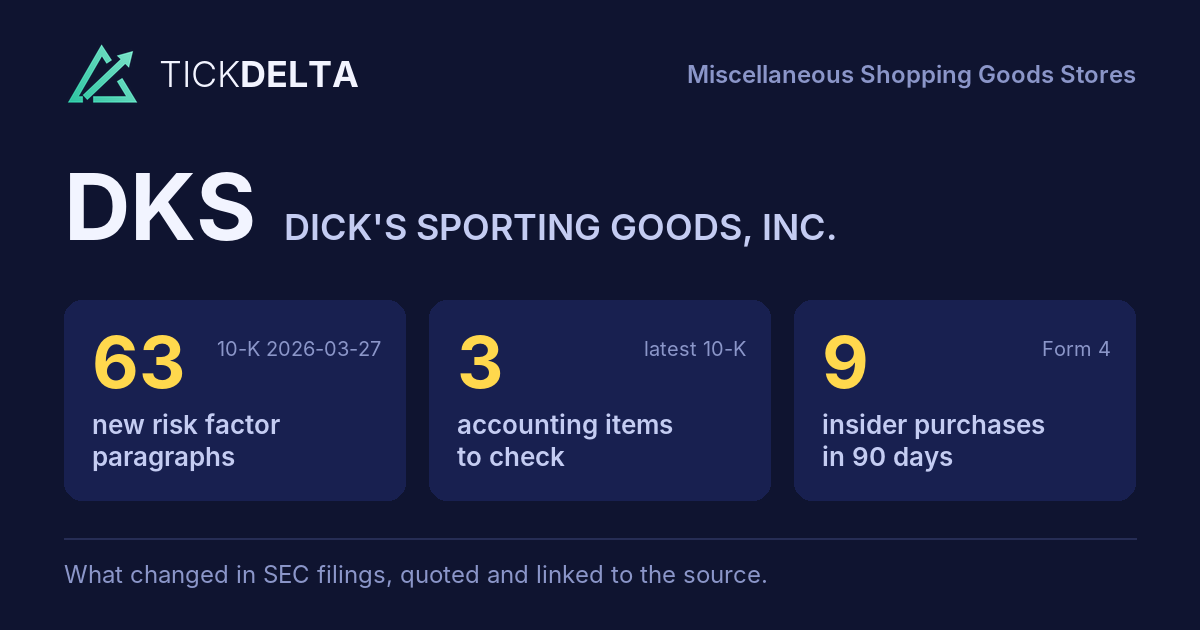
Paragraphs with nothing like them in last year's 10-K
63 paragraphs in Risk Factors of the 10-K filed Mar 27, 2026 with nothing like them in the 10-K filed Mar 27, 2025. Quoted exactly. Paragraphs that were only edited are under 10-K change.
Our business depends on consumer discretionary spending, and are sensitive to changes in global macroeconomic conditions outside of our control, including inflation, prolonged inflationary pressures and measures taken to curb inflation; elevated interest rates and recessionary pressures; changes in consumer disposable income consumer confidence and debt burdens; perceptions of global economic stability (including in response to shifts in government policies); and wage and unemployment levels. These conditions can cause consumers to reduce or postpone discretionary purchases, resulting in lower traffic, reduced comparable sales, and decreased average value per transaction across our business.
Geopolitical developments may also adversely affect our business and financial results. Ongoing conflicts and tensions —such as those in the Middle East (particularly the recent U.S. military operations in Iran), Ukraine and Venezuela—and the threat or outbreak of additional conflicts, war, terrorism, or public unrest may create economic instability, disrupt supply chains, increase fuel and transportation costs, or elevate cybersecurity risks. Such developments continue to introduce uncertainty regarding long‑term trade and economic conditions in the European Union and other markets, which may particularly affect our Foot Locker Business given its international footprint.
In response to reduced demand, we may need to increase promotional activity or adjust pricing strategies, which could negatively impact our planned sales levels and gross margins. A sustained reduction in consumer spending or an extended period of economic instability could adversely affect our business, operations, liquidity, financial condition, and results of operations.
We operate in a highly fragmented, intensely competitive and rapidly evolving global marketplace. We operate a number of different store formats and compete with an expanding set of retailers and other potential competitors across multiple formats and channels—including large-format, specialty and traditional retailers; mass merchants; department stores; and online and direct‑to‑consumer sellers, including vendors. Many of our competitors have significant international, national, regional, or local market presence, and their name recognition, and financial, marketing, technological, and other resources allow them to meaningfully compete with our business across various channels. Our ability to effectively and successfully respond to competitive pressures may adversely affect our results of operations, profitability or reputation.
Consumers can compare prices and product offerings in real time, increasing pressure on us to maintain competitive pricing, differentiated assortments and compelling marketing programs. If our varied marketing and advertising strategies, particularly across digital and social media channels, are unsuccessful, we could lose customers and experience declining sales. In addition, the retail industry is undergoing continued technological innovation and disruption—including increased use of artificial intelligence (“AI”) and machine learning. If we cannot innovate, enhance our platforms or adopt new technologies at a pace consistent with consumer expectations and industry developments, our business could be harmed.
Fluctuations in product costs and availability could adversely affect our business, financial condition, and results of operations.
Our product costs depend in part on the cost and availability of raw materials and component inputs. Significant increases in those costs—whether due to trade tensions, shifting tariff policies in key sourcing countries like China, Mexico, and Canada (including recently enacted tariffs and potential additional shifts in tariff policies in the future), currency fluctuations, material shortages, supply chain disruptions, or other factors—could increase manufacturing and other costs for both our own private brand merchandise and the products we purchase from our vendors. These factors could also compel us to seek alternative suppliers, take pricing actions, modify operations, or take other actions that may not fully mitigate the associated cost increases, and our sales, margins, and profitability could be adversely affected.
Our business also depends heavily on third‑party transportation providers to move products (including those manufactured overseas). Transportation availability and other sourcing costs are influenced by fuel price volatility, extreme weather conditions, geopolitical conflicts and tensions as discussed above, acts of war or terrorism, port congestion, government shutdowns, labor disputes, regulatory changes, inspections, and other disruptions to global trade routes, shortages of qualified transportation personnel, and limited availability of aircraft, ships, trucks, and rail equipment. In particular, the military conflict recently launched in Iran has had, and may continue to have, adverse impacts on global trade with respect to goods passing through the Strait of Hormuz and material supply chain disruptions resulting in significant increases in oil and fuel prices
globally. Increased demand for transportation services and spikes in fuel prices have resulted in higher transportation costs for us and our vendors, and continued volatility could further pressure our operating results. Any inability by us or our vendors to secure adequate and timely transportation resources at competitive rates or to otherwise obtain sufficient quantities of merchandise at acceptable cost on a timely basis could delay product flow, result in shipment delays, disrupt inventory levels, and negatively impact our ability to serve customers, any of which may adversely affect our sales, profitability, and customer experience.
Our reliance on products manufactured outside the United States and our significant international operations expose us to numerous global economic, political, regulatory, and supply‑chain risks that could materially and adversely affect our sales, profitability, results of operations, and financial condition.
A substantial portion of our merchandise, including most of our vertical brand merchandise, is manufactured abroad. As a result, our business is subject to a broad range of risks inherent in international sourcing and global retail operations, including changes in import duties, quotas, tariffs, and other trade restrictions; the potential introduction or expansion of taxes on imported goods; the loss of favorable trade status; trade remedy actions; geopolitical tensions; and other trade restraints affecting the countries where our vendors and manufacturers operate. Heightened political and economic uncertainty may further disrupt global trade flows, limit access to vital trade routes, or affect the availability and cost of imported goods.
In addition, imported products are often subject to excise duties, sales taxes, and value‑added taxes, and our international retail operations are subject to various taxes in foreign jurisdictions. Changes in duty structures, tax rates, or tax legislation—including indirect‑tax reforms, digital services taxes, or customs‑valuation rules—could increase the cost of goods sold or operating expenses. Foreign manufacturers’ pricing may also be affected by local currency movements relative to the U.S. dollar, as well as changes in the cost of raw materials, which could further increase our product costs and negatively impact our margins.
Our success depends on our ability to anticipate and respond in a timely manner to changing consumer demand, preferences and fashion, and cultural trends, as well as evolving shopping patterns across digital and in‑store channels of our business and international markets. We operate a fully omni‑channel business model and must meet customers’ expectations for appealing and consistent online experiences; localized and differentiated assortments; premium products; elevated customer service; fast, accurate and reliable delivery and pickup options; and convenient returns. Consumer expectations and shopping behaviors continue to evolve rapidly and vary across geographic and demographic groups, and these factors could be particularly pronounced within the global multi-cultural nature of our customer base with respect to the Foot Locker Business. If we do not provide an omni‑channel experience that aligns with customer expectations, our results of operations could be adversely affected. Our need to make advanced merchandise purchase commitments can limit our ability to adjust quickly to changes in demand or fashion trends. If we misjudge consumer preferences or the market for our merchandise, we may experience significant markdowns, lower margins, missed sales opportunities and inventory write‑downs.
The athletic footwear and apparel industry, particularly at the premium end of the market, is driven by fashion and cultural trends, changing consumer preferences and product innovation. We rely on our suppliers to maintain product innovation and to anticipate shifts in consumer tastes across the various geographic regions of our operations. We cannot guarantee that our merchandise selection will accurately reflect consumer preferences when offered for sale or that we will be able to identify and respond quickly to changes in fashion trends, especially given the long lead times required to source much of our product. Failure by us—or by our suppliers—to anticipate, identify or react appropriately to changes in fashion trends or consumer preferences could materially adversely affect our business, financial condition and results of operations.
Negative publicity or perceptions involving us, our brands, products, or individuals or entities associated with us, or failure to detect, prevent, mitigate or address issues giving rise to reputational risk, could adversely impact our reputation, business, results of operations, and financial condition, and may adversely impact our ability to attract and retain customers and employees. Issues that might pose a reputational risk include any of the risks enumerated in these risk factors. Furthermore, the prevalence of social media and potential misinformation may accelerate and in the short-term increase the potential scope of any negative publicity we or others might receive and could increase the negative impact of these issues on our reputation, business, results of operations, and financial condition.
Our ability to successfully implement and execute our strategic plans and initiatives, including the ongoing integration of the Foot Locker Business, depends on many factors, some of which are out of our control. For additional risks related to the integration of the Foot Locker Business, see the risk factor captioned “We may not realize the anticipated benefits of the Foot Locker transaction or other strategic alliances, acquisitions or investments, and integration challenges or other risks associated with such transactions could adversely affect our business” below.
Show the other 12
Our financial performance depends, in part, on our ability to execute our real estate strategies across our business, which are varying and multi-faceted. For our DICK’S Business, this includes growing and optimizing larger-format specialty store concepts and to repositioning and optimizing our existing store portfolio over time, and for our Foot Locker Business, includes maintaining and acquiring locations in highly productive urban retail corridors, high streets, and enclosed regional and
neighborhood malls. There can be no assurance that we will be able to locate and obtain control of adequate desirable real estate that meets the criteria of our business or that such locations will continue to be available on favorable terms.
Because a meaningful portion of our stores, particularly within our Foot Locker Business, are located in shopping centers or malls, our performance is influenced by the volume of mall traffic and the sustained success and relevance of those locations. Mall traffic may be adversely affected by economic downturns; the closing or decline of anchor tenants and specialty retailers; vacancies or closures; shifts in consumer shopping habits, including increased online shopping; singular material events, such as a public health emergency, or decline in the popularity of mall shopping among our target customers. Our DICK’S Business may also be affected by changes in traffic patterns in the regional shopping areas and off-mall retail nodes where many of our stores are located. Declines in traffic or conversion rates may require us to increase markdowns, promotions, or marketing spend, which could adversely impact our financial results. Additionally, the growth of our business is dependent on our ability to open and operate our various store concepts synergistically in geographic regions where multiple store concepts may exist in close proximity to one another.
Unauthorized access to, or disclosure of, sensitive or confidential information could result in substantial costs, operational disruption, legal exposure, and reputational harm, and evolving privacy and cybersecurity regulations may increase our compliance obligations and related risks.
The protection of customer, employee, vendor, and Company data is critical to our business. In the normal course of operations, we collect, receive, store, manage, transmit, and delete confidential and sensitive information, including payment card data, personally identifiable information, employee and vendor information, and other proprietary or confidential Company data, and rely on numerous third‑party vendors and service providers in this regard. Although we have established cybersecurity
governance processes, implemented security measures, and conduct regular training and system updates, cyber threats continue to evolve rapidly accelerated by emerging technologies such as advanced artificial intelligence and machine learning. We may be unable to anticipate, prevent, or fully mitigate new or sophisticated cyberattacks or insider threats, whether intentional or inadvertent.
While we and our third-party providers have experienced non‑material data security issues from time-to-time, and in the future may continue to experience cyberattacks or threats of varying degrees in the conduct of our business, we are not aware of any material data breach to date. Nevertheless, any actual or perceived compromise of data security could interrupt our operations; result in loss, theft, or misuse of sensitive information; harm our reputation; undermine customer trust; discourage participation in our loyalty program; and require significant remediation costs, including investments in additional technology, system upgrades, or personnel. A material compromise could also expose us to substantial legal, regulatory, and financial consequences beyond the scope or limits of our insurance coverage.
In addition, the data privacy and cybersecurity regulatory environment is becoming increasingly complex, with new, more rigorous, and often inconsistent requirements emerging at the federal, state, and global levels. We are subject to numerous laws and regulations, including the EU General Data Protection Regulation (GDPR), the United Kingdom GDPR, the California Consumer Privacy Act (CCPA), and other U.S. state and international privacy laws. We are also subject to payment card industry compliance and other regulatory requirements. These laws impose strict requirements regarding the collection, use, storage, transfer, deletion, and protection of personal data, and grant enhanced rights to individuals. Regulatory scrutiny from international regulatory authorities, U.S. federal agencies, U.S. state attorneys general, and newly created U.S. state privacy regulators continues to increase, and we have received inquiries from government authorities from time-to-time regarding our data practices.
Our ability to maintain appropriate inventory levels is a key component of our operating performance. We must carry sufficient inventory to meet customer demand while avoiding excess or slow‑moving merchandise. If we fail to accurately forecast demand, consumer buying patterns, or shifts in product trends, we may be required to take markdowns or run promotional activity to clear excess inventory, negatively affecting our gross margins and overall financial performance. We have and are continuing to implement key strategic initiatives designed to optimize inventory levels, enhance supply‑chain efficiency, and improve product‑to‑market processes, including expansion of our capabilities in data science, demand forecasting, and customer‑behavior analytics to better localize assortments and increase store‑level allocation accuracy, as well as deploying technology intended to improve in‑season responsiveness. We’ve also taken and are continuing to take strategic actions with respect to historically unproductive inventory in our Foot Locker Business to optimize our assortment. Because these initiatives require significant changes to our inventory management systems, processes, and organizational capabilities, any failure to
implement, integrate, or fully utilize these initiatives could prevent us from realizing the expected benefits and could adversely affect our operating results.
In addition, our business is exposed to risks related to inventory shrinkage—losses from damage, theft (including organized retail crime), and other causes. Although some level of inventory shrink is inherent in the retail business and our inventory shrink generally stabilized in 2025, we have experienced elevated levels of inventory shrink in the past, which could return or worsen. We must also maintain a safe store environment for our employees and customers. Elevated levels of shrink or an unsafe store environment can negatively affect profitability, result in asset impairments at affected stores, and may require strategic changes in operational procedures or security measures that could increase our costs and adversely impact our reputation and the employee or customer in-store experience.
Our future growth may depend on the Foot Locker Business’s ability to expand its market share in international markets, including through licensed or franchise arrangements, and failure to do so could adversely affect our business, financial condition, and results of operations.
Future growth within our Foot Locker Business will depend, in part, on our ability to expand our presence and market share in international regions where we currently operate as well as in new markets where we may have limited operating experience. In certain countries, we rely—and may increasingly rely—on third‑party partners through licensing or franchise arrangements to operate stores or digital platforms under our banners. Our ability to grow internationally therefore depends not only on our own execution but also on the capabilities, financial stability, operational discipline, and brand stewardship of these foreign business partners.
Our Foot Locker Business has retail operations in 20 countries across North America, Europe, Asia, and Australia, plus a licensed store presence in Europe, the Middle East, and Asia. These international operations expose us to retail‑market and regulatory risks unique to non‑U.S. jurisdictions, including distinct consumer behaviors and preferences and shifts related thereto; political or social instability; changes in local economic conditions; fluctuations in real estate and occupancy costs and variations in real estate conditions generally; foreign tax structures; and labor, employment, data‑protection and other regulatory and compliance requirements that differ significantly from those in the United States. Because these businesses primarily conduct transactions in their local currencies, fluctuations in foreign currency exchange rates—especially the euro, British pound, Canadian dollar, Australian dollar and the Japanese yen—may materially affect our reported results when translated into U.S. dollars. In some markets, local business practices and regulatory frameworks may be unfamiliar or more complex than those in our historical footprint for the DICK’S Business. In addition, expansion into new geographies may require significant capital investment, adjustments to our store formats or digital platforms, enhanced supply‑chain capabilities, and increased management attention.
If we or our licensed or franchised partners are unable to successfully execute expansion strategies, adapt our banners to new market dynamics, comply with local regulatory requirements, or maintain consistent brand standards, our international growth may not materialize as expected. Any failure to expand profitably—or at all—in targeted international markets could adversely affect the Foot Locker Business’s future growth trajectory and could have a material adverse effect on our overall business, financial condition, and results of operations.
Our ability to provide a compelling merchandise assortment depends on maintaining strong relationships with a large but concentrated group of suppliers. We purchased merchandise from approximately 1500 vendors in fiscal 2025, with Nike, our largest vendor, representing approximately 31% of total merchandise purchases. Because of this concentration, any adverse development in a key supplier’s brand power, reputation, financial condition, product innovation, or manufacturing capability—or its decision to change its distribution or allocation strategies—could materially adversely affect our business.
Any inability to obtain merchandise in a timely manner, secure adequate product allocations, or maintain favorable supplier terms could have a material adverse effect on our business, financial condition, results of operations or profit margins.
Our business is subject to a broad, increasingly complex and sometimes conflicting array of U.S. federal, state, local, and foreign laws and regulations. As regulatory expectations increase globally, we are required to devote substantial resources to develop and maintain internal compliance programs, monitoring systems, reporting structures, and controls. Failure to comply with applicable laws and regulations, or alleged non‑compliance, could result in governmental investigations, enforcement actions, fines, penalties, injunctions, civil litigation, reputational harm, and operational disruptions.
We are also subject to numerous domestic and foreign labor and employment laws governing wages, minimum hours, overtime, paid leave, scheduling, unemployment insurance, workers’ compensation, and workplace safety. Potential changes to these laws—including increases in minimum wage or overtime obligations, or reforms such as the Protecting the Right to Organize Act—could significantly increase our labor costs. Shifts in regulatory priorities at agencies such as the National Labor Relations Board or analogous international regulators may also affect our employee‑relations practices and expose us to additional administrative or litigation risks.
Complying with new or amended legislation, changes in regulatory interpretations, or reversals of previously implemented rules can be time‑consuming and costly, requiring adjustments to policies, systems, and staffing. Any failure to effectively manage these evolving global compliance obligations could negatively impact our business, financial condition, or results of operations.
Our intellectual property, trade secrets, domain names, and exclusive licensing rights are valuable assets that are critical to our brand strength. Effective intellectual property protection may not be available in every country in which we operate or manufacture products. Certain countries may not provide protections comparable to those available in the United States, and operating in these regions increases the risk that our proprietary designs, content, technology, or brand assets may be counterfeited, copied, misused, or otherwise misappropriated. Enforcement measures may be costly and not always successful.
Unauthorized use, reproduction or other misappropriation of our intellectual property can diminish the value of our brands or goodwill and negatively impact our revenues and competitive position. In addition, infringement or other third-party intellectual property claims—regardless of their merit—could be time‑consuming, result in litigation, product delays or modifications monetary damages, or require us to enter into royalty, licensing, or settlement agreements or result in our loss of ownership or use of the intellectual property rights, which could adversely affect our business, financial condition, and results of operations.
As a U.S.-based multinational company subject to tax in multiple U.S. and foreign jurisdictions, our effective income tax rate and overall tax liability are affected by a variety of factors, including changes in applicable tax laws, regulations, treaties, administrative interpretations and guidance, including the possibility of retroactive effect; changes in transfer pricing rules; shifts in the mix of pretax earnings by jurisdiction; and the valuation of deferred tax assets and liabilities. Significant judgment is required in determining our provision for income taxes and in evaluating our tax positions on a worldwide basis.
We are also subject to routine income tax audits in various jurisdictions, and the final outcomes of these audits may differ from the amounts recorded in our financial statements. Adverse developments, including assessments of additional taxes, interest or penalties, could materially affect our tax expense and profitability.
In addition, many jurisdictions are considering or have adopted new tax regimes, such as digital services taxes and the Organization for Economic Co‑operation and Development’s Pillar Two global minimum tax framework, which countries are in the process of implementing. Future changes in tax laws or related interpretations, including at the federal level in the United
States, could increase our effective tax rate, impose new taxes or reporting requirements, or otherwise adversely impact our financial results, cash flows and overall financial condition.
Evolving environmental, social and governance (“ESG”) standards, regulatory requirements, stakeholder expectations and related political and social dynamics may increase our costs, subject us to additional risks and adversely affect our business, reputation and financial performance.
We are subject to rules and regulations related to ESG matters imposed by governmental and self‑regulatory organizations, including the SEC, the New York Stock Exchange, California’s Climate Corporate Data Accountability Act and Climate‑Related Financial Risk Act, and the European Sustainability Reporting Standards. Failure to comply could result in fines, penalties or other regulatory consequences, as well as reputational harm.
In addition, some third‑party organizations, institutional investors, proxy advisory firms and customers evaluate companies on ESG performance using differing, and evolving, criteria. These assessments can influence investor sentiment, capital allocation decisions and consumer preferences. Reduced access to or increased cost of capital may result if we do not meet stakeholder expectations related to ESG matters. Developing, implementing and reporting on ESG initiatives, including environmental sustainability, human rights and labor practices, worker safety, materials traceability, packaging and textile waste reduction, and diversity and inclusion initiatives, is complex, costly and subject to evolving reporting standards, internal controls and methodologies. Our ESG disclosures, goals and progress may rely on assumptions, data and measurement frameworks that continue to develop. We could be criticized for the accuracy, adequacy or completeness of our disclosures, the pace of our progress, the scope or ambition of our goals, or for modifying or abandoning previously announced goals. Any such criticism or perceived shortcomings could result in reputational harm, loss of customer or investor confidence, or adverse business impacts.
At the same time, “anti‑ESG” and “anti‑DEI” sentiment has gained momentum in parts of the U.S., leading to proposed or enacted policies, legislation, litigation, legal opinions, investigations and other actions that challenge certain ESG‑related or DEI‑related practices. These developments may conflict with other regulatory requirements, create uncertainty, increase compliance obligations and expose us to additional scrutiny, enforcement actions, litigation risk or reputational harm. They may also influence investor behavior or reduce demand from certain customers.
If we fail to meet applicable ESG‑related regulatory requirements or standards, or if our ESG initiatives, disclosures or performance fall short of expectations of regulators, investors, customers, employees or other stakeholders, we could experience adverse publicity, loss of investor or customer confidence, reduced access to or increased cost of capital, increased compliance costs, or other negative impacts on our business, results of operations, financial condition and liquidity.
We may not realize the anticipated benefits of the Foot Locker transaction or other strategic alliances, acquisitions or investments, and integration challenges or other risks associated with such transactions could adversely affect our business.
We expect to continue to operate Foot Locker as a standalone business segment within our portfolio, maintain the Foot Locker brands, and grow the business by applying our operational expertise. Achieving the anticipated cost synergies and other benefits will depend, in part, on our ability to operate Foot Locker’s Business successfully and efficiently integrate certain operations, which are complex and time consuming, and include, among others:
•preserving operational and other important relationships of Foot Locker and attracting new business and operational relationships;
•operating multiple banners, a differentiated store concept and successfully addressing the challenges facing Foot Locker’s business;
•integrating financial forecasting and controls, procedures and reporting cycles;
•consolidating and integrating corporate, information technology, finance and administrative infrastructures, including enterprise resource planning systems;
•coordinating sales and marketing efforts to effectively position our and Foot Locker’s capabilities;
•coordinating operations in countries in which we have not previously operated; and
•integrating employees and related HR systems and benefits, maintaining employee morale and retaining and attracting key employees.
Strategic alliances, acquisitions and investments (including the Transaction) may also result in the diversion of capital and significant management attention from other business issues and opportunities, both before and after completion, which could adversely affect our ongoing operations. We may not be able to successfully integrate acquired operations, including personnel, financial systems, supply chain and other processes, or successfully operate an acquired business, which could negatively affect revenue, increase expenses, and impair operating results.
In addition, acquisitions may result in dilutive issuances of equity securities, the incurrence of debt, contingent liabilities, amortization expenses, or write-offs, including with respect to historically unproductive inventory in the context of the Transaction, any of which could harm our financial condition. If we do not successfully manage the challenges inherent in strategic alliances, acquisitions and investments, we may not achieve the anticipated benefits on the anticipated timeframe or at all, and our revenue, expenses, operating results, financial condition and common stock price could be materially adversely affected.
Our indebtedness and the terms of our debt instruments, together with potential constraints in the capital markets, could adversely affect our business, financial condition and results of operations, and may limit our flexibility to respond to changing business and economic conditions.
Material changes in the value or liquidity of the securities and other investments we hold may adversely affect our business, financial condition, results of operations, and future capital requirements.
On January 31, 2026, we held $1.4 billion in cash and cash equivalents, the majority of which was invested in short‑term deposits with highly rated banking institutions. We regularly monitor counterparty credit risk and mitigate exposure by limiting the amount invested with any single institution. Although all such investments were in investment‑grade institutions as of that date, the value or liquidity of these investments could decline due to general market conditions, bank‑specific credit issues, or broader financial system stress. Any such decline could adversely affect our liquidity and our ability to fund operations or capital needs.
In addition, our U.S. and Canadian pension plans’ trusts held $408.4 million in assets on January 31, 2026. The fair values of these assets are compared to the plan’s projected benefit obligations to determine the funded status of the plan. We seek to mitigate funding risk through asset diversification and ongoing monitoring of investment risk, including quarterly portfolio reviews and periodic asset‑liability studies. Despite these measures, changes in market conditions, interest rates, credit quality, or other external factors could reduce the value of our pension assets, negatively affect the funded status of the plan, and increase future required contributions.
We currently hold non-controlling minority investments and may make additional minority investments in the future. Because we do not control the operations or strategic decisions of these investees, these investments inherently involve greater financial, operational, governance, and compliance risks. Other investors may have interests that differ from ours or may exercise their rights in ways that impair our ability to realize the anticipated benefits of these investments, including causing delays, disputes, or litigation. If our investees pursue additional financing to fund growth, such transactions may dilute our ownership and could occur at valuations below those at which we initially invested, thereby reducing the fair value of our holdings. Conversely, if our investees are unable to obtain needed financing, they may be forced to reduce spending, alter their business strategies, or face insolvency, each of which could significantly reduce the value of our investments in those entities.
Paragraphs in the 10-Q filed Sep 3, 2026 that were not in the one before
New in the latest 10-Q
8 paragraphs in the 10-Q filed Sep 3, 2026 with nothing like them in the 10-Q filed Jun 4, 2026 (at least half the words must differ; new numbers alone do not count). Quoted exactly, grouped by the item heading above them. This is text that changed, not a judgement of how serious it is.
Financial statements and notes
CONDENSED CONSOLIDATED STATEMENTS OF CHANGES IN STOCKHOLDERS’ EQUITY (Continued)
Read in the 10-Q
13 Weeks Ended 26 Weeks Ended (in thousands, except per share amounts) August 2, August 2,
Read in the 10-Q
13 Weeks Ended 26 Weeks Ended August 1, August 2, August 1, August 2, 2026 (4) 2026 (4)
Read in the 10-Q
▪ Compared to the prior year, we expect segment profit as a percentage of net sales to decline, which includes our expectation for a more promotional marketplace through the balance of the year as well as higher expected fuel prices and supply chain expenses. We expect full year gross margin to decline slightly compared to the prior year, with the gross margin pressure to be most pronounced in the third quarter of 2026. In addition, we expect selling, general and administrative expenses to deleverage as a percentage of net sales compared to last year, reflecting planned strategic digital and in-store investments across technology and talent, marketing, including increased advertising for the FIFA World Cup, and higher teammate healthcare costs.
Read in the 10-Q
We are reducing our full year outlook for the Foot Locker Business to reflect the previously noted footwear marketplace promotional pressures and continued challenges in Foot Locker’s international operations. For fiscal 2026, we expect proforma comparable sales to be in the range of negative 2.0% to flat and segment loss to be in the range of $80 million to $40 million.
Read in the 10-Q
Show the other 3
▪ Net income for the current quarter includes $22.0 million, net of tax, or $0.24 per diluted share, of Foot Locker acquisition-related charges and $11.4 million, net of tax, or $0.13 per diluted share, of costs associated with redesigning the store operating model for the DICK’S Business to better serve the Company’s athletes, offset by $30.3 million, net of tax, or $0.34 per diluted share, of IEEPA tariff refunds received attributable to tariff costs incurred in the prior year and related interest income.
Read in the 10-Q
In connection with the issuance of the 2029 Notes, the Company entered into a registration rights agreement with the initial purchasers, pursuant to which the Company was obligated to file with the SEC and offer to exchange the unregistered 2029 Notes for registered notes with substantially identical terms. On June 17, 2026, the Company completed an exchange offer of the outstanding unregistered 2029 Senior Notes (the “Original 2029 Senior Notes”) for new notes registered under the Securities Act (the “Exchange 2029 Senior Notes”). The terms of the Exchange 2029 Senior Notes are substantially identical to the terms of the applicable Original 2029 Senior Notes, except that the Exchange 2029 Senior Notes are registered under the Securities Act and are not subject to the transfer restrictions, registration rights, or additional interest provisions applicable to the Original 2029 Senior Notes.
Read in the 10-Q
Other information
On June 5, 2026, Lauren Hobart, President and Chief Executive Officer of the Company, entered into a Rule 10b5-1 trading arrangement (the “10b5-1 Plan”). Ms. Hobart’s 10b5-1 Plan provides for the potential sale of up to 24,182 shares of the Company’s common stock. The 10b5-1 Plan commences on September 4, 2026, is intended to satisfy the affirmative defense of Rule 10b5-1(c) and will terminate on the earlier of the date all the shares under the plan are sold or June 27, 2027.
Read in the 10-Q
The 10-Q's risk factors against the 10-K
Item 1A of the 10-Q filed Sep 3, 2026 against Item 1A of the 10-K filed Mar 27, 2026.
A 10-Q repeats only the risks that changed, so a 10-K paragraph that is missing from it is not counted as removed.
Added is a paragraph with nothing like it in the 10-K, Reworded a sentence that is in both with several words changed,
Quiet changes a sentence in both where one to four words changed and one is a hedge or a modal
(cut words struck through, new words highlighted).
Text on the page, not a score; each links to the filing at sec.gov.
What the 10-Q itself says about its risk factors:There have been no material changes to the risk factors affecting the Company from those disclosed in Part I, Item 1A. “Risk Factors” of the Company’s 2025 Annual Report.
Read in the 10-Q
1 paragraph in the 10-Q's Item 1A, and none of them adds, rewords or quietly edits a paragraph of the 10-K's.
Phrases used for the first time
Two-word phrases in Risk Factors of the 10-K filed Mar 27, 2026 that are in none of the 1 earlier 10-Ks stored, back to Mar 27, 2025
Where each one is used
- foot locker: Geopolitical developments may also adversely affect our business and financial results. Ongoing conflicts and tensions —such as those in the Middle East (particularly the recent U.S. military operations in Iran), Ukraine and Venezuela—and the threat or outbreak of additional conflicts, war, terrorism, or public...
- international markets: Our success depends on our ability to anticipate and respond in a timely manner to changing consumer demand, preferences and fashion, and cultural trends, as well as evolving shopping patterns across digital and in‑store channels of our business and international markets. We operate a fully omni‑channel business...
- anticipated benefits: Our ability to successfully implement and execute our strategic plans and initiatives, including the ongoing integration of the Foot Locker Business, depends on many factors, some of which are out of our control. For additional risks related to the integration of the Foot Locker Business, see the risk factor...
- regulatory requirements: In addition, the data privacy and cybersecurity regulatory environment is becoming increasingly complex, with new, more rigorous, and often inconsistent requirements emerging at the federal, state, and global levels. We are subject to numerous laws and regulations, including the EU General Data Protection...
- fashion trends: If we are unable to anticipate or respond effectively to changes in consumer demand, preferences, fashion trends or shopping patterns, our sales and profitability may be adversely affected.
- global trade: Our business also depends heavily on third‑party transportation providers to move products (including those manufactured overseas). Transportation availability and other sourcing costs are influenced by fuel price volatility, extreme weather conditions, geopolitical conflicts and tensions as discussed above, acts...
- product innovation: The athletic footwear and apparel industry, particularly at the premium end of the market, is driven by fashion and cultural trends, changing consumer preferences and product innovation. We rely on our suppliers to maintain product innovation and to anticipate shifts in consumer tastes across the various geographic...
- geographic regions: The athletic footwear and apparel industry, particularly at the premium end of the market, is driven by fashion and cultural trends, changing consumer preferences and product innovation. We rely on our suppliers to maintain product innovation and to anticipate shifts in consumer tastes across the various geographic...
Used at least twice, small words left out. Counted, not picked: a phrase can be new because the company renamed something.
What was taken out
37 paragraphs of last year's Risk Factors with nothing like them now. The longest are quoted.
Sources
Item 1A of each 10-K and 10-Q on EDGAR, quoted exactly. Each paragraph links to the filing at sec.gov.
Also
10-K change: what was reworded or cut, section by section.
Work with it
Excel workbook · CSV. Google Sheet that stays up to date: paste =IMPORTDATA("https://tickdelta.com/company/DKS/export.csv") into a cell.