Added10-Q Jul 30, 2026 vs 10-K Nov 18, 2025
Our revenue from the PC market is reliant on key partnerships and is vulnerable to macroeconomic risks. Our
Each branch is a paragraph in Risk Factors with nothing like it in the 10-K filed Nov 19, 2024. A box jumps to the paragraph as filed, below.
9 paragraphs in Risk Factors of the 10-K filed Nov 18, 2025 with nothing like them in the 10-K filed Nov 19, 2024. Quoted exactly. Paragraphs that were only edited are under 10-K change.
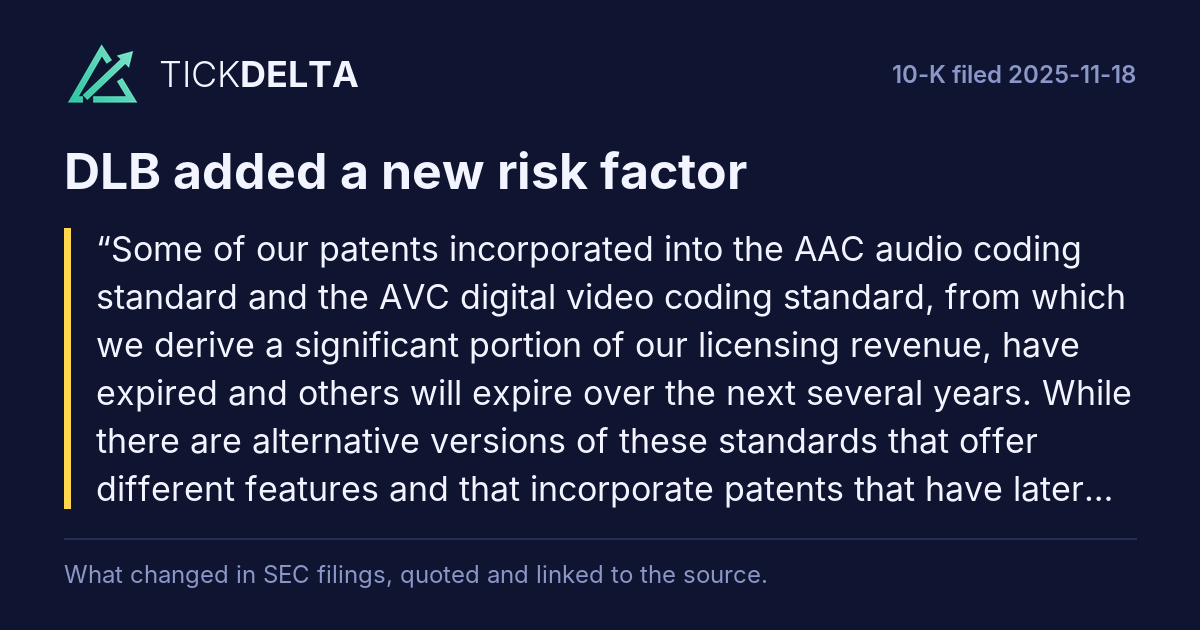
Some of our patents incorporated into the AAC audio coding standard and the AVC digital video coding standard, from which we derive a significant portion of our licensing revenue, have expired and others will expire over the next several years. While there are alternative versions of these standards that offer different features and that incorporate patents that have later expirations, licensees may see less value in those alternative versions, resulting in a decrease in royalty revenue. A decrease in royalty revenue may also result in decreased revenue from patent pool administration fees. Our patents are incorporated into newer coding standards that represent successive generations
of technology, such as, in the case of AAC, Extended HE-AAC and, in the case of AVC, HEVC whose patents generally expire later than the AAC and AVC patents and to which many of the AAC and AVC licensees have, are in the process of, or may in the future transition. However it is not certain that all or most licensees will transition to such newer technologies.
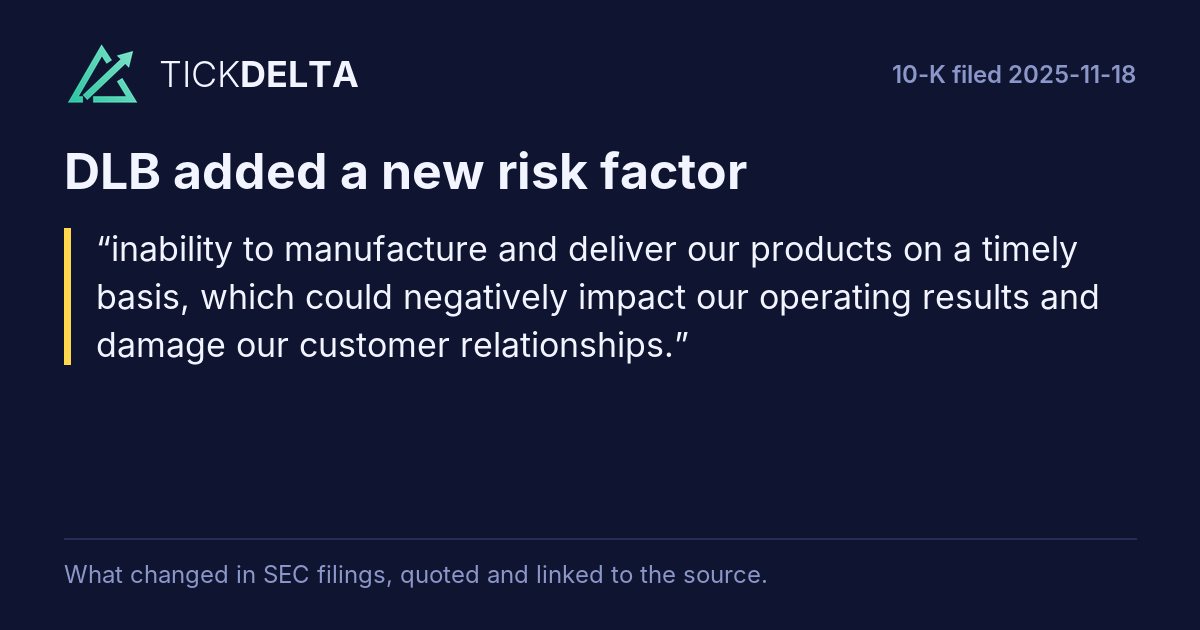
inability to manufacture and deliver our products on a timely basis, which could negatively impact our operating results and damage our customer relationships.
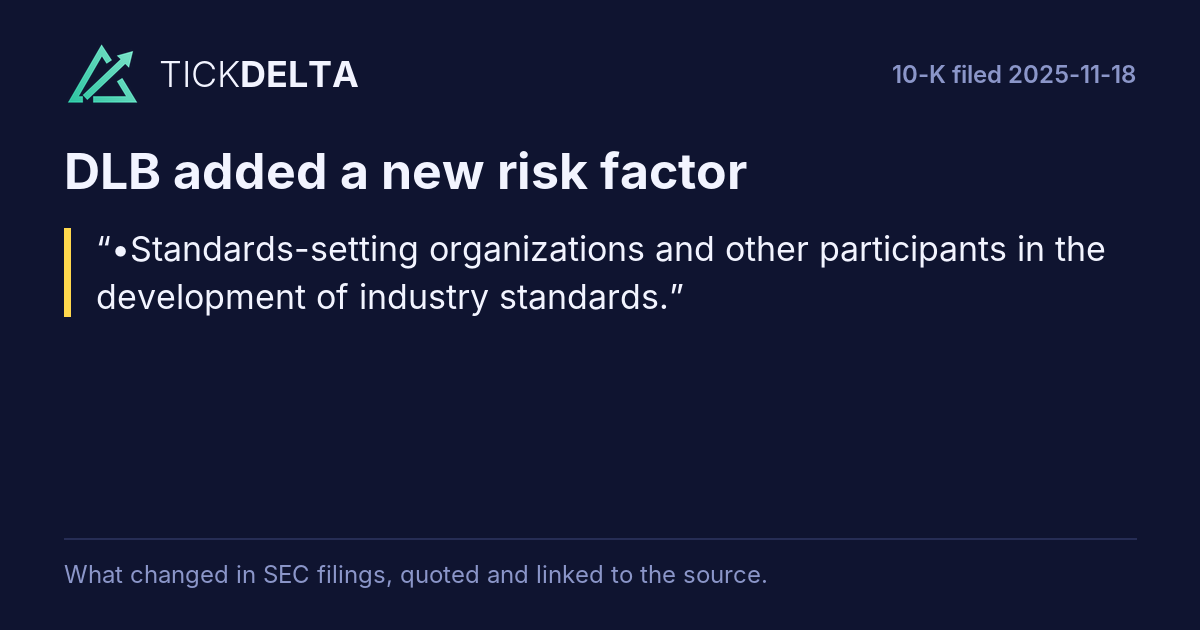
•Standards-setting organizations and other participants in the development of industry standards.
industry participants may be less likely to purchase and use our technologies, products, and services, create content incorporating our technologies, or develop standards that incorporate our technologies.
The process of integrating an acquired company, business, or technology into our organization may create challenges to our business, including:
Adverse changes to tariffs, trade agreements, and trade policies may have a negative effect on our business and results of operations. The United States and other countries in our supply chain or in which we have sales have imposed and may impose additional tariffs and other trade regulations, or may adversely adjust prevailing tariff levels and other trade restrictions. We rely on contract manufacturers and component suppliers, some of which are located outside of the United States, and we export our products to and license our technology in foreign countries. As such, newly implemented tariffs and potential future tariffs or other trade barriers could, directly or indirectly, increase the cost or time required to produce or deliver our products and may increase the costs associated with licensing our technology. Our results may also be impacted indirectly by the imposition of tariffs and other trade barriers on our customers and licensees. If the cost to manufacture products that incorporate our technology, such as consumer electronics or cars, is increased as a result of tariffs, it may exert general pricing pressure which could lead manufacturers to discontinue including our technology in their products or to seek price reductions. If the costs or lead
times associated with exporting licensees’ products or the components thereof result in higher prices or longer lead times for end consumers, sales of those products may decrease and thus royalty payments to us based on unit shipments may decrease. More generally, the imposition of tariffs and the outbreak of a trade war may lead to general negative economic effects, such as decreased consumer demand, recession or the elevated risk of recession, or higher inflationary pressures, which could adversely impact our business and results of operations.
Maintaining a credit facility and future debt obligations could adversely affect our business and financial condition. We maintain a revolving credit facility (the “Credit Facility”) with Bank of America, N.A. which is currently undrawn. The Credit Facility provides us with an additional source of capital and liquidity, but maintaining a debt facility inevitably presents certain risks. We are subject to certain covenants and other obligations under the Credit Facility, such as maintaining a required gross leverage ratio, avoiding certain liens and paying commitment fees. Our failure to comply with these covenants could result in the declaration of an event of default and cause us to be unable to borrow under the Credit Facility or result in the acceleration of the maturity of any indebtedness thereunder. In the event we draw on the Credit Facility, our debt obligations could adversely impact us by, for example, requiring us to use a large portion of our cash flow to service the debt, which would reduce the amount of cash flow available to fund working capital, capital expenditures, and other business activities. Borrowing under the Credit Facility would also increase our exposure to interest rate risk from variable rate indebtedness.
New in the latest 10-Q
12 paragraphs in the 10-Q filed Jul 30, 2026 with nothing like them in the 10-Q filed Apr 30, 2026 (at least half the words must differ; new numbers alone do not count). Quoted exactly, grouped by the item heading above them. This is text that changed, not a judgement of how serious it is.
2026 2025 Operating activities: Net income including noncontrolling interest $ 178,349 $ 206,838 Adjustments to reconcile net income to net cash provided by operating activities: Depreciation and amortization 70,842 65,829 Stock-based compensation 98,883 97,462 Amortization of operating lease right-of-use assets 7,889 8,193 Provision for credit losses 4,244 2,582 Deferred income taxes 1,542 (9,146) Share of net income of equity method investees, net of cash distributions (7,602) 1,845 Other non-cash items affecting net income (1,289) (429) Changes in operating assets and liabilities: Accounts receivable, net 1,489 15,234 Contract assets, net (28,442) (6,902) Inventories 6,512 4,020 Operating lease right-of-use assets (17,547) (1,717) Prepaid expenses and other assets (31,999) 28,003 Accounts payable and accrued liabilities 35,611 (48,979) Income taxes, net (2,771) 1,895 Contract liabilities 1,620 (1,061) Operating lease liabilities 9,036 (8,237) Other non-current liabilities (11,600) (6,063) Net cash provided by operating activities 314,767 349,367 Investing activities: Proceeds from sales of marketable securities — 15,911 Proceeds from sale of assets held for sale — 16,881 Purchases of property, plant, and equipment (28,681) (20,104) Business combinations, net of cash and restricted cash acquired, and other related payments — (1,362) Purchases of intangible assets (42,575) — Proceeds from sale of intangible assets 16,623 — Net cash provided by/(used in) investing activities (54,633) 11,326 Financing activities: Proceeds from issuance of common stock 24,685 38,681 Repurchase of common stock (200,001) (89,990) Payment of excise tax on repurchase of common stock — (261) Payment of cash dividend (102,659) (95,010) Distributions to noncontrolling interest (1,640) (1,449) Shares repurchased for tax withholdings on vesting of restricted stock (33,113) (35,154) Net cash used in financing activities (312,728) (183,183) Effect of foreign exchange rate changes on cash, cash equivalents, and restricted cash (1,881) 1,302 Net increase/(decrease) in cash, cash equivalents, and restricted cash (54,475) 178,812 Cash, cash equivalents, and restricted cash at beginning of period 793,361 577,752 Cash, cash equivalents, and restricted cash at end of period $ 738,886 $ 756,564 Supplemental disclosure: Cash paid for income taxes, net of refunds received $ 57,327 $ 58,520 Non-cash investing activities and financing activities: Change in property, plant, and equipment purchased, unpaid at period-end $ (1,512) $ 10,738 Accrual of unpaid stock repurchase excise tax 1,088 —
Read in the 10-Q
Environmental Credits and Environmental Credit Obligations. In May 2026, the FASB issued ASU 2026-02, Environmental Credits and Environmental Credit Obligations (Topic 818), which establishes guidance for the recognition, measurement, presentation, and disclosure of environmental credits and environmental credit obligations. This standard will be effective for Dolby's annual period beginning September 30, 2028, including interim periods
Read in the 10-Q
within that annual period, and required to be adopted retrospectively through a cumulative-effect adjustment to the opening balance of retained earnings as of the beginning of the annual reporting period of adoption, with early adoption permitted. We do not expect the adoption of this standard to have a material impact on our consolidated financial statements.
Read in the 10-Q
June 26, 2026 September 26, 2025 Intangible Assets, Net Cost Accumulated Net Cost Accumulated Net
Read in the 10-Q
Payments Due By Fiscal Period Remainder of Fiscal Fiscal Fiscal Fiscal Fiscal Thereafter Total
Read in the 10-Q
delivery, personalization, and customizable on-screen presentation. Dolby OptiView Ads integrates with advertising platforms like Google Ad Manager.
Read in the 10-Q
As the world of streaming audiovisual content continues to evolve, understanding and engaging viewers presents a challenge for content creators and distributors. We are partnering with our Dolby OptiView customers to develop a solution that increases engagement and delivers value.
Read in the 10-Q
We, together with our patent pool partners, continue to make progress in licensee expansion across our video programs. In July 2026, Access Advance announced that Meta Platforms, Inc. one of the world’s largest distributors of video content across its social media platforms, joined the VDP, HEVC, and VVC programs as a licensee. Also in July, Access Advance announced that Alibaba expanded their VDP license to cover their full video ecosystem. In the third quarter of fiscal 2026, eight new licensors joined Access Advance’s VDP program, including Sharp, Digital Insights and Hanwha, 25 new licensees joined the HEVC program, and six new licensees joined the VVC program, including Samsung and Sharp. Dolby is a licensor in the VDP, HEVC and VVC programs.
Read in the 10-Q
We are initially focusing on live sports as a key vertical. We are delivering solutions to improve the streaming experience and drive fan engagement, which is a top priority for the sports industry. These solutions include ultra-low latency streaming of audiovisual content, which enables more interactivity around live content for fantasy sports, betting, communal viewing, and many other benefits; and optimized advertising delivery which increases revenue by delivering ads that are personalized to viewers and more integrated with the content they are watching.
Read in the 10-Q
In the third quarter of fiscal 2026, Roberts Communications Network, the largest horse racing streaming provider in the U.S., agreed to use Dolby OptiView for ultra-low latency video streaming. In addition, Google announced that Dolby OptiView Ads has been certified through their Ad Manager Technology Partner program. The certification recognizes the performance and monetization improvements that Dolby OptiView Ads delivers when integrated with Google Ad Manager, and creates an opportunity to partner with Google to reach their Google Ad Manager customers more efficiently and with the benefit of Google’s endorsement.
Read in the 10-Q
Factor Products and Services Revenue Gross Margin Products â Lower cinema products revenue â Lower gross margin primarily due to lower cinema products revenue Services ßà No significant fluctuations á Higher gross margin primarily due to lower Dolby Cinema warranty and maintenance costs ────────────────────────────────────────────────────────────────────────────────────────────────────────────────────────────────────────────────────────────────────────────────────────────────
Read in the 10-Q
Year-To-Date: Q3 2026 vs. Q3 2025 Category Key Drivers Systems, Telecom, and Computer Equipment á Higher costs of $1.6 million primarily due to higher spend on IT costs and cloud computing costs ─────────────────────────────────────────────────────────────────────────────────────────────────────────────────────────────────────────────────────────────────── Various á Higher salaries expense and stock-based compensation expense, offset by lower consulting costs
Read in the 10-Q
Item 1A of the 10-Q filed Jul 30, 2026 against Item 1A of the 10-K filed Nov 18, 2025.
A 10-Q repeats only the risks that changed, so a 10-K paragraph that is missing from it is not counted as removed.
Added is a paragraph with nothing like it in the 10-K, Reworded a sentence that is in both with several words changed,
Quiet changes a sentence in both where one to four words changed and one is a hedge or a modal
(cut words struck through, new words highlighted).
Text on the page, not a score; each links to the filing at sec.gov.
The first 18 of 38 are shown (at most 12 of each type).
Two-word phrases in Risk Factors of the 10-K filed Nov 18, 2025 that are in none of the 1 earlier 10-Ks stored, back to Nov 19, 2024
Used at least twice, small words left out. Counted, not picked: a phrase can be new because the company renamed something.
9 paragraphs of last year's Risk Factors with nothing like them now. The longest are quoted.
Item 1A of each 10-K and 10-Q on EDGAR, quoted exactly. Each paragraph links to the filing at sec.gov.
10-K change: what was reworded or cut, section by section.
Excel workbook · CSV. Google Sheet that stays up to date: paste =IMPORTDATA("https://tickdelta.com/company/DLB/export.csv") into a cell.