DNOW Inc. DNOW
New risk paragraphs, branching off last year
Each branch is a paragraph in Risk Factors with nothing like it in the 10-K filed Feb 18, 2025. A box jumps to the paragraph as filed, below.
Paragraphs with nothing like them in last year's 10-K
64 paragraphs in Risk Factors of the 10-K filed Feb 26, 2026 with nothing like them in the 10-K filed Feb 18, 2025. Quoted exactly. Paragraphs that were only edited are under 10-K change.
The following is a summary of the certain risks that we believe apply to our business and the industry in which we operate:
•Demand for our gas utilities products and services depends on our customers’ capital investment programs, which may be reduced or delayed.
•General economic and geopolitical conditions may adversely affect our business.
•We may be adversely impacted by holding more inventory than can be sold in a commercial time frame.
•We may be unable to successfully execute or effectively integrate acquisitions.
•We may continue to experience challenges with the stabilization of the U.S. ERP system inherited from MRC Global.
•Interruptions in the proper functioning of our information systems, including as a result of cyber incidents, deficiencies in our cybersecurity or disruptions involving third-party service providers, could compromise data, disrupt operations, impair financial reporting, expose us to liability and regulatory scrutiny, and adversely affect our financial results and the market price of our stock.
Show the other 11
•We may not be able to successfully integrate the business of MRC Global into our business or realize the anticipated benefits of the mergers.
•MRC Global may initially operate outside our existing control environment, and delays in integrating their systems and processes could expose us to control deficiencies and financial reporting risks.
•The failure to successfully combine the businesses of DNOW and MRC Global may adversely affect our business.
•The future results of DNOW following the merger will suffer if the combined company does not effectively manage its expanded operations.
•The financial forecasts disclosed in connection with the merger are based on various assumptions that may not be realized.
•The combined company’s ability to use the existing U.S. federal capital loss carryforwards, net operating loss carryforwards and other tax attributes could be limited.
•We are a defendant in asbestos-related lawsuits. Exposure to these and any future lawsuits could have a material adverse effect on us.
Demand for our gas utilities products and services depends on our customers’ capital investment programs, which may be reduced or delayed.
Gas utilities must obtain regulatory approval for many infrastructure and maintenance projects. As a result, our revenues depend in part on the timing and magnitude of our customers’ capital expenditure programs. Regulatory delays, adverse rate case outcomes, political considerations, or changes in economic conditions may cause utilities to postpone, scale back, or cancel projects. Any such reductions or delays could reduce demand for our products and services and materially adversely affect our business.
We may be adversely impacted by holding more inventory than can be sold in a commercial time frame.
A fundamental aspect of our business is to have inventory available for customers when they need it. If we over-estimate the amount of inventory that can be sold in a commercial time frame or if market demand for a product drops unexpectedly, we may be forced to sell the product at substantially lower prices, scrap the product or write down its carrying value. This can adversely impact our business.
A meaningful portion of our business also depends on project-based activity that can be cyclical and susceptible to delay or cancellation. Our results may fluctuate based on the timing of contract awards, project start dates, scope changes, execution schedules and completion timelines. Delays in obtaining awards, shifts in project timing, extended development cycles or cancellations can result in significant period-to-period volatility in our revenue, operating results, financial condition and cash flows.
Many of these projects directly or indirectly involve complex design, engineering, financing, permitting, procurement and construction phases that can occur over extended time periods, sometimes several years. We have encountered, and may continue to encounter, project delays, cost increases, supply-chain or labor constraints, and other execution challenges. If we are unable to effectively manage these risks, accurately estimate costs, or recover increases through contractual protections or change orders, our margins and competitive position could be negatively impacted.
•complications and issues resulting from the integration/conversion of ERP systems, including data-migration errors or loss of information, disruption across order-to-cash and procure-to-pay processes (for example, order entry, inventory visibility, shipping and receiving, invoicing and collections and vendor payments), instability of customer and supplier integrations, the need for manual workarounds, increased error rates and delays and the risk that anticipated benefits are delayed or not realized);
We may continue to experience challenges with the stabilization of the U.S. ERP system inherited from MRC Global.
Prior to the Mergers, MRC Global had commenced the implementation of its new cloud-based ERP system for the U.S. segment. The combined company continues to address configuration, data-migration and stabilization matters arising from that implementation. Large-scale implementations are complex and may require extended stabilization. Disruptions or deficiencies in configuration, data migration, testing or deployment—or in related change-management—could adversely affect order-to-cash and procure-to-pay processes (e.g., order entry and fulfillment, inventory visibility, shipping/receiving, pricing and invoicing, collections, vendor payments, and customer/supplier integrations). During stabilization, manual workarounds and reconciliations may increase errors, delays and costs, and could delay synergy realization.
The integration of disparate systems also present risks of data-migration errors, loss or corruption of information, interface failures between legacy and new applications, and limitations in underlying infrastructure or third-party services. These issues could cause service interruptions, missed obligations, shipment delays, inventory imbalances, customer or supplier dissatisfaction, and negatively affect revenues, margins, cash flows and working capital. The complexity of changes may heighten cybersecurity and privacy risks and make incidents harder to detect, contain and remediate, requiring significant remediation and recovery efforts.
These system changes also affect our financial reporting environment. During and after stabilization, we may experience control design or operating deficiencies, increased reliance on manual procedures and higher remediation and audit costs. If we are unable to timely design, implement and maintain effective ICFR and disclosure controls, we could record audit adjustments, delay external reporting, or identify one or more material weaknesses, which could trigger regulatory scrutiny or litigation and adversely affect investor confidence and financing costs.
We depend on qualified personnel and implementation partners. Resource shortages, turnover, competing integration priorities, vendor performance issues or technical constraints could extend timelines, increase costs or force re-sequencing. We may not realize expected efficiencies, cost savings or other benefits, or such benefits may be delayed. Failure to effectively stabilize and integrate the ERP and other core systems on schedule and within budget could adversely affect our business, financial condition, results of operations and cash flows. See “Controls and Procedures” (Part II, Item 9A) and “Cybersecurity” (Part I, Item 1C).
Interruptions in the proper functioning of our information systems, including as a result of cyber incidents, deficiencies in our cybersecurity or disruptions involving third-party service providers, could compromise data, disrupt operations, impair financial reporting, expose us to liability and regulatory scrutiny, and adversely affect our financial results and the market price of our stock.
The proper functioning of our information systems is critical to the successful operation of our business. We increasingly rely on complex information technology systems and third-party service providers to process orders, track credit risk, manage inventory, monitor accounts receivable collections, purchase products from our vendors, ship products to our customers on a timely basis and maintain cost-effective operations. Any failure, interruption, or deficiency in these systems—including those caused by natural disasters, power losses, telecommunications failures, significant system changes (such as the stabilization of MRC Global's U.S. ERP system), security breaches, cyber incidents, or other disruptive events—could impair our ability to procure products, process and ship orders, maintain inventory levels, collect receivables or pay obligations, and could hinder our ability to integrate our systems with those of our customers.
As our reliance on technology has increased, so have the risks to our systems, whether internal or those operated by third parties. Cyber incidents—such as unauthorized access, data corruption, system disruption, theft of confidential or proprietary information and the misuse or malicious use of artificial intelligence—continue to grow in frequency and sophistication. Additionally, the rapid evolution and increased availability of artificial intelligence and machine learning technologies may intensify cybersecurity risks by making targeted attacks more sophisticated and cybersecurity incidents more difficult to detect, contain and mitigate. These events could result in operational interruptions, exposure of private data, financial loss, reputational harm, legal claims, and regulatory scrutiny. They could also impair our financial reporting processes, potentially resulting in unreliable financial data or delays in our ability to produce required filings.
Although we maintain programs intended to identify, assess and manage these risks, including controls designed to protect against unauthorized access and program changes, no controls can eliminate all risk. Our security measures may be undermined by evolving technologies, actions of outside parties, employee error, malfeasance or other factors. A significant systems failure or cyber incident could require substantial remediation costs, result in the loss of critical data, interrupt our ability to manage inventories or process transactions, reduce customer loyalty, and expose us to liability. Any such event could adversely affect our results of operations, cash flows, financial condition and the market price of our stock. See Cybersecurity (Part I, Item 1C of this Form 10-K).
We have now and will likely continue to have indebtedness. As of December 31, 2025, we had total debt outstanding of $411 million and $424 million in aggregate availability under our senior secured revolving credit facility. We may incur significant additional indebtedness in the future. If new indebtedness is added to our current indebtedness, the risks described below could increase. Our significant level of indebtedness could have important consequences, such as:
•limiting our ability to obtain additional financing to fund our working capital, acquisitions, expenditures, debt service requirements or other general corporate purposes;
•limiting our ability to use operating cash flow in other areas of our business because we must dedicate a substantial
•limiting our ability to compete with other companies who are not as highly leveraged;
•subjecting us to restrictive financial and operating covenants in the agreements governing our and our subsidiaries’ long-term indebtedness;
•exposing us to potential events of default (if not cured or waived) under financial and operating covenants contained in our or our subsidiaries’ debt instruments that could have a material adverse effect on our business, results of operations and financial condition;
•increasing our vulnerability to a downturn in general economic conditions or in pricing of our products; and
•limiting our ability to react to changing market conditions in our industry and in our customers’ industries.
Our ability to make scheduled debt payments, to refinance our obligations with respect to our indebtedness and to fund capital and non-capital expenditures necessary to maintain the condition of our operating assets, properties and systems software, as well as to provide capacity for the growth of our business, depends on our financial and operating performance. Our business may not generate sufficient cash flow from operations, and future borrowings may not be available to us under our credit facility in an amount sufficient to enable us to pay our indebtedness or to fund our other liquidity needs. We may seek to sell assets to fund our liquidity needs but may not be able to do so. We may also need to refinance all or a portion of our indebtedness on or before maturity. We may not be able to refinance any of our indebtedness on commercially reasonable terms or at all.
In addition, we are and will be subject to covenants contained in agreements governing our present and future indebtedness. These covenants include and will likely include restrictions on operations, business and capital flexibility.
For a description of our revolving credit facility and indebtedness, see Management’s Discussion and Analysis of Financial Condition and Results of Operations (Part II, Item 7 of this Form 10-K).
We may not be able to successfully integrate the business of MRC Global into our business or realize the anticipated benefits of the mergers.
The mergers involved the combination of two companies that previously operated as independent public companies. The combination of two independent businesses is complex, costly and time consuming, and we are devoting significant management attention and resources to integrating the business practices and operations of MRC Global into us. Potential difficulties that we may encounter as part of the integration process, which are heightened while ERP and related core systems are being integrated and stabilized, include the following:
•the inability to successfully combine our business and MRC Global in a manner that permits the combined company to achieve, on a timely basis, or at all, the enhanced revenue opportunities and cost savings and other benefits anticipated to result from the mergers;
•complexities associated with managing the combined businesses, including difficulty addressing possible differences in operational philosophies and the challenge of integrating complex systems, technology, networks and other assets of each of the companies in a seamless manner that minimizes any adverse impact on customers, suppliers, employees and other constituencies, including the ongoing stabilization of MRC Global’s ERP and other core business systems (including configuration and stabilization matters arising from MRC Global’s pre-merger U.S. ERP implementation), which could result in operational disruptions, increased costs and delays in realizing anticipated synergies;
•the assumption of contractual obligations with less favorable or more restrictive terms; and
•potential unknown liabilities and unforeseen increased expenses associated with the mergers.
Any of these issues could adversely affect our ability to maintain relationships with customers, suppliers, employees and other constituencies, our ability to achieve the anticipated benefits of the mergers, our earnings or our business and financial results following the mergers. We have already experienced operational disruptions attributable to ERP stabilization matters inherited from MRC Global, including challenges affecting our ability to provide financial guidance, and there can be no assurance that additional disruptions will not occur as we continue the conversion and integration process.
MRC Global may initially operate outside our existing control environment, and delays in integrating their systems and processes could expose us to control deficiencies and financial reporting risks.
Newly acquired operations may temporarily function without full alignment to our established control structure, and the process of integrating their financial reporting systems, policies, and procedures may take significant time and resources. During this transition period, we may identify deficiencies in disclosure controls and procedures or internal control over financial reporting (“ICFR”) that, if not remediated timely, could affect the reliability or timeliness of our financial reporting. These risks are heightened while we stabilize MRC Global’s U.S. ERP—including addressing configuration and data-integrity matters—and integrating other core systems with ours, which may require manual workarounds, data-reconciliation efforts, system reconfiguration and additional remediation costs during an extended stabilization period. Any such deficiencies, or any material weaknesses identified during or after integration, could increase the risk of errors in our financial statements, lead to audit adjustments, limit our ability to conclude that our controls are effective, or expose us to litigation or regulatory scrutiny and could delay or complicate our SEC reporting. We refer you to Controls and Procedures (Part II, Item 9A of this Form 10-K) for additional information regarding the scope of our ICFR assessment and the treatment of recently acquired businesses.
The failure to successfully combine the businesses of DNOW and MRC Global may adversely affect our business.
The success of the merger will depend, in part, on our ability to realize the anticipated benefits from combining our business with MRC Global. To realize these anticipated benefits, our and MRC Global’s businesses must be successfully combined. If the combined company is not able to achieve these objectives, the anticipated benefits of the mergers may not be realized fully or at all or may take longer to realize than expected. In addition, the actual integration may result in additional and unforeseen expenses, which could reduce the anticipated benefits of the mergers, and such integration may not be successful or may take longer than anticipated. It is possible that the integration process could result in the loss of key employees, as well as the disruption of our ongoing businesses or inconsistencies in our standards, controls, procedures and policies. Any or all of those occurrences could affect adversely the combined company’s ability to maintain relationships with customers and employees after the mergers or to achieve the anticipated benefits of the mergers. Integration efforts between the two companies will also divert management attention and resources. These integration matters could have an adverse effect on us.
The future results of DNOW following the merger will suffer if the combined company does not effectively manage its expanded operations.
Following the merger, the size of the business of the combined company increased significantly. The combined company’s future success will depend, in part, upon its ability to manage this expanded business, which will pose substantial challenges for management, including challenges related to the management and monitoring of new operations and associated increased costs and complexity. The combined company may also face increased scrutiny from governmental authorities as a result of the significant increase in the size of its business. There can be no assurances that the combined company will be successful or that it will realize the expected operating efficiencies, cost savings, revenue enhancements or other benefits currently anticipated from the mergers.
The financial forecasts disclosed in connection with the merger are based on various assumptions that may not be realized.
The financial estimates disclosed in connection with the mergers were based on assumptions of, and information available to, our management when prepared, and these estimates and assumptions are subject to uncertainties, many of which are beyond our control and may not be realized. Many factors will be important in determining the future results following the mergers. As a result of these contingencies, actual future results may vary materially from our estimates. In view of these uncertainties, these financial estimates should not be viewed as a representation that the forecasted results will necessarily reflect actual future results.
Our financial estimates were not prepared with a view toward public disclosure, and such financial estimates were not prepared with a view toward compliance with published guidelines of any regulatory or professional body. Further, any forward-looking statement speaks only as of the date on which it is made, and we do not undertake any obligation, other than as required by applicable law, to update the financial estimates to reflect events or circumstances after the date those financial estimates were prepared or to reflect the occurrence of anticipated or unanticipated events or circumstances.
The combined company’s ability to use the existing U.S. federal capital loss carryforwards, net operating loss carryforwards and other tax attributes could be limited.
DNOW had approximately $157 million of U.S. federal net operating loss (“NOL”) carryforwards (among other U.S. tax attributes) as of December 31, 2025 of which $20 million was recognized by MRC Global and succeeded to DNOW as a result of the mergers. The NOL carryforwards have no expiration date. In addition, MRC Global had approximately $111 million of U.S. federal capital loss (“CL”) carryforwards that carried over to DNOW, which will expire in 2028. The combined company’s ability to utilize such U.S. NOL carryforwards, CL carryforwards and certain other U.S. tax attributes to reduce future income subject to U.S. federal income tax
may be subject to certain limitations, including under Sections 382 and 383 of the Code in the event of an “ownership change” within the meaning of the Code.
As a result of the mergers, MRC Global is expected to undergo such an ownership change. Accordingly, the utilization of MRC Global’s NOL and CL carryforwards is expected to be subject to an annual limitation under the Code. However, the impact of such limitation is not expected to be material since MRC Global believed it was more likely than not that the U.S. federal CL carryforwards would not have been realized prior to the mergers and had offset the benefit with a corresponding valuation allowance which DNOW is maintaining following the mergers. In addition, while DNOW is not expected to undergo an ownership change as a result of the mergers, such mergers could contribute to an ownership change now or in the future. However, based on current expectations, any limitation that may be imposed as a result of an ownership change is not expected to have a material impact on the combined company’s ability to utilize DNOW’s U.S. federal NOL carryforwards.
business or results of operations, we cannot predict further developments, and such existing or future tariffs could have a material adverse effect on our results of operations, financial position and cash flows.
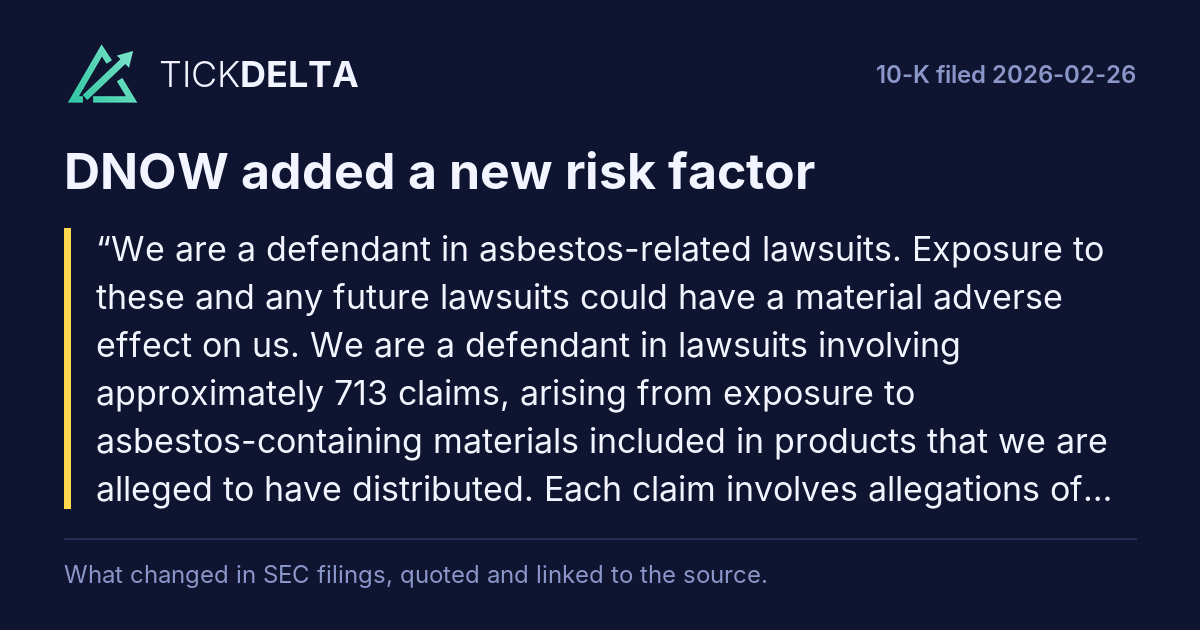
We are a defendant in asbestos-related lawsuits. Exposure to these and any future lawsuits could have a material adverse effect on us.
We are a defendant in lawsuits involving approximately 713 claims, arising from exposure to asbestos-containing materials included in products that we are alleged to have distributed. Each claim involves allegations of exposure to asbestos-containing materials by a single individual, his or her spouse or family members. The complaints in these lawsuits typically name many other defendants. In the majority of these lawsuits, little or no information is known regarding the nature of the plaintiffs’ alleged injuries or their connection with the products we distributed. The potential liability associated with asbestos claims is subject to many uncertainties, including negative trends with respect to settlement payments, dismissal rates and the types of medical conditions alleged in pending or future claims, negative developments in the claims pending against us, the current or future insolvency of co-defendants, adverse changes in relevant laws or the interpretation of those laws and the extent to which insurance will be available to pay for defense costs, judgments or settlements. In addition, applicable insurance policies are subject to overall caps on limits, which coverage may exhaust the amount available from insurers under those limits. In those cases, the Company is seeking indemnity payments from responsive excess insurance policies, but other insurers may not be solvent or may not make payments under the policies without contesting their liability. Further, while we anticipate that additional claims will be filed against us in the future, we are unable to predict with any certainty the number, timing and magnitude of future claims. Therefore, pending or future asbestos litigation may ultimately have a material adverse effect on us. See Management’s Discussion and Analysis of Financial Condition and Results of Operations (Part II, Item 7 of this Form 10-K), Legal Proceedings (Part I, Item 3 of this Form 10-K) and Note 14 “Commitments and Contingences” of the Notes to Consolidated Financial Statements (Part IV, Item 15 of this Form 10-K) for more information.
Paragraphs in the 10-Q filed Nov 5, 2026 that were not in the one before
New in the latest 10-Q
5 paragraphs in the 10-Q filed Nov 5, 2026 with nothing like them in the 10-Q filed Aug 6, 2026 (at least half the words must differ; new numbers alone do not count). Quoted exactly, grouped by the item heading above them. This is text that changed, not a judgement of how serious it is.
Financial statements and notes
Long-lived assets, other than goodwill and indefinite-lived intangibles, include property, plant and equipment, operating right-of-use (“ROU”) assets and identified intangible assets with finite lives. The Company evaluates the recoverability of long-lived assets for possible impairment whenever events or circumstances indicate that the carrying amount of such assets may not be recoverable.
Read in the 10-Q
• Gas Utilities: regulated natural gas utilities and infrastructure, including local gas distribution, transmission and storage, residential and commercial gas meters and metering infrastructure, pipeline integrity and modernization, utility construction and maintenance and related gas infrastructure serving residential, commercial and industrial customers
Read in the 10-Q
such as carbon capture, sequestration and storage and hydrogen. However, as U.S. government support continues to decline for these types of projects, European government support continues.
Read in the 10-Q
We believe Adjusted EBITDA provides investors with a helpful measure for comparing our operating performance with the performance of other companies that may have different financing and capital structures or tax rates. We believe it is a useful indicator
Read in the 10-Q
Item 4
Item 5. Other Information Insider Trading Arrangements and Policies During the three months ended September 30, 2026, the following officer (as defined in Rule 16a-1(f) of the Exchange Act) adopted a “Rule 10b5-1 trading arrangement”, as defined in Item 408 of Regulation S-K, for the sale of our common stock. Trading arrangements were entered into during an open insider trading window and are intended to satisfy the affirmative defense of Rule 10b5-1(c) under the Exchange Act and our policies regarding transactions in our securities. Shares in the 10b5-1 trading arrangement that are subject to restricted stock awards (“RSAs”) and performance share awards (“PSAs”) may only be traded following satisfaction of applicable vesting requirements. In addition, because of the achievement of performance conditions, pricing (such as future share price targets), and timing in the 10b5-1 trading arrangement, it is not yet determinable how many shares actually will be sold under the trading arrangement prior to its expiration date. On August 21, 2026, Mark Johnson, Senior Vice President and Chief Financial Officer, entered into a Rule 10b5-1 trading arrangement that is scheduled to expire no later than March 31, 2028. The trading arrangement provides for the potential sale of up to 95,000 shares currently held by Mr. Johnson and the potential sale of up to 203,937 shares from underlying unvested RSAs and PSAs that are scheduled to vest on February 21, 2027 and February 25, 2028 following satisfaction of applicable vesting requirements. The value of the unvested PSAs reflect the maximum potential performance payout of 200% of target. If actual performance yields fewer shares, the trading arrangement will execute, in accordance with its terms, only on the number of shares actually delivered at the achieved performance levels.
Read in the 10-Q
The 10-Q's risk factors against the 10-K
Item 1A of the 10-Q filed Nov 5, 2026 against Item 1A of the 10-K filed Feb 26, 2026.
A 10-Q repeats only the risks that changed, so a 10-K paragraph that is missing from it is not counted as removed.
Added is a paragraph with nothing like it in the 10-K, Reworded a sentence that is in both with several words changed,
Quiet changes a sentence in both where one to four words changed and one is a hedge or a modal
(cut words struck through, new words highlighted).
Text on the page, not a score; each links to the filing at sec.gov.
What the 10-Q itself says about its risk factors:The Company and its operations are affected by risks specific to the Company as well as factors that affect all businesses operating in a global market. The significant factors known to the Company that could materially adversely affect its business, financial condition or operating results are contained in Part 1, Item 1A “Risk Factors” in our 2025 Annual Report on Form 10-K for the year ended December 31, 2025.
Read in the 10-Q
1 paragraph in the 10-Q's Item 1A, and none of them adds, rewords or quietly edits a paragraph of the 10-K's.
Phrases used for the first time
Two-word phrases in Risk Factors of the 10-K filed Feb 26, 2026 that are in none of the 1 earlier 10-Ks stored, back to Feb 18, 2025
Where each one is used
- mrc global: •We may continue to experience challenges with the stabilization of the U.S. ERP system inherited from MRC Global.
- anticipated benefits: •We may not be able to successfully integrate the business of MRC Global into our business or realize the anticipated benefits of the mergers.
- combined company’s: •The combined company’s ability to use the existing U.S. federal capital loss carryforwards, net operating loss carryforwards and other tax attributes could be limited.
- regulatory scrutiny: •Interruptions in the proper functioning of our information systems, including as a result of cyber incidents, deficiencies in our cybersecurity or disruptions involving third-party service providers, could compromise data, disrupt operations, impair financial reporting, expose us to liability and regulatory...
- company’s ability: •The combined company’s ability to use the existing U.S. federal capital loss carryforwards, net operating loss carryforwards and other tax attributes could be limited.
- mrc global’s: •complexities associated with managing the combined businesses, including difficulty addressing possible differences in operational philosophies and the challenge of integrating complex systems, technology, networks and other assets of each of the companies in a seamless manner that minimizes any adverse impact on...
- ownership change: may be subject to certain limitations, including under Sections 382 and 383 of the Code in the event of an “ownership change” within the meaning of the Code.
- erp system: •We may continue to experience challenges with the stabilization of the U.S. ERP system inherited from MRC Global.
Used at least twice, small words left out. Counted, not picked: a phrase can be new because the company renamed something.
What was taken out
7 paragraphs of last year's Risk Factors with nothing like them now. The longest are quoted.
Sources
Item 1A of each 10-K and 10-Q on EDGAR, quoted exactly. Each paragraph links to the filing at sec.gov.
Also
10-K change: what was reworded or cut, section by section.
Work with it
Excel workbook · CSV. Google Sheet that stays up to date: paste =IMPORTDATA("https://tickdelta.com/company/DNOW/export.csv") into a cell.