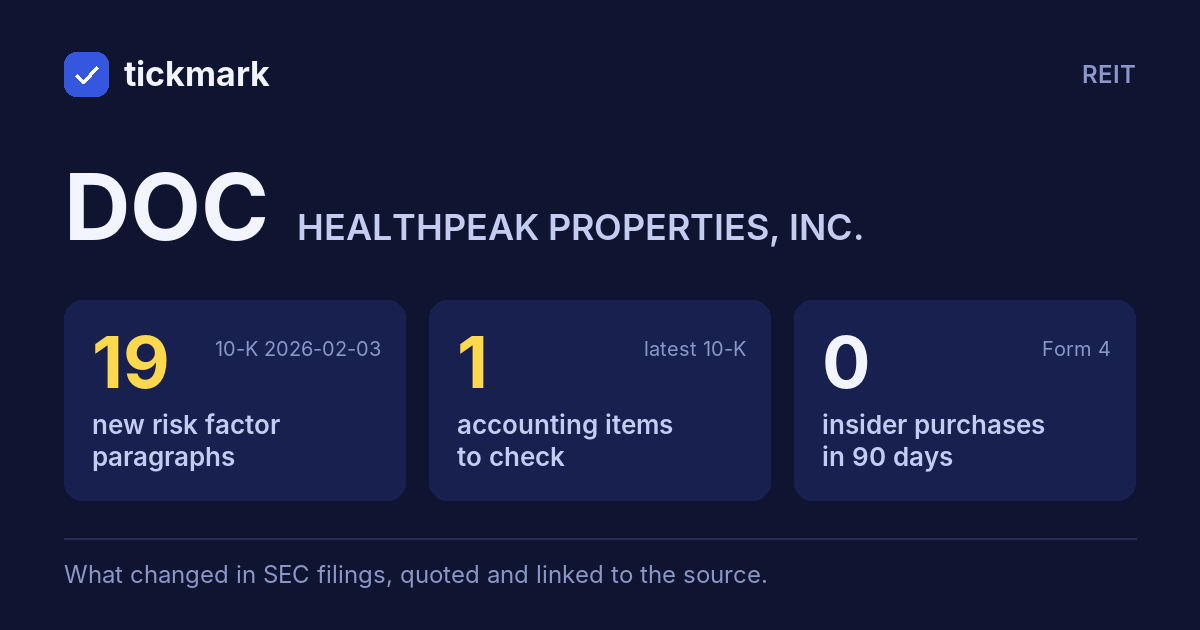
Marked against last year's 10-K:
cut words struck through, new words highlighted and underlined.
MD&A 281 words changed in this paragraph; it is 64% similar to last year's version.
Adjusted FFO (“AFFO”). AFFO is defined as FFO as Adjusted after excluding the impact of the following: (i) stock-based compensation amortization expense, (ii) amortization of deferred financing costs and debt discounts (premiums), (iii) straight-line rents, (iv) deferred income taxes, (v) amortization of above (below) market lease intangibles, net, (vi) non-refundable entrance fees collected in excess of (less than) the related amortization, and (vii) other AFFO adjustments, which include: (a) lease incentive amortization (reduction of straight-line rents), (b) actuarial reserves for insurance claims that have been incurred but not reported, and (c) amortization of deferred revenues, excluding amounts amortized into rental income that are associated with tenant funded improvements owned/recognized by us and up-front cash payments made by tenants to reduce their contractual rents. Also, AFFO is computed after deducting recurring capital expenditures, including second generation leasing costs and second generation tenant and capital improvements (“AFFO capital expenditures”). All adjustments are reflective of our pro rata share of both our consolidated and unconsolidated joint ventures (reported in “other AFFO adjustments”). We reflect our share of AFFO for unconsolidated joint ventures by applying our actual ownership percentage for the period to the applicable reconciling items on an entity by entity basis. We reflect our share for consolidated joint ventures in which we do not own 100% of the equity by adjusting our AFFO to remove the third-party ownership share of the applicable reconciling items based on actual ownership percentage for the applicable periods. See “Nareit FFO” above for further disclosures regarding our use of pro rata share information and its limitations. We believe AFFO is an alternative run-rate performance measure that improves the understanding of our operating results among investors and makes comparisons with: (i) expected results, (ii) results of previous periods, and (iii) results among REITs more meaningful. AFFO does not represent cash generated from operating activities determined in accordance with GAAP and is not indicative of cash available to fund cash needs as it excludes the following items which generally flow through our cash flows from operating activities: (i) adjustments for changes in working capital or the actual timing of the payment of income or expense items that are accrued in the period, (ii) transaction-related costs, (iii) litigation settlement expenses, and (iv) restructuring and severance-related charges. Furthermore, AFFO is adjusted for recurring capital expenditures, which are generally not considered when determining cash flows from operations or liquidity. Other REITs or real estate companies may use different methodologies for calculating AFFO, and accordingly, our AFFO may not be comparable to those reported by other REITs. Management believes AFFO provides a meaningful supplemental measure of our performance and is frequently used by analysts, investors, and other interested parties in the evaluation of our performance as a REIT, and by presenting AFFO, we are assisting these parties in their evaluation. AFFO is a non-GAAP supplemental financial measure and should not be considered as an alternative to net income (loss) determined in accordance with GAAP and should only be considered together with and as a supplement to our financial information prepared in accordance with GAAP. For a reconciliation of net income (loss) to AFFO and other relevant disclosures, refer to “Non-GAAP Financial Measures Reconciliations” below.
Source: Item 7, 10-K 0001628280-26-005044 vs Item 7, 10-K 0001628280-25-003748
Risk Factors 241 words changed in this paragraph; it is 33% similar to last year's version.
Congressional consideration Furthermore, reductions in Medicaid spending and cuts to Medicaid provider rates, the expiration of legislation pertaining to health insurance subsidies under the federal debt ceiling, the Patient Protection and Affordable Care Act, tax reform, along with the Health Care and entitlement programs, Education Reconciliation Act of 2010 (collectively, the “Affordable Care Act”), other potential changes to federal reimbursement policies, and other potential policy initiatives focused on medical care, including site-neutral payments and changes to reimbursement for certain outpatient services, could reduce patient volumes, increase uncompensated care, and put downward pressure on reimbursement rates for physicians, hospitals and outpatient medical facilities, which could have a material an adverse effect on our tenants’, operators’, and borrowers’ liquidity, financial condition, or results of operations. In particular, reduced funding for entitlement programs such as Medicare and Medicaid would could result in increased costs and fees for programs such as Medicare Advantage Plans and additional reductions in reimbursements to providers. Amendments to the Affordable Care Act in whole or in part and decisions by the Centers for Medicare and Medicaid Services could impact the delivery of services and benefits under Medicare, Medicaid, or Medicare Advantage Plans and could affect our tenants and operators and the manner in which they are reimbursed by such programs. Any shutdown of the federal government that delays or disrupts payments or any other material adverse effect on payments to our tenants, operators, or borrowers could adversely affect their ability to satisfy their obligations to us and could have a material adverse effect on us. In addition, changes in federal, state, or local laws affecting the healthcare or life sciences industries, particularly that apply to REITs, or changes in the scope, interpretation, or enforcement of the related regulatory frameworks could adversely affect us or our tenants, operators, or borrowers.
Source: Item 1A, 10-K 0001628280-26-005044 vs Item 1A, 10-K 0001628280-25-003748
Accounting Policies 97 words changed in this paragraph; it is 45% similar to last year's version.
The Company’s fair values of its equity method investments are determined based on discounted cash flow models that include all estimated cash inflows and outflows over a specified holding period and, where applicable, any estimated debt premiums or discounts. Capitalization These fair values are typically determined using an income approach and/or a market approach (comparable sales model), which rely on certain assumptions by management. Determining the fair value of these investments may involve significant judgment to develop forecasted cash flows which utilize observable and unobservable inputs such as market rents, expense rates, forecasted occupancy, capitalization rates, discount rates, expected capital expenditures, and credit spreads utilized in these valuation models are based on assumptions that the Company believes to be within a reasonable range of current market rates for the respective investments. comparable sales data, among other things.
Source: Item 8, Note 2 – Summary of Significant Accounting Policies, 10-K 0001628280-26-005044 vs Item 8, Note 2 – Summary of Significant Accounting Policies, 10-K 0001628280-25-003748
Legal Proceedings 9 words changed in this paragraph; it is 98% similar to last year's version.
In connection with the formation of DownREITs, members may contribute appreciated real estate to a DownREIT in exchange for DownREIT units. These contributions are generally tax-deferred, so that the pre-contribution gain related to the property is not taxed to the member. However, if a contributed property is later sold by the DownREIT, the unamortized pre-contribution gain that exists at the date of sale is specifically allocated and taxed to the contributing members. In many of the DownREITs, the Company has entered into indemnification agreements with those members who contributed appreciated property into the DownREIT. Under these indemnification agreements, if any of the appreciated real estate contributed by the members is sold by the DownREIT in a taxable transaction within a specified number of years, the Company will reimburse the affected members for the federal and state income taxes associated with the pre-contribution gain that is specially allocated to the affected member under the Internal Revenue Code (“make-whole payments”). These make-whole payments include a tax gross-up provision. As of December 31, 2024, 2025, the Company had indemnification agreements on a total of 41 28 properties within its DownREITs. In January 2025, indemnification agreements on 13 properties expired.
Source: Item 3, via Note 12 – Commitments and Contingencies, 10-K 0001628280-26-005044 vs Item 3, via Note 12 – Commitments and Contingencies, 10-K 0001628280-25-003748