Paragraph 232 · 49% changed
Every version of it
Screener
/
SEC EDGAR
/CIK 0001516513
/10-K filed May 19, 2026, compared with May 20, 2025
/Numbers from the XBRL of the 10-Ks
NYSE
Technology · IT Services
Doximity, Inc. DOCS
The 10-K against last year's
98 changes: 31 added, 7 removed, 60 reworded
10-K May 19, 2026 vs May 20, 2025
Risk Factors
10.6%
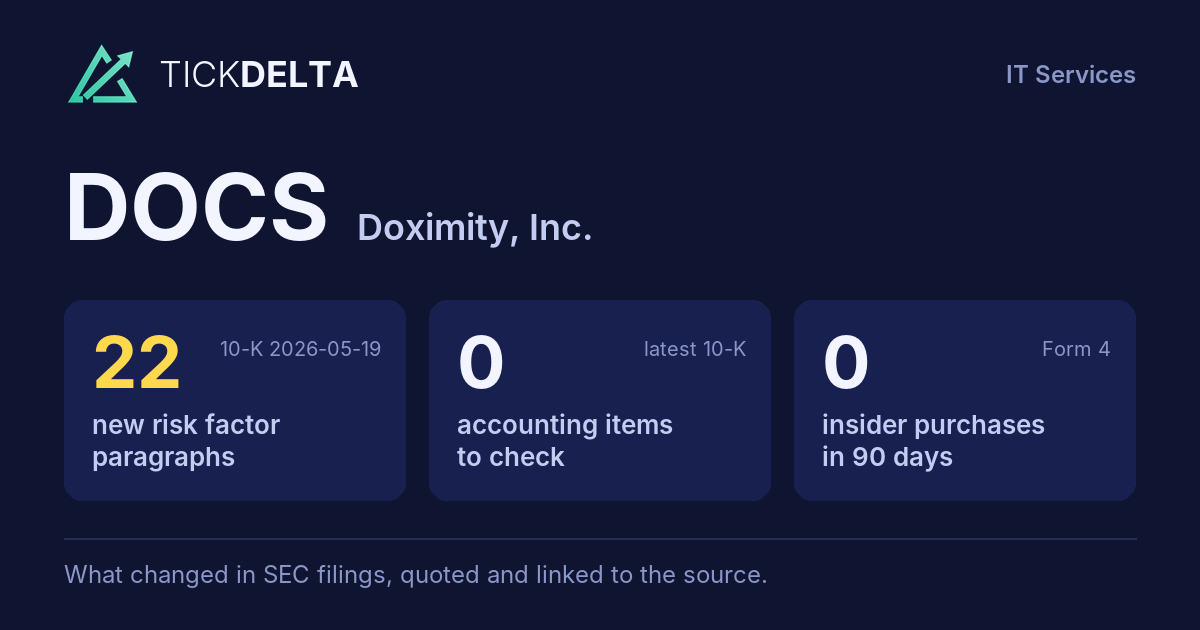
of the text changed · 24,887 words now · 22 new paragraphs, 3 gone
MD&A
15.9%
of the text changed · 6,437 words now · 9 new paragraphs, 4 gone
Legal Proceedings
49.0%
of the text changed · 1,140 words now
Accounting Policies
13.3%
of the text changed · 5,359 words now
10-K 0001516513-26-000025 (May 19, 2026) vs 10-K 0001516513-25-000056 (May 20, 2025)
Every paragraph, and how much of it changed
One bar per paragraph, in the order of the 10-K. Height and colour show the share of its words not in the closest paragraph a year earlier; the tallest bars are new paragraphs.
Risk Factors
289 paragraphs · 22 new · 54 reworded · 3 gone · 10-K May 19, 2026 against May 20, 2025
New paragraph
Reworded (5% of its words or more)
Same or nearly
Paragraph 67 · 48% changed
Every version of it
Paragraph 216 · 48% changed
Every version of it
In the future, we may identify additional third-party intellectual property we may need to license in order to engage in our business, including to develop or commercialize new solutions or services. However, such licenses may not be available on acceptable terms or at all. The licensing or acquisition of third-party intellectual property rights is a competitive area, and several more established companies may pursue strategies to license or acquire third-party intellectual property rights that we may consider attractive or necessary. These established companies may have a competitive advantage over us due to their size, capital resources, and greater development or commercialization capabilities. In addition, companies that perceive us to be a competitor may be unwilling to assign or license rights to us. Even if such licenses are available, we may be required to pay the licensor substantial royalties based on sales of our solutions and services. Such royalties are a component of the cost of our solutions or services and may affect the margins on our solutions and services. In addition, such licenses may be non-exclusive, which could give our competitors access to the same intellectual property licensed to us. If we are unable to enter into the necessary licenses on acceptable terms or at all, if any necessary licenses are subsequently terminated, if our licensors fail to abide by the terms of the licenses, if our licensors fail to prevent infringement by third parties, or if the licensed intellectual property rights are found to be invalid or unenforceable, our business, financial condition, results of operations, and prospects could be affected. If licenses to third-party intellectual property rights are, or become required for us, to engage in our business, the rights may be non-exclusive, which could give our competitors access to the same technology or intellectual property rights licensed to us. Moreover, we could encounter delays and other obstacles in our attempt to develop alternatives. Defense of any lawsuit or failure to obtain any of these licenses on favorable terms could prevent us from commercializing solutions and services, which could harm our competitive position, business, financial condition, results of operations, and prospects.
Paragraph 140 · 47% changed
Every version of it
Additionally, we may not be in a position to exercise sole decision making authority regarding the transaction or arrangement, which could create the potential risk of creating impasses on decisions, and our collaborators may have economic or business interests or goals that are, or that may become, inconsistent with our business interests or goals. It is possible that conflicts may arise with our collaborators, such as conflicts concerning the achievement of performance milestones, or the interpretation of significant terms under any agreement, such as those related to financial obligations or the ownership or control of intellectual property developed during the collaboration. If any conflicts arise with our current or future collaborators, they may act in their self-interest, which may be adverse to our best interest, and they may breach their obligations to us. In addition, we have limited control over the amount and timing of resources that our current collaborators or any future collaborators devote to our collaborators’ or our future solutions. Disputes between us and our collaborators may result in litigation or arbitration which would increase our expenses and divert the attention of our management. Further, these transactions and arrangements are contractual in nature and may be terminated or dissolved under the terms of the applicable agreements and, in such event, we may not continue to have rights to the products relating to such transaction or arrangement or may need to purchase such rights at a premium.
Paragraph 159 · 38% changed
Every version of it
We are subject to income taxes in the United States and Canada and our tax provision could also be impacted by changes in accounting principles and changes in U.S. federal and state or international tax laws applicable to corporations. For example, legislation enacted in 2017, informally titled on July 4, 2025, the Tax Cuts and Jobs Act, One Big Beautiful Bill Act (the “Tax Act” or Tax Act, and “OBBB”) was enacted. Key income tax-related provisions of the Coronavirus Aid, Relief, and Economic Security Act, or CARES Act, OBBB include repeal of 2020 significantly changed how the U.S. Department mandatory capitalization of Treasury imposes income taxes on U.S. corporations. For tax years beginning after December 31, 2021, the Tax Act eliminated the option to deduct domestic research and development expenditures under Internal Revenue Code Section 174 (reinstating full expensing beginning in the current period 2025) and requires taxpayers revisions to capitalize and amortize U.S.-based research and development expenditures over five years. This legislation has accelerated the utilization of our net operating losses and research and development international tax credits in the U.S. federal and state jurisdictions. We made significant judgments and assumptions in the interpretation of these laws and in our calculations reflected in our financial statements. regimes, among other provisions. The U.S. Department of Treasury, the Internal Revenue Service, or the IRS, and other standard-setting bodies may issue additional guidance on how the provisions of the Tax Act and CARES Act will be applied or otherwise administered, and additional accounting guidance or interpretations may be issued in the future that is different from our current interpretation.
Paragraph 50 · 37% changed
Every version of it
Paragraph 78 · 36% changed
Every version of it
Paragraph 194 · 31% changed
Every version of it
Paragraph 232 · 49% changed
Every version of it
10-K May 20, 2025These laws and regulations may change rapidly, and it is frequently unclear how they apply to our business. Any failure of our solutions or services to comply with these laws and regulations could result in substantial administrative, civil, or criminal liability and could, among other things, adversely affect demand for our services, force us to expend significant capital, research and development, and other resources to address the failure, invalidate all or portions of some of our contracts with our customers, require us to change or terminate some portions of our business, require us to refund portions of our revenue, cause us to be disqualified from serving customers doing business with government payors, and give our customers the right to terminate our contracts with them, any one of which could have an adverse effect on our business. Even an unsuccessful challenge by regulatory authorities of our activities could result in adverse publicity and could require a costly response from us.
10-K May 19, 2026
terminate our contracts with them, any one of which could have an adverse effect on our business. Even an unsuccessful challenge by regulatory authorities of our activities could result in adverse publicity and could require a costly response from us.
Paragraph 67 · 48% changed
Every version of it
10-K May 20, 2025In addition, to attract top talent, we have had to offer, and believe we will need to continue to offer, highly competitive compensation packages before we can validate the productivity of those employees. In addition, fluctuations in the price of our common stock may make it more difficult or costly to use equity compensation to motivate, incentivize, and retain our employees. We face significant competition for talent from other healthcare, technology, and high-growth companies, which include both large enterprises and privately-held companies. We may not be able to hire new employees quickly enough to meet our needs. If we fail to effectively manage our hiring needs and successfully integrate our new hires, our efficiency and ability to meet our forecasts and our employee morale, productivity, and retention could suffer, and our business, results of operations, and financial condition could be adversely affected.
10-K May 19, 2026
our needs. If we fail to effectively manage our hiring needs and successfully integrate our new hires, our efficiency and ability to meet our forecasts and our employee morale, productivity, and retention could suffer, and our business, results of operations, and financial condition could be adversely affected.
Paragraph 216 · 48% changed
Every version of it
10-K May 20, 2025
In the future, we may identify additional third-party intellectual property we may need to license in order to engage in our business, including to develop or commercialize new solutions or services. However, such licenses may not be available on acceptable terms or at all. The licensing or acquisition of third-party intellectual property rights is a competitive area, and several more established companies may pursue strategies to license or acquire third-party intellectual property rights that we may consider attractive or necessary. These established companies may have a competitive advantage over us due to their size, capital resources, and greater development or commercialization capabilities. In addition, companies that perceive us to be a competitor may be unwilling to assign or license rights to us. Even if such licenses are available, we may be required to pay the licensor substantial royalties based on sales of our solutions and services. Such royalties are a component of the cost of our solutions or services and may affect the margins on our solutions and services. In addition, such licenses may be non-exclusive, which could give our competitors access to the same intellectual property licensed to us. If we are unable to enter into the necessary licenses on acceptable terms or at all, if any necessary licenses are subsequently terminated, if our licensors fail to abide by the terms of the licenses, if our licensors fail to prevent infringement by third parties, or if the licensed intellectual property rights are found to be invalid or unenforceable, our business, financial condition, results of operations, and prospects could be affected. If licenses to third-party intellectual property rights are, or become required for us, to engage in our business, the rights may be non-exclusive, which could give our competitors access to the same technology or intellectual property rights licensed to us. Moreover, we could encounter delays and other obstacles in our attempt to develop alternatives. Defense of any lawsuit or failure to obtain any of these licenses on favorable terms could prevent us from commercializing solutions and services, which could harm our competitive position, business, financial condition, results of operations, and prospects.
10-K May 19, 2026
In the future, we may identify additional third-party intellectual property we may need to license in order to engage in our business, including to develop or commercialize new solutions or services. However, such licenses may not be available on acceptable terms or at all. The licensing or acquisition of third-party intellectual property rights is a competitive area, and several more established companies may pursue strategies to license or acquire third-party intellectual property rights that we
Paragraph 140 · 47% changed
Every version of it
10-K May 20, 2025
Additionally, we may not be in a position to exercise sole decision making authority regarding the transaction or arrangement, which could create the potential risk of creating impasses on decisions, and our collaborators may have economic or business interests or goals that are, or that may become, inconsistent with our business interests or goals. It is possible that conflicts may arise with our collaborators, such as conflicts concerning the achievement of performance milestones, or the interpretation of significant terms under any agreement, such as those related to financial obligations or the ownership or control of intellectual property developed during the collaboration. If any conflicts arise with our current or future collaborators, they may act in their self-interest, which may be adverse to our best interest, and they may breach their obligations to us. In addition, we have limited control over the amount and timing of resources that our current collaborators or any future collaborators devote to our collaborators’ or our future solutions. Disputes between us and our collaborators may result in litigation or arbitration which would increase our expenses and divert the attention of our management. Further, these transactions and arrangements are contractual in nature and may be terminated or dissolved under the terms of the applicable agreements and, in such event, we may not continue to have rights to the products relating to such transaction or arrangement or may need to purchase such rights at a premium.
10-K May 19, 2026
Additionally, we may not be in a position to exercise sole decision making authority regarding the transaction or arrangement, which could create the potential risk of creating impasses on decisions, and our collaborators may have economic or business interests or goals that are, or that may become, inconsistent with our business interests or goals. It is possible that
Paragraph 159 · 38% changed
Every version of it
10-K May 20, 2025
We are subject to income taxes in the United States and our tax provision could also be impacted by changes in accounting principles and changes in U.S. federal and state tax laws applicable to corporations. For example, legislation enacted in 2017, informally titled the Tax Cuts and Jobs Act, or Tax Act, and the Coronavirus Aid, Relief, and Economic Security Act, or CARES Act, of 2020 significantly changed how the U.S. Department of Treasury imposes income taxes on U.S. corporations. For tax years beginning after December 31, 2021, the Tax Act eliminated the option to deduct research and development expenditures in the current period and requires taxpayers to capitalize and amortize U.S.-based research and development expenditures over five years. This legislation has accelerated the utilization of our net operating losses and research and development tax credits in the U.S. federal and state jurisdictions. We made significant judgments and assumptions in the interpretation of these laws and in our calculations reflected in our financial statements. The U.S. Department of Treasury, the Internal Revenue Service, or the IRS, and other standard-setting bodies may issue additional guidance on how the provisions of the Tax Act and CARES Act will be applied or otherwise administered, and additional accounting guidance or interpretations may be issued in the future that is different from our current interpretation.
10-K May 19, 2026
We are subject to income taxes in the United States and Canada and our tax provision could also be impacted by changes in accounting principles and changes in U.S. federal and state or international tax laws applicable to corporations. For example, on July 4, 2025, the One Big Beautiful Bill Act (the “Tax Act” or “OBBB”) was enacted. Key income tax-related provisions of the OBBB include repeal of mandatory capitalization of domestic research and development expenditures under Internal Revenue Code Section 174 (reinstating full expensing beginning in 2025) and revisions to international tax regimes, among other provisions. The U.S. Department of Treasury, the Internal Revenue Service, or the IRS, and other standard-setting bodies may issue additional guidance on how the provisions of the Tax Act will be applied or otherwise administered, and additional accounting guidance or interpretations may be issued in the future that is different from our current interpretation.
Paragraph 50 · 37% changed
Every version of it
10-K May 20, 2025While for the fiscal years ended March 31, 2025, 2024 and 2023, no customer accounted for 10% or more of total revenue, our revenue is relatively concentrated within a small number of key customers. In addition, some of our customers purchase our services indirectly through marketing agencies, some of whom represent a number of customers. The sudden loss of any of our largest customers or the renegotiation of any of our largest customer contracts, either directly or through marketing agencies, could have a significant impact on our revenue, the growth rate of our revenue, our reputation, and our ability to obtain new customers.
10-K May 19, 2026
our largest customer contracts, either directly or through marketing agencies, could have a significant impact on our revenue, the growth rate of our revenue, our reputation, and our ability to obtain new customers.
Paragraph 78 · 36% changed
Every version of it
10-K May 20, 2025Our operating results have in the past, and may in the future, continue to fluctuate significantly on a quarterly and annual basis and may fail to match our past performance, and if we fail to meet or exceed the expectations of securities analysts or investors, the trading price of our Class A common stock could decline. Moreover, our stock price may be based on expectations of our future performance that may be unrealistic or that may not be met. Some of the important factors that could cause our revenue and operating results to fluctuate from quarter to quarter include:
10-K May 19, 2026
expectations of our future performance that may be unrealistic or that may not be met. Some of the important factors that could cause our revenue and operating results to fluctuate from quarter to quarter include:
Paragraph 194 · 31% changed
Every version of it
10-K May 20, 2025Intellectual property disputes can be costly to defend and may cause our business, operating results, and financial condition to suffer. Whether merited or not, we have in the past and may in the future face allegations that we, our partners, our licensees, or parties indemnified by us have infringed or otherwise violated the patents, trademarks, copyrights, or other intellectual property rights of third parties. Such claims may be made by competitors seeking to obtain a competitive advantage or by other parties. Some third parties may be able to sustain the costs of complex litigation more effectively than we can because they have substantially greater resources. Even if resolved in our favor, litigation or other legal proceedings relating to intellectual property claims may cause us to incur significant expenses and could distract our technical and management personnel from their normal responsibilities. In addition, there could be public announcements of the results of hearings, motions, or other interim proceedings or developments, and if securities analysts or investors perceive these results to be negative, it could have a material adverse effect on the price of our Class A common stock. Moreover, any uncertainties resulting from the initiation and continuation of any legal proceedings could have a material adverse effect on our ability to raise the funds necessary to continue our operations. Assertions by third parties that we violate their intellectual property rights could therefore have a material adverse effect on our business, financial condition, and results of operations.
10-K May 19, 2026
their normal responsibilities. In addition, there could be public announcements of the results of hearings, motions, or other interim proceedings or developments, and if securities analysts or investors perceive these results to be negative, it could have a material adverse effect on the price of our Class A common stock. Moreover, any uncertainties resulting from the initiation and continuation of any legal proceedings could have a material adverse effect on our ability to raise the funds necessary to continue our operations. Assertions by third parties that we violate their intellectual property rights could therefore have a material adverse effect on our business, financial condition, and results of operations.
MD&A
90 paragraphs · 9 new · 36 reworded · 4 gone · 10-K May 19, 2026 against May 20, 2025
New paragraph
Reworded (5% of its words or more)
Same or nearly
Paragraph 39 · 40% changed
The gross margin for the fiscal year ended March 31, 2025 increased due 2026 remained consistent as compared to growth the same period in our revenue outpacing the growth in our cost of revenue. 2025.
Paragraph 85 · 40% changed
Stock-based compensation is measured at the grant date based on the fair value of the award and award. Compensation expense for restricted stock units, or RSUs, is recognized as expense in the consolidated statements of operations on a straight-line basis over the requisite service period, which is generally the same as the vesting period. Compensation expense for performance-based restricted stock units, or PSUs, is recognized using the accelerated attribution method over the requisite service period of when it is probable that the respective award. performance conditions will be satisfied.
Paragraph 64 · 34% changed
Cash provided by operating activities was $184.1 $326.5 million for the fiscal year ended March 31, 2024. 2026. This consisted of net income of $147.6 $196.1 million, adjusted for non-cash items of $61.0 $176.1 million and a net outflow from operating assets and liabilities of $24.5 $45.7 million. Non-cash items primarily consisted of stock-based compensation expense of $51.1 $121.6 million, deferred income tax expense of $32.1 million, depreciation and amortization expense of $10.3 $14.4 million, amortization of deferred contract costs of $8.9 $13.5 million, and non-cash lease expense of $2.1 $1.7 million, partially offset by deferred income taxes of $8.6 million and accretion of discount on marketable securities of $5.2 $7.6 million. The net outflow from operating assets and liabilities was driven by a $20.5 $16.9 million increase in prepaid expenses and other assets primarily accounts receivable due to the prepayment timing of taxes, an $8.6 billings and collections, a $14.5 million increase in deferred contract costs due to increased sales activity, a $8.3 million increase in prepaid expenses and other assets, a $8.1 million decrease of $6.1 million in deferred revenue due to the timing of customer billings and program launches. The launches, and a $2.2 million decrease in operating lease liabilities. These outflows were partially offset by an $8.3 a $4.3 million increase in accounts payable, payable and accrued expenses, and other liabilities which was primarily expenses due to the timing of transferable tax credit payments. During the fiscal years ended March 31, 2026 and 2025, the Company made $21.8 million and $55.7 million, respectively, in payments and a $4.0 million for taxes. The decrease in accounts receivable due cash paid for income taxes was related to the timing One Big Beautiful Bill Act (“Tax Act”, which addresses certain business tax provisions enacted as a part of billings the 2017 Tax Cuts and collections. Jobs Act including restoration of Section 174 expensing for US-based research. Accounting Standards Codification Topic 740, Income Taxes, (“Topic 740”) requires the tax impacts to be included in the reporting period that includes the date the Tax Act was signed into law. Management elected to accelerate the deduction of all remaining unamortized domestic R&D expenses originally capitalized in fiscal years 2023 through 2025 in one year—i.e., in fiscal year 2026.
Paragraph 38 · 33% changed
Cost of revenue for the fiscal year ended March 31, 2025 2026 increased $5.2 $14.5 million as compared to the fiscal year ended 2024, 2025, primarily driven by a $1.9 $5.6 million increase in third-party hosting and software costs in connection with the delivery of our services, and a $1.5 $2.5 million increase in stock-based compensation as a result related to amortization of new awards granted an acquired intangible and internally developed software. Both increases were incurred to existing employees, a $1.0 million increase in third-party software support our AI initiatives. The remaining increases were due to personnel and other costs to support revenue growth, and a $0.8 million increase in amortization of internally developed software. growth.
Paragraph 57 · 32% changed
Paragraph 56 · 30% changed
All repurchases are subject to general business and market conditions and other investment opportunities and may be executed through open market purchases or privately negotiated transactions, including through Rule 10b5-1 plans. Immediately upon the repurchase of any shares of Class A common stock, such shares shall be retired by the Company and shall automatically return to the status of authorized but unissued shares of Class A common stock.
Paragraph 73 · 27% changed
Adjusted EBITDA and adjusted EBITDA margin are non-GAAP measures and are presented for supplemental informational purposes only and should not be considered as alternatives or substitutes to the financial information presented in accordance with GAAP. These measures have certain limitations in that they do not include the impact of certain expenses that are reflected in our consolidated statements of operations that are necessary to run our business. Other companies, including other companies in our industry, may not use these measures or may calculate these measures differently than as presented in this Annual Report on Form 10-K, limiting their usefulness as comparative measures.
Paragraph 74 · 27% changed
Paragraph 39 · 40% changed
10-K May 20, 2025
The gross margin for the fiscal year ended March 31, 2025 increased due to growth in our revenue outpacing the growth in our cost of revenue.
10-K May 19, 2026
The gross margin for the fiscal year ended March 31, 2026 remained consistent as compared to the same period in 2025.
Paragraph 85 · 40% changed
10-K May 20, 2025
Stock-based compensation is measured at the grant date based on the fair value of the award and is recognized as expense in the consolidated statements of operations over the requisite service period, which is generally the vesting period of the respective award.
10-K May 19, 2026
Stock-based compensation is measured at the grant date based on the fair value of the award. Compensation expense for restricted stock units, or RSUs, is recognized on a straight-line basis over the requisite service period, which is generally the same as the vesting period. Compensation expense for performance-based restricted stock units, or PSUs, is recognized using the accelerated attribution method over the requisite service period when it is probable that the performance conditions will be satisfied.
Paragraph 64 · 34% changed
10-K May 20, 2025
Cash provided by operating activities was $184.1 million for the fiscal year ended March 31, 2024. This consisted of net income of $147.6 million, adjusted for non-cash items of $61.0 million and a net outflow from operating assets and liabilities of $24.5 million. Non-cash items primarily consisted of stock-based compensation expense of $51.1 million, depreciation and amortization expense of $10.3 million, amortization of deferred contract costs of $8.9 million, non-cash lease expense of $2.1 million, partially offset by deferred income taxes of $8.6 million and accretion of discount on marketable securities of $5.2 million. The net outflow from operating assets and liabilities was driven by a $20.5 million increase in prepaid expenses and other assets primarily due to the prepayment of taxes, an $8.6 million increase in deferred contract costs due to increased sales activity, a decrease of $6.1 million in deferred revenue due to the timing of customer billings and program launches. The outflows were partially offset by an $8.3 million increase in accounts payable, accrued expenses, and other liabilities which was primarily due to the timing of transferable tax credit payments and a $4.0 million decrease in accounts receivable due to the timing of billings and collections.
10-K May 19, 2026
Cash provided by operating activities was $326.5 million for the fiscal year ended March 31, 2026. This consisted of net income of $196.1 million, adjusted for non-cash items of $176.1 million and a net outflow from operating assets and liabilities of $45.7 million. Non-cash items primarily consisted of stock-based compensation expense of $121.6 million, deferred income tax expense of $32.1 million, depreciation and amortization expense of $14.4 million, amortization of deferred contract costs of $13.5 million, and non-cash lease expense of $1.7 million, partially offset by accretion of discount on marketable securities of $7.6 million. The net outflow from operating assets and liabilities was driven by a $16.9 million increase in accounts receivable due to the timing of billings and collections, a $14.5 million increase in deferred contract costs due to increased sales activity, a $8.3 million increase in prepaid expenses and other assets, a $8.1 million decrease in deferred revenue due to the timing of customer billings and program launches, and a $2.2 million decrease in operating lease liabilities. These outflows were partially a $4.3 million increase in accounts payable and accrued expenses due to timing of payments. During the fiscal years ended March 31, 2026 and 2025, the Company made $21.8 million and $55.7 million, respectively, in payments for taxes. The decrease in cash paid for income taxes was related to the One Big Beautiful Bill Act (“Tax Act”, which addresses certain business tax provisions enacted as a part of the 2017 Tax Cuts and Jobs Act including restoration of Section 174 expensing for US-based research. Accounting Standards Codification Topic 740, Income Taxes, (“Topic 740”) requires the tax impacts to be included in the reporting period that includes the date the Tax Act was signed into law. Management elected to accelerate the deduction of all remaining unamortized domestic R&D expenses originally capitalized in fiscal years 2023 through 2025 in one year—i.e., in fiscal year 2026.
Paragraph 38 · 33% changed
10-K May 20, 2025
Cost of revenue for the fiscal year ended March 31, 2025 increased $5.2 million as compared to the fiscal year ended 2024, primarily driven by a $1.9 million increase in third-party costs in connection with the delivery of our services, a $1.5 million increase in stock-based compensation as a result of new awards granted to existing employees, a $1.0 million increase in third-party software costs to support revenue growth, and a $0.8 million increase in amortization of internally developed software.
10-K May 19, 2026
Cost of revenue for the fiscal year ended March 31, 2026 increased $14.5 million as compared to the fiscal year ended 2025, primarily driven by a $5.6 million increase in hosting and software costs and a $2.5 million increase related to amortization of an acquired intangible and internally developed software. Both increases were incurred to support our AI initiatives. The remaining increases were due to personnel and other costs to support revenue growth.
Paragraph 57 · 32% changed
10-K May 20, 2025All repurchases are subject to general business and market conditions and other investment opportunities and may be executed through open market purchases or privately negotiated transactions, including through Rule 10b5-1 plans. Immediately upon the repurchase of any shares of Class A common stock, such shares shall be retired by the Company and shall automatically return to the status of authorized but unissued shares of Class A common stock.
10-K May 19, 2026
Immediately upon the repurchase of any shares of Class A common stock, such shares shall be retired by the Company and shall automatically return to the status of authorized but unissued shares of Class A common stock.
Paragraph 56 · 30% changed
10-K May 20, 2025
All repurchases are subject to general business and market conditions and other investment opportunities and may be executed through open market purchases or privately negotiated transactions, including through Rule 10b5-1 plans. Immediately upon the repurchase of any shares of Class A common stock, such shares shall be retired by the Company and shall automatically return to the status of authorized but unissued shares of Class A common stock.
10-K May 19, 2026
All repurchases are subject to general business and market conditions and other investment opportunities and may be executed through open market purchases or privately negotiated transactions, including through Rule 10b5-1 plans.
Paragraph 73 · 27% changed
10-K May 20, 2025
Adjusted EBITDA and adjusted EBITDA margin are non-GAAP measures and are presented for supplemental informational purposes only and should not be considered as alternatives or substitutes to the financial information presented in accordance with GAAP. These measures have certain limitations in that they do not include the impact of certain expenses that are reflected in our consolidated statements of operations that are necessary to run our business. Other companies, including other companies in our industry, may not use these measures or may calculate these measures differently than as presented in this Annual Report on Form 10-K, limiting their usefulness as comparative measures.
10-K May 19, 2026
Adjusted EBITDA and adjusted EBITDA margin are non-GAAP measures and are presented for supplemental informational purposes only and should not be considered as alternatives or substitutes to the financial information presented in accordance with GAAP. These measures have certain limitations in that they do not include the impact of certain expenses that
Paragraph 74 · 27% changed
10-K May 20, 2025Adjusted EBITDA and adjusted EBITDA margin are non-GAAP measures and are presented for supplemental informational purposes only and should not be considered as alternatives or substitutes to the financial information presented in accordance with GAAP. These measures have certain limitations in that they do not include the impact of certain expenses that are reflected in our consolidated statements of operations that are necessary to run our business. Other companies, including other companies in our industry, may not use these measures or may calculate these measures differently than as presented in this Annual Report on Form 10-K, limiting their usefulness as comparative measures.
10-K May 19, 2026
are reflected in our consolidated statements of operations that are necessary to run our business. Other companies, including other companies in our industry, may not use these measures or may calculate these measures differently than as presented in this Annual Report on Form 10-K, limiting their usefulness as comparative measures.
A paragraph is matched with the one last year that shares the most of its words; under half in common makes it new. The paragraphs shown are the 8 reworded the most in each section.
The paragraph that changed most in each section
The redline
Marked against last year's 10-K: cut words struck through, new words highlighted.
Risk Factors277 words changed in this paragraph; it is 35% similar to last year's version.
In the future, we may identify additional third-party intellectual property we may need to license in order to engage in our business, including to develop or commercialize new solutions or services. However, such licenses may not be available on acceptable terms or at all. The licensing or acquisition of third-party intellectual property rights is a competitive area, and several more established companies may pursue strategies to license or acquire third-party intellectual property rights that we may consider attractive or necessary. These established companies may have a competitive advantage over us due to their size, capital resources, and greater development or commercialization capabilities. In addition, companies that perceive us to be a competitor may be unwilling to assign or license rights to us. Even if such licenses are available, we may be required to pay the licensor substantial royalties based on sales of our solutions and services. Such royalties are a component of the cost of our solutions or services and may affect the margins on our solutions and services. In addition, such licenses may be non-exclusive, which could give our competitors access to the same intellectual property licensed to us. If we are unable to enter into the necessary licenses on acceptable terms or at all, if any necessary licenses are subsequently terminated, if our licensors fail to abide by the terms of the licenses, if our licensors fail to prevent infringement by third parties, or if the licensed intellectual property rights are found to be invalid or unenforceable, our business, financial condition, results of operations, and prospects could be affected. If licenses to third-party intellectual property rights are, or become required for us, to engage in our business, the rights may be non-exclusive, which could give our competitors access to the same technology or intellectual property rights licensed to us. Moreover, we could encounter delays and other obstacles in our attempt to develop alternatives. Defense of any lawsuit or failure to obtain any of these licenses on favorable terms could prevent us from commercializing solutions and services, which could harm our competitive position, business, financial condition, results of operations, and prospects.
Source: Item 1A, 10-K 0001516513-26-000025 vs Item 1A, 10-K 0001516513-25-000056
Legal Proceedings248 words changed in this paragraph; it is 37% similar to last year's version.
Source: Item 3, via Note 14 – Commitments and Contingencies, 10-K 0001516513-26-000025 vs Item 3, via Note 14 – Commitments and Contingencies, 10-K 0001516513-25-000056
MD&A224 words changed in this paragraph; it is 57% similar to last year's version.
Cash provided by operating activities was $184.1 $326.5 million for the fiscal year ended March 31, 2024. 2026. This consisted of net income of $147.6 $196.1 million, adjusted for non-cash items of $61.0 $176.1 million and a net outflow from operating assets and liabilities of $24.5 $45.7 million. Non-cash items primarily consisted of stock-based compensation expense of $51.1 $121.6 million, deferred income tax expense of $32.1 million, depreciation and amortization expense of $10.3 $14.4 million, amortization of deferred contract costs of $8.9 $13.5 million, and non-cash lease expense of $2.1 $1.7 million, partially offset by deferred income taxes of $8.6 million and accretion of discount on marketable securities of $5.2 $7.6 million. The net outflow from operating assets and liabilities was driven by a $20.5 $16.9 million increase in prepaid expenses and other assets primarily accounts receivable due to the prepayment timing of taxes, an $8.6 billings and collections, a $14.5 million increase in deferred contract costs due to increased sales activity, a $8.3 million increase in prepaid expenses and other assets, a $8.1 million decrease of $6.1 million in deferred revenue due to the timing of customer billings and program launches. The launches, and a $2.2 million decrease in operating lease liabilities. These outflows were partially offset by an $8.3 a $4.3 million increase in accounts payable, payable and accrued expenses, and other liabilities which was primarily expenses due to the timing of transferable tax credit payments. During the fiscal years ended March 31, 2026 and 2025, the Company made $21.8 million and $55.7 million, respectively, in payments and a $4.0 million for taxes. The decrease in accounts receivable due cash paid for income taxes was related to the timing One Big Beautiful Bill Act (“Tax Act”, which addresses certain business tax provisions enacted as a part of billings the 2017 Tax Cuts and collections. Jobs Act including restoration of Section 174 expensing for US-based research. Accounting Standards Codification Topic 740, Income Taxes, (“Topic 740”) requires the tax impacts to be included in the reporting period that includes the date the Tax Act was signed into law. Management elected to accelerate the deduction of all remaining unamortized domestic R&D expenses originally capitalized in fiscal years 2023 through 2025 in one year—i.e., in fiscal year 2026.
Source: Item 7, 10-K 0001516513-26-000025 vs Item 7, 10-K 0001516513-25-000056
Accounting Policies53 words changed in this paragraph; it is 61% similar to last year's version.
The Company recognizes the tax benefit from an uncertain tax position only if it is more likely than not that the tax position will be sustained on examination by the taxing authorities, based on the technical merits of the position. The tax benefits recognized in the consolidated financial statements from such positions are then measured based on the largest benefit that has a greater than 50% likelihood of being realized. The Company’s policy is to classify interest and penalties associated with uncertain tax positions, if any, as a component of its provision for income taxes.
Source: Item 8, Note 2 – Summary of Significant Accounting Policies, 10-K 0001516513-26-000025 vs Item 8, Note 2 – Summary of Significant Accounting Policies, 10-K 0001516513-25-000056
Sentences and paragraphs added, removed or reworded
Every change, by type
Sentences and paragraphs of DOCS's Risk Factors and MD&A, 10-K May 19, 2026 against 10-K May 20, 2025. Each links to the text at sec.gov.
Quiet changes are sentences kept from last year with one to four words changed, at least one of them a hedge, a modal or a qualifier (may, could, will, not, significant, material…). A year or date rolling forward is not counted.
The full word list
adverse, adversely, all, although, anticipate, anticipates, any, approximately, believe, believes, can, cannot, certain, could, expect, expects, generally, however, if, intend, intends, largely, likely, many, material, materially, may, might, most, must, never, no, not, possible, primarily, probable, should, significant, significantly, some, substantial, substantially, unlikely, will, would
AddedRisk Factors
•Our development, deployment, and use of artificial intelligence (AI) may not achieve the expected benefits and may create operational, reputational, competitive, regulatory, legal, and liability risks.
Read it in 10-K May 19, 2026 at sec.gov
AddedRisk Factors
Our investments in AI may not achieve the expected benefits and may expose us to additional risks.
Read it in 10-K May 19, 2026 at sec.gov
AddedRisk Factors
markets, or if we do not address these risks successfully, our operating and financial results may differ materially from our expectations and our business may suffer. These risks and challenges include our ability to:
Read it in 10-K May 19, 2026 at sec.gov
AddedRisk Factors
secure additional new customers. If we do not successfully maintain and enhance our reputation and brand recognition with our members and customers, our business may not grow and we could lose these relationships, which would harm our business, financial condition, and results of operations.
Read it in 10-K May 19, 2026 at sec.gov
AddedRisk Factors
In addition, laws, regulations, enforcement priorities and industry standards relating to AI, automated decision-making, privacy, data security, transparency and consumer protection are evolving and could increase our compliance costs or require changes to our products, services or business practices.
Read it in 10-K May 19, 2026 at sec.gov
AddedRisk Factors
without limitation, regulatory investigations or enforcement actions, litigation, indemnity obligations, negative publicity, and financial loss.
Read it in 10-K May 19, 2026 at sec.gov
AddedRisk Factors
enforcement action for violations of the TCPA or other laws and regulations potentially applicable to telephone, text message, and facsimile communications made by members or others using our platform.
Read it in 10-K May 19, 2026 at sec.gov
AddedRisk Factors
Our development, deployment, and use of artificial intelligence may not achieve the expected benefits and may create operational, reputational, competitive, regulatory, legal, and liability risks.
Read it in 10-K May 19, 2026 at sec.gov
Show the other 44
AddedRisk Factors
We use artificial intelligence, machine learning, generative AI, and other AI-enabled technologies as part of operating our business, and we incorporate AI-enabled features and applications into certain of our offerings, including our Workflow Solutions. We have invested, and expect to continue to invest, in expanding AI capabilities intended to improve physician productivity, support clinical reference, documentation, administrative, patient communication, and other healthcare workflows, enhance content generation and delivery, improve data analysis, and increase the efficiency of our internal operations. AI technologies can be complex and are rapidly evolving, and while we believe that AI-enabled features may help support the future growth of our business, there is no guarantee that such features or investments will ultimately be successful. Our AI-enabled offerings may not perform as expected, may not be adopted by members or customers, may be more costly to develop, operate, or support than anticipated, or may fail to improve our competitive position. Our competitors and other third parties, including larger technology companies, healthcare technology companies, and emerging AI-focused companies, may incorporate AI into their products or operations more quickly or more successfully than us, which could impair our ability to compete effectively.
Read it in 10-K May 19, 2026 at sec.gov
AddedRisk Factors
AI-enabled tools and features may produce outputs, recommendations, summaries, classifications, drafts, documentation, clinical reference responses, analyses, workflow-related content, or other materials that are inaccurate, incomplete, biased, offensive, misleading, or otherwise deficient. AI systems may also produce “hallucinations,” reflect errors or bias in training, input, or customer data, or behave unpredictably in response to incomplete, ambiguous, or adversarial prompts. Because our members and customers operate in the healthcare industry, errors or perceived errors in AI-enabled outputs may be particularly sensitive and could result in reduced trust in our offerings, member or customer dissatisfaction, reputational harm, contractual disputes, regulatory scrutiny, litigation, or other liability. If our AI-enabled features are perceived as unreliable, unsafe, insufficiently transparent, or inconsistent with member or customer expectations, our reputation, business, financial condition, and results of operations could be adversely affected.
Read it in 10-K May 19, 2026 at sec.gov
AddedRisk Factors
The development, deployment, and use of AI present various intellectual property, privacy, cybersecurity, confidentiality, data governance, contractual, and regulatory risks. Significant investment in the development, implementation, and maintenance of AI-enabled tools, datasets, models, safeguards, policies, procedures, and governance may be costly and may not adequately prevent errors, misuse, or other harm. AI-enabled tools may generate code, text, content, analyses, recommendations, documentation, or other materials that are alleged to infringe, misappropriate, or otherwise violate third-party intellectual property, privacy, publicity, contractual, or other rights. Employees, contractors, vendors, customers, members, or other third parties may use our AI-enabled features or other AI tools in ways that are inconsistent with our policies, contractual obligations, or applicable law, including by entering confidential, proprietary, personal, protected health, or other regulated information into third-party AI tools. Our AI-enabled tools and workflows may also be susceptible to emerging AI-related attack techniques, including prompt injection, data poisoning, model manipulation, malicious inputs, insecure model
Read it in 10-K May 19, 2026 at sec.gov
AddedRisk Factors
behavior, unauthorized access to model outputs or training data, and other threats. Any such issues could result in data leakage, loss of intellectual property or trade secret protection, privacy violations, security incidents, contractual breaches, regulatory scrutiny, litigation, indemnity obligations, or reputational harm.
Read it in 10-K May 19, 2026 at sec.gov
RemovedRisk Factors
RemovedRisk Factors
RemovedRisk Factors
RewordedRisk Factors
While for the fiscal years ended March 31, 2025, 2024 and 2023, no one customer accounted for 10% or more of total revenue, revenue for the fiscal year ended March 31, 2026 and no customer met this threshold for the fiscal years ended March 31, 2025 and 2024, our revenue is relatively concentrated within a small number of key customers.
Read it in 10-K May 19, 2026 at sec.gov
RewordedRisk Factors
In addition, the Federal Communications Commission, or FCC, which implements and enforces the TCPA, a state attorney general or other federal and state regulators may seek civil penalties in an enforcement action for violations of the TCPA or other laws and regulations potentially applicable to telephone, text message, and facsimile communications made by members or others using our platform.
Read it in 10-K May 19, 2026 at sec.gov
RewordedRisk Factors
Our business would be harmed if the providers discontinue or limit our access to their platforms or marketplaces; the platforms or marketplaces decline in popularity; the platforms modify their algorithms, communication channels available to developers, respective terms of service or other policies, including fees; the providers adopt changes or updates to their technology that impede integration with other software systems or otherwise require us to modify our technology or update our apps in order to ensure that consumers can continue to access and use our platform.
Read it in 10-K May 19, 2026 at sec.gov
RewordedRisk Factors
If our assumptions regarding these risks and uncertainties are incorrect or change due to changes in our markets, or if we do not address these risks successfully, our operating and financial results may differ materially from our expectations and our business may suffer.
Read it in 10-K May 19, 2026 at sec.gov
RewordedRisk Factors
If our policies and procedures are not fully effective or we are not successful in identifying and mitigating all risks to which we are or may be exposed, we may suffer uninsured liability, harm to our reputation, or be subject to litigation or regulatory actions that could adversely affect our business, financial condition, or results of operations.
Read it in 10-K May 19, 2026 at sec.gov
RewordedRisk Factors
If we are unable to identify suitable acquisitions or strategic relationships, or if we are unable to integrate any acquired businesses, technologies, tools, and solutions effectively, our business, financial condition, and results of operations could be materially and adversely affected.
Read it in 10-K May 19, 2026 at sec.gov
RewordedRisk Factors
Our effective tax rates could be affected by numerous factors, such as changes in tax, accounting, and other laws, regulations, administrative practices, principles, and interpretations, the mix and level of earnings in a given taxing jurisdiction, or our ownership or capital structures.
Read it in 10-K May 19, 2026 at sec.gov
RewordedRisk Factors
Volatility in capital markets and lower market prices for many securities may affect our ability to access new capital through sales of shares of our Class A common stock or the issuance of indebtedness, which may harm our liquidity, limit our ability to grow our business, pursue acquisitions, or improve our operating infrastructure and restrict our ability to compete in our markets.
Read it in 10-K May 19, 2026 at sec.gov
RewordedRisk Factors
Any failure of our solutions or services to comply with these laws and regulations could result in substantial administrative, civil, or criminal liability and could, among other things, adversely affect demand for our services, force us to expend significant capital, research and development, and other resources to address the failure, invalidate all or portions of some of our contracts with our customers, require us to change or terminate some portions of our business, require us to refund portions of our revenue, cause us to be disqualified from serving customers doing business with government payors, and give our customers the right to terminate our contracts with them, any one of which could have an adverse effect on our business.
Read it in 10-K May 19, 2026 at sec.gov
RewordedRisk Factors
Moreover, our stock price may be based on expectations of our future performance that may be unrealistic or that may not be met.
Read it in 10-K May 19, 2026 at sec.gov
RewordedRisk Factors
If we, our service providers, partners, or other relevant third parties have experienced or in the future experience any security incidents that result in any data loss, deletion or destruction, unauthorized access to, loss of, unauthorized acquisition or disclosure of, or inadvertent exposure of, sensitive information, or compromise related to the security, confidentiality, integrity, or availability of our (or their) information technology, software, services, communications, or data (collectively, a Security Breach), it may result in material harm to our business, including, without limitation, regulatory investigations or enforcement actions, litigation, indemnity obligations, negative publicity, and financial loss.
Read it in 10-K May 19, 2026 at sec.gov
RewordedRisk Factors
Proceedings to enforce our intellectual property in foreign jurisdictions could result in substantial costs and divert our efforts and attention from other aspects of our business.
Read it in 10-K May 19, 2026 at sec.gov
AddedMD&A
We are the leading digital platform for U.S. medical professionals, with over 3 million registered members2 as of March 31, 2026. Our registered members represent more than 85% of U.S. physicians, spanning all 50 states and every medical specialty, along with two-thirds of U.S. nurse practitioners and physician assistants, and approximately 90% of graduating U.S. medical students. As of March 31, 2026, the total number of U.S. physicians was approximately 1 million. We calculate U.S. physicians as all U.S. physicians (MDs/DOs) who are under the age of 76, not retired, hold an active medical license, and have a physician status on the National Provider Identifier (NPI) registry. To be included in our calculation of registered members as a percentage of U.S. physicians, we include those U.S. physicians who meet the above criteria and have registered on Doximity by claiming their pre-populated profile or creating a new profile.
Read it in 10-K May 19, 2026 at sec.gov
AddedMD&A
2 A registered member is a user who has completed the registration flow on Doximity by either claiming a pre-populated profile or creating a new profile.
Read it in 10-K May 19, 2026 at sec.gov
AddedMD&A
Unfavorable conditions in the economy may negatively affect the growth of our business and our results of operations. For example, macroeconomic events and policy uncertainty may slow decision making and budget allocation and reduce discretionary marketing spend at pharmaceutical companies. Adverse changes in budget allocation and discretionary marketing spend could impact our business, collection of accounts receivable and our expected cash flow generation, which may adversely impact our financial condition and results of operations.
Read it in 10-K May 19, 2026 at sec.gov
AddedMD&A
We continue to closely monitor the impact of policy and macroeconomic uncertainties on all aspects of our business. While these uncertainties have not had a material adverse impact on our financial condition and results of operations to date, the extent to which these events and future policy and macroeconomic events will impact our business, results of operations and financial condition is still unknown and will depend on future developments, which are highly uncertain and cannot be predicted.
Read it in 10-K May 19, 2026 at sec.gov
AddedMD&A
Quarterly Unique Active Providers using our Workflow Tools. Quarterly unique active providers3 using our Workflow Tools is a key performance indicator of our platform’s adoption and long-term growth potential among providers on our platform. We calculate the number of unique active providers by counting providers who securely login and use any of the following workflow functions on our technology platform during the quarter: placing phone calls or video calls lasting more than 10 seconds, sending voicemails, or sending secure text messages using our Dialer communications tools; sending or receiving faxes; submitting a prompt on Ask (formerly DoxGPT), our HIPAA‑compliant generative AI clinical research tool and writing assistant; conducting research on prescription drugs; reviewing AI responses for our PeerCheck feature; scheduling via our on-
Read it in 10-K May 19, 2026 at sec.gov
AddedMD&A
3 Providers are health care professionals with clinical / prescribing roles specifically Physicians (MD/DO), Nurse practitioners (NPs), Certified registered nurse anesthetist (CRNAs), Physician assistants (PAs), Pharmacists, and Medical students
Read it in 10-K May 19, 2026 at sec.gov
AddedMD&A
call scheduling tool, Amion; or using our HIPAA-compliant ambient note taking tool, Scribe, for a patient visit. Each provider is counted once per quarter, even if they use multiple tools or use them many times.
Read it in 10-K May 19, 2026 at sec.gov
AddedMD&A
March 31, 2026 2025 2024 Quarterly unique active providers using our workflow tools 0.81 0.62 0.58
Read it in 10-K May 19, 2026 at sec.gov
AddedMD&A
Other income, net for the fiscal year ended March 31, 2026 remained materially consistent as compared to the fiscal year ended 2025.
Read it in 10-K May 19, 2026 at sec.gov
RemovedMD&A
RemovedMD&A
RemovedMD&A
RemovedMD&A
RewordedMD&A
Cost of revenue for the fiscal year ended March 31, 2025 2026 increased $5.2 $14.5 million as compared to the fiscal year ended 2024, 2025, primarily driven by a $1.9 $5.6 million increase in third-party hosting and software costs in connection with the delivery of our services, and a $1.5 $2.5 million increase in stock-based compensation as a result of new awards granted related to existing employees, a $1.0 million increase in third-party software costs to support revenue growth, and a $0.8 million increase in amortization of an acquired intangible and internally developed software.
Read it in 10-K May 19, 2026 at sec.gov
RewordedMD&A
The net outflow from operating assets and liabilities was driven by a $20.5 $16.9 million increase in prepaid expenses and other assets primarily accounts receivable due to the prepayment timing of taxes, an $8.6 billings and collections, a $14.5 million increase in deferred contract costs due to increased sales activity, a $8.3 million increase in prepaid expenses and other assets, a $8.1 million decrease of $6.1 million in deferred revenue due to the timing of customer billings and program launches. launches, and a $2.2 million decrease in operating lease liabilities.
Read it in 10-K May 19, 2026 at sec.gov
RewordedMD&A
Research and development expense for the fiscal year ended March 31, 2025 2026 increased $11.1 $37.7 million as compared to the fiscal year ended 2024, 2025, primarily driven by an $8.2 a $28.6 million increase in stock-based compensation as a result of new service-based as well as performance-based awards granted to new hires and existing employees, a $2.2 $4.9 million increase in personnel costs as due to merit increases and increase in average headcount, a result of merit increases, a $1.1 $3.7 million increase in third-party contractor costs, a $1.5 million increase in hosting and software costs, and a $0.8 $1.3 million increase in employee events and travel-related expenses.
Read it in 10-K May 19, 2026 at sec.gov
RewordedMD&A
RewordedMD&A
Acquisition and other related expenses 1,616 — — 30 Stock-based compensation 121,627 72,386 47,430 47,834 Depreciation and amortization 14,383 10,659 10,265 10,283 Provision for income taxes 53,954 40,389 37,620 20,338 Restructuring and impairment charges — 2,304 7,936 — Change in fair value of contingent earn-out consideration liability 417 680 951 728 Legal expenses 4,853 — — Other income, net (35,085) (35,774) (21,324) (8,048) Adjusted EBITDA $ 357,816 $ 313,829 $ 230,460 Revenue $ 183,983 Revenue 644,863 $ 570,399 $ 475,422 $ 419,052 Net income margin 30 % 39 % 31 % 27 % Adjusted EBITDA margin 55 % 55 % 48 % 44 %
Read it in 10-K May 19, 2026 at sec.gov
RewordedMD&A
We generally bill customers either upon contract execution for a portion of the contract upon contract execution and then bill throughout contract, with the remainder of the contract billed based on various time-based milestones. milestones, or on a monthly basis beginning in the month services are launched.
Read it in 10-K May 19, 2026 at sec.gov
RewordedMD&A
Cash provided by investing activities was $31.2 $147.2 million for the fiscal year ended March 31, 2024, 2026, which primarily consisted of proceeds from the maturities of marketable securities of $435.2 $561.4 million and proceeds from the sale of marketable securities of $74.7 million. $10.4 million, partially offset by $389.2 million of marketable securities purchases, $26.5 million cash paid for acquisition and $8.9 million for internal-use software development costs.
Read it in 10-K May 19, 2026 at sec.gov
RewordedMD&A
As of March 31, 2025, 2026, the Company repurchased and retired 1,875,226 11,591,950 shares of Class A common stock under and completed this program for an aggregate purchase price of $76.0 million and $424.0 million remained available and authorized for repurchase. program.
Read it in 10-K May 19, 2026 at sec.gov
RewordedMD&A
Stock-based compensation is measured at the grant date based on the fair value of the award and is recognized as expense in the consolidated statements of operations over the requisite service period, which is generally the vesting period of the respective award.
Read it in 10-K May 19, 2026 at sec.gov
RewordedMD&A
Non-cash items primarily consisted of stock-based compensation expense of $51.1 $121.6 million, deferred income tax expense of $32.1 million, depreciation and amortization expense of $10.3 $14.4 million, amortization of deferred contract costs of $8.9 $13.5 million, and non-cash lease expense of $2.1 $1.7 million, partially offset by deferred income taxes of $8.6 million and accretion of discount on marketable securities of $5.2 $7.6 million.
Read it in 10-K May 19, 2026 at sec.gov
RewordedMD&A
Sales and marketing expense for the fiscal year ended March 31, 2025 2026 increased $12.6 $17.9 million as compared to the fiscal year ended 2024, 2025, primarily driven by a $9.5 $13.1 million increase in stock-based compensation as a result of new awards granted to new hires and existing employees, and a $2.5 $6 million increase in sales incentive compensation due to an increase in bookings, and a marketing activities.
Read it in 10-K May 19, 2026 at sec.gov
RewordedMD&A
Fiscal Year Ended March 31, 2026 2025 2024 2023 Net cash provided by operating activities $ 326,458 $ 273,265 $ 184,096 $ 179,602 Purchases of property and equipment — — (147) (1,701) Purchases of intangible assets (62) — — Internal-use software development costs (8,901) (6,525) (5,654) (4,483) Free cash flow $ 317,495 $ 266,740 $ 178,295 $ 173,418 Other cash flow components:
Read it in 10-K May 19, 2026 at sec.gov
Sources
The two latest 10-Ks on EDGAR, section by section. Each change links to the text at sec.gov.
Also
New risk factors: paragraphs with nothing like them last year, quoted in full.
Work with it
Excel workbook · CSV. Google Sheet that stays up to date: paste =IMPORTDATA("https://tickdelta.com/company/DOCS/export.csv") into a cell.