Screener / SEC EDGAR /CIK 0001261333 /10-K filed Mar 18, 2026, compared with Mar 18, 2025 /Numbers from the XBRL of the 10-Ks
Nasdaq Technology · Software

Docusign, Inc. DOCU

Compare with peers Embed
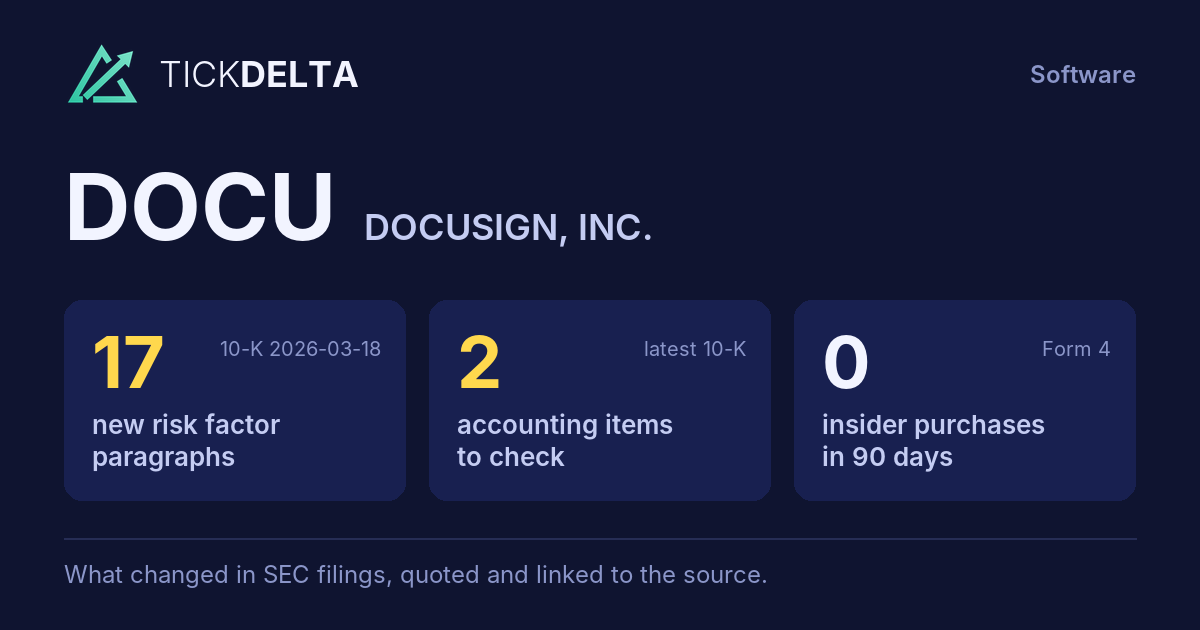
New in the 10-K 17 paragraphs with nothing like them in the 10-K filed Mar 18, 2025 New in the 10-Q 16 paragraphs not in the 10-Q filed Jun 5, 2026 10-Q against the 10-K 24 risk factor paragraphs and sentences added or reworded

New risk paragraphs, branching off last year

Each branch is a paragraph in Risk Factors with nothing like it in the 10-K filed Mar 18, 2025. A box jumps to the paragraph as filed, below.

17 new

Paragraphs with nothing like them in last year's 10-K

Quoted exactly

17 paragraphs in Risk Factors of the 10-K filed Mar 18, 2026 with nothing like them in the 10-K filed Mar 18, 2025. Quoted exactly. Paragraphs that were only edited are under 10-K change.

•Disruptions to our business, strategy and demand for our solutions due to advances in, and uses of, AI and other technologies.

Read in the 10-K

•Damage to our systems, data, reputation, brand and customer trust due to data breaches, cyberattacks, malicious activity, or failures of our (or third party cloud providers’) technical infrastructure.

Read in the 10-K

Rapid and unpredictable advances in AI and other technologies could reduce demand for our solutions, disrupt our business and strategy, and cause competitive and financial harm.

While we believe recent technological advances complement Docusign’s strategy and will ultimately benefit our business, AI and other technological advances are unpredictable, and there can be no assurance that our strategy will succeed. We may fail to predict or respond effectively to market demand for AI-powered solutions, or customer concerns regarding those solutions. Even if we successfully create, market and sell AI-based offerings that meet customer demand, the costs of developing and operating such solutions (including initial training costs and ongoing processing and inference costs) may reduce profitability and adversely affect our results of operations.

Advances in AI have made and may continue to make some foundational capabilities for agreements (such as analyzing, summarizing and comparing text) cheaper and easier to replicate, enabling companies not previously focused on agreements to provide solutions that compete with some or all of ours. In addition, advances in AI may significantly lower the cost of developing software, enabling companies to quickly and cheaply create agents or other homegrown alternatives that perform some or all of the functions they currently obtain from Docusign.

If providers of large language models, data platform companies, enterprise software companies, “hyperscalers,” or other businesses develop solutions that provide comparable functionality at lower cost or in more convenient formats, demand for our products would suffer and our business, financial condition and results of operations would be adversely affected.

Read in the 10-K

Our ability to retain and grow our customer base depends on our ability to deliver excellent service and support to our customers. Any failure to maintain high-quality customer support and meet or exceed customer expectations could adversely affect customer retention, growth, and our financial condition and results of operations.

Read in the 10-K

their subscription amounts at the time of renewal, our revenue will decline, and our business, operating results and financial condition will suffer.

Read in the 10-K
Show the other 7

Like other organizations providing valuable technology and services, we are subject to increasing cyberattacks from malicious third parties using widely varying and frequently changing tactics, which may be enhanced or facilitated by AI technology, and may include phishing and fraud campaigns targeting our personnel via email, text, instant messaging and voice calls. As AI technologies develop rapidly, threat actors are using these technologies to create new attack methods that are increasingly automated, targeted, and coordinated and more difficult to defend against. In addition, we may face increased risk in our ability to maintain the performance, reliability, security and availability of our products and technical infrastructure to the satisfaction of our customers.

Read in the 10-K

Existing laws and regulations may be interpreted, or new laws and regulations regarding AI have been and may in the future be adopted and interpreted, in ways which could negatively affect the way we use AI in our products. For

Read in the 10-K

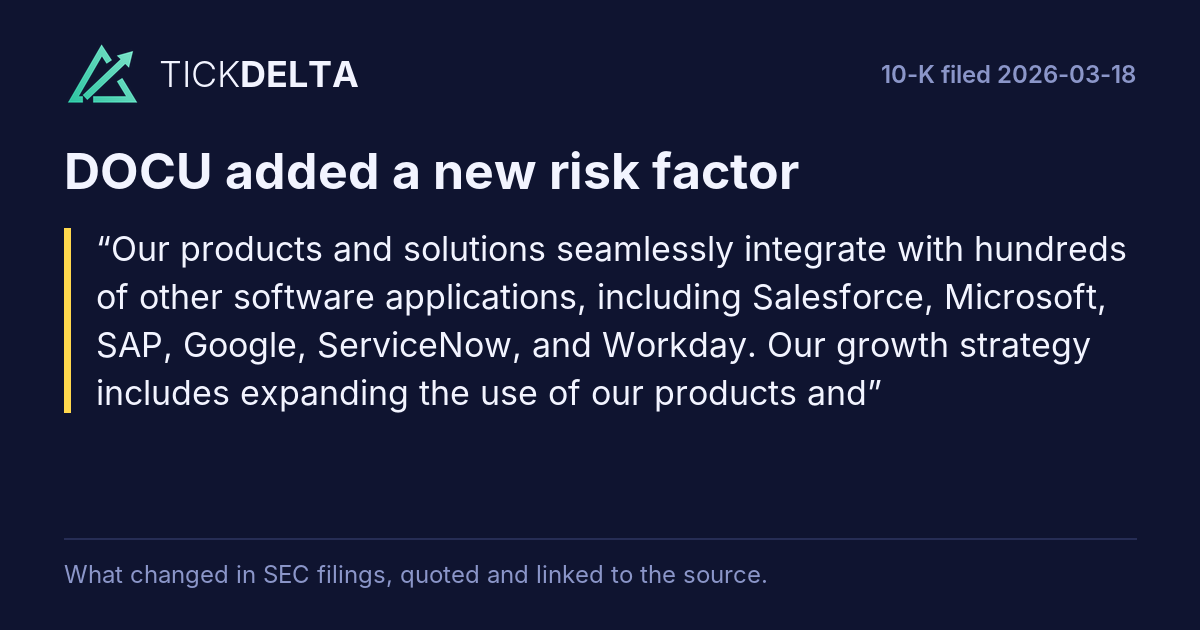
Our products and solutions seamlessly integrate with hundreds of other software applications, including Salesforce, Microsoft, SAP, Google, ServiceNow, and Workday. Our growth strategy includes expanding the use of our products and

Read in the 10-K

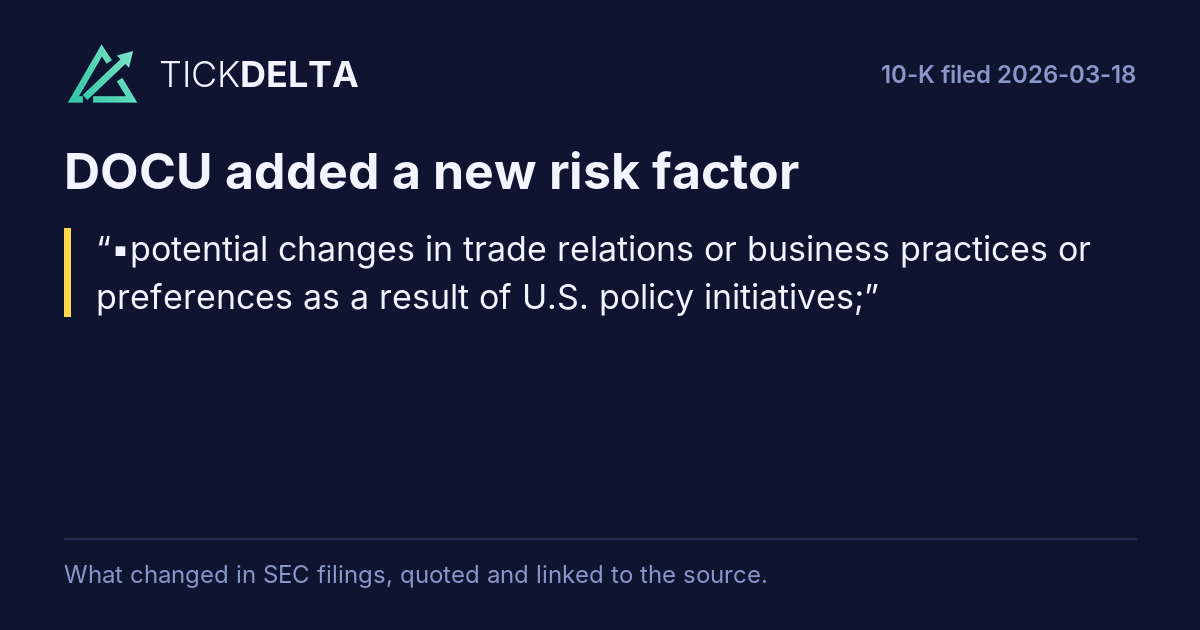
▪potential changes in trade relations or business practices or preferences as a result of U.S. policy initiatives;

Read in the 10-K

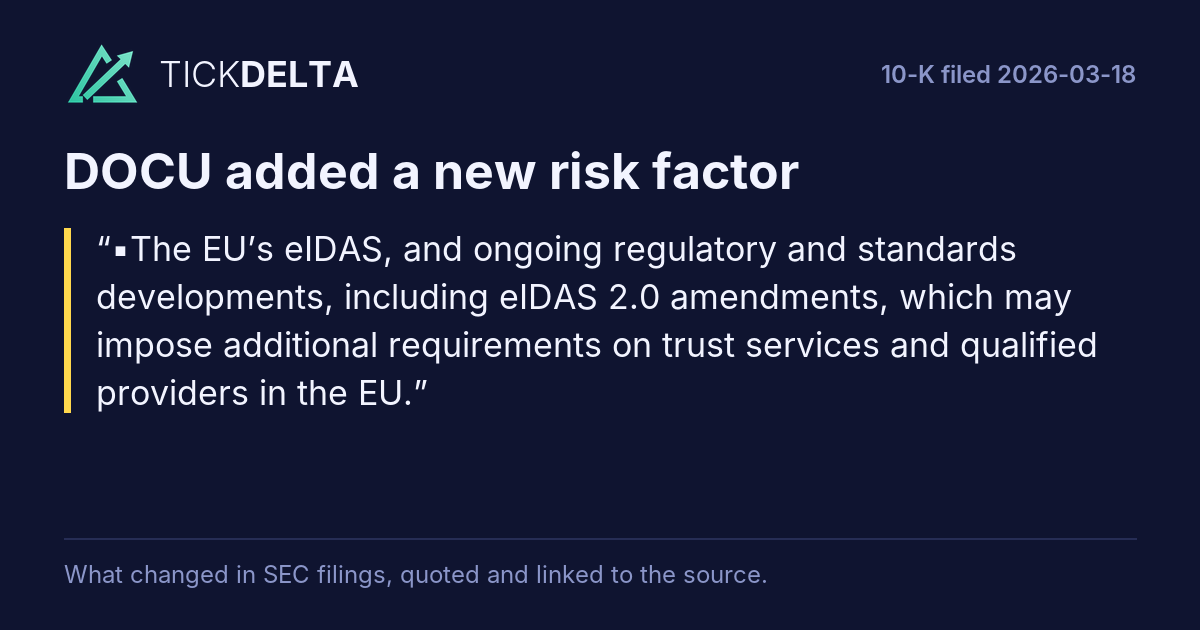
▪The EU’s eIDAS, and ongoing regulatory and standards developments, including eIDAS 2.0 amendments, which may impose additional requirements on trust services and qualified providers in the EU.

Read in the 10-K

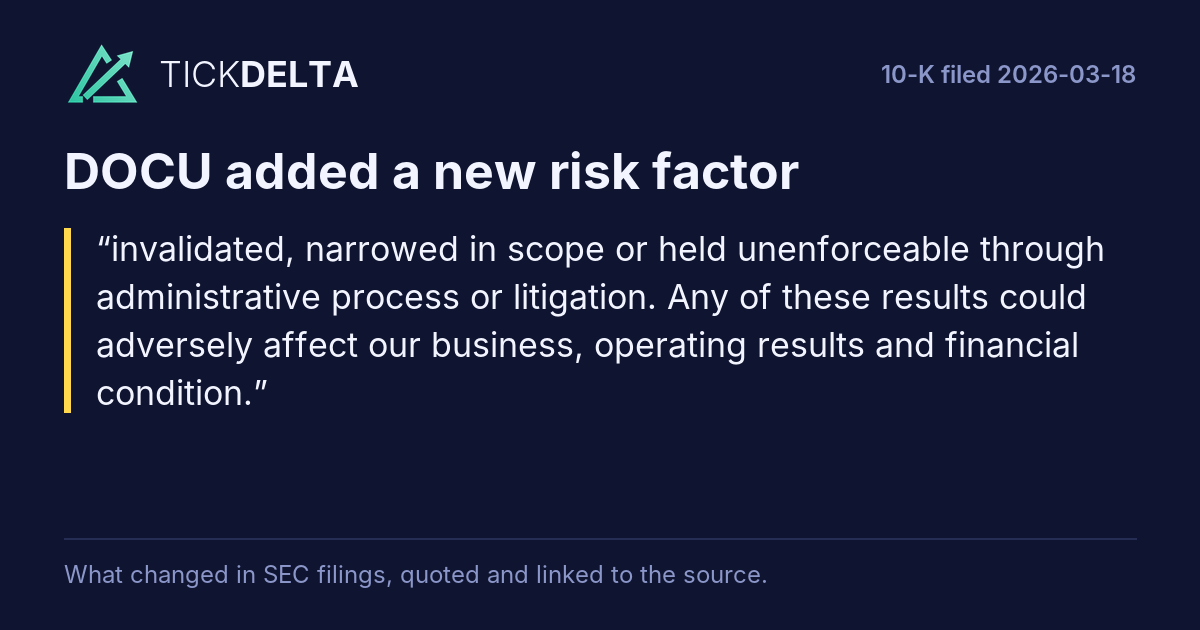
invalidated, narrowed in scope or held unenforceable through administrative process or litigation. Any of these results could adversely affect our business, operating results and financial condition.

Read in the 10-K

We are a U.S.-based multinational company subject to tax in multiple U.S. and foreign tax jurisdictions. Significant judgment is required in determining our global provision for income taxes, deferred taxes and other tax liabilities and receivables, and in evaluating our tax positions and other tax attributes on a worldwide basis. We are subject to the periodic examination of our domestic and foreign tax returns by the Internal Revenue Service, state, local, and foreign tax authorities, some of whom are challenging our tax positions. We regularly assess the likelihood of adverse outcomes from these examinations in determining the adequacy of our provision for income taxes and other tax liabilities and have reserved for potential adjustments that may result from these examinations. While we believe our tax estimates are reasonable, the ultimate outcome may differ from the amounts recorded in our financial statements and could materially affect our financial results in the period or periods for which such determination is made. We consider many factors when evaluating and estimating our tax positions and tax benefits, which may require periodic adjustments and may not accurately forecast actual tax audit outcomes. If the ultimate determination of income and other tax liabilities differ from the amounts recorded or accrued, our business, financial condition or results of operations may be adversely impacted.

Changes in tax laws or tax rulings, or changes in interpretations of existing laws, could materially affect our financial position, results of operations, and cash flows. Tax laws are regularly being re-examined and evaluated globally. New laws and interpretations of the law are taken into account for financial statement purposes in the quarter or year that they become applicable. Tax authorities are increasingly scrutinizing the tax positions and transfer pricing of companies and we are (and may continue to be) subject to tax audits in a number of jurisdictions.

Over the last several years, the Organization for Economic Cooperation and Development (“OECD”) has been working on a Base Erosion and Profit Shifting Project that, if implemented, would change various aspects of the existing framework under which our tax obligations are determined in many of the countries in which we do business. A number of countries have enacted legislation to implement the OECD’s 15% global minimum tax regime. As additional jurisdictions enact legislation, transitional relief expires, and other provisions of the minimum tax legislation become effective, our effective tax rate and cash tax payments could increase in future years.

Read in the 10-K

Paragraphs in the 10-Q filed Sep 4, 2026 that were not in the one before

New in the latest 10-Q

16 paragraphs in the 10-Q filed Sep 4, 2026 with nothing like them in the 10-Q filed Jun 5, 2026 (at least half the words must differ; new numbers alone do not count). Quoted exactly, grouped by the item heading above them. This is text that changed, not a judgement of how serious it is.

Financial statements and notes

Adjustments to reconcile net income to net cash provided by operating activities:

Read in the 10-Q

Payment of tax withholding obligation on net RSU settlement and ESPP purchase (78,116) (131,957)

Read in the 10-Q

Effect of foreign exchange on cash, cash equivalents and restricted cash (3,248) 11,452

Read in the 10-Q

Cash, cash equivalents and restricted cash at end of period (1) $ 545,501 $ 616,286

Read in the 10-Q

We lease offices under noncancelable operating lease agreements that expire at various dates through the end of July 2040. Some of our operating leases contain escalation provisions for adjustments in the consumer price index and options to renew. We include a renewal option in the lease terms for calculating our lease liability when we are reasonably certain that we will exercise the renewal option.

Read in the 10-Q
Show the other 11

2026, and January 31, 2026. We maintain commercial general liability insurance and product liability insurance to offset certain of our potential liabilities under these indemnification agreements.

Read in the 10-Q

Increases in the three months and six months ended July 31, 2026, primarily consisted of:

Read in the 10-Q

• $4.7 million and $6.5 million increase in depreciation and amortization, primarily attributable to our capitalized software projects.

Read in the 10-Q

Additionally, in the six months ended July 31, 2026, partner and reseller fees increased by $6.9 million due to higher transaction volume and merchant processing fees.

Read in the 10-Q

Sales and marketing expenses increased by $8.5 million, or 3%, in the three months ended July 31, 2026 and by $8.3 million, or 1%, in the six months ended July 31, 2026, primarily due to investments in our workforce to support long-term growth.

Read in the 10-Q

Research and development expenses decreased by $6.0 million, or 4%, in the three months ended July 31, 2026 and by $5.9 million, or 2%, in the six months ended July 31, 2026. The decrease in both the three months and six months ended July 31, 2026 primarily consisted of personnel costs, including stock-based compensation.

Read in the 10-Q

Risk Factors

Our usage of third-party AI models and related infrastructure providers exposes us to risks arising from model deprecation, changes in model architectures, pricing, usage limits, safety policies, licensing terms, service availability, and capacity constraints. Such providers may modify or discontinue models with limited notice, prioritize their own products or customers, or impose restrictions that affect our ability to offer, scale, or monetize certain AI-powered features. In addition, updates to models, prompts, training data, or agent orchestration may cause previously tested workflows to behave differently or produce inconsistent results, making it more difficult to detect regressions and ensure compliance with customer requirements and applicable laws. For example, any integration of third-party AI functionality with our products and solutions relies on safeguards implemented by the third-party developers of the underlying AI models, including those related to the accuracy, bias, and other variables of the data, and these safeguards may be insufficient.

Read in the 10-Q

In addition to our direct sales force and our website, we use strategic partners, such as global system integrators, value-added resellers and independent software vendors, to sell our subscription offerings and solutions. Our agreements with our partners are generally nonexclusive, meaning our partners may offer their customers products and services of several different companies, including products and services that compete with ours, or may themselves become

Read in the 10-Q

▪ shifts in the level of costs we capitalize, including wages, in particular when we move in and out of innovation cycles;

Read in the 10-Q

originally sought. To the extent we expand our international activities, our exposure to unauthorized copying and use of our products and proprietary information may increase.

Read in the 10-Q

We use open source software in our products and solutions. Any use of open source software may expose us to greater risks than the use of commercial software because open source licensors generally do not provide warranties or controls on the functionality or origin of the software. Any use of open source software may involve security risks, making it easier for hackers and other third parties to determine how to compromise our platform. On occasion,

Read in the 10-Q

The 10-Q's risk factors against the 10-K

Item 1A of the 10-Q filed Sep 4, 2026 against Item 1A of the 10-K filed Mar 18, 2026. A 10-Q repeats only the risks that changed, so a 10-K paragraph that is missing from it is not counted as removed. Added is a paragraph with nothing like it in the 10-K, Reworded a sentence that is in both with several words changed, Quiet changes a sentence in both where one to four words changed and one is a hedge or a modal (cut words struck through, new words highlighted). Text on the page, not a score; each links to the filing at sec.gov.

Added10-Q Sep 4, 2026 vs 10-K Mar 18, 2026
introduce new or enhanced products and solutions, they must achieve high levels of market acceptance to justify the amount of our investment in developing or acquiring them and bringing them to market.

Read it in the 10-Q at sec.gov

Added10-Q Sep 4, 2026 vs 10-K Mar 18, 2026
We are subject to increasingly frequent and sophisticated cyberattacks, including advanced persistent threats by state-sponsored actors, cyberattacks relying on complex social engineering or “phishing” tactics, ransomware attacks and

Read it in the 10-Q at sec.gov

Added10-Q Sep 4, 2026 vs 10-K Mar 18, 2026
Our usage of third-party AI models and related infrastructure providers exposes us to risks arising from model deprecation, changes in model architectures, pricing, usage limits, safety policies, licensing terms, service availability, and capacity constraints. Such providers may modify or discontinue models with limited notice, prioritize their own products or customers, or impose restrictions that affect our ability to offer, scale, or monetize certain AI-powered features. In addition, updates to models, prompts, training data, or agent orchestration may cause previously tested workflows to behave differently or produce inconsistent results, making it more difficult to detect regressions and ensure compliance with customer requirements and applicable laws. For example, any integration of third-party AI functionality with our products and solutions relies on safeguards implemented by the third-party developers of the underlying AI models, including those related to the accuracy, bias, and other variables of the data, and these safeguards may be insufficient.

Read it in the 10-Q at sec.gov

Added10-Q Sep 4, 2026 vs 10-K Mar 18, 2026
In addition to our direct sales force and our website, we use strategic partners, such as global system integrators, value-added resellers and independent software vendors, to sell our subscription offerings and solutions. Our agreements with our partners are generally nonexclusive, meaning our partners may offer their customers products and services of several different companies, including products and services that compete with ours, or may themselves become

Read it in the 10-Q at sec.gov

Added10-Q Sep 4, 2026 vs 10-K Mar 18, 2026
▪ shifts in the level of costs we capitalize, including wages, in particular when we move in and out of innovation cycles;

Read it in the 10-Q at sec.gov

Show the other 19
Added10-Q Sep 4, 2026 vs 10-K Mar 18, 2026
originally sought. To the extent we expand our international activities, our exposure to unauthorized copying and use of our products and proprietary information may increase.

Read it in the 10-Q at sec.gov

Added10-Q Sep 4, 2026 vs 10-K Mar 18, 2026
developments, and if securities analysts or investors perceive these results to be negative, it could have a substantial

Read it in the 10-Q at sec.gov

Added10-Q Sep 4, 2026 vs 10-K Mar 18, 2026
We use open source software in our products and solutions. Any use of open source software may expose us to greater risks than the use of commercial software because open source licensors generally do not provide warranties or controls on the functionality or origin of the software. Any use of open source software may involve security risks, making it easier for hackers and other third parties to determine how to compromise our platform. On occasion,

Read it in the 10-Q at sec.gov

Added10-Q Sep 4, 2026 vs 10-K Mar 18, 2026
(1) Our board of directors authorized a stock repurchase program, which commenced in March 2022. Most recently, in March 2026, our board of directors authorized an increase to our existing stock repurchase program for an additional amount of up to $2.0 billion of our outstanding common stock, increasing our total authorization to an aggregate $4.5 billion. Repurchases of our common stock may be effected from time to time, either on the open market, in block trades, in privately negotiated transactions, and through other transactions in accordance with applicable securities laws. The program does not obligate us to repurchase any specific number of shares and may be discontinued at any time. The program has no expiration date and will continue until otherwise suspended, terminated, or modified at any time for any reason by our board of directors. See Note 8 of this Quarterly Report on Form 10-Q for additional information related to stock repurchases.

Read it in the 10-Q at sec.gov

Added10-Q Sep 4, 2026 vs 10-K Mar 18, 2026
(2) Average price paid includes costs associated with the repurchases, excluding the 1% excise tax as a result of the IRA.

Read it in the 10-Q at sec.gov

Reworded10-Q Sep 4, 2026 vs 10-K Mar 18, 2026
Our actual or perceived failure to comply with laws or regulations could harm our business.” and “Complying with laws and regulations related to privacy and data protection could result in additional costs and liabilities to us or inhibit sales of our software. ” If we are not able to comply with these laws or regulations or if we become liable under these evolving laws or regulations, we could be directly harmed, and we may be forced to implement new measures to reduce our exposure to this liability.

Read it in the 10-Q at sec.govThe 10-K sentence

Reworded10-Q Sep 4, 2026 vs 10-K Mar 18, 2026
Moreover, there could be public announcements of the results of hearings, motions or other interim proceedings or developments, and if securities analysts or investors perceive these results to be negative, it could have a substantial adverse effect on the price of our common stock.

Read it in the 10-Q at sec.govThe 10-K sentence

Reworded10-Q Sep 4, 2026 vs 10-K Mar 18, 2026
Furthermore, if our customers do not renew their subscriptions for our products and solutions or if they reduce their subscription amounts at the time of renewal, our revenue will decline, and our business, operating results and financial condition will suffer.

Read it in the 10-Q at sec.govThe 10-K sentence

Reworded10-Q Sep 4, 2026 vs 10-K Mar 18, 2026
Additionally, global events as well as geopolitical developments, including regional conflicts in Europe and the Middle East, fluctuating commodity prices, trade tariff developments and inflation have caused, and may in the future cause, global economic uncertainty and uncertainty about the interest rate environment, which could amplify the volatility of currency fluctuations.

Read it in the 10-Q at sec.govThe 10-K sentence

Reworded10-Q Sep 4, 2026 vs 10-K Mar 18, 2026
We use AI in our business, and challenges with properly governing its and managing the development, incorporation and use of AI could result in reputational harm, competitive harm, and legal liability, and adversely affect our results of operations.

Read it in the 10-Q at sec.govThe 10-K sentence

Reworded10-Q Sep 4, 2026 vs 10-K Mar 18, 2026
You should carefully consider the following risks, together with all the other information in this Annual Quarterly Report on Form 10-K, 10-Q, including in the preceding Risk Factors Summary, and our consolidated financial statements and the related notes included elsewhere in this Annual Quarterly Report on Form 10-K. 10-Q.

Read it in the 10-Q at sec.govThe 10-K sentence

Reworded10-Q Sep 4, 2026 vs 10-K Mar 18, 2026
Errors, “hallucinations,” or unintended actions taken by these agents—especially agents - especially in customer-facing or operationally critical environments—could environments - could lead to significant financial loss, data breaches, contractual breaches, or regulatory non-compliance.

Read it in the 10-Q at sec.govThe 10-K sentence

Phrases used for the first time

Two-word phrases in Risk Factors of the 10-K filed Mar 18, 2026 that are in none of the 1 earlier 10-Ks stored, back to Mar 18, 2025

trade policies ×5tax positions ×4deliver excellent ×3excellent service ×3practices geopolitical ×3corresponding adoption ×2technological advances ×2large language ×2language models ×2prompt injection ×2collect store ×2software code ×2impact assessments ×2federal acquisition ×2acquisition regulations ×2themselves become ×2
Where each one is used
  • trade policies: ▪macro- and micro-economic factors, including inflation, changes in interest rates or foreign exchange rates, increased debt and equity market volatility, tariffs and changes in trade policies and practices, geopolitical conflict or public health crises.
  • tax positions: We are a U.S.-based multinational company subject to tax in multiple U.S. and foreign tax jurisdictions. Significant judgment is required in determining our global provision for income taxes, deferred taxes and other tax liabilities and receivables, and in evaluating our tax positions and other tax attributes on a...
  • deliver excellent: •Any inability to deliver excellent service and support to customers, retain and expand sales to existing customers, and attract new customers.
  • excellent service: •Any inability to deliver excellent service and support to customers, retain and expand sales to existing customers, and attract new customers.
  • practices geopolitical: ▪macro- and micro-economic factors, including inflation, changes in interest rates or foreign exchange rates, increased debt and equity market volatility, tariffs and changes in trade policies and practices, geopolitical conflict or public health crises.
  • corresponding adoption: •Any decrease in adoption or sales of our eSignature product, without corresponding adoption or sales of our other solutions in our IAM platform.
  • technological advances: While we believe recent technological advances complement Docusign’s strategy and will ultimately benefit our business, AI and other technological advances are unpredictable, and there can be no assurance that our strategy will succeed. We may fail to predict or respond effectively to market demand for AI-powered...
  • large language: If providers of large language models, data platform companies, enterprise software companies, “hyperscalers,” or other businesses develop solutions that provide comparable functionality at lower cost or in more convenient formats, demand for our products would suffer and our business, financial condition and...

The 10-K at sec.gov

Used at least twice, small words left out. Counted, not picked: a phrase can be new because the company renamed something.

What was taken out

9 paragraphs of last year's Risk Factors with nothing like them now. The longest are quoted.

Across all companies
Additionally, our corporate structure and associated transfer pricing policies contemplate future growth into international markets, and consider the functions, risks and assets of the various entities involved in the intercompany transactions. We may be subject to taxation in international jurisdictions with increasingly complex tax laws and precedents which could have an adverse effect on our liquidity and operating results. The amount of taxes we pay in these different jurisdictions may depend on the application of the tax laws of those jurisdictions, including the U.S., to our...
In the 10-K filed Mar 18, 2025
We operate globally and are subject to taxes in the U.S. and numerous other jurisdictions throughout the world, and the tax regimes we are subject to or operate under, including income and non-income taxes, are unsettled and may be subject to significant change. The U.S., other jurisdictions or governmental bodies, such as the European Commission of the European Union, and intergovernmental economic organizations, such as the Organization for Economic Cooperation and Development, have made or could make unprecedented assertions about how taxation is determined and, in some cases, have...
In the 10-K filed Mar 18, 2025
For example, in 2021, the Organization for Economic Cooperation and Development announced Pillar Two Model Rules defining the global minimum tax, which calls for the taxation of large multinational corporations at a minimum of 15%. Many non-U.S. tax jurisdictions have either recently enacted legislation to adopt certain components of the Pillar Two Model Rules beginning in 2024, including the adoption of additional components in later years, or announced their plans to enact legislation in future years. Our effective tax rate could increase in future years as a result of these changes,...
In the 10-K filed Mar 18, 2025
In order to protect our intellectual property rights, we may be required to spend significant resources to monitor and protect and enforce these rights, including through litigation. Litigation brought to protect and enforce our intellectual property rights could be costly, time consuming and distracting to management and could result in the impairment or loss of portions of our intellectual property. Furthermore, our efforts to enforce our intellectual property rights may be
In the 10-K filed Mar 18, 2025

Sources

Item 1A of each 10-K and 10-Q on EDGAR, quoted exactly. Each paragraph links to the filing at sec.gov.

Also

10-K change: what was reworded or cut, section by section.

Work with it

Excel workbook · CSV. Google Sheet that stays up to date: paste =IMPORTDATA("https://tickdelta.com/company/DOCU/export.csv") into a cell.

Next:10-K change
Esc

Type a ticker such as AAPL, a name, an investor such as Buffett, or a topic such as tariffs. ↑ ↓ to move, Enter to open.