Screener / SEC EDGAR /CIK 0001298946 /10-K filed Feb 27, 2026, compared with Feb 28, 2025 /Numbers from the XBRL of the 10-Ks
Nasdaq Real estate · REIT

DiamondRock Hospitality Co DRH

Compare with peers Embed
SEC comment letters, last 20 years

4 reviews of DRH's filings by SEC staff

UPLOAD and CORRESP
Reviews 4 latest letter Sep 28, 2016
Questions asked 17 each answered in the company's own letter
No closing letter 0 reviews without a letter saying the staff completed it

When the SEC's staff reviews a filing, it writes to the company with numbered questions, and the company answers each one in a letter. SEC publishes the exchange once the review is over, at least 20 business days later. A question is not an accusation; most reviews end with the company adding detail to its next filing.

How the reviews went

Every review on EDGAR, from the first staff letter to the letter that closes it

  1. 1. Staff letters 5 UPLOAD
  2. 2. Questions in them 17 numbered comments
  3. 3. Company replies 5 CORRESP
  4. 4. Reviews closed 4 of 4 closing letter

Half the closed reviews took 37 days or less from the first letter to the closing letter.

Form 8-K

2016-09-28 to 2016-10-27 · 3 questions · 1 letter from the SEC, 1 from the company
Review closed 2016-10-27
Non-GAAP measures
FORM 8-K FILED ON AUGUST 5, 2016 · Exhibit 99.1
SEC asked (1)
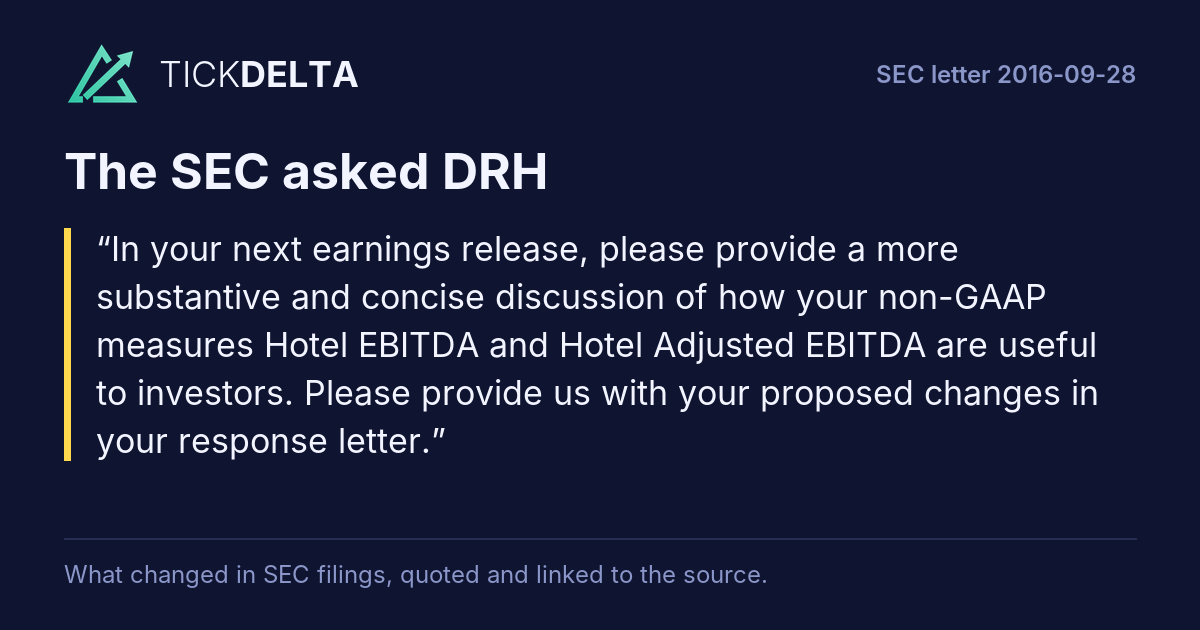
In your next earnings release, please provide a more substantive and concise discussion of how your non-GAAP measures Hotel EBITDA and Hotel Adjusted EBITDA are useful to investors. Please provide us with your proposed changes in your response letter.
DRH answered
In future earnings releases, the Company plans to provide a more substantive and concise discussion of how its non-GAAP measures Hotel EBITDA and Hotel Adjusted EBITDA are useful to investors. Please see the proposed disclosure attached hereto at Exhibit A, which is marked against the disclosure in Exhibit 99.1 to the August 5 Form 8-K (“Previous Earnings Release”).
Read in the reply
FORM 8-K FILED ON AUGUST 5, 2016 · Exhibit 99.1
SEC asked (2)
Please clarify your disclosures on pages 9 and 10 to further explain why adjustments made to EBITDA and FFO are not reflective of the underlying operating performance of your hotels.
DRH answered
In future earnings releases, the Company will enhance and clarify its disclosures to further explain why adjustments made to EBITDA, FFO and Hotel EBITDA are not reflective of the underlying operating performance of our hotels. The Company believes that providing such supplemental information to investors in the lodging industry is useful for a more complete understanding of the Company’s ongoing operational performance. Please see the proposed disclosure attached hereto at Exhibit A for clarification of the Company’s disclosures on pages 9 and 10 of the Previous Earnings Release.
Read in the reply
FORM 8-K FILED ON AUGUST 5, 2016 · Exhibit 99.1
SEC asked (3)
We note that you exclude corporate expenses from consolidated Hotel EBITDA and Hotel Adjusted EBITDA on page 12. Please explain to us why you concluded that these are not normal, recurring, cash operating expenses necessary to operate your business. See Question 100.01 of the updated Non-GAAP Compliance and Disclosure Interpretations issued on May 17, 2016.
DRH answered
The Company acknowledges the Staff’s comment and has reviewed the updated Non-GAAP Compliance and Disclosure Interpretations issued on May 17, 2016. We continue to believe that Hotel EBITDA and Hotel Adjusted EBITDA provide our investors useful supplemental financial measures to evaluate our hotel operating performance, excluding the impact of our capital structure, our asset base, and our corporate-level expenses.
Rest of the answer

We believe that excluding the effect of corporate-level expenses is necessary in order to provide our investors with a more complete understanding of the operating results of our hotels over which individual hotels and third-party management companies have direct control. In future earnings releases, the Company proposes to add an explanation as to why it excludes corporate expenses from consolidated Hotel EBITDA and Hotel Adjusted EBITDA. See Exhibit A.

In addition to filing this response letter via EDGAR, the Company will separately deliver to the Staff a clean copy of Exhibit A.

Read in the reply

Also in this review: closing letter, 2016-10-27
Form 10-K for the fiscal year ended December 31, 2015

2016-04-18 to 2016-06-22 · 6 questions · 2 letters from the SEC, 2 from the company
Review closed 2016-06-22
AcquisitionsNon-GAAP measuresKey metricsRevenue
Operations · Non-GAAP Financial Measures, page 47
SEC asked (1)
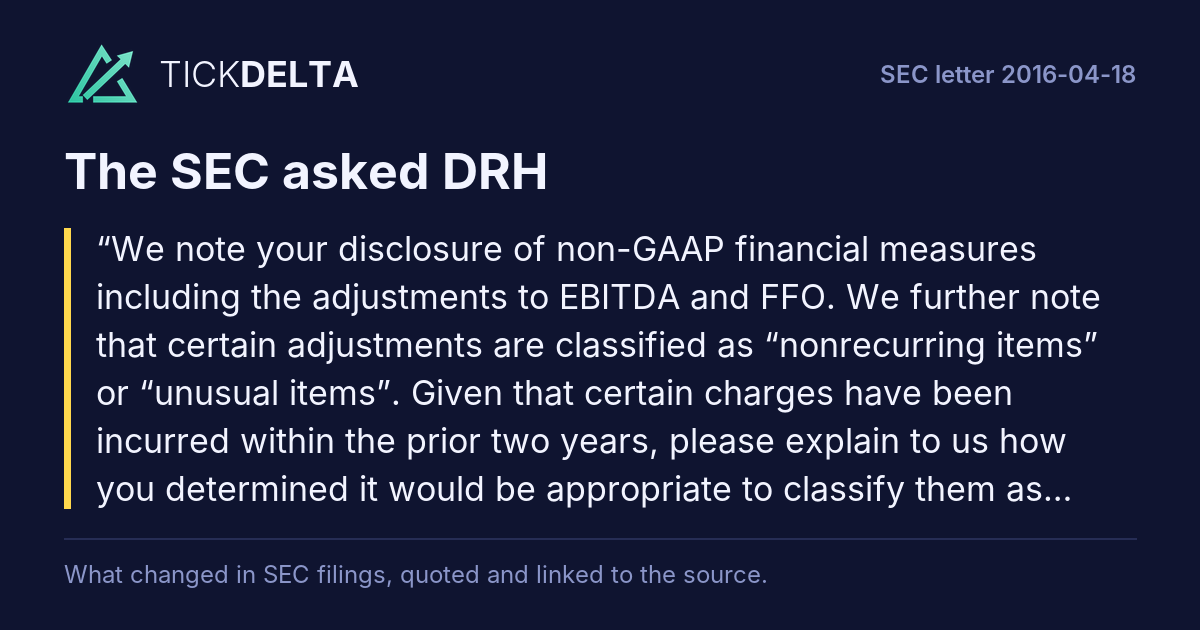
We note your disclosure of non-GAAP financial measures including the adjustments to EBITDA and FFO. We further note that certain adjustments are classified as “nonrecurring items” or “unusual items”. Given that certain charges have been incurred within the prior two years, please explain to us how you determined it would be appropriate to classify them as “non-recurring” or “unusual”.
Rest of the question

Reference is made to Item 10(e)(1)(ii)(B) of Regulation S-K.

DRH answered
The Company believes that its presentation of Adjusted EBITDA and Adjusted FFO as additional non-GAAP financial measures is useful to its stockholders and financial analysts in evaluating the ongoing operating performance of the Company and its hotels. Even though certain charges have been incurred within the prior two years, the adjustments are not an attempt by the Company to smooth earnings.
Rest of the answer

Rather, for each reporting period following management’s analysis, the Company makes only appropriate adjustments to EBITDA and FFO to eliminate the effects on EBITDA and FFO of both recurring and non-recurring items that do not accurately reflect the underlying operating performance of the Company’s hotels for the respective period. As required by Item 10(e) of Regulation S-K, the Company’s current disclosure identifies the rationale for the exclusion and describes the usefulness of the measure to the Company and its stockholders and financial analysts.

In response to the Staff’s comments, beginning with its Quarterly Report on Form 10-Q for the quarter ending March 31, 2016, the Company will further enhance its current disclosure by adding the following:

· clearly label each adjustment that the Company believes does not accurately reflect the underlying operating performance of the Company (e.g. see the first bullet on page 47 labeled Non-Cash Ground Rent);

· eliminate the label “Other Non-Cash and/or Unusual Items” as a general category and use the label for such adjustments as “Other Items” and within such category specifically identify the adjustments made for that period; and

· expand the Company’s disclosure of the nature of each adjustment to provide greater context as to why management feels each adjustment is useful for its stockholders and financial analysts to evaluate the Company’s operating performance.

Read in the reply
In its next report

First report after the company's reply of Apr 28, 2016: 10-Q filed May 6, 2016 ↗, against the 10-Q filed Nov 6, 2015 ↗.

Tickdelta does not hold the text of both reports, so they are not compared here.

Form 8-K filed February 23, 2016 · Exhibit 99.1
SEC asked (2)
Please clarify how you determined it was appropriate to exclude the Hilton Garden Inn Times Square Central from your pro forma hotel operating results.
DRH answered
The Company respectfully advises the Staff that the Hilton Garden Inn Times Square Central did not open for business until September 1, 2014. Therefore, the 2015 pro forma operating results exclude the hotel for the period from January 1, 2015 to August 31, 2015 because there are no operating results for the comparable period of 2014 (prior to the opening of the hotel). We believe that the inclusion of the Hilton Garden Inn Times Square Central in the 2015 pro forma operating results for the full year would be misleading to investors as it would overstate the Company’s year-over-year growth.
Rest of the answer

Please see the disclosure under the caption “Operating Results” and the table “Hotel Operating Data-Schedule of Property Level Results-Pro Forma” in the Form 8-K.

Read in the reply
In its next report

First report after the company's reply of Apr 28, 2016: 10-Q filed May 6, 2016 ↗, against the 10-Q filed Nov 6, 2015 ↗.

Tickdelta does not hold the text of both reports, so they are not compared here.

Form 8-K filed February 23, 2016 · Exhibit 99.1
SEC asked (3)
In future periodic filings, please revise your presentation of Pro Forma Hotel EBITDA and Pro Forma Hotel Adjusted EBITDA as follows: a. Reconcile to the most directly comparable GAAP financial measure in accordance with Item 10(e)(1)(i) of Regulation S-K. b. Present Actual Hotel Adjusted EBITDA, followed by a single adjustment for preacquisition results to arrive at Pro Forma Hotel Adjusted EBITDA. c.
Rest of the question

Describe the source of pre-acquisition results and any adjustments made to those results. In addition, please consider disclosing whether the pre-acquisition results were audited or reviewed by your auditors as indicated in your response. d. To the extent that you continue to present Pro Forma Hotel EBITDA or other measures that include pre-acquisition results, please tell us how you considered providing the relevant non-GAAP disclosures. Please include a sample of management’s proposed disclosure within your response.

DRH answered
a. Beginning with the Company’s earnings release for the quarter ended March 31, 2016, which will be furnished to the Commission as Exhibit 99.1 to a Current Report on Form 8-K on or about May 6, 2016, the Company will present a reconciliation of Hotel EBITDA and Hotel Adjusted EBITDA. A sample of management’s proposed disclosure is set forth on Annex A (Table 3(a)) attached hereto for the three months ended December 31, 2014 and 2015 and for the year ended December 31, 2014 and 2015. This disclosure will be presented in the Non-GAAP Financial Measures section of Exhibit 99.1.

b.
Rest of the answer

Beginning with the Company’s earnings release for the quarter ended March 31, 2016, which will be furnished to the Commission as Exhibit 99.1 to a Current Report on Form 8-K on or about May 6, 2016, the Company will present actual Hotel Adjusted EBITDA, with an adjustment for pre-acquisition results. A sample of management’s proposed disclosure is set forth on Annex A (Table 3(b)) attached hereto for the three months ended December 31, 2014 and 2015 and for the year ended December 31, 2014 and 2015. This disclosure will be provided as a footnote to the Hotel Operating Data schedule. Currently this schedule can be found on page 13 of Exhibit 99.1.

c. The Company informs the Staff that the historical pre-acquisition operating results for the hotels acquired in 2014 and 2015 were derived from property-level operations and accounting records obtained from the respective seller(s) of the hotels during the pre-acquisition due diligence period and have not been subject to the standard quarterly review procedures of an independent registered public accounting firm. Such operating results provided to the Company by the respective seller(s) are not adjusted by the Company. As such, these results may be subject to normal and recurring adjustments that arise during such a review. In its future periodic filings, the Company will include disclosure as to the source of the pre-acquisition operating results (e.g., the respective seller(s)) and whether or not pre-acquisition results were audited or reviewed by the Company’s auditors.

d. The Company acknowledges the Staff’s comment and will present in future periodic filings reconciliation of Pro Forma Hotel EBITDA or other measures to their most directly comparable GAAP financial, including appropriate adjustments for pre-acquisition results, as set forth in the tables set forth on Annex A (Tables 3(a) and 3(b)).

Read in the reply
In its next report

First report after the company's reply of Apr 28, 2016: 10-Q filed May 6, 2016 ↗, against the 10-Q filed Nov 6, 2015 ↗.

Tickdelta does not hold the text of both reports, so they are not compared here.

Form 8-K filed February 23, 2016 · Exhibit 99.1
SEC asked (4)
Please tell us whether you have made any significant changes to your hotels after acquisition. To the extent that significant post-acquisition changes have been made, tell us how you concluded that combining pre-acquisition and post-acquisition was useful.
DRH answered
The Company does not believe that it has made any significant post-acquisition changes to the hotels identified in the Form 8-K acquired in 2014 or 2015. The Company regularly evaluates all of its hotels, including those recently acquired, to identify value-add opportunities, such as repositioning through a change in brand or changing the third-party hotel manager to a more efficient operator, neither of which the Company has deemed to be significant.
Rest of the answer

To the extent that a future post-acquisition change is deemed a significant change by management, we believe that combining pre-acquisition and post-acquisition results is useful to stockholders and financial analysts to reflect the value added by the Company’s management following acquisition. In any case, post-acquisition changes (e.g., change in brand or third-party hotel manager) are, and will be, reported in the Company’s public disclosures.

Read in the reply
In its next report

First report after the company's reply of Apr 28, 2016: 10-Q filed May 6, 2016 ↗, against the 10-Q filed Nov 6, 2015 ↗.

Tickdelta does not hold the text of both reports, so they are not compared here.

Form 8-K filed February 23, 2016 · Exhibit 99.1
SEC asked (5)
We note that you disclose key performance indicators (i.e. ADR, RevPAR, and Occupancy) on a pro forma basis. Please include balancing disclosure throughout future periodic filings of these indicators excluding pre-acquisition amounts. Please include a sample of management’s proposed disclosure in your response.
DRH answered
The Company acknowledges the Staff’s comment and beginning with the Company’s earnings release for the quarter ended March 31, 2016, which will be furnished to the Commission as Exhibit 99.1 to a Current Report on Form 8-K on or about May 6, 2016, will include balancing disclosure substantially as presented on Annex A (Table 5) attached hereto when presenting key performance indicators on a pro forma basis.

* * *

On behalf of the Company, I hereby acknowledge that:

· the Company is responsible for the adequacy and accuracy of the disclosure in the filing;

· Staff comments or changes to
Rest of the answer

disclosure in response to Staff comments do not foreclose the Commission from taking any action with respect to the filing; and

· the Company may not assert Staff comments as a defense in any proceeding initiated by the Commission or any person under the federal securities laws of the United States.

Read in the reply
In its next report

First report after the company's reply of Apr 28, 2016: 10-Q filed May 6, 2016 ↗, against the 10-Q filed Nov 6, 2015 ↗.

Tickdelta does not hold the text of both reports, so they are not compared here.

Form 8-K filed May 6, 2016 · Exhibit 99.1
SEC asked
We note your responses to our prior comments 3, 4 and 5 and the revisions to your disclosures. We note that on page 11 of your earnings release for the quarterly period ended March 31, 2016, you continue to present a schedule of revenue and operating expenses including the pre-acquisition results of certain acquired properties.
Rest of the question

Please revise your disclosure in future filings to remove this schedule as it does not appear to be in compliance with Item 10(e) of Regulation S-K.

DRH answered
We acknowledge the Staff’s comment and in future Item 2.02 Form 8-K filings we will delete the schedule captioned “DiamondRock Hospitality Company — Hotel Operating Data — Schedule of Property Level Results.”

The Company strives to present the best information to its investors to assist them in making an informed investment decision regarding the Company. In furtherance of this goal, the Company views the presentation of its operating expenses and variances as important granular information that enhances the Company’s investors’ understanding of the operating results of its hotel portfolio.
Rest of the answer

Such information has historically been very important to the Company’s investors. Furthermore, because acquisitions and dispositions are a core component of the Company’s business, the Company believes that this information should be presented on a comparable basis. The Company notes that only disclosing this information on a GAAP basis could be misleading to the Company’s investors because the operating expenses and variances are impacted by acquisitions and dispositions. In order to provide this important information to the Company’s investors, the Company proposes substituting the deleted schedule with the schedule set forth on Annex A (the “Proposed Schedule”). For illustration purposes, the Proposed Schedule is for the three months ended March 31, 2016 and 2015.

The Proposed Schedule has three columns: (1) the first column titled “As Reported” presents the GAAP basis operating expenses reported by the Company for the applicable quarter and the corresponding variance (% Change); (2) the second column titled “Adjustments for Acquisitions” presents a reconciliation of each operating expense from the GAAP “As Reported” basis to the comparable basis, which reflects adjustments for acquisitions, and in future quarters will present adjustments for acquisitions and dispositions, if any; and (3) the third column titled “Comparable” presents comparable results and the corresponding variance (% Change). The Company believes that the enhanced disclosure showing the adjustments to reported results more accurately reflects the results of operations of its hotel portfolio on a comparative basis and is commonly used by investors to evaluate the Company’s performance from period to period.

In addition, the Company has added an introductory paragraph to the Proposed Schedule disclosing the reasons why the Company’s management believes that presentation of hotel operating expenses, as adjusted, provides useful information to investors regarding the Company’s financial condition and results of operations. We believe that the Proposed Schedule, including the introductory paragraph, satisfies the requirements of Item 10(e) of Regulation S-K and provides important disclosure to the Company’s investors.

* * *

On behalf of the Company, I hereby acknowledge that:

· the Company is responsible for the adequacy and accuracy of the disclosure in the filing;

· Staff comments or changes to disclosure in response to Staff comments do not foreclose the Commission from taking any action with respect to the filing; and

· the Company may not assert Staff comments as a defense in any proceeding initiated by the Commission or any person under the federal securities laws of the United States.

Read in the reply
In its next report

First report after the company's reply of Jun 7, 2016: 10-Q filed Aug 5, 2016 ↗, against the 10-Q filed Nov 6, 2015 ↗.

Tickdelta does not hold the text of both reports, so they are not compared here.

Also in this review: closing letter, 2016-06-22

Form 10-K for the fiscal year ended December 31, 2013

2014-07-08 to 2014-08-14 · 3 questions · 1 letter from the SEC, 1 from the company
Review closed 2014-08-14
SegmentsResults discussion (MD&A)Liquidity and cash
General
SEC asked (1)
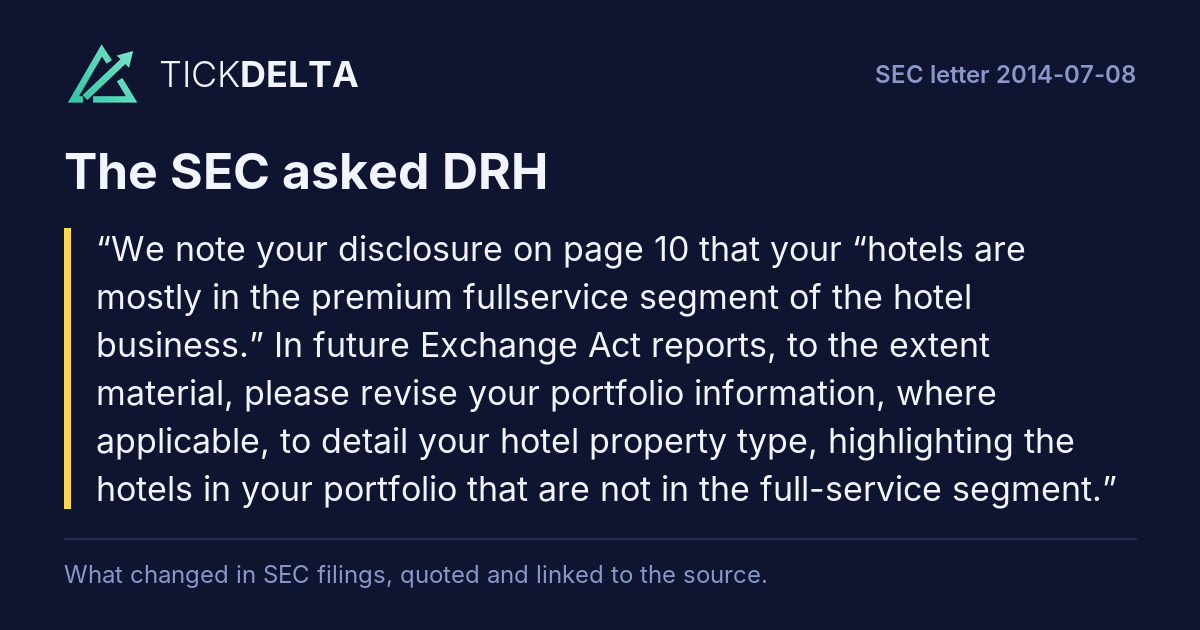
We note your disclosure on page 10 that your “hotels are mostly in the premium fullservice segment of the hotel business.” In future Exchange Act reports, to the extent material, please revise your portfolio information, where applicable, to detail your hotel property type, highlighting the hotels in your portfolio that are not in the full-service segment.
DRH answered
In response to the Staff’s comment, the Company confirms that in future Exchange Act periodic reports it will revise its portfolio information, where applicable, to detail the Chain Scale Segment, as defined by Smith Travel Research, and service category of each of the Company’s hotels.
Read in the reply
Financial Statements · Consolidated Statements of Cash Flows, page F-8
SEC asked (2)
We note that you have expended significant amounts of funds toward property renovations. Please tell us if you capitalized personnel costs to property and equipment. To the extent material, please quantify and disclose personnel costs capitalized to property and equipment for all periods presented and discuss fluctuations in capitalized personnel costs for all periods presented within your MD&A.
Rest of the question

Additionally, please disclose capitalized interest related to development and/or re-development projects for each year presented.

DRH answered
The Company respectfully informs the Staff that it does not capitalize personnel costs to property and equipment. Accordingly, no disclosure for the periods presented within the MD&A for capitalized personnel costs was included in the Form 10-K.

The Company respectfully informs the Staff that capitalized interest related to development and/or re-development projects is disclosed under the line item “Capitalized Interest” in the Supplemental Disclosure of Cash Flow Information section of the Consolidated

Statements of Cash Flows on page F-9 of the Form 10-K.
Read in the reply
In its next report

First report after the company's reply of Jul 16, 2014: 10-Q filed Aug 8, 2014 ↗, against the 10-Q filed May 12, 2014 ↗.

Tickdelta does not hold the text of both reports, so they are not compared here.

Notes Receivable, page F-14
SEC asked (3)
Please provide to us management’s analysis supporting the determination that the settlement in January 2013 should be considered a restructuring. We urge al l who are responsible for the accuracy and adequacy of the disclosure in the filing to be certain that the filing includes the information the Securities Exchange Act of 1934 and all applicable Exchange Act rules require.
Rest of the question

Since the company and its managem ent are in possession of all facts relating to a company’s disclosure, they are responsible for the accuracy and adequacy of the disclosures they have made. In responding to our comments, please provide a written statement from the company acknowledging that:  the company is responsible for the adequacy and accuracy of the disclosure in the filing;  staff comments or changes to disclosure in response to staff comments do not foreclose the Commission from taking any action with respect to the filing; and  the company may not assert staff comments as a defense in any proceeding initiated by the Commission or any person under the federal securities laws of the United States.

DRH answered
Background

The Company acquired the $69 million senior loan secured by the Allerton Hotel (the “Allerton”) during 2010 for approximately $60 million. Due to uncertainty about the timing and amount of cash flows from the Allerton, the Company concluded that it was appropriate to place the note receivable in “non-accrual” status and record cash receipts from the Allerton loan as a reduction in the basis of our note receivable. Cash receipts from the Allerton during our ownership period reduced the carrying value of the note receivable to $50.1 million as of December 31, 2012.
Rest of the answer

During 2011, the borrower filed for bankruptcy protection, which had the effect of automatically staying the foreclosure proceedings that had been previously filed against the borrower. During January 2013, the Company closed on a settlement of the bankruptcy and related litigation involving the Allerton. As a result of this settlement, the Company received a $5.0 million cash principal payment and entered into a new $66.0 million mortgage loan with a four year term (plus a one-year extension option), bearing interest at a fixed rate of 5.5%.

Management’s Analysis

Under generally accepted accounting principles, a debt restructuring is considered a troubled debt restructuring

(“TDR”) if a creditor (i.e., the Company), for economic or legal reasons, grants a concession to the debtor that it would not otherwise consider (FASB ASC 310-40-20). Management of the Company assessed whether the restructuring of the Allerton loan included concessions that resulted in the Allerton loan being considered a TDR. Management of the Company analyzed whether a concession was granted to the debtor by comparing the estimated effective yield at the time the Allerton loan was acquired to the effective yield after the restructuring of the Allerton loan. Management concluded that the estimated effective yield after the restructuring was approximately 20% lower than the estimated effective yield at the acquisition date (16.2% vs. 12.8%). Accordingly, management concluded after comparing the original expected yield at time of the acquisition of the Allerton loan (16.2%) to the effective yield of the restructured note (12.8%) that a concession had been granted by the Company and the restructured Allerton loan should be considered a TDR.

* * *

On behalf of the Company, I hereby acknowledge that:

• the Company is responsible for the adequacy and accuracy of the disclosure in the filing;

Staff comments or changes to disclosure in response to Staff comments do not foreclose the Commission from taking any action with respect to the filing; and the Company may not assert Staff comments as a defense in any proceeding initiated by the Commission or any person under the federal securities laws of the United States.

Read in the reply
In its next report

First report after the company's reply of Jul 16, 2014: 10-Q filed Aug 8, 2014 ↗, against the 10-Q filed May 12, 2014 ↗.

Tickdelta does not hold the text of both reports, so they are not compared here.

Also in this review: closing letter, 2014-08-14

Form 10-K

2012-04-19 to 2012-04-30 · 5 questions · 1 letter from the SEC, 1 from the company
Review closed 2012-04-30
Results discussion (MD&A)LeasesLiquidity and cashDebt
Form 10-K for the year ended December 31, 2011 · Item 7. Management’s Discussion and Analysis …, page 44
SEC asked (1)
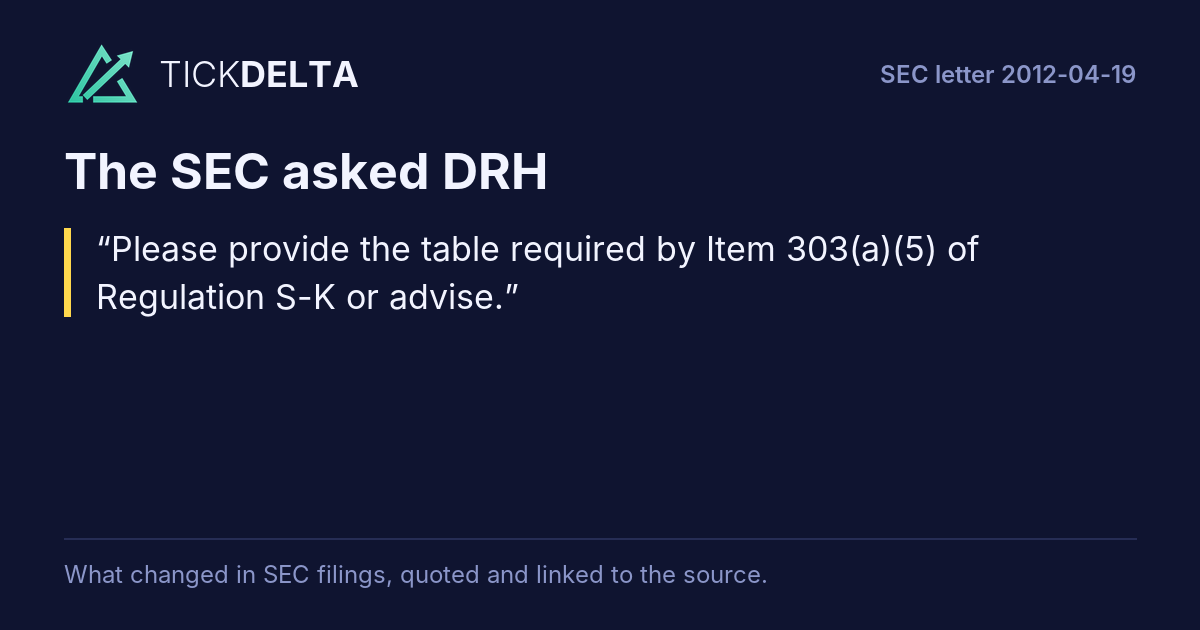
Please provide the table required by Item 303(a)(5) of Regulation S-K or advise.
DRH answered
The Company acknowledges the Staff’s comment and advises the Staff that the omission of the table required by Item 303(a)(5) of Regulation S-K was inadvertent. The Company has previously filed such contractual obligations table in all other Annual Reports on Form 10-K subsequent to its initial public offering.

Mr. Kevin Woody

Mr. Tom Kluck

Ms. Stacie Gorman

Division of Corporation Finance

Page

Notwithstanding the inadvertent omission, the Company believes that it provided investors with substantially the same information in the

Form 10-K that would have been included in the table.
Rest of the answer

In each instance, the information provided to the Company’s investors in the Form 10-K was in an easy-to-understand tabular format and the periods presented included at least the periods required by the contractual obligations table.

Long-Term Debt Obligations

The Company provided extensive disclosure regarding its long-term debt obligations on a property-by-property basis as of December 31,

2011. This disclosure included aggregate debt maturities for each year beginning in 2012 through 2016 (and thereafter) in the Form 10-K as follows:

•

Item 2—Our Properties—Debt (page 44)

Item 7—Management’s Discussion and Analysis of Financial Conditions and Results of Operations—Senior Unsecured Credit Facility

(pages 65 and 66)

Financial Statements—Note 9—Debt and Mortgage Debt (pages F-18 to F-21)

Capital Lease Obligations

The Company had no capital lease obligations (as defined in Item 3.03(5)(ii)(B)) as of December 31, 2011 and, accordingly, there would have been no disclosure under this item in the contractual obligations table.

Operating Lease Obligations

With regard to operating lease obligations (as defined in Item 3.03(5)(ii)(C)), the Company provided information with regard to its ground and other operating leases in the Form 10-K as follows:

Item 2—Our Properties—Our Ground Lease Agreements (pages 41 to 43)

Financial Statements—Note 15—Commitments and Contingencies—Ground Leases (which includes a table that sets forth all future minimum annual rental commitments under all non-cancelable operating leases as of December 31, 2011)(pages F-32 and F-33)

Purchase Obligations

The Company described its commitment to purchase a hotel in New York City upon its completion in the Form 10-K as follows:

Item 7—Management’s Discussion and Analysis of Financial conditions and Results of Operations—2011 Highlights—Times Square

Development (page 55)

Financial Statements—Note 15—Commitment and Contingencies—Hotel Under Development (page F-33).

The Company had no other purchase obligations (as defined in Item 3.03(5)(ii)(D)) as of December 31, 2011.

Other Long-Term Liabilities Reflected on the Registrant’s Balance Sheet under GAAP

The Company had no other long-term liabilities to be disclosed pursuant to this item and accordingly, there would have been no disclosure under this item in the contractual obligations table as of December 31, 2011.

The Company confirms that in future filings it will include the contractual obligations table in the form required by Item 303(a)(5) of Regulation S-K.

Sources and Uses of Cash,

Read in the reply
In its next report

First report after the company's reply of Apr 24, 2012: 10-Q filed Apr 30, 2012 ↗, against the 10-Q filed Oct 19, 2011 ↗.

Tickdelta does not hold the text of both reports, so they are not compared here.

Sources and Uses of Cash, page 56
SEC asked (2)
In future Exchange Act periodic reports please provide a more detailed analysis of your sources and uses of cash for the current year. With respect to sources of cash, if applicable and known, please quantify your estimated proceeds from anticipated property sales net of expenses and debt repayment, and remaining capacity on any credit facilities that will not expire prior to year end.
Rest of the question

Please quantify your debt and interest obligations for the current year, budgeted capital expenditures, and any scheduled payments. If applicable and known, please quantify the amount you expect to have to finance or refinance during the current year to satisfy cash needs. Financial Statements Notes to the Consolidated Financial Statements 4. Favorable Lease Assets, page F-13

DRH answered
In response to the Staff’s comment, the Company confirms that it will provide a more detailed analysis of its sources and uses of cash for the current year, if applicable and known, as requested above, in future Exchange Act periodic reports, commencing with its next quarterly report on Form 10-Q.

Financial Statements

Notes to the Consolidated Financial Statements

4. Favorable Lease Assets, page F-13
Read in the reply
In its next report

First report after the company's reply of Apr 24, 2012: 10-Q filed Apr 30, 2012 ↗, against the 10-Q filed Oct 19, 2011 ↗.

Tickdelta does not hold the text of both reports, so they are not compared here.

Sources and Uses of Cash, page 56
SEC asked (3)
Given your option to acquire a leasehold interest in a parcel of land adjacent to the Westin Boston Waterfront Hotel expires in 2016, explain to us why you are not amortizing the related lease asset over the life of the option agreement. In your response tell us whether the amount paid to acquire the option is refundable if the option expires unused. 5. Note Receivable, page F-14
DRH answered
The Company’s 2007 acquisition of the Boston Westin Waterfront Hotel (the “Hotel”) included, among the assets acquired, an option to develop 320 to 350 new hotel rooms on a vacant land parcel adjacent to the Hotel (the “Option”). The Option expires in 2016. If the Company exercises the Option, the terms of the existing Hotel ground lease will extend to the adjacent land parcel. The Company is not entitled to any consideration if the Option expires unused.

In the Hotel purchase accounting, the Company allocated a portion of the purchase price to the acquisition date fair value of the Option.
Rest of the answer

The Company concluded that the fair value of the Option was derived from (i) the “optionality” value to the Company for the ability to exercise the option between its acquisition date and the expiration date in 2016 (“Option Value”) and (ii) the intrinsic value to the Company if the Option were exercised and the Company benefited from the favorable terms of the Hotel ground lease as compared to market ground lease terms as of the acquisition date (“Intrinsic Value”). Accordingly, the Company allocated purchase consideration for both Option Value ($0.3 million) and Intrinsic Value ($12.75 million) in the purchase accounting.

Under generally accepted accounting principles, intangible assets should be amortized over its period of benefit.

The Company separately assessed the period of benefit for the Option Value and Intrinsic Value. The Company’s evaluation of the period of benefit for each of these assets is as follows:

Option Value: The Company concluded that the Option Value was created by the Company’s ability to defer a decision to exercise the

Option until market conditions provided an appropriate economic return on the construction of 320 to 350 new hotel rooms. The Company concluded that the period during which the Option could be exercised (from the acquisition date through 2016) was the period of economic benefit. Accordingly, the Option Value is amortized on a straight line basis over the period between the Company’s acquisition date and the Option expiration.

Intrinsic Value: The Company concluded that Intrinsic Value was created from the ability to enter into a ground lease with favorable lease terms. The Company further concluded that, as of the acquisition date, the timing of exercising the Option was uncertain (the uncertainty remains today). As a result of the exercise date uncertainty, the life of Intrinsic Value is indefinite.

Therefore, the Company concluded to periodically evaluate whether any declines in fair value have occurred and to recognize an impairment loss if declines in fair value are other-than-temporary. The Company supported this accounting conclusion by analogy to ASC 815-10-35-5 (formerly EITF 96-11). If the Option is exercised, the carrying value of Intrinsic Value will be recognized as an intangible asset that will approximate the intrinsic value associated with the remaining lease term and will be amortized over the period of economic benefit. If the Option is not exercised or if it becomes probable that the Company will not exercise the Option, the asset will be written off.

5. Note

Read in the reply
In its next report

First report after the company's reply of Apr 24, 2012: 10-Q filed Apr 30, 2012 ↗, against the 10-Q filed Oct 19, 2011 ↗.

Tickdelta does not hold the text of both reports, so they are not compared here.

Sources and Uses of Cash, page 56
SEC asked (4)
Given that the borrower on the Allerton loan has declared bankruptcy, and foreclosure proceedings have been delayed, explain to us how you determined the loan was not impaired as of December 31, 2011. In your response please provide us with an update on the bankruptcy and foreclosure proceedings through the date of your response.
DRH answered
The Company acquired the $69 million senior mortgage loan (the “Senior Loan”) secured by the Allerton Hotel (the “Allerton”) during 2010 for approximately $60 million. When the Senior Loan was acquired, it was in default and the previous lender had commenced foreclosure proceedings against the borrower under the Senior Loan (the “Borrower”).
Rest of the answer

Due to uncertainty about the timing and amount of cash flows from the Allerton, the Company concluded that it was appropriate to place the note receivable under the Senior Loan in “non-accrual” status and record cash receipts from the Allerton as a reduction in the basis of the

Company’s note receivable. Cash receipts from the Allerton during the Company’s ownership period reduced the carrying value of the note receivable to $54.8 million as of December 31, 2011.

Current Status

In May 2011, the Borrower filed for bankruptcy protection, which had the effect of automatically staying the foreclosure proceedings. The Borrower filed a plan of reorganization with the bankruptcy court in December 2011 and a disclosure statement with the bankruptcy court in January 2012. In March 2012, the plan of reorganization and the disclosure statement (together, the “Plan”) were approved for solicitation to the creditors for a vote to approve the Plan. If the creditors approve the Plan, then the Plan will be subject to a confirmation hearing which is currently scheduled for July 2012. The various likely outcomes of the confirmation hearing are discussed below.

Impairment Analysis

The Company assesses its investment in the Senior Loan for impairment on a quarterly basis. The impairment analysis considers multiple factors including the following:

Estimated value of cash receipts from the Allerton.

Estimated value of the Company’s investment if the bankruptcy court approves the proposed plan of reorganization.

Estimated value of the collateral for the note receivable under the Senior Loan.

The

Company concluded that its investment in the Senior Loan was not impaired as of December 31, 2011. The Company’s conclusion was based on the following possible outcomes of the bankruptcy proceedings:

Approval of Plan of Reorganization: Our counsel has advised that if the Plan is approved, the Borrower will emerge from bankruptcy and the Company will hold a new senior mortgage loan secured by the Allerton. The new senior mortgage loan would likely have a face value of at least $66.8 million, a term of three to five years and accrue interest at approximately 4.5%. The Company believes that the face value of the new senior mortgage loan would equal or exceed the carrying value of the Senior Loan ($54.8 million as of December 31, 2011).

Obtain Allerton Title: If the Plan is not confirmed, the Company would likely be permitted to file its own plan of reorganization which will provide for the Company’s acquisition of the Allerton. A third party appraisal prepared on behalf of the Company as of December 31, 2011 concluded that the fair value of the Allerton was $68.6 million as of December 31, 2011.

This amount is in excess of the carrying value of the Senior Loan at December 31, 2011.

Foreclosure and Sale of Allerton: If the Plan is not confirmed, another possible outcome is that the stay of the foreclosure proceedings is lifted and the Allerton is sold in an auction to a third party or to the Company. Based on the recent appraisal, the Company believes that the Allerton would be sold for at least $68.6 million and the Company would then receive sale proceeds up to the amount determined to be due under the Senior Loan, which is projected to be in excess of $70 million. Alternatively, the Company would acquire title to the Allerton by bidding in its Senior Loan. In either event, the value that the Company would receive would be in excess of the carrying value of the Senior Loan at December 31, 2011.

Read in the reply
In its next report

First report after the company's reply of Apr 24, 2012: 10-Q filed Apr 30, 2012 ↗, against the 10-Q filed Oct 19, 2011 ↗.

Tickdelta does not hold the text of both reports, so they are not compared here.

Exhibits
SEC asked (5)
We note that you have incorporated by reference forms of various agreements, rather than executed agreements. For example, please see Exhibit 10.2 and 10.3. Please tell us why you have not filed executed copies of these agreements. Refer to Item 601(a)(4) and Instruction 1 to Item 601 of Regulation S-K.
DRH answered
In response to the Staff’s comment, the Company hereby advises the Staff that it does not consider Exhibit 10.2 (Form of Hotel Management Agreement) and Exhibit 10.3 (Form of TRS Lease) to be

“material” agreements under Item 601(b)(10) of Regulation S-K. The Company considers these exhibits to represent agreements that are entered into in the ordinary course of its business and therefore does not consider such exhibits to be “material.” The Company has historically filed these exhibits on a voluntary basis to provide additional information regarding the Company’s business.
Rest of the answer

The Company believes, however, that the extensive disclosure provided in the

Form 10-K regarding each of its management and franchise agreements (see, for example, the disclosure under the captions “Our Hotel Management Agreements,” “Amounts Payable under our Hotel Management Agreements” and “Our

Franchise Agreements”) adequately disclose the material terms of each of these agreements. The Company will update its exhibit index in its future Annual Report on Form 10-K to delete these two form of exhibits.

Certain other exhibits filed as a form to the Form 10-K (Exhibits 10.5, 10.6, 10.7, 10.8, 10.9, 10.10, 10.14, 10.15 and 10.16) consist of the form of equity award agreements with respect to the Company’s compensatory plans. The Company respectfully advises the Staff that the form of equity award agreements were filed pursuant to Item 601(b)(10)(iii) of Regulation S-K as a form (in lieu of filing each director’s or executive officer’s personal agreements) consistent with Instruction 1 to Paragraph (b)(10) of Item 601 of Regulation S-K. The Company does not believe there are particular provisions in such personal agreements whose disclosure is necessary to an investor’s understanding of that individual’s compensation under the plan.

With respect to Exhibit 10.18 (Form of Indemnification Agreement), the Company respectfully advises the Staff that it has entered into an indemnification agreement with each of its directors and certain executive officers. Each of these agreements are identical other than the names of the parties thereto and the dates of execution. Accordingly, the Company elected to file only the form of the indemnification agreement as permitted by Instruction 2 to Item 601 of Regulation S-K.

The Company respectfully advises the Staff that the Company filed a form of severance agreement (Exhibit 10.13) executed by each of our named executive officers (other than Mr. Tennis, the Company’s Executive Vice President and General Counsel) pursuant to Instruction 2 to Item 601 of Regulation S-K because such executed severance agreements are substantially identical in all material respects except as the parties thereto, the dates of execution, or other details. In addition, a description of the terms of these severance agreements were extensively disclosed in the Form 8-K dated as of March 9, 2007 (the “Form 8-K”). Among other disclosure, the Form 8-K included a table that sets forth the individual cost of termination under the severance agreement for each named executive officer (see, “Cost of Termination Under the New Severance Agreements”). As such, the Company determined that filing the executed agreements or a schedule setting forth the material differences was unnecessary pursuant to

Instruction 2 of Item 601 of Regulation S-K.

With regard to Mr. Tennis, his severance agreement with the Company was not substantially identical in all material respects to the other named executive officers because his severance agreement does not include any tax gross-up protection. Accordingly, the Company filed the form of his severance agreement as Exhibit

10.20 to the Form 10-K. The Company respectfully informs the Staff that such form of severance agreement was validly executed by Mr. Tennis in the form filed with the Commission. Thus, no information—material or otherwise—was omitted from the filing other than a conformed signature, date and the executive’s address. The Company respectfully advises the Staff that it will include in its upcoming quarterly report on Form 10-Q as an exhibit a final executed copy of this severance agreement.

* * *

On behalf of the Company, I hereby acknowledge that:

the Company is responsible for the adequacy and accuracy of the disclosure in the filings;

Staff comments or changes to disclosure in response to Staff comments do not foreclose the Commission from taking any action with respect to the filings; and

The Company may not assert Staff comments as a defense in any proceeding initiated by the Commission or any person under the federal securities laws of the United States.

Read in the reply

Also in this review: closing letter, 2012-04-30

From the SEC's correspondence on EDGAR: staff letters (form UPLOAD) and company letters (form CORRESP), 14 letters filed since 2012-04-19. Questions and answers are matched by their numbers; topics come from words in each question. The reports are compared word for word (same form, before the first SEC letter against the first report after the company's reply). No AI.

Sources

The SEC's correspondence on EDGAR: staff letters (form UPLOAD) and company letters (form CORRESP), matched question by question. No AI.

Also

Filings: the letters in the filing list.

Work with it

Excel workbook · CSV. Google Sheet that stays up to date: paste =IMPORTDATA("https://tickdelta.com/company/DRH/export.csv") into a cell.

Next in Owners and insiders:Insider trades
Esc

Type a ticker such as AAPL, a name, an investor such as Buffett, or a topic such as tariffs. ↑ ↓ to move, Enter to open.